

ISO/DTR 23585
(Main)Safety and environment information for biogas plants, biogas transportation and biogas use
General Information
- Abstract
- Status
- Not Published
- Technical Committee
- ISO/TC 255 - Biogas
- Drafting Committee
- ISO/TC 255/WG 4 - Safety and environmental aspects
- Current Stage
- 5092 - FDIS referred back to TC or SC
- Start Date
- 19-May-2023
- Completion Date
- 29-Aug-2026
Buy Documents


ISO/DTR 23585 - Safety and environment information for biogas plants, biogas transportation and biogas use Released:3/8/2023

REDLINE ISO/DTR 23585 - Safety and environment information for biogas plants, biogas transportation and biogas use Released:3/8/2023
Overview
ISO/DTR 23585:2023 is an ISO technical report that provides comprehensive safety and environmental guidelines for biogas plants, biogas transportation, and biogas use. Developed by ISO/TC 255, this document targets the design, construction, operation, and maintenance of biogas systems. Its core aim is to support internationally harmonized best practices, reduce hazards, encourage environmental sustainability, and facilitate safe and efficient global biogas trade.
Biogas, primarily composed of methane, carbon dioxide, and trace substances, is generated via anaerobic digestion of organic matter. The potential hazards associated with biogas production and use - such as fire, explosion, gas exposure, and pollution - demand stringent safety and environmental management across the entire biogas lifecycle.
Key Topics
- Hazard Identification: The standard lists occupational and environmental hazards typical for biogas plants, including mechanical, electrical, fire, explosion, health, confined space, vehicle, and environmental hazards such as greenhouse gas and odor emissions.
- Safety Guidelines:
- Risk assessment protocols for plant design and construction.
- Requirements for materials selection, fire detection and alarms.
- Safe operation of equipment in explosive atmospheres.
- Use of gas detection, ventilation systems, and safety signage.
- Emergency procedures for fire and gas leaks.
- Environmental Protection:
- Measures to minimize methane emissions due to its high Global Warming Potential (GWP).
- Control of odor, dust, and liquid spills to prevent water and soil pollution.
- Proper handling of digestate, feedstock, and process residues.
- Plant Design and Equipment:
- Protective measures for feedstock pre-treatment and storage systems.
- Biogas transfer pipeline safety and clear marking.
- Digesters and storage with appropriate safety valves, pressure sensors, and explosion protection.
- Requirements for chemical-resistant, UV-resistant, and gas-tight materials.
- Adequate drainage and ventilation systems.
- Operational Controls:
- Maintenance of fire extinguishers, gas sensors, and emergency lighting.
- Traffic and access control to reduce vehicle-related incidents.
Applications
ISO/DTR 23585 is particularly valuable for:
- Biogas Plant Designers and Operators: Guidance on implementing robust safety protocols in new and existing facilities, from feedstock input to biogas extraction, storage, and distribution.
- Transportation Providers: Recommendations for safe, environmentally responsible biogas transportation by pipeline or truck, including pipeline installation and hazard prevention.
- Regulators and Inspectors: Common criteria for assessing safety and environmental protection in biogas operations.
- Consultants and Engineering Firms: An authoritative reference for risk assessment, compliance studies, and project planning.
- Communities and Policy-Makers: Framework to foster responsible biogas production, reduce accident frequency, and protect local environments.
By adopting these methods, stakeholders can prevent accidents, minimize pollution, facilitate regulatory compliance, and optimize the overall sustainability of biogas as a renewable energy source.
Related Standards
For a comprehensive approach to biogas project safety and environmental management, the following ISO standards are relevant:
- ISO 20675: Biogas - Biogas production, conditioning, upgrading and utilization - Terms, definitions, and classification scheme.
- ISO/IEC Directives Part 1 & 2: Guidelines for ISO standard preparation and editorial rules.
- ISO environmental and occupational safety standards: For broader environmental management and worker safety frameworks.
For updates and to access the full list of related standards, consult the ISO Online Browsing Platform and the ISO Technical Committee 255 resources.
Proper implementation of ISO/DTR 23585 helps the biogas industry advance globally with increased safety, lower environmental footprint, and improved public confidence in biogas as a sustainable energy solution.
Relations
- Consolidated By
ISO 8536-15:2022/Amd 1:2023 - Infusion equipment for medical use — Part 15: Light-protective infusion sets for single use — Amendment 1 - Effective Date
- 06-Jun-2022
Buy Documents
ISO/DTR 23585 - Safety and environment information for biogas plants, biogas transportation and biogas use Released:3/8/2023
REDLINE ISO/DTR 23585 - Safety and environment information for biogas plants, biogas transportation and biogas use Released:3/8/2023
Get Certified
Connect with accredited certification bodies for this standard

DNV
DNV is an independent assurance and risk management provider.

Lloyd's Register
Lloyd's Register is a global professional services organisation specialising in engineering and technology.
DNV Energy Systems
Energy and renewable energy certification.
Sponsored listings
Frequently Asked Questions
ISO/DTR 23585 is a draft published by the International Organization for Standardization (ISO). Its full title is "Safety and environment information for biogas plants, biogas transportation and biogas use". This standard covers: Safety and environment information for biogas plants, biogas transportation and biogas use
Safety and environment information for biogas plants, biogas transportation and biogas use
ISO/DTR 23585 is classified under the following ICS (International Classification for Standards) categories: 27.190 - Biological sources and alternative sources of energy. The ICS classification helps identify the subject area and facilitates finding related standards.
ISO/DTR 23585 has the following relationships with other standards: It is inter standard links to ISO 8536-15:2022/Amd 1:2023. Understanding these relationships helps ensure you are using the most current and applicable version of the standard.
ISO/DTR 23585 is available in PDF format for immediate download after purchase. The document can be added to your cart and obtained through the secure checkout process. Digital delivery ensures instant access to the complete standard document.
Standards Content (Sample)
FINAL
TECHNICAL ISO/DTR
DRAFT
REPORT 23585
ISO/TC 255
Safety and environment information
Secretariat: SAC
for biogas plants, biogas
Voting begins on:
2023-03-21 transportation and biogas use
Voting terminates on:
2023-05-16
RECIPIENTS OF THIS DRAFT ARE INVITED TO
SUBMIT, WITH THEIR COMMENTS, NOTIFICATION
OF ANY RELEVANT PATENT RIGHTS OF WHICH
THEY ARE AWARE AND TO PROVIDE SUPPOR TING
DOCUMENTATION.
IN ADDITION TO THEIR EVALUATION AS
Reference number
BEING ACCEPTABLE FOR INDUSTRIAL, TECHNO-
LOGICAL, COMMERCIAL AND USER PURPOSES,
DRAFT INTERNATIONAL STANDARDS MAY ON
OCCASION HAVE TO BE CONSIDERED IN THE
LIGHT OF THEIR POTENTIAL TO BECOME STAN-
DARDS TO WHICH REFERENCE MAY BE MADE IN
NATIONAL REGULATIONS. © ISO 2023
FINAL
TECHNICAL ISO/DTR
DRAFT
REPORT 23585
ISO/TC 255
Safety and environment information
Secretariat: SAC
for biogas plants, biogas
Voting begins on:
transportation and biogas use
Voting terminates on:
© ISO 2023
All rights reserved. Unless otherwise specified, or required in the context of its implementation, no part of this publication may
be reproduced or utilized otherwise in any form or by any means, electronic or mechanical, including photocopying, or posting on
the internet or an intranet, without prior written permission. Permission can be requested from either ISO at the address below
or ISO’s member body in the country of the requester.
RECIPIENTS OF THIS DRAFT ARE INVITED TO
ISO copyright office
SUBMIT, WITH THEIR COMMENTS, NOTIFICATION
OF ANY RELEVANT PATENT RIGHTS OF WHICH
CP 401 • Ch. de Blandonnet 8
THEY ARE AWARE AND TO PROVIDE SUPPOR TING
CH-1214 Vernier, Geneva
DOCUMENTATION.
Phone: +41 22 749 01 11
IN ADDITION TO THEIR EVALUATION AS
Reference number
Email: copyright@iso.org
BEING ACCEPTABLE FOR INDUSTRIAL, TECHNO
Website: www.iso.org
LOGICAL, COMMERCIAL AND USER PURPOSES,
DRAFT INTERNATIONAL STANDARDS MAY ON
Published in Switzerland
OCCASION HAVE TO BE CONSIDERED IN THE
LIGHT OF THEIR POTENTIAL TO BECOME STAN
DARDS TO WHICH REFERENCE MAY BE MADE IN
ii
NATIONAL REGULATIONS. © ISO 2023
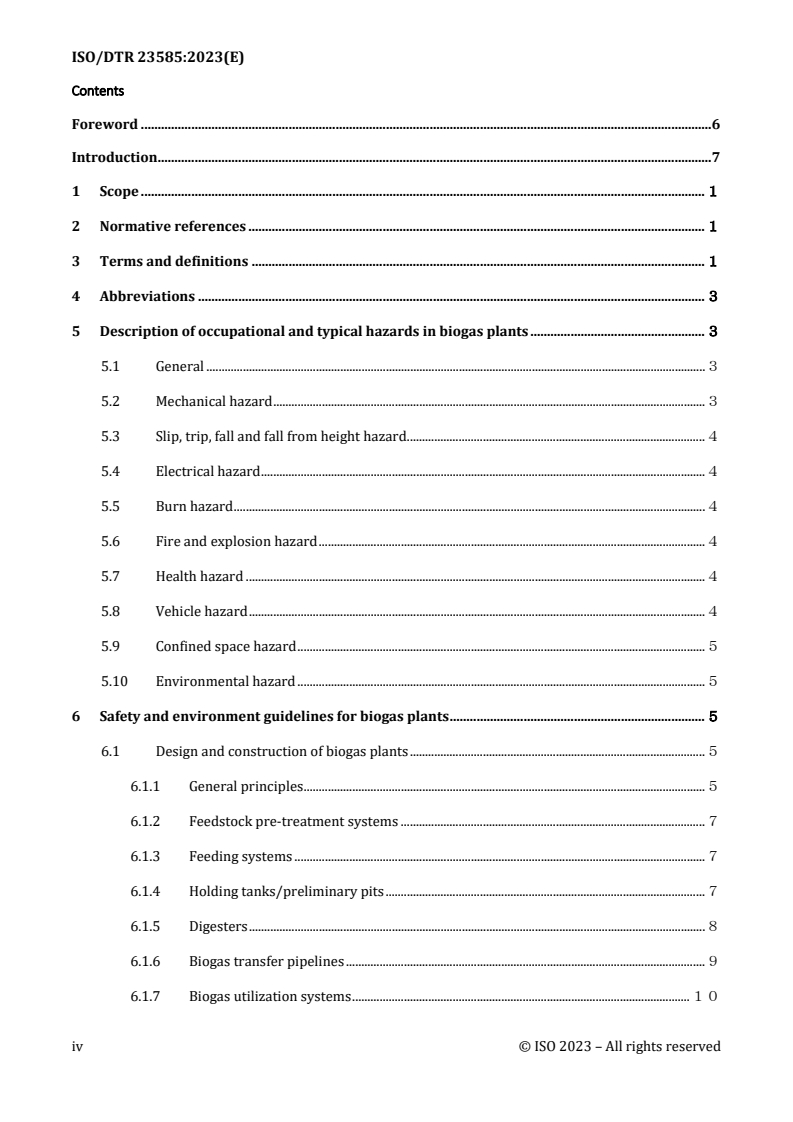
Contents Page
Foreword .v
Introduction . vi
1 Scope . 1
2 Normative references . 1
3 Terms and definitions . 1
4 Abbreviations . 2
5 Description of occupational and typical hazards in biogas plants . 3
5.1 General . 3
5.2 Mechanical hazard . 3
5.3 Slip, trip, fall and fall from height hazard . 3
5.4 Electrical hazard . . 3
5.5 Burn hazard . 3
5.6 Fire and explosion hazard . 3
5.7 Health hazard . 4
5.8 Vehicle hazard . 4
5.9 Confined space hazard . 4
5.10 Environmental hazard . 4
6 Safety and environment guidelines for biogas plants . 5
6.1 Design and construction of biogas plants . 5
6.1.1 General principles . 5
6.1.2 Feedstock pre-treatment systems . 6
6.1.3 Feeding systems. 6
6.1.4 Holding tanks/preliminary pits . 6
6.1.5 Digesters . 7
6.1.6 Biogas transfer pipelines . 8
6.1.7 Biogas utilization systems . 9
6.1.8 Digestate treatment and storage systems . 9
6.2 Operation and maintenance of biogas plants . 10
6.2.1 General principles . 10
6.2.2 Feedstock pre-treatment systems . 14
6.2.3 Feeding systems.15
6.2.4 Holding tanks or preliminary pits . 15
6.2.5 Digester . 15
6.2.6 Information for the disposal of digestate . . 17
6.2.7 Overhaul of biogas plants . 18
6.2.8 Suspension and restart of biogas plants . 19
7 Safety and environment guidelines for biogas storage, desulphurization,
decarbonization and transportation .19
7.1 General . 19
7.2 Biogas storage . 19
7.3 Biogas desulphurization . 20
7.4 Biogas decarbonization . 20
7.5 Biogas transportation . 21
7.5.1 General . 21
7.5.2 Pipeline transmission . 21
7.5.3 Truck transportation .22
8 Safety and environment guidelines for biogas use .22
8.1 General .22
8.2 Heat supplying from biogas .22
8.3 Power generation from biogas.23
8.4 Compressed natural gas as vehicle fuel from biogas . 23
iii
8.5 City gas from biogas. 24
Bibliography .25
iv
Foreword
ISO (the International Organization for Standardization) is a worldwide federation of national standards
bodies (ISO member bodies). The work of preparing International Standards is normally carried out
through ISO technical committees. Each member body interested in a subject for which a technical
committee has been established has the right to be represented on that committee. International
organizations, governmental and nongovernmental, in liaison with ISO, also take part in the work.
ISO collaborates closely with the International Electrotechnical Commission (IEC) on all matters of
electrotechnical standardization.
The procedures used to develop this document and those intended for its further maintenance are
described in the ISO/IEC Directives, Part 1. In particular, the different approval criteria needed for the
different types of ISO documents should be noted. This document was drafted in accordance with the
editorial rules of the ISO/IEC Directives, Part 2 (see www.iso.org/directives).
Attention is drawn to the possibility that some of the elements of this document may be the subject of
patent rights. ISO shall not be held responsible for identifying any or all such patent rights. Details of
any patent rights identified during the development of the document will be in the Introduction and/or
on the ISO list of patent declarations received (see www.iso.org/patents).
Any trade name used in this document is information given for the convenience of users and does not
constitute an endorsement.
For an explanation of the voluntary nature of standards, the meaning of ISO specific terms and
expressions related to conformity assessment, as well as information about ISO's adherence to
the World Trade Organization (WTO) principles in the Technical Barriers to Trade (TBT), see
www.iso.org/iso/foreword.html.
This document was prepared by Technical Committee ISO/TC 255, Biogas.
Any feedback or questions on this document should be directed to the user’s national standards body. A
complete listing of these bodies can be found at www.iso.org/members.html.
v
Introduction
This document contains information on the state of the art of biogas technology.
There are many and complex links in the process of biogas plants construction, biogas production and
biogas utilization. In addition, the requirements for safe production and environmental protection have
been continuously enhanced. Safety accidents and environmental pollution risks are directly related to
the survival and sustainable development of the biogas industry.
The safety and environmental information for biogas plants, biogas transportation and biogas use
introduced in this document are indispensable in the processes of safe, environmental protection and
stable operation of biogas plants.
By introducing the safe production and environmental protection operation of the whole process of
biogas plants, the risk of safety accidents and environmental pollution of biogas plants can be reduced
to a certain extent, and the purpose of effectively ensuring the safe, environmental protection operation
and application of biogas technology can be achieved.
Biogas is a flammable gas, mainly comprises methane, carbon dioxide, nitrogen, oxygen, hydrogen
sulphide and/or water and furthermore can contain hydrogen, carbon monoxide, heavier hydrocarbons
(including aromatic hydrocarbons), siloxanes and/or other substances, generated by the anaerobic
fermentation (without oxygen) of organic matter.
Biogas can be treated to eliminate hydrogen sulphide, siloxanes, water and other substances and be
upgraded to a gas with higher methane content. Sometimes, the biogas is pressurized.
vi
TECHNICAL REPORT ISO/DTR 23585:2023(E)
Safety and environment information for biogas plants,
biogas transportation and biogas use
1 Scope
This document provides safety-related and environmental-friendly operations for biogas plants, biogas
transportation and biogas use.
This document is applicable to:
— the enhancement of the safety of biogas plant construction, operation and maintenance, the
prevention of environmental pollution, and the achievement of the full benefits of biogas energy;
— the contribution to reduce and eliminate the environmental impacts during the processes of biogas
production, storage, purification, transportation and utilization.
This document is limited to the existing technologies.
2 Normative references
The following documents are referred to in the text in such a way that some or all of their content
constitutes requirements of this document. For dated references, only the edition cited applies. For
undated references, the latest edition of the referenced document (including any amendments) applies.
ISO 20675, Biogas — Biogas production, conditioning, upgrading and utilization — Terms, definitions and
classification scheme
3 Terms and definitions
For the purposes of this document, the terms and definitions given in in ISO 20675 and the following
apply.
ISO and IEC maintain terminology databases for use in standardization at the following addresses:
— ISO Online browsing platform: available at https:// www .iso .org/ obp
— IEC Electropedia: available at https:// www .electropedia .org/
3.1
biogas plant
installation including its pipelines, accessories for AD of biomass, storage and upgrading of biogas,
storage of feedstock and digestate
Note 1 to entry: To purify or upgrade the biogas to a higher methane percentage, it should include cooling,
compressing, heating, separation and reaction installations.
3.2
hazard
source, situation or act with a potential for harm in terms of human injury or ill health, damage to
plants (such as fire and explosion), impacts (fire, explosion, discharges…) to the environment (fauna
and flora), or a combination of these
3.3
explosion
violent release of energy caused by a chemical or mechanical reaction
3.4
harmful substance
chemical, physical or biological substance which can threaten or put the health of the operator at risk
3.5
desulfurization system
equipment filling with water-based and chemical compounds or desulfurization agent through physico-
chemical, biological or combined processes which can remove sulphides such as H S from the biogas
3.6
decarbonization system
equipment which can remove CO from the biogas
3.7
condenser
equipment in which H O vapor and other vapor can be condensed into liquid form
3.8
gas-water separator
equipment which can separate H O and possibly other liquids from gas
3.9
desulfurization agent
chemical or biological compound that is used for H S removal in the biogas
3.10
flammable gas detection
portable detector or fixed detection system that detects presence of flammable gas in the atmosphere
at a given location and triggers safety actions (typically sending alarms or activating safety actions
such as fast closing of a valve) when gas concentration exceeds a percentage of the lower explosion limit
of that gas
3.11
biogas purification
biogas upgrading
removal of carbon dioxide and contaminants from biogas to increase the percentage of methane
3.12
boiler
device using the heat energy or other heat energy released by fuel combustion to heat hot water or
other working fluids to produce steam, hot water or other working fluids with specified parameters
(temperature, pressure) and quality
3.13
conductive material
material that becomes charged with static electricity due to its conductivity and operational use
3.14
conductive area
area where static electricity can be generated if conductive material (3.13) is not earth grounded and
not at equipotentiality
4 Abbreviations
AD Anaerobic digestion
CHP Combined heat and power
GHG Greenhouse gas
GWP Global warming potential
HDPE High density polyethylene
LNG Liquefied natural gas
PEL Permissible exposure limits
PPE Personal protective equipment
5 Description of occupational and typical hazards in biogas plants
5.1 General
The main hazards specific for biogas plants are mentioned in this clause.
5.2 Mechanical hazard
Hazards due to the moving parts of machinery, in particular, the presence of undesired parts in solid
biomass input (e.g. construction materials, stones) can lead to plugging at various stages (pumps, pipes)
or to breakage of material (e.g. rotating elements, shredders) and thus lead to additional wearing of the
infrastructure which in turn increases risks.
5.3 Slip, trip, fall and fall from height hazard
This risk refers to falling into pits or from buildings and ladders, falling from a height on gratings or
slipping on floors covered with solid, pasty or liquid waste.
5.4 Electrical hazard
The electric hazard exists if there is a possibility of electric shock, electrocution, fire, arc flash or
explosion caused by contact with live conductors or short circuit.
5.5 Burn hazard
The risk refers to hot surfaces that are present on biogas facilities and the risks linked to hot liquids
under pressure such as valve opening and pipe rupture.
5.6 Fire and explosion hazard
A fire can emit a large amount of heat, smoke and gases. Three elements are essential for the beginning
of fire:
— a fuel, i.e. a material capable of being combusted or oxidized (e.g. feedstock storage, wood, building,
and insulation combustible material, activated carbon filter, gas, oil, hazardous compounds),
— an oxidizer, by combining with the fuel permits the combustion (e.g. air [21 % oxygen]), and
— an ignition source that triggers the combustion reaction (e.g. electricity, open flame, cigarettes, hot
surfaces, spark from a mechanical device).
Fire is able to start in many locations at a biogas plant. The most likely places where fire or explosion
can be originated are the anaerobic fermentation tank, gas storage tanks, distribution rooms, biogas
power generation room, boiler room and biogas pipelines. Solid combustible biomass can generate
powder area ATEX zone.
5.7 Health hazard
On biogas plants, because of the composition of biogas, the personnel can be exposed to dangerous
gases (CH , H S, NH , and CO and trace VOCs or siloxanes) that can lead to intoxication or anoxia in
4 2 3 2
confined areas. To prevent this risk, gas sensors are designed to be put in place in confined and semi-
confined areas and operators carry a portable gas detector. Biomass feedstock and digestate contain
microorganisms such as bacteria, viruses, parasites, and fungi which potentially cause pathogenic
diseases. They can cause infections, allergies, or intoxications (via toxins or endotoxins). Dust, aerosols
from feedstock handling can be hazardous to workers. Hazards associated with the use of additives and
auxiliary materials with hazardous properties, such as carcinogenic and reprotoxic mixtures of trace
elements or carcinogenic or toxic compounds in the biomass.
5.8 Vehicle hazard
The risk refers to vehicles circulating on the facility for feedstock supply/handling and digestate
removal, for example, the vehicles can cause collisions with personnel on site, equipment and other
vehicles. Anti-collision measures can prevent collisions between vehicles and for example, gas storage
tanks and biogas pipes. Implement a traffic plan, such as pedestrian path painted on the ground.
5.9 Confined space hazard
The anaerobic digester tanks and pits in the system sometimes emit poisonous gases such as hydrogen
sulphide, ammonia and other gases in varied concentrations. Each of these gases have safety issues and
induce explosion, asphyxiation or poisoning.
Hazards associated with the use of additives and auxiliary materials with hazardous properties, such
as carcinogenic and reprotoxic mixtures of trace elements or carcinogenic or toxic compounds in the
biomass.
5.10 Environmental hazard
Biogas plants present various risks for the environment:
— biogas is mainly composed of CO and CH which are greenhouse gases; methane has a GWP 28
2 4
times more than CO over a 100-year period and so minimizes the methane emission as much as
possible;
— release of volatile organic compounds and odours like (ammonia, hydrogen sulphide, thiols,
mercaptans, etc.) during material storage (raw, liquid, and solid digestate) and ensilage;
— spill of feedstock or digestate that can result in soil and water pollution (for instance, nitrogen
pollution) or microbial pollution; depending on the composition, also soil and water pollution by
heavy metals or carbohydrates present in the biomass feedstock can occur;
— spill of mineral oils (used in compressors, pumps and machine such as telescopic loader) or hazardous
compounds (such as cooling agents, odorants, etc.) can result in soil and water pollution;
— noise emissions by various equipment and motor vehicles during the construction and operation of
the biogas plants;
— light pollution from exterior lighting during the construction and operation of the biogas plants.
6 Safety and environment guidelines for biogas plants
6.1 Design and construction of biogas plants
6.1.1 General principles
To prevent the main risks associated with the design and construction of biogas plants, the golden rules
and principles are:
— Specific safety and environment risk assessment for biogas plants during the design and before
construction, commissioning, startup, operation and maintenance is implemented.
— The construction material is chosen according to the operating conditions (such as chemical
characteristics, UV, thermal, pressure, seismology, fire-resistant and gas-tight).
— Fire detection and alarms are set up in hazardous areas as well as appropriate equipment to deal
with a fire emergency.
— Explosive atmosphere zones are defined and marked, and flammable gas detection and alarms are
set up in hazardous areas as well as appropriate equipment to deal with an explosion emergency.
— The equipment and electrical conduits match the required electrical classification.
— Fixed gas sensors are set up in hazardous areas and particular attention is given to places where
hydrogen sulphide can be present.
— The ventilation is appropriate to the hazardous area (natural or mechanical).
— Avoidance of biogas pipelines in confined spaces, otherwise, gas detection and the ventilation are
sufficiently effective to avoid H S, CO and CH accumulation in case of leakage.
2 2 4
— Any biogas storage equipment (digester, post digester, supplementary gas storage, etc.) are equipped
with safety valves and connected to the flare.
— ‘No smoking and open fire’ signs are prominently displayed. In case of hot work activities, a risk
assessment is executed in advance and a hot work permit is obtained from an authorized person.
— All the lifesaving facilities and supplies are located at a clear location.
Fire safety equipment is installed in:
— electrical rooms, including isolated electrical rooms or containers,
— any other buildings (storage building if any, pump room, etc.) where there is a risk of fire.
The fire safety equipment includes:
— automatic fire sensors with a signal to an external alarm: luminous or audible,
— alarm transfer,
— power shutdown and/or turnoff of forced ventilation, and
— starting of emergency lighting,
Specific fighting system for the risks:
— Fire extinguishers are suitable for the type of fire. Moreover, these fire extinguishers are easily
accessible, identified, visible and regularly maintained. The number of fire extinguishers is adapted
to the risk and to the facility size,
— Automatic extinguishing systems or extinguishing systems for electrical rooms can be applied as
well.
The biogas plant is situated in the position of good drainage conditions and the drainage ditch is in the
biogas plant and connected with the total drainage ditch in the area.
Note the prevailing wind direction when positioning the odorous facilities and buildings so that gases
are blown away from the operating area.
For the layout of a biogas plant, the traffic around the installation and the staging of a circulation plan
is considered.
For each facility, the sizing of water needs, the number of devices as well as intervention procedures are
designed considering the total area, the escape routes and other requirements.
It is better to contact the local fire brigade services to assess these needs and to determine the right
firefighting systems and fire alarm systems.
Plant construction mainly includes field levelling, groove excavation, factories and facilities construction.
The main pollutants including construction waste, noise, dust, wastewater and construction personnel
sewage and garbage. More attention is paid to the discharge of major pollutants, bringing the discharge
of major pollutants under effective control, and environmental quality improves notably.
6.1.2 Feedstock pre-treatment systems
Rotating units are equipped with protective covers to prevent people from being pulled in or falling in.
The equipment is appropriate to explosive atmosphere zones and the appropriate warning signs are
installed.
The grinder is designed with unreachable moving parts and with an easy-to-handle unwanted object
retrieval system, provided with a sump.
A sufficiently large input hopper is provided to avoid multiple fillings every day.
A loop is set in the pre-treatment system to repeat the treatment in case of failure to achieve the
parameters and for the sanitation system.
Level sensors (high and low) are installed in the hydrolysis tank or feed tank to prevent malfunctioning
of the feed pump.
6.1.3 Feeding systems
Stainless steel or coatings, particularly, in sensitive areas are supplied. Safe access such as platform,
crinoline ladder is applied.
The vehicle circulation plan as well as the pedestrian circuit are marked on the site.
An earth grounded system is set up to empty trucks tanks to avoid electrostatic risks.
The equipment in the supply area is appropriate to explosive atmosphere hazardous places and the
appropriate warning signs are required.
Concrete slab is adapted (surface area and resistance notably) for the different vehicles that will go and
park for feedstock supply (trucks, tractors).
Filling level indicators are given for tanks/covered pits.
6.1.4 Holding tanks/preliminary pits
Design of the preliminary storage pit and adoption of the equipment in a way that safety issues are
avoided.
The storage of feedstock is organized according to the risk of fire and self-heating. Depending on the
amount of storage allowed, the operations include:
— subdivision of the volume into multiple piles of defined dimensions (length, width and height limits),
— maintaining safe distances between piles, and
— detection and firefighting in accordance with the materials, areas and constraints of the project.
Suitable extraction units with explosion-protection, flow and pressure monitoring with an alarm are
applied.
The equipment is appropriate to explosive atmosphere zones and the appropriate warning signs are
installed.
The dimensions of storage systems are adequate to minimize the duration of storage and mechanical
ventilation is present to allow release of the gases which can be produced if the pit is covered.
The tightness of the storage system with suitable safety measures avoids harmful substance dispersal
and odour issues.
Collective fall protection (e.g. installation of railings) and warning signs are required for pits.
The materials choice for the storage system are made according to the characteristics of the feedstock
(e.g. corrosive, pH, and other factors). In addition to the chemical resistance, if the storage system
is outside, the materials are UV and thermal resistant. In the case of a storage building, fire-proof
materials are used.
If the storage is made inside (confined building with slight under pressure to avoid any odour), specific
ventilation systems are installed with air and odour treatment such as bio-filters or chemical air
cleaning systems. In such a case, a specific risk assessment is carried out.
If the storage is made outside, the feedstock is sheltered to avoid the modification of their characteristics
by rain or sunlight. Moreover, the floors and walls of the storage have an impervious surface with a
drain system for leachate (this leachate can be returned to and treated in the digester or separately).
6.1.5 Digesters
Thermal stresses in the structural analysis of concrete containers are considered. Surrounding walls
are built to retain the volume that can be released in the event of operational faults. Access openings
have an inside diameter of at least DN 800 (according to ISO 6708).
Every tank that holds gas, feedstock or digestion products are capable of being blocked in and
disconnected from the rest of the system.
The hopper is loaded outside. If the loading is done inside a building, appropriate dust removal and
ventilation systems are installed.
The equipment is appropriate to explosive atmosphere zones and the appropriate warning signs are
installed.
The anaerobic tanks are equipped with heating and insulation measures to ensure constant temperature
for fermentation when appropriate.
The material used for the pipes is appropriate for the corrosive characteristics of the feedstock, UV and
thermal resistant as well as mechanical shock and pressure resistant. HDPE and stainless steel can be
taken into consideration.
Take prevention measures against feedstock freezing in the pipelines or pipes.
The material uses for the construction of digester tanks are:
— chosen based on the harsh environment inside to ensure their sustainability,
— UV and thermal resistant to avoid their premature deterioration (particularly valid for membranes),
— resistant against mechanical impacts,
— gas-tight to avoid the inlet of air and release of gases produced during the process (toxic and/or
greenhouse gases),
— incombustible, and
— antistatic (membrane of digester, postdigester and gas storage).
Foam sensors can be installed in main digesters, and in post-digesters. The height access system is
designed to avoid any fall, for example, access ladders with fall protection devices.
Depending on the geographical implantation of the facilities, the cover of the digester (or postdigester)
is adjusted to the wind hazard to ensure the right installation of the double membrane storage unit and
is also adjusted to other climatic conditions (e.g. snow, hail).
The digester is equipped with suitable safety valves for releasing gas when needed. Their role is to
prevent the phenomena of over pressure and negative pressure.
A hatch is supplied for immersed stirrers without having to fully open the digesters. This will reduce
the maintenance and recommissioning time.
A protection system against explosions is set up (e.g. flexible membrane or explosion venting).
It is better to set up two drain valves, in the event one of them breaks. Moreover, one of the two drain
valves is manually lockable (with clear label of ‘on’ and ‘off’ position).
A retention area is installed in case the digester (or post digester) and digestate storage leak. For
example, this area is dimensioned considering the volume of the digester(s), post-digester(s) and liquid
digestate storage (or raw digestate if no pretreatment is applied).
6.1.6 Biogas transfer pipelines
The installation is designed in a way that biogas transfer pipelines do not pass confined areas to
avoid creation of an explosive and/or toxic atmosphere in case of biogas leaks. If this is not possible,
appropriate risk information (warning signs) and appropriate ventilation are set up in concerned
confined areas.
The corrosive characteristics of biogas are considered for the materials used for biogas pipelines, and
the pipelines are gastight (as well as pressure, UV and thermal resistant). HDPE (underground) and
stainless steel (outdoors or in rooms) can be taken into consideration.
The equipment is adapted to the explosive atmosphere zone and the appropriate warning signs are
installed.
The biogas piping connectors are welded to prevent any leak.
The biogas transfer pipelines are buried to avoid any explosive atmosphere formation and mechanical
shocks. The buried pipelines are never installed under buildings. The safety measures applied for
buried or aboveground pipelines are checked to be effective overtime.
Biogas pipelines are marked as carrying a fuel gas and the flow direction is indicated. If the pipelines
are buried, provide clear ground level markings. While burying the pipeline measures are taken to
remove the water condensates.
The pipework has pressure sensors or other test points at regular intervals to prevent/detect any over
pressure or locate a leak.
Biogas pipelines and condensation systems are frost-proof.
The condensation system is arranged to avoid biogas confinement, such as outdoors under a shelter or
in equipment, pipes or pipelines.
For the condenser, the water extraction is made safely. High and low-level sensors are installed in
the condensate pit with an automatic shutdown of the pump to ensure that the pump is always well
submerged inside the condensate.
The pump wells meet the ATEX requirements in the condensate.
6.1.7 Biogas utilization systems
Flame arresters are installed in front of gas-consuming equipment as close to the equipment as possible,
corresponding to the instructions of the manufacturer.
The connections are flexible and vibration resistant.
The CHP room is built with incombustible materials particularly thermal insulation (e.g. mineral wool).
The CHP unit and the electrical cabinet are separated by a wall of incombustible material.
Emergency push button to shut down the motor and a manual valve to shut down the biogas supply is
present outside the room of the CHP unit. These devices are clearly identified and easily accessible.
Protection of heat transport pipes to avoid burning personnel is supplied.
Clear presentation of safety signs in the hot parts (including transport pipes) is done.
In the design of the floor plan of the biogas purification project, the requirements of fire safety and
the layout of process pipelines are considered, but the convenience of installation and construction,
operation and maintenance, etc., are also considered.
6.1.8 Digestate treatment and storage systems
The system is suitable for explosive atmosphere zones and the appropriate warning signs are installed.
The pipelines for transferring the digestate from digesters are appropriate to the corrosive
characteristics of digestate and impermeable to gases (as well as pressure, UV and thermal resistant).
HDPE and/or stainless steel can be taken into consideration.
The pipelines are frostproof (e.g. trace heating).
Buildings and rooms for digestate treatment are built with incombustible materials (A1 class is
[12]
according to EN 135011 ) and the wall and floor have two hours fire resistance (REI 120).
The moving parts of presses and centrifuges are properly placed and properly secured.
Mechanical ventilation is present in a building for dehydration units and the air is filtered to remove the
pollutants.
Digestate storage is covered to limit biogas or odour emissions to the atmosphere. A gastight cover can
be used when the digested remains unstable and still produces biogas.
High-and low-level sensors are set up on raw or liquid digestate storage tanks.
Ventilation of the storage system is present.
Protection of heat transport pipes is present to avoid burning of personnel (in case of dehydration unit).
Any spillage in the system for transportation of digestate is avoided. Associated sealed equipment
(pumps, pipes, hygiene.) are required.
6.2 Operation and maintenance of biogas plants
6.2.1 General principles
6.2.1.1 General
To prevent the main risks associated with the operation and maintenance of biogas plants, the golden
rules and principles are as given in 6.2.1.2 to 6.2.1.14.
6.2.1.2 Settlement of alarms
Alarms are set for values and switches of important water, electricity and gas parts of large and medium
biogas plants in case of malfunctioning or incidents, and for plants where no staff is normally present
on site.
Safety instructions, operation procedures and regulations are placed on a prominent position on the
site.
Signs for ‘no open fire’ and ‘no smoking’ are present on site and the site is equipped with fire protection
and explosion-proof rescue tools.
6.2.1.3 Safe use of electricity
There is a certain deviation between the actual voltage and the rated voltage, which can be large
or small, but the gap cannot be too large, and it is within a certain deviation range, otherwise the
equipment will not work normally. It can be implemented with reference to the relevant provisions of
the design codes of power supply and distribution systems in various countries.
The electrical equipment is reliably grounded.
The voltage and other parts are carefully checked by the professional electrical technicians.
The electrical power supply is safely isolated when the equipment is repaired and the maintenance
alarms are hung outside the control box. Lock-out and tag-out procedures are clear.
6.2.1.4 Fire, explosion, and pollution prevention and protection
Emergency plans for fire, flammable and hazardous gas leakages, explosion, pollution and natural
disasters are present. Contingency procedures are part of this, including a plan that can be effectively
handled in case of an accident.
The tightness of biogas piping systems and equipment are checked regularly. In case leaks are found,
operations stop immediately. The air-tightness test is carried out when the piping system is overhauled.
The system is used only after the test is qualified and successful.
Operators are skilled in using the fire-extinguishing equipment. Sufficient fire-extinguishing equipment
are placed near the biogas system.
Well ventilation is set up in places where harmful gases or odour can be present.
Staff take care of slipping and falling during the inspection and operation of the installations or open
digesters and wells.
Fire safety equipment is installed in:
— electrical rooms, including isolated electrical rooms or containers,
— any other buildings (storage building if any, pump room, etc.) where there is a risk of fire.
This fire safety equipment includes:
— automatic fire sensors with a signal to an external alarm: luminous and/or audible,
— signal forwarding,
— power shut down and/or turnoff of forced ventilation, and
— starting of emergency lighting.
6.2.1.5 Lightning protection
The lightning protection device is tested and maintained at least yearly. A specific risk assessment is
performed concerning lightning hazard and the adequate equipment is set up to prevent any damage to
the equipment and electrical hazard.
6.2.1.6 Specific firefighting systems
Fire extinguishers which are suitable for the type of fire are present. Moreover, these fire extinguishers
need to be easily accessible, identified, visible and regularly maintained. The number of fire
extinguishers need to be adapted to the risk and the facility size. Automatic extinguishing systems or
extinguishing systems suitable for elect
...
ISO TC255TC 255/WG 4
Secretariat: SAC (China)
Safety and environment guidelinesinformation for biogas plants, biogas transportation, and
biogas use
Directives de sécurité et d'environnement pour les installations de production de biogaz, le transport de
biogaz et l'utilisation de biogaz
DTR stage v1.3
Revised document (version 1.3 dated September 16, 2022)
Warning
This document is not an ISO International Standard. It is distributed for review and comment. It is subject to change
without notice and may not be referred to as an International Standard.
Recipients of this draft are invited to submit, with their comments, notification of any relevant patent rights of which
they are aware and to provide supporting documentation.
First edition
Date: 2023-03-07
ii © ISO 2023 – All rights reserved
All rights reserved. Unless otherwise specified, or required in the context of its implementation, no part of
this publication may be reproduced or utilized otherwise in any form or by any means, electronic or
mechanical, including photocopying, or posting on the internet or an intranet, without prior written
permission. Permission can be requested from either ISO at the address below or ISO’sISO's member body
in the country of the requester.
ISO Copyright Office
CP 401 • CH. de Blandonnet 8
CH-1214 Vernier, Geneva
Phone: + 41 22 749 01 11
Fax: +41 22 749 09 47
Email: copyright@iso.org
copyright@iso.org
Website: www.iso.orgwww.iso.org
Published in Switzerland.
Contents
Foreword . 6
Introduction. 7
1 Scope . 1
2 Normative references . 1
3 Terms and definitions . 1
4 Abbreviations . 3
5 Description of occupational and typical hazards in biogas plants . 3
5.1 General . 3
5.2 Mechanical hazard . 3
5.3 Slip, trip, fall and fall from height hazard . 4
5.4 Electrical hazard . 4
5.5 Burn hazard . 4
5.6 Fire and explosion hazard . 4
5.7 Health hazard . 4
5.8 Vehicle hazard . 4
5.9 Confined space hazard . 5
5.10 Environmental hazard . 5
6 Safety and environment guidelines for biogas plants . 5
6.1 Design and construction of biogas plants . 5
6.1.1 General principles . 5
6.1.2 Feedstock pre-treatment systems . 7
6.1.3 Feeding systems . 7
6.1.4 Holding tanks/preliminary pits . 7
6.1.5 Digesters . 8
6.1.6 Biogas transfer pipelines . 9
6.1.7 Biogas utilization systems . 10
iv © ISO 2023 – All rights reserved
6.1.8 Digestate treatment and storage systems . 10
6.2 Operation and maintenance of biogas plants . 11
6.2.1 General principles . 11
6.2.2 Feedstock pre-treatment systems . 16
6.2.3 Feeding systems . 16
6.2.4 Holding tanks or preliminary pits . 17
6.2.5 Digester . 17
6.2.6 Information for the disposal of digestate . 19
6.2.7 Overhaul of biogas plants . 20
6.2.8 Suspension and restart of biogas plants . 21
7 Safety and environment guidelines for biogas storage, desulphurization, decarbonization and
transportation . 22
7.1 General . 22
7.2 Biogas storage . 22
7.3 Biogas desulphurization . 22
7.4 Biogas decarbonization . 23
7.5 Biogas transportation . 24
7.5.1 General . 24
7.5.2 Pipeline transmission . 24
7.5.3 Truck transportation . 24
8 Safety and environment guidelines for biogas use . 25
8.1 General . 25
8.2 Heat supplying from biogas . 25
8.3 Power generation from biogas . 26
8.4 Compressed natural gas as vehicle fuel from biogas . 26
8.5 City gas from biogas . 27
Bibliography . 28
Foreword
ISO (the International Organization for Standardization) is a worldwide federation of national standards
bodies (ISO member bodies). The work of preparing International Standards is normally carried out
through ISO technical committees. Each member body interested in a subject for which a technical
committee has been established has the right to be represented on that committee. International
organizations, governmental and non-governmental, in liaison with ISO, also take part in the work. ISO
collaborates closely with the International Electrotechnical Commission (IEC) on all matters of
electrotechnical standardization.
The procedures used to develop this document and those intended for its further maintenance are
described in the ISO/IEC Directives, Part 1. In particular, the different approval criteria needed for the
different types of ISO documents should be noted. This document was drafted in accordance with the
editorial rules of the ISO/IEC Directives, Part 2 (see www.iso.org/directives).
Attention is drawn to the possibility that some of the elements of this document may be the subject of
patent rights. ISO shall not be held responsible for identifying any or all such patent rights. Details of any
patent rights identified during the development of the document will be in the Introduction and/or on
the ISO list of patent declarations received (see www.iso.org/patents).
Any trade name used in this document is information given for the convenience of users and does not
constitute an endorsement.
For an explanation of the voluntary nature of standards, the meaning of ISO specific terms and
expressions related to conformity assessment, as well as information about ISO's adherence to the World
Trade Organization (WTO) principles in the Technical Barriers to Trade (TBT), see
www.iso.org/iso/foreword.html.
This document was prepared by Technical Committee ISO/TC 255, Biogas, Working Group 4.
This was the first edition.
A list of all parts in the ISO 23585 series can be found on the ISO website.
Any feedback or questions on this document should be directed to the user’s national standards body. A
complete listing of these bodies can be found at www.iso.org/members.html.
vi © ISO 2023 – All rights reserved
Introduction
The Technical CommitteeThis document contains information on Biogas (ISO/TC 255) was established in
2011 in order to:
— provide liberalization and facilitation for international tradethe state of the art of biogas
systems;technology.
— contribute to international co-operation on technical regulations, standards and assessment procedures;
— curb discriminatory technical requirements as the main form of trade protectionism; and
— reduce and eliminate the technical barriers for international trade of biogas systems.
ISO/TC 255 intends to promote international technology exchange and to accelerate international application
of biogas (products) and equipment by developing and maintaining globally harmonized standards.
ISO/TC 255 Working Group 4 was established to prepare a standard that covers There are many and complex
links in the process of biogas plants construction, biogas production and biogas utilization. In addition,
the requirements for safe production and environmental protection have been continuously enhanced.
Safety accidents and environmental pollution risks are directly related to the survival and sustainable
development of the biogas industry.
The safety and environment guidelinesenvironmental information for biogas plants, biogas
transportation, and biogas use and biogas use introduced in this document are indispensable in the
processes of safe, environmental protection and stable operation of biogas plants.
This document is applicable for biogas plants, biogas transportation, and biogas use. The main purpose of this
document isBy introducing the safe and environment friendlyproduction and environmental protection
operation of the whole process of biogas systems.
This document for plants, the risk of safety and environment guidelines for biogas plants, biogas
transportation, and biogas use is applicable to:
— enhancing the safety of biogas plant construction, operation, and maintenance, preventing accidents and
environmental pollution and achieving the full benefits of biogas energy;
contributingplants can be reduced to reducea certain extent, and eliminate the environmental impacts
duringpurpose of effectively ensuring the processes of biogas production, storage, purification,
transportation and utilization.safe, environmental protection operation and application of biogas
technology can be achieved.
Biogas is a flammable gas, mainly comprises methane, carbon dioxide, nitrogen, oxygen, hydrogen
sulphide and/or water and furthermore couldcan contain hydrogen, carbon monoxide, heavier
hydrocarbons (including aromatic hydrocarbons), siloxanes and/or other substances.,, generated by the
anaerobic fermentation (without oxygen) of organic matter.
Biogas can be treated to eliminate hydrogen sulphide, siloxanes, water and other substances and be
upgraded to a gas with higher methane content. Sometimes, the biogas will beis pressurized.
viii © ISO 2023 – All rights reserved
TECHNICAL REPORT ISO/DTR 23585: 2023(E)
Safety and environmental information for biogas plants, biogas
transportation and biogas use
1 Scope
This document provides safety-related and environmental-friendly operations for biogas plants, biogas
transportation, and biogas use.
This document is applicable to:
— the enhancement of the safety of biogas plant construction, operation and maintenance, the
prevention of environmental pollution, and the achievement of the full benefits of biogas energy;
— the contribution to reduce and eliminate the environmental impacts during the processes of biogas
production, storage, purification, transportation and utilization.
This document is limited to the existing technologies.
2 2 Normative references
There are no normative references in this document.
3 The following documents are referred to in the text in such a way that some or all of their content
constitutes requirements of this document. For dated references, only the edition cited applies. For
undated references, the latest edition of the referenced document (including any amendments) applies.
ISO 20675, Biogas — Biogas production, conditioning, upgrading and utilization — Terms &, definitions
and classification scheme
3 Terms and definitions
For the purposes of this document, the terms and definitions given in ISO 20675 “Terms, definitions and
classification scheme for the biogas production, conditioning, upgrading and utilization”in ISO 20675 and the
following apply.
ISO and IEC maintain terminology databases for use in standardization at the following addresses:
— ISO Online browsing platform: available at https://www.iso.org/obp
— IEC Electropedia: available at https://www.electropedia.org/
3.1
biogas plant
installation including its pipelines, accessories for AD of biomass, storage and upgrading of biogas,
storage of feedstock and digestate
Note 1 to entry: To purify or upgrade the biogas to a higher methane percentage, it should include cooling,
compressing, heating, separation, and reaction installations.
3.2
hazard
source, situation, or act with a potential for harm in terms of human injury or ill health, damage to plants
(such as fire and explosion), impacts (fire, explosion, discharges…) to the environment (fauna and flora),
or a combination of these
3.3
explosion
violent release of energy caused by a chemical or mechanical reaction
3.4
harmful substancessubstance
chemical, physical, or biological substancessubstance which can threaten or put the health of the operator
at risk
3.5
desulfurization system
equipment filling with water-based and chemical compounds or desulfurization agent through physico-
chemical, biological, or combined processes which can remove sulphides such as H S from the biogas
3.6
decarbonization system
equipment which can remove CO from the biogas
3.7
condenser
equipment in which H O vapor and other vapor can be condensed into liquid form
3.8
gas-water separator
equipment which can separate H O and possibly other liquids from gas
3.9
desulfurization agent
chemical or biological compoundscompound that is used for H S removal in the biogas
3.10
flammable gas detection
portable detector or fixed detection system that detects presence of flammable gas in the atmosphere at
a given location and triggers safety actions (typically sending alarms or activating safety actions such as
fast closing of a valve) when gas concentration exceeds a percentage of the lower explosion limit of that
gas
3.11
biogas purification
biogas upgrading
removal of carbon dioxide and contaminants from biogas to increase the percentage of methane
Note 1 to entry: instead of biogas purification also the term biogas upgrading is used [remark: in ISO 20675
the term upgrading is used].
3.12
boiler
device using the heat energy or other heat energy released by fuel combustion to heat hot water or other
working fluids to produce steam, hot water or other working fluids with specified parameters
(temperature, pressure) and quality
3.13
2 © ISO 2023 – All rights reserved
conductive material
material that becomebecomes charged with static electricity due to its conductivity and operational use
3.14
conductive area
area where static electricity mightcan be generated if conductive material (3.13) is not earth grounded
and not at equipotentiality
4 4 Abbreviations
AD Anaerobic Digestion
CHP Combined Heat and Power
GHG Green House Gas
GWP Global Warming Potential
HDPE High Density Polyethylene
LNG Liquefied Natural Gas
PPE Personal Protective Equipment
AD Anaerobic digestion
CHP Combined heat and power
GHG Greenhouse gas
GWP Global warming potential
HDPE High density polyethylene
LNG Liquefied natural gas
PEL Permissible exposure limits
PPE Personal protective equipment
5 Description of occupational and typical hazards in biogas plants
5.1 General
The main hazards specific for biogas plants are mentioned in this paragraphclause.
5.15.2 Mechanical hazard
Hazards due to the moving parts of machinery., in particular, the presence of undesired parts in solid
biomass input (e.g. construction materials, stones .)) can lead to plugging at various stages (pumps,
pipes) or to breakage of material (e.g. rotating elements, shredders .)) and thus lead to additional
wearing of the infrastructure which in turn increases risks.
5.25.3 Slip, trip and, fall and fall from height hazard
This risk refers to falling into pits or from buildings and ladders, falling from a height on gratings or
slipping on floors covered with solid, pasty, or liquid waste.
5.35.4 Electrical hazard
The electric hazard exists if there is a possibility of electric shock, electrocution, fire, arc flash or explosion
caused by contact with live conductors or short circuit.
5.45.5 Burn hazard
The risk refers to hot surfaces that are present on biogas facilities and the risks linked to hot liquids under
pressure such as valve opening, and pipe rupture.
5.55.6 Fire and explosion hazard
A fire can emit a large amount of heat, smoke, and gases. Three elements are essential for the beginning
of fire:
— a fuel, i.e.,. a material capable of being combusted or oxidized (e.g. feedstock storage, wood, building,
and insulation combustible material, activated carbon filter, gas, oil, hazardous compounds .),),
— an oxidizer, by combining with the fuel permits the combustion (e.g. air [21 % oxygen], .),]), and
— an ignition source that will triggertriggers the combustion reaction (e.g. electricity, open flame,
cigarettes, hot surfaces, spark from a mechanical device, …).).
Fire is able to start in many locations at a biogas plant. The most likely places where fire or explosion can
be originated are the anaerobic fermentation tank, gas storage tanks, distribution rooms, biogas power
generation room, boiler room and biogas pipelines. Solid combustible biomass can generate powder area
ATEX zone.
5.65.7 Health hazard
On biogas plants, because of the composition of biogas, the personnel can be exposed to dangerous gases
(CH , H S, NH , and CO and trace VOCs or siloxanes) that can lead to intoxication or anoxia in confined
4 2 3 2
areas. To prevent this risk, gas sensors are designed to be put in place in confined and semi-confined
areas and operators carry a portable gas detector. Biomass feedstock and digestate contain
microorganisms such as bacteria, viruses, parasites, and fungi which potentially cause pathogenic
diseases. They can cause infections, allergies, or intoxications (via toxins or endotoxins). Dust, aerosols
from feedstock handling can be hazardous to workers. Hazards associated with the use of additives and
auxiliary materials with hazardous properties, such as carcinogenic and reprotoxic mixtures of trace
elements or carcinogenic or toxic compounds in the biomass.
5.75.8 Vehicle hazard
The risk refers to vehicles circulating on the facility for feedstock supply/handling and digestate removal,
for example, the vehicles can cause collisions with personnel on site, equipment and other vehicles. Anti-
collision measures can prevent collisions between vehicles and for example, gas storage tanks and biogas
pipes. Implement a traffic plan, such as pedestrian path painted on the ground.
4 © ISO 2023 – All rights reserved
5.85.9 Confined space hazard
The anaerobic digester tanks and pits in the system sometimes emit poisonous gases such as hydrogen
sulphide, ammonia, and other gases in varied concentrations. Each of these gases hashave safety issues
and induce explosion, asphyxiation, or poisoning.
Hazards associated with the use of additives and auxiliary materials with hazardous properties, such as
carcinogenic and reprotoxic mixtures of trace elements or carcinogenic or toxic compounds in the
biomass.
5.95.10 Environmental hazard
Biogas plants present various risks for the environment:
— biogas is mainly composed of CO and CH which are greenhouse gases.; methane has a Global
2 4
Warming Potential (GWP) 28 times more than carbon dioxide (CO ) over a 100-year period, and so
minimizeminimizes the methane emission as much as possible.;
— release of volatile organic compounds and odours like (ammonia, hydrogen sulphide, thiols,
mercaptans, etc.) during material storage (raw, liquid, and solid digestate) and ensilage.;
— spill of feedstock or digestate that can result in soil and water pollution (for instance, nitrogen
pollution) or microbial pollution.; depending on the composition, also soil and water pollution by
heavy metals or carbohydrates present in the biomass feedstock can occur.;
— spill of mineral oils (used in compressors, pumps and machine such as telescopic loader) or
hazardous compounds (such as cooling agents, odorants, etc.) can result in soil and water pollution.;
— noise emissions by various equipment and motor vehicles during the construction and operation of
the biogas plants.;
— light pollution from exterior lighting during the construction and operation of the biogas plants.
6 6 Safety and environment guidelines for biogas plants
6.1 6.1 Design and construction of biogas plants
6.1.1 6.1.1 General principles
To prevent the main risks associated with the design and construction of biogas plants, the golden rules
and principles are as follows:
— Implement of Specific safety &and environment risk assessment for biogas plants during the design
and before construction, commissioning, start-up, operation, and maintenance is
essentialimplemented.
— The construction material is chosen according to the operating conditions (such as chemical
characteristics, UV, thermal, pressure, seismology, fire-resistant and gas-tight).
— Fire detection and alarms are essentialset up in hazardous areas as well as appropriate equipment to
deal with a fire emergency.
— Explosive atmosphere zones are defined and marked, and flammable gas detection and alarms are
essential to be set up in hazardous areas as well as appropriate equipment to deal with an explosion
emergency.
— The equipment and electrical conduits match the required electrical classification.
— Fixed gas sensors are set up in hazardous areas and particular attention is given to the places where
hydrogen sulphide mightcan be present are essential.
— The ventilation is appropriate to the hazardous area (natural or mechanical).
— Avoidance of raw biogas pipelines in confined spaces, otherwise, gas detection and the ventilation
are sufficiently effective to avoid H S, CO and CH accumulation in case of leakage.
2 2 4
— Any biogas storage equipment (digester, post digester, supplementary gas storage, etc.) are equipped
with safety valves and connected to the flare.
— Equipment subjected to (local) legislation such as conformity declarations (explosive atmosphere
equipment, machinery, etc.) are identified. For the European Union CE, PED or ATEX regulations are mandatory
(not always applicable).
— ‘No smoking and open fire’ signs are essential to be prominently displayed. In case of hot work
activities, a risk assessment is executed in advance and a hot work permit is obtained from an
authorized person.
— All the life-saving facilities and supplies are essential to be located at a clear location.
Fire safety equipment is installed in:
— electrical rooms, including isolated electrical rooms or containers,
— any other buildings (storage building if any, pump room, etc.) where there is a risk of fire.
The fire safety equipment includes:
— automatic fire sensors with a signal to an external alarm: luminous or audible,
— alarm transfer,
— power shutdown and/or turn-off of forced ventilation, and
— starting of emergency lighting,
Specific fighting system for the risks:
— Fire extinguishers are suitable for the type of fire. Moreover, these fire extinguishers are easily
accessible, identified, visible and regularly maintained. The number of fire extinguishers is adapted
to the risk and to the facility size,
— Automatic extinguishing systems or extinguishing systems for electrical rooms can be applied as
well.
The biogas plant is essential to be situated in the position of good drainage conditions, and the drainage
ditch is essential in the biogas plant and connected with the total drainage ditch in the area.
6 © ISO 2023 – All rights reserved
Note the prevailing wind direction when positioning the odorous facilities and buildings so that gases will
beare blown away from the operating area.
For the layout of a biogas plant, the traffic around the installation and the staging of a circulation plan is
considered.
For each facility, the sizing of water needs, the number of devices as well as intervention procedures are
designed considering the total area, the escape routes, and other requirements such as local regulations.
It is better to contact the local fire brigade services to assess these needs and to determine the right
firefighting systems and fire alarm systems.
Plant construction mainly includes field levelling, groove excavation, factories, and facilities construction.
The main pollutants including construction waste, noise, dust, wastewater and construction personnel
sewage and garbage. The disposal and More attention is paid to the discharge of major pollutants comply
with, bringing the relevant provisionsdischarge of the local regulationsmajor pollutants under effective
control, and environmental quality improves notably.
6.1.2 6.1.2 Feedstock pretreatmentpre-treatment systems
Rotating units are equipped with protective covers to prevent people from being pulled in or falling in.
The equipment is appropriate to explosive atmosphere zones and the appropriate warning signs are
essentialinstalled.
The grinder is designed with unreachable moving parts and with an easy-to-handle unwanted object
retrieval system, provided with a sump.
It is essential to provide a sufficientA sufficiently large input hopper is provided to avoid multiple fillings
every day.
It is important to set A loop is set in the pretreatment pre-treatment system to repeat the treatment in case
of failure to achieve the parameters, and it is particularly important for the sanitation system.
Level sensors (high and low) are installed in the hydrolysis tank or feed tank to prevent malfunctioning
of the feed pump.
6.1.3 6.1.3 Feeding systems
Supply of Stainless steel or coatings, particularly, in sensitive areas is essentialare supplied. Safe access
such as platform, crinoline ladder is applied.
It is particularly important to mark The vehicle circulation plan as well as the pedestrian circuit are marked
on the site.
It is particularly important to set upAn earth grounded system is set up to empty trucks tanks to avoid
electrostatic risks.
The equipment in the supply area is appropriate to explosive atmosphere hazardous places and the
appropriate warning signs are essentialrequired.
Concrete slab is adapted (surface area and resistance notably) for the different vehicles that will go and
park for feedstock supply (trucks, tractors).
Filling level indicators are essentialgiven for tanks/covered pits.
6.1.4 6.1.4 Holding tanks/preliminary pits
Design of the preliminary storage pit and adoption of the equipment in a way that safety issues are
avoided.
It is important to organize The storage of feedstock in function of is organized according to the risk of fire
and self-heating. Depending on the amount of storage allowed, the important operations include:
— subdivision of the volume into multiple piles of defined dimensions (length, width, and height limits),
— maintaining safe distances between piles, and
— detection and firefighting in accordance with the materials, areas, and constraints of the project.
Suitable extraction units with explosion-protection, flow and pressure monitoring with an alarm are
applied.
The equipment is appropriate to explosive atmosphere zones and the appropriate warning signs are
essentialinstalled.
The dimensions of storage systems are adequate to minimize the duration of storage and mechanical
ventilation is essential to be present to allow release of the gases which can be produced if the pit is
covered.
It is particularly important for The tightness of the storage system with suitable safety measures to
avoidavoids harmful substance dispersal and odour issues.
Collective fall protection (e.g. installation of railings for example) and warning signs are essentialrequired
for pits.
The materials choice for the storage system are made according to the characteristics of the feedstock
(e.g.,. corrosive, pH, and other factors). In addition to the chemical resistance, if the storage system is
outside, the materials is essential to beare UV and thermal resistant. In the case of a storage building, fire-
proof materials are used.
If the storage is made inside (confined building with slight under pressure to avoid any odour), specific
ventilation systems are essentialinstalled with air and odour treatment such as bio-filters or chemical air
cleaning systems. In such a case, a specific risk assessment is carried out.
If the storage is made outside, the feedstock is sheltered to avoid the modification of their characteristics
by rain or sunlight. Moreover, the floors and walls of the storage have an impervious surface with a drain
system for leachate (this leachate can be returned to and treated in the digester or separately, if required).
6.1.5 6.1.5 Digesters
Consider Thermal stresses in the structural analysis of concrete containers. are considered. Surrounding
walls are built to retain the volume that couldcan be released in the event of operational faults. Access
openings have an inside diameter of at least DN 800 (according to ISO 6708).
Every tank that holds gas, feedstock or digestion products are capable of being blocked in and
disconnected from the rest of the system.
Loading of The hopper outdoors is important.loaded outside. If the loading is done inside a building,
appropriate dust removal and ventilation systems are essentialinstalled.
The equipment is appropriate to explosive atmosphere zones and the appropriate warning signs are
essentialinstalled.
The anaerobic tanks are equipped with heating and insulation measures to ensure constant temperature
for fermentation when appropriate.
The material used for the pipes is appropriate for the corrosive characteristics of the feedstock, UV and
thermal resistant as well as mechanical shock and pressure resistant. HDPE and stainless steel can be
taken into consideration.
8 © ISO 2023 – All rights reserved
Take prevention measures against feedstock freezing in the pipelines or pipes.
The material uses for the construction of digester tanks isare:
— chosen based on the harsh environment inside to ensure their sustainability,
— UV and thermal resistant to avoid their premature deterioration (particularly valid for membranes),
— resistant against mechanical impacts,
— gas-tight to avoid the inlet of air and release of gases produced during the process (toxic and/or
greenhouse gases),
— incombustible, and
— anti-static (membrane of digester, post-digester, and gas storage).
Foam sensors can be installed in main digesters, and in post-digesters. The height access system is
essential to be designed to avoid any fall, e.g.,for example, access ladders with fall protection devices.
Depending on the geographical implantation of the facilities, the cover of the digester (or post-digester)
is adjusted to the wind hazard to ensure the right installation of the double membrane storage unit and
is also adjusted to other climatic conditions (e.g.,. snow, hail).
The digester is equipped with suitable safety valves for releasing gas when needed. Their role is to
prevent the phenomena of over pressure and negative pressure.
Supply of A hatch is supplied for immersed stirrers without having to fully open the digesters is important.
This will reduce the maintenance and re-commissioning time.
A protection system against explosions is essentialset up (e.g.,. flexible membrane or explosion venting).
It is better to set up two drain valves, in the event one of them breaks. Moreover, one of the two drain
valves is manually lockable (with clear label of ‘on’ and ‘off’ position).
A retention area is essentialinstalled in case the digester (or post digester) and digestate storage leak. For
example, this area will beis dimensioned considering the volume of the digester(s), post-digester(s) and
liquid digestate storage (or raw digestate if no pretreatmentpre-treatment is applied).
6.1.6 6.1.6 Biogas transfer pipelines
The installation is designed in a way that biogas transfer pipelines do not pass confined areas to avoid
creation of an explosive and/or toxic atmosphere in case of biogas leaks. If this is not possible,
appropriate risk information (warning signs) and appropriate ventilation is essentialare set up in
concerned confined areas.
It is particularly important to consider The corrosive characteristics of biogas are considered for the
materials used for biogas pipelines, and the pipelines are gas-tight (as well as pressure, UV and thermal
resistant). HDPE (underground) and stainless steel (outdoors or in rooms) can be taken into
consideration.
The equipment is adapted to the explosive atmosphere zone and the appropriate warning signs are
essentialinstalled.
The biogas piping connectors are welded to prevent any leak.
The biogas transfer pipelines are buried to avoid any explosive atmosphere formation and mechanical
shocks. The buried pipelines are never installed under buildings. It particularly important to ensure that
The safety measures applied for buried or above-ground pipelines are checked to be effective overtime.
Biogas pipelines are marked as carrying a fuel gas and the flow direction is indicated. If the pipelines are
buried, provide clear ground level markings. While burying the pipeline measures are taken to remove
the water condensates.
The pipework has pressure sensors or other test points at regular intervals to prevent/detect any over
pressure or locate a leak.
Biogas pipelines and condensation systems are frost-proof.
The condensation system is arranged to avoid biogas confinement, such as outdoors under a shelter or
in equipment, pipes, or pipelines.
For the condenser: it is important to ensure that, the water extraction is made safely. It is essential to set-
up High and low-level sensors are installed in the condensate pit with an automatic shutdown of the pump
to ensure that the pump is always well submerged inside the condensate.
The pumps wellpump wells meet the ATEX requirements in the condensate.
6.1.7 6.1.7 Biogas utilization systems
The equipment and electrical installations related to biogas treatment and upgrading have certification, and
it is rated for explosion zones.
It is essential to install Flame arresters are installed in front of gas-consuming equipment as close to the
equipment as possible, corresponding to the instructions of the manufacturer.
The connections are flexible and vibration resistant.
The CHP room is built with incombustible materials particularly thermal insulation (e.g.,. mineral wool).
Separation of The CHP unit and the electrical cabinet are separated by a wall of incombustible material is
important.
Emergency push button to shut down the motor and a manual valve to shut down the biogas supply is
present outside the room of the CHP unit. These devices are clearly identified and easily accessible.
Automatic shutdown valve is required.
Supply of Protection of heat transport pipes to avoid burning personnel is essentialsupplied.
Clear presentation of safety signs in the hot parts (including transport pipes) is importantdone.
In the design of the floor plan of the biogas purification project, consider meeting the requirements of fire
safety and the layout of process pipelines are considered, but also consider the convenience of installation
and construction, operation, and maintenance, etc., are also considered.
6.1.8 6.1.8 Digestate treatment, and storage systems
The system is suitable for explosive atmosphere zones and the appropriate warning signs are
essentialinstalled.
The pipelines for transferring the digestate from digesters are appropriate to the corrosive
characteristics of digestate and impermeable to gases (as well as pressure, UV and thermal resistant).
HDPE and/or stainless steel can be taken into consideration.
The pipelines are frost-proof (e.g.,. trace heating).
Buildings and rooms for digestate treatment are built with incombustible materials (A1 class is according
[12]
to the standard EN 13501-1+A1) ) and the wall and floor have two hours fire resistance (REI 120).
The moving parts of presses and centrifuges are properly placed and properly secured.
10 © ISO 2023 – All rights reserved
Mechanical ventilation is present in a building for dehydration units and the air is filtered to remove the
pollutants.
Digestate storage is covered to limit biogas or odour emissions to the atmosphere. In case A gas-tight
cover couldcan be used when the digested remains unstable and still produces biogas.
High-and low-level sensors are essentialset up on raw or liquid digestate storage tanks.
Ventilation of the storage system is present.
Protection of heat transport pipes is present to avoid burning of personnel (in case of dehydration unit).
Avoidance of Any spillage in the system for transportation of digestate is importantavoided. Associated
sealed equipment (pumps, pipes, hygiene.) is essentialare required.
6.2 6.2 Operation and maintenance of biogas plants
6.2.1 6.2.1 General principles
6.2.1.1 General
To prevent the main risks associated with the operation and maintenance of biogas plants, the golden
rules and principles are as follows:given in 6.2.1.2 to 6.2.1.14.
6.2.1.16.2.1.2 Settlement of alarms
It is essential toAlarms are set alarms for values and switches of important water, electricity, and gas parts
of large and medium biogas plants in case of malfunctioning or incidents. It is especially important, and for
plants where normally no staff is normally present on site.
Safety instructions, operation procedures and regulations are placed on a prominent position on the site.
Signs for ‘no open fire’ and ‘no smoking’ are present on site and the site is equipped with fire protection
and explosion-proof rescue tools.
6.2.1.26.2.1.3 Safe use of electricity
There is a certain deviation between the actual voltage and the rated voltage, which can be large or small,
but the gap cannot be too large, and it is within a certain deviation range, otherwise the equipment will
not work normally. It can be implemented with reference to the relevant provisions of the design codes
of power supply and distribution systems in various countries.
It is particularly important for the The electrical equipme
...