

ISO/IEC 8613-1:1994
(Main)Information technology — Open Document Architecture (ODA) and interchange format: Introduction and general principles — Part 1:
General Information
- Abstract
Introduces the ISO/IEC 8613 series, gives the necessary references, defines terms, presents the concepts of the document architecture, gives an overview of the series, describes the inter-dependencies, defines conformance to the ITU-T T.410 series, gives rules for defining document application profiles. The purpose is to facilitate the interchange of documents for either or both of the following purposes: to allow presentation as intended by the originator, to allow processing, such as editing and reformatting. The content elements used within the documents may include graphic characters, raster graphics elements and geometric graphics elements.
- Status
- Published
- Publication Date
- 21-Dec-1994
- Technical Committee
- ISO/IEC JTC 1 - Information technology
- Drafting Committee
- ISO/IEC JTC 1 - Information technology
- Current Stage
- 9093 - International Standard confirmed
- Start Date
- 21-Feb-2025
- Completion Date
- 29-Aug-2026
Buy Documents
ISO/IEC 8613-1:1994 - Information technology — Open Document Architecture (ODA) and interchange format: Introduction and general principles — Part 1: Released:12/22/1994
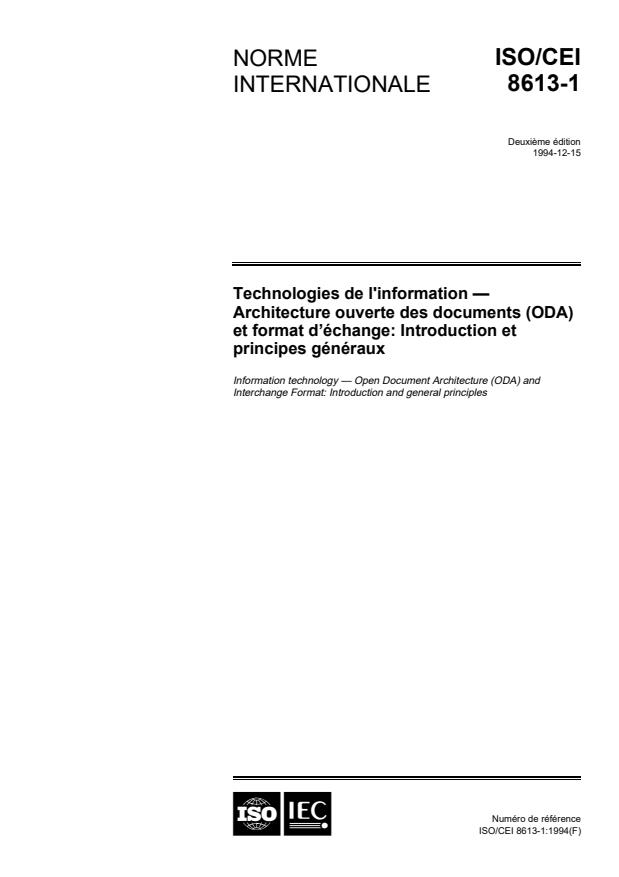
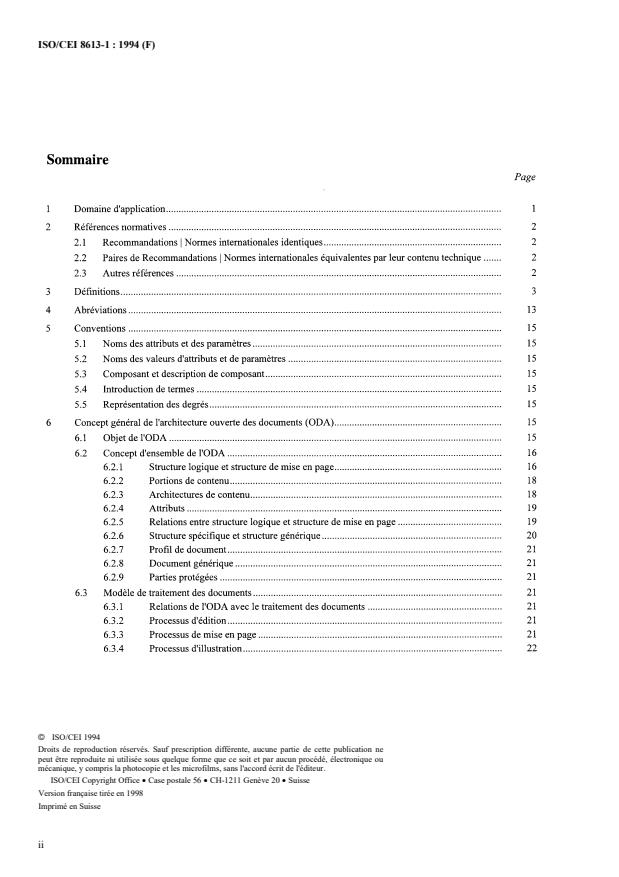
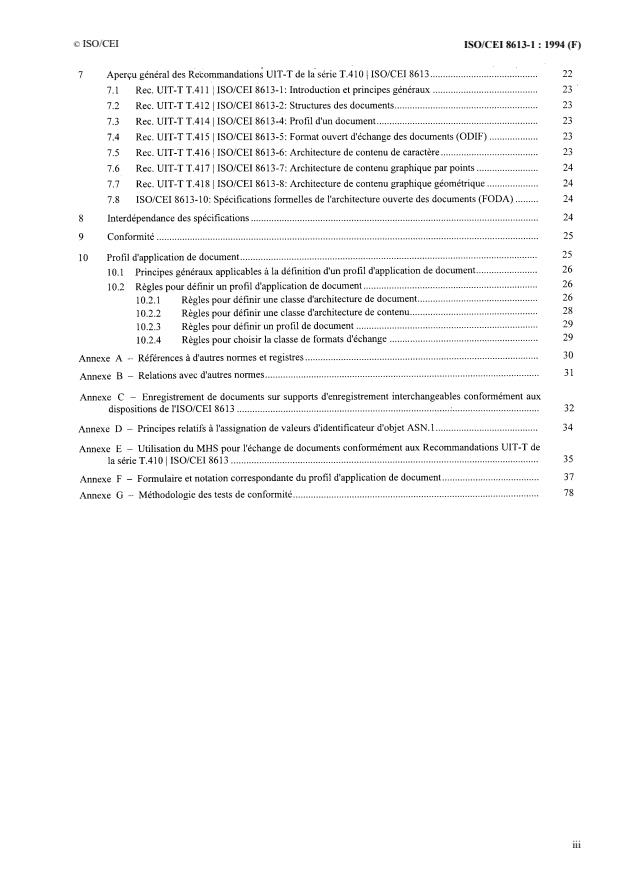
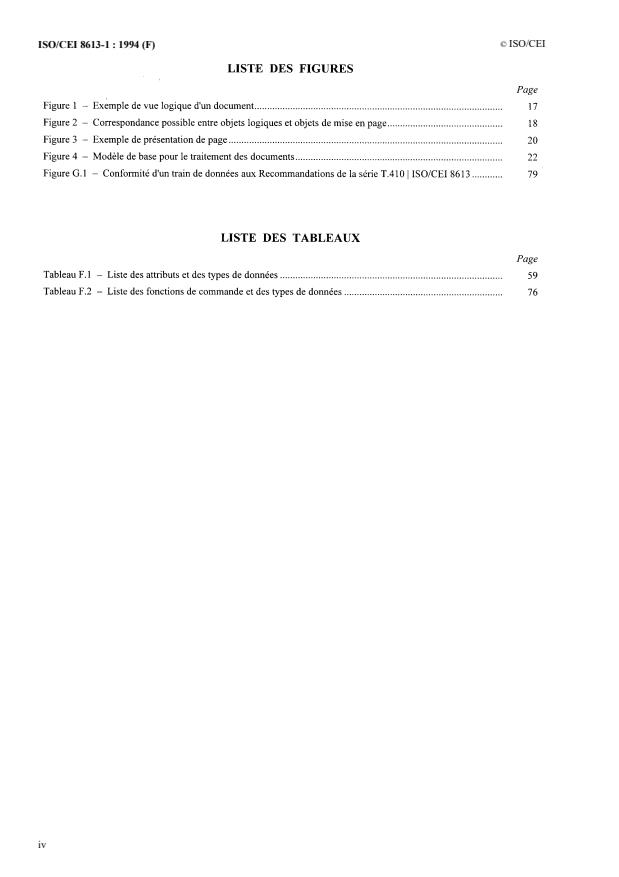
ISO/IEC 8613-1:1994 - Technologies de l'information — Architecture des documents ouverts (ODA) et format d'échange: Introduction et principes généraux — Partie 1: Released:6/25/1998
Overview
ISO/IEC 8613-1:1994 - part of the Open Document Architecture (ODA) and Interchange Format family - defines the introduction and general principles for exchanging complex documents across systems. It explains the overall document architecture, scope, terminology and objectives of the ISO/IEC 8613 (ITU‑T T.410 series) suite, and specifies how ODA supports both faithful presentation and processable forms of documents that may include graphic characters, raster graphics and geometric graphics.
Key topics and technical requirements
- Document architecture concepts: logical structure vs. layout structure, content portions, content architectures, attributes, and protected parts.
- Document processing model: stages such as editing, layout and imaging are described to clarify how documents are created, transformed and rendered.
- Interchange forms: defines formatted, processable and formatted-processable representations to support presentation and/or downstream processing (editing, reformatting).
- Document application profiles: rules and guidelines for defining document architecture classes, content architecture classes, document profiles and interchange format classes to ensure predictable interoperability.
- Conformance: criteria for conformance to the ITU‑T T.410 / ISO/IEC 8613 family and directions for conformance testing.
- References & inter-dependencies: maps the relationships among the parts of the series (document structures, profiles, interchange format, character/raster/geometric content architectures, formal specifications) and to related standards such as ASN.1/BER.
- Extensions & amendments: supports extensions (e.g., styles, security, streams, tiled raster graphics, MHS/MOTIS usage) while preserving core interchange semantics.
Applications and who uses this standard
- Software vendors building document editors, layout engines, or converters that must preserve original author intent and layout when exchanging documents across platforms.
- Document management and archiving solutions requiring standardized, long-term interchange formats for complex documents with mixed content types.
- Enterprise messaging and interchange systems that integrate documents across heterogeneous environments (including MHS/MOTIS messaging scenarios).
- Standards bodies and test labs developing conformance tests, application profiles and interoperability guidelines.
- Implementers of content architectures (character, raster, geometric) who need consistent references for encoding and rendering.
Related standards
- ITU‑T T.410 series / ISO/IEC 8613 parts 2–14 (Document structures, profiles, interchange format, content architectures, formal specifications)
- ASN.1 and BER specifications (for encoding structures)
- Other document and interchange standards referenced within the series
ISO/IEC 8613-1 is a foundational document for achieving interoperable, presentation‑accurate and processable document interchange in multi‑vendor and long‑term archival contexts.
Relations
- Effective Date
- 06-Jun-2022
- Effective Date
- 15-Apr-2008
- Effective Date
- 15-Apr-2008
Buy Documents
ISO/IEC 8613-1:1994 - Information technology — Open Document Architecture (ODA) and interchange format: Introduction and general principles — Part 1: Released:12/22/1994
ISO/IEC 8613-1:1994 - Technologies de l'information — Architecture des documents ouverts (ODA) et format d'échange: Introduction et principes généraux — Partie 1: Released:6/25/1998
Get Certified
Connect with accredited certification bodies for this standard

BSI Group
BSI (British Standards Institution) is the business standards company that helps organizations make excellence a habit.

NYCE
Mexican standards and certification body.
Sponsored listings
Frequently Asked Questions
ISO/IEC 8613-1:1994 is a standard published by the International Organization for Standardization (ISO). Its full title is "Information technology — Open Document Architecture (ODA) and interchange format: Introduction and general principles — Part 1:". This standard covers: Introduces the ISO/IEC 8613 series, gives the necessary references, defines terms, presents the concepts of the document architecture, gives an overview of the series, describes the inter-dependencies, defines conformance to the ITU-T T.410 series, gives rules for defining document application profiles. The purpose is to facilitate the interchange of documents for either or both of the following purposes: to allow presentation as intended by the originator, to allow processing, such as editing and reformatting. The content elements used within the documents may include graphic characters, raster graphics elements and geometric graphics elements.
Introduces the ISO/IEC 8613 series, gives the necessary references, defines terms, presents the concepts of the document architecture, gives an overview of the series, describes the inter-dependencies, defines conformance to the ITU-T T.410 series, gives rules for defining document application profiles. The purpose is to facilitate the interchange of documents for either or both of the following purposes: to allow presentation as intended by the originator, to allow processing, such as editing and reformatting. The content elements used within the documents may include graphic characters, raster graphics elements and geometric graphics elements.
ISO/IEC 8613-1:1994 is classified under the following ICS (International Classification for Standards) categories: 35.240.20 - IT applications in office work. The ICS classification helps identify the subject area and facilitates finding related standards.
ISO/IEC 8613-1:1994 has the following relationships with other standards: It is inter standard links to ISO/IEC 8613-1:1994/Cor 1:1998, ISO 8613-1:1989; is excused to ISO/IEC 8613-1:1994/Cor 1:1998. Understanding these relationships helps ensure you are using the most current and applicable version of the standard.
ISO/IEC 8613-1:1994 is available in PDF format for immediate download after purchase. The document can be added to your cart and obtained through the secure checkout process. Digital delivery ensures instant access to the complete standard document.
Standards Content (Sample)
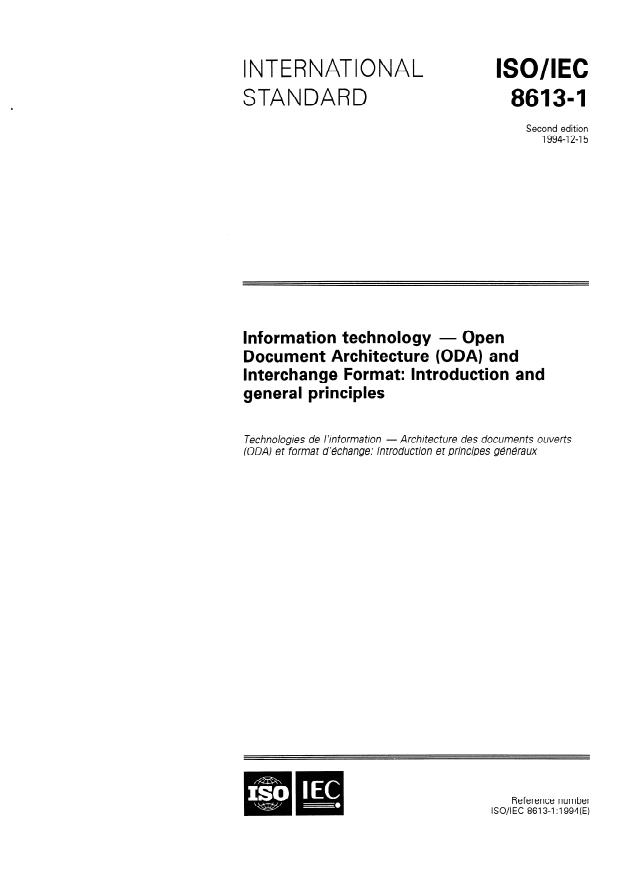
INTERNATIONAL ISO/IEC
STANDARD 8613-1
Second edition
1994-l 2-15
Information technology - Open
Document Architecture (ODA) and
Interchange Format: Introduction and
general principles
Technologies de I’informa tion - Architecture des documents ouverts
(ODA) et format d’bchange: Introduction et principes g&Graux
Reference number
lSO/IEC 8613-I :I 994(E)
l[SO/IEC 8613=1:1994(E)
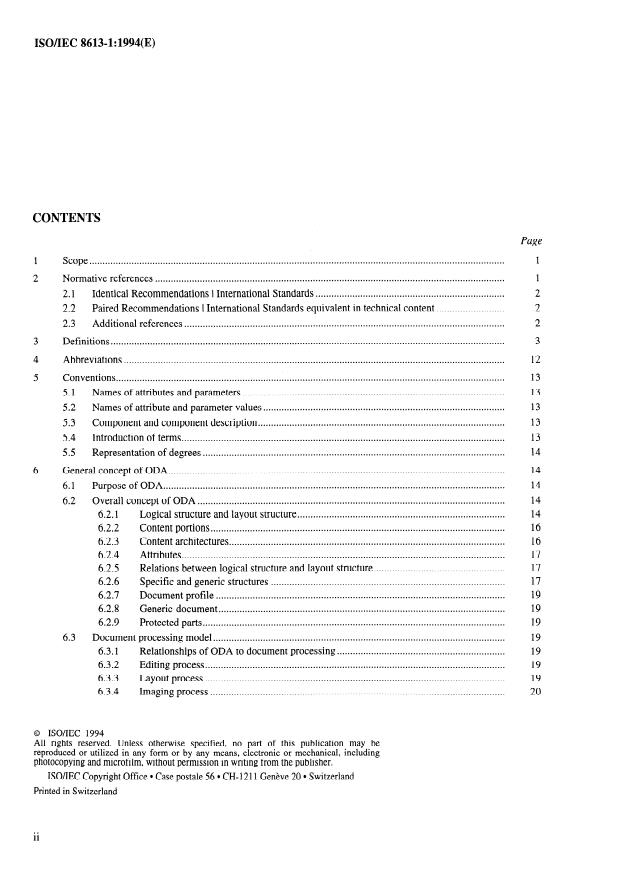
CONTENTS
Page
..............................................................................................................................................................
Scope
.....................................................................................................................................
Normative references
........................................................................
2.1 Identical Recommendations I International Standards
..........................
2.2 Paired Recommendations I International Standards equivalent in technical content
2.3 Additional references .
Definitions .
Abbreviations .
Conventions .
Names of attributes and parameters .
5.1
............................................................................................
52 Names of attribute and parameter values
..............................................................................................
5:3 Component and component description
...........................................................................................................................
5.4 Introduction of terms
5.5 Representation of degrees .
General concept of ODA .
..................................................................................................................................
61 Purpose of ODA
6:2 Overall concept of ODA .
............................................................................... 14
6.2.1 Logical structure and layout structure
6.2.2 Content portions .
.........................................................................................................
6.2.3 Content architectures
6.2.4 Attributes .
..................................................
6.2.5 Relations between logical structure and layout structure
.........................................................................................
6.2.6 Specific and generic structures
6.2.7 Document profile .
6.2.8 Generic-document .
................................................................................................................... 19
6.2.9 Protected parts
. Document processing model .
Relationships of ODA to document processing .
6.3.1
.................................................................................................................. 19
6.3.2 Editing process
6.3.3 Layout process .
6.3.4 Imaging process .
ISO/IEC 1994
All rights reserved. Unless otherwise specified, no part of this publication may be
reproduced or utilized in any form or by any means, electronic or mechanical, including
photocopying and microfilm, without permission in writing from the publisher.
ISOLIEC Copyright Office l Case postale 56 l CI-I-1211 Geneve 20 l Switzerland
Printed in Switzerland
ISO/IEC 8613-l: 1994(E)
8‘ ISO/IEC
........................................................................... 20
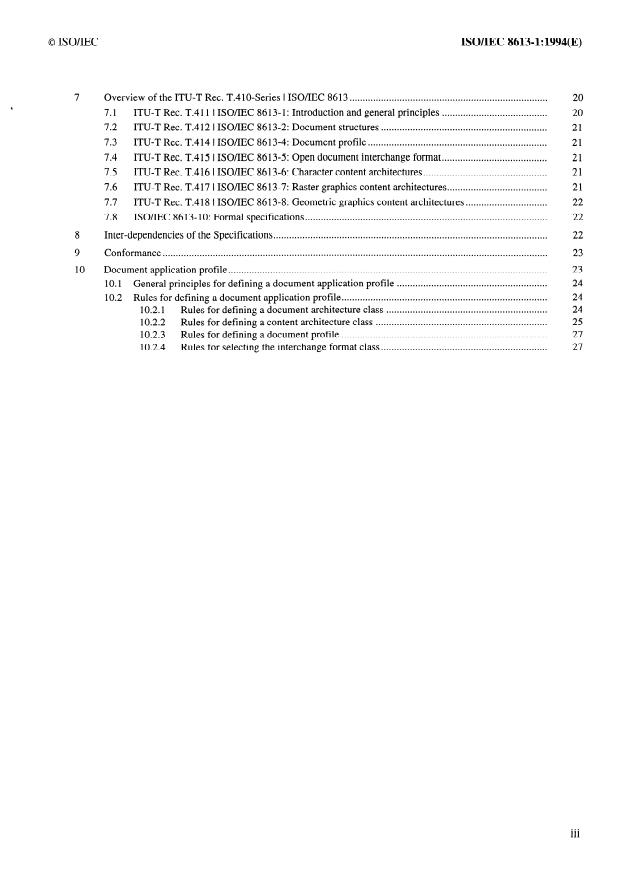
7 Overview of the ITU-T Rec. T.410-Series I ISO/IEC 8613
........................................ 20
ITU-T Rec. T.411 I ISO/IEC 8613-1: Introduction and general principles
7.1
............................................................... 21
7.2 ITU-T Rec. T.412 I ISO/IEC 8613-2: Document structures
.................................................................... 21
7.3 ITU-T Rec. T.414 I ISO/IEC 8613-4: Document profile
........................................ 21
7.4 ITU-T Rec. T.415 I ISO/IEC 8613-5: Open document interchange format
...............................................
7.5 ITU-T Rec. T.416 I ISO/IEC 8613-6: Character content architectures
......................................
7.6 ITU-T Rec. T.417 I ISO/IEC 8613-7: Raster graphics content architectures
............................... 22
7.7 ITU-T Rec. T.418 I ISO/IEC 8613-8: Geometric graphics content architectures
............................................................................................
7.8 ISO/IEC 86 13- 10: Formal specifications
8 Inter-dependencies of the Specifications .
Conformance .
.........................................................................................................................
10 Document application profile
.........................................................
10.1 General principles for defining a document application profile
..............................................................................
Rules for defining a document application profile
10.2
.............................................................
10.2.1 Rules for defining a document architecture class
.................................................................
10.2.2 Rules for defining a content architecture class
..............................................................................
10.2.3 Rules for defining a document profile
...............................................................
10.2.4 Rules for selecting the interchange format class
. . .
ISO/IEC 8613=1:1994(E)
0 ISO/IEC
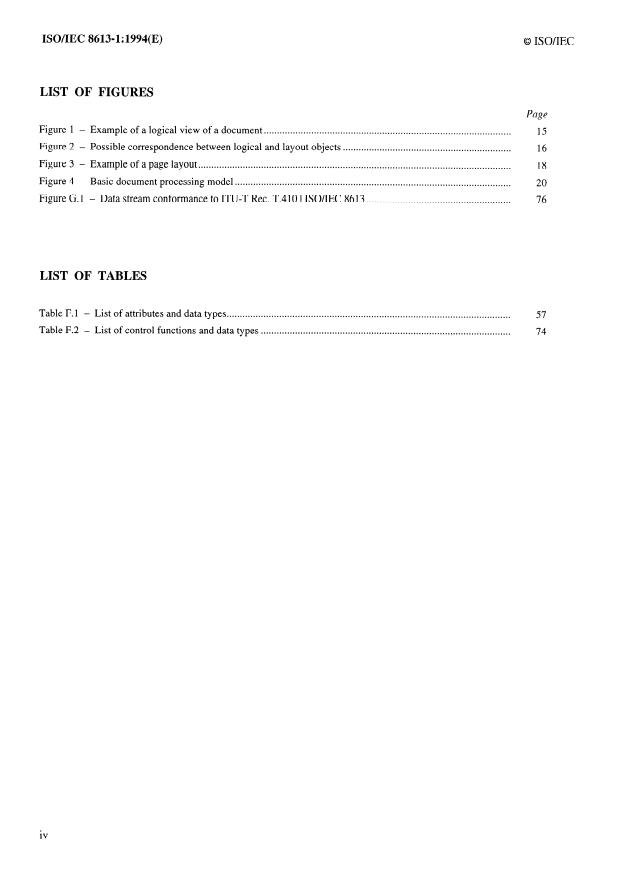
LIST OF FIGURES
Page
Figure 1 - Example of a logical view of a document . . . . . . . . . . . . . . . . . . . . . . . . . . . . . . . . . . . . . . . . . . . . . . . . . . . . . . . . . . . . . . . . . . . . . . . . . . . . . . . . . . . . . . . . . . . . . . 15
Figure 2
- Possible correspondence between logical and layout objects . . . . . . . . . . . . . . . . . . . . . . . . . . . . . . . . . . . . . . . . . . . . . . . . . . . . . . . . . . . . . . . . 16
Figure 3 - Example of a page layout . . . . . . . . . . . . . . . . . . . . . . . . . . . . . . . . . . . . . . . . . . . . . . . . . . . . . . . . . . . . . . . . . . . . . . . . . . . . . . . . . . . . . . . . . . . . . . . . . . . . . . . . . . . . .~. 18
Figure 4 - Basic document processing model . . . . . . . . . . . . . . . . . . . . . . . . . . . . . . . . . . . . . . . . . . . . . . . . . . . . . . . . . . . . . . . . . . . . . . . . . . . . . . . . . . .~. 20
Figure G. 1
- Data stream conformance to ITU-T Rec. T.410 I ISO/IEC 8613 . . . . . . . . . . . . . . . . . . . . . . . . . . . . . . . . . . . . . . . . . . . . . . . . . . . . . . . 76
LIST OF TABLES
Table F. 1 - List of attributes and data types . 57
...............................................................................................
Table F.2 - List of control functions and data types 74
iv
o ISO/IEC ISO/IEC 8613-l: 1994(E)
Foreword
IS0 (the International Organization for Standardization) and IEC (the Inter-
national Electrotechnical Commission) form the specialized system for worldwide
standardization. National bodies that are members of IS0 or IEC participate in the
development of International Standards through technical committees established
by the respective organization to deal with particular fields of technical activity.
IS0 and IEC technical committees collaborate in fields of mutual interest. Other
international organizations, governmental and non-governmental, in liaison with
IS0 and IEC, also take part in the work.
In the field of information technology, IS0 and IEC have established a joint
technical committee, ISO/IEC JTC 1. Draft International Standards adopted by the
joint technical committee are circulated to national bodies for voting. Publication
as an International Standard requires approval by at least 75 % of the national
bodies casting a vote.
International Standard ISO/IEC 8613-1 was prepared by Joint Technical
Committee ISO/IEC JTC 1, Information technology, Subcommittee SC 18,
Document processing and related communication, in collaboration with ITU-T.
The identical text is published as ITU-T Rec. T.411.
This second edition cancels and replaces the first edition (IS0 8613-1: 1989),
which has been technically revised.
ISO/IEC 8613 consists of the following parts, under the general title Information
technology - Open Document Architecture (ODA) and Interchange Format:
- Part I: Introduction and general principles
- Part 2: Document structures
- Part 3: Abstract inter$ace for the manipulation of ODA documents
- Part 4: Document profile
Part 5: Open Document Interchange Format
Part 6: Character content architectures
- Part 7: Raster graphics content architectures
Part 8: Geometric graphics content architectures
- Part 9: Audio content architectures
- Part 10: Formal specifications
Part I I: Tabular structures and tabular layout
- Part 12: Identification of document fragments
- Part 13: Spreadsheet
- Part 14: Temporal relationships and non-linear structures
Annexes C, D and E form an integral part of this part of ISO/IEC 86 13. Annexes
A, B, F and G are for information only.
o ISO/IEC
ISO/IEC 8613=1:1994(E)
Introduction
This ITU-T Recommendation I International Standard was prepared as a joint publication by TSS Study Group 8 and
ISO/IEC Joint Technical Committee 1.
At present, the ITU-T series of Recommendations in the T.410-Series I International Standard ISO/IEC 8613 consists of:
-
Introduction and general principles;
-
Document structures;
Document profile;
-
Open document interchange format;
-
Character content architectures;
-
Raster graphics content architectures;
-
Geometric graphics content architectures;
-
Formal specifications.
(The formal specification is applicable to ISO/IEC 8613 only.)
Further Recommendations I International Standards may be added to this series of ITU-T Recommendations I
International Standard.
Development of this series of ITU-T Recommendations I International Standards was originally in parallel with the
ECMA 101 standard: Open Document Architecture.
This series of ITU-T Recommendations I International Standards is a new edition of the CCITT T.410-Series of
Recommendations (1988) and ISO/IEC 8613 (1989).
Significant technical changes are the inclusion of the following amendments as agreed by TSS and ISO/IEC:
-
Alternative representation
-
Annex on use of MHS/MOTIS
-
Colour
-
Conformance Testing annex
-
Document Application Profile Proforma and Notation
-
Security
-
Streams
-
Styles
-
Tiled raster graphics
In addition, a number of technical corrigenda have been applied to this series of ITU-T Recommendations I International
Standard.
o ISO/IEC
ISO/IEC 8613=1:1994(E)
This ITU-T Recommendation I International Standard contains eight annexes:
-
Annex A (non-integral) gives references to other standards and registers;
-
Annex B (non-integral) gives the relationship of this series of ITU-T Recommendations I International
Standards with other CCITT Recommendations and International Standards;
-
Annex C (integral) specifies the method of recording documents in conformance with this series of ITU-T
Recommendations I International Standards on volume and file structures of interchangeable storage
media in conformance with international standards for volume and file structures;
-
Annex D (integral) gives the principles for the assignment of ASN.l object identifier values for this series
of ITU-T Recommendations I International Standards;
-
Annex E (integral) describes the use of MHS to interchange documents conforming to this series of
ITU-T Recommendations I International Standards;
-
Annex F (non-integral) defines a standardized proforma for the specification of document application
profiles based on this series of ITU-T Recommendations I International Standards;
-
Annex G (non-integral) gives directions for the development of a conformance testing methodology for
this series of ITU-T Recommendations I International Standards.
ISOIIEC $613=1:1994(E)
8 ISO/IEC
. . .
Vlll
ISO/IEC 8613=1:1994(E)
INTERNATIONAL STANDARD
ITU-T RECOMMENDATION
INFORMATION TECHNOLOGY - OPEN DOCUMENT ARCHITECTURE (ODA)
AND INTERCHANGE FORMAT: INTRODUCTION AND GENERAL PRINCIPLES
1 Scope
The purpose of the ITU-T Rec. T.410-Series I ISO/IEC 8613 is to facilitate the interchange of documents.
In the context of these Recommendations I International Standards, documents are to be items such as memoranda,
letters, invoices, forms and reports, which may include pictures and tabular material. The content elements used within
the documents may include graphic characters, raster graphics elements, and geometric graphics elements, all potentially
within one document.
NOTE - These Recommendations I International Standards are designed to allow for extensions, including hypermedia
features, spreadsheets and additional types of content such as audio and video.
In addition to content types defined in these Recommendations I International Standards, ODA also provides for
arbitrary content types to be included in documents.
These Recommendations I International Standards apply to the interchange of documents by means of data
comm unications or the exchange of storage media.
These Recommendations I International Standards provide for the interchange of documents for either or both of the
following purposes:
-
to allow presentation as intended by the originator;
-
to allow processing, such as editing and reformatting.
The composition of a document in interchange can take several forms:
-
formatted form, allowing presentation of the document;
-
processable form, allowing processing of the document;
-
formatted processable form, allowing both presentation and processing of the document.
These Recommendations I International Standards also provide for the interchange of ODA information structures used
for the processing of interchanged documents.
This ITU-T Recommendation I International Standard:
-
introduces this ITU-T T.410-Series of Recommendations I ISOIIEC 8613 as a whole;
-
gives the references necessary for the ITU-T T.410-Series of Recommendations I ISO/IEC 86 13;
-
defines terms used in the context of the ITU-T T.410-Series of Recommendations I ISO/IEC 8613;
-
presents the concepts of the document architecture;
-
gives an overview of the ITU-T T.410-Series of Recommendations I ISO/IEC 86 13;
-
describes the inter-dependencies of the ITU-T T.410-Series of Recommendations I ISO/IEC 8613;
-
defines conformance to the ITU-T T.410-Series of Recommendations I ISO/IEC 8613;
-
gives rules for defining document application profiles.
2 Normative references
The following ITU-T/CCITT Recommendations and International Standards contain provisions which, through
reference in this text, constitute provisions of this Recommendation I International Standard. At the time of publication,
the editions indicated were valid. All Recommendations and Standards are subject to revision, and parties to agreements
based on this Recommendation I International Standard are encouraged to investigate the possibility of applying the most
recent edition of the Recommendations and Standards listed below. Members of IEC and IS0 maintain registers of
currently valid International Standards. The ITU-T Secretariat maintains a list of the currently valid ITU-TKCITT
Recommendations.
ITU-T Rec. T.411(1993 E) 1
21 . Identical Recommendations I International Standards
-
ITU-T Recommendation T.412 (1993) I ISO/IEC 8613-2: 1994, Information technology - Open Document
Architecture (ODA) and Interchange Format: Document structures.
-
ITU-T Recommendation T.4 14 (1993) I ISO/IEC 86 13-4: 1994, Information technology - Open Document
Architecture (ODA) and Interchange Format: Document profile.
-
ITU-T Recommendation T.4 15 (1993) I ISO/IEC 8613-S: 1994, Information technology - Open Document
Architecture (ODA) and Interchange Format: Open Document Interchange Format.
-
ITU-T Recommendation T.416 (1993) I ISO/IEC 8613-6: 1994, Information technology - Open Document
Architecture (ODA) and Interchange Format: Character content architectures.
-
ITU-T Recommendation T.417 (1993) I ISOIIEC 8613-7: 1994, Information technology - Open Document
Architecture (ODA) and Interchange Format: Raster graphics content architectures.
-
ITU-T Recommendation T.4 18 (1993) I ISO/IEC 8613-8: 1994, Information technology - Open Document
Architecture (ODA) and Interchange Format: Geometric graphics content architectures.
22 . Paired Recommendations I International Standards equivalent in technical content
-
CCITT Recommendation X.208 (1988), Specification of Abstract Syntax Notation One (ASN. I).
ISO/IEC 8824: 1990, Information technology - Open Systems Interconnection - Specification of Abstract
Syntax Notation One (ASN.1).
-
CCITT Recommendation X.209 (1988), Specification of basic encoding rules for Abstract Syntax
Notation One (ASN. I ).
ISOAEC 8825: 1990, Information technology - Open Systems Interconnection - Specification of Basic
Encoding Rules for Abstract Syntax Notation One (ASN. I).
-
CCITT Recommendation X.41 1 (1992), Message Handling Systems: Message Transfer System: Abstract
Service Definition and Procedures.
ISOAEC 10021-4: 1990, Information technology - Text Communication - Message Oriented Text
Interchange Systems (MOTIS) - Part 4: Message Transfer System: Abstract Service Definition and
Procedures.
-
CCITT Recommendation X.420 (1992), Message Handling Systems: Message Transfer System.
Interpersonal Messaging System.
ISO/IEC 10021-7: 1990, Information technology - Text Communication - Message Oriented Text
Interchange Systems (MOTIS) - Part 7: Interpersonal Messaging System.
23 . Additional references
-
IS0 2022: 1986, Information processing - IS0 7-bit and 8-bit coded character sets - Code extension
techniques.
-
ISO/IEC 8613- 10: 1991, Information processing - Text and ofice systems - Office Document Architecture
- Part 10: Formal specifications.
(ODA) and Interchange Format
-
ISO/IEC 8632-l : 1992, Information technology - Computer graphics - Metafile for the storage and
- Part I: Functional specification.
transfer of picture description information
-
ISO/IEC 8632-3: 1992, Information technology - Computer graphics - Metafile for the storage and
transfer of picture description information - Part 3: Binary encoding.
-
- Standard Generalized Markup
IS0 8879:1986, Information processing - Text and once systems
Language (SGML).
-
IS0 9069:1988, Information processing - SGML support facilities - SGML Document Interchange
Format (SDIF).
-
IS0 9293: 1987, Information processing - Volume and file structure of flexible disk cartridges for
information interchange.
-
ISO/IEC 9541- 1: 1991, Information technology - Font information interchange - Part 1: Architecture.
-
IS0 9660: 1988, Information processing - Volume and file structure of CD-ROM for information
interchange.
2 ITU-T Rec. T.411(1993 E)
ISO/IEC 8613=1:1994(E)
3 Definitions
For the purposes of this Recommendation I International Standard, the following definitions apply.
3.1 active position: The point at which the action specified by the next character is to be effected.
32 . aligned around: A tabulation alignment that positions the sequence of character images for a specified
character string such that the position point of the character image of the first instance of a specified group of characters
within that string is positioned at the tabulation stop.
alternative description: A descripti on that represents a basic object that is intended to be used by the recipient
3.3
in lieu of the primary description of that basic object when the primary description cannot be processed.
object description in conjunction with its
3.4 alternative subtree: An alternative basic associated content portion
descriptions.
3.5 aspect ratio: The ratio of the dimension of a pel array in the direction of the pel path to the dimension in the
direction of the line progression.
rectangular area that remains on the nominal page
36 . assured reproduction area: The after deducting an agreed
allowance for edge losses.
a constituent of a documen t that has a name and a value and that expresses a
37 . attribute: An element of
characteristic of this constituent or a rel .ationship with one or more consti tuents.
. authenticity: The property that the claimed data source can be verified to the satisfaction of the recipient.
available area: The area de term ined by the document layout process into which the content portion is
formatted by the content layout process.
object, or an object class from which
3.10 basic component: A basic logical or layout basic logical or layout
m
objects ay be derived.
3.11 basic layout object: An object in the specific layout structure that has no subordinate.
basic logical object: An object in the specific logical structure that has no subordinate.
3.12
3.13 basic measurement unit; BMU (abbreviation): A unit of linear measurement equal to l/1200 of 25,4 mm.
NOTE - A locally defined scaling factor may be used to map the document to a particular imaging device.
function parameter value or the value of any other capability that is
3.14 basic value: An attribute value, a control
unconditionally allowed in document interchange in the context of a given document applicati .on profile.
may be specified by
3.15 binding: A pair comprising an identifier and a value, where the value may be of any
type,
an expression, and is accessed through use of the binding identifier.
3.16 block: A basic layout component that corresponds to a rectangular area within a frame or a page.
3.17 bottom edge: The edge of the positioning area of a basic layout object that is in the direction of the line
progression.
3.18 bottom left corner: The corner of a layout object that is least progressed in the horizontal direction and most
progressed in the vertical direction of a layout object.
3.19 bottom right corner: The corner of a layout object that is most progressed both in the horizontal and vertical
directions of a layout object.
3.20 centred:
a) The result of a layout or imaging process that positions the sequence of character images for a line such
that the distance from the line home position to the position point of the first character image is
approximately equal to the distance from the escapement point of the last character image to the end edge
of the positioning area.
b) A tabulation alignment that positions the sequence of character images for a specified character string
such that the distance from the position point of the first character image to the tabulation stop is
approximately equal to the distance from the tabulation stop to the escapement point of the last character
image.
NOTE - The term centred is also used as a value in the sub-parameter “alignment” of the parameter “position” and in the
attribute “block alignment”.
3.21 character: A member of a set of elements used for the organization, control and representation of information.
ITU-T Rec. T.411(1993 E) 3
ISO/IEC 8613=1:1994(E)
line across a character image, in the horizontal direction when the character
3.22 character base line: A image is in
its intended viewing orientation.
3.23 character image: The human perceptible rendering of a character on a presentation medium.
NOTE - The term glyph in ISO/IEC 9541 is equivalent to the term character image in this Specification.
3.24 character orientation: The direction of the character base line relative to the characters.
3.25 character path: The direction of progression of successive character images within a line box.
3.26 character sequence: A sequence of characters intended to be presented as one or more lines.
between the position points of successive
3.27 character spacing (for constant spacing fonts only): The distance
character
images when the inter-character space equals zero.
3.28 clipped pel array: The actual pel array to be imaged as determined by taking account of all clipping
parameters.
3.29
colour component: One of the dimensions of a colour space.
3.30 colour gamut: The range of colours a given system is capable of reproducing.
3.31 complete generator set: A constituent of a document consisting of a document root object class description
and at least one level of subordinate object class descriptions which are used to control the creation and/or modification
of the set of object descriptions representing a corresponding specific structure.
3.32 component: An object or an object class.
A composite logical or layout object, or an object class from which composite logical
3.33 composite component:
or layout objects may be derived.
3.34 composite layout object: An object in the layout structure that has one or more subordinate objects.
3.35 composite logical object: An object in the logical structure that has one or more subordinate objects.
3.36 confidentiality: The property that information is not made available or disclosed to unauthorized individuals,
entities or processes.
NOTE - This property is limited here to preventing unauthorized semantic knowledge of a document or specified parts
of it.
3.37 constant spacing: The characteristic of a font wherein the distance between the position point and the
escapement point is the same for all character images.
3.38 types: a document profile, an object d .escription, an
constituent: A set of attributes that is one of the following
objet t class description, a presentation style, a layout style, a content portion description or a protected part description.
3.39 content: The information conveyed by the document, other than the structural information, and that is
intended for human perception.
3.40 content architecture: Rules for defining the internal structure and representation of the content of basic
components in terms of a set of content elements, attributes and control functions, and guidelines for the presentation of
the content.
3.41 content architecture class: The rules for defining the internal structure and representation of the content of
basic components in one of a set of forms defined for each type of content element.
NOTE - Examples of content architecture classes are formatted form, processable form and formatted processable form in
the case of character content elements.
3.42 content editing process: The process that creates new content or modifies previous content.
3.43 content element: A basic element of the content of a document.
3.44
content layout process: The process that, interacting with the document layout process, consists of the
formatting of content portions into available areas and the determination of the sizes of blocks in accordance with
information contained in the presentation styles.
3.45 content portion: The partitioning the content of a document according to its logical and/or layout
result of
structure.
content portion description: A
3.46 constituent of a document, representing a content portion that consists of
content information and attributes to specify information.
the properties of its content
4 ITU-T Rec. T.411(1993 E)
characters, raster graphic elements and
3.47 content type: A category of content elements such as
geometric graphic
elements.
3.48 control function: An element of a character set that affects the recording, processing, transmission or
interpretation of data, and that has a coded representation consisting of one or more bit combinations.
NOTE - Examples of control functions are Selected Graphic Rendition (SGR) in character content architectures and Set
Line Type in geometric graphics content architectures.
3.49 current layout position: The identification of a lowest level frame which is maintained during the layout
process for each layout stream which occurs.
3.50 Cyan Magenta Yellow (Black); CMY(K) (abbreviation) colour space: Colour space based on the
subtractive colour mixture of Cyan (C), Magenta (M) and Yellow (Y) primaries with the optional inclusion of Black (K)
as indicated by the parentheses.
accordance with a particular
DAP-n data stream: An ODA data stream in which the data elements are in
3.51
document application profile named ~1, defined i n accordance with this Specification.
3.52 data integrity: The property that data has not been altered or destroyed.
3.53 data structure: A set of data items and the relationship between them representing the whole or a part of a
constituent.
NOTE - The data items constituting a data structure represent attributes of the document, the document profile, the
components, the styles, or the content portions concerned.
description: A constituent that corresponds to a structural element.
3.54
NOTE - A basic object may have several descriptions when alternative descriptions are used.
an object class description, a layout style, a
3.55 descriptor: A data structure representing the document profile,
presentation style, an object description, or a protected part description.
device space: A colour space where the coordinates are those used by a particular device in the measurement
3.56
or rendition of colour.
3.57 digital signature: A form of seal associated with a specified part of a document which provides proof of
uniqueness of the identity of the originator (source) who applied the seal; it supports non-repudiation of origin of the
sealed (signed) part.
document: A structured amount of information intended for human perception, that may be interchanged as a
3.58
unit between users and/or systems.
The specification of a combination of features defined in ITU-T
3.59 document application profile:
Rec. T.410-Series I ISO/IEC 8613, intended to form a subset to fulfil the requirements of an application.
3.60 document architecture:
a) Rules for defining the structure of documents, in terms of collections of constituents and the attributes of
which these are composed.
b) The structural information of a document consisting of the set of one or more of the following structures:
specific logical structure, specific layout structure, generic logical structure and/or generic layout
structure together with presentation styles and/or layout styles.
the structure and representation of documents in
3.61 document architecture class: The rules for defining
formatted form, processable form or formatted processable form.
3.62 document body: The part of a document that may include a generic logical and layout structure, specific
logical and layout structure, layout and presentation styles, protected parts but excludes the document profile.
3.63 document class: A set of logical object class descriptions, layout object class descriptions, generic content
portion descriptions, styles and a document profile, that specifies a set of documents with common characteristics.
3.64 document class description: The specification of a document class.
3.65 document layout process: The process that creates a specific layout structure in accordance with the generic
layout structure and information contained in the specific logical structure, the generic logical structure and the layout
styles.
document layout root: The composite object of the specific layout structure at the highest level of the
3.66
hierarchy.
ITU-T Rec. T.411(1993 E)
3.67 document logical root: The composite object of the specific logical structure at the highest level of the
hierarchy.
document profile: A set of attributes which specifies the characteristics of the document as a whole.
3.68
3.69 editing: The carrying out of operations associated with creation and modification of the structure and/or the
content of a document.
3.70 editing process: The stage of document processing that consists of the content editing process and the logical
structure editing process.
3.71 end-aligned:
a) The result of a layout or imaging process that positions the sequence of character images for a line such
that the escapement point of the last character image is positioned at the end edge of the positioning area.
b) A tabulation alignment that positions the sequence of character images for a specified character string
such that the escapement point of the last character image is positioned at the tabulation stop.
3.72 end edge: The edge of the positioning area of a basic layout object that is in the direction of the character path.
with a character image that is used for positioning of the next
3.73 escapement A reference point associated
character image.
3.74 external document class : A document class referred to by the document profile of an interchanged document
contai ni ng no generic structure.
class descriptions which are used to factorise the attributes of object
3.75 factor set: One or more object
specific structure.
descriptions representing a
3.76 file: A named collection of information.
3.77 file section: For a file recorded over more than one volume, that part of the file that is recorded on any one
volume.
NOTE - The termfile in IS0 9293 is equivalent to the termfile section in this Specification.
file space: The region within which a file section may be recorded on a volume.
3.78
3.79 filing: The storage of a document according to some defined method in order to facilitate retrieval of the
document.
fingerprint: A short and compact code that may be computed in order to characterize some specified
3.80
information, with the property that it is not practicable to construct different information which would yield the same
output.
3.81 font: A set of character images normally with a common design and size.
3.82 font size: The height of the character images in a font.
as
formatted form: A form of representation of a document that allows the presentation of the document
3.83
not support editing and (re)formatting.
intended by the originator and that does
3.84 formatted processable form: A form of representation of the document that allows presentation of the
document as intended by the originator and also supports editing and (re)formatting.
formatting: The carrying out of operations to determine the layout of a document.
3.85
3.86 frame: A type of composite layout component that corresponds to a rectangular area within a page or another
frame.
3.87
generic content portion: A content portion associated with an object class.
descrip tion associated with an objet t class
3.88 generic content portion description: A content portion
description.
3.89
generic-document: A structured amount of information intended for the interchange of generic structures, and
optionally associated styles and content portions, for use in the processing of interchanged documents.
3.90
generic layout structure: A set of layout object classes and associated generic content portions.
3.91 generic logical structure: A set of logical object classes and associated generic content portions.
ITU-T Rec. T.411(1993 E)
ISO/IEC 8613=1:1994(E)
3.92 geometric graphic element: A graphic element used to describe an image by geometric graphical means.
NOTE - Geometric graphics elements include those describing primitive geometric shapes such as points, arcs, lines.
graphic character: A member of a set of graphic symbols used for the representation of information.
3.93
NOTE - Graphic characters include simple alphanumeric characters (for example, accented letters) and pictorial characters
(for example, mosaics).
3.94 graphic element: A content element that is capable of having a visual representation.
NOTE - Three types of graphic elements are distinguished in the ITU-T Rec. T.410-Series I ISO/IEC 8613: graphic
characters, raster graphics elements, and geometric graphics elements.
3.95 hard line terminator: A line terminator that is intended not to be removed in a reformatting process.
3.96 horizontal direction (of a layout object): The direction in a layout object relative to which content
architectures may define attributes determined by using the horizontal axis of the page.
3.97 imaging order: The order of precedence of layout objects for imaging in the layout object to which they are
immediately subordinate.
a presentation medium i
3.98 imaging process: The process of producing a document on .n human-perceptible form,
making u ures, presentation styles and content portions.
se of the document profile, specific and generic layout struct
3.99 implicit layout category: The layout category of a logical object which is used in the absence of an explicit
specification of a layout category for that object.
3.100 indentation: The result of a layout or imaging process that causes the sequence of character images for a line
to begin at a distance from the line home position in the direction of the character path.
3.101 initial point:
a) The point associated with a basic layout object relative to which all line boxes imaged within that basic
layout object are positioned (character content architectures ITU-T Rec. T.416 I ISO/IEC 8613-6).
b) The point associated with a basic layout object relative to which all pels imaged within that basic layout
object are positioned (raster graphics content architectures ITU-T Rec. T.417 I ISO/IEC 8613-7).
integrity : Used here synonymously with data i ntegrity.
3.102
3.103 intended recipient: A recipient of a document that is expected to receive or have access to the document.
interchange: The process of providing a document to a receiving person or device, by means of data
3.104
communication or by exchange of storage media.
3.105 interchange data element: A data structure representing a constituent of a document.
3.106 interchange format: The rules for representing a document for the purpose of interchange.
3.107 interchange format class: A form of interchange format suitable to a specific application.
NOTE - In the ITU-T Rec. T.41 O-Series I ISO/IEC 8613, the defined classes differ by the ordering of the interchange data
elements or by the coding.
3.108 interchangeable storage medium: Storage medium which can be used to interchange information by moving
the medium from one information processing system to another.
3.109 inter-character space: An additional amount of spacing that is included between adjacent character images.
3.110 intersection: The common area of two or more layout objects that overlap each other partially or fully on the
presentation medium.
3.111 item identifier: A string of characters that precedes and is separated from the remainder of the first line of a
basic component with content. An item identifier is used to identify the subsequent text.
3.112 justified: The result of a layout or imaging process that varies the width of the space character and/or the
inter-character space to produce a simultaneously start-aligned and end-aligned presentation of the text.
3.113 kern: The part of a character image which extends beyond its position point or escapement point.
3.114
layout category: The association of basic logical objects with lowest level frames such that the content of
these basic logical objects is placed in the appropriate frames.
3.115 layout object: An element of the specific layout structure of a document, for example, page, block.
ITU-T Rec. T.411(1993 E) 7
ISO/IEC 8613=1:1994(E)
of 1 ayout
3.116 layout object class: An element of the generic layout structure from which a set objects with
common characteristics may be derived, for example, pages with common headers and footers.
3.117 layout process: The stage of document processing that consists of the document layout process and the
content layout process.
NOTE - This is also referred to as formatting.
3.118 layout stream: A set of basic logical objects pertaining to the same layout category.
3.119 layout structure:
ument into increasingly smaller parts, on the
a) The result of dividing and subdividing the content of a dot
basis of the presentation, for example, into pages, blocks.
b) All layout objects and associated content portions forming the layout hierarchy of a document.
document, referred to from a logical component, that guides the creation of a
3.120 layout style: A constituent of the
specific layout structure.
3.121 leading edge: The edge of a frame or block that is orthogonal to the direction of the layout path and that is met
first, from the outside of the frame or the block, in the opposite direction of the layout path.
3.122 left hand edge: The edge of a frame or block that is parallel to the direction of the layout path and that is met
first, from the outside of the frame or the block, in the direction at an angle of 270 degrees counterclockwise relative to
the direction of the layout path.
3.123 line box: A rectangular area within which a sequence of character images are positioned.
line home position: The point within a line box that is used for positioning that line box.
3.124
3.125 line progression:
a) The direction of progression of successive line boxes within a basic layout object (character content
architectures ITU-T Rec. T.416 1 ISO/IEC $613-6).
The direction of progression of successive lines of pels within a basic layout object (raster graphics
b)
content architectures ITU-T Rec. T.417 I ISO/IEC 8613-7).
3.126 line spacing:
lines within a (character content
a) The distance between two adjacent reference basic layout object
architectures ITU-T Rec. T.416 I ISOLIEC 8613-6).
The distance between two adjacent lines of pels within a basic layout object (raster graphics content
b)
architectures ITU-T Rec. T.417 I ISO/IEC 8613-
...
NORME ISO/CEI
INTERNATIONALE 8613-1
Deuxième édition
1994-12-15
Technologies de l'information —
Architecture ouverte des documents (ODA)
et format d’échange: Introduction et
principes généraux
Information technology — Open Document Architecture (ODA) and
Interchange Format: Introduction and general principles
Numéro de référence
bc
ISO/CEI 8613-1:1994(F)
ISO/CEI 8613-1 : 1994 (F)
© ISO/CEI 1994
Droits de reproduction réservés. Sauf prescription différente, aucune partie de cette publication ne
peut être reproduite ni utilisée sous quelque forme que ce soit et par aucun procédé, électronique ou
mécanique, y compris la photocopie et les microfilms, sans l'accord écrit de l'éditeur.
ISO/CEI Copyright Office • Case postale 56 • CH-1211 Genève 20 • Suisse
Version française tirée en 1998
Imprimé en Suisse
ii
©
ISO/CEI ISO/CEI 8613-1 : 1994 (F)
iii
©
ISO/CEI 8613-1 : 1994 (F) ISO/CEI
iv
©
ISO/CEI ISO/CEI 8613-1 : 1994 (F)
v
©
ISO/CEI 8613-1 : 1994 (F) ISO/CEI
vi
©
ISO/CEI ISO/CEI 8613-1 : 1994 (F)
vii
ISO/CEI 8613-1 : 1994 (F)
Rec. UIT-T T.411 (1993 F) 1
ISO/CEI 8613-1 : 1994 (F)
2 Rec. UIT-T T.411 (1993 F)
ISO/CEI 8613-1 : 1994 (F)
Rec. UIT-T T.411 (1993 F) 3
ISO/CEI 8613-1 : 1994 (F)
4 Rec. UIT-T T.411 (1993 F)
ISO/CEI 8613-1 : 1994 (F)
Rec. UIT-T T.411 (1993 F) 5
ISO/CEI 8613-1 : 1994 (F)
6 Rec. UIT-T T.411 (1993 F)
ISO/CEI 8613-1 : 1994 (F)
Rec. UIT-T T.411 (1993 F) 7
ISO/CEI 8613-1 : 1994 (F)
8 Rec. UIT-T T.411 (1993 F)
ISO/CEI 8613-1 : 1994 (F)
Rec. UIT-T T.411 (1993 F) 9
ISO/CEI 8613-1 : 1994 (F)
10 Rec. UIT-T T.411 (1993 F)
ISO/CEI 8613-1 : 1994 (F)
Rec. UIT-T T.411 (1993 F) 11
ISO/CEI 8613-1 : 1994 (F)
12 Rec. UIT-T T.411 (1993 F)
ISO/CEI 8613-1 : 1994 (F)
Rec. UIT-T T.411 (1993 F) 13
ISO/CEI 8613-1 : 1994 (F)
14 Rec. UIT-T T.411 (1993 F)
ISO/CEI 8613-1 : 1994 (F)
Rec. UIT-T T.411 (1993 F) 15
ISO/CEI 8613-1 : 1994 (F)
16 Rec. UIT-T T.411 (1993 F)
ISO/CEI 8613-1 : 1994 (F)
Rec. UIT-T T.411 (1993 F) 17
ISO/CEI 8613-1 : 1994 (F)
18 Rec. UIT-T T.411 (1993 F)
ISO/CEI 8613-1 : 1994 (F)
Rec. UIT-T T.411 (1993 F) 19
ISO/CEI 8613-1 : 1994 (F)
20 Rec. UIT-T T.411 (1993 F)
ISO/CEI 8613-1 : 1994 (F)
Rec. UIT-T T.411 (1993 F) 21
ISO/CEI 8613-1 : 1994 (F)
22 Rec. UIT-T T.411 (1993 F)
ISO/CEI 8613-1 : 1994 (F)
Rec. UIT-T T.411 (1993 F) 23
ISO/CEI 8613-1 : 1994 (F)
24 Rec. UIT-T T.411 (1993 F)
ISO/CEI 8613-1 : 1994 (F)
Rec. UIT-T T.411 (1993 F) 25
ISO/CEI 8613-1 : 1994 (F)
26 Rec. UIT-T T.411 (1993 F)
ISO/CEI 8613-1 : 1994 (F)
Rec. UIT-T T.411 (1993 F) 27
ISO/CEI 8613-1 : 1994 (F)
28 Rec. UIT-T T.411 (1993 F)
ISO/CEI 8613-1 : 1994 (F)
Rec. UIT-T T.411 (1993 F) 29
ISO/CEI 8613-1 : 1994 (F)
30 Rec. UIT-T T.411 (1993 F)
ISO/CEI 8613-1 : 1994 (F)
Rec. UIT-T T.411 (1993 F) 31
ISO/CEI 8613-1 : 1994 (F)
32 Rec. UIT-T T.411 (1993 F)
ISO/CEI 8613-1 : 1994 (F)
Rec. UIT-T T.411 (1993 F) 33
ISO/CEI 8613-1 : 1994 (F)
34 Rec. UIT-T T.411 (1993 F)
ISO/CEI 8613-1 : 1994 (F)
Rec. UIT-T T.411 (1993 F) 35
ISO/CEI 8613-1
...