

ISO 22256:2020
(Main)Traditional Chinese medicine — Detection of irradiated natural products by photostimulated luminescence
General Information
- Abstract
This document specifies a method using photostimulated luminescence (PSL) to detect the radiation status of natural products. It can be used to identify whether raw and traditionally processed Chinese medicinal materials and solid forms of manufactured product made from these materials have been irradiated by ionizing radiation (gamma, X-ray or beam). It is not applicable for use in testing liquid dosage forms or partially solid extracted dosage forms that do not contain directly crushed medicinal materials.
- Status
- Published
- Publication Date
- 13-Jul-2020
- Technical Committee
- ISO/TC 249 - Traditional Chinese medicine
- Drafting Committee
- ISO/TC 249/WG 2 - Quality and safety of manufactured TCM products
- Current Stage
- 9092 - International Standard to be revised
- Start Date
- 08-Jun-2026
- Completion Date
- 29-Aug-2026
Buy Documents


ISO 22256:2020 - Traditional Chinese medicine -- Detection of irradiated natural products by photostimulated luminescence
ISO 22256:2020 - Traditional Chinese medicine — Detection of irradiated natural products by photostimulated luminescence/14/2020
Overview
ISO 22256:2020 is an international standard that defines a method for detecting irradiation in traditional Chinese medicinal natural products using photostimulated luminescence (PSL). This standard is essential for ensuring the authenticity and safety of raw and processed Chinese medicinal materials by identifying whether they have been exposed to ionizing radiation such as gamma rays, X-rays, or electron beams. The method is applicable mainly to solid forms of medicinal products containing crushed natural materials and excludes liquid or partially solid extracts without direct solid material content.
The adoption of this standard helps regulatory bodies, manufacturers, and traders to monitor and verify the radiation status of traditional Chinese medicine (TCM) products. Through reliable detection, ISO 22256:2020 supports compliance with international trade regulations and prevents the use of irradiated materials, thereby maintaining product quality.
Key Topics
- Photostimulated Luminescence (PSL) Method: Utilizes light stimulation to release trapped energy stored in minerals like silicates and calcite present in medicinal products, resulting in luminescence detectable by specialized instruments.
- Sample Preparation: Grinding natural product samples to a fine powder with specific sample mass (typically 2 grams) placed in standardized Petri dishes for uniform testing.
- Instrument Calibration: Includes operational parameters such as acquisition frequency, dark count limits, and use of positive and negative irradiated reference materials for accurate measurement.
- Screening and Confirmation: The method consists of a two-step approach-initial screening PSL measurement followed by calibrated PSL post-irradiation with a known radiation dose to calculate the F-factor.
- Result Interpretation: F-factor (ratio of calibrated PSL to screening PSL) is critical to categorize samples as irradiated or non-irradiated, minimizing false positives by requiring repeated analysis if results are borderline.
- Limitations: Not applicable to liquid dosage forms or solid extracts lacking crushed materials; sample handling guidelines are provided to avoid contamination and sample degradation.
Applications
ISO 22256:2020 is designed primarily for:
- Regulatory Authorities: To enforce radiation restrictions on traditional Chinese medicine products and ensure compliance with safety regulations.
- Manufacturing Quality Control: Enabling manufacturers to verify the radiation status of raw materials and finished solid dosage forms, ensuring product integrity.
- Customs and Import Inspection: Providing inspection agencies with a rapid, cost-effective screening method to identify irradiated TCM products and prevent unauthorized imports.
- Research and Development: Assisting in the development of non-irradiated processing techniques by confirming irradiation status.
- International Trade: Facilitating smoother trade negotiations and reducing disputes related to non-compliant radiation treatment of natural products.
Related Standards
When implementing ISO 22256:2020, the following complementary standards may be relevant:
- EN 13751:2009 – Foodstuffs - Detection of irradiated food using photostimulated luminescence, providing foundational PSL definitions and methodologies.
- EN 1788:2001 – Foodstuffs - Thermoluminescence detection of irradiated food, useful for detecting silicate minerals isolated from foods.
- USP <2250> – Detection of irradiated dietary supplements as per the United States Pharmacopeia standards.
- Research publications such as Zhang et al. (2013) provide refined PSL criteria tailored to traditional Chinese medicinal herbs.
Keywords: ISO 22256:2020, traditional Chinese medicine, photostimulated luminescence, PSL detection, irradiated natural products, ionizing radiation detection, gamma radiation, X-ray, beam radiation, TCM product safety, radiation status identification, quality control in Chinese medicine, medicinal material irradiation, international trade compliance.
Buy Documents
ISO 22256:2020 - Traditional Chinese medicine -- Detection of irradiated natural products by photostimulated luminescence
ISO 22256:2020 - Traditional Chinese medicine — Detection of irradiated natural products by photostimulated luminescence/14/2020
Get Certified
Connect with accredited certification bodies for this standard

BSI Group
BSI (British Standards Institution) is the business standards company that helps organizations make excellence a habit.

TÜV Rheinland
TÜV Rheinland is a leading international provider of technical services.

TÜV SÜD
TÜV SÜD is a trusted partner of choice for safety, security and sustainability solutions.
Sponsored listings
Frequently Asked Questions
ISO 22256:2020 is a standard published by the International Organization for Standardization (ISO). Its full title is "Traditional Chinese medicine — Detection of irradiated natural products by photostimulated luminescence". This standard covers: This document specifies a method using photostimulated luminescence (PSL) to detect the radiation status of natural products. It can be used to identify whether raw and traditionally processed Chinese medicinal materials and solid forms of manufactured product made from these materials have been irradiated by ionizing radiation (gamma, X-ray or beam). It is not applicable for use in testing liquid dosage forms or partially solid extracted dosage forms that do not contain directly crushed medicinal materials.
This document specifies a method using photostimulated luminescence (PSL) to detect the radiation status of natural products. It can be used to identify whether raw and traditionally processed Chinese medicinal materials and solid forms of manufactured product made from these materials have been irradiated by ionizing radiation (gamma, X-ray or beam). It is not applicable for use in testing liquid dosage forms or partially solid extracted dosage forms that do not contain directly crushed medicinal materials.
ISO 22256:2020 is classified under the following ICS (International Classification for Standards) categories: 11.120.10 - Medicaments. The ICS classification helps identify the subject area and facilitates finding related standards.
ISO 22256:2020 is available in PDF format for immediate download after purchase. The document can be added to your cart and obtained through the secure checkout process. Digital delivery ensures instant access to the complete standard document.
Standards Content (Sample)
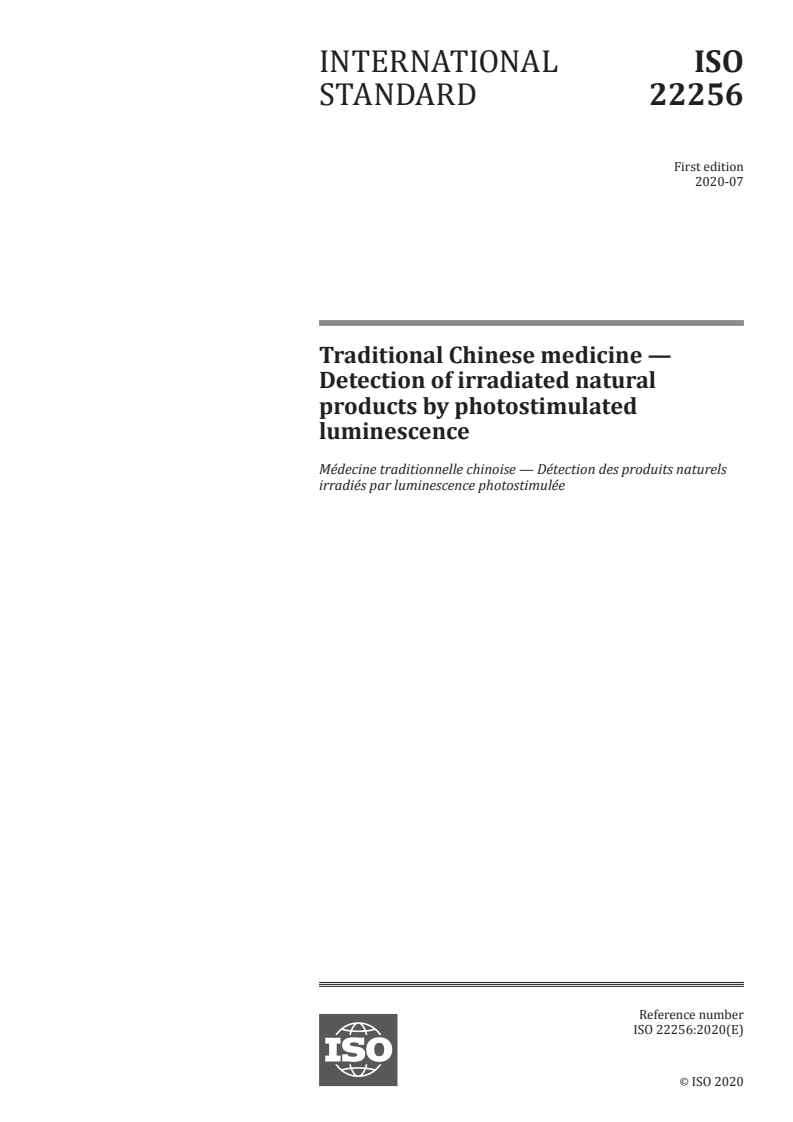
INTERNATIONAL ISO
STANDARD 22256
First edition
2020-07
Traditional Chinese medicine —
Detection of irradiated natural
products by photostimulated
luminescence
Médecine traditionnelle chinoise — Détection des produits naturels
irradiés par luminescence photostimulée
Reference number
©
ISO 2020
© ISO 2020
All rights reserved. Unless otherwise specified, or required in the context of its implementation, no part of this publication may
be reproduced or utilized otherwise in any form or by any means, electronic or mechanical, including photocopying, or posting
on the internet or an intranet, without prior written permission. Permission can be requested from either ISO at the address
below or ISO’s member body in the country of the requester.
ISO copyright office
CP 401 • Ch. de Blandonnet 8
CH-1214 Vernier, Geneva
Phone: +41 22 749 01 11
Email: copyright@iso.org
Website: www.iso.org
Published in Switzerland
ii © ISO 2020 – All rights reserved
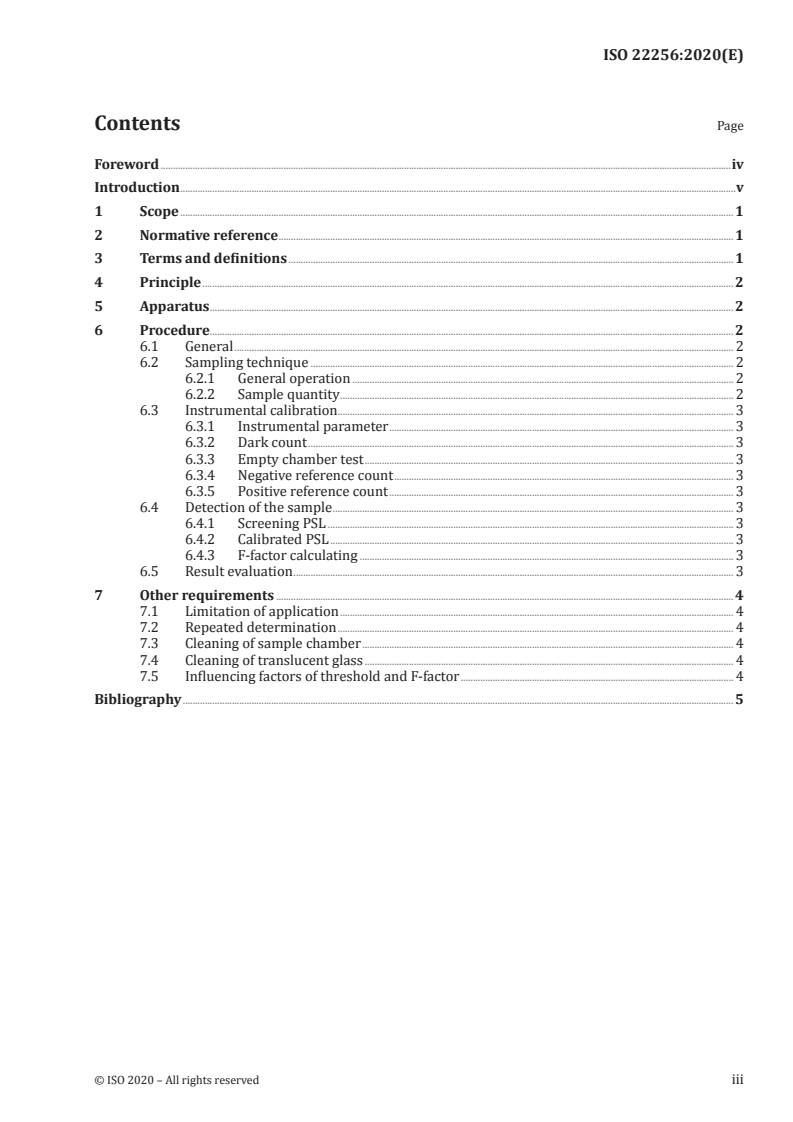
Contents Page
Foreword .iv
Introduction .v
1 Scope . 1
2 Normative reference . 1
3 Terms and definitions . 1
4 Principle . 2
5 Apparatus . 2
6 Procedure. 2
6.1 General . 2
6.2 Sampling technique . 2
6.2.1 General operation . 2
6.2.2 Sample quantity . 2
6.3 Instrumental calibration. 3
6.3.1 Instrumental parameter . 3
6.3.2 Dark count . 3
6.3.3 Empty chamber test . 3
6.3.4 Negative reference count . 3
6.3.5 Positive reference count . 3
6.4 Detection of the sample . 3
6.4.1 Screening PSL . 3
6.4.2 Calibrated PSL . 3
6.4.3 F-factor calculating . 3
6.5 Result evaluation . 3
7 Other requirements . 4
7.1 Limitation of application . 4
7.2 Repeated determination . 4
7.3 Cleaning of sample chamber . 4
7.4 Cleaning of translucent glass . 4
7.5 Influencing factors of threshold and F-factor . 4
Bibliography . 5
Foreword
ISO (the International Organization for Standardization) is a worldwide federation of national standards
bodies (ISO member bodies). The work of preparing International Standards is normally carried out
through ISO technical committees. Each member body interested in a subject for which a technical
committee has been established has the right to be represented on that committee. International
organizations, governmental and non-governmental, in liaison with ISO, also take part in the work.
ISO collaborates closely with the International Electrotechnical Commission (IEC) on all matters of
electrotechnical standardization.
The procedures used to develop this document and those intended for its further maintenance are
described in the ISO/IEC Directives, Part 1. In particular, the different approval criteria needed for the
different types of ISO documents should be noted. This document was drafted in accordance with the
editorial rules of the ISO/IEC Directives, Part 2 (see www .iso .org/ directives).
Attention is drawn to the possibility that some of the elements of this document may be the subject of
patent rights. ISO shall not be held responsible for identifying any or all such patent rights. Details of
any patent rights identified during the development of the document will be in the Introduction and/or
on the ISO list of patent declarations received (see www .iso .org/ patents).
Any trade name used in this document is information given for the convenience of users and does not
constitute an endorsement.
For an explanation of the voluntary nature of standards, the meaning of ISO specific terms and
expressions related to conformity assessment, as well as information about ISO's adherence to the
World Trade Organization (WTO) principles in the Technical Barriers to Trade (TBT) see www .iso .org/
iso/ foreword .html.
This document was prepared by Technical Committee ISO/TC 249, Traditional Chinese medicine.
Any feedback or questions on this document should be directed to the user’s national standards body. A
complete listing of these bodies can be found at www .iso .org/ members .html.
iv © ISO 2020 – All rights reserved
Introduction
Ionizing radiation (gamma ray, X-ray or beam) is used extensively for the sterilization of medical devices
and for a variety of other materials and products. However, irradiation of traditional natural products
for sanitation purposes is not permitted by the regulations of most countries. It is necessary to set
up a method to identify whether a product has been subjected to irradiation, because overex
...
INTERNATIONAL ISO
STANDARD 22256
First edition
2020-07
Traditional Chinese medicine —
Detection of irradiated natural
products by photostimulated
luminescence
Médecine traditionnelle chinoise — Détection des produits naturels
irradiés par luminescence photostimulée
Reference number
©
ISO 2020
© ISO 2020
All rights reserved. Unless otherwise specified, or required in the context of its implementation, no part of this publication may
be reproduced or utilized otherwise in any form or by any means, electronic or mechanical, including photocopying, or posting
on the internet or an intranet, without prior written permission. Permission can be requested from either ISO at the address
below or ISO’s member body in the country of the requester.
ISO copyright office
CP 401 • Ch. de Blandonnet 8
CH-1214 Vernier, Geneva
Phone: +41 22 749 01 11
Email: copyright@iso.org
Website: www.iso.org
Published in Switzerland
ii © ISO 2020 – All rights reserved
Contents Page
Foreword .iv
Introduction .v
1 Scope . 1
2 Normative reference . 1
3 Terms and definitions . 1
4 Principle . 2
5 Apparatus . 2
6 Procedure. 2
6.1 General . 2
6.2 Sampling technique . 2
6.2.1 General operation . 2
6.2.2 Sample quantity . 2
6.3 Instrumental calibration. 3
6.3.1 Instrumental parameter . 3
6.3.2 Dark count . 3
6.3.3 Empty chamber test . 3
6.3.4 Negative reference count . 3
6.3.5 Positive reference count . 3
6.4 Detection of the sample . 3
6.4.1 Screening PSL . 3
6.4.2 Calibrated PSL . 3
6.4.3 F-factor calculating . 3
6.5 Result evaluation . 3
7 Other requirements . 4
7.1 Limitation of application . 4
7.2 Repeated determination . 4
7.3 Cleaning of sample chamber . 4
7.4 Cleaning of translucent glass . 4
7.5 Influencing factors of threshold and F-factor . 4
Bibliography . 5
Foreword
ISO (the International Organization for Standardization) is a worldwide federation of national standards
bodies (ISO member bodies). The work of preparing International Standards is normally carried out
through ISO technical committees. Each member body interested in a subject for which a technical
committee has been established has the right to be represented on that committee. International
organizations, governmental and non-governmental, in liaison with ISO, also take part in the work.
ISO collaborates closely with the International Electrotechnical Commission (IEC) on all matters of
electrotechnical standardization.
The procedures used to develop this document and those intended for its further maintenance are
described in the ISO/IEC Directives, Part 1. In particular, the different approval criteria needed for the
different types of ISO documents should be noted. This document was drafted in accordance with the
editorial rules of the ISO/IEC Directives, Part 2 (see www .iso .org/ directives).
Attention is drawn to the possibility that some of the elements of this document may be the subject of
patent rights. ISO shall not be held responsible for identifying any or all such patent rights. Details of
any patent rights identified during the development of the document will be in the Introduction and/or
on the ISO list of patent declarations received (see www .iso .org/ patents).
Any trade name used in this document is information given for the convenience of users and does not
constitute an endorsement.
For an explanation of the voluntary nature of standards, the meaning of ISO specific terms and
expressions related to conformity assessment, as well as information about ISO's adherence to the
World Trade Organization (WTO) principles in the Technical Barriers to Trade (TBT) see www .iso .org/
iso/ foreword .html.
This document was prepared by Technical Committee ISO/TC 249, Traditional Chinese medicine.
Any feedback or questions on this document should be directed to the user’s national standards body. A
complete listing of these bodies can be found at www .iso .org/ members .html.
iv © ISO 2020 – All rights reserved
Introduction
Ionizing radiation (gamma ray, X-ray or beam) is used extensively for the sterilization of medical devices
and for a variety of other materials and products. However, irradiation of traditional natural products
for sanitation purposes is not permitted by the regulations of most countries. It is necessary to set
up a method to identify whether a product has been subjected to irradiation, because overex
...