


ISO 15031-4:2005
(Main)Road vehicles — Communication between vehicle and external equipment for emissions-related diagnostics — Part 4: External test equipment
Road vehicles — Communication between vehicle and external equipment for emissions-related diagnostics — Part 4: External test equipment
ISO 15031-4:2005 specifies: a means of establishing communications between an OBD-equipped vehicle and external test equipment, a set of diagnostic services to be provided by the external test equipment in order to exercise the services defined in ISO 15031-5, conformance criteria for the external test equipment.
Véhicules routiers — Communications entre un véhicule et un équipement externe pour le diagnostic relatif aux émissions — Partie 4: Équipement d'essai externe
General Information
- Status
- Withdrawn
- Publication Date
- 14-Jun-2005
- Withdrawal Date
- 14-Jun-2005
- Technical Committee
- ISO/TC 22 - Road vehicles
- Drafting Committee
- ISO/TC 22 - Road vehicles
- Current Stage
- 9599 - Withdrawal of International Standard
- Start Date
- 05-Feb-2014
- Completion Date
- 14-Feb-2026
Relations
- Effective Date
- 22-Aug-2009
Get Certified
Connect with accredited certification bodies for this standard

TÜV Rheinland
TÜV Rheinland is a leading international provider of technical services.

TÜV SÜD
TÜV SÜD is a trusted partner of choice for safety, security and sustainability solutions.

AIAG (Automotive Industry Action Group)
American automotive industry standards and training.
Sponsored listings
Frequently Asked Questions
ISO 15031-4:2005 is a standard published by the International Organization for Standardization (ISO). Its full title is "Road vehicles — Communication between vehicle and external equipment for emissions-related diagnostics — Part 4: External test equipment". This standard covers: ISO 15031-4:2005 specifies: a means of establishing communications between an OBD-equipped vehicle and external test equipment, a set of diagnostic services to be provided by the external test equipment in order to exercise the services defined in ISO 15031-5, conformance criteria for the external test equipment.
ISO 15031-4:2005 specifies: a means of establishing communications between an OBD-equipped vehicle and external test equipment, a set of diagnostic services to be provided by the external test equipment in order to exercise the services defined in ISO 15031-5, conformance criteria for the external test equipment.
ISO 15031-4:2005 is classified under the following ICS (International Classification for Standards) categories: 13.040.50 - Transport exhaust emissions; 43.180 - Diagnostic, maintenance and test equipment. The ICS classification helps identify the subject area and facilitates finding related standards.
ISO 15031-4:2005 has the following relationships with other standards: It is inter standard links to ISO 15031-4:2014. Understanding these relationships helps ensure you are using the most current and applicable version of the standard.
ISO 15031-4:2005 is available in PDF format for immediate download after purchase. The document can be added to your cart and obtained through the secure checkout process. Digital delivery ensures instant access to the complete standard document.
Standards Content (Sample)
INTERNATIONAL ISO
STANDARD 15031-4
First edition
2005-06-15
Road vehicles — Communication
between vehicle and external equipment
for emissions-related diagnostics —
Part 4:
External test equipment
Véhicules routiers — Communications entre un véhicule et un
équipement externe pour le diagnostic relatif aux émissions —
Partie 4: Équipement d'essai externe
Reference number
©
ISO 2005
PDF disclaimer
This PDF file may contain embedded typefaces. In accordance with Adobe's licensing policy, this file may be printed or viewed but
shall not be edited unless the typefaces which are embedded are licensed to and installed on the computer performing the editing. In
downloading this file, parties accept therein the responsibility of not infringing Adobe's licensing policy. The ISO Central Secretariat
accepts no liability in this area.
Adobe is a trademark of Adobe Systems Incorporated.
Details of the software products used to create this PDF file can be found in the General Info relative to the file; the PDF-creation
parameters were optimized for printing. Every care has been taken to ensure that the file is suitable for use by ISO member bodies. In
the unlikely event that a problem relating to it is found, please inform the Central Secretariat at the address given below.
© ISO 2005
All rights reserved. Unless otherwise specified, no part of this publication may be reproduced or utilized in any form or by any means,
electronic or mechanical, including photocopying and microfilm, without permission in writing from either ISO at the address below or
ISO's member body in the country of the requester.
ISO copyright office
Case postale 56 • CH-1211 Geneva 20
Tel. + 41 22 749 01 11
Fax + 41 22 749 09 47
E-mail copyright@iso.org
Web www.iso.org
Published in Switzerland
ii © ISO 2005 – All rights reserved
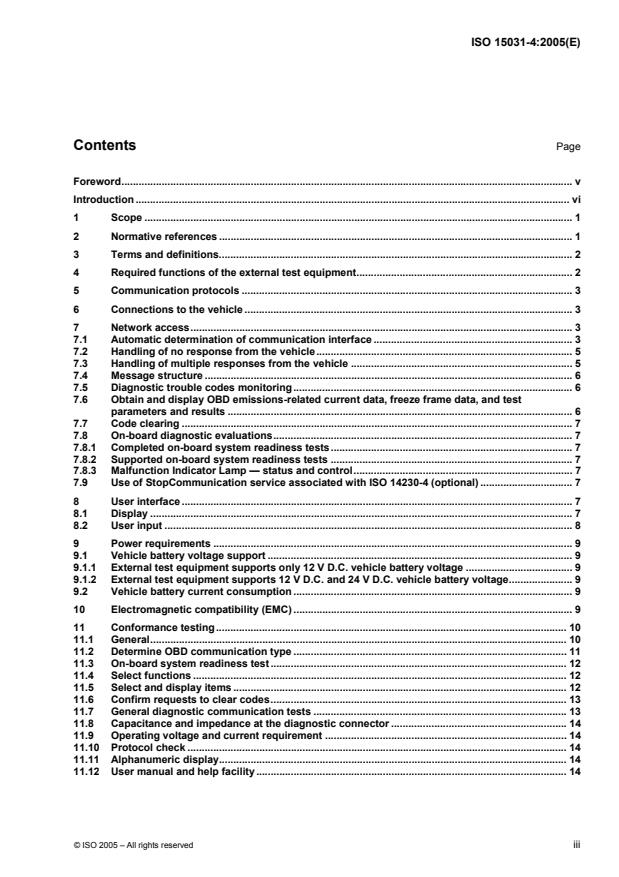
Contents Page
Foreword. v
Introduction . vi
1 Scope . 1
2 Normative references . 1
3 Terms and definitions. 2
4 Required functions of the external test equipment. 2
5 Communication protocols . 3
6 Connections to the vehicle . 3
7 Network access. 3
7.1 Automatic determination of communication interface . 3
7.2 Handling of no response from the vehicle. 5
7.3 Handling of multiple responses from the vehicle . 5
7.4 Message structure . 6
7.5 Diagnostic trouble codes monitoring. 6
7.6 Obtain and display OBD emissions-related current data, freeze frame data, and test
parameters and results . 6
7.7 Code clearing . 7
7.8 On-board diagnostic evaluations. 7
7.8.1 Completed on-board system readiness tests. 7
7.8.2 Supported on-board system readiness tests . 7
7.8.3 Malfunction Indicator Lamp — status and control. 7
7.9 Use of StopCommunication service associated with ISO 14230-4 (optional) . 7
8 User interface. 7
8.1 Display . 7
8.2 User input . 8
9 Power requirements . 9
9.1 Vehicle battery voltage support . 9
9.1.1 External test equipment supports only 12 V D.C. vehicle battery voltage . 9
9.1.2 External test equipment supports 12 V D.C. and 24 V D.C. vehicle battery voltage. 9
9.2 Vehicle battery current consumption . 9
10 Electromagnetic compatibility (EMC) . 9
11 Conformance testing. 10
11.1 General. 10
11.2 Determine OBD communication type . 11
11.3 On-board system readiness test . 12
11.4 Select functions . 12
11.5 Select and display items . 12
11.6 Confirm requests to clear codes. 13
11.7 General diagnostic communication tests . 13
11.8 Capacitance and impedance at the diagnostic connector . 14
11.9 Operating voltage and current requirement . 14
11.10 Protocol check . 14
11.11 Alphanumeric display. 14
11.12 User manual and help facility. 14
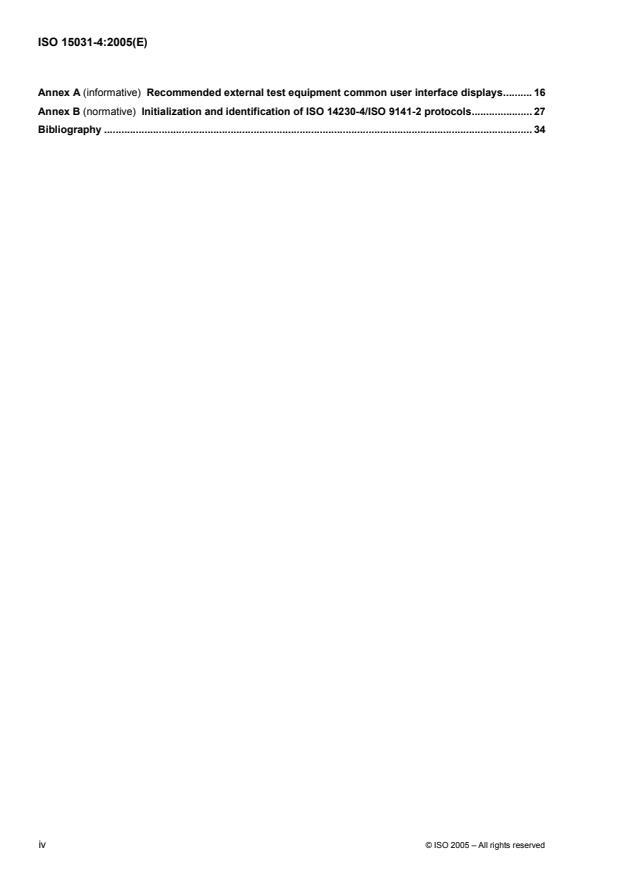
Annex A (informative) Recommended external test equipment common user interface displays. 16
Annex B (normative) Initialization and identification of ISO 14230-4/ISO 9141-2 protocols. 27
Bibliography . 34
iv © ISO 2005 – All rights reserved
Foreword
ISO (the International Organization for Standardization) is a worldwide federation of national standards bodies
(ISO member bodies). The work of preparing International Standards is normally carried out through ISO
technical committees. Each member body interested in a subject for which a technical committee has been
established has the right to be represented on that committee. International organizations, governmental and
non-governmental, in liaison with ISO, also take part in the work. ISO collaborates closely with the
International Electrotechnical Commission (IEC) on all matters of electrotechnical standardization.
International Standards are drafted in accordance with the rules given in the ISO/IEC Directives, Part 2.
The main task of technical committees is to prepare International Standards. Draft International Standards
adopted by the technical committees are circulated to the member bodies for voting. Publication as an
International Standard requires approval by at least 75 % of the member bodies casting a vote.
Attention is drawn to the possibility that some of the elements of this document may be the subject of patent
rights. ISO shall not be held responsible for identifying any or all such patent rights.
ISO 15031-4 was prepared by Technical Committee ISO/TC 22, Road vehicles, Subcommittee SC 3, Electric
and electronic equipment.
ISO 15031 consists of the following parts, under the general title Road vehicles — Communication between
vehicle and external test equipment for emissions-related diagnostics:
Part 1: General information
Part 2: Terms, definitions, abbreviations and acronyms
Part 3: Diagnostic connector and related electrical circuits, specification and use
Part 4: External test equipment
Part 5: Emissions-related diagnostic services
Part 6: Diagnostic trouble code definitions
Part 7: Data link security
Introduction
ISO 15031 consists of a number of parts which, taken together, provide a coherent self-consistent set of
specifications to facilitate emissions-related diagnostics. Each part is based on an SAE recommended
practice.
This part of ISO 15031 is based on SAE J1978 FEB98, OBD Scan tool (On-board diagnosis).
ISO 15031 specifies a set of standard diagnostic services to be provided by vehicles (OBD services). This
International Standard specifies a complementary set of facilities, to be provided by external test equipment,
which will include scan tool facilities. These facilities provide complete, efficient and safe access to all of the
public OBD (on-board diagnosis) services on any vehicle, which is compliant with ISO 15031.
Only external test equipment passing the conformance tests specified in ISO 15031-4 may claim or advertise
that it meets or exceeds the requirements of ISO 15031-4.
Partially conforming external test equipment, which does not accommodate all approved protocols is permitted
but shall be so marked.
ISO 15031-4 conformance allows potential purchasers to identify external test equipment which shall work
correctly with a variety of vehicle types and provides assurance for external test equipment users that they
shall not inadvertently cause damage, obtain incorrect results or be unable to access all available OBD
(on-board diagnosis) services. Diagnostic authors who base their test strategies on ISO 15031-4 facilities do
not need to concern themselves with the details of specific types of external test equipment. ISO 15031-4
provides vehicle manufacturers with a level of protection against misdiagnosis or damage to their products
resulting from external test equipment unavailability or inadequacies.
ISO 15031-4 does not preclude the inclusion of additional capabilities or functions in external test equipment.
However, it is the responsibility of the external test equipment designer to ensure that no such capability or
function can adversely affect either an OBD-equipped vehicle, which may be connected to the equipment or
the equipment itself.
ISO 15031-1 provides an introduction to the International Standard.
vi © ISO 2005 – All rights reserved
INTERNATIONAL STANDARD ISO 15031-4:2005(E)
Road vehicles — Communication between vehicle and external
equipment for emissions-related diagnostics —
Part 4:
External test equipment
1 Scope
The document specifies:
a means of establishing communications between an OBD-equipped vehicle and external test equipment,
a set of diagnostic services to be provided by the external test equipment in order to exercise the services
defined in ISO 15031-5,
conformance criteria for the external test equipment.
2 Normative references
The following referenced documents are indispensable for the application of this document. For dated
references, only the edition cited applies. For undated references, the latest edition of the referenced
document (including any amendments) applies.
ISO 7637-2:1990, Road vehicles — Electrical disturbance by conduction and coupling — Part 2: Commercial
vehicles with nominal 24 V supply voltage — Electrical transient conduction along supply lines only
ISO 9141-2: 1994, Road vehicles — Diagnostic systems — Part 2: CARB requirements for interchange of
digital information
ISO 9141-2:1994/Amd.1:1996, Road vehicles — Diagnostic systems — Part 2: CARB requirements for
interchange of digital information — Amendment 1
ISO 11898-1, Road vehicles — Controller area network (CAN) — Part 1: Data link layer and physical
signalling
ISO 11898-2, Road vehicles — Controller area network (CAN) — Part 2: High-speed medium access unit
ISO 14230-4:2000, Road vehicles — Diagnostic systems — Keyword protocol 2000 — Part 4: Requirements
for emission-related systems
ISO TR 15031-2, Road vehicles — Communication between vehicle and external equipment for
emissions-related diagnostics — Part 2: Terms, definitions, abbreviations and acronyms
ISO 15031-3, Road vehicles — Communication between vehicle and external equipment for emissions-related
diagnostics — Part 3: Diagnostic connector and related electrical circuits, specification and use
ISO 15031-4, Road vehicles — Communication between vehicle and external equipment for emissions-related
diagnostics — Part 4: External test equipment
ISO 15031-5, Road vehicles — Communication between vehicle and external equipment for emissions-related
diagnostics — Part 5: Emissions-related diagnostic services
ISO 15031-6, Road vehicles — Communication between vehicle and external equipment for emissions-related
diagnostics — Part 6: Diagnostic trouble code definitions
ISO 15765-4, Road vehicles — Diagnostics on Controller Area Networks (CAN) — Part 4: Requirements for
emissions-related systems
ISO 16750-2, Road vehicles — Environmental conditions and testing for electrical and electronic
equipment — Part 2: Electrical loads
SAE J1850:MAY2001, Class B Data Communications Network Interface
SAE J1939, Recommended Practice for Serial Control and Communications Vehicle Network
SAE J1939-11, Physical layer, 250 kbps , twisted shielded pair
SAE J1939-13, Off-Board diagnostic connector
SAE J1939-21, Data link layer
SAE J1939-71, Vehicle application layer
SAE J1939-73, Application layer — Diagnostics
3 Terms and definitions
For the purposes of this document, the terms and definitions given in ISO/TS 15031-2 and SAE J1939 apply.
4 Required functions of the external test equipment
The following are the basic functions that the external test equipment is required to support or provide:
automatic hands-off determination of the communication interface used to provide OBD services on the
vehicle,
obtaining and displaying the status and results of vehicle on-board diagnostic evaluations,
obtaining and displaying OBD emissions-related diagnostic trouble codes (DTCs),
obtaining and displaying OBD emissions-related current data,
obtaining and displaying OBD emissions-related freeze frame data,
clearing the storage of OBD emissions-related diagnostic trouble codes, OBD emissions-related freeze
frame data storage and OBD emissions-related diagnostic tests status,
obtaining and displaying OBD emissions-related test parameters and results as described in ISO 15031-5
or SAE J1939-73,
provide a user manual and/or help facility.
2 © ISO 2005 – All rights reserved
5 Communication protocols
The following communication protocols shall be supported:
a) ISO 9141-2;
The following specifications clarify and, if in conflict with ISO 9141-2, override any related specifications in
ISO 9141-2:
1) The maximum sink current to be supported by the external test equipment is 100 mA.
2) The range for all tests performed relative to ISO 7637-2 is −1,0 to +40,0 V.
3) The minimum bus idle period before the external test equipment shall transmit an address, shall be
300 ms.
b) SAE J1850 41,6 kbps PWM (pulse width modulation);
c) SAE J1850 10,4 kbps VPW (variable pulse width);
d) ISO 14230-4 (Keyword protocol 2000);
e) ISO 15765-4 (CAN);
f) SAE J1939-73 (CAN).
A fully compliant external test equipment shall support all communication protocols as specified in Clause 5.
Only one protocol is allowed to be used in any one vehicle to access all legislated emission-related functions.
The external test equipment is not required to support simultaneous use of different protocols.
6 Connections to the vehicle
To connect the external test equipment to the vehicle, the SAE J1939-13 connector for the SAE J1939-73
protocol shall be used and for all other protocols the ISO 15031-3 connector shall be used.
7 Network access
7.1 Automatic determination of communication interface
The external test equipment shall have an “Automatic hands-off determination of the communication interface”
built in to determine the communication protocol used in a given vehicle.
Prior to connecting the external test equipment to the vehicle's diagnostic connector, the ignition key of the
vehicle shall be turned to position “ON”.
The tests to determine the communication interface and protocol may be performed in any order and, where
possible, may be performed simultaneously. The specified sequence for each test shall be used to determine
the interface to be used to access OBD services on a vehicle:
a) The electrical interface in the external test equipment for the manufacturer discretionary contact
assignments shall be effectively open circuit as a default condition or state whilst this procedure is being
performed.
b) The equipment shall inform the user that initialization is occurring.
c) The equipment shall, using only the following tests, attempt to determine the OBD communications
protocol used by the vehicle. No user intervention is allowed during this stage. The test equipment shall
not cause bus failures such as CAN bus off.
1) Test for SAE J1850 41,6 kbps (kilobits per second) PWM (pulse width modulation):
i) enable the SAE J1850 41,6 kbps PWM interface;
ii) send a service $01 PID $00 request message;
iii) if a service $01 PID $00 response message is received, then SAE J1850 41,6 kbps PWM is the
vehicle's OBD protocol.
2) Test for SAE J1850 10,4 kbps VPW (variable pulse width):
i) enable the SAE J1850 10,4 kbps VPW interface;
ii) send a service $01 PID $00 request message;
iii) if a service $01 PID $00 response message is received, then SAE J1850 10,4 kbps VPW is the
vehicle's OBD protocol.
3) Fast initialization of ISO 14230-4:
i) Refer to Annex B.1 ISO 14230-4:2000.
4) 5 baud initialization of ISO 14230-4/ISO 9141-2:
i) Refer to Annex B.2 ISO 14230-4/ISO 9141-2 how to perform the 5 baud initialization and
protocol detection of the ISO 14230-4 / ISO 9141-2 protocols.
5) Test for ISO 15765-4:
i) legacy vehicles previously were allowed to use the contacts now defined for CAN
communication as manufacturer discretionary. The external test equipment shall ensure
adequate protection from these legacy signals,
ii) perform the “External Test Equipment Initialization Sequence” defined in ISO 15765-4,
iii) if the initialization sequence specified in ISO 15765-4 is completed successfully, then
ISO 15765-4 is the vehicle's OBD protocol.
6) Test for SAE J1939:
i) Once concluded that the OBD protocol is not ISO 15765-4, then proceed to the sequence to see
if the vehicle is SAE J1939 OBD capable.
ii) Set CAN controller as appropriate for SAE J1939 and perform the initialization sequence
specified in J1939-73.
iii) If this SAE J1939 initialization sequence is completed successfully, then SAE J1939 is the
vehicle's OBD protocol.
The service $01 PID $00 request is used to identify the ISO 15765-4 protocol in step 5. Vehicles supporting
OBD diagnostics with SAE J1939-73 diagnostics will not respond to this request.
4 © ISO 2005 – All rights reserved
Both ISO 9141-2 and ISO 14230-4 specify a time within which a module(s) that has successfully been
initialized must receive a message or the module(s) will return to the address mode. To maintain
communication with the vehicle in case no service request is needed at this moment, the external test
equipment shall send an idle message.
For vehicles using ISO 9141-2, service $01 PID $00 request shall be used as the idle message.
For vehicles using ISO 14230-4, the service TesterPresent is the recommended way to satisfy the idle
message requirement as specified in ISO 14230-4. Alternatively, the service $01 PID $00 as specified in
ISO 15031-5 may be used.
If during the initialization of the ISO 15765-4 (CAN) protocol the external test equipment receives a negative
response message(s) from the emissions-related ECU(s) with the negative response code (NRC) $21
busy-RepeatRequest the external test equipment is required to perform five (5) retries (repeat request
message as specified in ISO 15765-4). The reception of NRC $21 busy-RepeatRequest during the
initialization indicates that an On-board diagnostic tester may be active and is currently diagnosing one or
multiple emissions-related ECUs. The On-board tester and vehicle ECU(s) shall complete the in-progress
communication. This may take several seconds. The external test equipment shall continue to initialize the
ISO 15765-4 (CAN) protocol until it receives a positive response or aborts after five (5) seconds have expired
(measured after the completion of the fifth (5th) re-try).
If none of the protocol tests shown above succeeds, the equipment shall repeat all of them and advise the
user:
a) that communication with the vehicle could not be established,
b) to confirm that the ignition key is still in the “ON” position,
c) to check the emissions label or vehicle service information to confirm that the vehicle is OBD equipped,
d) to confirm that the external test equipment is connected to the vehicle correctly.
The equipment shall continue to repeat the protocol tests shown above until either one of them passes or the
user chooses to abandon the attempt. The equipment may also indicate the number of failed initialization
attempts to the user.
7.2 Handling of no response from the vehicle
A vehicle module may fail to respond to a request message from the external test equipment because of
incorrect transmission or because the module does not support that message. If a response is not received
within the time-out period prescribed by the protocol, the external test equipment shall:
a) retransmit the request message,
b) if there is still no response, transmit a service $01 PID $00 request message, in order to determine if
communication with the vehicle is currently possible, and if the data desired is available,
c) if a service $01 PID $00 response is received, transmit other messages, if available, to determine
whether the desired data is supported by the vehicle,
d) if the above steps fail then indicate to the user, as appropriate, that communication with the vehicle
cannot be performed, that communication with the module cannot be performed or that the information
the user has selected is unavailable.
7.3 Handling of multiple responses from the vehicle
The external test equipment shall be capable of interfacing with a vehicle in which multiple modules support
OBD requirements.
The external test equipment shall inform the user when multiple modules respond to the same request.
The external test equipment shall inform the user when multiple modules respond with different values for the
same data item.
The external test equipment shall provide the user with the ability to select for display, as separate items, the
responses received from multiple modules for the same data item.
7.4 Message structure
Communication between the external test equipment and the vehicle consists of repeated cycles of the
external test equipment issuing a request message to the vehicle module(s) and the vehicle module(s)
responses. The structure of these messages is specified in ISO 15031-5. ISO 15031-6 specifies the usage of
diagnostic trouble codes, which may be contained in response messages. Message structures for SAE J1939
are described in SAE J1939-73 and SAE J1939-71.
7.5 Diagnostic trouble codes monitoring
The external test equipment shall be capable of continuously obtaining, converting and displaying OBD
emissions-related diagnostic trouble codes from the vehicle. Either the diagnostic trouble code, its descriptive
text or both shall be displayed. Diagnostic trouble codes and their descriptive text are specified in
ISO 15031-6, or SAE J1939 and SAE J1939-73. The external test equipment shall continuously obtain and
display DTCs (diagnostic trouble codes) whilst this facility is selected.
If the protocol is ISO 15031-5 and the response message includes a DTC number equal $0000, the data
reported may not be valid and shall not be displayed.
7.6 Obtain and display OBD emissions-related current data, freeze frame data, and test
parameters and results
The external test equipment shall create an internal table in its memory to maintain a list of supported
PIDs/OBDMIDs/TIDs/INFOTYPEs for each ECU that responds to a service request message with the
requested “Supported PID/OBDMID/TID/INFOTYPE” ($00, $20, . $C0). If bit 0 of Data D is reported as “0”,
that indicates that no additional PIDs/OBDMIDs/TIDs/INFOTYPEs are supported by that ECU. If bit 0 of Data
D is reported as “1”, that indicates that additional PIDs/OBDMIDs/TIDs/INFOTYPEs are supported by that
ECU. The external test equipment does not need to request any additional “Supported
PIDs/OBDMIDs/TIDs/INFOTYPEs” if bit 0 of Data D is reported as “0” by all ECUs.
The external test equipment shall test for support of PID $4F and $50. If supported, the external test
equipment shall override the data scaling of those PIDs included in the definition of ISO 15031-5 Annex B.
The external test equipment shall only display data from an ECU if that ECU indicated it supports that data
item. The external test equipment shall not display data from an ECU if that ECU indicated it does not support
that data item.
The external test equipment shall be capable of obtaining, converting, and displaying:
a) OBD emissions-related current data as described in ISO 15031-5 and SAE J1939-73 specifying all
emission-related data. For each data item, an external test equipment display text string and the
−−−−1
formatting of the data value is specified (e.g. RPM: xxxxx min ),
b) OBD emissions-related freeze frame data [same data display as specified in a)], and
c) test parameters and results data as described in ISO 15031-5 and SAE J1939-73. ISO 15031-5 and
SAE J1939-73 details what data is available, the messages to be used to request the data, the messages
to be used to return the data, the conversion values for the data and the format to be used to display the
data.
6 © ISO 2005 – All rights reserved
When current data items are selected for display, the external test equipment will continuously request of the
vehicle the data to be displayed and will display the data received in the corresponding response messages.
When freeze frame or test parameters and results are selected for display, the external test equipment does
not need to continuously request and display those items.
Where applicable, the external test equipment shall indicate whether a test limit is a high limit or a low limit.
Where applicable, the display of test results shall also show the test ID (identifier) and component ID.
Data from the vehicle may indicate which items are supported, in which case this information shall be made
available to the user by the external test equipment. The external test equipment shall also allow users to
specify requests for services, parameters, test IDs, etc. irrespective of whether the vehicle has indicated
support for such items.
7.7 Code clearing
The external test equipment shall be capable of sending a request to clear OBD emissions-related diagnostic
trouble codes, freeze frame data and diagnostic tests status information. The external test equipment shall
require the user to confirm such a request prior to transmission.
7.8 On-board diagnostic evaluations
7.8.1 Completed on-board system readiness tests
Immediately after the equipment has successfully established communication with the vehicle, it shall check
the status of the system readiness tests. If the supported tests have not all been completed, the equipment
shall indicate to the user: “Not all supported on-board system readiness tests have been completed” or
equivalent. The equipment shall also allow the user to identify any readiness tests that have not been
completed.
7.8.2 Supported on-board system readiness tests
The external test equipment shall indicate to the user which of the tests specified by ISO 15031-5 service
$01 PID $01 data B - D, or SAE J1939-73 DM5 bytes 4-8, are supported and which of these have been
completed.
7.8.3 Malfunction Indicator Lamp — status and control
The external test equipment shall be capable of indicating whether the MIL (Malfunction Indicator Lamp) has
been commanded ON and if so, by which module or modules.
7.9 Use of StopCommunication service associated with ISO 14230-4 (optional)
When ISO 14230-4 is being used to support OBD requirements in a vehicle, the external test equipment may
provide to the operator the ability to select the StopCommunication service defined for ISO 14230-4.
8 User interface
8.1 Display
The external test equipment shall be capable of displaying simultaneously at least two items of OBD
emissions-related current data items, emissions-related freeze frame data items, or emissions-related
diagnostic trouble codes. A list of the OBD current data and freeze frame data items, their parameter IDs, data
resolution and data conversion information, units and display formats is provided in ISO 15031-5. The display
shall be capable of displaying alphanumeric characters. The display shall at least support the SI-units as
specified in ISO 15031-5. The unit conversions specified in ISO 15031-5 shall be used.
If the protocol is SAE J1939-73, then data parameters shall be displayed as specified in SAE J1939-73 using
the SI-units and unit conversions. DTCs shall be displayed as specified in Annex A.
As a minimum, the data values of two data items shall be displayed simultaneously. A display of the
parameter IDs of the data items and the IDs of the modules that supplied the data items shall be easily
accessible if not displayed with the data values.
The units of measurement associated with the data items shall either be:
displayed with the data values,
easily accessible on the display, or
readily available to the user (e.g. on the body of the external test equipment).
Having this information available in a user manual separate from the body of the external test equipment does
not satisfy this requirement.
8.2 User input
The external test equipment shall allow the user these services as specified by ISO 15031-5:
a) Select between the basic functions required by OBD, e.g.:
1) system readiness test status display,
2) MIL (Malfunction Indicator Lamp) status and control,
3) display current data,
4) display freeze frame data,
5) display diagnostic trouble codes,
6) clear emissions-related data,
7) display test parameters and results,
8) read vehicle identification.
b) Select for simultaneous display at least two OBD emissions-related items of any one of the following
categories:
1) current data,
2) freeze frame data,
3) diagnostic trouble codes,
4) test parameters and results.
c) Confirm a request to clear and/or reset OBD emissions-related diagnostic information.
d) Request operation of an on-board system, test or component.
Responses from multiple modules to requests for a current data item or a freeze frame data item are treated
as separate data items for selection and display purposes.
8 © ISO 2005 – All rights reserved
9 Power requirements
9.1 Vehicle battery voltage support
9.1.1 External test equipment supports only 12 V D.C. vehicle battery voltage
If the test tool manufacturer chooses to develop external test equipment with only 12 V D.C. vehicle battery
voltage support, the following requirements shall apply:
operate normally within a vehicle battery voltage range of 8,0 to 18,0 V D.C.,
survive a vehicle battery voltage of up to 24,0 volts D.C. for at least 10 m,
survive, non-operationally, a reverse vehicle battery voltage of up to 24,0 V D.C. for at least 10 m.
Preferably the external test equipment will withstand cranking, in that communications and data shall not be
lost during vehicle battery voltage reductions to 5,5 V for up to 0,5 s. The display need not function during this
period. This is not a requirement for compliance.
9.1.2 External test equipment supports 12 V D.C. and 24 V D.C. vehicle battery voltage
If the test tool manufacturer chooses to develop external test equipment with 12 V D.C. and 24 V D.C. vehicle
battery voltage support the following requirements shall apply:
operate normally within a vehicle battery voltage range of 8,0 to 32,0 volts D.C.,
survive a vehicle battery voltage of up to 36,0 volts D.C. for at least 10 minutes,
survive, non-operationally, a reverse vehicle battery voltage of up to 36,0 Volts D.C. for at least 10
minutes.
Preferably the external test equipment will withstand cranking, in that communications and data shall not be
lost during vehicle battery voltage reductions as specified in ISO 16750-2. The display need not function
during this period. This is not a requirement for compliance.
9.2 Vehicle battery current consumption
The maximum current drawn by the external test equipment through the power contacts of the diagnostic
connector shall not exceed that specified in ISO 15031-3 as the minimum current carrying capacity supplied
by the vehicle.
10 Electromagnetic compatibility (EMC)
The external test equipment shall not interfere with the normal operation of the vehicle electrical system.
The normal operation of the external test equipment shall be immune to conducted and radiated emissions
present in a service environment and when connected to a vehicle.
EMC and ESD measurements and limits shall be in accordance with the standards prevailing in the country in
which the tester is to be sold.
11 Conformance testing
11.1 General
Conformance testing specifies the tests required to be passed in order for external test equipment to be type
approved as “conforms to ISO 15031-4”. Only external test equipment that passes all tests may be so labelled.
External test equipment shall support all the listed protocols (specified in Clause 5) as allowed by
national/regional legislation of the country where the equipment will be offered to the market. Equipment that
passes all tests shall be labelled “Conforms to ISO 15031-4” and shall list the protocols supported as shown in
Clause 5.
The external test equipment manufacturer may optimize the Automatic determination of communication
interface sequence to test only for those protocols allowed by the national/regional legislation of the country.
EXAMPLE If national/regional specific legislation only allows e.g. 500 kbps data rate of ISO 15765-4 (CAN) although
the standard allows 250 kbps, the external test equipment manufacturers are allowed to only support that baudrate.
Validation of the conformance test is the responsibility of the equipment manufacturer, and the equipment
manufacturer may elect to self-certify.
The tests in this clause, shall be performed successfully five (5) consecutive times, on each sample unit to be
considered passed.
Three (3) examples of at least production intent level external test equipment shall pass all these tests in order
for a given version of external test equipment hardware and software to be considered passed, and the
equipment manufacturer shall ensure consistent quality of manufacture to meet this standard, to ensure
consistent compatibility between external test equipment and vehicle.
Any changes to the hardware or software used in an external test equipment for the functions described in this
International Standard shall require a retest of these tests or an explanation from the external test equipment
manufacturer as to why the change shall not require a retest. Where an explanation is submitted in lieu of a
retest due to a change, the organization originally performing these tests shall determine whether the
explanation is acceptable or whether a retest is required. Reasonable normal engineering criteria shall be
used when determining whether to accept an explanation.
For every product type which is labelled as conforming to, or compatible with the requirements of ISO 15031-4
OBD access facilities, or other labelling to that effect, the manufacturer shall record:
a) clear indication of the versions of product hardware, software and protocols supported,
b) the methods used to make these tests,
c) the results of the tests.
Both proper and improper response messages will be employed during these tests. Improper responses for
ISO 15031-5 are those that have incorrect header information, an incorrect Service Identifier, an incorrect PID,
an incorrect length of the response message, or an incorrect CRC or checksum. Improper responses for
J1939 are those that have incorrect addresses or message labelling, incorrect parameter identification, an
incorrect length of the response message, or an incorrect CRC or checksum. The external test equipment
must ignore all improper response messages and perform as if no response was received.
Situations involving multiple ECUs responding to a single request message, single ECUs responding with
multiple response messages to a single request message and multiple ECUs responding with multiple
response messages to a single request message will be tested.
The interval between the end of the request message and the beginning of the response message(s) will be
varied from 0 ms up to the delay required to show a no response message indication on the external test
equipment. This delay that causes the no response message indication will be compared to the value defined
in ISO 15031-5 or the value defined in SAE J1939-21 specifications.
10 © ISO 2005 – All rights reserved
The format, content and order of messages transmitted on the data links referenced in ISO 15031-5 and
SAE J1939-73 will be observed and reviewed for correctness.
The ability to obtain and report the results of the on-board system readiness tests shall be verified. The ability
to report which tests the vehicle supports and which have been completed shall be verified.
The requirements described in 11.3 through 11.7 (inclusive) shall be verified on each protocol specified in
Clause 5.
When performing these tests, observation of the indications and displays provided to the user and the signals
of each protocol specified in Clause 5 (bus + and bus −, K and L lines if applicable) will be the criteria for
proper performance.
Testing shall be conducted at a temperature of (23 ± 5) °C and between 25 % and 95 % relative humidity.
Testing information and results shall be made available to the buying public.
11.2 Determine OBD communication type
Items to be tested:
automatic determination of interface and protocol type when the ISO 15031-3 or SAE J1939-13
connector is plugged into its mating connector in the vehicle and/or OBD support is selected, where such
a selection is necessary,
all supported OBD communication interfaces at least once per scan,
the interface contacts related to protocols not supported by the external test equipment are not activated
during the test cycle,
the scan of all interfaces continues until successful or until terminated by the user,
some indication is provided to the user that the scan of interfaces is being performed,
a failure to successfully find an OBD interface during a scan of all the possible interfaces is indicated to
the user at the completion of each and every scan,
when an OBD interface is successfully found, the external test equipment automatically prompts the user
for function selection,
the external test equipment provides and uses the facilities and/or messages specified in ISO 15031-5,
ISO 9141-2, SAE J1850, ISO 14230-4, ISO 15765-4, ISO 15031-6 SAE J1939 and SAE J1939-73
the external test equipment does not exceed the polling rates specified in ISO 15031-5 and
SAE J1939-21,
the external test equipment provides the proper bias for the K and L lines as specified in ISO 9141-2 and
ISO 14230-4,
the external test equipment performs the initialization tests according to 7.1 and the external test
equipment supports the use of an idle message when ISO 9141-2 and ISO 14230-4 are used.
The interface determination tests shall be performed:
with no modules connected,
with one ISO 9141-2 module connected,
with one ISO 14230-4 module connected,
with one SAE J1850 41,6 kbps PWM module connected,
with one SAE J1850 10,4 kbps VPW module connected,
with one ISO 15765-4 module connected,
with one SAE J1939-73 module connected. (This module shall support DM5.)
For unsupported interfaces, it is only necessary to ensure that the specific contacts related to that protocol
remain open circuit and that no damage occur, either to the external test equipment or vehicle.
Table 1 lists the required vehicle response dependant on the protocol in use.
Table 1 — Vehicle configuration and required responses for supported protocols
Vehicle configuration Required response
ISO 9141-2 module con
...
Questions, Comments and Discussion
Ask us and Technical Secretary will try to provide an answer. You can facilitate discussion about the standard in here.
Loading comments...