


ISO/TR 6132:1981
(Main)Numerical control of machines — Operational command and data format
Numerical control of machines — Operational command and data format
Commande numérique des machines — Format de données et de commandes
General Information
- Status
- Withdrawn
- Publication Date
- 31-Jul-1981
- Withdrawal Date
- 31-Jul-1981
- Technical Committee
- ISO/TC 184/SC 1 - Industrial cyber and physical device control
- Drafting Committee
- ISO/TC 184/SC 1 - Industrial cyber and physical device control
- Current Stage
- 9599 - Withdrawal of International Standard
- Start Date
- 10-Dec-2013
- Completion Date
- 14-Feb-2026
Get Certified
Connect with accredited certification bodies for this standard

National Aerospace and Defense Contractors Accreditation Program (NADCAP)
Global cooperative program for special process quality in aerospace.
CARES (UK Certification Authority for Reinforcing Steels)
UK certification for reinforcing steels and construction.
DVS-ZERT GmbH
German welding certification society.
Sponsored listings
Frequently Asked Questions
ISO/TR 6132:1981 is a technical report published by the International Organization for Standardization (ISO). Its full title is "Numerical control of machines — Operational command and data format". This standard covers: Numerical control of machines — Operational command and data format
Numerical control of machines — Operational command and data format
ISO/TR 6132:1981 is classified under the following ICS (International Classification for Standards) categories: 25.040.20 - Numerically controlled machines. The ICS classification helps identify the subject area and facilitates finding related standards.
ISO/TR 6132:1981 is available in PDF format for immediate download after purchase. The document can be added to your cart and obtained through the secure checkout process. Digital delivery ensures instant access to the complete standard document.
Standards Content (Sample)
TECHNICAL REPORT 6132
Published 1981-08-15
INTERNATIONAL ORGANIZATION FOR STANDARDIZATION .MEXA’YHAPOAHAR OPI-AHIGI3AUWl II0 CTAHAAPTH3AIJWH .ORGANISATION INTEIWATIONALE DE NORMALISATION
Numerical control of machines - Operational command
and data format
Format de donnkes et de commandes
Commande numhrique des machines -
Technical Report 6132 was drawn up by Technical Committee ISO/TC 97, Computers and information processing, and approved by
the majority of its members. It was decided to publish the document in the form of a Technical Report because it is not possible, in
view of the present state of the art on the subject of numerical control systems, to draw up an International Standard which would be
complete and precise and which would not be too restrictive in this rapidly developing field. It is intended as a guideline and will be
reviewed and augmented periodically.
Contents Page
................................................................................................. 2
0 Introduction
1 Scope and field of application 2
..................................................................................
1.1 Datatypes . 2
1.2 Operational statements . 2
................................................................................... 2
1.3 Hardwareconfiguration
1.4 Functional categories of commands 4
........................................................................
1.5 Machineprograms . 4
2 References. . 5
3 Format, symbols and conventions used in data entry. .
3.1 Generalinformation . 5
3.2 Format for Operational Statements Commands. 6
..............................................................
3.3 Conventions and symbols 6
.................................................................................
..................................................................................... 7
4 ModeSelectorCommands
...................................................................................... 7
4.1 Generalinformation
4.2 ModeSelectorCommands. . 7
5 UniversalCommands . 7
Generalinformation. . 7
5.1
5.2 UniversalCommands . 7
6 EditorCommands . 8
6.1 Generalinformation . 8
........................................................................................ 8
6.2 EditorCommands
7 FileHandler Commands . 8
7.1 Generalinformation . 8
7.2 Devicemnemonics . 8
................................................................................... 9
7.3 FileHandlerCommands
8 . 9
MachineControlCommands
8.1 Generalinformation . 9
8.2 Machine Control Commands . 10
9 Keyboard . 10
Annexes
A Programming examples and command summary. . . . . . . . . . . . . . . . . . . . . . . . . . . u . . . . . . . . . . . . . . . . . . . . . . . . . . . . . . . . . . . . . 13
B Character sets - LEVEL1,2and3. 18
Ref. No. ISOITR 61324981 (E)
UDC 681.323 : 621 .S-52 : 681.3.06
numerical control, data layout, control procedures, high-level data link control, block formats, symbols.
Descriptors : data processing,
0 International Organization for Standardization, 1981 l
Price based on 21 pages
Printed in Switzerland
ISO/TR 61324981 (E)
0 Introduction
This document is intended to provide guidelines for the design of a new set of command data for numerical control of machines. This
new set is needed because of the rapid and widespread development of new techniques and new systems which may be termed
“Advanced Systems”. It is highly desirable that uncontrolled development of incompatible systems and simultaneous creations
of different MAN-MACHINE LANGUAGES be avoided.
er to take advantage of the flexibi capability of current and future NC systems, it is necessary to be
In ord ity and able to enter initializa-
tion a nd parameter data in addition to that in eluded in the machine program formats specified in IS0 2539.
This Technical Report is intended to serve as a guide in the co-ordination of system design to promote uniformity in part programming
and operating techniques for inputting extended machine set-up, initialization and/or operational parameter data. This format can be
used either at a panel on the machine control equipment or at a central unit when DNC is used. Thedesirabilityof establishing uniform-
ity and a degree of interchangeability of recorded input data for numerical control systems has long been recognized by equipment
builders as well as users. Further, with extensive use of general purpose alphanumeric keyboards for entry of data by the operator, it is
desirable to promote uniformity of manual entry formats between equipment to compensate for the lack of functional labelling of the
system operator input devices.
In the past, this type of data was minimal and special entry devices such as functional pushbutton switches and digital entry switches
(thumbwheel switches, for example) were used. The amount and variety of this type of data required make it desirable from economic
and operational standpoints to enter this data via machine program input media such as punched tape or general purpose
alphanumeric keyboards on the system.
1 Scope and field of application
1.1 Data types
The numerical control systems addressed by this Technical Report use a combination of two types of data :
1) Machine program data - Data formatted in accordance with IS0 2539 and coded in accordance with IS0 840.
2) Operational statements - Machine set-up, initialization and/or operational parameter data formatted in accordance with this
Technical Report and coded in accordance with IS0 646.
Character subset :
O-10
O-8 o-9 o-13
characters of column 2 except 2-7
characters of column 3 except 3-11 and 3-15
characters of column 4 except 4-O
characters of column 5
characters 7-12 and 7-15
1.2 Operational statements
It is not expected that all NC systems will embody all the features and capabilities for which operational statements have been defined
in this Technical Report. When an NC system has the capability to enter operational statements, the mnemonics and formats defined
in this Technical Report shall be used. It is not intended that the functions defined herein shall limit the capabilities of NC systems; ad-
ditional functions and operational statements may be defined and implemented by the control builder as required. It is also expected
that in some instances, a control builder may, at his discretion, implement one or more of the functions defined herein exclusively with
pushbutton switches or other conventional operator controls. If these functions are labelled in an abbreviated or mnemonic fashion,
the mnemonics defined in this Technical Report shall be used.
1.3 Hardware configuration
a wide variety of hardware configura tions ac-
This Technical Report deals with numerical control systems which may assume any of
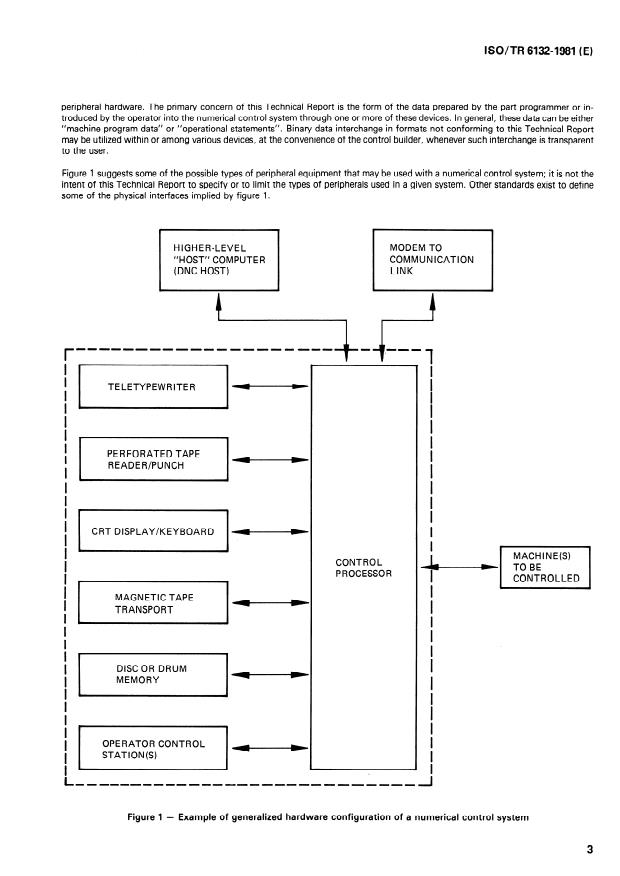
cording to the purpose and capabilities requ ired of the system. Figure 1 shows a numer ical control sys Item containing several types of
ISO/TR 6132-1981 (E)
peripheral hardware. The primary concern of this Technical Report is the form of the data prepared by the part programmer or in-
troduced by the operator into the numerical control system through one or more of these devices. In general, these data can be either
“machine program data” or “operational statements”. Binary data interchange in formats not conforming to this Technical Report
may be utilized within or among various devices, at the convenience of the control builder, whenever such interchange is transparent
to the user.
Figure 1 suggests some of the possible types of peripheral equipment that may be used with a numerical control system; it is not the
intent of this Technical Report to specify or to limit the types of peripherals used in a given system. Other standards exist to define
some of the physical interfaces implied by figure 1.
MODEM TO
HIGHER-LEVEL
COMMUNICATION
“HOST” COMPUTER
LINK
(DNC HOST)
I
---w---w----------m- - ---
r
+ ,"
I
I
TELETYPEWRITER
I
I
I
I
I
I
I
I
I
I
I
I
j 1 CRT DISPLAY/KEYBOARD 11
I
CONTROL
PROCESSOR
DISC OR DRUM
MEMORY
OPERATOR CONTROL e ---_
I
STATION(S)
I I I
Figure 1 - Example of generalized hardware configuration of a numerical control system
ISO/TR 6132-1981 (E)
1.4 Functional categories of commands
To illustrate the implementation of a system having a broad range of commands and with maximum utilization of an alphanumeric
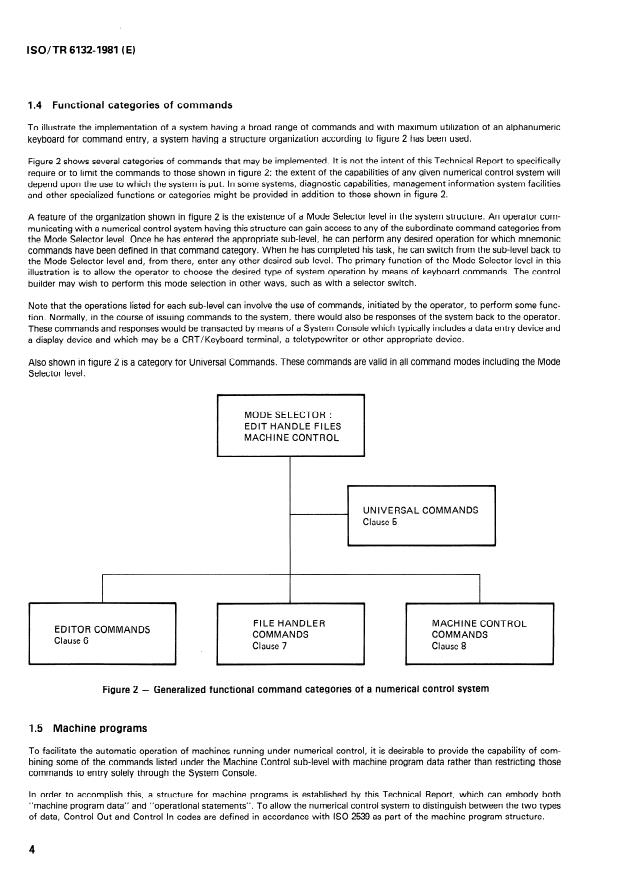
keyboard for command entry, a system having a structure organization according to figure 2 has been used.
Figure 2 shows several categories of commands that may be implemented. It is not the intent of this Technical Report to specifically
require or to limit the commands to those shown in figure 2; the extent of the capabilities of any given numerical control system will
depend upon the use to which the system is put. In some systems, diagnostic capabilities, management information system facilities
and other specialized functions or categories might be provided in addition to those shown in figure 2.
A feature of the organization shown in figure 2 is the existence of a Mode Selector level in the system structure. An operator com-
municating with a numerical control system having this structure can gain access to any of the subordinate command categories from
the Mode Selector level. Once he has entered the appropriate sub-level, he can perform any desired operation for which mnemonic
commands have been defined in that command category. When he has completed his task, he can switch from the sub-level back to
the Mode Selector level and, from there, enter any other desired sub-level. The primary function of the Mode Selector level in this
illustration is to allow the operator to choose the desired type of system operation by means of keyboard commands. The control
builder may wish to perform this mode selection in other ways, such as with a selector switch.
Note that the operations listed for each sub-level can involve the use of commands, initiated by the operator, to perform some func-
tion. Normally, in the course of issuing commands to the system, there would also be responses of the system back to the operator.
These commands and responses would be transacted by means of a System Console which typically includes a data entry device and
a display device and which may be a CRT/Keyboard terminal, a teletypewriter or other appropriate device.
Also shown in figure 2 is a category for Universal Commands. These commands are valid in all command modes including the Mode
Selector level.
MODE SELECTOR :
EDIT HANDLE FILES
MACHINE CONTROL
UNIVERSAL COMMANDS
Clause 5
. \ 4 .
FILE HANDLER
MACHINE CONTROL
EDITOR COMMANDS
COMMANDS COMMANDS
Clause 6
Clause 7 Clause 8
. b I 4
Figure 2 - Generalized functional command categories of a numerical control system
1.5 Machine programs
To facilitate the automatic operation of machines running under numerical control, it is desirable to provide the capability of com-
bining some of the commands listed under the Machine Control sub-level with machine program data rather than restricting those
commands to entry solely through the System Console.
In order to accomplish this, a structure for machine programs is established by this Technical Report, which can embody both
To allow the numerical control system to distinguish between the two types
“machine program data” and “operational statements”.
of data, Control Out and Control In codes are defined in accordance with IS0 2539 as part of the machine program structure.
lSO/TR 61324981 (E)
Figure 3 shows a conceptualization of this structure. Note that a conventional machine program consisting of machine program data
has embedded within it a sequence of operational statements set-up data. The open parenthesis, ‘Y”, is used to switch from the
machine program data format to the operational statements format. The close parenthesis, “)“, is used to return to machine program
data format.
These format changes can occur throughout the machine program. It is recommended that sequence numbers as defined in IS0 2539
be used as line numbers. Sequence numbers should be assigned in ascending order.
It is strongly recommended that only persons with the necessary authority should be allowed to modify programs. When a switch is
used for mode selection, operation should be by a key. When the mode is selected by push button or keyboard, passwords should be
used with prompting from the system.
Control Out Control In
( 1
MACHINE PROGRAM DATA OPERATIONAL STATEMENTS DATA MACHINE PROGRAM DATA
Classical machine program data per Set-up data or operator messages per
Classical machine program data per
IS0 2539 and IS0 840 this Technical Report and IS0 646
IS0 2539 and IS0 840
N42 Xl2487 276543 MO1 NL
MACHINE PROGRAM DATA
N43 X34567 254321 NL
(MSL, 2*MSG, MACHINE NO 2
OPERATIONALSTATEMENTS DATA
SELECTED)
N44 GO1 X11268 NL
MACHINE PROGRAM DATA
N45 X25148 Y64318 F515 NL
Figure 3 - Typical machine program data structure embodying both machine program and operational statements data
2 References
IS0 646, 7-bit coded character set for information processing interchange.
IS0 840, Numerical control of machines - 7-bit coded character set.
IS0 2126, Office machines - Basic arrangement for the alphanumeric section of keyboards operated with both hands.
IS0 2539, Numerical control of machines - Punched variable block format for con touring and con touring/positioning.
Principles governing the positioning of control keys and keyboards.
IS0 3244, Office machines and data processing equipment -
IS0 4342, Numerical control processor input - Basic part program reference language. 1)
IS0 698311, Numerical control of machines - Word address program format and definition - Part 1 : Data format for positioning
and con touring control systems. 1)
IS0 698312, Numerical control of machines - Word address program format and definition - Part 2 : Coding of preparatory func-
tions, G, and miscellaneous functions, M. 1)
3 Format, symbols and conventions used in data entry
3.1 General information
In the course of entering mnemonic commands from a keyboard, striking the wrong key may give rise to entry errors. The control
builder should provide appropriate means to allow correction of and/or recovery from keyboard entry errors. Typically, functions
would be defined to delete the previous character entered from the keyboard or to ignore the entire command just typed.
1) At present at the stage of draft.
ISO/TR 6132-1981 (E)
Interactive “prompting” is recommended as an approach to operator/machine communication. Although not required by the com-
mands defined by this Technical Report, such interactive response from the NC system assist in removing a burden from the operator
and in reducing the probability of command errors. The control builder may elect, at his discretion, to lock out the keyboard of the
System Console and/or to display error messages to the operator if commands are issued incorrectly or if, for any reason, the system
is not ready to accept commands. The control builder may also elect to require the operator to enter a “password” to allow him access
to certain sensitive commands.
It is also suggested that the control builder provide suitable interlocks for the machine motion system to inhibit motion (which could
result unintentionally from an erroneous command) until the operator makes an active effort to initiate it (by pressing a Start button,
for example).
3.2 Format for Operational Statements Commands
Operational Statements Commands shall be presented as operational statements whether entered manually or by other media. Each
operational statement shall consist of a function mnemonic code followed, where appropriate, by one or more arguments qualifying
the command.
Command function mnemonics are structured uniformly from three characters. The first and second characters will be alphabetic
characters. The third will be an alphabetic or numeric character. Mnemonics beginning with the character U are permanently reserved
for use by control builders and users.
content as appro
uments contained within the operational statement shall be of such length and priate to the comma nds defined in
m
ta is preferred in #resentation of
the following sub-clauses. A word address format similar to that of IS0 2539 da the p arguments.
A delimiter character shall be used to separate the function mne manic from argument( s). Add itional delimiters may be required to
separate arguments from one another from each other.
or operational statements
Conventions and symbols
3.3
operator ini tiates system responses to by entering the comma nd and pressing a key meaning “enter
The a command the command
the control system”. In this Technical symbol -I will be used to represent pressing the enter- key.
into Report, the
In the text that follows, certain command arguments are printed in italic. This convention is used to mean that the italicized element is
ill be replaced (by the programmer or a specific entry according to
va riable and w operator) by the desired effect.
Usage Example
Represents pressing a key meaning “enter the command into the control system”, caus- FIL -I
ing termination of the command and initiation of the commanded function.
The comma is a delimiter which separates the command mnemonic from the argument MIR, XIYO J
icomma) which follows it and, when necessary, separates successive arguments of a command.
Arguments representing line numbers within a file being edited, taking “lines” to be text DEL, n, m -I
n, m
separated by NEW LINE (line feed) code. n is the first line and m is the last line in the direc-
tion of normal program execution.
A text delimiter required when using certain Editor Commands. No character need be
(2/2)”
printed.
( Control Out IS0 2539. Used, when constructing machine programs employing both See figure 3
(open parenthesis) machine program and operational statements data, as the code to enter the operational
statements data mode.
) Control In IS0 2539. Code to return to the machine program data mode. See figure 3
(close parenthesis)
*
Delimiter to separate successive Commands within the operational statements data mode See figure 3
(asterisk) of machine programs employing both machine program and operational statements data.
NL Represents the End of Block character (new line) for IS0 2539/840 programs. See figure 3
<
Used in the operational statements mode to denote the beginning of a nested command. See 7.3
(less than)
> Used in the operational statements data mode to denote the end of a nested command. See 7.3
(greater than)
See 6.2
I Delimiter used with File Handler Commands to separate filenames from devicename.
(slash)
ISO/TR 6132-1981(E)
4 Mode selector commands
4.1 General information
The Mode Selector level is a portion of command structure that allows the operator to select the type of System operation. Its utiliza-
tion is not compulsory and not functionally necessary, but is given as an option for organizing the operator procedure.
If utilized, it shall be in accordance with this Technical Report.
The Mode Selection, if any, may be performed :
a) by keyboard (Mode Selector commands table 1);
b) by separate push buttons;
c) by a switch.
The status of the System (Mode Selector level ly indicated to the operator.
1 should be clear
4.2 Mode Selector Commands
Table 1 lists the mnemonic code, the format and the function of each Mode Selector Command. These commands correspond to the
three command categories (operation modes) illustrated in this Technical Report.
Note that in several cases further interaction between the system and operator may be required to qualify the basic command.
Some NC systems may be configured with some or all of these sub-levels or additional sub-levels, or both, as required by the system.
If additional sub-levels are provided by the control builder, appropriate commands shall be defined to access them.
5 Universal commands
5.1 General information
Universal commands are intended for general system control rather than for implementation of specific operational functions. The
universal commands must be effective without selection of a particular mode.
5.2 Universal Commands
Table 2 lists the mnemonic code, the format and the function of each Universal Command.
Table 1 - Mode Selector Commands Table 2 - Universal Commands
Mne- Mne-
Format Function Format Function
manic manic
EDT EDT, oldfile, Conditions system to enter DIS DIS, arguments DISPLAY on the device selected
newfle -I Editor sub-level. Oldfile is altered argument m, the parameters specified by the
device name
if newfile is not defined arguments. A list of arguments
argument and the resulting displayed
FIL FIL J
Conditions system to enter File
n.J parameters, shall be specified by
Handler sub-level
I
the control builder
MCH MC H , machine- Conditions system to enter
name -J Machine Control sub-level.
Specification of machinename
optional
END
1 END 1 End of all the modes
I
...
Questions, Comments and Discussion
Ask us and Technical Secretary will try to provide an answer. You can facilitate discussion about the standard in here.
Loading comments...