

ISO 23218-2:2022
(Main)Industrial automation systems and integration — Numerical control systems for machine tools — Part 2: Requirements for numerical control system integration
General Information
- Abstract
This document specifies requirements for the integration of numerical control systems (NC systems). It consists of technical and inspection requirements and test methods. This document is applicable to all machine tools using NC systems not already covered by class C standards (including metal cutting machine tools, metal forming machine tools and woodworking machine tools) and for partial assemblies of machine tools (including cabinets and auxiliary devices) intended to be integrated into machine tools. It is also applicable to other production equipment using NC systems. NOTE NC system integration with machine tools is performed mainly by machine tool builders using an NC system to control their machine tools, system integrators by assembling machine tools with the NC system to a production line, and machine tool users by upgrading their existing equipment.
- Status
- Published
- Publication Date
- 26-Sep-2022
- Technical Committee
- ISO/TC 184/SC 1 - Industrial cyber and physical device control
- Current Stage
- 6060 - International Standard published
- Start Date
- 27-Sep-2022
- Due Date
- 16-Dec-2023
- Completion Date
- 27-Sep-2022
Overview
ISO 23218-2:2022 - "Industrial automation systems and integration - Numerical control systems for machine tools - Part 2" specifies requirements for the integration of numerical control (NC) systems into machine tools and production equipment. The standard contains technical and inspection requirements plus test methods for NC system enclosures, electrical supply, safety protection and verification. It applies to machine tools (metal cutting, metal forming, woodworking), partial assemblies (cabinets, auxiliary devices) and other production equipment using NC systems.
Key topics and technical requirements
- Scope and applicability: Integration requirements for NC systems not already covered by class C standards; intended for integrators, machine tool builders and users upgrading equipment.
- Marking and identification: Enclosure and component marking requirements aligned with IEC 60204-1.
- Colour coding and indicators: Conductor and actuator colours, and indicating elements in accordance with IEC 60204-1 and IEC 61310-1.
- Wiring and connections: Requirements for wires, terminals and internal connections per IEC 60204-1.
- Protection and enclosures: Degrees of protection (IP code) and design guidance for cabinets and enclosures; consideration of harsh environments (dust, coolant, EMI).
- Nameplate information: Minimum nameplate data such as rated voltage, number of phases, frequency, rated current/power, certification marking and serial number.
- AC input power and earthing: Guidance on target-market power supply types and earthing systems (TN-S recommended); rules on neutral (N), protective earth (PE) and prohibition of PEN connections; use of isolation transformers where grounding changes to TT.
- Safety and electrical protection: Protection against electric shock and safety of electrical cabinets per IEC 60204-1 and related IEC technical specifications.
- Test methods: Inspection and verification tests including enclosure protection degree, protective earthing and bonding continuity, insulation resistance and withstand voltage tests.
Practical applications
- Ensures safe, compliant integration of NC systems into CNC machine tools and production lines.
- Guides design engineers, machine tool builders and system integrators on electrical, mechanical and safety aspects during procurement, assembly and retrofit.
- Useful for facility planners and maintenance teams performing acceptance testing, verification and periodic inspections of NC system installations.
Who uses this standard
- Machine tool builders procuring or integrating NC systems.
- System integrators assembling machines into production lines.
- End users and maintenance teams upgrading or verifying existing NC-equipped equipment.
- Design and safety engineers responsible for electrical cabinet layout, earthing and compliance testing.
Related standards
- ISO 23218-1 (NC system requirements)
- IEC 60204-1, IEC/TS 60204-34 (electrical equipment of machines)
- IEC 60529 (IP Code), IEC 61310-1 (indication/marking)
- IEC 60364-1, IEC 61000-4-3 (earthing and EMC considerations)
Keywords: ISO 23218-2:2022, NC system integration, numerical control, machine tools, electrical safety, AC input power, TN-S, IEC 60204-1.
Get Certified
Connect with accredited certification bodies for this standard

DVS-ZERT GmbH
German welding certification society.
CARES (UK Certification Authority for Reinforcing Steels)
UK certification for reinforcing steels and construction.
EWF/IIW (European/International Welding Federation)
International welding personnel certification.
Sponsored listings
Frequently Asked Questions
ISO 23218-2:2022 is a standard published by the International Organization for Standardization (ISO). Its full title is "Industrial automation systems and integration — Numerical control systems for machine tools — Part 2: Requirements for numerical control system integration". This standard covers: This document specifies requirements for the integration of numerical control systems (NC systems). It consists of technical and inspection requirements and test methods. This document is applicable to all machine tools using NC systems not already covered by class C standards (including metal cutting machine tools, metal forming machine tools and woodworking machine tools) and for partial assemblies of machine tools (including cabinets and auxiliary devices) intended to be integrated into machine tools. It is also applicable to other production equipment using NC systems. NOTE NC system integration with machine tools is performed mainly by machine tool builders using an NC system to control their machine tools, system integrators by assembling machine tools with the NC system to a production line, and machine tool users by upgrading their existing equipment.
This document specifies requirements for the integration of numerical control systems (NC systems). It consists of technical and inspection requirements and test methods. This document is applicable to all machine tools using NC systems not already covered by class C standards (including metal cutting machine tools, metal forming machine tools and woodworking machine tools) and for partial assemblies of machine tools (including cabinets and auxiliary devices) intended to be integrated into machine tools. It is also applicable to other production equipment using NC systems. NOTE NC system integration with machine tools is performed mainly by machine tool builders using an NC system to control their machine tools, system integrators by assembling machine tools with the NC system to a production line, and machine tool users by upgrading their existing equipment.
ISO 23218-2:2022 is classified under the following ICS (International Classification for Standards) categories: 25.040.20 - Numerically controlled machines. The ICS classification helps identify the subject area and facilitates finding related standards.
ISO 23218-2:2022 is available in PDF format for immediate download after purchase. The document can be added to your cart and obtained through the secure checkout process. Digital delivery ensures instant access to the complete standard document.
Standards Content (Sample)
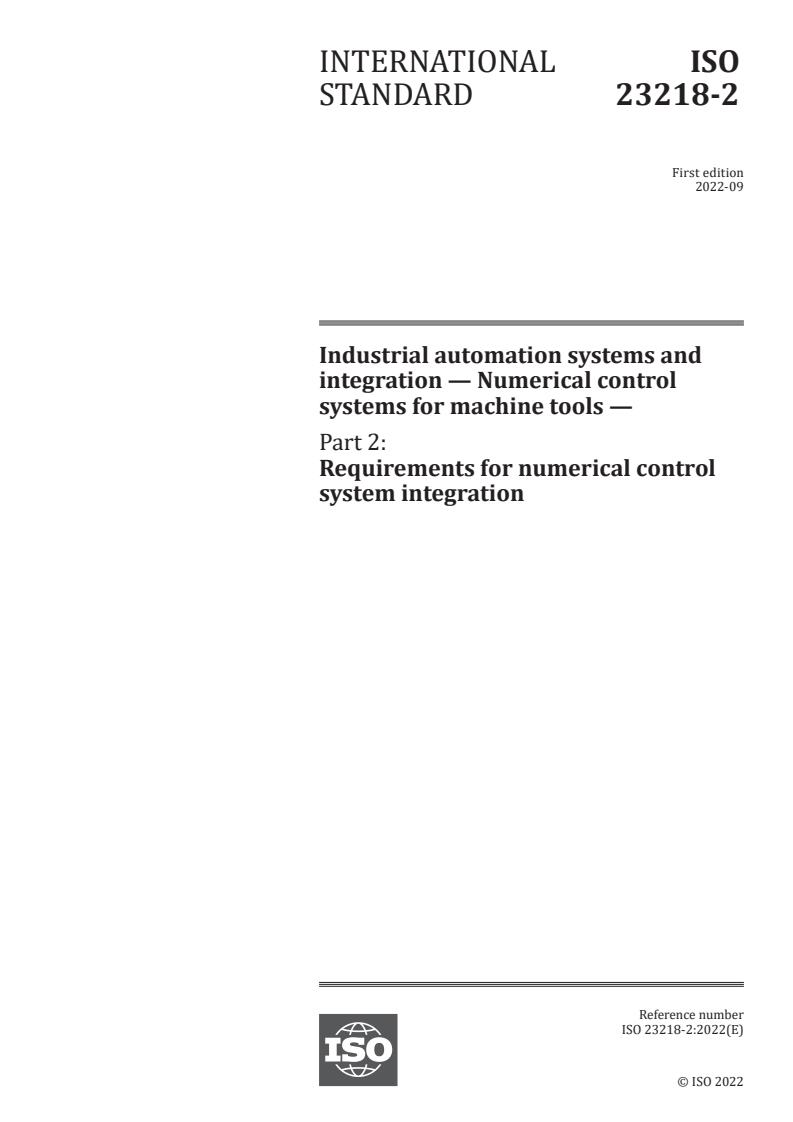
INTERNATIONAL ISO
STANDARD 23218-2
First edition
2022-09
Industrial automation systems and
integration — Numerical control
systems for machine tools —
Part 2:
Requirements for numerical control
system integration
Reference number
© ISO 2022
All rights reserved. Unless otherwise specified, or required in the context of its implementation, no part of this publication may
be reproduced or utilized otherwise in any form or by any means, electronic or mechanical, including photocopying, or posting on
the internet or an intranet, without prior written permission. Permission can be requested from either ISO at the address below
or ISO’s member body in the country of the requester.
ISO copyright office
CP 401 • Ch. de Blandonnet 8
CH-1214 Vernier, Geneva
Phone: +41 22 749 01 11
Email: copyright@iso.org
Website: www.iso.org
Published in Switzerland
ii
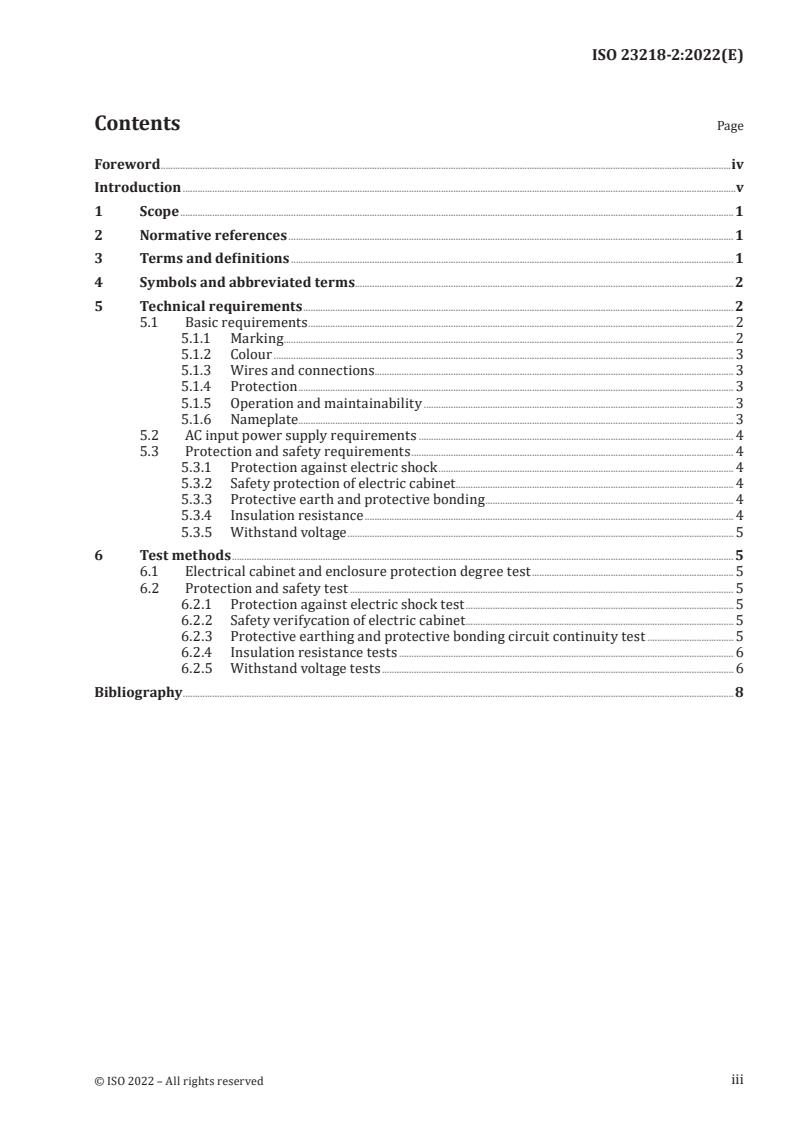
Contents Page
Foreword .iv
Introduction .v
1 Scope . 1
2 Normative references . 1
3 Terms and definitions . 1
4 Symbols and abbreviated terms.2
5 Technical requirements . 2
5.1 Basic requirements . 2
5.1.1 Marking . . . 2
5.1.2 Colour . 3
5.1.3 Wires and connections. 3
5.1.4 Protection . 3
5.1.5 Operation and maintainability . 3
5.1.6 Nameplate . . 3
5.2 AC input power supply requirements . 4
5.3 Protection and safety requirements . 4
5.3.1 Protection against electric shock . 4
5.3.2 Safety protection of electric cabinet . 4
5.3.3 Protective earth and protective bonding . 4
5.3.4 Insulation resistance . 4
5.3.5 Withstand voltage . 5
6 Test methods . 5
6.1 Electrical cabinet and enclosure protection degree test . 5
6.2 Protection and safety test . 5
6.2.1 Protection against electric shock test . 5
6.2.2 Safety verifycation of electric cabinet . 5
6.2.3 Protective earthing and protective bonding circuit continuity test . 5
6.2.4 Insulation resistance tests . 6
6.2.5 Withstand voltage tests . 6
Bibliography . 8
iii
Foreword
ISO (the International Organization for Standardization) is a worldwide federation of national standards
bodies (ISO member bodies). The work of preparing International Standards is normally carried out
through ISO technical committees. Each member body interested in a subject for which a technical
committee has been established has the right to be represented on that committee. International
organizations, governmental and non-governmental, in liaison with ISO, also take part in the work.
ISO collaborates closely with the International Electrotechnical Commission (IEC) on all matters of
electrotechnical standardization.
The procedures used to develop this document and those intended for its further maintenance are
described in the ISO/IEC Directives, Part 1. In particular, the different approval criteria needed for the
different types of ISO documents should be noted. This document was drafted in accordance with the
editorial rules of the ISO/IEC Directives, Part 2 (see www.iso.org/directives).
Attention is drawn to the possibility that some of the elements of this document may be the subject of
patent rights. ISO shall not be held responsible for identifying any or all such patent rights. Details of
any patent rights identified during the development of the document will be in the Introduction and/or
on the ISO list of patent declarations received (see www.iso.org/patents).
Any trade name used in this document is information given for the convenience of users and does not
constitute an endorsement.
For an explanation of the voluntary nature of standards, the meaning of ISO specific terms and
expressions related to conformity assessment, as well as information about ISO's adherence to
the World Trade Organization (WTO) principles in the Technical Barriers to Trade (TBT), see
www.iso.org/iso/foreword.html.
This document was prepared by Technical Committee ISO/TC 184, Automation systems and integration,
Subcommittee SC 1, Industrial cyber and physical device control.
A list of all parts in the ISO 23218 series can be found on the ISO website.
Any feedback or questions on this document should be directed to the user’s national standards body. A
complete listing of these bodies can be found at www.iso.org/members.html.
iv
Introduction
Numerically controlled machine tools are effective production assets with an operations stock of more
than four million units and still increasing.
While mechanical construction sets the base for accuracy and durability, the numerical control system
(NC system) is the enabler to leverage the potential of the system.
The NC system comprises a powerful computing hardware, a sophisticated NC-Kernel, and an
elaborated connectivity, stretching from internal process parameters to high level manufacturing
execution system (MES) integration and beyond. It supports operation concepts from push buttons to
sophisticated touch-panel systems.
Machine tools and their NC systems are used in harsh environments facing operational conditions such
as vibrations, dirt, coolant spray and electromagnetical interferences. Purchasers and operators of
machine tools require confidence on the appropriate quality, durability and usability in order to ensure
intended use and productivity.
The ISO 23218 series addresses requirements for NC systems. This document provides requirements
for NC system integration, and ISO 23218-1 specifically provides requirements for the NC system itself.
Expected users of this document include:
— design engineers working for a company that uses an NC system for machine tools, for developing a
new and/or improving a current NC system for machine tools;
— design engineers working for a machine tools builder company, for developing and providing new
and/or improving current machine tools by procuring an NC system;
— facility planning engineers, for procuring new and/or improving current machine tools with an NC
system.
v
INTERNATIONAL STANDARD ISO 23218-2:2022(E)
Industrial automation systems and integration —
Numerical control systems for machine tools —
Part 2:
Requirements for numerical control system integration
1 Scope
This document specifies requirements for the integration of numerical control systems (NC systems). It
consists of technical and inspection requirements and test methods.
This document is applicable to all machine tools using NC systems not already covered by class C
standards (including metal cutting machine tools, metal forming machine tools and woodworking
machine tools) and for partial assemblies of machine tools (including cabinets and auxiliary devices)
intended to be integrated into machine tools. It is also applicable to other production equipment using
NC systems.
NOTE NC system integration with machine tools is performed mainly by machine tool builders using an NC
system to control their machine tools, system integrators by assembling machine tools with the NC system to a
production line, and machine tool users by upgrading their existing equipment.
2 Normative references
The following documents are referred to in the text in such a way that some or all of their content
constitutes requirements of this document. For dated references, only the edition cited applies. For
undated references, the latest edition of the referenced document (including any amendments) applies
ISO 2806, Industrial automation systems — Numerical control of machines — Vocabulary
ISO 23218-1, Industrial automation systems and integration — Physical device control — Numerical
control systems for machine tools — Part 1: Requirements for numerical control systems
IEC 60204-1:2016, Safety of machinery — Electrical equipment of machines — Part 1: General requirements
IEC/TS 60204-34:2016, Safety of machinery — Electrical equipment of machines — Part 34: Requirements
for machine tools
IEC 60529, Degrees of protection provided by enclosures (IP Code)
IEC 61310-1, Safety of machinery — Indication, marking and actuation — Part 1: Requirements for visual,
acoustic and tactile signals
3 Terms and definitions
For the purposes of this document, the terms and definitions given in ISO 2806, ISO 23218-1 and the
following apply. ISO and IEC maintain terminology databases for use in standardization at the following
addresses:
— ISO Online browsing platform: available at https:// www .iso .org/ obp
— IEC Electropedia: available at https:// www .electropedia .org/ ”
3.1
numerical control system
NC system
system that realizes the automatic control of a process by using numerical data introduced while the
operation is in progress
Note 1 to entry: Driving devices are not included in NC systems.
3.2
port
access to a device or network of a numerical control system (NC system) (3.1) where electromagnetic
energy or signals may be supplied or received or where the device or network variables may be
observed or measured
Note 1 to entry: The port generally refers to the boundary on the external interface of the NC system, and
interface generally refers to the boundary of each unit in an NC system.
[SOURCE: IEC 60050-131:2002, 131-12-60, modified — The term "NC system" was added to the
...