

ISO 23704-2:2022
(Main)General requirements for cyber-physically controlled smart machine tool systems (CPSMT) — Part 2: Reference architecture of CPSMT for subtractive manufacturing
General Information
- Abstract
This document specifies a reference architecture of cyber-physically controlled smart machine tool systems (CPSMT) for subtractive manufacturing based on the reference architecture of a CPSMT as provided in ISO 23704-1. The reference architecture of a CPSMT for subtractive manufacturing includes: — the reference architecture of a cyber-physically controlled machine tool (CPCM), — the reference architecture of a cyber-supporting system for machine tools (CSSM), and — the interface architecture of a CPSMT. This document also provides: — a conceptual description of a shop floor device system (SFDS), — a conceptual description of a shop floor control system (SFCS), — a conceptual description of a unified interface system (UIS), and — example use cases of a reference architecture of a CPSMT for subtractive manufacturing. This document does not specify physical or implementation architecture.
- Status
- Published
- Publication Date
- 27-Jun-2022
- Technical Committee
- ISO/TC 184/SC 1 - Industrial cyber and physical device control
- Current Stage
- 6060 - International Standard published
- Start Date
- 28-Jun-2022
- Due Date
- 08-May-2023
- Completion Date
- 28-Jun-2022

Overview
ISO 23704-2:2022 - "General requirements for cyber-physically controlled smart machine tool systems (CPSMT) - Part 2: Reference architecture of CPSMT for subtractive manufacturing" defines a reference architecture for cyber-physically controlled smart machine tool systems (CPSMT) used in subtractive manufacturing. Published by ISO in 2022, this part builds on ISO 23704-1 and focuses on architectural elements (logical and interface views) rather than physical or implementation details.
Key topics and technical scope
The standard organizes the CPSMT architecture into three primary components and several functional views:
- Cyber‑physically controlled machine tool (CPCM) - functional view of the machine tool, including the Machine Tool Unit (MTU) and the CPS control loops (inner‑loop, intra‑loop, inter‑loop).
- Cyber‑supporting system for machine tools (CSSM) - platform-level services such as the Data Processing Unit (DPU), Digital Twin Unit, MAPE (Monitor‑Analyze‑Plan‑Execute) unit, and External Interface Unit.
- Interface architecture - definitions for interfaces supporting:
- Autonomous handling of machine abnormalities
- Coordination with shop‑floor devices (SFDS)
- Collaboration with shop‑floor control systems (SFCS)
- Exchange with life‑cycle systems and humans via a Unified Interface System (UIS)
- Conceptual descriptions of Shop Floor Device System (SFDS), Shop Floor Control System (SFCS), and UIS
- Informative material including example use cases and a shop‑floor concept model
Important notes:
- The document provides conceptual and logical architectures; it does not specify physical hardware or implementation details.
- Functional elements include data fusion, data storage, state and behaviour models for digital twins, and interface schema/management.
Practical applications and intended users
ISO 23704-2:2022 is intended as a reference and guideline for stakeholders implementing Industry 4.0 / smart manufacturing solutions for subtractive processes:
- Design engineers and system architects creating smart machine tool systems
- Software engineers at machine tool builders (MTBs) and CNC/control vendors
- Solution and service providers integrating analytics, digital twins, and shop‑floor orchestration
- Factory operators and plant integrators who need standardized interfaces for interoperability
Adopting this reference architecture helps organizations design interoperable CPSMT solutions that enable predictive maintenance, autonomous fault handling, digital twin integration, and coordinated shop‑floor automation.
Related standards and context
ISO 23704-2 complements other Industry 4.0 and digital‑manufacturing frameworks referenced in the ISO text, including:
- ISO 23704-1 (foundational principles)
- ISO 23247 (digital twin framework)
- RAMI 4.0 (IEC PAS 63088), OPC‑UA, MTConnect and other interoperability standards
Keywords: ISO 23704-2:2022, CPSMT, cyber-physically controlled smart machine tool systems, subtractive manufacturing, reference architecture, CPCM, CSSM, digital twin, shop floor, UIS, SFDS, SFCS.
Get Certified
Connect with accredited certification bodies for this standard

DVS-ZERT GmbH
German welding certification society.
CARES (UK Certification Authority for Reinforcing Steels)
UK certification for reinforcing steels and construction.
EWF/IIW (European/International Welding Federation)
International welding personnel certification.
Sponsored listings
Frequently Asked Questions
ISO 23704-2:2022 is a standard published by the International Organization for Standardization (ISO). Its full title is "General requirements for cyber-physically controlled smart machine tool systems (CPSMT) — Part 2: Reference architecture of CPSMT for subtractive manufacturing". This standard covers: This document specifies a reference architecture of cyber-physically controlled smart machine tool systems (CPSMT) for subtractive manufacturing based on the reference architecture of a CPSMT as provided in ISO 23704-1. The reference architecture of a CPSMT for subtractive manufacturing includes: — the reference architecture of a cyber-physically controlled machine tool (CPCM), — the reference architecture of a cyber-supporting system for machine tools (CSSM), and — the interface architecture of a CPSMT. This document also provides: — a conceptual description of a shop floor device system (SFDS), — a conceptual description of a shop floor control system (SFCS), — a conceptual description of a unified interface system (UIS), and — example use cases of a reference architecture of a CPSMT for subtractive manufacturing. This document does not specify physical or implementation architecture.
This document specifies a reference architecture of cyber-physically controlled smart machine tool systems (CPSMT) for subtractive manufacturing based on the reference architecture of a CPSMT as provided in ISO 23704-1. The reference architecture of a CPSMT for subtractive manufacturing includes: — the reference architecture of a cyber-physically controlled machine tool (CPCM), — the reference architecture of a cyber-supporting system for machine tools (CSSM), and — the interface architecture of a CPSMT. This document also provides: — a conceptual description of a shop floor device system (SFDS), — a conceptual description of a shop floor control system (SFCS), — a conceptual description of a unified interface system (UIS), and — example use cases of a reference architecture of a CPSMT for subtractive manufacturing. This document does not specify physical or implementation architecture.
ISO 23704-2:2022 is classified under the following ICS (International Classification for Standards) categories: 25.040.20 - Numerically controlled machines. The ICS classification helps identify the subject area and facilitates finding related standards.
ISO 23704-2:2022 is available in PDF format for immediate download after purchase. The document can be added to your cart and obtained through the secure checkout process. Digital delivery ensures instant access to the complete standard document.
Standards Content (Sample)
INTERNATIONAL ISO
STANDARD 23704-2
First edition
2022-06
General requirements for cyber-
physically controlled smart machine
tool systems (CPSMT) —
Part 2:
Reference architecture of CPSMT for
subtractive manufacturing
Exigences générales relatives aux systèmes de machines-outils
intelligents à commandes cyber-physiques (CPSMT) —
Partie 2: Architecture de référence des CPSMT pour la fabrication
soustractive
Reference number
© ISO 2022
All rights reserved. Unless otherwise specified, or required in the context of its implementation, no part of this publication may
be reproduced or utilized otherwise in any form or by any means, electronic or mechanical, including photocopying, or posting on
the internet or an intranet, without prior written permission. Permission can be requested from either ISO at the address below
or ISO’s member body in the country of the requester.
ISO copyright office
CP 401 • Ch. de Blandonnet 8
CH-1214 Vernier, Geneva
Phone: +41 22 749 01 11
Email: copyright@iso.org
Website: www.iso.org
Published in Switzerland
ii
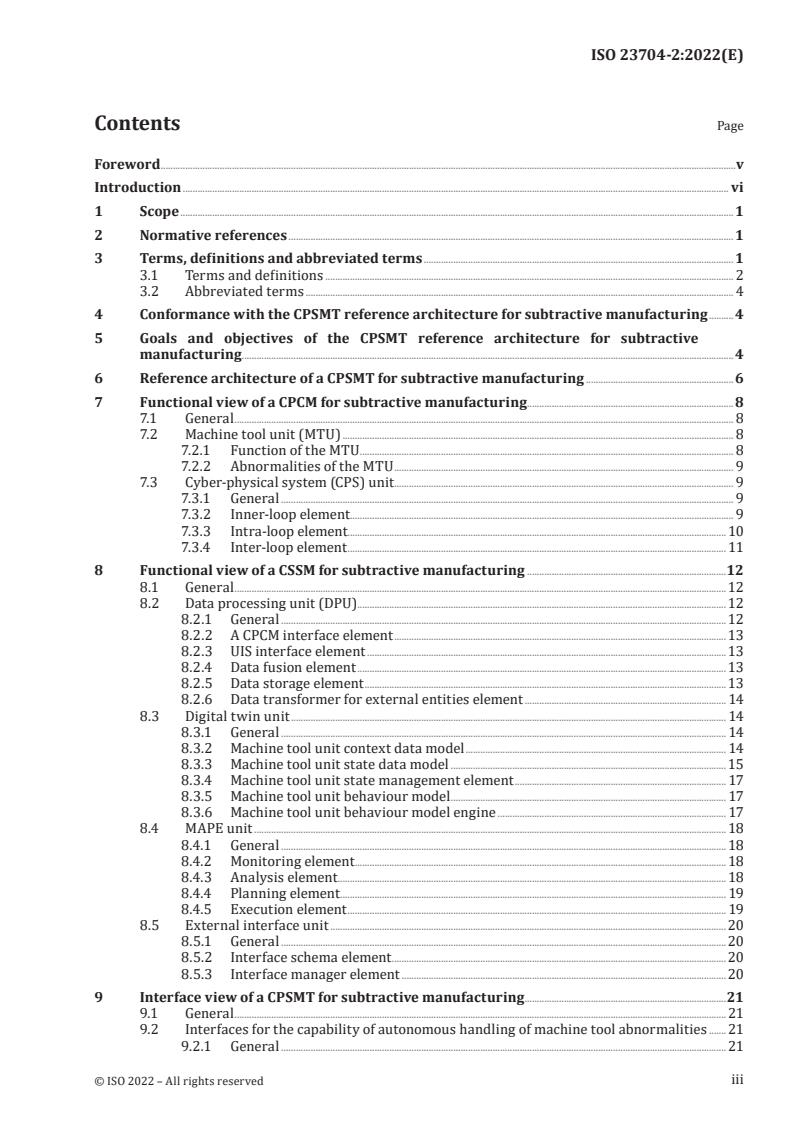
Contents Page
Foreword .v
Introduction . vi
1 Scope . 1
2 Normative references . 1
3 Terms, definitions and abbreviated terms . 1
3.1 Terms and definitions . 2
3.2 Abbreviated terms . 4
4 Conformance with the CPSMT reference architecture for subtractive manufacturing .4
5 Goals and objectives of the CPSMT reference architecture for subtractive
manufacturing . .4
6 Reference architecture of a CPSMT for subtractive manufacturing .6
7 Functional view of a CPCM for subtractive manufacturing . 8
7.1 General . 8
7.2 Machine tool unit (MTU) . 8
7.2.1 Function of the MTU . . 8
7.2.2 Abnormalities of the MTU . 9
7.3 Cyber-physical system (CPS) unit . 9
7.3.1 General . 9
7.3.2 Inner-loop element. 9
7.3.3 Intra-loop element. 10
7.3.4 Inter-loop element . 11
8 Functional view of a CSSM for subtractive manufacturing .12
8.1 General .12
8.2 Data processing unit (DPU). 12
8.2.1 General .12
8.2.2 A CPCM interface element . 13
8.2.3 UIS interface element .13
8.2.4 Data fusion element . 13
8.2.5 Data storage element .13
8.2.6 Data transformer for external entities element . 14
8.3 Digital twin unit . 14
8.3.1 General . 14
8.3.2 Machine tool unit context data model . 14
8.3.3 Machine tool unit state data model . 15
8.3.4 Machine tool unit state management element . 17
8.3.5 Machine tool unit behaviour model . 17
8.3.6 Machine tool unit behaviour model engine . 17
8.4 MAPE unit . 18
8.4.1 General . 18
8.4.2 Monitoring element . 18
8.4.3 Analysis element . . 18
8.4.4 Planning element . 19
8.4.5 Execution element . 19
8.5 External interface unit . 20
8.5.1 General .20
8.5.2 Interface schema element . 20
8.5.3 Interface manager element . 20
9 Interface view of a CPSMT for subtractive manufacturing .21
9.1 General . 21
9.2 Interfaces for the capability of autonomous handling of machine tool abnormalities . 21
9.2.1 General . 21
iii
9.2.2 Data from a CPCM to a CSSM . 21
9.2.3 Data from a CSSM to a CPCM . 21
9.3 Interfaces for the capability of autonomous coordination with various shop floor
devices. 21
9.4 Interfaces for the capability of autonomous collaboration with the SFCS .22
9.4.1 General .22
9.4.2 Interface between a CSSM and an SFCS .22
9.4.3 The interface between an SFCS and a CPCM .22
9.5 Interfaces for the capability of exchange with the life cycle aspects, hierarchy
level, and humans through a UIS . 23
9.5.1 General .23
9.5.2 Interface between a CPCM and a UIS. 23
9.5.3 Interface between a CSSM and a UIS . 23
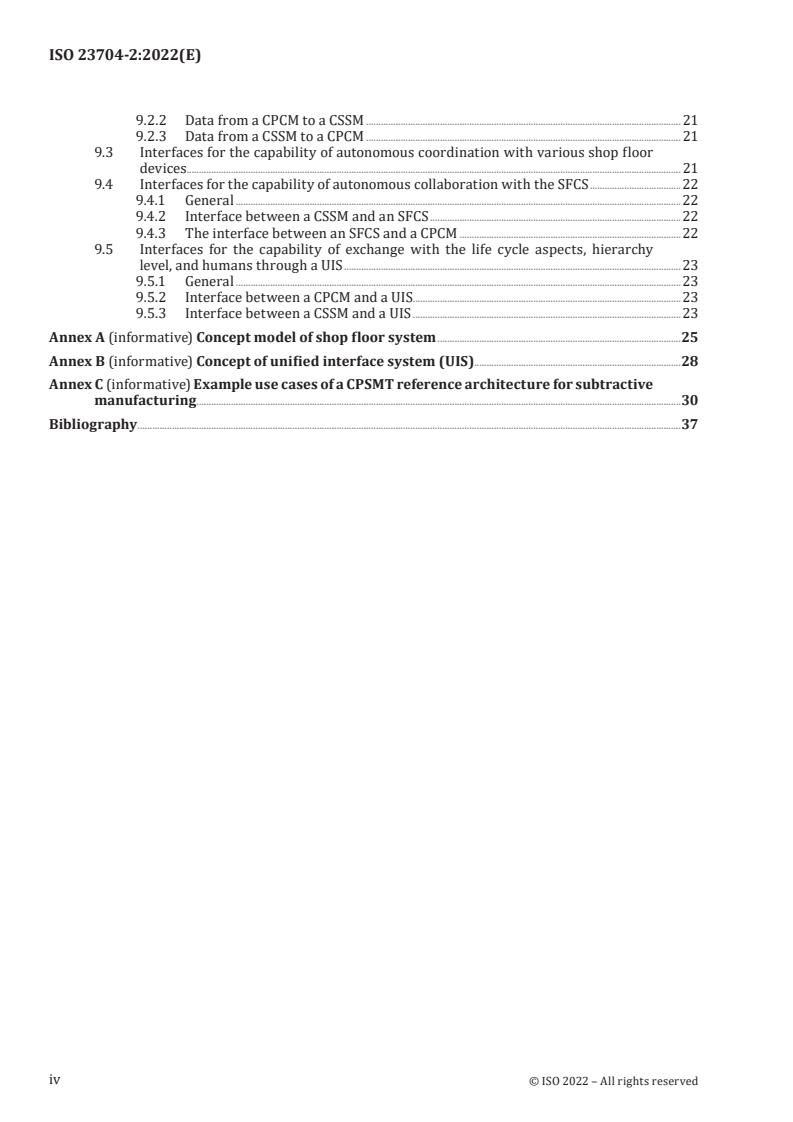
Annex A (informative) Concept model of shop floor system .25
Annex B (informative) Concept of unified interface system (UIS).28
Annex C (informative) Example use cases of a CPSMT reference architecture for subtractive
manufacturing . .30
Bibliography .37
iv
Foreword
ISO (the International Organization for Standardization) is a worldwide federation of national standards
bodies (ISO member bodies). The work of preparing International Standards is normally carried out
through ISO technical committees. Each member body interested in a subject for which a technical
committee has been established has the right to be represented on that committee. International
organizations, governmental and non-governmental, in liaison with ISO, also take part in the work.
ISO collaborates closely with the International Electrotechnical Commission (IEC) on all matters of
electrotechnical standardization.
The procedures used to develop this document and those intended for its further maintenance are
described in the ISO/IEC Directives, Part 1. In particular, the different approval criteria needed for the
different types of ISO documents should be noted. This document was drafted in accordance with the
editorial rules of the ISO/IEC Directives, Part 2 (see www.iso.org/directives).
Attention is drawn to the possibility that some of the elements of this document may be the subject of
patent rights. ISO shall not be held responsible for identifying any or all such patent rights. Details of
any patent rights identified during the development of the document will be in the Introduction and/or
on the ISO list of patent declarations received (see www.iso.org/patents).
Any trade name used in this document is information given for the convenience of users and does not
constitute an endorsement.
For an explanation of the voluntary nature of standards, the meaning of ISO specific terms and
expressions related to conformity assessment, as well as information about ISO's adherence to
the World Trade Organization (WTO) principles in the Technical Barriers to Trade (TBT), see
www.iso.org/iso/foreword.html.
This document was prepared by Technical Committee ISO/TC 184 Automation systems and integration,
Subcommittee SC 1, Industrial cyber and physical device control.
A list of all parts in the ISO 23704 series can be found on the ISO website.
Any feedback or questions on this document should be directed to the user’s national standards body. A
complete listing of these bodies can be found at www.iso.org/members.html.
v
Introduction
A machine tool is a key device in manufacturing since it is used indispensably in the production
of machine parts used in various industrial areas. Many institutions have long been devoted to
technological development from the viewpoint of reducing downtime and defects and are considering
smart technologies such as the Internet-of-Things (IoT) as a new means to achieve this.
From the market perspective, there is a variety of so-called smart machine tools incorporating smart
technologies based on their own concepts using, e.g. local terminologies by machine tool builders
(MTBs), machine tool control, e.g. computerized numerical control (CNC) vendors, solution vendors
and service providers, which can be confusing to stakeholders, including end-users. For this and other
reasons, standards and substantial modelling for smart machine tool systems are needed.
1)
From the standards perspective, RAMI 4.0 (IEC PAS 63088) and IEC TR 63319 TR-SMRM provide a
reference model for Industry 4.0 and smart manufacturing on a high level. The ISO 23247 series defines
a generic framework to support the creation of a digital twin of observable manufacturing elements.
Furthermore, although some existing standards deal with Industry 4.0 enabling technologies, e.g. OPC-
UA (IEC TR 62541-1), MTConnect (ANSI/MTC1.4-2018), ISO/IEC 30141, the IEC 62769 series, and many
machine tool standards from ISO TC39, no standard yet exists for smart machine tools for realizing
smart manufacturing / Industry 4.0 in the shop floor via cyber-physical systems (CPSs).
The ISO 23704 series specifies general requirements on smart machine tools for supporting smart
manufacturing in the shop floor via cyber-physical system control scheme, namely cyber-physically
controlled smart machine tool systems (CPSMT).
Figure 1 shows the overall structure of the ISO 23704 series, including:
— Overview and fundamental principles of a CPSMT in ISO 23704-1,
— Reference architecture of a CPSMT for subtractive manufacturing in ISO 23704-2, and
2)
— Reference architecture of a CPSMT for additive manufacturing in ISO 23704-3 .
Other related parts such as implementation guidelines or reference architectures for other types of
manufacturing will be added if and when necessary.
Figure 1 — Overall structure of the ISO 23704 series on general requirements for cyber-
physically controlled smart machine tool systems (CPSMT)
This document can be used as a reference and guidelines for users such as, but not limited to:
a) Design engineers in the area of smart machine tools,
1) Under development. Stage at the time of publication: IEC/DTR 63319.
2) Under development. Stage at the time of publication: ISO/DIS 23704-3.
vi
b) System architects in the area of smart machine tools,
c) Software engineers at the MTBs in the area of smart machine tools,
d) Machine tool control vendors in the area of smart machine tools,
e) Solution and service providers in the area of smart machine tools, and
f) End users such as factory operators working with smart machine tools.
vii
INTERNATIONAL STANDARD ISO 23704-2:2022(E)
General requirements for cyber-physically controlled
smart machine tool systems (CPSMT) —
Part 2:
Reference architecture of CPSMT for subtractive
manufacturing
1 Scope
This document specifies a reference architecture of cyber-physically controlled smart machine tool
systems (CPSMT) for subtractive manufacturing based on the reference architecture of a CPSMT as
provided in ISO 23704-1.
The reference architecture of a CPSMT for subtractive manufacturing includes:
— the reference architecture of a cyber-physically controlled machine tool (CPCM),
— the reference architecture of a cyber-supporting system for machine tools (CSSM), and
— the interface architecture of a CPSMT.
This document also provides:
— a conceptual description of a shop floor device system (SFDS),
— a conceptual description of a shop floor control system (SFCS),
— a conceptual description of a unified interface system (UIS), and
— example use cases of a reference architecture of a CPSMT for subtractive manufacturing.
This document does not specify physical or implementation architecture.
2 Normative references
The following documents are referred to in the text in such a way that some or all of their content
constitutes requirements of this document. For dated references, only the edition cited applies. For
undated references, the latest edition of the referenced document (including any amendments) applies.
ISO 23704-1:2022, General requirements for Cyber-Physically Controlled Smart Machine Tool Systems
(CPSMT) —Part 1: Overview and fundamentals principles
3 Terms, definitions and abbreviated terms
For the purposes of this document, the terms and definitions given in ISO 23704-1 and the following
apply.
ISO and IEC maintain terminology databases for use in standardization at the following addresses:
— ISO Online browsing platform: available at https:// www .iso .org/ obp
— IEC Electropedia: available at https:// www .electropedia .org/
3.1 Terms and definitions
3.1.1
context data
data specifying in which circumstances the state data (3.1.16) is obtained from the various perspectives,
e.g. products, processes, tool paths and process variables
3.1.2
cyber-physical system unit
CPS unit
instance of a cyber-physical system (CPS) according to the reference architecture
Note 1 to entry: The CPS unit provides advanced control functionalities for the machine tool unit (see 3.1.12),
interfacing with data from sensors, numerical control kernel / programmable logic controller, the cyber-
supporting system for machine tool (CSSM), shop floor control system (SFCS), and unified interface system (UIS).
3.1.3
data model
graphical and/or lexical representation of data, specifying their properties, structures and
interrelationships.
[SOURCE: ISO/IEC 19778-1:2015, 3.1.7]
3.1.4
data processing unit
DPU
instance of data processing according to the reference architecture of cyber-physically controlled smart
machine tool (CPSMT) for subtractive manufacturing
3.1.5
digital twin unit
instance of a digital twin according to the reference architecture of cyber-physically controlled smart
machine tool (CPSMT) for subtractive manufacturing
Note 1 to entry: The digital twin unit describes the digital replica or digital representation of a machine tool
system and its surrounding environment.
Note 2 to entry: The perspective of digital representation of the machine tool system contains: a) machine body,
b) cutting tool, c) workpiece, and d) environment.
Note 3 to entry: The digital representation of the machine tool consists of the data model and behaviour model.
3.1.6
element
component or part as a constituent function in a unit (3.1.17)
3.1.7
engineering phase context data
part of the context data for machining specified in the engineering phase, e.g. computer-aided design,
process planning and manufacturing data
Note 1 to entry: Example data is included in, e.g. the ISO 14649 series, ISO 6983-1, ISO 13399-1.
3.1.8
external interface unit
unit (3.1.17) that receives data from a) the data processing unit (3.1.4), b) the MAPE unit (3.1.13) via
execution element, and transmits that data to a shop floor control system (SFCS) and a unified interface
system (UIS) instance of interface with external entities according to the reference architecture for
subtractive manufacturing
3.1.9
inner-loop element
part of the cyber-physical system (CPS) unit (3.1.2) that detects and resolves abnormalities for the
machine tool unit (3.1.12) in hard-real time
3.1.10
inter-loop element
part of the cyber-physical system (CPS) unit (3.1.2) that generates event-driven control instructions for
the machine tool unit (3.1.12) based on data from a shop floor control system (SFCS) for the sake of
collaboration
3.1.11
intra-loop element
part of the cyber-physical system (CPS) unit (3.1.2) that generates control instructions for the machine
tool unit (3.1.12) based on the data from a cyber-supporting system for machine tools (CSSM) in soft-
real time
3.1.12
machine tool unit
MTU
instance of machine tool according to the reference architecture for subtractive manufacturing
Note 1 to entry: According to ISO 14955-1, 3.12: 2017, the machine tool function of a machine tool unit consists of
machine tool operation (machining process, motion and control), process conditioning, workpiece handling, tool
handling or die change, recyclables and waste handling and machine tool cooling / heating. This functionality is
used for determining areas for abnormalities.
3.1.13
monitoring, analysis, planning, and execution unit
MAPE unit
instance of monitoring, planning, and execution according to the reference architecture
3.1.14
numerical control kernel
NCK
component for controlling the servo motors consisting of, e.g. an interpreter, interpolator, acceleration
/ deceleration controller and position controller
Note 1 to entry: Numerical control kernel is the key module not only of the computerized numerical control (CNC)
[38]
but it is also a typical position control for servo motors .
3.1.15
operation phase context data
set of data specified at the machine tool before machining operation start, including, e.g. setup data of
machine tool, cutting tool and workpiece
3.1.16
state data
set of data on the state of the machine tool unit (3.1.12) during machining operation from which the key
performance indicators (KPIs) of the machine body, cutting tool, workpiece and environment can be
identified
Note 1 to entry: Typical means for obtaining the state data are various sensors and a computerized numerical
control (CNC) on the machine tool components.
3.1.17
unit
group of elements (3.1.6) that constitutes part of the reference architecture of a cyber-physically
controlled machine tool (CPCM) and a cyber-supporting system for machine tools (CSSM) for subtractive
manufacturing
Note 1 to entry: The term “unit” in this document is used as an instance of a collection of elements.
3.2 Abbreviated terms
CAx computer-aided-x
CNC computerized numerical control
CPCA cyber-physically controlled autonomous guided vehicle
CPCM cyber-physically controlled machine tool
CPCR cyber-physically controlled robot
CPCS cyber-physically controlled storage
CPS cyber physical system
CPSMT cyber-physically controlled smart machine tool
CSSA cyber supporting system for autonomous guided vehicle
CSSM cyber supporting system for machine tool
CSSR cyber supporting system for robot
CSSS cyber supporting system for storage
FFT fast Fourrier transform
HMI human machine interface
MAPE monitoring, analysis, planning, execution
MTB machine tool builder
MTU machine tool unit
NCK numerical control kernel
PLC programmable logic controller
SFCS shop floor control system
SFDS shop floor device system
UIS unified interface system
4 Conformance with the CPSMT reference architecture for subtractive
manufacturing
To claim conformance, the definition of specific system architecture provided by a vendor or system
integrator should use the terminology, architectural concepts, and have the capabilities defined in this
document, within the scope of their specific use cases.
5 Goals and objectives of the CPSMT reference architecture for subtractive
manufacturing
The CPSMT reference architecture for subtractive manufacturing describes an architecture of smart
machine tool systems for subtractive manufacturing based on the generic reference architecture
specified in ISO 23704-1. It provides guidance for designers developing smart machine tool systems
for subtractive manufacturing and aims to give a better understanding of smart machine tools to the
stakeholders of such systems.
NOTE Examples of stakeholders are MTBs, computerized numerical control (CNC) vendors, solution vendors,
service providers, customers and end-users.
The CPSMT reference architecture for subtractive manufacturing supports the following important
standardization objectives:
a) To ensure clear and unambiguous communication between all interested parties of smart machine
tools for subtractive manufacturing.
b) To ensure the interoperability of smart machine tools with related hardware devices, software,
service, and manufacturing system for subtractive manufacturing.
c) To ensure the quality / capability of smart machine tools for subtractive manufacturing.
d) To ensure the use of smart machine tools for subtractive manufacturing.
e) To ensure systematic development, modification of smart machine tools for subtractive
manufacturing.
Figure 2 illustrates the context of how the CPSMT reference architecture for subtractive manufacturing
is derived and viewed from various perspectives based on the architecture description defined in
[29]
ISO/IEC/IEEE 42010:2011 .
Figure 2 — Context of the CPSMT reference architecture for subtractive manufacturing
Based on Figure 2, this document includes the following descriptions:
— The reference architecture of a CPSMT for subtractive manufacturing in Clause 6.
— The reference architecture of a CPCM viewed from functionality perspective in Clause 7.
— The reference architecture of a CSSM viewed from functionality perspective in Clause 8.
— The reference architecture of a CPSMT viewed from the interface perspective in Clause 9.
— The use cases of the reference architecture in Annex C.
6 Reference architecture of a CPSMT for subtractive manufacturing
Based on the reference architecture for a CPSMT of ISO 23704-1:2022, Clause 7. Figure 3 displays the
reference architecture of a CPSMT for subtractive manufacturing.
The structure is as follows:
— The CPSMT primary system for subtractive manufacturing is composed of a cyber-physically
controlled machine tool (CPCM) and a cyber-supporting system for machine tools (CSSM). It
has the primary function to deal with machine tool abnormalities in autonomous fashion (see
ISO 23704-1:2022, 10.2).
— The CPSMT associated system for subtractive manufacturing is composed of a shop floor device
system (SFDS), a shop floor control system (SFCS), and a unified interface system (UIS). An SFDS
and an SFCS have capabilities as described in ISO 23704-1:2022, 10.3 and 10.4.
— Through the UIS, the CPSMT for subtractive manufacturing interfaces with external entities, e.g.
humans, life cycle aspects, and hierarchy levels, according to ISO 23704-1:2022, 10.5, 10.6, and 10.7.
Details on units and elements of a CPCM and a CSSM for subtractive manufacturing and their interfaces,
are specified in Clauses 7, 8, and 9. Details on an SFDS, an SFCS and a UIS are given in Annex A and
Annex B.
Key
1 data exchange between a CPCM and a CSSM
2 data exchange between a CPCM and a UIS
3 data exchange between a CSSM and a UIS
4 data / control signal exchange between a CPCM and an SFDS
5 data exchange between a CSSM and an SFCS
6 data exchange between a CPCM and an SFCS
7 data exchange between a UIS and an SFDS
8 data exchange between a UIS and an SFCS
9 data exchange between an SFCS and an SFDS
10 data exchange between MTU and a CPS unit
11 data exchange between data processing unit (DPU) and digital twin unit
12 data exchange between digital twin unit and a MAPE unit
13 data exchange between a MAPE unit and external interface unit
14 data exchange between data processing unit (DPU) and a MAPE unit
15 data exchange between data processing unit (DPU) and external interface unit
Figure 3 — Reference architecture of a CPSMT for subtractive manufacturing
7 Functional view of a CPCM for subtractive manufacturing
7.1 General
This clause provides a set of requirements for constituent elements that make up a CPCM.
A CPCM consists of
a) a machine tool unit, and
b) a cyber-physical system (CPS) unit.
7.2 Machine tool unit (MTU)
7.2.1 Function of the MTU
The physical system to be monitored, analyzed, and for which decisions are made about possible
abnormalities. (see ISO 23704-1:2022, 3.1) is the MTU. Depending on the viewpoints, the MTU can be
classified in several ways, as specified in ISO 13399-1, ISO 14649-201, ISO 14955-1 which deal with
different aspects of the MTU. Here, the definitions from ISO 14955-1 are used as a basis for the MTU
functionality.
According to ISO 14955-1, every machine tool, independent of the technology, can be described by the
following general functions:
— Machine tool operation (machining process, motion and control),
— Process conditioning,
— Workpiece handling,
— Tool handling,
— Recyclables and waste handling, and
— Machine cooling / heating.
NOTE 1 See ISO 14955-1 for an extensive description of the functions and subfunctions of a machine tool.
The machining control subfunctions in the machine tool operation function should:
— Control the machine tool operation and all other functions of the MTU,
— Manage the part program (e.g. the ISO 14649 series or ISO 6983-1) received from the UIS,
— Generate status signals of all MTU functions via sensors and I/O modules,
— Transmit the collected data to the CSSM, the UIS, and the CPS unit, and
— Receive control instructions from the CPS unit.
NOTE 2 Typical machine tool components for the subfunction "machining control" are, e.g. CNC system,
programmable logic controller, display, sensors, relays, touch probes, based on ISO 14955-1.
NOTE 3 Computerized numerical control (CNC) system can consist of numerical control kernel, programmable
[38]
logic controller, fieldbus interface, and their interfaces .
The MTU interfaces with:
— The CPS unit for retrieving control instructions and transmission of data,
— The UIS for retrieving context data, including part program, and
— The SFDS for coordination.
NOTE 4 Coordination is a recommended capability of a CPSMT, as specified in ISO 23704-1:2022, 10.2.
7.2.2 Abnormalities of the MTU
A machine tool’s performance can decrease over time, especially by repeated machining operation, e.g.
due to degradation of mechanical properties (fatigue, impact, hardness, corrosion).
Abnormality can be viewed not only from the functionality of the MTU but also key performance
indicators (KPIs) of the machine tool. See 8.3 for a more detailed description.
The status of the MTU should be monitored, analysed, planned and executed utilizing data from the
MTU, CSSM and a UIS in order to:
— Prevent failure,
— Use the machine tool efficiently,
— Achieve prognosis health maintenance, and
— Optimize the use of the machine tool.
7.3 Cyber-physical system (CPS) unit
7.3.1 General
Compared with the conventional machine tool system, the CPS unit is an additional control function
that enables the CPCM to realize the two capabilities of a CPSMT:
— Autonomously dealing with abnormalities (see ISO 23704-1:2022, 10.2) by interfacing with sensors,
machine controller, e.g. numerical control kernel (NCK), programmable logic controller (PLC) and
UIS, and
— Autonomously collaborating with an SFCS (see ISO 23704-1:2022, 10.4) by interfacing with an SFCS.
To fulfil these tasks, a CPS unit should consist of:
— An inner-loop element,
— An intra-loop element, and
— An inter-loop element.
NOTE Physical deployment of the CPS unit should be determined in the implementation phase. A CPS unit
can be in the machine tool controller, outside of the machine tool controller, or both.
7.3.2 Inner-loop element
As defined in 3.1.9, inner-loop element is the part of the CPS unit that detects and resolves abnormalities
for the MTU in hard-real time.
NOTE Inner-loop can be used as a means for adaptive control for the optimization of material removal rate,
for instance.
To this end, the inner-loop element should:
— Receive the data from the MTU (e.g. sensor and controller) and the UIS for engineering context data,
including part program as specified in, e.g. the ISO 14649 series or ISO 6983-1,
— Identify the current CPCM status based on data from the MTU,
— Compare the current state of the MTU with the reference state,
— Generate control instructions for improving operation of the MTU,
— Transmit the generated control instructions to the MTU, and
— Transmit the generated data to the UIS.
Figure 4 is a recommended functional structure of the inner-loop element composed of:
— Data interface component composed of sensor interface, controller interface, and a UIS interface to
obtain sensor, controller data from the MTU, engineering context data, a part program, Controller
elements can be: Numerical Control Kernel (NCK) / Programmable Logic Controller (PLC), for
example.
— Parameter estimation component composed of a CPCM status identifier and a CPCM reference control
model to receive the data from the data interface and identify the current status or difference from
reference status of the MTU, and
— Adjustment mechanism component to receive output from parameter estimation and generate
control instructions for transmission to the MTU.
Key
1 transmission of collected data from the data interface to parameter estimation
2 transmission of generated feature from the parameter estimation component to the adjustment mechanism
Figure 4 — Functional structure of the inner-loop element
7.3.3 Intra-loop element
As defined in 3.1.11, intra-loop element is the part of the CPS unit that generates control instructions for
the controller (machining control) based on the data from a CSSM in soft-real time.
Compared with the capability of the inner-loop element, the intra-loop capability is more powerful in
many respects, including, e.g. detectability of abnormality, adjustment of the machine tool parameters
for the next operations.
To this end, the intra-loop element should:
— Receive the control command data from the CSSM,
— Receive the status of the controller from the MTU,
— Convert the control command for the MTU,
— Make a decision as to whether the proposed command can be accommodated, based on data from
the MTU,
— Generate an override command for the MTU, and
— Transmit the generated command to the MTU.
Figure 5 is a recommended functional structure of the intra-loop element composed of:
— A CSSM interface to receive the output from a CSSM,
— A machine tool unit interface to get data from the MTU,
— A CSSM interpreter for machine tool to convert the output from a CSSM to a form executable by the
MTU,
— A checker for override to examine whether the MTU can accommodate the output from a CSSM to
operate the MTU with the current status, and
— An override command generator to transmit the converted command to the MTU.
Figure 5 — Functional structure of the intra-loop element
7.3.4 Inter-loop element
As defined in 3.1.10, inter-loop element is the part of the CPS unit that generates event-driven control
instructions for the controller (machining control) based on data from an SFCS for the sake of
collaboration.
NOTE Example situations can be: a) resource reallocation or rescheduling of the shop floor devices due to
failure and delay of some shop floor devices, b) special request from manufacturing execution system due to
unexpected situation in, e.g. customer relationship management, supply chain management.
To this end, the inter-loop element should:
— Receive outputs (e.g. task allocation plan) from an SFCS,
— Receive the status of the controller from the MTU,
— Convert the control command for the MTU,
— Make a decision as to whether the proposed command can be accommodated, based on data from
the machine tool unit,
— Generate override commands for the MTU, and
— Transmit the generated commands to the MTU.
Figure 6 is a recommended functional structure of the inter-loop element composed of:
— An SFCS interface to receive the output from a CSSM,
— An MTU interface to get data from the MTU,
— An SFCS interpreter for the machine tool to convert the output from an SFCS to a form executable by
a MTU,
— A checker for override to examine whether the MTU can accommodate the output from an SFCS to
operate the MTU with the current status, and
— An override command generator to transmit the converted command to the MTU.
Figure 6 — Functional structure of the inter-loop element
8 Functional view of a CSSM for subtractive manufacturing
8.1 General
This clause provides a set of requirements for constituent elements that make up a CSSM.
A CSSM is mainly to support the performance of a CPCM. This is done by identifying the current status
of the MTU based on the data related to the machine tool status.
Subsequently, decisions can be made based on reasoning for the enhancement of KPIs of the MTU. To
this end, the CSSM consists of:
a) The data processing unit (DPU),
b) Digital twin unit,
c) A MAPE unit, and
d) External interface unit.
In addition, a CSSM interfaces with an SFCS and external entities, including life cycle aspects and
hierarchy level via a UIS.
8.2 Data processing unit (DPU)
8.2.1 General
A DPU is a set of functions to process the acquired data for the use of the digital twin unit, a MAPE unit,
and external interface unit.
The DPU consists of:
— A CPCM interface element,
— A UIS interface element,
— A data fusion element,
— A data storage element, and
— A data transformer for external entities element.
8.2.2 A CPCM interface element
The CPCM interface element is the element that acquires data related to machine tool status from the
MTU of a CPCM.
To this end, the CPCM interface element should:
— Retrieve the state data and operation phase context data, and
— Transmit the retrieved data to the data fusion element.
This document does not specify industrial communication protocols for the CPCM interface (e.g.,
Profibus, Modbus and EtherCAT). Communication protocol should be determined based on the purpose
of implementation, e.g. required latency threshold, system configuration type (edge, fog and cloud), the
amount of data.
8.2.3 UIS interface element
The UIS interface element is the element that acquires context-related data of the MTU, such as
engineering phase context data, to be used for identifying the status of machine body, cutting tool,
workpiece, and environment.
To this end, the UIS interface element should:
— Retrieve engineering phase context data, and
— Transmit the retrieved data to the data fusion element.
This document does not specify industrial communication protocols for the UIS interface (e.g. Profibus,
Modbus and Ethernet). Communication protocol should be determined based on the purpose of
implementation, e.g. required latency threshold, system configuration type (edge, fog and cloud), the
amount of data.
8.2.4 Data fusion element
The data fusion element is the element that integrates multiple data sources from a CPCM and a UIS
interface elements for the sake of producing consistent, accurate, and useful data.
To this end, the data fusion element should perform:
— Data cleansing function a) to search for and correct (or remove) corrupted or inaccurate data items
in the collected data, b) to identify incomplete, inaccurate, or irrelevant parts of the data, and c) to
replace, modify, or delete the data,
— Data formatting function to organize cleansed data to fit in a predefined specification that is defined
by the MTU state data model (see 8.3.3) and MTU context data model (see 8.3.2) in the digital twin
unit, and
— Data grouping function to group the data items that are involved in each abnormality on the machine
tool with specific contexts.
8.2.5 Data storage element
The data storage element is the element that stores the deliverables of a CSSM, including the output of
data fusion, the output of monitoring, analysis, and the planning f
...