


ISO/FDIS 959-1
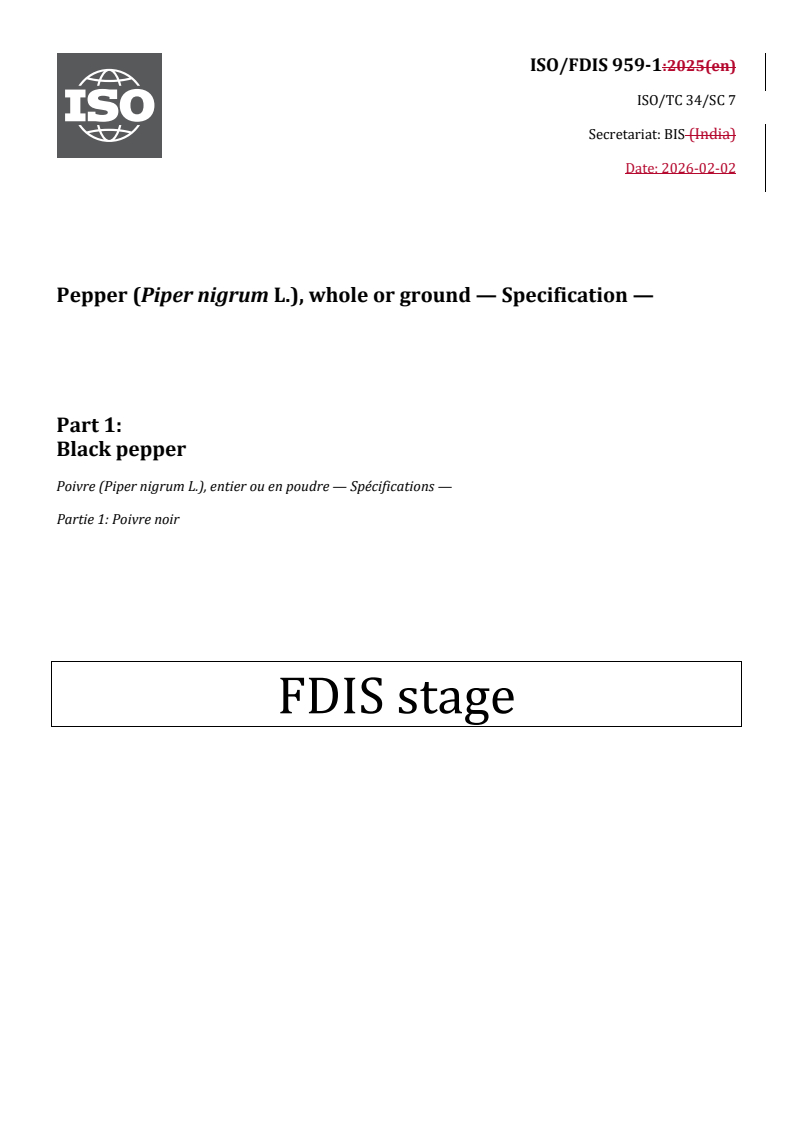
(Main)Pepper (Piper nigrum L.), whole or ground — Specification — Part 1: Black pepper
Pepper (Piper nigrum L.), whole or ground — Specification — Part 1: Black pepper
Poivre (Piper nigrum L.), entier ou en poudre — Spécifications — Partie 1: Poivre noir
General Information
- Status
- Not Published
- Technical Committee
- ISO/TC 34/SC 7 - Spices, culinary herbs and condiments
- Drafting Committee
- ISO/TC 34/SC 7 - Spices, culinary herbs and condiments
- Current Stage
- 5020 - FDIS ballot initiated: 2 months. Proof sent to secretariat
- Start Date
- 16-Feb-2026
- Completion Date
- 16-Feb-2026
Relations
- Revises
ISO 959-1:1998 - Pepper (Piper nigrum L.), whole or ground — Specification — Part 1: Black pepper - Effective Date
- 25-Feb-2023
Overview
ISO/FDIS 959-1:2026 specifies the quality requirements, sampling, testing, packing, and marking of black pepper (Piper nigrum L.), both whole and ground. Developed by ISO/TC 34/SC 7, this international standard ensures that black pepper meets globally recognized specifications throughout the food supply chain. It replaces previous editions to reflect updated normative references and labeling requirements, enhancing clarity and global market access for producers and traders.
Utilizing ISO 959-1 allows food businesses, exporters, importers, and regulators to ensure product quality, authenticity, and safety from farm to consumer.
Key Topics
- Product Description: Defines black pepper as the dried berry of Piper nigrum L. with an unbroken pericarp, available as whole or ground.
- Commercial Stages: Classifies black pepper into non-processed (NP), semi-processed (SP), and processed (P), depending on the extent of cleaning and grading before export.
- Physical and Chemical Requirements: Specifies limits for extraneous matter, light berries, pinheads, bulk density, moisture, ash, piperine content, and volatile oils to ensure consistency and quality.
- Odour and Flavour: Requires that black pepper, especially when ground, has a characteristic, strong, and aromatic flavour with no off-odours.
- Freedom from Contaminants: Mandates pepper be free from mold, insects, and rodent contamination, with specifications for physical and microscopic cleanliness.
- Sampling and Testing: Prescribes sampling methods in accordance with ISO standards and outlines laboratory procedures for determining compliance with physical and chemical specifications.
- Packing and Marking: Outlines requirements for packaging materials to protect pepper from moisture and contamination. Mandatory package markings include product name, batch number, country of origin, "best before" date, and reference to ISO 959-1.
Applications
ISO/FDIS 959-1 serves as a vital quality control and trade facilitation tool throughout the global black pepper industry:
- Export and Import: Producers and exporters use the standard to assure buyers of product quality, simplify customs clearance, and access international markets.
- Food Manufacturing: Food processors and spice blenders rely on these specifications to guarantee ingredient consistency and regulatory compliance in finished goods.
- Retail and Distribution: Packagers and retailers use ISO 959-1 to ensure their products meet food safety and labelling requirements, building consumer trust.
- Quality Assurance: Laboratories and certification bodies use prescribed test methods to verify product quality, authenticity, and adherence to import requirements in different countries.
- Regulatory Compliance: Governments and inspection agencies refer to this ISO standard for ensuring black pepper imports align with national food safety standards.
Related Standards
When working with black pepper under ISO/FDIS 959-1, the following international standards are also relevant:
- ISO 676: Spices and condiments - Botanical nomenclature
- ISO 927: Determination of extraneous and foreign matter content in spices
- ISO 928, ISO 930, ISO 939: Methods for measuring total ash, acid-insoluble ash, and moisture content
- ISO 948: Guidelines for sampling spices and condiments
- ISO 1108: Determination of non-volatile ether extract
- ISO 1208: Determination of filth in spices
- ISO 5498: Measurement of crude fibre content in agricultural products
- ISO 5564: Determination of piperine content in black and white pepper
- ISO 6571: Measurement of volatile oil content in spices (hydrodistillation method)
- ISO 959-2: Specification for white pepper (complementary for full product range)
By referencing ISO/FDIS 959-1 and these related standards, stakeholders in the spice trade can achieve consistent quality, seamless trade, and food safety in the handling and distribution of black pepper worldwide.
Buy Documents
ISO/FDIS 959-1 - Pepper (Piper nigrum L.), whole or ground — Specification — Part 1: Black pepper Released:2. 02. 2026
REDLINE ISO/FDIS 959-1 - Pepper (Piper nigrum L.), whole or ground — Specification — Part 1: Black pepper Released:2. 02. 2026
Get Certified
Connect with accredited certification bodies for this standard

BSI Group
BSI (British Standards Institution) is the business standards company that helps organizations make excellence a habit.

Bureau Veritas
Bureau Veritas is a world leader in laboratory testing, inspection and certification services.

DNV
DNV is an independent assurance and risk management provider.
Sponsored listings
Frequently Asked Questions
ISO/FDIS 959-1 is a draft published by the International Organization for Standardization (ISO). Its full title is "Pepper (Piper nigrum L.), whole or ground — Specification — Part 1: Black pepper". This standard covers: Pepper (Piper nigrum L.), whole or ground — Specification — Part 1: Black pepper
Pepper (Piper nigrum L.), whole or ground — Specification — Part 1: Black pepper
ISO/FDIS 959-1 is classified under the following ICS (International Classification for Standards) categories: 67.220.10 - Spices and condiments. The ICS classification helps identify the subject area and facilitates finding related standards.
ISO/FDIS 959-1 has the following relationships with other standards: It is inter standard links to ISO 959-1:1998. Understanding these relationships helps ensure you are using the most current and applicable version of the standard.
ISO/FDIS 959-1 is available in PDF format for immediate download after purchase. The document can be added to your cart and obtained through the secure checkout process. Digital delivery ensures instant access to the complete standard document.
Standards Content (Sample)
FINAL DRAFT
International
Standard
ISO/TC 34/SC 7
Pepper (Piper nigrum L.), whole or
Secretariat: BIS
ground — Specification —
Voting begins on:
2026-02-16
Part 1:
Black pepper
Voting terminates on:
2026-04-13
Poivre (Piper nigrum L.), entier ou en poudre — Spécifications —
Partie 1: Poivre noir
RECIPIENTS OF THIS DRAFT ARE INVITED TO SUBMIT,
WITH THEIR COMMENTS, NOTIFICATION OF ANY
RELEVANT PATENT RIGHTS OF WHICH THEY ARE AWARE
AND TO PROVIDE SUPPOR TING DOCUMENTATION.
IN ADDITION TO THEIR EVALUATION AS
BEING ACCEPTABLE FOR INDUSTRIAL, TECHNO-
LOGICAL, COMMERCIAL AND USER PURPOSES, DRAFT
INTERNATIONAL STANDARDS MAY ON OCCASION HAVE
TO BE CONSIDERED IN THE LIGHT OF THEIR POTENTIAL
TO BECOME STAN DARDS TO WHICH REFERENCE MAY BE
MADE IN NATIONAL REGULATIONS.
Reference number
FINAL DRAFT
International
Standard
ISO/TC 34/SC 7
Pepper (Piper nigrum L.), whole or
Secretariat: BIS
ground — Specification —
Voting begins on:
Part 1:
Black pepper
Voting terminates on:
Poivre (Piper nigrum L.), entier ou en poudre — Spécifications —
Partie 1: Poivre noir
RECIPIENTS OF THIS DRAFT ARE INVITED TO SUBMIT,
WITH THEIR COMMENTS, NOTIFICATION OF ANY
RELEVANT PATENT RIGHTS OF WHICH THEY ARE AWARE
AND TO PROVIDE SUPPOR TING DOCUMENTATION.
© ISO 2026
IN ADDITION TO THEIR EVALUATION AS
All rights reserved. Unless otherwise specified, or required in the context of its implementation, no part of this publication may
BEING ACCEPTABLE FOR INDUSTRIAL, TECHNO-
LOGICAL, COMMERCIAL AND USER PURPOSES, DRAFT
be reproduced or utilized otherwise in any form or by any means, electronic or mechanical, including photocopying, or posting on
INTERNATIONAL STANDARDS MAY ON OCCASION HAVE
the internet or an intranet, without prior written permission. Permission can be requested from either ISO at the address below
TO BE CONSIDERED IN THE LIGHT OF THEIR POTENTIAL
or ISO’s member body in the country of the requester.
TO BECOME STAN DARDS TO WHICH REFERENCE MAY BE
MADE IN NATIONAL REGULATIONS.
ISO copyright office
CP 401 • Ch. de Blandonnet 8
CH-1214 Vernier, Geneva
Phone: +41 22 749 01 11
Email: copyright@iso.org
Website: www.iso.org
Published in Switzerland Reference number
ii
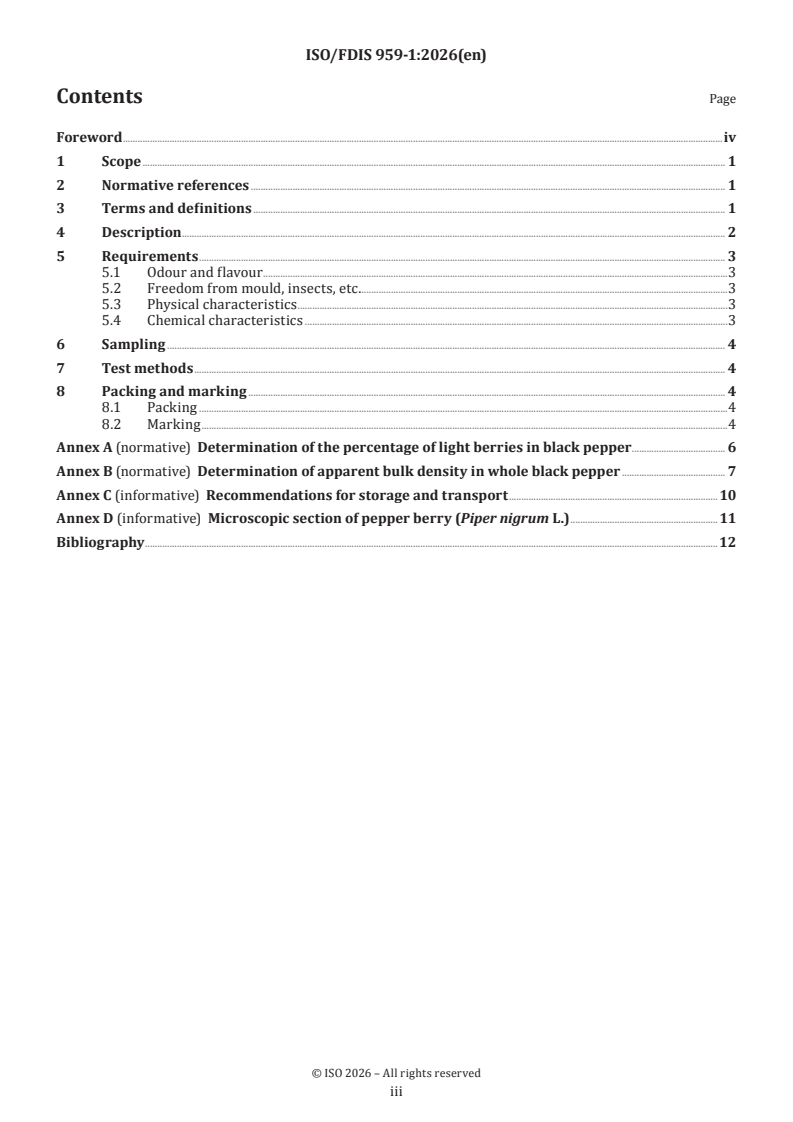
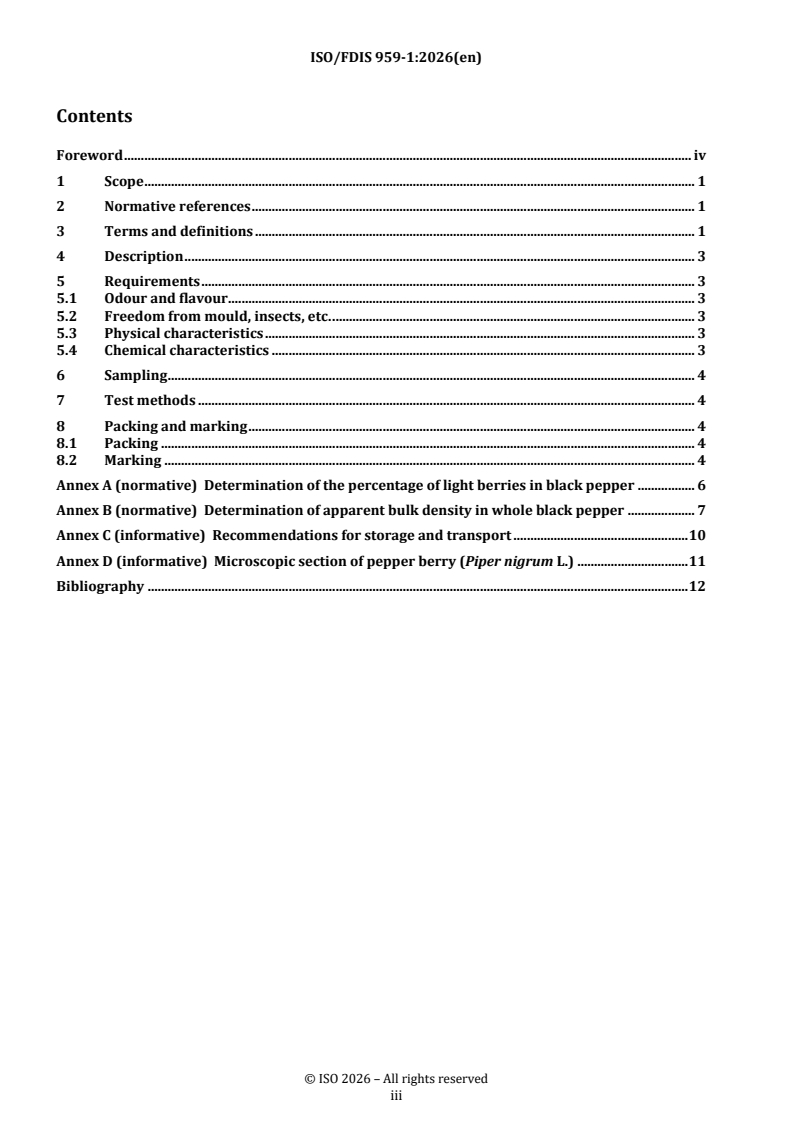
Contents Page
Foreword .iv
1 Scope . 1
2 Normative references . 1
3 Terms and definitions . 1
4 Description . . 2
5 Requirements . 3
5.1 Odour and flavour .3
5.2 Freedom from mould, insects, etc. .3
5.3 Physical characteristics .3
5.4 Chemical characteristics .3
6 Sampling . 4
7 Test methods . 4
8 Packing and marking . 4
8.1 Packing .4
8.2 Marking .4
Annex A (normative) Determination of the percentage of light berries in black pepper . 6
Annex B (normative) Determination of apparent bulk density in whole black pepper . 7
Annex C (informative) Recommendations for storage and transport .10
Annex D (informative) Microscopic section of pepper berry (Piper nigrum L.) .11
Bibliography .12
iii
Foreword
ISO (the International Organization for Standardization) is a worldwide federation of national standards
bodies (ISO member bodies). The work of preparing International Standards is normally carried out through
ISO technical committees. Each member body interested in a subject for which a technical committee
has been established has the right to be represented on that committee. International organizations,
governmental and non-governmental, in liaison with ISO, also take part in the work. ISO collaborates closely
with the International Electrotechnical Commission (IEC) on all matters of electrotechnical standardization.
The procedures used to develop this document and those intended for its further maintenance are described
in the ISO/IEC Directives, Part 1. In particular, the different approval criteria needed for the different types
of ISO document should be noted. This document was drafted in accordance with the editorial rules of the
ISO/IEC Directives, Part 2 (see www.iso.org/directives).
ISO draws attention to the possibility that the implementation of this document may involve the use of (a)
patent(s). ISO takes no position concerning the evidence, validity or applicability of any claimed patent
rights in respect thereof. As of the date of publication of this document, ISO had not received notice of (a)
patent(s) which may be required to implement this document. However, implementers are cautioned that
this may not represent the latest information, which may be obtained from the patent database available at
www.iso.org/patents. ISO shall not be held responsible for identifying any or all such patent rights.
Any trade name used in this document is information given for the convenience of users and does not
constitute an endorsement.
For an explanation of the voluntary nature of standards, the meaning of ISO specific terms and expressions
related to conformity assessment, as well as information about ISO’s adherence to the World Trade
Organization (WTO) principles in the Technical Barriers to Trade (TBT), see www.iso.org/iso/foreword.html.
This document was prepared by Technical Committee ISO/TC 34, Food products, Subcommittee SC 7, Spices,
culinary herbs and condiments.
This third edition cancels and replaces the second edition (ISO 959-1:1998), which has been technically
revised.
The main changes are as follows:
— the normative references have been updated;
— the “best before date” has been added in 8.2.
A list of all parts in the ISO 959 series can be found on the ISO website.
Any feedback or questions on this document should be directed to the user’s national standards body. A
complete listing of these bodies can be found at www.iso.org/members.html.
iv
FINAL DRAFT International Standard ISO/FDIS 959-1:2026(en)
Pepper (Piper nigrum L.), whole or ground — Specification —
Part 1:
Black pepper
1 Scope
This document specifies requirements for black pepper (Piper nigrum L.) (see ISO 676), whole or ground at
the following commercial stages:
a) non-processed black pepper (NP) or semi-processed black pepper (SP);
b) processed black pepper (P), which can, in certain cases, be re-sold directly to the consumers.
This document does not apply to black pepper categories called “light”.
NOTE Specifications for white pepper are given in ISO 959-2.
Recommendations relating to storage and transport conditions are given in Annex C.
Information regarding the microscopic structure of the pepper berry is given in Annex D.
2 Normative references
The following documents are referred to in the text in such a way that some or all of their content constitutes
requirements of this document. For dated references, only the edition cited applies. For undated references,
the latest edition of the referenced document (including any amendments) applies.
ISO 927, Spices and condiments — Determination of extraneous matter and foreign matter content
ISO 928, Spices and condiments — Determination of total ash
ISO 930, Spices and condiments — Determination of acid-insoluble ash
ISO 939, Spices and condiments — Determination of moisture content
ISO 948, Spices and condiments — Sampling
ISO 1108, Spices and condiments — Determination of non-volatile ether extract
ISO 1208, Spices and condiments — Determination of filth
ISO 5498, Agricultural food products — Determination of crude fibre content — General method
ISO 5564, Black pepper and white pepper, whole or ground — Determination of piperine content —
Spectrophotometric method
ISO 6571, Spices, condiments and herbs — Determination of volatile oil content (hydrodistillation method)
3 Terms and definitions
For the purposes of this document, the following terms and definitions apply.
ISO and IEC maintain terminology databases for use in standardization at the following addresses:
— ISO Online browsing platform: available at https://www.iso.org/obp
— IEC Electropedia: available at https://www.electropedia.org/
3.1
black pepper
dried berry of Piper nigrum L. that has an unbroken pericarp
Note 1 to entry: When the term “black pepper” is used alone, it means that the specification applies to both types
described, without distinction.
3.2
non-processed black pepper
NP
black pepper (3.1) that has not undergone any clearing, preparation or grading by the producing country
before being exported
3.3
semi-processed black pepper
SP
black pepper (3.1) that has undergone partial cleaning but without preparation or grading by the producing
country before being exported
3.4
processed black pepper
P
black pepper (3.1) that has been processed (cleaning, preparation, grading, etc.) by the producing country
before being exported
3.5
ground black pepper
pepper obtained by grinding black pepper (3.1) without adding any additives to the pepper
N
...
ISO/TC 34/SC 7
Secretariat: BIS (India)
Date: 2026-02-02
Pepper (Piper nigrum L.), whole or ground — Specification —
Part 1:
Black pepper
Poivre (Piper nigrum L.), entier ou en poudre — Spécifications —
Partie 1: Poivre noir
FDIS stage
All rights reserved. Unless otherwise specified, or required in the context of its implementation, no part of this publication
may be reproduced or utilized otherwise in any form or by any means, electronic or mechanical, including photocopying,
or posting on the internet or an intranet, without prior written permission. Permission can be requested from either ISO
at the address below or ISO’s member body in the country of the requester.
ISO copyright office
CP 401 • Ch. de Blandonnet 8
CH-1214 Vernier, Geneva
Phone: + 41 22 749 01 11
E-mail: copyright@iso.org
Website: www.iso.org
Published in Switzerland
ii
Contents
Foreword . iv
1 Scope . 1
2 Normative references . 1
3 Terms and definitions . 1
4 Description . 3
5 Requirements . 3
5.1 Odour and flavour . 3
5.2 Freedom from mould, insects, etc. . 3
5.3 Physical characteristics . 3
5.4 Chemical characteristics . 3
6 Sampling . 4
7 Test methods . 4
8 Packing and marking . 4
8.1 Packing . 4
8.2 Marking . 4
Annex A (normative) Determination of the percentage of light berries in black pepper . 6
Annex B (normative) Determination of apparent bulk density in whole black pepper . 7
Annex C (informative) Recommendations for storage and transport . 10
Annex D (informative) Microscopic section of pepper berry (Piper nigrum L.) . 11
Bibliography . 12
iii
Foreword
ISO (the International Organization for Standardization) is a worldwide federation of national standards
bodies (ISO member bodies). The work of preparing International Standards is normally carried out through
ISO technical committees. Each member body interested in a subject for which a technical committee has been
established has the right to be represented on that committee. International organizations, governmental and
non-governmental, in liaison with ISO, also take part in the work. ISO collaborates closely with the
International Electrotechnical Commission (IEC) on all matters of electrotechnical standardization.
The procedures used to develop this document and those intended for its further maintenance are described
in the ISO/IEC Directives, Part 1. In particular, the different approval criteria needed for the different types of
ISO document should be noted. This document was drafted in accordance with the editorial rules of the
ISO/IEC Directives, Part 2 (see www.iso.org/directives).
ISO draws attention to the possibility that the implementation of this document may involve the use of (a)
patent(s). ISO takes no position concerning the evidence, validity or applicability of any claimed patent rights
in respect thereof. As of the date of publication of this document, ISO had not received notice of (a) patent(s)
which may be required to implement this document. However, implementers are cautioned that this may not
represent the latest information, which may be obtained from the patent database available at
www.iso.org/patents. ISO shall not be held responsible for identifying any or all such patent rights.
Any trade name used in this document is information given for the convenience of users and does not
constitute an endorsement.
For an explanation of the voluntary nature of standards, the meaning of ISO specific terms and expressions
related to conformity assessment, as well as information about ISO’s adherence to the World Trade
Organization (WTO) principles in the Technical Barriers to Trade (TBT), see www.iso.org/iso/foreword.html.
This document was prepared by Technical Committee ISO/TC 34, Food products, Subcommittee SC 7, Spices,
culinary herbs and condiments.
This third edition cancels and replaces the second edition (ISO 959-1:1998), which has been technically
revised. The revision was undertaken to update the normative references, incorporate the 'best before date'
in the marking clause, and make editorial changes for better clarity and understanding of the standard.
The main changes are as follows:
— the normative references have been updated;
— the “best before date” has been added in 8.2.
A list of all parts in the ISO 959 series can be found on the ISO website.
Any feedback or questions on this document should be directed to the user’s national standards body. A
complete listing of these bodies can be found at www.iso.org/members.html.
iv
Pepper (Piper nigrum L.), whole or ground — Specification —
Part 1:
Black pepper
1 Scope
This document specifies requirements for black pepper (Piper nigrum L.) (see ISO 676), whole or ground at
the following commercial stages:
a) non-processed black pepper (NP) or semi-processed black pepper (SP);
b) processed black pepper (P), which can, in certain cases, be re-sold directly to the consumers.
This document does not apply to black pepper categories called “light”.
NOTE Specifications for white pepper are given in ISO 959-2.
Recommendations relating to storage and transport conditions are given in Annex C.
Information regarding the microscopic structure of the pepper berry is given in Annex D.
2 Normative Referencesreferences
The following documents are referred to in the text in such a way that some or all of their content constitutes
requirements of this document. For dated references, only the edition cited applies. For undated references,
the latest edition of the referenced document (including any amendments) applies.
ISO 927, Spices and condiments — Determination of extraneous matter and foreign matter content
ISO 928, Spices and condiments — Determination of total ash
ISO 930, Spices and condiments — Determination of acid-insoluble ash
ISO 939, Spices and condiments — Determination of moisture content
ISO 948, Spices and condiments — Sampling
ISO 1108, Spices and condiments — Determination of non-volatile ether extract
ISO 1208, Spices and condiments — Determination of filth
ISO 5498, Agricultural food products — Determination of crude fibre content — General method
ISO 5564, Black pepper and white pepper, whole or ground — Determination of piperine content —
Spectrophotometric method
ISO 6571, Spices, condiments and herbs — Determination of volatile oil content (hydrodistillation method)
3 Terms and Definitions definitions
For the purposes of this document, the following terms and definitions apply.
ISO and IEC maintain terminology databases for use in standardization at the following addresses:
— ISO Online browsing platform: available at https://www.iso.org/obp
— IEC Electropedia: available at https://www.electropedia.org/
3.1
black pepper
dried berry of Piper nigrum L. that has an unbroken pericarp
Note 1 to entry: When the term “black pepper” is used alone, it means that the specification applies to both types
described, without distinction.
3.2
non-processed black pepper
NP
black pepper (3.1) that has not undergone any clearing, preparation or grading by the producing country
before being exported
3.3
semi-processed black pepper
SP
black pepper (3.1) that has undergone partial cleaning but without preparation or grading by the producing
country before being exported
3.4
processed black pepper
P
black pepper (3.1) that has been processed (cleaning, preparation, grading, etc.) by the producing country
before being exported
3.5
ground black pepper
pepper obtained by grinding black pepper (3.1) without adding any additives to the pepper.
Note 1 to entry: Black pepper often commercially addressed as “grey pepper.”.
3.6
light berry
berry that has reached an apparently normal stage of development but the kernel does not exist
3.7
pinhead
berry of very small size that has not developed
3.8
broken berry
berry that has been broken into two or more pieces
3.9
extraneous matter
material other than black pepper (3.1), irrespective of whether they are of vegetable (e.g. stems and leaves) or
mineral (e.g. sand) origin
Note 1 to entry: Light berries (3.6), pinheads (3.7) or broken berries (3.8) are not considered as extraneous matter.
4 Description
Whole black pepper is the whole dry berry of Piper nigrum L., generally picked before complete ripening.
Berries of black pepper generally have a diameter of 3 mm to 6 mm and are brown, grey or black in colour
with a wrinkled pericarp.
Ground black pepper is obtained by grinding black pepper berries, without adding any foreign matter to the
pepper.
5 Requirements
5.1 Odour and flavour
When ground, the odour and flavour shall b
...
Questions, Comments and Discussion
Ask us and Technical Secretary will try to provide an answer. You can facilitate discussion about the standard in here.
Loading comments...