

ISO 18731:2025
(Main)Spices and condiments — Seasoning oil of Zanthoxyli pericarpium — Specification
General Information
- Abstract
This document specifies requirements for the seasoning oil of Zanthoxyli pericarpium.
- Status
- Published
- Publication Date
- 21-Sep-2025
- Technical Committee
- ISO/TC 34/SC 7 - Spices, culinary herbs and condiments
- Drafting Committee
- ISO/TC 34/SC 7 - Spices, culinary herbs and condiments
- Current Stage
- 6060 - International Standard published
- Start Date
- 22-Sep-2025
- Due Date
- 23-Nov-2025
- Completion Date
- 22-Sep-2025
Overview
ISO 18731:2025 - Spices and condiments: Seasoning oil of Zanthoxyli pericarpium - Specification - defines quality, safety and labelling requirements for seasoning oil produced from Zanthoxyli pericarpium (prickly ash / Sichuan pepper) fruits. The standard standardizes sensory, physicochemical and contaminant criteria, test methods (including annexed procedures), and packaging, storage and transport rules to support consistent production, testing and international trade.
Key Topics and Requirements
- Scope: Applies to seasoning oil of Zanthoxyli pericarpium produced by extraction, cold pressing, supercritical CO2 or dilution into vegetable matrix oil.
- Sensory requirements: Appearance (clear oily liquid), colour under sunlight, characteristic Zanthoxyli flavour and taste; free from foreign flavours/tastes.
- Physicochemical limits:
- Acid value (KOH): max 3.0 mg/g (Grade I & II) - ISO 660
- Peroxide value: max 20.0 meq/kg - ISO 3960
- Moisture: max 0.8 g/100 g - ISO 662
- Amides (key active compounds, e.g., sanshools): Grade I min 5.0 mg/g; Grade II min 4.0 mg/g - tested by Annex B (UV spectrophotometry)
- Residual solvents: testing by Annex C or ISO 9832; values < 10 mg/kg are regarded as “not detected.”
- Contaminant & toxin limits:
- Lead ≤ 0.08 mg/kg, arsenic ≤ 0.1 mg/kg (CXS 193)
- Benzo[a]pyrene ≤ 2.0 µg/kg - ISO 15302
- Total aflatoxins ≤ 10 µg/kg - ISO 16050
- Packaging & marking: Sealed, inert containers; labelling must include product (botanical name), batch, producer, country, packaging date, shelf life, grade/type and reference to the standard when applicable.
- Storage & transport: Dry, ventilated, avoid direct sunlight and separation from toxic/odorous goods (Annex A).
Applications and Users
ISO 18731:2025 is intended for:
- Producers and packers of Zanthoxyli pericarpium seasoning oil for product specification, quality control and grading.
- Food testing laboratories using the standard’s annexed analytical methods (UV spectrophotometry for amides; headspace/GC or ISO methods for residual solvents).
- Importers, exporters and retailers seeking compliance with international safety and labelling expectations.
- Regulators and standards bodies harmonizing trade requirements for spices and condiments.
Practical uses include product development, batch release testing, supplier specification, trade documentation and risk-based compliance with pesticide, mycotoxin and contaminant limits.
Related Standards
Referenced standards and resources used by ISO 18731:2025 include:
- ISO 660, ISO 662, ISO 3960, ISO 9832, ISO 15302, ISO 16050
- CXS 193 (Codex General Standard for Contaminants) and the Codex Pesticide Residues in Food online database
Keywords: ISO 18731:2025, seasoning oil of Zanthoxyli pericarpium, Zanthoxyli pericarpium oil specification, spices and condiments standard, amides testing, residual solvent limits.
Get Certified
Connect with accredited certification bodies for this standard

BSI Group
BSI (British Standards Institution) is the business standards company that helps organizations make excellence a habit.

Bureau Veritas
Bureau Veritas is a world leader in laboratory testing, inspection and certification services.

DNV
DNV is an independent assurance and risk management provider.
Sponsored listings
Frequently Asked Questions
ISO 18731:2025 is a standard published by the International Organization for Standardization (ISO). Its full title is "Spices and condiments — Seasoning oil of Zanthoxyli pericarpium — Specification". This standard covers: This document specifies requirements for the seasoning oil of Zanthoxyli pericarpium.
This document specifies requirements for the seasoning oil of Zanthoxyli pericarpium.
ISO 18731:2025 is classified under the following ICS (International Classification for Standards) categories: 67.220.10 - Spices and condiments. The ICS classification helps identify the subject area and facilitates finding related standards.
ISO 18731:2025 is available in PDF format for immediate download after purchase. The document can be added to your cart and obtained through the secure checkout process. Digital delivery ensures instant access to the complete standard document.
Standards Content (Sample)
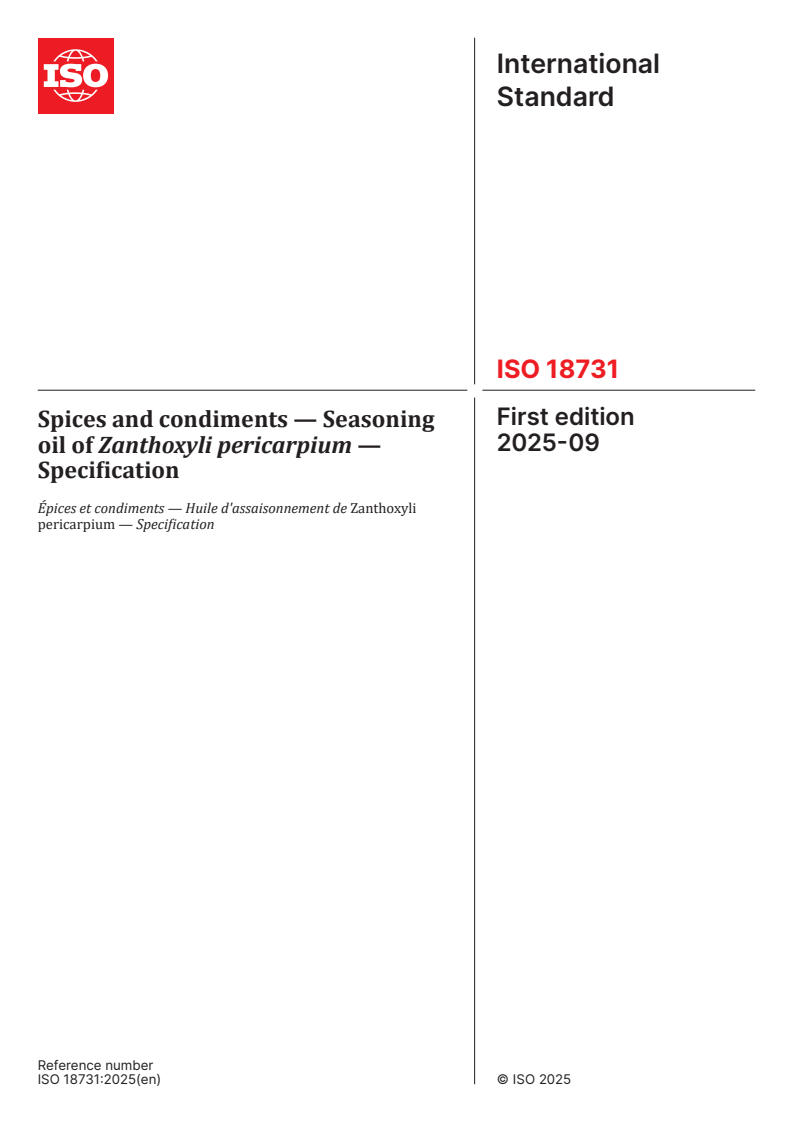
International
Standard
ISO 18731
First edition
Spices and condiments — Seasoning
2025-09
oil of Zanthoxyli pericarpium —
Specification
Épices et condiments — Huile d'assaisonnement de Zanthoxyli
pericarpium — Specification
Reference number
© ISO 2025
All rights reserved. Unless otherwise specified, or required in the context of its implementation, no part of this publication may
be reproduced or utilized otherwise in any form or by any means, electronic or mechanical, including photocopying, or posting on
the internet or an intranet, without prior written permission. Permission can be requested from either ISO at the address below
or ISO’s member body in the country of the requester.
ISO copyright office
CP 401 • Ch. de Blandonnet 8
CH-1214 Vernier, Geneva
Phone: +41 22 749 01 11
Email: copyright@iso.org
Website: www.iso.org
Published in Switzerland
ii
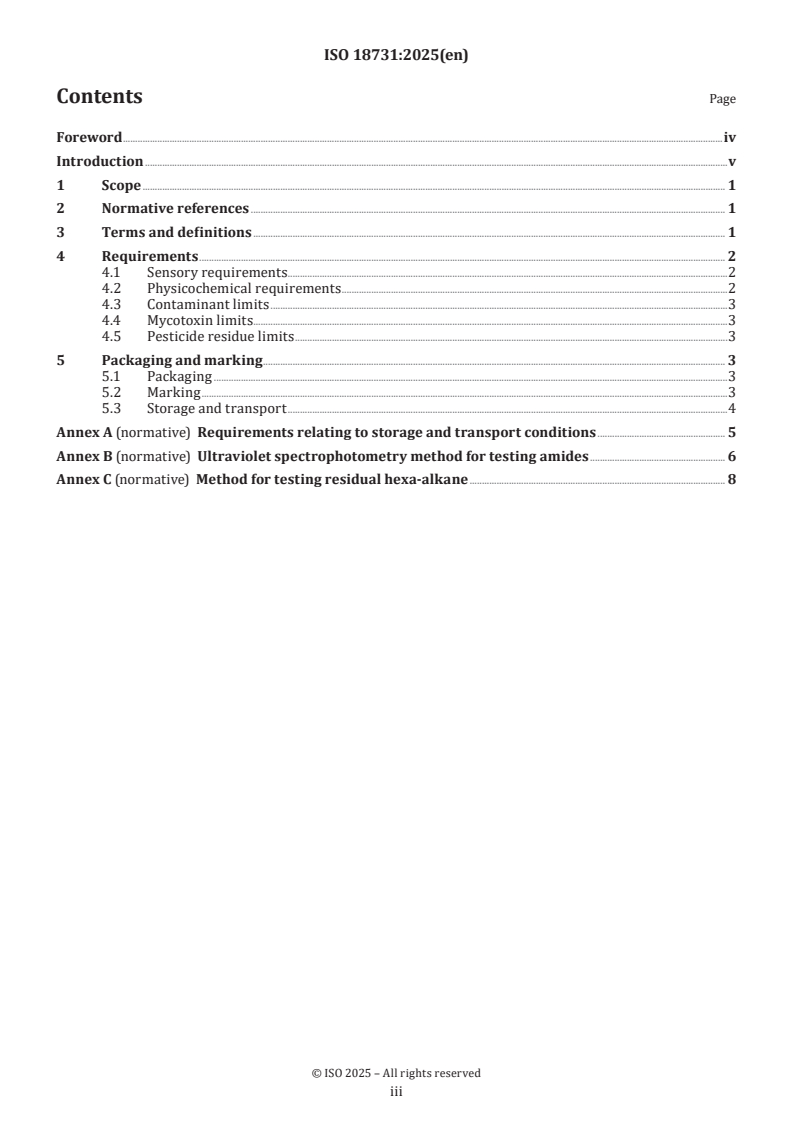
Contents Page
Foreword .iv
Introduction .v
1 Scope . 1
2 Normative references . 1
3 Terms and definitions . 1
4 Requirements . 2
4.1 Sensory requirements.2
4.2 Physicochemical requirements .2
4.3 Contaminant limits .3
4.4 Mycotoxin limits .3
4.5 Pesticide residue limits .3
5 Packaging and marking . 3
5.1 Packaging .3
5.2 Marking .3
5.3 Storage and transport .4
Annex A (normative) Requirements relating to storage and transport conditions . 5
Annex B (normative) Ultraviolet spectrophotometry method for testing amides . 6
Annex C (normative) Method for testing residual hexa-alkane . 8
iii
Foreword
ISO (the International Organization for Standardization) is a worldwide federation of national standards
bodies (ISO member bodies). The work of preparing International Standards is normally carried out through
ISO technical committees. Each member body interested in a subject for which a technical committee
has been established has the right to be represented on that committee. International organizations,
governmental and non-governmental, in liaison with ISO, also take part in the work. ISO collaborates closely
with the International Electrotechnical Commission (IEC) on all matters of electrotechnical standardization.
The procedures used to develop this document and those intended for its further maintenance are described
in the ISO/IEC Directives, Part 1. In particular, the different approval criteria needed for the different types
of ISO document should be noted. This document was drafted in accordance with the editorial rules of the
ISO/IEC Directives, Part 2 (see www.iso.org/directives).
ISO draws attention to the possibility that the implementation of this document may involve the use of (a)
patent(s). ISO takes no position concerning the evidence, validity or applicability of any claimed patent
rights in respect thereof. As of the date of publication of this document, ISO had received notice of (a)
patent(s) which may be required to implement this document. However, implementers are cautioned that
this may not represent the latest information, which may be obtained from the patent database available at
www.iso.org/patents. ISO shall not be held responsible for identifying any or all such patent rights.
Any trade name used in this document is information given for the convenience of users and does not
constitute an endorsement.
For an explanation of the voluntary nature of standards, the meaning of ISO specific terms and expressions
related to conformity assessment, as well as information about ISO’s adherence to the World Trade
Organization (WTO) principles in the Technical Barriers to Trade (TBT), see www.iso.org/iso/foreword.html.
This document was prepared by Technical Committee ISO/TC 34, Food products, Subcommittee SC 7, Spices,
culinary herbs and condiments.
Any feedback or questions on this document should be directed to the user’s national standards body. A
complete listing of these bodies can be found at www.iso.org/members.html.
iv
Introduction
With the growth of global population and economic development, the demand for the quantities and varieties
of condiments is increasing, which promotes the significant growth of international trade volume and
types of condiments, including seasoning oil of Zanthoxyli pericarpium. Although the condiments industry
is developing rapidly, due to the lack of a unified standard for product quality and safety assurance, the
international trade of seasoning oil of Zanthoxyli pericarpium has not reached its potential.
This document standardizes the characteristics of seasoning oil of Zanthoxyli pericarpium, and provides
corresponding qualitative and quantitative methods to help with detection and identification, product
grading, scaling, standardized production, reducing trade and communication barriers, meeting increasing
demand in the international market, and promoting the commercialization and trade of seasoning oil of
Zanthoxyli pericarpium.
v
International Standard ISO 18731:2025(en)
Spices and condiments — Seasoning oil of Zanthoxyli
pericarpium — Specification
1 Scope
This document specifies requirements for the seasoning oil of Zanthoxyli pericarpium.
2 Normative references
The following documents are referred to in the text in such a way that some or all of their content constitutes
requirements of this document. For dated references, only the edition cited applies. For undated references,
the latest edition of the referenced document (including any amendments) applies.
ISO 660, Animal and vegetable fats and oils — Determination of acid value and acidity
ISO 662, Animal and vegetable fats and oils — Determination of moisture and volatile matter content
ISO 3960, Animal and vegetable fats and oils — Determination of peroxide value — Iodometric (visual) endpoint
determination
ISO 9832, Animal and vegetable fats and oils — Determination of residual technical hexane content
ISO 15302, Animal and vegetable fats and oils — Determination of benzo[a]pyrene — Reverse-phase high
performance liquid chromatography method
ISO 16050, Foodstuffs — Determination of aflatoxin B1, and the total content of aflatoxins B1, B2, G1 and G2 in
cereals, nuts and derived products — High-performance liquid chromatographic method
CXS 193, General standard for contaminants and toxins in food and feed
Codex Pesticides Residues in Food Online Database. Available at : https:// www .fao .org/ fao -who
-codexalimentarius/ codex -texts/ dbs/ pestres/ en/
3 Terms and definitions
For the purposes of this document, the terms and definitions given in ISO 9832 and the following apply.
ISO and IEC maintain terminology databases for use in standardization at the following addresses:
— ISO Online browsing platform: available at https:// www .iso .org/ obp
— IEC Electropedia: available at https:// www .electropedia .org/
3.1
seasoning oil of Zanthoxyli pericarpium
oil made from Zanthoxyli pericarpium fruits as the main raw material, using vegetable oil extraction, filtration
or supercritical CO extraction, cold pressing and other methods, via diluting with vegetable oil and filtering
Note 1 to entry: Zanthoxyli pericarpium includes red prickly ash pepper (Zanthoxylum bungeanum Maxim. Syn.
Zanthoxylum bungei Planch), green prickly ash pepper (Zanthoxylum schinifolium Sieb.et Zucc.), bamboo prickly ash
pepper (Zanthoxylum armatum DC.), Chinese pepper (Zanthoxylum acanthopodium DC.), Japanese pepper (Zanthoxylum
piperitum DC.).
3.2
residual solvent content
content of volatile hydrocarbons such as those remaining in fats following processing involving the use of
hydrocarbon solvents
Note 1 to entry: The residual solvent is determined according to the method specified in this document.
Note 2 to entry: The content is expressed as milligrams of volatile hydrocarbons per kilogram of sample.
[SOURCE: ISO 9832:2002, 3.1, modified — Term changed from “residual technical hexane content”. Last part
of the definition moved to a note to entry.]
3.3
matrix oil
vegetable oil used for dilution of oil of Zanthoxyli pericarpium to make its seasoning oil, when used for
purpose of analysis of the product
Note 1 to entry: The matrix oil is obtained by refining processes such as deodorization and decolorization or by
ultrasonic degassing at room temperature.
4 Requirements
4.1 Sensory requirements
The seasoning oil of Zanthoxyli pericarpium shall conform to the sensory requirements given in Table 1.
Table 1 — Sensory requirements
Characteristics Requirements Method of test
Appearance Oily liquid, clear, no visible foreign matter.
Place an appropriate sample in a 50 ml
beaker; observe appearance and colour
Colour Seasoning oil shall have the characteristics colour
under sunlight.
of the spice or oil depending on the process used.
Flavour The flavour contains the characteristic of Zanthox-
Pour the sample into a 150 ml beaker.
yli pericarpium fruit. The product shall be free from
Heat the water bath to 50 °C. Stir the
foreign flavours.
contents quickly with a glass stick and
Taste The taste contains t
...