


ISO 21983:2019
(Main)Guidelines for the harvesting, transportation, separation of stigma, drying and storage of saffron before packing
Guidelines for the harvesting, transportation, separation of stigma, drying and storage of saffron before packing
This document gives guidelines for the harvesting, transportation, separation of stigma, drying and storage of saffron before processing and packaging.
Lignes directrices pour la récolte, le transport, la séparation des stigmates, le séchage et le stockage du safran avant l'emballage
General Information
- Status
- Published
- Publication Date
- 06-Nov-2019
- Technical Committee
- ISO/TC 34/SC 7 - Spices, culinary herbs and condiments
- Drafting Committee
- ISO/TC 34/SC 7 - Spices, culinary herbs and condiments
- Current Stage
- 9093 - International Standard confirmed
- Start Date
- 19-May-2025
- Completion Date
- 14-Feb-2026
Overview
ISO 21983:2019 provides comprehensive guidelines for the harvesting, transportation, separation of stigma, drying, and storage of saffron before packing. This international standard ensures that saffron producers and processors can maintain high product quality and safety by adopting standardized procedures from the field to post-harvest handling.
The standard focuses on preserving the key quality indicators of saffron such as flavor, color, and aroma by outlining best practices during critical stages - harvesting saffron flowers, transporting them to processing units, carefully separating the valuable stigma, optimizing drying conditions, and securely storing the dried product before packaging.
Key Topics
Harvesting Practices
- Harvest timing: Flowers are to be harvested in mid-autumn, ideally early in the morning when temperatures are low and flower corollas remain closed to preserve stigma quality.
- Manual collection: Harvesting is primarily manual by cutting flower stems carefully to avoid damaging the plants and encourage future growth.
- Hygiene: Workers must maintain high personal hygiene to prevent contamination, focusing especially on clean hands.
- Appropriate containers: Use clean, dry baskets that protect flowers from mechanical damage and environmental pollutants.
Transportation Guidelines
- Protection during transit: Flowers should be shielded from mechanical damage, excessive heat, and light to prevent quality loss.
- Minimize transit time: Transport flowers promptly to processing units or storage at controlled temperatures (4°C to 5°C) to prolong freshness.
Separation of Stigma
- Sanitary environment: Separation must be performed in clean, dust-free conditions with personnel practicing strict food hygiene.
- Handling and grading: Stigmas should be separated carefully from floral waste to produce different grades of saffron, with specific length and purity criteria.
- Containers: Use washable, safe containers that do not degrade saffron quality.
Drying Process
- Immediate drying: Stigmas must be dried soon after separation to maintain quality.
- Drying conditions: Controlled temperature and humidity are vital to achieve optimal moisture content, avoiding degradation of color and aroma.
- Methods: Various drying techniques may be employed, but maintaining moisture content in line with ISO 3632-1 standards is critical.
Storage Recommendations
- Controlled environment: Store dried saffron in clean, dry, and cool conditions to ensure the preservation of sensory and chemical properties.
- Packaging preparation: Proper curing prior to packing helps maintain long-term saffron quality and safety.
Applications
ISO 21983:2019 is invaluable for a broad range of stakeholders involved in the saffron supply chain, including:
- Farmers and harvesters ensuring the initial crop quality.
- Processors and separation unit operators aiming to meet specific saffron grades and certifications.
- Quality control and food safety professionals applying hygienic standards during handling.
- Exporters and packaging companies who require preserving saffron quality during storage and shipment.
- Regulatory bodies and certification agencies monitoring compliance with international best practices.
Adherence to these guidelines promotes standardization across saffron production processes, reducing economic losses and delivering premium quality saffron to consumers globally.
Related Standards
To complement ISO 21983:2019, organizations may consider the following related standards:
- ISO 3632-1 – Defines quality criteria for saffron based on chemical and sensory characteristics, including moisture content limits.
- ISO/TS 22002-1 and ISO/TS 22002-3 – Provide prerequisite programs for food hygiene management in agricultural production and food processing.
- Codex Alimentarius Guidelines (CAC/RCP 1 and CAC/RCP 42) – Cover general food hygiene principles that support safe handling during saffron processing.
Implementing these interconnected standards creates a robust framework to achieve high-quality, safe, and authentic saffron products.
By following ISO 21983:2019 guidelines, saffron producers can ensure superior product quality from harvest through to packaging - enhancing consumer trust and supporting sustainable saffron industry development worldwide.
Buy Documents
ISO 21983:2019 - Guidelines for the harvesting, transportation, separation of stigma, drying and storage of saffron before packing
ISO 21983:2019 - Guidelines for the harvesting, transportation, separation of stigma, drying and storage of saffron before packing Released:11/7/2019
Get Certified
Connect with accredited certification bodies for this standard

BSI Group
BSI (British Standards Institution) is the business standards company that helps organizations make excellence a habit.

Bureau Veritas
Bureau Veritas is a world leader in laboratory testing, inspection and certification services.

DNV
DNV is an independent assurance and risk management provider.
Sponsored listings
Frequently Asked Questions
ISO 21983:2019 is a standard published by the International Organization for Standardization (ISO). Its full title is "Guidelines for the harvesting, transportation, separation of stigma, drying and storage of saffron before packing". This standard covers: This document gives guidelines for the harvesting, transportation, separation of stigma, drying and storage of saffron before processing and packaging.
This document gives guidelines for the harvesting, transportation, separation of stigma, drying and storage of saffron before processing and packaging.
ISO 21983:2019 is classified under the following ICS (International Classification for Standards) categories: 67.220.10 - Spices and condiments. The ICS classification helps identify the subject area and facilitates finding related standards.
ISO 21983:2019 is available in PDF format for immediate download after purchase. The document can be added to your cart and obtained through the secure checkout process. Digital delivery ensures instant access to the complete standard document.
Standards Content (Sample)
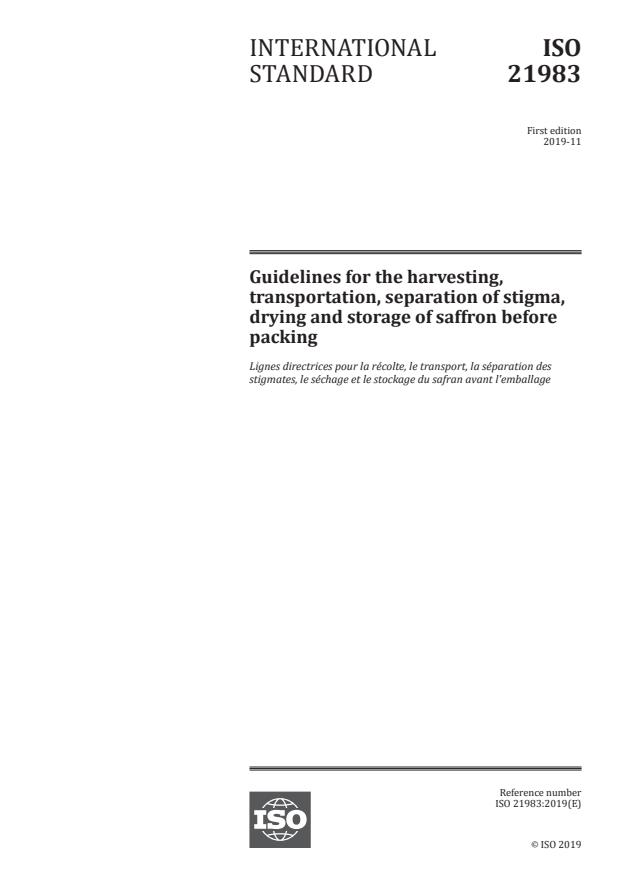
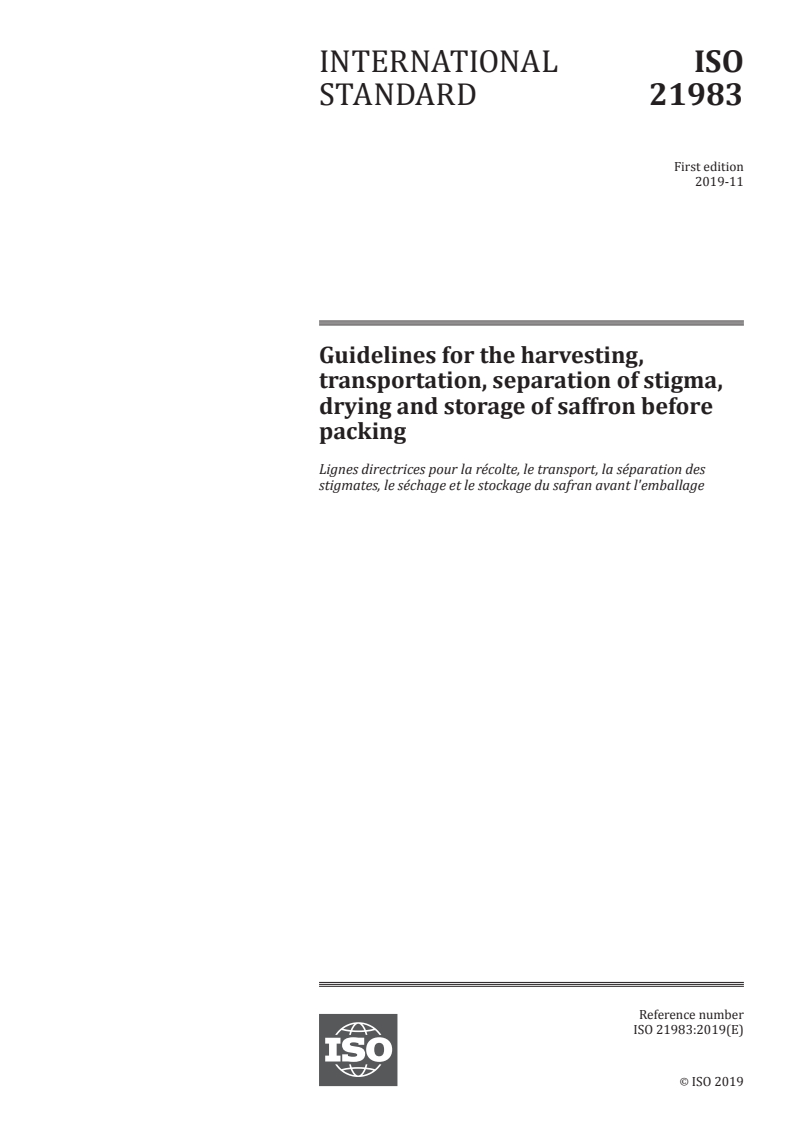
INTERNATIONAL ISO
STANDARD 21983
First edition
2019-11
Guidelines for the harvesting,
transportation, separation of stigma,
drying and storage of saffron before
packing
Lignes directrices pour la récolte, le transport, la séparation des
stigmates, le séchage et le stockage du safran avant l'emballage
Reference number
©
ISO 2019
© ISO 2019
All rights reserved. Unless otherwise specified, or required in the context of its implementation, no part of this publication may
be reproduced or utilized otherwise in any form or by any means, electronic or mechanical, including photocopying, or posting
on the internet or an intranet, without prior written permission. Permission can be requested from either ISO at the address
below or ISO’s member body in the country of the requester.
ISO copyright office
CP 401 • Ch. de Blandonnet 8
CH-1214 Vernier, Geneva
Phone: +41 22 749 01 11
Fax: +41 22 749 09 47
Email: copyright@iso.org
Website: www.iso.org
Published in Switzerland
ii © ISO 2019 – All rights reserved
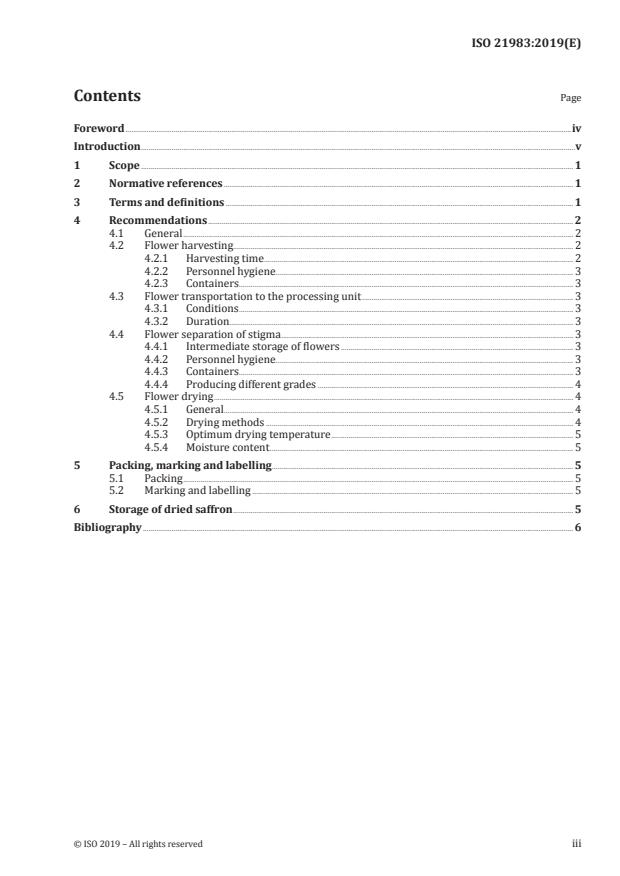
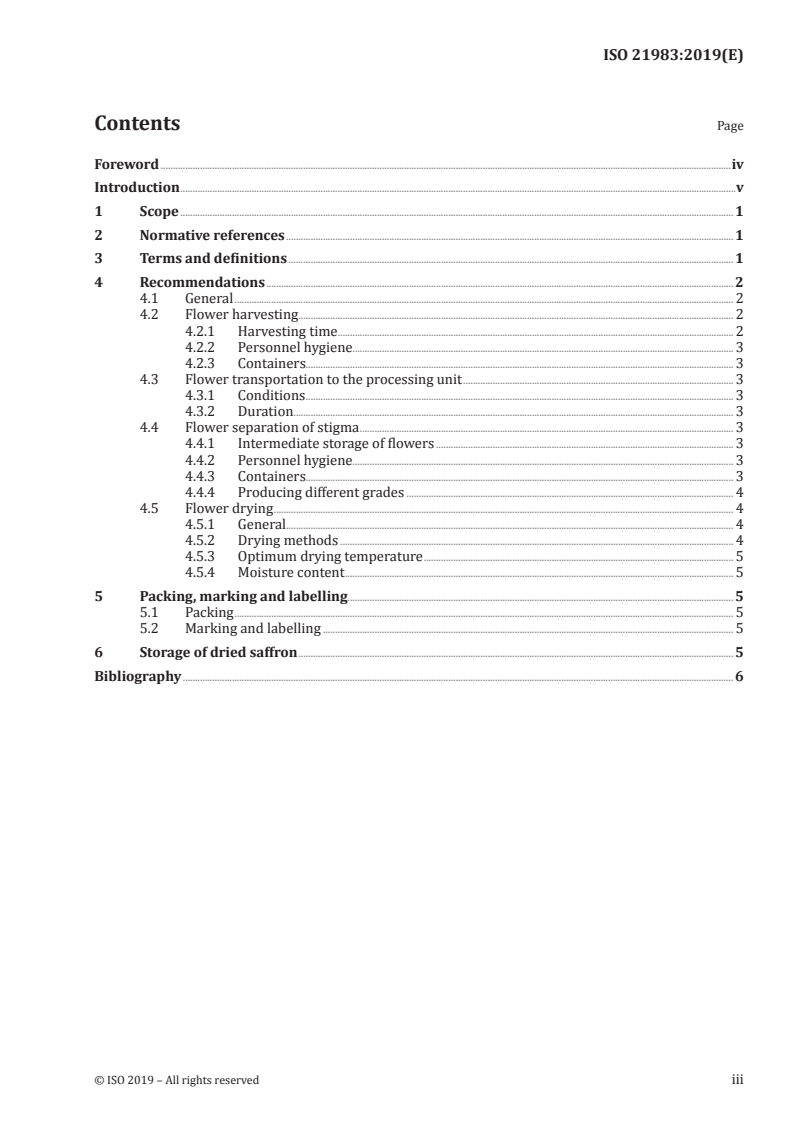
Contents Page
Foreword .iv
Introduction .v
1 Scope . 1
2 Normative references . 1
3 Terms and definitions . 1
4 Recommendations . 2
4.1 General . 2
4.2 Flower harvesting . . 2
4.2.1 Harvesting time . . 2
4.2.2 Personnel hygiene. 3
4.2.3 Containers. 3
4.3 Flower transportation to the processing unit . 3
4.3.1 Conditions . 3
4.3.2 Duration. 3
4.4 Flower separation of stigma . 3
4.4.1 Intermediate storage of flowers . 3
4.4.2 Personnel hygiene. 3
4.4.3 Containers. 3
4.4.4 Producing different grades . 4
4.5 Flower drying . 4
4.5.1 General. 4
4.5.2 Drying methods . 4
4.5.3 Optimum drying temperature . 5
4.5.4 Moisture content . 5
5 Packing, marking and labelling. 5
5.1 Packing . 5
5.2 Marking and labelling . 5
6 Storage of dried saffron . 5
Bibliography . 6
Foreword
ISO (the International Organization for Standardization) is a worldwide federation of national standards
bodies (ISO member bodies). The work of preparing International Standards is normally carried out
through ISO technical committees. Each member body interested in a subject for which a technical
committee has been established has the right to be represented on that committee. International
organizations, governmental and non-governmental, in liaison with ISO, also take part in the work.
ISO collaborates closely with the International Electrotechnical Commission (IEC) on all matters of
electrotechnical standardization.
The procedures used to develop this document and those intended for its further maintenance are
described in the ISO/IEC Directives, Part 1. In particular, the different approval criteria needed for the
different types of ISO documents should be noted. This document was drafted in accordance with the
editorial rules of the ISO/IEC Directives, Part 2 (see www .iso .org/ directives).
Attention is drawn to the possibility that some of the elements of this document may be the subject of
patent rights. ISO shall not be held responsible for identifying any or all such patent rights. Details of
any patent rights identified during the development of the document will be in the Introduction and/or
on the ISO list of patent declarations received (see www .iso .org/ patents).
Any trade name used in this document is information given for the convenience of users and does not
constitute an endorsement.
For an explanation of the voluntary nature of standards, the meaning of ISO specific terms and
expressions related to conformity assessment, as well as information about ISO’s adherence to the
World Trade Organization (WTO) principles in the Technical Barriers to Trade (TBT), see www .iso .org/
iso/ foreword .html.
This document was prepared by Technical Committee ISO/TC 34, Food products, Subcommittee SC 7,
Spices, culinary herbs and condiments.
Any feedback or questions on this document should be directed to the user’s national standards body. A
complete listing of these bodies can be found at www .iso .org/ members .html.
iv © ISO 2019 – All rights reserved
Introduction
The main factor affecting the quality of saffron is the attention paid to the correct procedures of
harvesting, processing and packing. Familiarity with the principles of harvesting the flowers from
farms and attention to the transportation conditions from the farm to the processing place play an
important role in maintaining the flavour, colour and other specifications of saffron. In addition, the
processing method of separation, the collection of stigma and the drying method are very important.
After drying the stigma, storage in good conditions can maintain the quality of saffron, especially
regarding colour and flavour. Unfortunately, in many cases during the harvest, due to a lack of
knowledge of farmers and processors, aspects such as transportation, the separation of stigma, and
drying and storage are neglected and the quality of saffron is compromised. Not only does this cause
economic losses but consumers receive a substandard product. This guidance document on the correct
principles of harvesting, transportation, the separation of stigma, and the drying and storage of saffron
is designed to help growers and processors provide higher quality products.
INTERNATIONAL STANDARD ISO 21983:2019(E)
Guidelines for the harvesting, transportation, separation of
stigma, drying and storage of saffron before packing
1 Scope
This document gives guidelines for the harvesting, transportation, separation of stigma, drying and
storage of saffron before processing and packaging.
2 Normative references
There are no normative references in this document.
3 Terms and definitions
For the purposes of this document, the following terms and definitions apply.
ISO and IEC maintain terminological databases for use in standardization at the following addresses:
— ISO Online browsing platform: available at https:// www .iso .org/ obp
— IEC Electropedia: available at http:// www .electropedia .org/
3.1
saffron plant
flowering plant of the Crocus genus (Crocus sativus L.) in the Iridaceae family
3.2
saffron
dried stigmas (3.3) and part of styles (3.4) of the flower (Crocus sativus L.) that is edible in nature
3.3
stigma
section of the aerial part of the pistil of Crocus sativus L. flower, dark red in colour and trumpet shaped,
serrated or indented at the top and joined to the style (3.4) at the end
Note 1 to entry: The stigma length is about 20 mm to 40 mm.
3.4
style
part of the pistil between the stigma (3.3) and the ovary
Note 1 to entry: The style length is usually between 5 cm and 10 cm, and the diameter between 0,15 mm and
0,25 mm.
3.5
stamen
yellow male reproductive organ of the Crocus sativus L. flower
3.6
extraneous matter
all matter visible to the naked eye or with a maximum 10 times magnification that are other parts
...
INTERNATIONAL ISO
STANDARD 21983
First edition
2019-11
Guidelines for the harvesting,
transportation, separation of stigma,
drying and storage of saffron before
packing
Lignes directrices pour la récolte, le transport, la séparation des
stigmates, le séchage et le stockage du safran avant l'emballage
Reference number
©
ISO 2019
© ISO 2019
All rights reserved. Unless otherwise specified, or required in the context of its implementation, no part of this publication may
be reproduced or utilized otherwise in any form or by any means, electronic or mechanical, including photocopying, or posting
on the internet or an intranet, without prior written permission. Permission can be requested from either ISO at the address
below or ISO’s member body in the country of the requester.
ISO copyright office
CP 401 • Ch. de Blandonnet 8
CH-1214 Vernier, Geneva
Phone: +41 22 749 01 11
Fax: +41 22 749 09 47
Email: copyright@iso.org
Website: www.iso.org
Published in Switzerland
ii © ISO 2019 – All rights reserved
Contents Page
Foreword .iv
Introduction .v
1 Scope . 1
2 Normative references . 1
3 Terms and definitions . 1
4 Recommendations . 2
4.1 General . 2
4.2 Flower harvesting . . 2
4.2.1 Harvesting time . . 2
4.2.2 Personnel hygiene. 3
4.2.3 Containers. 3
4.3 Flower transportation to the processing unit . 3
4.3.1 Conditions . 3
4.3.2 Duration. 3
4.4 Flower separation of stigma . 3
4.4.1 Intermediate storage of flowers . 3
4.4.2 Personnel hygiene. 3
4.4.3 Containers. 3
4.4.4 Producing different grades . 4
4.5 Flower drying . 4
4.5.1 General. 4
4.5.2 Drying methods . 4
4.5.3 Optimum drying temperature . 5
4.5.4 Moisture content . 5
5 Packing, marking and labelling. 5
5.1 Packing . 5
5.2 Marking and labelling . 5
6 Storage of dried saffron . 5
Bibliography . 6
Foreword
ISO (the International Organization for Standardization) is a worldwide federation of national standards
bodies (ISO member bodies). The work of preparing International Standards is normally carried out
through ISO technical committees. Each member body interested in a subject for which a technical
committee has been established has the right to be represented on that committee. International
organizations, governmental and non-governmental, in liaison with ISO, also take part in the work.
ISO collaborates closely with the International Electrotechnical Commission (IEC) on all matters of
electrotechnical standardization.
The procedures used to develop this document and those intended for its further maintenance are
described in the ISO/IEC Directives, Part 1. In particular, the different approval criteria needed for the
different types of ISO documents should be noted. This document was drafted in accordance with the
editorial rules of the ISO/IEC Directives, Part 2 (see www .iso .org/ directives).
Attention is drawn to the possibility that some of the elements of this document may be the subject of
patent rights. ISO shall not be held responsible for identifying any or all such patent rights. Details of
any patent rights identified during the development of the document will be in the Introduction and/or
on the ISO list of patent declarations received (see www .iso .org/ patents).
Any trade name used in this document is information given for the convenience of users and does not
constitute an endorsement.
For an explanation of the voluntary nature of standards, the meaning of ISO specific terms and
expressions related to conformity assessment, as well as information about ISO’s adherence to the
World Trade Organization (WTO) principles in the Technical Barriers to Trade (TBT), see www .iso .org/
iso/ foreword .html.
This document was prepared by Technical Committee ISO/TC 34, Food products, Subcommittee SC 7,
Spices, culinary herbs and condiments.
Any feedback or questions on this document should be directed to the user’s national standards body. A
complete listing of these bodies can be found at www .iso .org/ members .html.
iv © ISO 2019 – All rights reserved
Introduction
The main factor affecting the quality of saffron is the attention paid to the correct procedures of
harvesting, processing and packing. Familiarity with the principles of harvesting the flowers from
farms and attention to the transportation conditions from the farm to the processing place play an
important role in maintaining the flavour, colour and other specifications of saffron. In addition, the
processing method of separation, the collection of stigma and the drying method are very important.
After drying the stigma, storage in good conditions can maintain the quality of saffron, especially
regarding colour and flavour. Unfortunately, in many cases during the harvest, due to a lack of
knowledge of farmers and processors, aspects such as transportation, the separation of stigma, and
drying and storage are neglected and the quality of saffron is compromised. Not only does this cause
economic losses but consumers receive a substandard product. This guidance document on the correct
principles of harvesting, transportation, the separation of stigma, and the drying and storage of saffron
is designed to help growers and processors provide higher quality products.
INTERNATIONAL STANDARD ISO 21983:2019(E)
Guidelines for the harvesting, transportation, separation of
stigma, drying and storage of saffron before packing
1 Scope
This document gives guidelines for the harvesting, transportation, separation of stigma, drying and
storage of saffron before processing and packaging.
2 Normative references
There are no normative references in this document.
3 Terms and definitions
For the purposes of this document, the following terms and definitions apply.
ISO and IEC maintain terminological databases for use in standardization at the following addresses:
— ISO Online browsing platform: available at https:// www .iso .org/ obp
— IEC Electropedia: available at http:// www .electropedia .org/
3.1
saffron plant
flowering plant of the Crocus genus (Crocus sativus L.) in the Iridaceae family
3.2
saffron
dried stigmas (3.3) and part of styles (3.4) of the flower (Crocus sativus L.) that is edible in nature
3.3
stigma
section of the aerial part of the pistil of Crocus sativus L. flower, dark red in colour and trumpet shaped,
serrated or indented at the top and joined to the style (3.4) at the end
Note 1 to entry: The stigma length is about 20 mm to 40 mm.
3.4
style
part of the pistil between the stigma (3.3) and the ovary
Note 1 to entry: The style length is usually between 5 cm and 10 cm, and the diameter between 0,15 mm and
0,25 mm.
3.5
stamen
yellow male reproductive organ of the Crocus sativus L. flower
3.6
extraneous matter
all matter visible to the naked eye or with a maximum 10 times magnification that are other parts
...
Questions, Comments and Discussion
Ask us and Technical Secretary will try to provide an answer. You can facilitate discussion about the standard in here.
Loading comments...