

ISO 15914:2004
(Main)Animal feeding stuffs — Enzymatic determination of total starch content
General Information
- Abstract
ISO 15914:2004 specifies a method for the enzymatic determination of the total starch content of animal feeding stuffs and raw materials for animal feeding stuffs. The method is also applicable to the determination of starch in starch. It is important that in the sample matrix no components are present which contribute to the measured extinction at 340 nm. The analytical range of the method is 40 g/kg to 1 000 g/kg starch. The standard procedure is applicable to the range 200 g/kg to 1000 g/kg. For the lower range, 40 g/kg to 200 g/kg, another dilution procedure for the standard glucose solution and samples can be used.
- Status
- Published
- Publication Date
- 20-Jan-2004
- Technical Committee
- ISO/TC 34/SC 10 - Animal feeding stuffs
- Drafting Committee
- ISO/TC 34/SC 10 - Animal feeding stuffs
- Current Stage
- 9093 - International Standard confirmed
- Start Date
- 29-Oct-2022
- Completion Date
- 29-Aug-2026
Overview
ISO 15914:2004 - "Animal feeding stuffs - Enzymatic determination of total starch content" specifies a validated laboratory method for measuring total starch in animal feeds and raw feed materials. The standard describes an enzymatic procedure that converts solubilized starch to glucose and quantifies glucose enzymatically (hexokinase method), with measurement at 340 nm. The method covers an analytical range of 40 g/kg to 1 000 g/kg starch (standard procedure 200–1 000 g/kg; alternate dilution for 40–200 g/kg).
Key topics and technical requirements
- Principle: Remove soluble sugars with 40% ethanol, solubilize starch in 90% DMSO at 100 °C, partially hydrolyse with concentrated HCl at 60 °C, enzymatically convert starch to glucose using amyloglucosidase, and quantify glucose using the hexokinase UV method (measurement at 340 nm).
- Analytical range: 40–1 000 g/kg (standard workflow optimized for 200–1 000 g/kg; alternate dilution procedures provided for lower concentrations).
- Interference control: Sample matrices must not contain components that absorb at 340 nm (avoid false results from interfering extinction).
- Reagents & enzymes: Specifies DMSO 90% (v/v), 40% ethanol, Carrez clarifying reagents, amyloglucosidase solution (activity defined), and freshly prepared standard glucose solutions.
- Apparatus: UV spectrometer capable at 340 nm, centrifuges, calibrated pipettes, water baths (100 °C and 60 °C), pH meter, and suitable centrifuge tubes.
- Sample preparation: Follow ISO 6498 for feed sample prep and use water meeting ISO 3696. Tests are performed in duplicate with a sample blank in each series.
- Precision & reporting: Contains procedural details for calculation, precision, and required test report content.
Applications and who uses it
ISO 15914:2004 is used for:
- Routine quality control in feed manufacturing and formulation
- Contract testing laboratories analysing feed raw materials (cereals, by-products)
- Verification of starch purity in starch products
- Regulatory and compliance testing where standardized starch quantification is required
- Nutritional analysis for feed formulation and labelling
Primary users:
- Feed manufacturers and mill laboratories
- Agricultural testing and food/feed analytical labs
- Academia and research groups studying feed composition
- Regulatory agencies overseeing feed composition standards
Related standards
- ISO 6498:1998 - Preparation of test samples for animal feeding stuffs (referenced for sample prep)
- ISO 3696:1987 - Water for analytical laboratory use (reagent water quality)
Using ISO 15914:2004 ensures reproducible, enzyme-based starch analysis in animal feeding stuffs, supporting accurate feed formulation, quality control, and compliance with international testing practices.
Relations
- Effective Date
- 09-Feb-2026
- Effective Date
- 09-Feb-2026
Get Certified
Connect with accredited certification bodies for this standard

Control Union Certifications
Global certification for agriculture and sustainability.

ECOCERT
Organic and sustainability certification.

FSC International
Forest Stewardship Council certification.
Sponsored listings
Frequently Asked Questions
ISO 15914:2004 is a standard published by the International Organization for Standardization (ISO). Its full title is "Animal feeding stuffs — Enzymatic determination of total starch content". This standard covers: ISO 15914:2004 specifies a method for the enzymatic determination of the total starch content of animal feeding stuffs and raw materials for animal feeding stuffs. The method is also applicable to the determination of starch in starch. It is important that in the sample matrix no components are present which contribute to the measured extinction at 340 nm. The analytical range of the method is 40 g/kg to 1 000 g/kg starch. The standard procedure is applicable to the range 200 g/kg to 1000 g/kg. For the lower range, 40 g/kg to 200 g/kg, another dilution procedure for the standard glucose solution and samples can be used.
ISO 15914:2004 specifies a method for the enzymatic determination of the total starch content of animal feeding stuffs and raw materials for animal feeding stuffs. The method is also applicable to the determination of starch in starch. It is important that in the sample matrix no components are present which contribute to the measured extinction at 340 nm. The analytical range of the method is 40 g/kg to 1 000 g/kg starch. The standard procedure is applicable to the range 200 g/kg to 1000 g/kg. For the lower range, 40 g/kg to 200 g/kg, another dilution procedure for the standard glucose solution and samples can be used.
ISO 15914:2004 is classified under the following ICS (International Classification for Standards) categories: 65.120 - Animal feeding stuffs. The ICS classification helps identify the subject area and facilitates finding related standards.
ISO 15914:2004 has the following relationships with other standards: It is inter standard links to EN ISO 6647-1:2007, EN ISO 6647-1:2020. Understanding these relationships helps ensure you are using the most current and applicable version of the standard.
ISO 15914:2004 is available in PDF format for immediate download after purchase. The document can be added to your cart and obtained through the secure checkout process. Digital delivery ensures instant access to the complete standard document.
Standards Content (Sample)
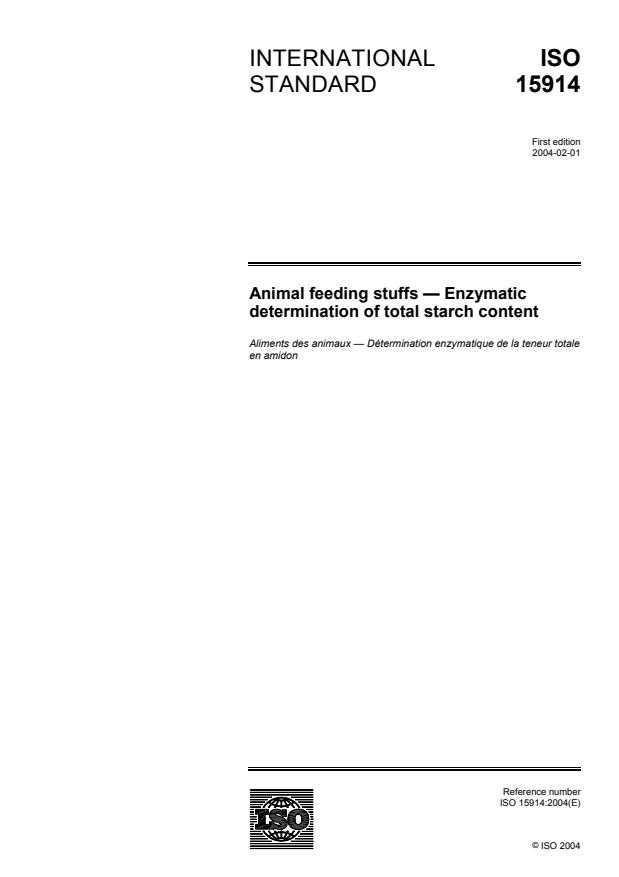
INTERNATIONAL ISO
STANDARD 15914
First edition
2004-02-01
Animal feeding stuffs — Enzymatic
determination of total starch content
Aliments des animaux — Détermination enzymatique de la teneur totale
en amidon
Reference number
©
ISO 2004
PDF disclaimer
This PDF file may contain embedded typefaces. In accordance with Adobe's licensing policy, this file may be printed or viewed but
shall not be edited unless the typefaces which are embedded are licensed to and installed on the computer performing the editing. In
downloading this file, parties accept therein the responsibility of not infringing Adobe's licensing policy. The ISO Central Secretariat
accepts no liability in this area.
Adobe is a trademark of Adobe Systems Incorporated.
Details of the software products used to create this PDF file can be found in the General Info relative to the file; the PDF-creation
parameters were optimized for printing. Every care has been taken to ensure that the file is suitable for use by ISO member bodies. In
the unlikely event that a problem relating to it is found, please inform the Central Secretariat at the address given below.
© ISO 2004
All rights reserved. Unless otherwise specified, no part of this publication may be reproduced or utilized in any form or by any means,
electronic or mechanical, including photocopying and microfilm, without permission in writing from either ISO at the address below or
ISO's member body in the country of the requester.
ISO copyright office
Case postale 56 • CH-1211 Geneva 20
Tel. + 41 22 749 01 11
Fax + 41 22 749 09 47
E-mail copyright@iso.org
Web www.iso.org
Published in Switzerland
ii © ISO 2004 – All rights reserved
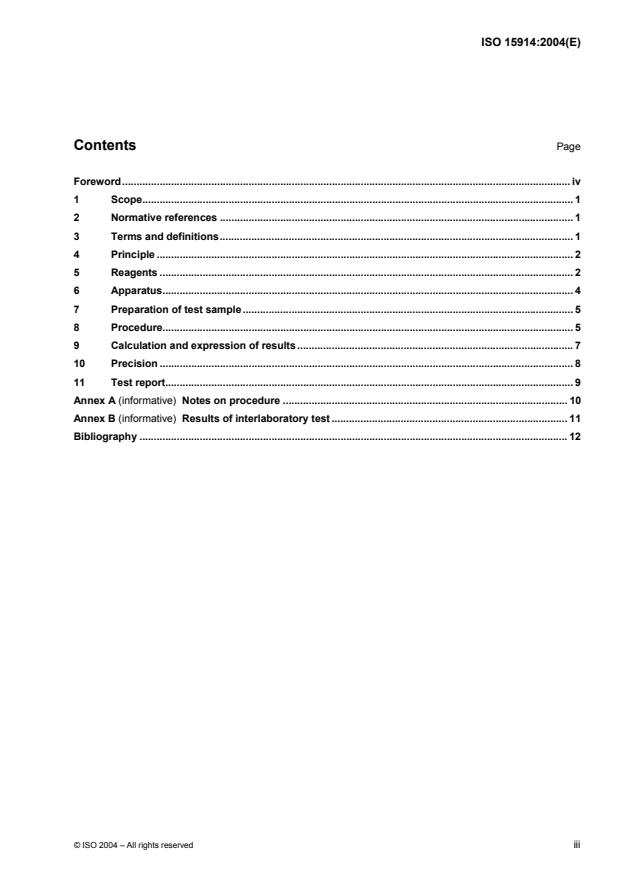
Contents Page
Foreword. iv
1 Scope. 1
2 Normative references . 1
3 Terms and definitions. 1
4 Principle . 2
5 Reagents . 2
6 Apparatus. 4
7 Preparation of test sample. 5
8 Procedure. 5
9 Calculation and expression of results . 7
10 Precision . 8
11 Test report. 9
Annex A (informative) Notes on procedure . 10
Annex B (informative) Results of interlaboratory test . 11
Bibliography . 12
Foreword
ISO (the International Organization for Standardization) is a worldwide federation of national standards bodies
(ISO member bodies). The work of preparing International Standards is normally carried out through ISO
technical committees. Each member body interested in a subject for which a technical committee has been
established has the right to be represented on that committee. International organizations, governmental and
non-governmental, in liaison with ISO, also take part in the work. ISO collaborates closely with the
International Electrotechnical Commission (IEC) on all matters of electrotechnical standardization.
International Standards are drafted in accordance with the rules given in the ISO/IEC Directives, Part 2.
The main task of technical committees is to prepare International Standards. Draft International Standards
adopted by the technical committees are circulated to the member bodies for voting. Publication as an
International Standard requires approval by at least 75 % of the member bodies casting a vote.
Attention is drawn to the possibility that some of the elements of this document may be the subject of patent
rights. ISO shall not be held responsible for identifying any or all such patent rights.
ISO 15914 was prepared by Technical Committee ISO/TC 34, Food products, Subcommittee SC 10, Animal
feeding stuffs.
iv © ISO 2004 – All rights reserved
INTERNATIONAL STANDARD ISO 15914:2004(E)
Animal feeding stuffs — Enzymatic determination of total starch
content
1 Scope
This international Standard specifies a method for the enzymatic determination of the total starch content of
animal feeding stuffs and raw materials for animal feeding stuffs.
The method is also applicable to the determination of the purity of starch.
It is important that in the sample matrix no components are present which contribute to the measured
extinction at 340 nm.
The analytical range of the method is 40 g/kg to 1 000 g/kg starch. The standard procedure is applicable to
the range 200 g/kg to 1000 g/kg. For the lower range, 40 g/kg to 200 g/kg, another dilution procedure for the
standard glucose solution and samples can be used.
2 Normative references
The following referenced documents are indispensable for the application of this document. For dated
references, only the edition cited applies. For undated references, the latest edition of the referenced
document (including any amendments) applies.
ISO 3696:1987, Water for analytical laboratory use — Specification and test methods
ISO 6498:1998, Animal feeding stuffs — Preparation of test samples
3 Terms and definitions
For the purpose of this document, the following terms and definitions apply.
3.1
starch
natural vegetable polymer consisting of long linear unbranched chains of 1,4-α-D-glucose units (amylose)
and/or long α-1,6-branched chains of α-1,4-linked glucose units (amylopectin)
3.2
starch content
mass fraction of starch and its high molecular mass breakdown products, insoluble in 40 % ethanol, and
determined in accordance with the method of this International Standard
NOTE The starch content is expressed in grams per kilogram.
4 Principle
The milled test sample is extracted with 40 % ethanol to remove the soluble sugars. Sample disintegration
and starch solubilization is achieved by dispersing the extracted test portion in aqueous DMSO (90 % volume
fraction) at 100 °C, followed by addition of concentrated hydrochloric acid at 60 °C. The solubilized and
dissolved starch is quantitatively converted into glucose by the enzyme amyloglucosidase. The glucose
quantification is carried out by the well-known hexokinase method (see [1], [2]).
5 Reagents
Use only reagents of recognized analytical grade.
5.1 Water, complying with at least grade 3 in accordance with ISO 3696:1987.
5.2 Ethanol (C H OH), 40 % (volume fraction)
2 5
Take 417 ml of ethanol (96 % volume fraction) and dilute with water to 1 000 ml
5.3 Hydrochloric acid, c(HCl) = 12 mol/l.
5.4 Aqueous sodium hydroxide, c(NaOH) = 4 mol/l.
Dissolve in a beaker 40 g of NaOH in about 50 ml water. After cooling, transfer quantitatively to a 250 ml
volumetric flask and dilute to the mark with water.
WARNING — Heat develops. Wear safety glasses.
5.5 Acetic acid solution, c(CH COOH) = 2 mol/l.
Add to a 500 ml volumetric flask about 200 ml water, followed by 59 ml of glacial acetic acid. Dilute to the
mark with water.
5.6 Sodium acetate solution, c(CH COONa) = 2 mol/l.
Dissolve, in a 500 ml volumetric flask, 82,0 g of sodium acetate in water and dilute to the mark with water.
5.7 Sodium acetate buffer, c(CH COONa/H) = 2 mol/l, pH = 4,8.
Mix 41 ml of acetic acid solution (5.5) with 59 ml of sodium acetate solution (5.6). Check the pH with a
pH-meter and, if necessary, adjust to obtain the correct pH with the acetic acid or the sodium acetate solution.
Prepare a fresh buffer solution daily.
5.8 Aqueous dimethylsulfoxide, (σ ) = 90 % (volume fraction).
DMSO
Mix pure DMSO and water in a volume ratio of 9:1.
5.9 Clarifying solutions, according to Carrez, prepared as follows.
5.9.1 Potassium hexacyanoferrate(II) solution, c[K Fe(CN) ] = 0,25 mol/l.
4 6
In a 1 litre volumetric flask, dissolve 106 g of potassium hexacyanoferrate(II) trihydrate [K Fe(CN) ⋅3H O] in
4 6 2
water. Dilute to the mark with water.
5.9.2 Zinc acetate, solution in 0,5 mol/l acetic acid, c[Zn(CH CO ) ] = 1 mol/l.
3 2 2
2 © ISO 2004 – All rights reserved
In a 1 litre volumetric flask, dissolve 219,5 g of zinc acetate dihydrate [Zn(CH CO ) ⋅2H O] and 30 g of glacial
3 2 2 2
acetic acid in water. Dilute to the mark with water.
5.10 Iodine solution in potassium iodide
In a 1 litre volumetric flask, dissolve 12,7 g of iodine (I ) and 24,0 g of potassium iodide (KI) in water. Dilute to
the mark with water. Dilute this solution 10-fold before use.
5.11 Standard glucose solution
5.11.1 Samples containing 200 g/kg to 1 000 g/kg starch
Prepare three independent standard glucose solutions (c = 0,0194 mol/l). In each 100 ml volumetric flask
dissolve 350 mg anhydrous glucose (C H O ) to the nearest mg in water. Dilute to the mark with water.
6 12 6
5.11.2 Samples containing 40 g/kg to 200 g/kg starch
Prepare three independent standard glucose solutions (c = 0,0039 mol/l). In each 500 ml volumetric flask,
dissolve 350 mg ± 1 mg of anhydrous glucose (C H O ) in water. Dilute to the mark with water.
6 12 6
Prepare fresh standard glucose solutions daily.
5.12 Amyloglucosidase solution, 160 U/ml AMG.
Dissolve, in a mixture of 9 ml of water and 1 ml of sodium acetate buffer (5.7), 267 mg of amyloglucosidase
1)
(AMG) [EC 3.2.1.3 (Aspergillus niger; Roche Diagnostics, No. 1 202 367, 6 U/mg)]. With respect to storage
and the use of the enzymes, follow carefully the recommendations of the enzyme supplier.
When another enzyme is used, the activity should be estimated as given in Note 1. The mass of the enzyme
should be adapted to the activity found.
NOTE 1 Different enzyme suppliers use different definitions for the units of activities of enzymes. In this International
Standard the following definition for the unit of activity for AMG has been used: 1 unit of amyloglucosidase will release
1 µmol of glucose from glycogen in 1 min at 25 °C and pH = 4,75.
NOTE 2 10 ml of enzyme solutions is enough for about 75 determinations.
5.13 D-Glucose UV test set, for quantifying glucose enzymaticly, with the hexokinase method (R-Biopharm,
2)
No. 716251 , according to the manufacturer, the unused kits may be stored for 1 year at 4 °C), as given in
5.13.1 to 5.13.3.
5.13.1 Buffer/substrate solution (Bottle 1)
Dissolve the content of Bottle 1 in 45 ml of freshly prepared distilled water. Store this reagent in a cool (4 °C)
and dark place for not longer than for 4 weeks. Use the required amount of this solution at ambient
temperature.
5.13.2 Enzyme solution (Bottle 2)
This solution is ready for use.
1) Roche Diagnostics No. 1 202 367 is an example of a suitable product available commercially. This information is
given for the convenience of users of this International Standard and does not constitute an endorsement by ISO of this
product.
2) R-Biopharm AG No. 716251 is an example of a suitable product available commercially. This information is given for
the convenience of users of this International Standard and does not constitute an endorsement by ISO of this products.
5.13.3 Colouring solution
Mix 22,5 ml of buffer/substrate solution (5.13.1) with 95 ml of water and 0,45 ml of enzyme solution (5.13.2)
and homogenize. This amount of reagent is enough for a series of about 40 measurements. If more or less
measurements are be carried out, the mixing volumes may be adapted.
Only use fresh prepared colouring solutions at ambient temperature.
6 Apparatus
Usual laboratory apparatus and, in particular, the following.
6.1 Analytical balance, capable of weighing to the nearest 0,1 mg.
6.2 Centrifuge, with an acceleration of (180 ± 10) g and of 3 000 g, suitable for screw cap tubes of 12 ml
(the value of g is given for the bottom of the tube).
6.3 Water bath, adjusted to (100 ± 2) °C.
6.4 Water bath, adjusted to (60 ± 1) °C.
6.5 pH-meter, calibrated, with a combined glass electrode, capable of measuring the pH to the nearest
0,01 pH unit.
6.6 Microlitre pipettes, calibrated and adjustable from 40 µl to 200 µl, 200 µl to 1 000 µl, and 1 ml to 5 ml,
and a dispenser, adjustable from 1 ml to 5 ml.
6.7 Spectrometer, with a flow cuvette, capable of measuring at 340 nm.
6.8 Rotary shaker, speed 50 r/min, for screw-cap-closed centrifuge tubes (6.11).
3)
6.9 Dispensor/diluter (e.g. Hook & Tucker Compudil D ).
6.10 Heating oven, with forced air circulation.
6.11 Centrifuge tubes, 100 mm × 16 mm, made of glass, with screw cap fitted with PTFE covered rubber
seals.
6.12 Measuring flasks, of capacity 100 ml, wide-neck, equipped with a ground glass joint 14/23.
It shall be possible to measure the pH in the flask with the combined glass electrode.
3)
6.13 Tube mixer, (e.g. Vortex mixer ), for the alternative method for the disintegration and solubilization of
the starch, as described in 8.4.2. The following apparatus is also needed.
6.14 Shaking water bath, adjusted to (100 ± 2) °C, with a stroke of 2 cm and a shaking frequency of 150 to
200 strokes per minute. The water bath should be equipped with a holder in which the tubes fit horizontally in
the water.
6.15 Centrifuge tubes, made of glass, of capacity at least 20 ml, with a screw cap fitted with PTFE covered
rubber seal.
6.16 Glass pearls, 3 mm in diameter.
3) Hook and Tucker Compudil D and Vortex are examples of suitable products available commercially. This information
is given for the con
...