ISO 14738:2002/Cor 1:2003
(Corrigendum)Safety of machinery — Anthropometric requirements for the design of workstations at machinery — Technical Corrigendum 1
- BACK
- 10-Dec-2003
- 13.110
- 13.180
- ISO/TC 159/SC 3
Safety of machinery — Anthropometric requirements for the design of workstations at machinery — Technical Corrigendum 1
Sécurité des machines — Prescriptions anthropométriques relatives à la conception des postes de travail sur les machines — Rectificatif technique 1
General Information
Relations
Standards Content (Sample)
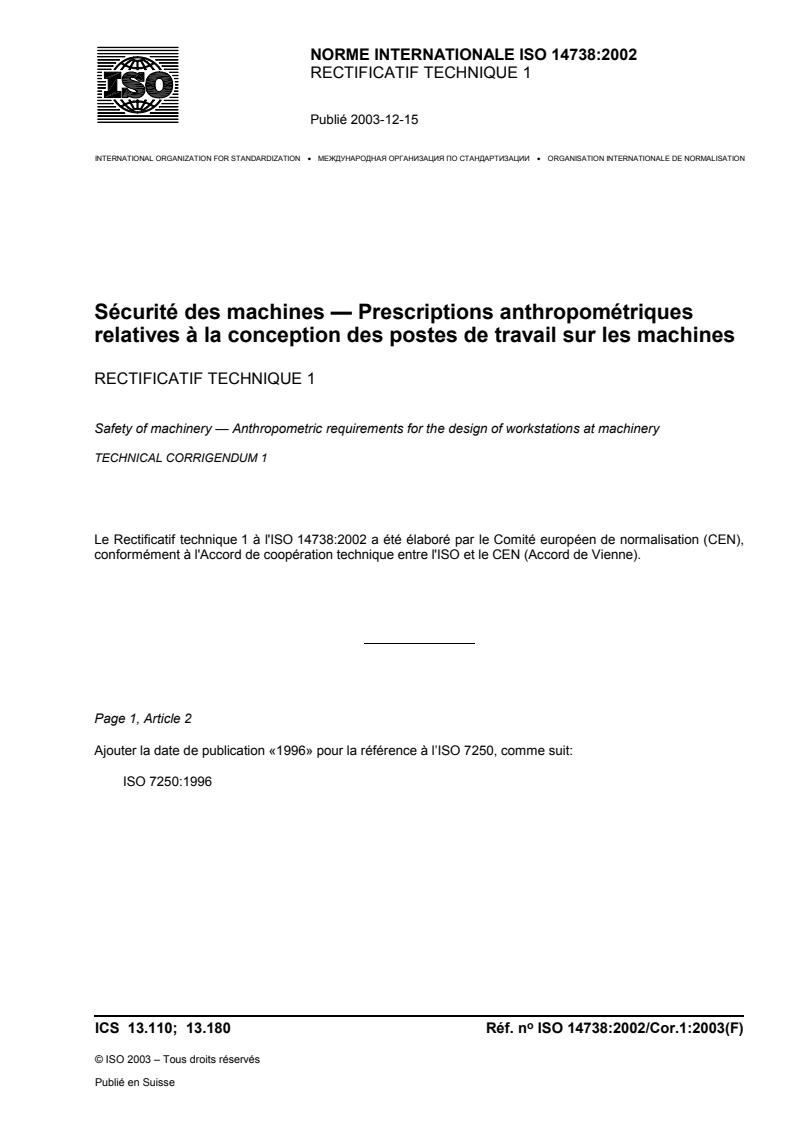
NORME INTERNATIONALE ISO 14738:2002
RECTIFICATIF TECHNIQUE 1
Publié 2003-12-15
INTERNATIONAL ORGANIZATION FOR STANDARDIZATION • МЕЖДУНАРОДНАЯ ОРГАНИЗАЦИЯ ПО СТАНДАРТИЗАЦИИ • ORGANISATION INTERNATIONALE DE NORMALISATION
Sécurité des machines — Prescriptions anthropométriques
relatives à la conception des postes de travail sur les machines
RECTIFICATIF TECHNIQUE 1
Safety of machinery — Anthropometric requirements for the design of workstations at machinery
TECHNICAL CORRIGENDUM 1
Le Rectific
...
This May Also Interest You
This document establishes methods for determining the composition of groups of persons whose anthropometric characteristics are to be representative of the intended user population of any specific object under test. This document is applicable to the testing of anthropometric aspects of industrial products and designs having direct contact with the human body or dependent on human body measurements, such as machinery, work equipment, personal protective equipment (PPE), consumer goods, working spaces, architectural details or transportation equipment. This document is also applicable to the testing of such safety aspects of products that are dependent on human body measurements. It does not deal with other aspects of the task or other requirements, such as perception of information (except geometrical arrangement of the viewing targets) and the use of controls (except their geometrical placement). Although this document deals with selecting test persons from an anthropometric perspective, similar general principles can be applied for other test variables, e.g. biomechanical aspects.
- Standard9 pagesEnglish languagesale 15% off
- Standard10 pagesFrench languagesale 15% off
- 16-May-2022
- 13.110
- 13.180
- ISO/TC 159/SC 3
- Standard3 pagesEnglish languagesale 15% off
- Standard3 pagesFrench languagesale 15% off
- 24-Feb-2005
- 13.110
- 13.180
- ISO/TC 159/SC 3
This International Standard establishes principles for deriving dimensions from anthropometric measurements and applying them to the design of workstations at non-mobile machinery. It is based on current ergonomic knowledge and anthropometric measurements. This International Standard specifies the body's space requirements for equipment during normal operation in sitting and standing positions. This International Standard does not specifically include space demands for maintenance, repairing and cleaning work. This International Standard does not give recommendations specifically for visual display terminal workstations at machinery. For this purpose ISO 9241-5 can be used in conjunction with this International Standard. Situations where people are to be prevented from reaching a hazard are dealt with in ISO 13852.
- Standard26 pagesEnglish languagesale 15% off
- Standard27 pagesFrench languagesale 15% off
- 09-Oct-2002
- 13.110
- 13.180
- ISO/TC 159/SC 3
This part of ISO 15534 specifies current requirements for human body measurements (anthropometric data) that are required by ISO 15534-1 and ISO 15534-2 for the calculation of access-opening dimensions as applied to machinery. The anthropometric data originate from static measurements of nude persons and do not take into account body movements, clothing, equipment, machinery-operating conditions or environmental conditions. The data are based on information from anthropometric surveys representative of population groups within Europe comprising at least three million people. Both men and women are taken into account. Measurements are given, as required by ISO 15534-1 and ISO 15534-2, for the 5th, 95th and 99th percentiles of the relevant population group within Europe.
- Standard4 pagesEnglish languagesale 15% off
- 16-Feb-2000
- 13.110
- 13.180
- ISO/TC 159/SC 3
- Standard12 pagesEnglish languagesale 15% off
- 16-Feb-2000
- 13.110
- 13.180
- ISO/TC 159/SC 3
This part of ISO 15534 specifies the dimensions of openings for access into machinery as defined in ISO/TR 12100-1. It provides the dimensions to which the values given in ISO 15534-3 are applicable. Values for additional space requirements are given in annex A. This part of ISO 15534 has been prepared primarily for nonmobile machinery; there may be additional specific requirements for mobile machinery. Dimensions for access openings are based on the values for the 95th percentile, whereas reach distances are based on the values for the 5th percentile, in each case the least favourable body dimension of the expected user population being used as a basis. The same considerations apply to the location of access openings. The anthropometric data given in ISO 15534-3 originate from static measurements of nude persons and do not take into account body movements, clothing, equipment, machinery-operating conditions or environmental conditions. This part of ISO 15534 shows how to combine the anthropometric data with suitable allowances to take these factors into account. Situations where people are to be prevented from reaching a hazard are dealt with in ISO 13852.
- Standard23 pagesEnglish languagesale 15% off
- 16-Feb-2000
- 13.110
- 13.180
- ISO/TC 159/SC 3
ISO/TR 22100-3:2016 describes the main ergonomic risk factors influencing the safety of machinery and gives a framework for incorporating them into the design of machines by the integration of important ergonomic principles relating to: - avoiding stressful postures and movements during use of the machine; - designing machines, and more especially hand-held and mobile machines, which can be operated easily; - avoiding as far as possible noise, vibration, thermal effects; NOTE 1: The health effects of noise, vibration and adverse thermal conditions are well-known and are not addressed here. However environmental factors can interact with machine design and risks arising from such influences are addressed in this document. ? avoiding linking the operator's working rhythm to an automatic succession of cycles; ? providing local lighting on or in the machine; NOTE 2: Lighting of the machine or of the surrounding workplace by the machine can have a significant impact on the safety of machine operation and this risk is addressed by this document. - selecting, locating and identifying manual controls (actuators) so that they are clearly visible and identifiable and appropriately marked where necessary; - selecting, designing and locating indicators, dials and visual display units. The approach is based on ISO 12100 with its iterative process to identify significant hazards and reduce risks. Relevant steps of this iterative process have been adapted to include ergonomic principles, and practical guidance is given to apply standards dealing with ergonomics which are relevant for machinery design. ISO/TR 22100-3:2016 is intended for use by standards writers and designers of machinery. It can be used when no relevant C-type standards are available.
- Technical report39 pagesEnglish languagesale 15% off
- 20-Sep-2016
- 01.120
- 13.110
- 13.180
- ISO/TC 199
ISO 17929:2014 has been drawn up with the objective of ensuring the safety of amusement ride passengers, based on the international experience of manufacture and operation of such structures throughout the world gained over decades prior to its publication. It enables the identification of potential hazards and classification of biomechanical effects, including information on recommended acceleration limits, rate of their onset and their duration, to ensure acceptable degrees of biomechanical risks at the stage of amusement ride design, as well as to take such risks into account during development of operational procedures and information on use limitations for amusement ride guests. It gives recommendations regarding use limitations for amusement rides in accordance with the health condition and the well-being of passengers. It also specifies body dimensions of passengers 1,20 m to 2,0 m in height for motion risk analysis on amusement rides. These body dimensions can be taken into account when designing passenger containments and restraints. It does not cover devices used in the circus, theatre or sports, or other devices intended for use only by specially trained people. Nevertheless, it can be used in the design of any similar structural or passenger-carrying device even if it does not explicitly mention the device. ISO 17929:2014 is not applicable to amusement rides put into operation before the date of its publication.
- Technical specification24 pagesEnglish languagesale 15% off
- 20-Aug-2014
- 13.110
- 13.180
- 97.200.40
- ISO/TC 254
The ISO 11929 series specifies a procedure, in the field of ionizing radiation metrology, for the calculation of the “decision threshold”, the “detection limit” and the “limits of the coverage interval” for a non-negative ionizing radiation measurand when counting measurements with preselection of time or counts are carried out. The measurand results from a gross count rate and a background count rate as well as from further quantities on the basis of a model of the evaluation. In particular, the measurand can be the net count rate as the difference of the gross count rate and the background count rate, or the net activity of a sample. It can also be influenced by calibration of the measuring system, by sample treatment and by other factors. ISO 11929 has been divided into four parts covering elementary applications in this document, advanced applications on the basis of the ISO/IEC Guide 3-1 in ISO 11929-2, applications to unfolding methods in ISO 11929-3, and guidance to the application in ISO 11929-4. This document covers basic applications of counting measurements frequently used in the field of ionizing radiation metrology. It is restricted to applications for which the uncertainties can be evaluated on the basis of the ISO/IEC Guide 98-3 (JCGM 2008). In REF Annex_sec_A \r \h Annex A 08D0C9EA79F9BACE118C8200AA004BA90B02000000080000000C00000041006E006E00650078005F007300650063005F0041000000 , the special case of repeated counting measurements with random influences is covered, while measurements with linear analogous ratemeters are covered in REF Annex_sec_B \r \h Annex B 08D0C9EA79F9BACE118C8200AA004BA90B02000000080000000C00000041006E006E00650078005F007300650063005F0042000000 . ISO 11929-2 extends the former ISO 11929:2010 to the evaluation of measurement uncertainties according to the ISO/IEC Guide 98-3:2008/Suppl 1:2008. ISO 11929-2 also presents some explanatory notes regarding general aspects of counting measurements and on Bayesian statistics in measurements. ISO 11929-3 deals with the evaluation of measurements using unfolding methods and counting spectrometric multi-channel measurements if evaluated by unfolding methods, in particular, for alpha- and gamma‑spectrometric measurements. Further, it provides some advice on how to deal with correlations and covariances. ISO 11929-4 gives guidance to the application of the ISO 11929 series, summarizes shortly the general procedure and then presents a wide range of numerical examples. Information on the statistical roots of ISO 11929 and on its current development may be found elsewhere[ REF Reference_ref_40 \r \h 33 08D0C9EA79F9BACE118C8200AA004BA90B0200000008000000110000005200650066006500720065006E00630065005F007200650066005F00340030000000 ][ REF Reference_ref_41 \r \h 34 08D0C9EA79F9BACE118C8200AA004BA90B0200000008000000110000005200650066006500720065006E00630065005F007200650066005F00340031000000 ]. The ISO 11929 series also applies analogously to other measurements of any kind especially if a similar model of the evaluation is involved. Further practical examples can be found, for example, in ISO 18589[ REF Reference_ref_8 \r \h 1 08D0C9EA79F9BACE118C8200AA004BA90B0200000008000000100000005200650066006500720065006E00630065005F007200650066005F0038000000 ], ISO 9696[ REF Reference_ref_9 \r \h 2 08D0C9EA79F9BACE118C8200AA004BA90B0200000008000000100000005200650066006500720065006E00630065005F007200650066005F0039000000 ], ISO 9697[ REF Reference_ref_10 \r \h 3 08D0C9EA79F9BACE118C8200AA004BA90B0200000008000000110000005200650066006500720065006E00630065005F007200650066005F00310030000000 ], ISO 9698[ REF Reference_ref_11 \r \h 4 08D0C9EA79F9BACE118C8200AA004BA90B0200000008000000110000005200650066006500720065006E00630065005F007200650066005F00310031000000 ], ISO 10703[ REF Reference_ref_12 \r \h 5 08D0C9EA79F9BACE118C8200AA004BA90B0200000008000000110000005200650066006500720065006E00630065005F007200650066005F00310032000000 ], ISO 7503[ REF Reference_ref_13 \r \h 6 08D0C9EA79
- Standard45 pagesEnglish languagesale 15% off
- Standard45 pagesFrench languagesale 15% off
- 11-Dec-2025
- 17.240
- ISO/TC 85/SC 2
This document specifies evaluation methods for determining the content of reactive oxygen species (ROS) used in the FB-facilitated advanced oxidation for pollution abatement in the wastewater treatment process. The probe based kinetic model is applicable to systems that generate ROS in substantial quantities, rather than at physiological concentrations, and is applicable to short-lived ROS. However, it is not applicable to long-lived ROS, such as ozone (O3) and hydrogen peroxide (H2O2). The probe based kinetic model method specifies: — cumulative concentration of different types of ROS during the reaction process; — concentration of different types of ROS at each time point during the reaction process. This method does not define the mechanisms of ROS generation, nor the correlation between bubble size and ROS production.
- Standard34 pagesEnglish languagesale 15% off
- 11-Dec-2025
- 07.030
- ISO/TC 281


Questions, Comments and Discussion
Ask us and Technical Secretary will try to provide an answer. You can facilitate discussion about the standard in here.
Loading comments...