

ISO 18842:2015
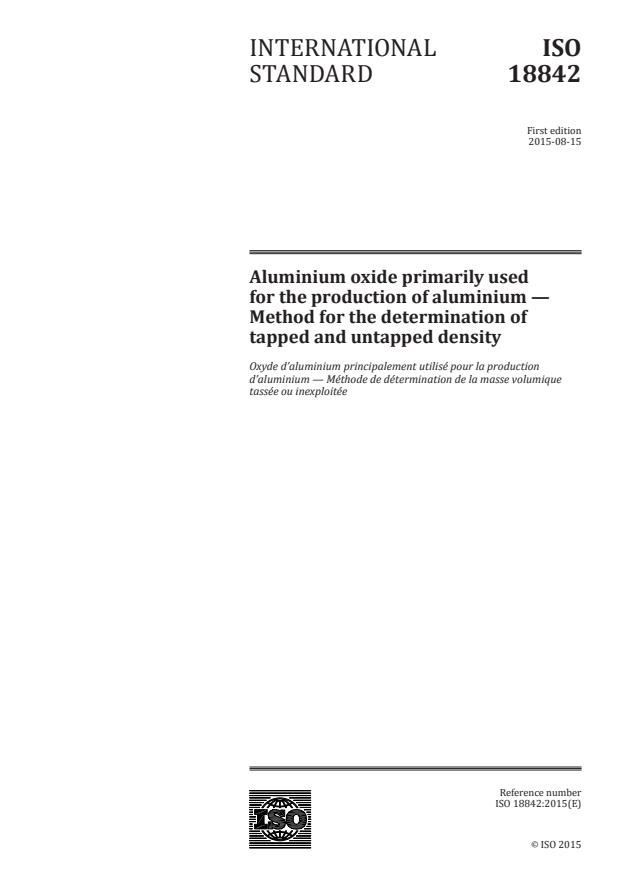
(Main)Aluminium oxide primarily used for the production of aluminium — Method for the determination of tapped and untapped density
General Information
- Abstract
ISO 18842:2015 describes methods for the determination of tapped and untapped bulk density of smelter grade aluminium oxide primarily used for the production of aluminium. Methods using the fall of sample into a receptacle have been found to be sensitive to flow rate variations, which are caused by physical properties of the aluminium oxide. ISO 18842:2015 minimizes flow rate variations.
- Status
- Published
- Publication Date
- 09-Aug-2015
- Technical Committee
- ISO/TC 226 - Materials for the production of primary aluminium
- Drafting Committee
- ISO/TC 226 - Materials for the production of primary aluminium
- Current Stage
- 9093 - International Standard confirmed
- Start Date
- 24-Oct-2022
- Completion Date
- 29-Aug-2026
Buy Documents
ISO 18842:2015 - Aluminium oxide primarily used for the production of aluminium -- Method for the determination of tapped and untapped density
ISO 18842:2015 - Aluminium oxide primarily used for the production of aluminium — Method for the determination of tapped and untapped density/10/2015
Overview
ISO 18842:2015 specifies a laboratory method for determining tapped and untapped bulk density of smelter‑grade aluminium oxide (alumina) used primarily in aluminium production. The standard defines a controlled sample delivery and receiving arrangement that minimizes flow‑rate variations seen in simple “fall into a receptacle” methods. Results are reported on a moisture‑free (300 °C) basis and are suitable for production control, quality assurance and materials specification.
Key topics and requirements
- Scope: Applies to smelter‑grade alumina for aluminium production; minimizes sensitivity to particle flow properties.
- Sample preparation:
- Condition sample in laboratory atmosphere for a minimum of 2 hours in a layer ≤ 5 mm, mix and split according to sampling guide (AS 4538.2).
- Typical test portions: ~300 g for density tests, ~50 g for moisture (loss on ignition at 300 °C).
- Apparatus:
- Sample delivery apparatus with a 5.0 mm orifice and impact plate (abrasion‑resistant materials such as stainless steel, brass or aluminium).
- Receiver: cylindrical container nominally 200 ± 10 ml and a length‑to‑diameter ratio ≈ 6:1; volume precisely determined by temperature‑corrected water mass.
- Balance capable of 0.1 g readability, sieves (300–1 000 µm), straight edge, tapper and brush.
- Procedure:
- Untapped density: allow narrow stream to fill receiver, level with straight edge, weigh.
- Tapped density: compact sample by controlled tapping while adding sample until no further settling; level and weigh.
- Moisture correction using loss of mass at 300 °C (ISO 806).
- Calculations and reporting:
- Densities are calculated on a moisture‑free basis and reported in kg/m3 (rounded to nearest 1 kg/m3).
- Test report must identify sample, reference ISO 18842:2015, provide untapped and tapped densities, test date and any unusual observations.
- Precision:
- Reported repeatability and reproducibility (95% confidence): untapped r = 13 kg/m3, R = 31 kg/m3; tapped r = 14 kg/m3, R = 52 kg/m3.
Applications and users
- Primary users: alumina producers, aluminium smelters, materials testing laboratories and quality control teams.
- Practical uses:
- Incoming inspection of smelter‑grade alumina shipments.
- Process control and specification compliance for aluminium production feedstock.
- Comparative testing for product development, procurement and contract verification.
Related standards
- ISO 806 - Determination of loss of mass at 300 °C and 1 000 °C (moisture correction).
- AS 4538.2 - Guide to sampling of alumina (sample preparation).
- AS 2850 - Interlaboratory precision guidance.
Keywords: ISO 18842:2015, aluminium oxide, alumina, tapped density, untapped density, bulk density, smelter grade, moisture‑free, MOI, aluminium production.
Buy Documents
ISO 18842:2015 - Aluminium oxide primarily used for the production of aluminium -- Method for the determination of tapped and untapped density
ISO 18842:2015 - Aluminium oxide primarily used for the production of aluminium — Method for the determination of tapped and untapped density/10/2015
Get Certified
Connect with accredited certification bodies for this standard

ECOCERT
Organic and sustainability certification.

Eurofins Food Testing Global
Global leader in food, environment, and pharmaceutical product testing.

Intertek Bangladesh
Intertek certification and testing services in Bangladesh.
Sponsored listings
Frequently Asked Questions
ISO 18842:2015 is a standard published by the International Organization for Standardization (ISO). Its full title is "Aluminium oxide primarily used for the production of aluminium — Method for the determination of tapped and untapped density". This standard covers: ISO 18842:2015 describes methods for the determination of tapped and untapped bulk density of smelter grade aluminium oxide primarily used for the production of aluminium. Methods using the fall of sample into a receptacle have been found to be sensitive to flow rate variations, which are caused by physical properties of the aluminium oxide. ISO 18842:2015 minimizes flow rate variations.
ISO 18842:2015 describes methods for the determination of tapped and untapped bulk density of smelter grade aluminium oxide primarily used for the production of aluminium. Methods using the fall of sample into a receptacle have been found to be sensitive to flow rate variations, which are caused by physical properties of the aluminium oxide. ISO 18842:2015 minimizes flow rate variations.
ISO 18842:2015 is classified under the following ICS (International Classification for Standards) categories: 71.100.10 - Materials for aluminium production. The ICS classification helps identify the subject area and facilitates finding related standards.
ISO 18842:2015 is available in PDF format for immediate download after purchase. The document can be added to your cart and obtained through the secure checkout process. Digital delivery ensures instant access to the complete standard document.
Standards Content (Sample)
INTERNATIONAL ISO
STANDARD 18842
First edition
2015-08-15
Aluminium oxide primarily used
for the production of aluminium —
Method for the determination of
tapped and untapped density
Oxyde d’aluminium principalement utilisé pour la production
d’aluminium — Méthode de détermination de la masse volumique
tassée ou inexploitée
Reference number
©
ISO 2015
© ISO 2015, Published in Switzerland
All rights reserved. Unless otherwise specified, no part of this publication may be reproduced or utilized otherwise in any form
or by any means, electronic or mechanical, including photocopying, or posting on the internet or an intranet, without prior
written permission. Permission can be requested from either ISO at the address below or ISO’s member body in the country of
the requester.
ISO copyright office
Ch. de Blandonnet 8 • CP 401
CH-1214 Vernier, Geneva, Switzerland
Tel. +41 22 749 01 11
Fax +41 22 749 09 47
copyright@iso.org
www.iso.org
ii © ISO 2015 – All rights reserved
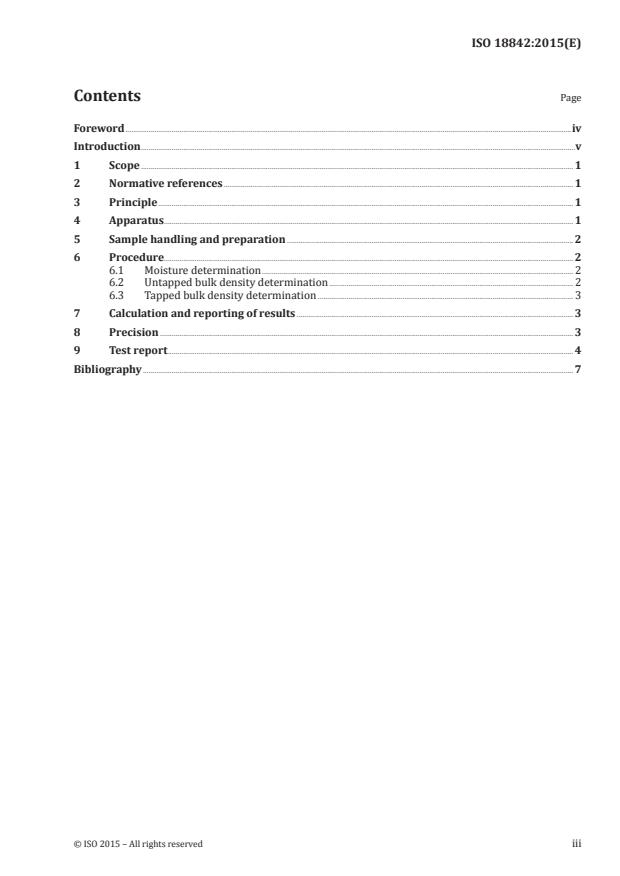
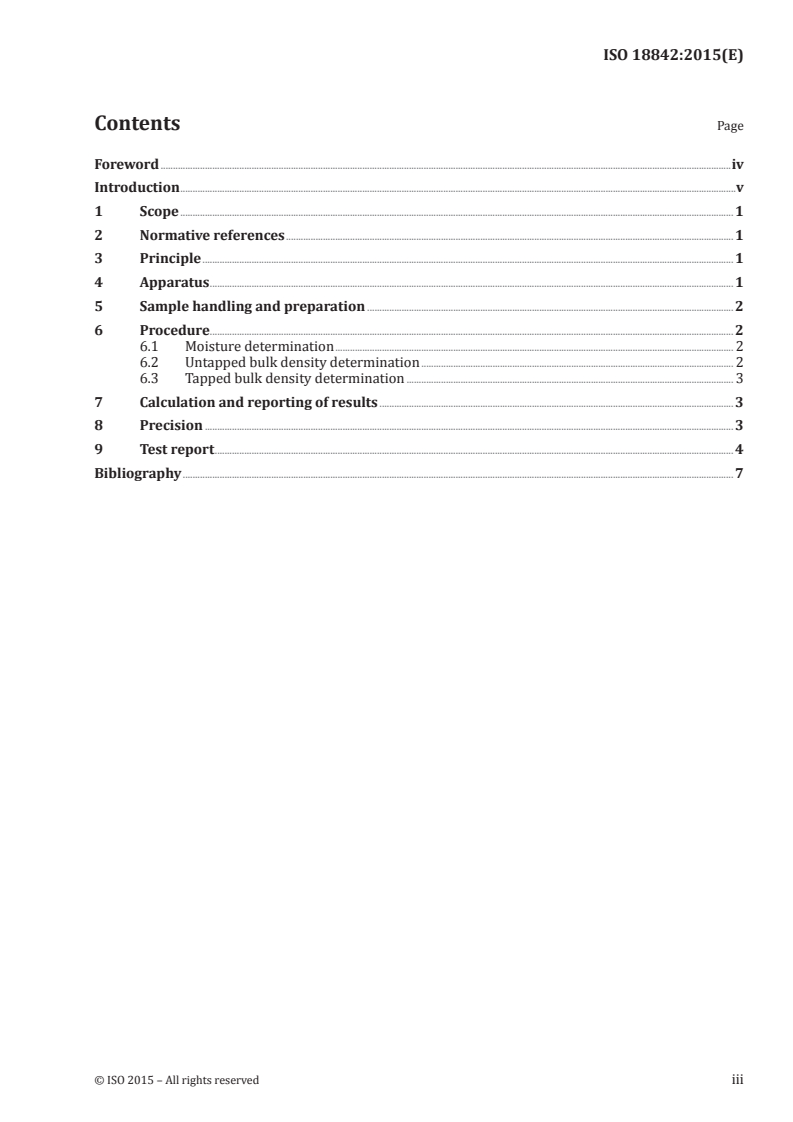
Contents Page
Foreword .iv
Introduction .v
1 Scope . 1
2 Normative references . 1
3 Principle . 1
4 Apparatus . 1
5 Sample handling and preparation . 2
6 Procedure. 2
6.1 Moisture determination . 2
6.2 Untapped bulk density determination . 2
6.3 Tapped bulk density determination . 3
7 Calculation and reporting of results . 3
8 Precision . 3
9 Test report . 4
Bibliography . 7
Foreword
ISO (the International Organization for Standardization) is a worldwide federation of national standards
bodies (ISO member bodies). The work of preparing International Standards is normally carried out
through ISO technical committees. Each member body interested in a subject for which a technical
committee has been established has the right to be represented on that committee. International
organizations, governmental and non-governmental, in liaison with ISO, also take part in the work.
ISO collaborates closely with the International Electrotechnical Commission (IEC) on all matters of
electrotechnical standardization.
The procedures used to develop this document and those intended for its further maintenance are
described in the ISO/IEC Directives, Part 1. In particular the different approval criteria needed for the
different types of ISO documents should be noted. This document was drafted in accordance with the
editorial rules of the ISO/IEC Directives, Part 2 (see www.iso.org/directives).
Attention is drawn to the possibility that some of the elements of this document may be the subject of
patent rights. ISO shall not be held responsible for identifying any or all such patent rights. Details of
any patent rights identified during the development of the document will be in the Introduction and/or
on the ISO list of patent declarations received (see www.iso.org/patents).
Any trade name used in this document is information given for the convenience of users and does not
constitute an endorsement.
For an explanation on the meaning of ISO specific terms and expressions related to conformity
assessment, as well as information about ISO’s adherence to the WTO principles in the Technical Barriers
to Trade (TBT) see the following URL: Foreword - Supplementary information
The committee responsible for this document is ISO/TC 226, Materials for the production of primary aluminium.
iv © ISO 2015 – All rights reserved
Introduction
This International Standard is based on the Australian Standard AS 2879.8.
INTERNATIONAL STANDARD ISO 18842:2015(E)
Aluminium oxide primarily used for the production of
aluminium — Method for the determination of tapped and
untapped density
1 Scope
This International Standard describes methods for the determination of tapped and untapped bulk
density of smelter grade aluminium oxide primarily used for the production of aluminium.
Methods using the fall of sample into a receptacle have been found to be sensitive to flow rate variations,
which are caused by physical properties of the aluminium oxide.
This International Standard minimizes flow rate variations.
2 Normative references
The following documents, in whole or in part, are normatively referenced in this document and are
indispensable for its application. For dated references, only the edition cited applies. For undated
references, the latest edition of the referenced document (including any amendments) applies.
ISO 806, Aluminium oxide primarily used for the production of aluminium — Determination of loss of mass
at 300 °C and 1 000 °C
AS 4538.2, Guide to the sampling of alumina — Preparation of samples
3 Principle
A test portion of the sample is allowed to fall in a narrow stream from a container onto a small metal
impact plate from which the stream
...
INTERNATIONAL ISO
STANDARD 18842
First edition
2015-08-15
Aluminium oxide primarily used
for the production of aluminium —
Method for the determination of
tapped and untapped density
Oxyde d’aluminium principalement utilisé pour la production
d’aluminium — Méthode de détermination de la masse volumique
tassée ou inexploitée
Reference number
©
ISO 2015
© ISO 2015, Published in Switzerland
All rights reserved. Unless otherwise specified, no part of this publication may be reproduced or utilized otherwise in any form
or by any means, electronic or mechanical, including photocopying, or posting on the internet or an intranet, without prior
written permission. Permission can be requested from either ISO at the address below or ISO’s member body in the country of
the requester.
ISO copyright office
Ch. de Blandonnet 8 • CP 401
CH-1214 Vernier, Geneva, Switzerland
Tel. +41 22 749 01 11
Fax +41 22 749 09 47
copyright@iso.org
www.iso.org
ii © ISO 2015 – All rights reserved
Contents Page
Foreword .iv
Introduction .v
1 Scope . 1
2 Normative references . 1
3 Principle . 1
4 Apparatus . 1
5 Sample handling and preparation . 2
6 Procedure. 2
6.1 Moisture determination . 2
6.2 Untapped bulk density determination . 2
6.3 Tapped bulk density determination . 3
7 Calculation and reporting of results . 3
8 Precision . 3
9 Test report . 4
Bibliography . 7
Foreword
ISO (the International Organization for Standardization) is a worldwide federation of national standards
bodies (ISO member bodies). The work of preparing International Standards is normally carried out
through ISO technical committees. Each member body interested in a subject for which a technical
committee has been established has the right to be represented on that committee. International
organizations, governmental and non-governmental, in liaison with ISO, also take part in the work.
ISO collaborates closely with the International Electrotechnical Commission (IEC) on all matters of
electrotechnical standardization.
The procedures used to develop this document and those intended for its further maintenance are
described in the ISO/IEC Directives, Part 1. In particular the different approval criteria needed for the
different types of ISO documents should be noted. This document was drafted in accordance with the
editorial rules of the ISO/IEC Directives, Part 2 (see www.iso.org/directives).
Attention is drawn to the possibility that some of the elements of this document may be the subject of
patent rights. ISO shall not be held responsible for identifying any or all such patent rights. Details of
any patent rights identified during the development of the document will be in the Introduction and/or
on the ISO list of patent declarations received (see www.iso.org/patents).
Any trade name used in this document is information given for the convenience of users and does not
constitute an endorsement.
For an explanation on the meaning of ISO specific terms and expressions related to conformity
assessment, as well as information about ISO’s adherence to the WTO principles in the Technical Barriers
to Trade (TBT) see the following URL: Foreword - Supplementary information
The committee responsible for this document is ISO/TC 226, Materials for the production of primary aluminium.
iv © ISO 2015 – All rights reserved
Introduction
This International Standard is based on the Australian Standard AS 2879.8.
INTERNATIONAL STANDARD ISO 18842:2015(E)
Aluminium oxide primarily used for the production of
aluminium — Method for the determination of tapped and
untapped density
1 Scope
This International Standard describes methods for the determination of tapped and untapped bulk
density of smelter grade aluminium oxide primarily used for the production of aluminium.
Methods using the fall of sample into a receptacle have been found to be sensitive to flow rate variations,
which are caused by physical properties of the aluminium oxide.
This International Standard minimizes flow rate variations.
2 Normative references
The following documents, in whole or in part, are normatively referenced in this document and are
indispensable for its application. For dated references, only the edition cited applies. For undated
references, the latest edition of the referenced document (including any amendments) applies.
ISO 806, Aluminium oxide primarily used for the production of aluminium — Determination of loss of mass
at 300 °C and 1 000 °C
AS 4538.2, Guide to the sampling of alumina — Preparation of samples
3 Principle
A test portion of the sample is allowed to fall in a narrow stream from a container onto a small metal
impact plate from which the stream
...