


ISO/TS 16774-3:2023
(Main)Test methods for repair materials for water-leakage cracks in underground concrete structures - Part 3: Test method for water (wash out) resistance
Test methods for repair materials for water-leakage cracks in underground concrete structures - Part 3: Test method for water (wash out) resistance
This document specifies a laboratory test method on the quantitative determination of repair materials performance and resistance against erosion and wash out due to underground water flow.
Méthodes d'essai pour matériaux de réparation pour fissures dues à l'eau dans les structures en béton souterraines — Partie 3: Méthode d'essai de la résistance à l'eau (de lixiviation)
General Information
Relations
Overview
ISO/TS 16774-3:2023 is a technical specification from ISO that defines a laboratory test method for water (wash out) resistance of repair materials used to stop water-leakage cracks in underground concrete structures. The method quantifies how well grouting and injection materials resist erosion and washout when exposed to continuous underground water flow by measuring mass loss before and after exposure.
Key topics and requirements
- Test principle: Evaluate washout resistance by comparing specimen mass before (Mb) and after (Ma) exposure to controlled water flow; mass change (Mc = Mb − Ma) and percentage mass loss are used to rate performance.
- Specimen preparation: Repair material is placed in a glass Petri dish (surface leveled) and cured to constant mass under controlled ambient conditions.
- Ambient conditions: Default laboratory conditions are (22 ± 2) °C and (55 ± 5) % relative humidity unless national standards require different values; drying to constant mass follows ISO 1920‑8 practice.
- Apparatus: Key equipment includes a water flow chamber capable of maintaining constant flow velocity, glass Petri dishes, an electronic scale (two decimal places in grams), non‑woven fabric filters (to collect eroded particulates), and standard placement tools.
- Procedure: Record specimen condition and Mb, cover with non‑woven fabric (not touching the material surface), expose to predetermined water flow (velocity and duration per national practice), dry to constant mass, record Ma, compute Mc and percentage loss. Photograph stages for traceability.
- Expression of results and reporting: Results are reported as absolute and relative mass loss. Test reports must include detailed specimen, material, test conditions and a technical declaration of conformity to ISO/TS 16774-3:2023. Manufacturer data, curing, equipment, and any deviations are recorded.
Applications and who uses this standard
ISO/TS 16774-3:2023 is intended for practical use by:
- Materials manufacturers developing or certifying injection grouts and repair compounds for underground concrete repairs.
- Testing laboratories performing standardized durability and washout resistance testing.
- Civil/structural engineers, contractors and repair specialists selecting repair products for tunnels, basements, sewer systems and other subterranean concrete structures subject to groundwater flow.
- Asset owners and infrastructure managers who need objective data to compare repair materials and specify performance requirements in procurement.
- Standards bodies and regulators adopting or adapting test parameters to national codes.
This TS supports objective comparison of washout resistance and helps inform selection of repair materials that resist erosion under sustained water flow.
Related standards
- ISO/TR 16475 - General practices for the repair of water‑leakage cracks in concrete structures (provides background and property definitions).
- ISO/TS 16774 series - Companion documents that cover other test methods for repair material performance.
Frequently Asked Questions
ISO/TS 16774-3:2023 is a technical specification published by the International Organization for Standardization (ISO). Its full title is "Test methods for repair materials for water-leakage cracks in underground concrete structures - Part 3: Test method for water (wash out) resistance". This standard covers: This document specifies a laboratory test method on the quantitative determination of repair materials performance and resistance against erosion and wash out due to underground water flow.
This document specifies a laboratory test method on the quantitative determination of repair materials performance and resistance against erosion and wash out due to underground water flow.
ISO/TS 16774-3:2023 is classified under the following ICS (International Classification for Standards) categories: 91.080.40 - Concrete structures. The ICS classification helps identify the subject area and facilitates finding related standards.
ISO/TS 16774-3:2023 has the following relationships with other standards: It is inter standard links to ISO/TS 16774-3:2016. Understanding these relationships helps ensure you are using the most current and applicable version of the standard.
You can purchase ISO/TS 16774-3:2023 directly from iTeh Standards. The document is available in PDF format and is delivered instantly after payment. Add the standard to your cart and complete the secure checkout process. iTeh Standards is an authorized distributor of ISO standards.
Standards Content (Sample)
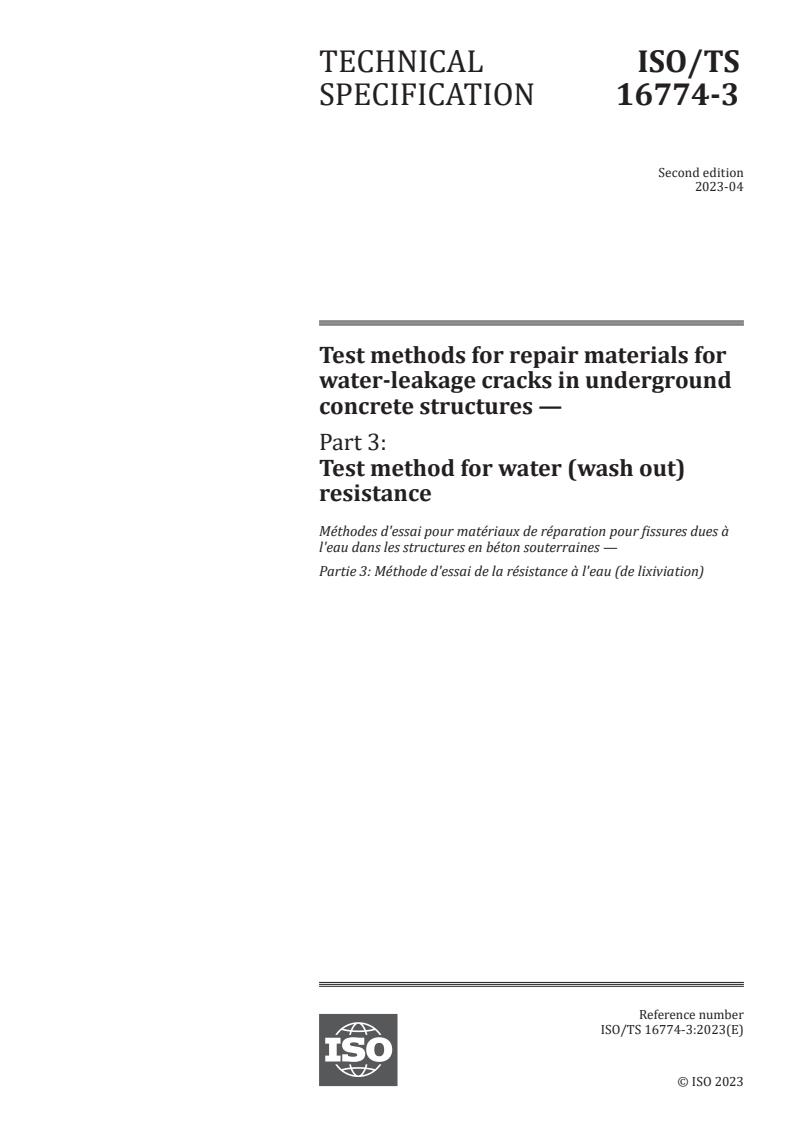
TECHNICAL ISO/TS
SPECIFICATION 16774-3
Second edition
2023-04
Test methods for repair materials for
water-leakage cracks in underground
concrete structures —
Part 3:
Test method for water (wash out)
resistance
Méthodes d'essai pour matériaux de réparation pour fissures dues à
l'eau dans les structures en béton souterraines —
Partie 3: Méthode d'essai de la résistance à l'eau (de lixiviation)
Reference number
© ISO 2023
All rights reserved. Unless otherwise specified, or required in the context of its implementation, no part of this publication may
be reproduced or utilized otherwise in any form or by any means, electronic or mechanical, including photocopying, or posting on
the internet or an intranet, without prior written permission. Permission can be requested from either ISO at the address below
or ISO’s member body in the country of the requester.
ISO copyright office
CP 401 • Ch. de Blandonnet 8
CH-1214 Vernier, Geneva
Phone: +41 22 749 01 11
Email: copyright@iso.org
Website: www.iso.org
Published in Switzerland
ii
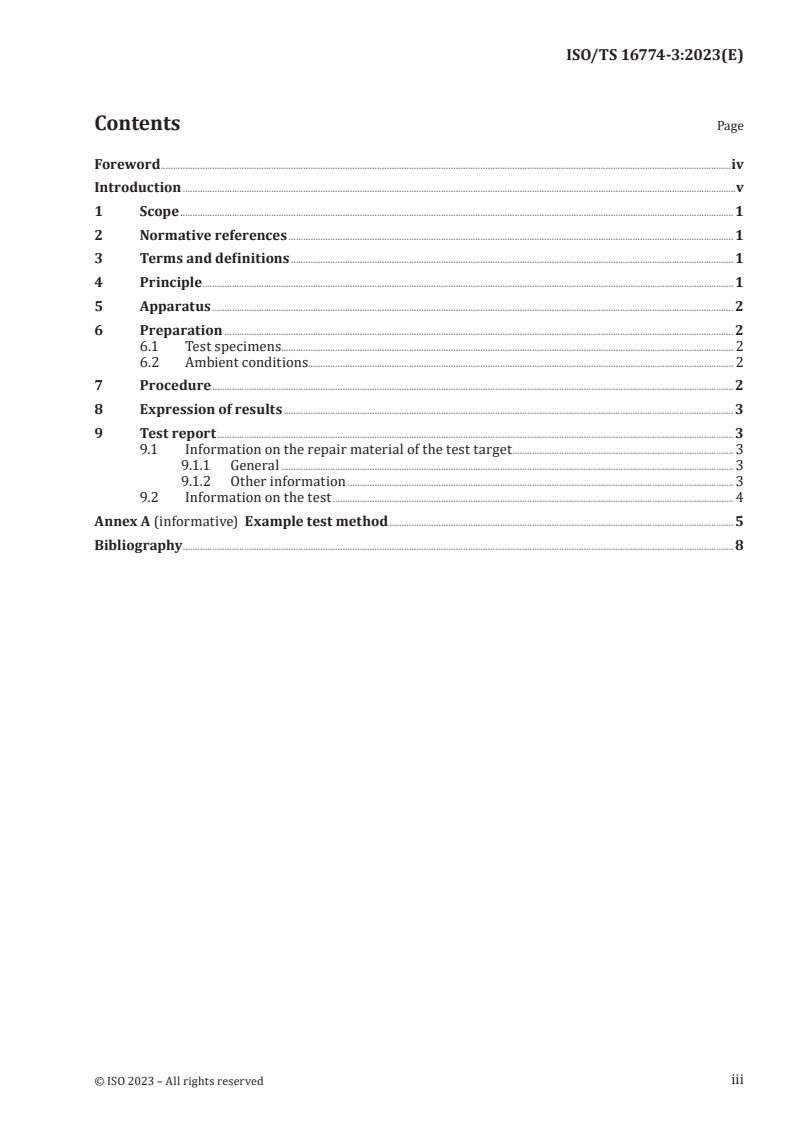
Contents Page
Foreword .iv
Introduction .v
1 Scope . 1
2 Normative references . 1
3 Terms and definitions . 1
4 Principle . 1
5 Apparatus . 2
6 Preparation . 2
6.1 Test specimens. 2
6.2 Ambient conditions. 2
7 Procedure .2
8 Expression of results . 3
9 Test report . 3
9.1 Information on the repair material of the test target . 3
9.1.1 General . 3
9.1.2 Other information . 3
9.2 Information on the test . 4
Annex A (informative) Example test method . 5
Bibliography . 8
iii
Foreword
ISO (the International Organization for Standardization) is a worldwide federation of national standards
bodies (ISO member bodies). The work of preparing International Standards is normally carried out
through ISO technical committees. Each member body interested in a subject for which a technical
committee has been established has the right to be represented on that committee. International
organizations, governmental and non-governmental, in liaison with ISO, also take part in the work.
ISO collaborates closely with the International Electrotechnical Commission (IEC) on all matters of
electrotechnical standardization.
The procedures used to develop this document and those intended for its further maintenance are
described in the ISO/IEC Directives, Part 1. In particular, the different approval criteria needed for the
different types of ISO documents should be noted. This document was drafted in accordance with the
editorial rules of the ISO/IEC Directives, Part 2 (see www.iso.org/directives).
Attention is drawn to the possibility that some of the elements of this document may be the subject of
patent rights. ISO shall not be held responsible for identifying any or all such patent rights. Details of
any patent rights identified during the development of the document will be in the Introduction and/or
on the ISO list of patent declarations received (see www.iso.org/patents).
Any trade name used in this document is information given for the convenience of users and does not
constitute an endorsement.
For an explanation of the voluntary nature of standards, the meaning of ISO specific terms and
expressions related to conformity assessment, as well as information about ISO's adherence to
the World Trade Organization (WTO) principles in the Technical Barriers to Trade (TBT), see
www.iso.org/iso/foreword.html.
This document was prepared by Technical Committee ISO/TC 71, Concrete, reinforced concrete and pre-
stressed concrete, Subcommittee SC 7, Maintenance and repair of concrete structures.
This second edition cancels and replaces the first edition (ISO/TS 16774-3:2016) which has been
technically revised.
The main changes are as follows:
— ambient conditions in 6.2 and A.3.2 have been modified;
— some clarifications have been made in Clause 7 and 9.2;
— some editorial corrections have been made.
A list of all parts in the ISO 16774 series can be found on the ISO website.
Any feedback or questions on this document should be directed to the user’s national standards body. A
complete listing of these bodies can be found at www.iso.org/members.html.
iv
Introduction
This document is linked to ISO/TR 16475. ISO/TR 16475 outlines six basic properties and the required
performance levels of water leakage repair materials, and the ISO/TS 16774 series proposes sample
testing methods that are capable of evaluating the respective properties of the repair materials.
The test methods in this document are intended to serve as references for nations that have not yet
developed a test method on the six required performance properties of water leakage repair materials.
If other forms of test methods that are simpler, more accurate or more organized are available, such
methods are recommended for use instead. Many of the dependent variables outlined in the reference
test methods of this document are subject to change in accordance with the environmental conditions
(temperature and humidity, chemical solution and concentration, width of movement activity, water
pressure or water flow velocity, etc.) outlined in the standards used in respective countries.
For ISO/TS 16774-1, ISO/TS 16774-5 and ISO/TS 16774-6, for the purpose of objectively comparing the
performance of injected repair materials, artificial cracks of same width, height, and volume were used
to control the usage of repair materials for each testing cycle and enable repetition of the same test
methods under the same conditions.
v
TECHNICAL SPECIFICATION ISO/TS 16774-3:2023(E)
Test methods for repair materials for water-leakage cracks
in underground concrete structures —
Part 3:
Test method for water (wash out) resistance
1 Scope
This document specifies a laboratory test method on the quantitative determination of repair materials
performance and resistance against erosion and wash out due to underground water flow.
2 Normative references
The following documents are referred to in the text in such a way that some or all of their content
constitutes requirements of this document. For dated references, only the edition cited applies. For
undated references, the latest edition of the referenced document (including any amendments) applies.
ISO/TR 16475, General practices for the repair of water-leakage cracks in concrete structures
3 Terms and definitions
For the purposes of this document, the terms and definitions given in ISO/TR 16475 and the following
apply.
ISO and IEC maintain terminology databases for use in standardization at the following addresses:
— ISO Online browsing platform: available at https:// www .iso .org/ obp
— IEC Electropedia: available at https:// www .electropedia .org/
3.1
water leakage repair material
grouting materials used to prevent water leakages in concrete cracks
Note 1 to entry: In this document, target ingredients are limited to injection materials outlined in ISO/TR 16475.
[SOURCE: ISO/TS 16774-2:2023, 3.1]
4 Principle
Resistance to water flow is one of the fundamental properties that water leakage repair materials
should possess. Repair materials are, in most cases, under constant pressure due to water flow, meaning
there are risks of erosion, and/or washout and eventual reopening of leakage paths. This test method
evaluates the performance of repair materials for water-leakage cracks by observing how closely the
materials can maintain their original state after being exposed to long term water flow. This is done by
comparing the mass difference of water leakage repair materials before and after flow testing in order
to determine the repair material’s wash out resistance. An example test method is provided in Annex A.
The test repair material is placed in a Petri dish container, which is then placed under exposure to water
flow for predetermined duration in a water flow chamber apparatus (flow velocity, duration of flow
testing and other relevant conditions are subject to change in accordance with regulated values and
figures outlined in different national standards). The mass of the test specimen prior to and after the
exposure to water flow is measured using an electronic scale and the data is recorded. For the purpose
of this test, specimens should try to retain its original mass as closely as possible as an indicator of
strong physical resistan
...
기사 제목: ISO/TS 16774-3:2023 - 지하 콘크리트 구조물의 누수 균열을 위한 수리 재료에 대한 시험 방법 - 제3부: 수 (세척) 내성 시험 방법 기사 내용: 이 문서는 지하 물의 흐름으로 인한 침식 및 세척으로부터 수리 재료의 성능과 내성을 정량적으로 결정하는 실험실 시험 방법을 규정합니다.
The article is about a new ISO standard, ISO/TS 16774-3:2023, which provides a test method to assess the performance and resistance of repair materials used for water-leakage cracks in underground concrete structures. The test method focuses on measuring the erosion and wash out of these materials caused by underground water flow.
記事のタイトル: ISO/TS 16774-3:2023 - 地下コンクリート構造物の水漏れ亀裂修理材の試験法 - 第3部: 水(洗浄)耐久性試験方法 記事の内容: この文書は、地下の水流による浸食や洗浄に対する修理材料の性能と耐久性を定量的に評価するための実験室での試験方法を規定しています。
Questions, Comments and Discussion
Ask us and Technical Secretary will try to provide an answer. You can facilitate discussion about the standard in here.
Loading comments...