

ISO 10238:1999
(Main)Carbonaceous materials used in the production of aluminium — Pitch for electrodes — Determination of sulfur content by an instrumental method
General Information
- Abstract
This International Standard describes a method for determining the sulfur content of pitch used in the production of aluminium. The method is applicable to pitches of both coal tar and petroleum origin, provided that they contain between 0,1 % and 4,0 % by mass of sulfur.
- Status
- Published
- Publication Date
- 15-Dec-1999
- Technical Committee
- ISO/TC 226 - Materials for the production of primary aluminium
- Drafting Committee
- ISO/TC 226/WG 1 - Carbonaceous binders, including pitch
- Current Stage
- 9093 - International Standard confirmed
- Start Date
- 02-May-2024
- Completion Date
- 29-Aug-2026

Overview
ISO 10238:1999 specifies an instrumental method for the determination of sulfur content in pitch used for the production of aluminium electrodes. This standard applies to pitches derived from both coal tar and petroleum origins, within a sulfur content range of 0.1% to 4.0% by mass. The analytical procedure is vital for quality control in the aluminium industry, ensuring pitch materials meet stringent requirements for sulfur content, which can affect the performance and lifetime of carbon electrodes in aluminium electrolysis cells.
Key Topics
Sulfur Content Determination:
The standard outlines a precise and reproducible technique involving combustion of the pitch sample in oxygen at high temperature, absorption of resultant sulfur oxides, and volumetric titration for quantification.Applicable Pitch Types:
Method applies to both coal tar pitch and petroleum pitch, common raw materials in the production of carbon electrodes for aluminium smelting.Instrumental Methodology:
The procedure uses a combination of a combustion furnace, oxygen flow, and chemical absorption to ensure accurate detection of sulfur.Precision and Repeatability:
ISO 10238:1999 defines acceptable repeatability and reproducibility limits, promoting reliability in laboratory measurements:- Repeatability threshold: differences in duplicate tests by the same operator should not exceed 0.066% by mass.
- Reproducibility threshold: average results between different laboratories should not differ by more than 0.09% by mass.
Sampling and Test Reporting:
Proper sampling in accordance with ISO 6257 and detailed test reports support traceability and compliance.
Applications
Aluminium Production Quality Control:
Ensuring sulfur levels in pitch are within acceptable limits is crucial for producing high-performance carbon electrodes, which directly impact the efficiency and service life of aluminium smelting technology.Material Selection and Procurement:
Suppliers and manufacturers use this standardized test to verify conformance of pitch batches, supporting informed sourcing decisions and safeguarding production quality.Laboratory Testing:
Accredited laboratories rely on ISO 10238:1999 for standardizing sulfur content analysis, aiding in comparison and certification processes across international supply chains.Research and Development:
The method provides a consistent analytical basis for R&D efforts aimed at improving pitch properties and reducing impurities in advanced aluminium production processes.
Related Standards
- ISO 6257: Carbonaceous materials for aluminium production - Pitch sampling.
- ISO 565: Test sieves - Specifications for metal wire cloth and grading.
- ISO 3696: Water for analytical laboratory use - Specifications and test methods.
- ISO 4793: Laboratory sintered filters - Porosity grading and classification.
Practical Value
Implementing ISO 10238:1999 enables manufacturers and laboratories in the aluminium industry to:
- Maintain product consistency and quality by monitoring sulfur levels in electrode pitch.
- Meet regulatory and customer requirements for carbonaceous materials.
- Reduce the risk of operational disruptions or reduced anode performance due to uncontrolled sulfur impurities.
- Facilitate reliable global trade and certification through standardized test methods.
Keywords: ISO 10238:1999, sulfur content, pitch for electrodes, aluminium production, coal tar pitch, petroleum pitch, analytical method, carbonaceous materials, industrial standards, quality control.
Get Certified
Connect with accredited certification bodies for this standard

ECOCERT
Organic and sustainability certification.

Eurofins Food Testing Global
Global leader in food, environment, and pharmaceutical product testing.

Intertek Bangladesh
Intertek certification and testing services in Bangladesh.
Sponsored listings
Frequently Asked Questions
ISO 10238:1999 is a standard published by the International Organization for Standardization (ISO). Its full title is "Carbonaceous materials used in the production of aluminium — Pitch for electrodes — Determination of sulfur content by an instrumental method". This standard covers: This International Standard describes a method for determining the sulfur content of pitch used in the production of aluminium. The method is applicable to pitches of both coal tar and petroleum origin, provided that they contain between 0,1 % and 4,0 % by mass of sulfur.
This International Standard describes a method for determining the sulfur content of pitch used in the production of aluminium. The method is applicable to pitches of both coal tar and petroleum origin, provided that they contain between 0,1 % and 4,0 % by mass of sulfur.
ISO 10238:1999 is classified under the following ICS (International Classification for Standards) categories: 71.100.10 - Materials for aluminium production. The ICS classification helps identify the subject area and facilitates finding related standards.
ISO 10238:1999 is available in PDF format for immediate download after purchase. The document can be added to your cart and obtained through the secure checkout process. Digital delivery ensures instant access to the complete standard document.
Standards Content (Sample)
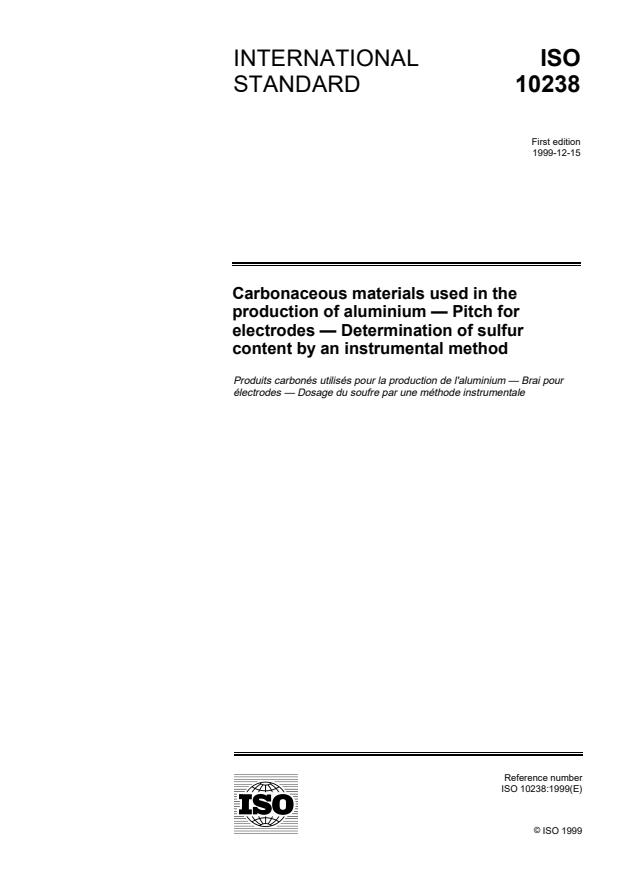
INTERNATIONAL ISO
STANDARD 10238
First edition
1999-12-15
Carbonaceous materials used in the
production of aluminium — Pitch for
electrodes — Determination of sulfur
content by an instrumental method
Produits carbonés utilisés pour la production de l'aluminium — Brai pour
électrodes — Dosage du soufre par une méthode instrumentale
Reference number
©
ISO 1999
PDF disclaimer
This PDF file may contain embedded typefaces. In accordance with Adobe's licensing policy, this file may be printed or viewed but shall not
be edited unless the typefaces which are embedded are licensed to and installed on the computer performing the editing. In downloading
this file, parties accept therein the responsibility of not infringing Adobe's licensing policy. The ISO Central Secretariat accepts no liability in
this area.
Adobe is a trademark of Adobe Systems Incorporated.
Details of the software products used to create this PDF file can be found in the General Info relative to the file; the PDF-creation
parameters were optimized for printing. Every care has been taken to ensure that the file is suitable for use by ISO member bodies. In the
unlikely event that a problem relating to it is found, please inform the Central Secretariat at the address given below.
© ISO 1999
All rights reserved. Unless otherwise specified, no part of this publication may be reproduced or utilized in any form or by any means, electronic
or mechanical, including photocopying and microfilm, without permission in writing from either ISO at the address below or ISO's member body
in the country of the requester.
ISO copyright office
Case postale 56 � CH-1211 Geneva 20
Tel. + 41 22 749 01 11
Fax + 41 22 734 10 79
E-mail copyright@iso.ch
Web www.iso.ch
Printed in Switzerland
ii © ISO 1999 – All rights reserved
Foreword
ISO (the International Organization for Standardization) is a worldwide federation of national standards bodies (ISO
member bodies). The work of preparing International Standards is normally carried out through ISO technical
committees. Each member body interested in a subject for which a technical committee has been established has
the right to be represented on that committee. International organizations, governmental and non-governmental, in
liaison with ISO, also take part in the work. ISO collaborates closely with the International Electrotechnical
Commission (IEC) on all matters of electrotechnical standardization.
International Standards are drafted in accordance with the rules given in the ISO/IEC Directives, Part 3.
Draft International Standards adopted by the technical committees are circulated to the member bodies for voting.
Publication as an International Standard requires approval by at least 75 % of the member bodies casting a vote.
Attention is drawn to the possibility that some of the elements of this International Standard may be the subject of
patent rights. ISO shall not be held responsible for identifying any or all such patent rights.
International Standard ISO 10238 was prepared by Technical Committee ISO/TC 47, Chemistry, Subcommittee
SC 7, Aluminium oxide, cryolite, aluminium fluoride, sodium fluoride, carbonaceous products for the aluminium
industry.
© ISO 1999 – All rights reserved iii
INTERNATIONAL STANDARD ISO 10238:1999(E)
Carbonaceous materials used in the production of aluminium —
Pitch for electrodes — Determination of sulfur content by an
instrumental method
1 Scope
This International Standard describes a method for determining the sulfur content of pitch used in the production of
aluminium. The method is applicable to pitches of both coal tar and petroleum origin, provided that they contain
between 0,1 % and 4,0 % by mass of sulfur.
2 Normative references
The following normative documents contain provisions which, through reference in this text, constitute provisions of
this International Standard. For dated references, subsequent amendments to, or revisions of, any of these
publications do not apply. However, parties to agreements based on this International Standard are encouraged to
investigate the possibility of applying the most recent editions of the normative documents indicated below. For
undated references, the latest edition of the normative document referred to applies. Members of ISO and IEC
maintain registers of currently valid International Standards.
ISO 565, Test sieves — Metal wire cloth, perforated metal plate and electroformed sheet — Nominal sizes of
openings.
ISO 3696, Water for analytical laboratory use — Specification and test methods.
ISO 4793, Laboratory sintered (fritted) filters — Porosity grading, classification and designation.
ISO 6257, Carbonaceous materials used in the production of aluminium — Pitch for electrodes — Sampling.
3 Principle
A known mass of the sample is burned in a stream of oxygen at a temperature of 1 350 °C. The oxides of sulfur
formed, together with any chlorine present, are absorbed in neutral hydrogen peroxide and determined
volumetrically. A correction is made to take account of the chlorine content of the sample. Aluminium oxide is added
to the sample to prevent the retention of sulfur in the ash.
4 Reagents
Unless otherwise specified, use reagents of analytical reagent grade and water conforming to grade 3 of ISO 3696.
4.1 Disodium tetraborate solution, c(½Na B O ·10H O) = 0,025 mol/l.
2 4 7 2
4.2 Sulfuric acid solution, c(½H SO ) = 0,025 mol/l.
2 4
4.3 Hydrogen peroxide solution, consisting of 3 % by volume of H 0 and 97 % by volume of water, neutralized
2 2
with the disodium tetraborate solution (4.1) to the screened indicator (4.4).
© ISO 1999 – All rights reserved 1
4.4 Screened indicator, consisting of equal volumes of a) and b) prepared as follows and mixed immediately
before use:
a) 0,125 g of methyl red dissolved in 100 ml of 95 % by volume ethanol solution;
b) 0,083 g of methylene blue dissolved in 100 ml of 95 % by volume ethanol solution.
Store in a dark glass bottle.
4.5 Mercury(II) oxycyanide solution, consisting of approximately 100 ml of water saturated with mercury(II)
oxycyanide (3Hg(CN) ·HgO).
Agitate thoroughly, filter and neutralize the filtrate with the sulfuric acid solution (4.2) to the screened indicator. Store
the solution in a dark glass bottle. Do not keep longer than 4 days.
WARNING — This compound and its solution are toxic and should be handled with appropriate care.
4.6 Aluminium oxide, finely divided, particle size approximately 0,1 mm.
4.7 Oxygen.
4.8 Sodium hydroxide on an inert base, preferably of coarse grading, for example 1,7 mm to 1,2 mm, and
preferably of the self-indicating type.
5 Apparatus
Ordinary laboratory apparatus and the following.
5.1 Combustion furnace and absorption train, as shown in Figure 1, and consisting of the following.
5.1.1 Furnace, electrically heated, designed to carry a tube of 28,5 mm outside diameter and to heat it over a
length of about 125 mm to give a temperature of 1 350 °C at the centre of the hot zone and a temperature
distribution curve similar to that shown in Figure 2.
5.1.2 Combustion tube, of 22 mm internal diameter and 28,5 mm outside diameter and 0,65 m long, made of
refractory aluminous porcelain that is not permeable to gases at 1 400 °C.
5.1.3 Combustion boat, of iron-free unglazed porcelain, 70 mm long, 12,5 mm wide and 10 mm deep, that does
not blister, discolour or change in mass on heating at 1 350 °C in oxygen for 3 h.
5.1.4 Silica pusher, comprising a sealed tube or rod of silica, 6 mm in diameter and approximately 450 mm long,
flattened at one end to form a disc of 12 mm diameter for pushing the combustion boat into the furnace.
The pusher passes loosely through a glass or metal T-piece, one end of which fits into the rubber stopper that
closes the inlet end
...