


ISO 13628-4:1999
(Main)Petroleum and natural gas industries - Design and operation of subsea production systems - Part 4: Subsea wellhead and tree equipment
Petroleum and natural gas industries - Design and operation of subsea production systems - Part 4: Subsea wellhead and tree equipment
La présente partie de l'ISO 13628 s'applique aux éléments suivants : tête de puits immergée, tête de puits de conduite de boue classique, forage par tête de puits de conduite de boue, têtes de production immergées conventionnelles et horizontales. Elle concerne également les outils associés nécessaires à la manipulation, aux essais et à l'installation des équipements. Elle spécifie les domaines relatifs à la conception, aux matériaux, au soudage, au contrôle de la qualité (y compris les essais de réception en usine), au marquage, au stockage et à l'expédition des sous-ensembles particuliers (utilisés pour construire les têtes de production immergées complètes) et des têtes de production immergées complètes.Le cas échéant, la présente partie de l'ISO 13628 s'applique également aux équipements montés en satellite, en grappe et sur châssis de guidage (template) multipuits.Les équipements compris dans le domaine d'application de la présente partie de l'ISO 13628 sont les suivants :a) Têtes de production immergées ;b) Têtes de puits immergées ;c) Systèmes de support de conduite de boue classiques ;d) Forage par systèmes de support de conduite de boue ;e) Systèmes de suspension des tubes de production ; f) Équipements divers.Équipements hors du domaine d'application de la présente partie de l'ISO 13628:- BOP de tube d'intervention/câble métallique sous-marins ;- tubes prolongateurs (risers) de reprise (workover) et de production ;- asservissements et modules de commande ;- raccordements de plate-forme ;- structures de protection primaire ;- équipement de traitement sous-marin ; - manifold immergé;- outils de tête de puits immergée ;- réparation et reprise ;- structures de châssis de guidage (template) multipuits ;- tubes prolongateurs (risers) haute pression de support de conduite de boue ;- conduite de châssis de guidage (template) ;- interfaces de châssis de guidage (template).
Industries du pétrole et du gaz naturel — Conception et fonctionnement des systèmes de production immergés — Partie 4: Équipements immergés de tête de puits et tête de production
General Information
Relations
Frequently Asked Questions
ISO 13628-4:1999 is a standard published by the International Organization for Standardization (ISO). Its full title is "Petroleum and natural gas industries - Design and operation of subsea production systems - Part 4: Subsea wellhead and tree equipment". This standard covers: La présente partie de l'ISO 13628 s'applique aux éléments suivants : tête de puits immergée, tête de puits de conduite de boue classique, forage par tête de puits de conduite de boue, têtes de production immergées conventionnelles et horizontales. Elle concerne également les outils associés nécessaires à la manipulation, aux essais et à l'installation des équipements. Elle spécifie les domaines relatifs à la conception, aux matériaux, au soudage, au contrôle de la qualité (y compris les essais de réception en usine), au marquage, au stockage et à l'expédition des sous-ensembles particuliers (utilisés pour construire les têtes de production immergées complètes) et des têtes de production immergées complètes.Le cas échéant, la présente partie de l'ISO 13628 s'applique également aux équipements montés en satellite, en grappe et sur châssis de guidage (template) multipuits.Les équipements compris dans le domaine d'application de la présente partie de l'ISO 13628 sont les suivants :a) Têtes de production immergées ;b) Têtes de puits immergées ;c) Systèmes de support de conduite de boue classiques ;d) Forage par systèmes de support de conduite de boue ;e) Systèmes de suspension des tubes de production ; f) Équipements divers.Équipements hors du domaine d'application de la présente partie de l'ISO 13628:- BOP de tube d'intervention/câble métallique sous-marins ;- tubes prolongateurs (risers) de reprise (workover) et de production ;- asservissements et modules de commande ;- raccordements de plate-forme ;- structures de protection primaire ;- équipement de traitement sous-marin ; - manifold immergé;- outils de tête de puits immergée ;- réparation et reprise ;- structures de châssis de guidage (template) multipuits ;- tubes prolongateurs (risers) haute pression de support de conduite de boue ;- conduite de châssis de guidage (template) ;- interfaces de châssis de guidage (template).
La présente partie de l'ISO 13628 s'applique aux éléments suivants : tête de puits immergée, tête de puits de conduite de boue classique, forage par tête de puits de conduite de boue, têtes de production immergées conventionnelles et horizontales. Elle concerne également les outils associés nécessaires à la manipulation, aux essais et à l'installation des équipements. Elle spécifie les domaines relatifs à la conception, aux matériaux, au soudage, au contrôle de la qualité (y compris les essais de réception en usine), au marquage, au stockage et à l'expédition des sous-ensembles particuliers (utilisés pour construire les têtes de production immergées complètes) et des têtes de production immergées complètes.Le cas échéant, la présente partie de l'ISO 13628 s'applique également aux équipements montés en satellite, en grappe et sur châssis de guidage (template) multipuits.Les équipements compris dans le domaine d'application de la présente partie de l'ISO 13628 sont les suivants :a) Têtes de production immergées ;b) Têtes de puits immergées ;c) Systèmes de support de conduite de boue classiques ;d) Forage par systèmes de support de conduite de boue ;e) Systèmes de suspension des tubes de production ; f) Équipements divers.Équipements hors du domaine d'application de la présente partie de l'ISO 13628:- BOP de tube d'intervention/câble métallique sous-marins ;- tubes prolongateurs (risers) de reprise (workover) et de production ;- asservissements et modules de commande ;- raccordements de plate-forme ;- structures de protection primaire ;- équipement de traitement sous-marin ; - manifold immergé;- outils de tête de puits immergée ;- réparation et reprise ;- structures de châssis de guidage (template) multipuits ;- tubes prolongateurs (risers) haute pression de support de conduite de boue ;- conduite de châssis de guidage (template) ;- interfaces de châssis de guidage (template).
ISO 13628-4:1999 is classified under the following ICS (International Classification for Standards) categories: 75.180.10 - Exploratory, drilling and extraction equipment. The ICS classification helps identify the subject area and facilitates finding related standards.
ISO 13628-4:1999 has the following relationships with other standards: It is inter standard links to ISO/R 68:1958, ISO 13628-4:2010. Understanding these relationships helps ensure you are using the most current and applicable version of the standard.
You can purchase ISO 13628-4:1999 directly from iTeh Standards. The document is available in PDF format and is delivered instantly after payment. Add the standard to your cart and complete the secure checkout process. iTeh Standards is an authorized distributor of ISO standards.
Standards Content (Sample)
INTERNATIONAL ISO
STANDARD 13628-4
First edition
1999-06-15
Petroleum and natural gas industries —
Design and operation of subsea production
systems —
Part 4:
Subsea wellhead and tree equipment
Industries du pétrole et du gaz naturel — Conception et fonctionnement des
systèmes de production immergés
Partie 4: Équipements immergés de tête de puits et tête de production
A
Reference number
Contents Pages
1 Scope .1
2 Normative references .3
3 Terms, definitions, symbols and abbreviations .5
3.1 Terms and definitions .5
3.2 Symbols and abbreviations .10
4 Service conditions and product specification levels.11
4.1 Service conditions.11
4.2 Product specification levels (PSL).11
5 Common system requirements .12
5.1 Design and performance requirements.12
5.2 Materials .22
5.3 Welding.23
5.4 Quality control.23
5.5 Equipment marking .25
5.6 Storing and shipping.26
6 Specific requirements — Subsea tree assemblies.27
6.1 Design.27
6.2 Testing of subsea tree assemblies .34
6.3 Marking .34
6.4 Storing and shipping.35
7 Specific requirements — Subsea tree related equipment and sub-assemblies.35
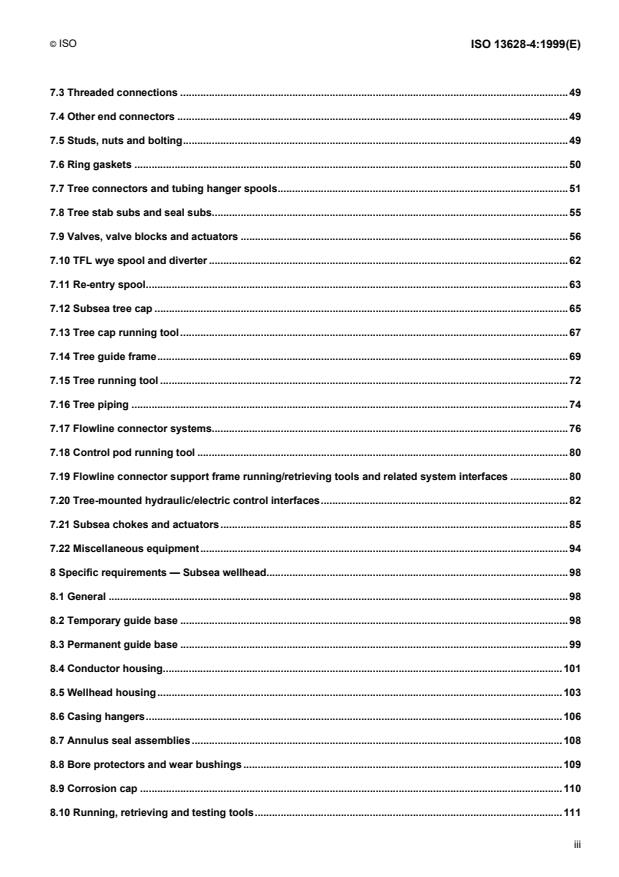
7.1 Flanged end and outlet connections .35
7.2 ISO clamp hub-type connections.49
© ISO 1999
All rights reserved. Unless otherwise specified, no part of this publication may be reproduced or utilized in any form or by any means, electronic
or mechanical, including photocopying and microfilm, without permission in writing from the publisher.
International Organization for Standardization
Case postale 56 • CH-1211 Genève 20 • Switzerland
Internet iso@iso.ch
Printed in Switzerland
ii
© ISO
7.3 Threaded connections . 49
7.4 Other end connectors . 49
7.5 Studs, nuts and bolting. 49
7.6 Ring gaskets . 50
7.7 Tree connectors and tubing hanger spools. 51
7.8 Tree stab subs and seal subs. 55
7.9 Valves, valve blocks and actuators . 56
7.10 TFL wye spool and diverter . 62
7.11 Re-entry spool. 63
7.12 Subsea tree cap . 65
7.13 Tree cap running tool. 67
7.14 Tree guide frame. 69
7.15 Tree running tool . 72
7.16 Tree piping . 74
7.17 Flowline connector systems. 76
7.18 Control pod running tool . 80
7.19 Flowline connector support frame running/retrieving tools and related system interfaces . 80
7.20 Tree-mounted hydraulic/electric control interfaces. 82
7.21 Subsea chokes and actuators. 85
7.22 Miscellaneous equipment. 94
8 Specific requirements — Subsea wellhead. 98
8.1 General . 98
8.2 Temporary guide base . 98
8.3 Permanent guide base . 99
8.4 Conductor housing. 101
8.5 Wellhead housing. 103
8.6 Casing hangers. 106
8.7 Annulus seal assemblies. 108
8.8 Bore protectors and wear bushings . 109
8.9 Corrosion cap . 110
8.10 Running, retrieving and testing tools. 111
iii
© ISO
9 Specific requirements — Subsea tubing hanger system .111
9.1 General.111
9.2 Design.111
9.3 Materials .113
9.4 Testing .113
10 Specific requirements — Conventional mudline suspension equipment.114
10.1 General.114
10.2 Mudline suspension-landing/elevation ring.118
10.3 Casing hangers.118
10.4 Casing hanger running and tieback tools.120
10.5 Abandonment caps .120
10.6 Tieback adapters — Mudline conversion equipment for subsea completions .121
10.7 Tubing hanger spools — Mudline conversion equipment for subsea completions.121
10.8 Tubing hanger system — Mudline conversion equipment for subsea completions .121
11 Scope specific requirements — Drill-through mudline suspension equipment .121
11.1 General.121
11.2 Conductor housing.122
11.3 508 mm (20 in) or 473 mm (18 5/8 in) casing hanger.123
11.4 Wellhead housing .125
11.5 Casing hangers.127
11.6 Annulus seal assemblies .129
11.7 Bore protectors and wear bushings .130
11.8 Abandonment caps .131
11.9 Running, retrieving and testing tools.131
12 Purchasing guide lines.131
12.1 General.131
12.2 Typical wellhead and tree configurations .131
12.3 Product specification levels .131
12.4 Material class rating .132
Annex A (informative) Conventional subsea trees .133
Annex B (informative) Horizontal subsea trees.136
iv
© ISO
Annex C (informative) Subsea wellhead . 140
Annex D (informative) Subsea tubing hanger . 142
Annex E (normative) Conventional mudline suspension and conversion systems . 145
Annex F (informative) Drill-through mudline suspension systems . 151
Annex G (normative) Recommended flange bolt torques . 153
Annex H (normative) Design and testing of subsea wellhead running, retrieving and testing tools. 155
Annex I (informative) Procedure for the application of a coating system. 157
Bibliography. 160
v
© ISO
Foreword
ISO (the International Organization for standardization) is a worldwide federation of national standards bodies (ISO
member bodies). The work of preparing International Standards is normally carried out through ISO technical
committees. Each member body interested in a subject for which a technical committee has been established has
the right to be represented on that committee. International organizations, governmental and non-governmental, in
liaison with ISO, also take part in the work. ISO collaborates closely with the International Electrotechnical
Commission (IEC) on all matters of electrotechnical standardization.
International Standards are drafted in accordance with the rules given in the ISO/IEC Directives, Part 3.
Draft International Standards adopted by the technical committees are circulated to the member bodies for voting.
Publication as an International Standard requires approval by at least 75 % of the member bodies casting a vote.
International Standard ISO 13628-4 was prepared by Technical Committee ISO/TC 67, Materials, equipment and
offshore structures for petroleum and natural gas industries, Subcommittee SC 4, Drilling and production
equipment.
ISO 13628 consists of the following parts, under the general title Petroleum and natural gas industries — Design
and operation of subsea production systems:
Part 1: General requirements and recommendations
Part 2: Flexible pipe systems for subsea and marine applications
Part 3: Through Flowline (TFL) systems
Part 4: Subsea wellhead and tree equipment
Part 5: Subsea control umbilicals
Part 6: Subsea production control systems
Part 7: Workover/completion riser systems
Part 8: Remotely Operated Vehicles (ROV) interfaces on subsea production systems
Part 9: Remotely Operated Tools (ROT) intervention systems
Annexes E, G and H form a normative part of this part of ISO 13628. Annexes A, B, C, D, F and I are for information
only.
vi
© ISO
Introduction
This part of ISO 13628 is not intended to obviate the need for sound engineering judgement as to when and where
this part of ISO 13628 should be utilized, and the users of this part of ISO 13628 should be aware that additional or
differing requirements may be needed to meet the needs for the particular service intended or to meet local
legislation.
The objective of this part of ISO 13628 is to define clear and unambiguous requirements which will facilitate
international standardization in order to enable safe and economic development of offshore oil and gas fields by the
use of subsea wellhead and christmas tree equipment. This part of ISO 13628 is written in a manner which will
allow the use of a wide variety of technology varying from the well established to the state of the art. This part of
ISO 13628 does not wish to restrict or deter the development of new technology. However, the reader is
encouraged to closely look at standard interfaces and the re-use of intervention systems and tools, in the interests
of minimizing life cycle costs and increasing reliability by the use of proven interfaces.
The International Organization for Standardization (ISO) draws attention to the fact that it is claimed that compliance
with this part of ISO 13628 may involve the use of one or more patents concerning certain of the horizontal tree
designs given in subclause 6.1.2, annex B and Figures 4, B.1, B.2 and B.3.
The ISO takes no position concerning the evidence, validity and scope of this patent right.
The holder of this patent right has assured the ISO that he is willing to negotiate licences under reasonable and
non-discriminatory terms and conditions with the applicants throughout the world. In this respect, the statement of
the holder of this patent right is registered with the ISO.
Information may be obtained from: Peter A. Bielinski, Esq.
Intellectual Property attorney
Cooper Cameron Corporation
515 Post Oak Blvd., Suite 1200
Houston, Texas 77027
U.S.A.
Attention is drawn to the possibility that some of the elements of this part of ISO 13628 may be the subject of patent
rights other than those identified above. ISO shall not be held responsible for identifying any or all such patent
rights.
This part of ISO 13628 is based on API Specification 17D First edition, October 30, 1992, Specification for Subsea
Wellhead and Christmas Tree Equipment including Supplement 1 (March 1, 1993).
vii
INTERNATIONAL STANDARD © ISO ISO 13628-4:1999(E)
Petroleum and natural gas industries — Design and operation of
subsea production systems —
Part 4:
Subsea wellhead and tree equipment
1 Scope
1.1 This part of ISO 13628 specifies subsea copewellhead, conventional mudline wellhead, drill through mudline
wellhead, conventional subsea trees and horizontal subsea trees. It also specifies the associated tooling necessary
to handle, test and install the equipment. It also specifies the areas of design, material, welding, quality control
(including factory acceptance testing), marking, storing and shipping for both individual sub-assemblies (used to
build complete subsea tree assemblies) and complete subsea tree assemblies.
Where applicable, this part of ISO 13628 may also be used for equipment on satellite, cluster arrangements and
multiple well template applications.
1.2 Equipment which is within the scope of this part of ISO 13628 is listed as follows:
a) Subsea trees
tree connectors and tubing hanger spools;
valves, valve blocks, and valve actuators;
chokes and choke actuators;
bleed, test and isolation valves;
TFL wye spool;
re-entry spool;
tree cap;
tree piping;
tree guide frames;
tree running tools;
tree cap running tools;
tree mounted flowline/umbilical connector;
control module/pod running/retrieval and testing tools;
flowline base running/retrieval tools;
tree mounted controls interfaces (instrumentation, sensors, hydraulic tubing/piping and fittings, electrical
controls cable and fittings).
© ISO
b) Subsea wellheads
conductor housings;
wellhead housings;
casing hangers;
seal assemblies;
guidebases;
bore protectors and wear bushings;
corrosion caps.
c) Conventional mudline suspension systems
wellheads;
running tools;
casing hangers;
casing hanger running tool;
tieback tools for subsea completion;
subsea completion adaptors for mudline wellheads;
tubing spools;
corrosion caps.
d) Drill through mudline suspension systems
conductor housings;
surface casing hangers;
wellhead housings;
casing hangers;
annulus seal assemblies;
bore protectors and wear bushings;
abandonment caps.
e) Tubing hanger systems
tubing hangers;
running tools.
f) Miscellaneous equipment
flanged end and outlet connections;
© ISO
clamp hub-type connections;
threaded end and outlet connections;
other end connections;
studs and nuts;
ring joint gaskets;
intervention equipment;
guide line establishment equipment.
1.3 Equipment which is beyond the scope of this part of ISO 13628 includes:
subsea wireline/coiled tubing BOPs;
workover and production risers;
control systems and control pods;
platform tiebacks;
primary protective structures;
subsea process equipment;
subsea manifolding;
subsea wellhead tools;
repair and rework;
multiple well template structures;
mudline suspension high pressure risers;
template piping;
template interfaces.
1.4 Equipment definitions are given in clause 3 and equipment use and function are explained in annexes A to F.
Service conditions and product specification levels are given in clause 4.
Critical components are those parts having requirements specified in this part of ISO 13628.
Rework and repair of used equipment are beyond the scope of this part of ISO 13628.
2 Normative references
The following normative documents contain provisions which, through reference in this text, constitute provisions of
this part of ISO 13628. For dated references, subsequent amendments to, or revisions of, any of these publications
do not apply. However, parties to agreements based on this part of ISO 13628 are encouraged to investigate the
possibility of applying the most recent editions of the normative documents indicated below. For undated
references, the latest edition of the normative document referred to applies. Members of ISO and IEC maintain
registers of currently valid International Standards.
© ISO
ISO 10422, Petroleum and natural gas industries — Threading, gauging, and thread inspection of casing, tubing,
and line pipe threads — Specification.
ISO 10423:1994, Petroleum and natural gas industries — Drilling and production equipment — Specification for
valves, wellhead and Christmas tree equipment.
ISO 10424, Petroleum and natural gas industries — Drilling and production equipment — Specification for rotary
drilling equipment.
ISO 11960, Petroleum and natural gas industries — Steel pipes for use as casing or tubing for wells.
ISO 13628-1, Petroleum and natural gas industries — Design and operation of subsea production systems —
Part 1: General requirements and recommendations.
ISO 13628-2, Petroleum and natural gas industries — Design and operation of subsea production systems —
Part 2: Flexible pipe systems for subsea and marine applications.
ISO 13628-9, Petroleum and natural gas industries — Design and operation of subsea production systems —
Part 9: Remote Operated Tools (ROT) intervention systems.
ANSI/ASME B16.11, Forged Fittings, Socket-Welding and Threaded.
ANSI/ASME B31.3, Process Piping.
ANSI/NACE MR0175, Sulphide Stress Cracking Resistant Metallic Materials for Oilfield Equipment.
ANSI/SAE J517, Hydraulic Hose.
ANSI/SAE J343, Tests and Procedures for SAE 100R Series Hydraulic Hose and Hose Assemblies.
1)
API Spec 16A
2)
API Spec 16R
3)
API RP 17C
AWS D1.1, Structural Welding Code.
Det Norske Veritas Offshore Standard RP B401,Cathodic Protection Design.
INACE RP0176, Cathodic protection of steel fixed offshore structures.
NAS 1638-64, National Aerospace Standard-Cleanliness Requirements of Parts Used in Hydraulic Systems.
PFI Standard ES-24, Pipe Bending Methods, Tolerances, Process and Material Requirements.
1)
For the purposes of this part of ISO 13628, API Spec 16A will be replaced by ISO 13533 when the latter becomes publicly
available.
2)
For the purposes of this part of ISO 13628, API Spec 16R will be replaced by ISO 13625 when the latter becomes publicly
available.
3)
For the purposes of this part of ISO 13628, API Spec 17C will be replaced by ISO 13628-3 when the latter becomes publicly
available.
© ISO
3 Terms, definitions, symbols and abbreviations
For the purposes of this part of ISO 13628, the following terms, definitions, symbols and abbreviations apply.
3.1 Terms and definitions
3.1.1
annulus seal assembly
mechanism which provides pressure isolation between each casing hanger and the wellhead housing
3.1.2
bore protector
device which protects internal bore surfaces during drilling or workover operations
3.1.3
check valve
device designed to restrict flow in one direction
3.1.4
completion riser
riser that is designed to fit inside a BOP to allow installation of a tubing hanger, and may also be suitable for
connection to the tree upper connection for use as a means for running the tree or for use as a workover riser
3.1.5
conductor housing
top of the first casing string which forms the basic foundation of the subsea wellhead and provides attachments for
guidance structures
3.1.6
corrosion cap
cap placed over the wellhead to protect it from contamination by debris, marine growth, or corrosion during
temporary abandonment of the well
3.1.7
corrosion-resistant alloys
ferrous and non-ferrous alloys which are more corrosion resistant than low alloy steels
NOTE This term includes nickel alloys, stainless steels, copper-nickel alloys and titanium.
3.1.8
depth rating
maximum rated working depth of a piece of equipment at a given set of operating conditions
3.1.9
downstream
direction of movement away from the reservoir
3.1.10
extension sub
sealing tubular member that provides tree bore continuity between adjacent tree components
3.1.11
fail closed valve
actuated valve designed to fail to the closed position
3.1.12
fail open valve
actuated valve designed to fail to the open position
© ISO
3.1.13
flowline
any pipeline connecting to the subsea tree assembly
3.1.14
flowline connector support frame
structural frame which receives and supports the flowline connector and transfers flowline loads back into the
wellhead or seabed anchored structure
3.1.15
flowline connector system
equipment used to attach subsea pipelines and/or control umbilicals to a subsea tree
NOTE The system may include means to guide the end of the pipeline or umbilical into place and may include remote
connection or disconnection capability.
3.1.16
flow loops
piping which connects the outlet(s) of the subsea tree to the subsea flowline connection and/or to other tree piping
connections (crossover piping, etc.)
3.1.17
guide funnel
tapered enlargement at the end of a guidance member to provide primary guidance over another guidance member
3.1.18
guide lineless systems
systems which do not depend on the establishment of guide lines from the seafloor to the surface vessel for
guidance and alignment of subsea equipment during installation, operation, intervention, or retrieval
3.1.19
guide lines
taut lines from the seafloor to the surface for the purpose of guiding equipment to the seafloor structure
3.1.20
high pressure riser
tubular member which extends the wellbore from the mudline wellhead or tubing spool to a surface BOP
3.1.21
inboard tree piping
subsea tree piping which is upstream of the first tree wing valve
3.1.22
intervention fixtures
devices or features permanently fitted to subsea well equipment to facilitate subsea intervention tasks including, but
not limited to:
grasping intervention fixtures
docking intervention fixtures
landing intervention fixtures
linear actuator intervention fixtures
rotary actuator intervention fixtures
fluid coupling intervention fixtures
© ISO
3.1.23
intervention system
means to deploy or convey intervention tools to subsea well equipment to carry out intervention tasks including:
ROV;
ROT;
ADS;
diver.
3.1.24
intervention tools
device or ROT deployed by an intervention system to mate or interface with intervention fixtures
3.1.25
LWRP
unitized assembly that interfaces with the tree upper connection and allows sealing of the tree vertical bore(s)
NOTE This may also allow disconnection from the top connection of the LWRP, to permit retrieval of the workover riser,
while wireline equipment is in the tree bore(s).
3.1.26
mudline suspension system
drilling system consisting of a series of housings used to support casing strings at the mudline, installed from a
bottom-supported rig using a surface BOP
3.1.27
nonpressure-containing/controlling parts
structural and other parts that do not contain or control pressure, such as guidebases, guideframes, and wear
bushings
3.1.28
orienting bushings
non-pressure-containing parts which are used to orient equipment or tools with respect to the wellhead
3.1.29
outboard tree piping
subsea tree piping which is downstream of the first tree wing valve and upstream of flowline connector (see flow
loop)
3.1.30
permanent guidebase
structure that sets alignment and orientation of the wellhead system and provides entry guidance for running
equipment on or into the wellhead assembly
3.1.31
plug catcher
device at the bottom of the tubing hanger annulus bore to prevent the wireline plug from passing through the tubing
hanger when an annulus string is not used
3.1.32
pressure-containing parts
those parts whose failure to function as intended would result in a release of retained fluid to the environment
EXAMPLES Bodies, bonnets and stems.
© ISO
3.1.33
pressure controlling parts
those parts intended to control or regulate the movement of pressurized fluids, such as valve bore sealing
mechanisms and hangers
3.1.34
power operated fail closed valve
hydraulically or electrically actuated valve designed to fail to the closed position
3.1.35
rated working pressure
maximum internal pressure equipment is designed to contain and/or control
NOTE Working pressure is not to be confused with test pressure.
3.1.36
re-entry spool
tree upper connection profile, which allows remote connection of a tree running tool, LWRP or tree cap
3.1.37
running tool
tool used to run, retrieve, position, or connect subsea equipment remotely from the surface
EXAMPLES Tree running tools, tree cap running tools, flowline connector running tools, etc.
3.1.38
second end connection
connection made at the termination of the pipelaying process
3.1.39
split gate valve
valve where the gate is made of two or more pieces which are capable of being energized to seal both upstream
and downstream at the same time
3.1.40
subsea BOP
blow-out preventer stack designed for use on subsea wellheads.
NOTE This provides the capability to remotely shear and seal the wellhead bore and also provides the capability to
circulate from the surface through the wellhead.
3.1.41
subsea casing hangers
device that supports a casing string in the wellhead at the mudline
3.1.42
subsea completion equipment
specialized tree and wellhead equipment used to complete a well below the surface of a body of water
NOTE This may be made above a subsea wellhead or mudline suspension system. Equipment includes subsea wellhead,
tree, tree appurtenances (e.g., tree cap, control pod), and associated subsea tree running tools.
3.1.43
subsea wellhead housing
pressure-containing housing that provides a means for suspending and sealing the well casing strings installed
during a floating drilling operation
3.1.44
subsea wireline/coiled tubing BOP
subsea BOP that attaches to the top of a subsea tree to facilitate wireline or coiled tubing intervention
© ISO
3.1.45
swivel flange (type 17SV)
flange assembly consisting of a central hub and a loose flange rim which is free to rotate about the hub
NOTE The rotating flange rim has holes to accept bolts. The central hub has a sealing mechanism which will engage an
ISO ring gasket. ISO type SV swivel flanges will mate with standard ISO type 17SS and 6BX flanges of the same size and
pressure rating.
3.1.46
tieback adapter
device used to provide the interface between mudline suspension equipment and subsea completion equipment
3.1.47
tree cap
protective cover for the upper tree connection
NOTE This may be used to contain pressure, and may be an integral part of the tree control system.
3.1.48
tree connector
mechanism to join and seal a subsea tree to a subsea wellhead
NOTE This may require diver assistance for installation, or be hydraulically actuated to permit remote operation.
3.1.49
tree guide frame
structural framework to provide guidance with the PGB interface, for installation of the subsea tree on the subsea
wellhead, and which also provides support for tree flowlines and connection equipment, control pods, anodes, and
counterbalance weights
3.1.50
tree upper connection
uppermost fitting of a subsea tree which allows full bore access to the tree
NOTE The connection profile may be API or other proprietary types (see re-entry spool).
3.1.51
tree side outlet
point where a bore exits at the side of the tree block
3.1.52
umbilicals
hose, tubing, piping, and/or electrical conductors which direct fluids and/or electrical current or signals to or from
subsea trees
NOTE Umbilical lines are typically used for control, monitoring, and/or injection functions.
3.1.53
upstream
direction of movement to the reservoir
3.1.54
valve block
integral block containing two or more valves
3.1.55
wear bushings
bore protector which also protects the casing hanger below it
3.1.56
wellhead housing pressure boundary
wellhead housing from the top of the wellhead to where the lowermost seal assembly seals
© ISO
3.1.57
workover riser
equipment to provide a conduit from the tree upper connection to the surface and allows the passage of wireline
tools.
NOTE It has to resist environmental wind, wave and current forces.
3.1.58
wye spool
spool between the master and swab (crown) valves of a TFL tree, that allows the passage of TFL tools from the
flowlines into the bores of the tree
3.2 Symbols and abbreviations
ADS atmospheric diving system
ANSI American National Standards Institute
API American Petroleum Institute
ASME American Society of Mechanical Engineers
AWS American Welding Society
BOP blow-out preventer
CRA corrosion-resistant alloys
EDP emergency disconnect package
FEA finite element analysis
FAT factory acceptance test
ID inside diameter
LRP lower riser package
LWRP lower workover riser package
MIL-STD Military Standard (USA)
MRWP maximum rated working pressure
MSS Manufacturer's Standardization Society of the Valve and Fittings Industry
NACE National Association of Corrosion Engineers
OD outside diameter
OEC other end connectors
PFI Pipe Fabrication Institute
PGB permanent guide base
PMR per manufacurer’s rating
PR2 performance requirement level two
PSL product specification level
© ISO
RMS root mean square
ROV remotely operated vehicle
ROT remotely operated tool
S bending stress
b
S membrane stress
m
S yield stress
y
SCSSV surface-controlled subsurface safety valve
SWL safe working load
TFL through-flowline
TGB temporary guide base
WCT-BOP wireline/coil tubing blow-out preventer
XT tree
4 Service conditions and product specification levels
4.1 Service conditions
4.1.1 General
Service conditions refer to classifications for pressure, temperature and the various wellbore constituents and
operating conditions for which the equipment will be designed.
4.1.2 Pressure ratings
Pressure ratings indicate maximum rated working pressures expressed as megapascals (MPa) with equivalent
pounds per square inch (psi) in parentheses. It should be noted that pressure is gauge pressure.
4.1.3 Temperature ratings
Temperature ratings indicate temperature ranges, from minimum ambient to maximum flowing fluid temperatures,
expressed in degrees Celsius (°C) with equivalent degrees Fahrenheit (°F) given in parentheses.
4.1.4 Material class ratings
Materials class ratings indicate the material of the equipment components. A guide line for the basic wellbore
constituents and operating conditions is covered in clause 12.
4.2 Product specification levels (PSL)
All pressure-containing and pressure-controlling parts of equipment manufactured to this part of ISO 13628 shall
comply with the requirements of PSL 2 or PSL 3 as established in ISO 10423 or PSL 3G as defined in 5.2.3 and
5.4.2. These PSL designations define different levels of requirements. Clause 12 provides guide lines for selecting
an acceptable PSL.
Structural components and other nonpressure-containing/controlling parts of equipment manufactured to this part of
ISO 13628 need not comply with the requirements of PSL 2, PSL 3 or PSL 3G. PSL rating of assembled wellhead
or tree equipment shall be determined by the lowest PSL rating of any pressure-containing/controlling component in
the assembly.
© ISO
5 Common system requirements
5.1 Design and performance requirements
5.1.1 General
Product capability is defined by two main aspects:
Performance verification testing (see 5.1.7), which is intended to demonstrate and qualify performance of generic
product families, as being representative of defined product variants.
Performance requirements, which define the operating capability of the specific "as-shipped" items (see this
subclause and 5.1.2), which is demonstrated by reference to both factory acceptance testing and relevant
performance verification testing data.
Performance requirements are specific and unique to the product in the as-shipped condition. All products shall be
designed to perform in accordance with 5.1, 6.1, and clauses 7 to 11.
5.1.1.1 Pressure integrity
Product designs shall be capable of withstanding rated working pressure at rated temperature without deformation
to the extent that any other performance requirement is not met, providing stress criteria are not exceeded.
5.1.1.2 Thermal integrity
Product designs shall be capable of functioning throughout the temperature range for which the product is rated.
5.1.1.3 Materials
Product designs shall be capable of functioning with appropriate material class selected from Table 1.
Table 1 — Material requirements
a
Materials class Minimum material requirements
Body, bonnet and flange Pressure controlling parts, stems and
mandrel hangers
AA-General service Carbon or low alloy steel Carbon or low alloy steel
BB-General service Carbon or low alloy steel Stainless steel
CC-General service Stainless steel Stainless steel
b c c
DD-Sour service Carbon or low alloy steel Carbon or low alloy steel
b c c
EE-Sour service Carbon or low alloy steel Stainless steel
b c
Stainless steel
FF-Sour service Stainless steel
b c c
HH-Sour service CRAs CRAs
a
Refer to 5.1.2.3 for information regarding material class selection.
b
As defined in ANSI/NACE MR0175.
c
In compliance with ANSI/NACE MR0175.
5.1.1.4 Leakage
No observable leakage is allowed.
5.1.1.5 Load capability
Product designs shall be capable of sustaining rated loads without deformation to the extent that any other
performance requirement is not met, providing stress criteria are not exceeded. Product designs that support
tubulars shall be capable of supporting the rated load without collapsing the tubulars below the drift diameter.
© ISO
5.1.1.6 Cycles
Product designs shall be capable of performing and operating in service as intended for the number of operating
cycles as specified by the manufacturer.
5.1.1.7 Operating force or torque
Products shall be designed to operate within the manufacturer's force or torque specification, as applicable and
where applicable as verified in performance verification testing.
5.1.1.8 The design shall consider the venting of trapped pressure and ensure that this can safely be released
prior to the disconnection of fittings, assemblies, etc.
5.1.2 Service conditions
5.1.2.1 Pressure ratings
5.1.2.1.1 General
Pressure ratings shall comply with the following paragraphs. Where small diameter lines, such as SCSSV control
lines or chemical injection lines, pass through a cavity, such as the tree/tubing hanger cavity, equipment bounding
that cavity shall be rated for the maximum pressure in any of the lines, unless a means is provided to monitor and
relieve the cavity pressure in the event of a leak in any of those lines. In addition, the effects of external loads (i.e.
bending moments, tension), ambient hydrostatic loads and fatigue shall be considered. For the purpose of this part
of ISO 13628, pressure ratings shall be interpreted as differential pressure. For clarity, the following examples are
offered.
EXAMPLE 1 Pressure-containing components (such as bodies, bonnets and end connectors) rated for 69,0 MPa (10 000 psi)
are tested, marked for 69,0 MPa (10 000 psi) differential pressure service. If the application is in a water depth that results in
17,25 MPa (2 500 psi) external ambient pressure, these components could be used up to a shut-in pressure of 86,25 MPa
(12 500 psi), even though their MRWP is marked as 69,0 MPa (10 000 psi).
EXAMPLE 2 Pressure-controlling components (such as valve bore sealing mechanisms and tubing plugs) may be isolated
from the external ambient pressure under certain operating conditions. For example, valves on a subsea gas well may have
little or no pressure on the "downstream" side of their gates when the valves are closed and the flowline pressure is vented to
atmosphere. In such cases, external ambient seawater pressure would not reduce the "differential pressure" acting across the
valve bore sealing mechanism. Thus, in most cases, valves in subsea gas service cannot be used in applications where the
shut-in pressures would exceed the MRWP stamped on the equipment.
EXAMPLE 3 Pressure-controlling components (such as va
...
Questions, Comments and Discussion
Ask us and Technical Secretary will try to provide an answer. You can facilitate discussion about the standard in here.
Loading comments...