

ISO 16634-2:2016
(Main)Food products — Determination of the total nitrogen content by combustion according to the Dumas principle and calculation of the crude protein content — Part 2: Cereals, pulses and milled cereal products
General Information
- Abstract
ISO 16634-2:2016 specifies a method for the determination of the total nitrogen content and the calculation of the crude protein content of cereals, pulses and milled cereal products. This method, like the Kjeldahl method (see References [1] and [6]), does not distinguish between protein nitrogen and non-protein nitrogen. For the calculation of the protein content, various conversion factors are used (see 3.2).
- Status
- Published
- Publication Date
- 19-May-2016
- Technical Committee
- ISO/TC 34/SC 4 - Cereals and pulses
- Drafting Committee
- ISO/TC 34/SC 4 - Cereals and pulses
- Current Stage
- 9092 - International Standard to be revised
- Start Date
- 24-Oct-2023
- Completion Date
- 29-Aug-2026
Buy Documents

ISO 16634-2:2016 - Food products -- Determination of the total nitrogen content by combustion according to the Dumas principle and calculation of the crude protein content
ISO 16634-2:2016 - Food products — Determination of the total nitrogen content by combustion according to the Dumas principle and calculation of the crude protein content — Part 2: Cereals, pulses and milled cereal products/20/2016


ISO 16634-2:2016 - Produits alimentaires -- Détermination de la teneur en azote total par combustion selon le principe Dumas et calcul de la teneur en protéines brutes
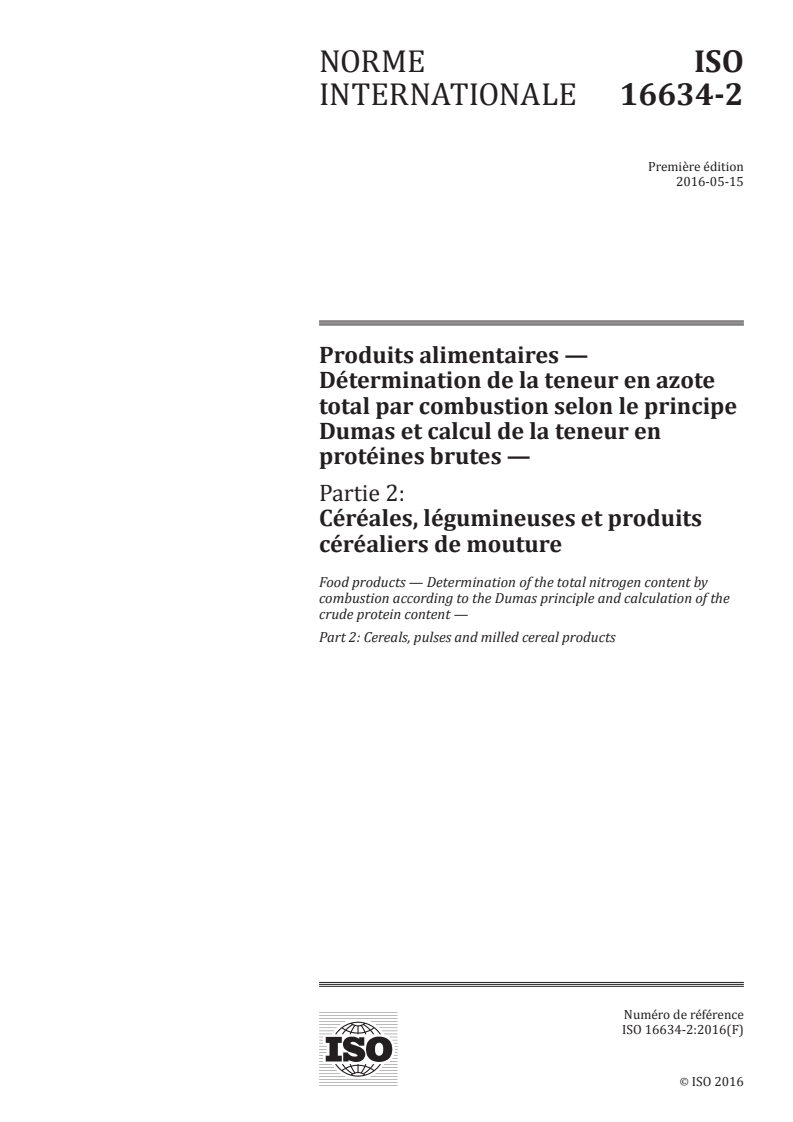
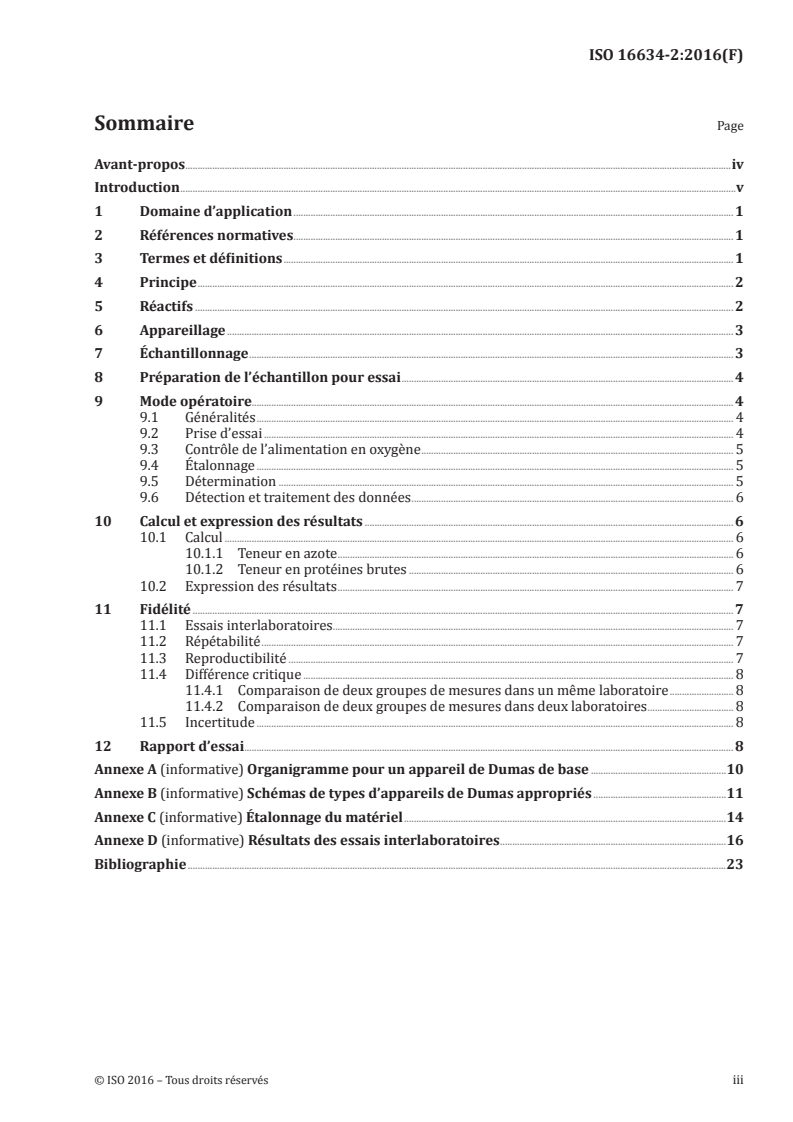
ISO 16634-2:2016 - Produits alimentaires — Détermination de la teneur en azote total par combustion selon le principe Dumas et calcul de la teneur en protéines brutes — Partie 2: Céréales, légumineuses et produits céréaliers de mouture/20/2016
Overview
ISO 16634-2:2016 sets out an internationally recognized method for determining the total nitrogen content and calculating the crude protein content in cereals, pulses, and milled cereal products. Using the Dumas principle of combustion, this standard offers an alternative to the Kjeldahl method for protein analysis in food products. The Dumas method is favored for its speed and avoidance of hazardous chemicals, making it increasingly popular in quality control and analytical laboratories within the food industry.
This standard is essential for manufacturers, laboratories, and regulatory bodies seeking accurate, reproducible, and comparable results for nitrogen and protein determination in cereal-based food products.
Key Topics
- Total Nitrogen Determination: Utilizes combustion (Dumas principle) to convert all nitrogenous compounds in the sample into nitrogen gas, which is then quantified.
- Crude Protein Calculation: The total nitrogen content is converted to crude protein content using product-specific conversion factors.
- Sample Preparation: Emphasizes obtaining homogenous samples and proper moisture determination using referenced ISO methods (e.g., ISO 712, ISO 6540, ISO 24557).
- Calibration and Quality Control: Outlines the need for frequent calibration using compounds of known nitrogen content and daily performance checks.
- Precision and Repeatability: Includes guidance on interlaboratory reproducibility, repeatability limits, and reporting uncertainty.
- Test Reporting: Specifies data and procedural details required in the analytical report for traceability and comparability.
Applications
ISO 16634-2:2016 has widespread practical applications for those engaged in food analysis, quality assurance, and regulatory compliance:
- Food Industry Laboratories: For routine monitoring of protein content in raw materials and finished products like wheat flour, pulses, barley, and maize.
- Regulatory Compliance: Assists in meeting national and international labeling requirements for protein content in cereal-based foods.
- Research & Development: Supports product development and nutritional research by providing a standard, validated approach to measuring protein content.
- Third-Party Testing Providers: Enables contract laboratories to deliver consistent, ISO-compliant results for clients in the grain and food processing sectors.
- Trade and Export: Facilitates fair commercial transactions by providing comparable analytical results, reducing trade disputes over product composition.
Related Standards
For reliable and standardized results, the following related ISO standards are often referenced alongside ISO 16634-2:2016:
- ISO 16634-1 - Food products - Determination of total nitrogen content by combustion (Dumas method) - Part 1: Oilseeds and animal feeding stuffs
- ISO 712 - Cereals and cereal products - Determination of moisture content - Reference method
- ISO 6540 - Maize - Determination of moisture content (on milled and whole grains)
- ISO 24557 - Pulses - Determination of moisture content - Air-oven method
- ISO 24333 - Cereals and cereal products - Sampling
Employing ISO 16634-2:2016 improves the reliability and credibility of protein measurement in cereals and pulses, ensuring consistent quality and meeting global market expectations. By adhering to this method, food producers and analytical laboratories demonstrate a commitment to best practices and regulatory alignment in food analysis.
Relations
- Effective Date
- 12-Feb-2026
- Effective Date
- 31-May-2014
Buy Documents
ISO 16634-2:2016 - Food products -- Determination of the total nitrogen content by combustion according to the Dumas principle and calculation of the crude protein content
ISO 16634-2:2016 - Food products — Determination of the total nitrogen content by combustion according to the Dumas principle and calculation of the crude protein content — Part 2: Cereals, pulses and milled cereal products/20/2016
ISO 16634-2:2016 - Produits alimentaires -- Détermination de la teneur en azote total par combustion selon le principe Dumas et calcul de la teneur en protéines brutes
ISO 16634-2:2016 - Produits alimentaires — Détermination de la teneur en azote total par combustion selon le principe Dumas et calcul de la teneur en protéines brutes — Partie 2: Céréales, légumineuses et produits céréaliers de mouture/20/2016
Get Certified
Connect with accredited certification bodies for this standard

BSI Group
BSI (British Standards Institution) is the business standards company that helps organizations make excellence a habit.

Bureau Veritas
Bureau Veritas is a world leader in laboratory testing, inspection and certification services.

DNV
DNV is an independent assurance and risk management provider.
Sponsored listings
Frequently Asked Questions
ISO 16634-2:2016 is a standard published by the International Organization for Standardization (ISO). Its full title is "Food products — Determination of the total nitrogen content by combustion according to the Dumas principle and calculation of the crude protein content — Part 2: Cereals, pulses and milled cereal products". This standard covers: ISO 16634-2:2016 specifies a method for the determination of the total nitrogen content and the calculation of the crude protein content of cereals, pulses and milled cereal products. This method, like the Kjeldahl method (see References [1] and [6]), does not distinguish between protein nitrogen and non-protein nitrogen. For the calculation of the protein content, various conversion factors are used (see 3.2).
ISO 16634-2:2016 specifies a method for the determination of the total nitrogen content and the calculation of the crude protein content of cereals, pulses and milled cereal products. This method, like the Kjeldahl method (see References [1] and [6]), does not distinguish between protein nitrogen and non-protein nitrogen. For the calculation of the protein content, various conversion factors are used (see 3.2).
ISO 16634-2:2016 is classified under the following ICS (International Classification for Standards) categories: 67.050 - General methods of tests and analysis for food products; 67.060 - Cereals, pulses and derived products. The ICS classification helps identify the subject area and facilitates finding related standards.
ISO 16634-2:2016 has the following relationships with other standards: It is inter standard links to EN ISO 16634-2:2016, ISO/TS 16634-2:2009. Understanding these relationships helps ensure you are using the most current and applicable version of the standard.
ISO 16634-2:2016 is available in PDF format for immediate download after purchase. The document can be added to your cart and obtained through the secure checkout process. Digital delivery ensures instant access to the complete standard document.
Standards Content (Sample)
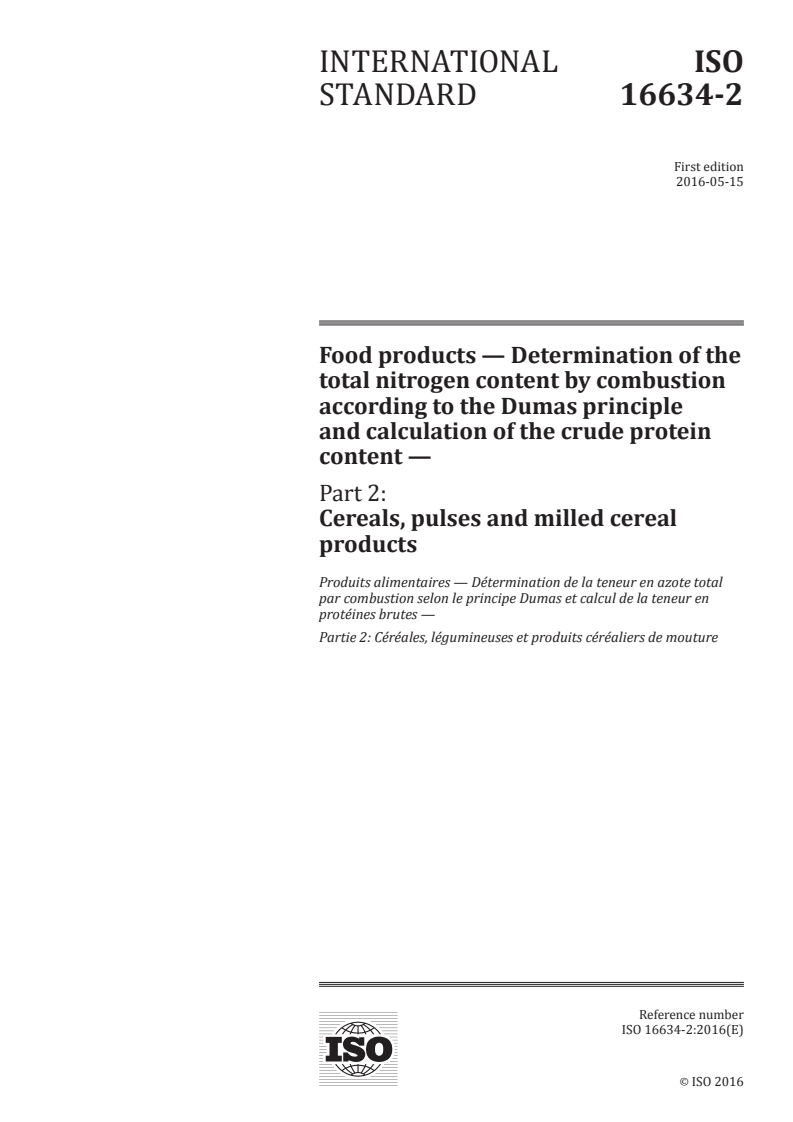
INTERNATIONAL ISO
STANDARD 16634-2
First edition
2016-05-15
Food products — Determination of the
total nitrogen content by combustion
according to the Dumas principle
and calculation of the crude protein
content —
Part 2:
Cereals, pulses and milled cereal
products
Produits alimentaires — Détermination de la teneur en azote total
par combustion selon le principe Dumas et calcul de la teneur en
protéines brutes —
Partie 2: Céréales, légumineuses et produits céréaliers de mouture
Reference number
©
ISO 2016
© ISO 2016, Published in Switzerland
All rights reserved. Unless otherwise specified, no part of this publication may be reproduced or utilized otherwise in any form
or by any means, electronic or mechanical, including photocopying, or posting on the internet or an intranet, without prior
written permission. Permission can be requested from either ISO at the address below or ISO’s member body in the country of
the requester.
ISO copyright office
Ch. de Blandonnet 8 • CP 401
CH-1214 Vernier, Geneva, Switzerland
Tel. +41 22 749 01 11
Fax +41 22 749 09 47
copyright@iso.org
www.iso.org
ii © ISO 2016 – All rights reserved
Contents Page
Foreword .iv
Introduction .v
1 Scope . 1
2 Normative references . 1
3 Terms and definitions . 1
4 Principle . 2
5 Reagents . 2
6 Apparatus . 3
7 Sampling . 3
8 Preparation of the test sample . 3
9 Procedure. 4
9.1 General . 4
9.2 Test portion . 4
9.3 Control of oxygen supply . 4
9.4 Calibration . 5
9.5 Determination . 5
9.6 Detection and data processing . 5
10 Calculation and expression of results . 6
10.1 Calculation . 6
10.1.1 Nitrogen content . 6
10.1.2 Crude protein content . 6
10.2 Expression of results . 6
11 Precision . 6
11.1 Interlaboratory tests . 6
11.2 Repeatability . 7
11.3 Reproducibility . 7
11.4 Critical difference. 7
11.4.1 Comparison of two groups of measurements in the same laboratory . 7
11.4.2 Comparison of two groups of measurements in two different laboratories . 8
11.5 Uncertainty . 8
12 Test report . 8
Annex A (informative) Flowchart for a basic Dumas apparatus . 9
Annex B (informative) Schematic diagrams of suitable types of Dumas apparatus .10
Annex C (informative) Equipment calibration .13
Annex D (informative) Results of interlaboratory tests .15
Bibliography .22
Foreword
ISO (the International Organization for Standardization) is a worldwide federation of national standards
bodies (ISO member bodies). The work of preparing International Standards is normally carried out
through ISO technical committees. Each member body interested in a subject for which a technical
committee has been established has the right to be represented on that committee. International
organizations, governmental and non-governmental, in liaison with ISO, also take part in the work.
ISO collaborates closely with the International Electrotechnical Commission (IEC) on all matters of
electrotechnical standardization.
The procedures used to develop this document and those intended for its further maintenance are
described in the ISO/IEC Directives, Part 1. In particular the different approval criteria needed for the
different types of ISO documents should be noted. This document was drafted in accordance with the
editorial rules of the ISO/IEC Directives, Part 2 (see www.iso.org/directives).
Attention is drawn to the possibility that some of the elements of this document may be the subject of
patent rights. ISO shall not be held responsible for identifying any or all such patent rights. Details of
any patent rights identified during the development of the document will be in the Introduction and/or
on the ISO list of patent declarations received (see www.iso.org/patents).
Any trade name used in this document is information given for the convenience of users and does not
constitute an endorsement.
For an explanation on the meaning of ISO specific terms and expressions related to conformity
assessment, as well as information about ISO’s adherence to the WTO principles in the Technical
Barriers to Trade (TBT) see the following URL: Foreword - Supplementary information
The committee responsible for this document is ISO/TC 34, Food products, Subcommittee SC 4, Cereals
and pulses.
This first edition cancels and replaces ISO/TS 16634-2:2009, which has been technically revised.
ISO 16634 consists of the following parts, under the general title, Food products — Determination of the
total nitrogen content by combustion according to the Dumas principle and calculation of the crude protein
content:
— Part 1: Oilseeds and animal feeding stuffs
— Part 2: Cereals, pulses and milled cereal products
iv © ISO 2016 – All rights reserved
Introduction
For a long time, the Kjeldahl method has been the most frequently used method for the determination
of the protein content of food products. In recent years, the Dumas method has gained importance
compared to the Kjeldahl method because it is faster and does not use dangerous chemicals. Although
the principles of the two methods are different, both measure the nitrogen content of the product.
Nitrogen content can be converted into protein content by using an appropriate factor. The value of this
factor varies depending on the relative amounts of different proteins and their amino-acid composition
in a given product.
Neither the Dumas nor the Kjeldahl method distinguishes between protein and non-protein nitrogen.
In most cases, results obtained by the Dumas method are slightly higher than those of the Kjeldahl
method. This is because the Dumas method measures almost all of the non-protein nitrogen, whereas
the Kjeldahl method measures only a part of it.
Taking into consideration that the protein content of a product calculated by both methods only
approximates to the true value, it is a matter of discretion which one is accepted. The best solution is
to use a second factor for the elimination of the systematic error caused by the non-protein nitrogen
content of the different products.
However, this second factor has to be determined for each product like the existing factors which
indicate the ratio of the protein content to the nitrogen content.
INTERNATIONAL STANDARD ISO 16634-2:2016(E)
Food products — Determination of the total nitrogen
content by combustion according to the Dumas principle
and calculation of the crude protein content —
Part 2:
Cereals, pulses and milled cereal products
1 Scope
This part of ISO 16634 specifies a method for the determination of the total nitrogen content and the
calculation of the crude protein content of cereals, pulses and milled cereal products.
This method, like the Kjeldahl method (see References [1] and [6]), does not distinguish between protein
nitrogen and non-protein nitrogen. For the calculation of the protein content, various conversion factors
are used (see 3.2).
2 Normative references
The following documents, in whole or in part, are normatively referenced in this document and are
indispensable for its application. For dated references, only the edition cited applies. For undated
references, the latest edition of the referenced document (including any amendments) applies.
ISO 712, Cereals and cereal products — Determination of moisture content — Reference method
ISO 6540, Maize — Determination of moisture content (on milled grains and on whole grains)
ISO 24557, Pulses — Determination of moisture content — Air-oven method
3 Terms and definitions
For the purposes of this document, the following terms and definitions apply.
3.1
nitrogen content
mass fraction of the total nitrogen
Note 1 to entry: Determined by the procedure specified in this part of ISO 16634.
Note 2 to entry: The mass fraction is expressed as a percentage.
3.2
crude protein content
nitrogen content (3.1) multiplied by a factor
Note 1 to entry: A 5,7 factor is generally used for cereals for human food (such as wheat, rye and their milled
products) and 6,25 for malting barley and cereals for feed and other products falling within the scope of this part
of ISO 16634.
Note 2 to entry: The factors for calculation of the crude protein content from the total nitrogen content are
derived from the Kjeldahl method, which is the reference method for the determination of total nitrogen content.
4 Principle
Samples are converted into gases by heating in a combustion tube. Interfering components are removed
from the resulting gas mixture. The nitrogen compounds in the gas mixture, or a representative
part of them, are converted to molecular nitrogen which is quantitatively determined by a thermal-
conductivity detector. The nitrogen content is calculated by a microprocessor.
5 Reagents
Use only reagents of recognized analytical grade or reagents of equivalent purity as specified by
instrument manufacturers. Except for the reference materials (5.12), all reagents shall be free from
nitrogen.
5.1 Carrier gas(es), use either 5.1.1 or 5.1.2.
5.1.1 Carbon dioxide, as pure as possible, but with a minimum CO volume fraction of 99,99 %.
5.1.2 Helium, as pure as possible, but with a minimum He volume fraction of 99,99 %.
5.2 Oxygen, as pure as possible, but with a minimum O volume fraction of 99,99 %.
5.3 Sulfur dioxide and halogen absorbent, to eliminate any sulfur from the sample [e.g. lead
chromate (PbCrO ) or steel wool].
5.4 Copper oxide/platinum catalyst, for the post-combustion tube.
Platinum catalyst [5 % of Pt on alumina (Al O )] is blended with CuO in the ratio 1 part:7 parts or
2 3
1 part:8 parts in accordance with the manufacturer’s recommendations.
To prevent separation as a result of the different bulk densities of the two materials, it is recommended
not to prepare the mixture before filling the tube, but to pour the platinum catalyst and copper oxide
simultaneously into the post-combustion tube using a suitable funnel.
5.5 Silver or copper wool.
This shall be disaggregated before being inserted into the post-combustion or reduction tube.
5.6 Silica (quartz) or glass wool or cotton wool, as recommended by the instrument manufacturer.
5.7 Copper or tungsten (wire, cuttings, turnings or powder), for the reduction tube.
The use of copper or tungsten in one of these forms can improve the precision of analytical results for
samples with low nitrogen contents (about 1 % mass fraction).
5.8 Diphosphorus pentoxide (P O ) or granulated magnesium perchlorate [Mg(ClO ) ], or
2 5 4 2
another suitable drying agent, to fill the drying tubes.
5.9 Hollow corundum spheres or aluminium oxide pellets, for the combustion tube.
5.10 Copper oxide (CuO), as filling material for the combustion tube.
5.11 Sodium hydroxide (NaOH), on a support material.
2 © ISO 2016 – All rights reserved
5.12 Aspartic acid (C H NO ) or ethylenediaminetetraacetic acid (C H N O ) or glutamic acid
4 7 4 10 16 2 8
(C H NO ) or hippuric acid (C H NO ) standard, or other suitable reference materials with a known,
5 9 4 9 9 3
constant, certified nitrogen content.
The minimum recovery should preferably be 99 % mass fraction.
5.13 Light petroleum, with a boiling range between 30 °C and 60 °C, or acetone or ethanol.
6 Apparatus
Usual laboratory equipment and, in particular, the following.
6.1 Analytical balance, capable of weighing to the nearest 0,000 1 g.
6.2 Grinding device, appropriate to the nature of the sample.
6.3 Sieve, of nominal opening size 800 µm or 1 mm, made of non-ferrous material.
6.4 Crucibles (e.g. made of stainless steel, quartz, ceramic material or platinum) or tin capsules
or tin foils or nitrogen-free filter paper, suitable for the Dumas apparatus used.
NOTE 1 Several instruments provided with an automatic sampler are commercially available.
NOTE 2 Some solid samples (e.g. powders) can be pressed to form pellets.
6.5 Dumas apparatus, fitted with a furnace able to maintain a given temperature greater than or
equal to 850 °C, with a thermal-conductivity detector and suitable device for signal integration.
Suitable Dumas apparatus operates according to the general flowchart given in Annex A, although
different arrangements and components may be used.
NOTE Schematic diagrams of three commercially available instruments are shown as examples in
Figures B.1 to B.3.
To avoid leaks, the sealing O-rings shall be slightly lubricated with high-vacuum grease prior to
installation.
Experience has shown that it is important to clean all pieces of silicaware and glassware carefully
and to remove fingerprints from tubes, using a suitable solvent (5.13), before inserting them into the
furnace.
7 Sampling
A representative sample should have been sent to the laboratory. This sample should not have been
damaged or changed during transport or storage.
Sampling is not part of the method specified in this part of ISO 16634. Recommended sampling methods
are given in ISO 24333 for cereals and cereal products.
8 Preparation of the test sample
The test sample shall be prepared from the laboratory sample in such a way that a homogeneous test
sample is obtained.
Using a suitable grinding device (6.2), grind the laboratory sample. Generally, pass the ground material
through a sieve (6.3) of nominal opening size 800 µm for small sample sizes (under 300 mg) or a sieve of
nominal opening size 1 mm for larger sample sizes (300 mg or more). Mills that produce particle sizes
meeting the specifications given in Table 1 will give acceptable results.
Table 1 — Required particle size
Nominal size of sieve openings Amount passing through sieve
µm % mass fraction
710 100
500 95 to 100
200 85 or less
Grinding may result in moisture loss and, therefore, the moisture content of the ground sample should
preferably also be determined when reporting nitrogen or protein contents on a dry-matter or constant-
moisture basis. Determination of the moisture content shall be carried out in accordance with ISO 712
for cereals other than maize, ISO 6540 for maize and ISO 24557 for pulses.
The grinder efficiency can be checked by replicate preparation of ground samples of a 2 + 1 mixture of
maize and soya seeds. The expected coefficient of variation should be less than 2 % mass fraction.
9 Procedure
9.1 General
Carefully, follow the manufacturer’s instructions for instrument set-up, optimization, calibration and
operation. Switch the instrument on and allow it to stabilize as defined in local procedures.
An instrument performance test should be carried out daily, using the reference material (5.12). The
recovery of nitrogen should be >99,0 % mass fraction.
9.2 Test portion
Weigh, to the nearest 0,000 1 g, at least 0,1 g of the test sample into a crucible or tin capsule or nitrogen-
free filter paper (6.4). For samples low in protein (<1 % mass fraction), the amount of the test portion
can be increased up to 3,5 g, depending on the type of Dumas equipment being used and on the nature
of the sample.
Depending on the type of equipment used, if the sample contains over 17 % mass fraction of moisture,
drying may be necessary before analysis.
Lower test portions may be necessary for very high protein content samples or when only very small
amounts of sample are available. In the case of portions below 0,1 g, a second (validation) determination
shall be performed.
9.3 Control of oxygen supply
Control the oxygen supply, in particular the flow, in accordance with the instructions of the material
supplier.
With each series of nitrogen content determinations, conduct as many blank runs as necessary to
stabilize the equipment, using for each run an equivalent mass of sucrose in place of the test portion.
The sucrose blank provides the amount of nitrogen that is introduced in the form of atmospheric air
trapped within a powdered organic material. Use the mean value of the blank determinations as an
error correction in the calculation of the nitrogen content of each test sample.
4 © ISO 2016 – All rights reserved
9.4 Calibration
For instrument calibration, use pure compounds with a known, constant nitrogen content, e.g. aspartic
acid (5.12), as standards. Analyse in duplicate, three pure compounds, each in three different amounts
chosen as a function of the measurement range for the actual samples.
To prepare a calibration curve, carry out at least five determinations with different amounts of the
same compound, choosing the compound and the amounts used in such a way that the curve obtained
will cover the range of nitrogen contents in the samples to be analysed.
If the test portion contains more than 200 mg of nitrogen, the calibration curve is likely to be nonlinear.
In the nonlinear section, short segments can, nevertheless, be used for calibration purposes. To ensure
the reliability of the curve in these segments, the amount of standard used shall be increased in steps
corresponding to 1 mg to 5 mg of nitrogen over the segments.
Calibration can also be performed using standard aqueous solutions.
Check the calibration at least three times at the beginning of a series of analyses and then, after every
15 to 25 samples, analysing either one of the standards (5.12) or a sample of known value. The value
obtained for the nitrogen mass fraction shall differ by less than 0,05 % from the expected value. If it
does not, repeat the calibration check after checking instrument performance.
9.5 Determination
With the instrument operating in the stable state, introduce the test portion in accordance with the
manufacturer’s instructions.
During the analysis, the following processes take place in the instrument (see Figures B.1, B.2 or B.3).
The test portion is quantitatively combusted under standard conditions at a temperature of at least
850 °C, depending on the instrument and the material being analysed.
Volatile decomposition products (mainly molecular nitrogen, nitrogen oxides, carbon dioxide and water
vapour) are transported by the carrier gas (5.1) through the instrument.
Nitrogen oxides are reduced to molecular nitrogen, and the excess oxygen is bound to the copper or
tungsten (5.7) in the reduction column.
Water is removed by drying tubes filled with magnesium perchlorate, diphosphorus pentoxide or
another drying agent (5.8). If carbon dioxide is used as the carrier gas (5.1.1), it is removed by being
passed over a suitable absorbent, e.g. sodium hydroxide (5.11), on a suitable support material.
Interfering compounds (e.g. volatile halogen and sulfur compounds) are removed by absorbents (5.3)
or chemical reagents, e.g. silver wool (5.5) or sodium hydroxide (5.11), on a suitable support material.
The remaining gas mixture, consisting of nitrogen and carrier gas, is passed through a thermal-
conductivity detector.
9.6 Detection and data processing
For quantitative nitrogen determination, the instrument uses a sensitive thermal-conductivity cell
that is optimized for the carrier gas employed and that may have automatic zero adjustment between
measurements on successive test portions. After amplification and analogue/digital conversion of the
detector signal, the data obtained a
...
INTERNATIONAL ISO
STANDARD 16634-2
First edition
2016-05-15
Food products — Determination of the
total nitrogen content by combustion
according to the Dumas principle
and calculation of the crude protein
content —
Part 2:
Cereals, pulses and milled cereal
products
Produits alimentaires — Détermination de la teneur en azote total
par combustion selon le principe Dumas et calcul de la teneur en
protéines brutes —
Partie 2: Céréales, légumineuses et produits céréaliers de mouture
Reference number
©
ISO 2016
© ISO 2016, Published in Switzerland
All rights reserved. Unless otherwise specified, no part of this publication may be reproduced or utilized otherwise in any form
or by any means, electronic or mechanical, including photocopying, or posting on the internet or an intranet, without prior
written permission. Permission can be requested from either ISO at the address below or ISO’s member body in the country of
the requester.
ISO copyright office
Ch. de Blandonnet 8 • CP 401
CH-1214 Vernier, Geneva, Switzerland
Tel. +41 22 749 01 11
Fax +41 22 749 09 47
copyright@iso.org
www.iso.org
ii © ISO 2016 – All rights reserved
Contents Page
Foreword .iv
Introduction .v
1 Scope . 1
2 Normative references . 1
3 Terms and definitions . 1
4 Principle . 2
5 Reagents . 2
6 Apparatus . 3
7 Sampling . 3
8 Preparation of the test sample . 3
9 Procedure. 4
9.1 General . 4
9.2 Test portion . 4
9.3 Control of oxygen supply . 4
9.4 Calibration . 5
9.5 Determination . 5
9.6 Detection and data processing . 5
10 Calculation and expression of results . 6
10.1 Calculation . 6
10.1.1 Nitrogen content . 6
10.1.2 Crude protein content . 6
10.2 Expression of results . 6
11 Precision . 6
11.1 Interlaboratory tests . 6
11.2 Repeatability . 7
11.3 Reproducibility . 7
11.4 Critical difference. 7
11.4.1 Comparison of two groups of measurements in the same laboratory . 7
11.4.2 Comparison of two groups of measurements in two different laboratories . 8
11.5 Uncertainty . 8
12 Test report . 8
Annex A (informative) Flowchart for a basic Dumas apparatus . 9
Annex B (informative) Schematic diagrams of suitable types of Dumas apparatus .10
Annex C (informative) Equipment calibration .13
Annex D (informative) Results of interlaboratory tests .15
Bibliography .22
Foreword
ISO (the International Organization for Standardization) is a worldwide federation of national standards
bodies (ISO member bodies). The work of preparing International Standards is normally carried out
through ISO technical committees. Each member body interested in a subject for which a technical
committee has been established has the right to be represented on that committee. International
organizations, governmental and non-governmental, in liaison with ISO, also take part in the work.
ISO collaborates closely with the International Electrotechnical Commission (IEC) on all matters of
electrotechnical standardization.
The procedures used to develop this document and those intended for its further maintenance are
described in the ISO/IEC Directives, Part 1. In particular the different approval criteria needed for the
different types of ISO documents should be noted. This document was drafted in accordance with the
editorial rules of the ISO/IEC Directives, Part 2 (see www.iso.org/directives).
Attention is drawn to the possibility that some of the elements of this document may be the subject of
patent rights. ISO shall not be held responsible for identifying any or all such patent rights. Details of
any patent rights identified during the development of the document will be in the Introduction and/or
on the ISO list of patent declarations received (see www.iso.org/patents).
Any trade name used in this document is information given for the convenience of users and does not
constitute an endorsement.
For an explanation on the meaning of ISO specific terms and expressions related to conformity
assessment, as well as information about ISO’s adherence to the WTO principles in the Technical
Barriers to Trade (TBT) see the following URL: Foreword - Supplementary information
The committee responsible for this document is ISO/TC 34, Food products, Subcommittee SC 4, Cereals
and pulses.
This first edition cancels and replaces ISO/TS 16634-2:2009, which has been technically revised.
ISO 16634 consists of the following parts, under the general title, Food products — Determination of the
total nitrogen content by combustion according to the Dumas principle and calculation of the crude protein
content:
— Part 1: Oilseeds and animal feeding stuffs
— Part 2: Cereals, pulses and milled cereal products
iv © ISO 2016 – All rights reserved
Introduction
For a long time, the Kjeldahl method has been the most frequently used method for the determination
of the protein content of food products. In recent years, the Dumas method has gained importance
compared to the Kjeldahl method because it is faster and does not use dangerous chemicals. Although
the principles of the two methods are different, both measure the nitrogen content of the product.
Nitrogen content can be converted into protein content by using an appropriate factor. The value of this
factor varies depending on the relative amounts of different proteins and their amino-acid composition
in a given product.
Neither the Dumas nor the Kjeldahl method distinguishes between protein and non-protein nitrogen.
In most cases, results obtained by the Dumas method are slightly higher than those of the Kjeldahl
method. This is because the Dumas method measures almost all of the non-protein nitrogen, whereas
the Kjeldahl method measures only a part of it.
Taking into consideration that the protein content of a product calculated by both methods only
approximates to the true value, it is a matter of discretion which one is accepted. The best solution is
to use a second factor for the elimination of the systematic error caused by the non-protein nitrogen
content of the different products.
However, this second factor has to be determined for each product like the existing factors which
indicate the ratio of the protein content to the nitrogen content.
INTERNATIONAL STANDARD ISO 16634-2:2016(E)
Food products — Determination of the total nitrogen
content by combustion according to the Dumas principle
and calculation of the crude protein content —
Part 2:
Cereals, pulses and milled cereal products
1 Scope
This part of ISO 16634 specifies a method for the determination of the total nitrogen content and the
calculation of the crude protein content of cereals, pulses and milled cereal products.
This method, like the Kjeldahl method (see References [1] and [6]), does not distinguish between protein
nitrogen and non-protein nitrogen. For the calculation of the protein content, various conversion factors
are used (see 3.2).
2 Normative references
The following documents, in whole or in part, are normatively referenced in this document and are
indispensable for its application. For dated references, only the edition cited applies. For undated
references, the latest edition of the referenced document (including any amendments) applies.
ISO 712, Cereals and cereal products — Determination of moisture content — Reference method
ISO 6540, Maize — Determination of moisture content (on milled grains and on whole grains)
ISO 24557, Pulses — Determination of moisture content — Air-oven method
3 Terms and definitions
For the purposes of this document, the following terms and definitions apply.
3.1
nitrogen content
mass fraction of the total nitrogen
Note 1 to entry: Determined by the procedure specified in this part of ISO 16634.
Note 2 to entry: The mass fraction is expressed as a percentage.
3.2
crude protein content
nitrogen content (3.1) multiplied by a factor
Note 1 to entry: A 5,7 factor is generally used for cereals for human food (such as wheat, rye and their milled
products) and 6,25 for malting barley and cereals for feed and other products falling within the scope of this part
of ISO 16634.
Note 2 to entry: The factors for calculation of the crude protein content from the total nitrogen content are
derived from the Kjeldahl method, which is the reference method for the determination of total nitrogen content.
4 Principle
Samples are converted into gases by heating in a combustion tube. Interfering components are removed
from the resulting gas mixture. The nitrogen compounds in the gas mixture, or a representative
part of them, are converted to molecular nitrogen which is quantitatively determined by a thermal-
conductivity detector. The nitrogen content is calculated by a microprocessor.
5 Reagents
Use only reagents of recognized analytical grade or reagents of equivalent purity as specified by
instrument manufacturers. Except for the reference materials (5.12), all reagents shall be free from
nitrogen.
5.1 Carrier gas(es), use either 5.1.1 or 5.1.2.
5.1.1 Carbon dioxide, as pure as possible, but with a minimum CO volume fraction of 99,99 %.
5.1.2 Helium, as pure as possible, but with a minimum He volume fraction of 99,99 %.
5.2 Oxygen, as pure as possible, but with a minimum O volume fraction of 99,99 %.
5.3 Sulfur dioxide and halogen absorbent, to eliminate any sulfur from the sample [e.g. lead
chromate (PbCrO ) or steel wool].
5.4 Copper oxide/platinum catalyst, for the post-combustion tube.
Platinum catalyst [5 % of Pt on alumina (Al O )] is blended with CuO in the ratio 1 part:7 parts or
2 3
1 part:8 parts in accordance with the manufacturer’s recommendations.
To prevent separation as a result of the different bulk densities of the two materials, it is recommended
not to prepare the mixture before filling the tube, but to pour the platinum catalyst and copper oxide
simultaneously into the post-combustion tube using a suitable funnel.
5.5 Silver or copper wool.
This shall be disaggregated before being inserted into the post-combustion or reduction tube.
5.6 Silica (quartz) or glass wool or cotton wool, as recommended by the instrument manufacturer.
5.7 Copper or tungsten (wire, cuttings, turnings or powder), for the reduction tube.
The use of copper or tungsten in one of these forms can improve the precision of analytical results for
samples with low nitrogen contents (about 1 % mass fraction).
5.8 Diphosphorus pentoxide (P O ) or granulated magnesium perchlorate [Mg(ClO ) ], or
2 5 4 2
another suitable drying agent, to fill the drying tubes.
5.9 Hollow corundum spheres or aluminium oxide pellets, for the combustion tube.
5.10 Copper oxide (CuO), as filling material for the combustion tube.
5.11 Sodium hydroxide (NaOH), on a support material.
2 © ISO 2016 – All rights reserved
5.12 Aspartic acid (C H NO ) or ethylenediaminetetraacetic acid (C H N O ) or glutamic acid
4 7 4 10 16 2 8
(C H NO ) or hippuric acid (C H NO ) standard, or other suitable reference materials with a known,
5 9 4 9 9 3
constant, certified nitrogen content.
The minimum recovery should preferably be 99 % mass fraction.
5.13 Light petroleum, with a boiling range between 30 °C and 60 °C, or acetone or ethanol.
6 Apparatus
Usual laboratory equipment and, in particular, the following.
6.1 Analytical balance, capable of weighing to the nearest 0,000 1 g.
6.2 Grinding device, appropriate to the nature of the sample.
6.3 Sieve, of nominal opening size 800 µm or 1 mm, made of non-ferrous material.
6.4 Crucibles (e.g. made of stainless steel, quartz, ceramic material or platinum) or tin capsules
or tin foils or nitrogen-free filter paper, suitable for the Dumas apparatus used.
NOTE 1 Several instruments provided with an automatic sampler are commercially available.
NOTE 2 Some solid samples (e.g. powders) can be pressed to form pellets.
6.5 Dumas apparatus, fitted with a furnace able to maintain a given temperature greater than or
equal to 850 °C, with a thermal-conductivity detector and suitable device for signal integration.
Suitable Dumas apparatus operates according to the general flowchart given in Annex A, although
different arrangements and components may be used.
NOTE Schematic diagrams of three commercially available instruments are shown as examples in
Figures B.1 to B.3.
To avoid leaks, the sealing O-rings shall be slightly lubricated with high-vacuum grease prior to
installation.
Experience has shown that it is important to clean all pieces of silicaware and glassware carefully
and to remove fingerprints from tubes, using a suitable solvent (5.13), before inserting them into the
furnace.
7 Sampling
A representative sample should have been sent to the laboratory. This sample should not have been
damaged or changed during transport or storage.
Sampling is not part of the method specified in this part of ISO 16634. Recommended sampling methods
are given in ISO 24333 for cereals and cereal products.
8 Preparation of the test sample
The test sample shall be prepared from the laboratory sample in such a way that a homogeneous test
sample is obtained.
Using a suitable grinding device (6.2), grind the laboratory sample. Generally, pass the ground material
through a sieve (6.3) of nominal opening size 800 µm for small sample sizes (under 300 mg) or a sieve of
nominal opening size 1 mm for larger sample sizes (300 mg or more). Mills that produce particle sizes
meeting the specifications given in Table 1 will give acceptable results.
Table 1 — Required particle size
Nominal size of sieve openings Amount passing through sieve
µm % mass fraction
710 100
500 95 to 100
200 85 or less
Grinding may result in moisture loss and, therefore, the moisture content of the ground sample should
preferably also be determined when reporting nitrogen or protein contents on a dry-matter or constant-
moisture basis. Determination of the moisture content shall be carried out in accordance with ISO 712
for cereals other than maize, ISO 6540 for maize and ISO 24557 for pulses.
The grinder efficiency can be checked by replicate preparation of ground samples of a 2 + 1 mixture of
maize and soya seeds. The expected coefficient of variation should be less than 2 % mass fraction.
9 Procedure
9.1 General
Carefully, follow the manufacturer’s instructions for instrument set-up, optimization, calibration and
operation. Switch the instrument on and allow it to stabilize as defined in local procedures.
An instrument performance test should be carried out daily, using the reference material (5.12). The
recovery of nitrogen should be >99,0 % mass fraction.
9.2 Test portion
Weigh, to the nearest 0,000 1 g, at least 0,1 g of the test sample into a crucible or tin capsule or nitrogen-
free filter paper (6.4). For samples low in protein (<1 % mass fraction), the amount of the test portion
can be increased up to 3,5 g, depending on the type of Dumas equipment being used and on the nature
of the sample.
Depending on the type of equipment used, if the sample contains over 17 % mass fraction of moisture,
drying may be necessary before analysis.
Lower test portions may be necessary for very high protein content samples or when only very small
amounts of sample are available. In the case of portions below 0,1 g, a second (validation) determination
shall be performed.
9.3 Control of oxygen supply
Control the oxygen supply, in particular the flow, in accordance with the instructions of the material
supplier.
With each series of nitrogen content determinations, conduct as many blank runs as necessary to
stabilize the equipment, using for each run an equivalent mass of sucrose in place of the test portion.
The sucrose blank provides the amount of nitrogen that is introduced in the form of atmospheric air
trapped within a powdered organic material. Use the mean value of the blank determinations as an
error correction in the calculation of the nitrogen content of each test sample.
4 © ISO 2016 – All rights reserved
9.4 Calibration
For instrument calibration, use pure compounds with a known, constant nitrogen content, e.g. aspartic
acid (5.12), as standards. Analyse in duplicate, three pure compounds, each in three different amounts
chosen as a function of the measurement range for the actual samples.
To prepare a calibration curve, carry out at least five determinations with different amounts of the
same compound, choosing the compound and the amounts used in such a way that the curve obtained
will cover the range of nitrogen contents in the samples to be analysed.
If the test portion contains more than 200 mg of nitrogen, the calibration curve is likely to be nonlinear.
In the nonlinear section, short segments can, nevertheless, be used for calibration purposes. To ensure
the reliability of the curve in these segments, the amount of standard used shall be increased in steps
corresponding to 1 mg to 5 mg of nitrogen over the segments.
Calibration can also be performed using standard aqueous solutions.
Check the calibration at least three times at the beginning of a series of analyses and then, after every
15 to 25 samples, analysing either one of the standards (5.12) or a sample of known value. The value
obtained for the nitrogen mass fraction shall differ by less than 0,05 % from the expected value. If it
does not, repeat the calibration check after checking instrument performance.
9.5 Determination
With the instrument operating in the stable state, introduce the test portion in accordance with the
manufacturer’s instructions.
During the analysis, the following processes take place in the instrument (see Figures B.1, B.2 or B.3).
The test portion is quantitatively combusted under standard conditions at a temperature of at least
850 °C, depending on the instrument and the material being analysed.
Volatile decomposition products (mainly molecular nitrogen, nitrogen oxides, carbon dioxide and water
vapour) are transported by the carrier gas (5.1) through the instrument.
Nitrogen oxides are reduced to molecular nitrogen, and the excess oxygen is bound to the copper or
tungsten (5.7) in the reduction column.
Water is removed by drying tubes filled with magnesium perchlorate, diphosphorus pentoxide or
another drying agent (5.8). If carbon dioxide is used as the carrier gas (5.1.1), it is removed by being
passed over a suitable absorbent, e.g. sodium hydroxide (5.11), on a suitable support material.
Interfering compounds (e.g. volatile halogen and sulfur compounds) are removed by absorbents (5.3)
or chemical reagents, e.g. silver wool (5.5) or sodium hydroxide (5.11), on a suitable support material.
The remaining gas mixture, consisting of nitrogen and carrier gas, is passed through a thermal-
conductivity detector.
9.6 Detection and data processing
For quantitative nitrogen determination, the instrument uses a sensitive thermal-conductivity cell
that is optimized for the carrier gas employed and that may have automatic zero adjustment between
measurements on successive test portions. After amplification and analogue/digital conversion of the
detector signal, the data obtained a
...
NORME ISO
INTERNATIONALE 16634-2
Première édition
2016-05-15
Produits alimentaires —
Détermination de la teneur en azote
total par combustion selon le principe
Dumas et calcul de la teneur en
protéines brutes —
Partie 2:
Céréales, légumineuses et produits
céréaliers de mouture
Food products — Determination of the total nitrogen content by
combustion according to the Dumas principle and calculation of the
crude protein content —
Part 2: Cereals, pulses and milled cereal products
Numéro de référence
©
ISO 2016
DOCUMENT PROTÉGÉ PAR COPYRIGHT
© ISO 2016, Publié en Suisse
Droits de reproduction réservés. Sauf indication contraire, aucune partie de cette publication ne peut être reproduite ni utilisée
sous quelque forme que ce soit et par aucun procédé, électronique ou mécanique, y compris la photocopie, l’affichage sur
l’internet ou sur un Intranet, sans autorisation écrite préalable. Les demandes d’autorisation peuvent être adressées à l’ISO à
l’adresse ci-après ou au comité membre de l’ISO dans le pays du demandeur.
ISO copyright office
Ch. de Blandonnet 8 • CP 401
CH-1214 Vernier, Geneva, Switzerland
Tel. +41 22 749 01 11
Fax +41 22 749 09 47
copyright@iso.org
www.iso.org
ii © ISO 2016 – Tous droits réservés
Sommaire Page
Avant-propos .iv
Introduction .v
1 Domaine d’application . 1
2 Références normatives . 1
3 Termes et définitions . 1
4 Principe . 2
5 Réactifs . 2
6 Appareillage . 3
7 Échantillonnage . 3
8 Préparation de l’échantillon pour essai . 4
9 Mode opératoire. 4
9.1 Généralités . 4
9.2 Prise d’essai . 4
9.3 Contrôle de l’alimentation en oxygène . 5
9.4 Étalonnage . 5
9.5 Détermination . 5
9.6 Détection et traitement des données . 6
10 Calcul et expression des résultats . 6
10.1 Calcul . 6
10.1.1 Teneur en azote . 6
10.1.2 Teneur en protéines brutes . 6
10.2 Expression des résultats . 7
11 Fidélité . 7
11.1 Essais interlaboratoires . . 7
11.2 Répétabilité . 7
11.3 Reproductibilité . 7
11.4 Différence critique . 8
11.4.1 Comparaison de deux groupes de mesures dans un même laboratoire . 8
11.4.2 Comparaison de deux groupes de mesures dans deux laboratoires . 8
11.5 Incertitude . 8
12 Rapport d’essai . 8
Annexe A (informative) Organigramme pour un appareil de Dumas de base .10
Annexe B (informative) Schémas de types d’appareils de Dumas appropriés .11
Annexe C (informative) Étalonnage du matériel .14
Annexe D (informative) Résultats des essais interlaboratoires .16
Bibliographie .23
Avant-propos
L’ISO (Organisation internationale de normalisation) est une fédération mondiale d’organismes
nationaux de normalisation (comités membres de l’ISO). L’élaboration des Normes internationales est
en général confiée aux comités techniques de l’ISO. Chaque comité membre intéressé par une étude
a le droit de faire partie du comité technique créé à cet effet. Les organisations internationales,
gouvernementales et non gouvernementales, en liaison avec l’ISO participent également aux travaux.
L’ISO collabore étroitement avec la Commission électrotechnique internationale (IEC) en ce qui
concerne la normalisation électrotechnique.
Les procédures utilisées pour élaborer le présent document et celles destinées à sa mise à jour sont
décrites dans les Directives ISO/IEC, Partie 1. Il convient, en particulier de prendre note des différents
critères d’approbation requis pour les différents types de documents ISO. Le présent document a été
rédigé conformément aux règles de rédaction données dans les Directives ISO/IEC, Partie 2 (voir www.
iso.org/directives).
L’attention est appelée sur le fait que certains des éléments du présent document peuvent faire l’objet de
droits de propriété intellectuelle ou de droits analogues. L’ISO ne saurait être tenue pour responsable
de ne pas avoir identifié de tels droits de propriété et averti de leur existence. Les détails concernant
les références aux droits de propriété intellectuelle ou autres droits analogues identifiés lors de
l’élaboration du document sont indiqués dans l’Introduction et/ou dans la liste des déclarations de
brevets reçues par l’ISO (voir www.iso.org/brevets).
Les appellations commerciales éventuellement mentionnées dans le présent document sont données
pour information, par souci de commodité, à l’intention des utilisateurs et ne sauraient constituer un
engagement.
Pour une explication de la signification des termes et expressions spécifiques de l’ISO liés à
l’évaluation de la conformité, ou pour toute information au sujet de l’adhésion de l’ISO aux principes
de l’OMC concernant les obstacles techniques au commerce (OTC), voir le lien suivant: Avant-propos —
Informations supplémentaires.
Le comité chargé de l’élaboration du présent document est l’ISO/TC 34, Produits alimentaires, sous-
comité SC 4, Céréales et légumineuses.
Cette première édition annule et remplace l’ISO/TS 16634-2:2009, qui a fait l’objet d’une révision
technique.
L’ISO 16634 comprend les parties suivantes, présentées sous le titre général Produits alimentaires —
Détermination de la teneur en azote total par combustion selon le principe Dumas et calcul de la teneur en
protéines brutes:
— Partie 1: Graines oléagineuses et aliments des animaux
— Partie 2: Céréales, légumineuses et produits céréaliers de mouture
iv © ISO 2016 – Tous droits réservés
Introduction
Longtemps, la méthode de Kjeldahl a été la méthode la plus fréquemment utilisée pour déterminer la
teneur en protéines des produits alimentaires. Ces dernières années, la méthode de Dumas a gagné en
importance par rapport à la méthode de Kjeldahl; plus rapide, la méthode de Dumas n’utilise en outre
aucun produit chimique dangereux. En dépit de principes différents, les deux méthodes mesurent la
teneur en azote du produit. Il est possible de convertir la teneur en azote pour obtenir la teneur en
protéines en utilisant un facteur approprié. La valeur de ce facteur varie en fonction des quantités
relatives des différentes protéines et de la composition en acides aminés de ces dernières dans un
produit donné.
Ni la méthode de Dumas ni la méthode de Kjeldahl ne distinguent l’azote protéique de l’azote non
protéique. Dans la plupart des cas, les résultats obtenus avec la méthode de Dumas sont légèrement
supérieurs à ceux produits par la méthode de Kjeldahl. En effet, la méthode de Dumas mesure presque
tout l’azote non protéique alors que la méthode de Kjeldahl n’en mesure qu’une partie.
Compte tenu du fait que la teneur en protéines d’un produit calculée à l’aide des deux méthodes ne fait
que se rapprocher de la vraie valeur, il est nécessaire de décider laquelle est acceptée. La solution la plus
appropriée doit consister à utiliser un second facteur afin d’éliminer l’erreur systématique causée par la
teneur en azote non protéique des différents produits. Cependant, il faut déterminer ce second facteur
pour chaque produit, tout comme les facteurs existants qui présentent le rapport entre la teneur en
protéines et la teneur en azote.
NORME INTERNATIONALE ISO 16634-2:2016(F)
Produits alimentaires — Détermination de la teneur en
azote total par combustion selon le principe Dumas et
calcul de la teneur en protéines brutes —
Partie 2:
Céréales, légumineuses et produits céréaliers de mouture
1 Domaine d’application
La présente partie de l’ISO 16634 spécifie une méthode pour la détermination de la teneur en azote
total et le calcul de la teneur en protéines brutes des céréales, légumineuses et produits céréaliers de
mouture.
Cette méthode, comme la méthode de Kjeldahl (voir Références [1] et [6]), ne distingue pas l’azote
protéique de l’azote non protéique. Divers facteurs de conversion sont utilisés pour le calcul de la teneur
en protéines (voir 3.2).
2 Références normatives
Les documents ci-après, dans leur intégralité ou non, sont des références normatives indispensables à
l’application du présent document. Pour les références datées, seule l’édition citée s’applique. Pour les
références non datées, la dernière édition du document de référence s’applique (y compris les éventuels
amendements).
ISO 712, Céréales et produits céréaliers — Détermination de la teneur en eau — Méthode de référence
ISO 6540, Maïs — Détermination de la teneur en eau (sur grains broyés et sur grains entiers)
ISO 24557, Légumineuses — Détermination de la teneur en eau — Méthode par séchage à l’étuve
3 Termes et définitions
Pour les besoins du présent document, les termes et définitions suivants s’appliquent.
3.1
teneur en azote
fraction massique de l’azote total
Note 1 à l’article: Déterminée selon le mode opératoire spécifié dans la présente partie de l’ISO 16634.
Note 2 à l’article: La fraction massique est exprimée en pourcentage.
3.2
teneur en protéines brutes
teneur en azote (3.1) multipliée par un facteur
Note 1 à l’article: On utilise généralement un facteur égal à 5,7 pour les produits destinés à l’alimentation humaine
(tels que le blé, le seigle et leurs produits de mouture), et un facteur égal et à 6,25 pour l’orge de brasserie et
les céréales destinées à l’alimentation animale et les autres produits relevant du domaine d’application de la
présente partie de l’ISO 16634.
Note 2 à l’article: Les facteurs utilisés pour calculer la teneur en protéines brutes à partir de la teneur en azote
total sont dérivés de la méthode de Kjeldahl, qui est la méthode de référence pour la détermination de la teneur
en azote total.
4 Principe
Les échantillons sont transformés en gaz par chauffage dans un tube de combustion. Les composants
interférents sont éliminés du mélange gazeux obtenu. Les composés azotés du mélange gazeux, ou
une partie représentative de ces composés, sont transformés en azote moléculaire, qui est déterminé
quantitativement au moyen d’un détecteur à conductivité thermique. La teneur en azote de l’échantillon
est ensuite calculée par un système informatique.
5 Réactifs
Utiliser uniquement des réactifs de qualité analytique reconnue ou des réactifs d’une pureté équivalente
selon les spécifications des fabricants d’appareils. À l’exception des matériaux de référence (5.12), aucun
réactif ne doit contenir d’azote.
5.1 Gaz vecteur(s), utiliser le gaz spécifié en 5.1.1 ou le gaz spécifié en 5.1.2.
5.1.1 Dioxyde de carbone, aussi pur que possible et de fraction volumique minimale de CO de
99,99 %.
5.1.2 Hélium, aussi pur que possible et de fraction volumique minimale de He de 99,99 %.
5.2 Oxygène, aussi pur que possible et de fraction volumique minimale de O de 99,99 %.
5.3 Produit absorbant le dioxyde de soufre et les halogènes, afin d’éliminer toute trace de
composés soufrés de l’échantillon [par exemple, chromate de plomb (PbCrO ) ou laine d’acier].
5.4 Oxyde de cuivre/catalyseur au platine, pour le tube de postcombustion.
Le catalyseur au platine [5 % de platine (Pt) sur alumine (Al O )] est mélangé à de l’oxyde de cuivre (CuO)
2 3
dans un rapport de 1:7 ou de 1:8, conformément aux recommandations du fabricant.
Afin d’éviter la séparation de ces deux matériaux en raison de leurs masses volumiques en vrac
différentes, il est recommandé de ne pas préparer le mélange avant de remplir le tube mais de verser
simultanément le catalyseur au platine et l’oxyde de cuivre dans le tube de postcombustion, en utilisant
un entonnoir adapté.
5.5 Laine d’argent ou de cuivre.
La laine d’argent ou de cuivre doit être désagrégée avant d’être introduite dans le tube de postcombustion
ou de réduction.
5.6 Laine de silice (quartz) ou de verre ou ouate, selon les recommandations du fabricant
d’appareils.
5.7 Cuivre ou tungstène (fils, copeaux, tournures ou poudre), pour le tube de réduction.
L’utilisation de cuivre ou de tungstène sous l’une de ces formes peut améliorer la fidélité des résultats
analytiques dans le cas d’échantillons à faibles teneurs en azote (fraction massique de 1 % environ).
5.8 Pentoxyde de diphosphore (P O ), perchlorate de magnésium en granulés [Mg(ClO ) ], ou
2 5 4 2
autre agent déshydratant approprié, afin de remplir les tubes de déshydratation.
2 © ISO 2016 – Tous droits réservés
5.9 Sphères creuses de corindon ou pastilles d’oxyde d’aluminium, pour le tube de combustion.
5.10 Oxyde de cuivre (CuO), comme matériau de remplissage du tube de combustion.
5.11 Hydroxyde de sodium (NaOH), sur un matériau de support.
5.12 Composés étalons, par exemple acide aspartique (C H NO ), acide éthylène diamine
4 7 4
tétraacétique (C H N O ), acide glutamique (C H NO ) ou acide hippurique (C H NO ), ou
10 16 2 8 5 9 4 9 9 3
autres matériaux de référence appropriés de teneur en azote certifiée, connue et constante.
Il convient que le dosage minimal soit de 99 % en fraction massique.
5.13 Éther de pétrole, dont le point d’ébullition est compris entre 30 °C et 60 °C, ou acétone ou
éthanol.
6 Appareillage
Matériel courant de laboratoire et, en particulier, ce qui suit:
6.1 Balance analytique, permettant des pesées à 0,000 1 g près.
6.2 Broyeur, adapté à la nature de l’échantillon.
6.3 Tamis, fabriqué dans un matériau non ferreux et de dimension nominale d’ouverture de 800 µm
ou de 1 mm.
6.4 Creusets (par exemple, en acier inoxydable, en quartz, en céramique ou en platine), capsules
en étain, feuilles d’étain ou papier-filtre exempt d’azote, adaptés à l’appareil de Dumas utilisé.
NOTE 1 Un certain nombre d’appareils disponibles dans le commerce sont munis d’un échantillonneur
automatique.
NOTE 2 Certains échantillons sous forme solide (par exemple, des poudres) peuvent être agglomérés sous
forme de pastilles.
6.5 Appareil de Dumas, équipé d’un four capable de maintenir une température donnée supérieure ou
égale à 850 °C, d’un détecteur à conductivité thermique et d’un dispositif approprié d’intégration du signal.
Les appareils de Dumas adaptés fonctionnent selon le principe général donné dans l’Annexe A, bien que
plusieurs configurations et composants puissent être utilisés.
NOTE Les schémas correspondant à trois types d’appareils disponibles dans le commerce sont présentés, à
titre d’exemple, dans les Figures B.1 à B.3.
Afin d’éviter les fuites, il faut légèrement lubrifier les joints toriques utilisés pour assurer l’étanchéité
avec une graisse compatible avec un vide poussé avant de les mettre en place.
L’expérience a montré qu’il est important de nettoyer soigneusement tous les éléments en silice et en
verre, et d’ôter les traces de doigts sur les tubes au moyen d’un solvant approprié (5.13) avant de placer
ces derniers dans le four.
7 Échantillonnage
Il convient d’envoyer préalablement au laboratoire un échantillon représentatif. Il convient de ne pas
endommager ni modifier cet échantillon au cours du transport ou de l’entreposage.
L’échantillonnage ne fait pas partie de la méthode spécifiée dans la présente partie de l’ISO 16634. Des
méthodes d’échantillonnage recommandées sont données dans l’ISO 24333 pour les céréales et les
produits céréaliers.
8 Préparation de l’échantillon pour essai
Il faut préparer l’échantillon pour essai à partir de l’échantillon pour laboratoire de façon à obtenir un
échantillon pour essai homogène.
À l’aide d’un broyeur approprié (6.2), broyer l’échantillon pour laboratoire. Généralement, passer le
produit broyé sur un tamis (6.3) de dimension nominale d’ouverture de 800 µm pour les échantillons de
petite taille (inférieure à 300 mg) ou sur un tamis de dimension nominale d’ouverture de 1 mm pour les
échantillons de plus grande taille (300 mg ou plus). Les broyeurs qui produisent des particules dont la
taille répond aux spécifications du Tableau 1 donnent des résultats acceptables.
Tableau 1 — Taille de particules requise
Dimension nominale d’ouverture du
Quantité passant à travers le tamis
tamis
µm fraction massique en %
710 100
500 95 à 100
200 85 ou moins
Il peut résulter du broyage une perte de teneur en eau et, par conséquent, il convient de déterminer
également la teneur en eau de l’échantillon broyé lorsque les valeurs relatives à l’azote et aux protéines
sont rapportées à la matière sèche ou à une base constante de teneur en eau. La détermination de
la teneur en eau doit être réalisée conformément à l’ISO 712 pour les céréales autres que le maïs, à
l’ISO 6540 pour le maïs et à l’ISO 24557 pour les légumineuses.
Il est possible de vérifier l’efficacité du broyeur en préparant un échantillon en double d’un mélange
broyé de maïs et de graines de soja dans un rapport de 2 + 1. Il convient que le coefficient de variation
soit inférieur à 2 % en fraction massique.
9 Mode opératoire
9.1 Généralités
Suivre attentivement les instructions du fabricant concernant l’installation, l’optimisation, l’étalonnage
et l’utilisation de l’appareil. Mettre l’appareil en position de marche et le laisser se stabiliser comme
défini dans les modes opératoires locaux.
Il convient de réaliser un essai de performance de l’appareil tous les jours, à l’aide du matériau de
référence (5.12). Il convient que le dosage d’azote soit supérieur à 99,0 % en fraction massique.
9.2 Prise d’essai
Peser, à 0,000 1 g près, au moins 0,1 g de l’échantillon pour essai dans un creuset ou une capsule en
étain ou du papier-filtre exempt d’azote (6.4). Pour les échantillons à faible teneur en protéines (fraction
massique inférieure à 1 %), la quantité de prise d’essai peut aller jusqu’à 3,5 g, selon le type d’appareil
de Dumas utilisé et la nature de l’échantillon.
En fonction du type de matériel utilisé, si l’échantillon contient une fraction massique de plus de 17 %
d’eau, il peut être nécessaire de le sécher avant l’analyse.
4 © ISO 2016 – Tous droits réservés
Des masses plus faibles peuvent être nécessaires dans le cas d’échantillons à très forte teneur en
protéines ou lorsque seules de très petites quantités d’échantillon sont disponibles. Dans le cas de
masses inférieures à 0,1 g, une deuxième détermination (validation) doit être réalisée.
9.3 Contrôle de l’alimentation en oxygène
Contrôler l’alimentation en oxygène, en particulier le débit, conformément aux instructions du fabricant
du matériel.
Pour chaque série de déterminations de la teneur en azote, réaliser autant de déterminations à blanc que
nécessaire pour stabiliser le matériel, en utilisant pour chacune une masse équivalente de saccharose à
la place de la prise d’essai. Le blanc à base de saccharose fournit la quantité d’azote qui est apportée par
l’air atmosphérique et qui est piégée dans une matière organique en poudre. Utiliser la valeur moyenne
des déterminations à blanc comme correction d’erreur dans le calcul de la teneur en azote de chaque
échantillon pour essai.
9.4 Étalonnage
Utiliser comme étalons des composés purs dont la teneur en azote est connue et constante, par exemple
l’acide aspartique (5.12), pour l’étalonnage de l’appareil. Effectuer deux analyses de trois composés
purs, chacun en trois quantités différentes, choisies selon la plage de mesures des échantillons réels.
Pour établir une courbe d’étalonnage, effectuer au moins cinq déterminations avec différentes quantités
du même composé et en quantités telles que la courbe obtenue couvre la plage des teneurs en azote des
échantillons à analyser.
Si la prise d’essai contient plus de 200 mg d’azote, la courbe d’étalonnage est théoriquement non linéaire.
Dans cette section non linéaire, il est néanmoins possible de réaliser l’étalonnage en utilisant plusieurs
segments de taille réduite. Afin de garantir la fiabilité de la courbe sur ces segments, il faut ajouter la
quantité d’étalon utilisée par paliers de 1 mg à 5 mg d’azote sur les segments.
L’étalonnage peut également être effectué à l’aide de solutions étalons aqueuses.
Vérifier l’étalonnage au moins trois fois au début d’une série d’analyses, puis tous les 15 à 25 échantillons,
en analysant soit l’un des étalons (5.12), soit un échantillon de valeur connue. La valeur obtenue pour la
fraction massique d’azote ne doit différer de la valeur théorique que de 0,05 % au plus. Si ce n’est pas le
cas, vérifier à nouveau l’étalonnage après avoir vérifié les performances de l’appareil.
9.5 Détermination
L’appareil étant en marche et stabilisé, introduire la prise d’essai conformément aux instructions du
fabricant.
Pendant l’analyse, les processus suivants se déroulent dans l’appareil (voir Figure B.1, B.2 ou B.3).
La prise d’essai est soumise à une combustion quantitative dans des conditions normalisées, à une
température minimale de 850 °C, en fonction de l’appareil et du matériau en cours d’analyse.
Les produits volatils issus de la décomposition (principalement azote moléculaire, oxydes d’azote,
dioxyde de carbone et eau) sont transportés par le gaz vecteur (5.1) à travers l’appareil.
Les oxydes d’azote sont réduits en azote moléculaire et l’oxygène en excès est retenu sur le cuivre ou le
tungstène (5.7) dans la colonne de réduction.
L’eau est éliminée au moyen de tubes de déshydratation remplis de perchlorate de magn
...
NORME ISO
INTERNATIONALE 16634-2
Première édition
2016-05-15
Produits alimentaires —
Détermination de la teneur en azote
total par combustion selon le principe
Dumas et calcul de la teneur en
protéines brutes —
Partie 2:
Céréales, légumineuses et produits
céréaliers de mouture
Food products — Determination of the total nitrogen content by
combustion according to the Dumas principle and calculation of the
crude protein content —
Part 2: Cereals, pulses and milled cereal products
Numéro de référence
©
ISO 2016
DOCUMENT PROTÉGÉ PAR COPYRIGHT
© ISO 2016, Publié en Suisse
Droits de reproduction réservés. Sauf indication contraire, aucune partie de cette publication ne peut être reproduite ni utilisée
sous quelque forme que ce soit et par aucun procédé, électronique ou mécanique, y compris la photocopie, l’affichage sur
l’internet ou sur un Intranet, sans autorisation écrite préalable. Les demandes d’autorisation peuvent être adressées à l’ISO à
l’adresse ci-après ou au comité membre de l’ISO dans le pays du demandeur.
ISO copyright office
Ch. de Blandonnet 8 • CP 401
CH-1214 Vernier, Geneva, Switzerland
Tel. +41 22 749 01 11
Fax +41 22 749 09 47
copyright@iso.org
www.iso.org
ii © ISO 2016 – Tous droits réservés
Sommaire Page
Avant-propos .iv
Introduction .v
1 Domaine d’application . 1
2 Références normatives . 1
3 Termes et définitions . 1
4 Principe . 2
5 Réactifs . 2
6 Appareillage . 3
7 Échantillonnage . 3
8 Préparation de l’échantillon pour essai . 4
9 Mode opératoire. 4
9.1 Généralités . 4
9.2 Prise d’essai . 4
9.3 Contrôle de l’alimentation en oxygène . 5
9.4 Étalonnage . 5
9.5 Détermination . 5
9.6 Détection et traitement des données . 6
10 Calcul et expression des résultats . 6
10.1 Calcul . 6
10.1.1 Teneur en azote . 6
10.1.2 Teneur en protéines brutes . 6
10.2 Expression des résultats . 7
11 Fidélité . 7
11.1 Essais interlaboratoires . . 7
11.2 Répétabilité . 7
11.3 Reproductibilité . 7
11.4 Différence critique . 8
11.4.1 Comparaison de deux groupes de mesures dans un même laboratoire . 8
11.4.2 Comparaison de deux groupes de mesures dans deux laboratoires . 8
11.5 Incertitude . 8
12 Rapport d’essai . 8
Annexe A (informative) Organigramme pour un appareil de Dumas de base .10
Annexe B (informative) Schémas de types d’appareils de Dumas appropriés .11
Annexe C (informative) Étalonnage du matériel .14
Annexe D (informative) Résultats des essais interlaboratoires .16
Bibliographie .23
Avant-propos
L’ISO (Organisation internationale de normalisation) est une fédération mondiale d’organismes
nationaux de normalisation (comités membres de l’ISO). L’élaboration des Normes internationales est
en général confiée aux comités techniques de l’ISO. Chaque comité membre intéressé par une étude
a le droit de faire partie du comité technique créé à cet effet. Les organisations internationales,
gouvernementales et non gouvernementales, en liaison avec l’ISO participent également aux travaux.
L’ISO collabore étroitement avec la Commission électrotechnique internationale (IEC) en ce qui
concerne la normalisation électrotechnique.
Les procédures utilisées pour élaborer le présent document et celles destinées à sa mise à jour sont
décrites dans les Directives ISO/IEC, Partie 1. Il convient, en particulier de prendre note des différents
critères d’approbation requis pour les différents types de documents ISO. Le présent document a été
rédigé conformément aux règles de rédaction données dans les Directives ISO/IEC, Partie 2 (voir www.
iso.org/directives).
L’attention est appelée sur le fait que certains des éléments du présent document peuvent faire l’objet de
droits de propriété intellectuelle ou de droits analogues. L’ISO ne saurait être tenue pour responsable
de ne pas avoir identifié de tels droits de propriété et averti de leur existence. Les détails concernant
les références aux droits de propriété intellectuelle ou autres droits analogues identifiés lors de
l’élaboration du document sont indiqués dans l’Introduction et/ou dans la liste des déclarations de
brevets reçues par l’ISO (voir www.iso.org/brevets).
Les appellations commerciales éventuellement mentionnées dans le présent document sont données
pour information, par souci de commodité, à l’intention des utilisateurs et ne sauraient constituer un
engagement.
Pour une explication de la signification des termes et expressions spécifiques de l’ISO liés à
l’évaluation de la conformité, ou pour toute information au sujet de l’adhésion de l’ISO aux principes
de l’OMC concernant les obstacles techniques au commerce (OTC), voir le lien suivant: Avant-propos —
Informations supplémentaires.
Le comité chargé de l’élaboration du présent document est l’ISO/TC 34, Produits alimentaires, sous-
comité SC 4, Céréales et légumineuses.
Cette première édition annule et remplace l’ISO/TS 16634-2:2009, qui a fait l’objet d’une révision
technique.
L’ISO 16634 comprend les parties suivantes, présentées sous le titre général Produits alimentaires —
Détermination de la teneur en azote total par combustion selon le principe Dumas et calcul de la teneur en
protéines brutes:
— Partie 1: Graines oléagineuses et aliments des animaux
— Partie 2: Céréales, légumineuses et produits céréaliers de mouture
iv © ISO 2016 – Tous droits réservés
Introduction
Longtemps, la méthode de Kjeldahl a été la méthode la plus fréquemment utilisée pour déterminer la
teneur en protéines des produits alimentaires. Ces dernières années, la méthode de Dumas a gagné en
importance par rapport à la méthode de Kjeldahl; plus rapide, la méthode de Dumas n’utilise en outre
aucun produit chimique dangereux. En dépit de principes différents, les deux méthodes mesurent la
teneur en azote du produit. Il est possible de convertir la teneur en azote pour obtenir la teneur en
protéines en utilisant un facteur approprié. La valeur de ce facteur varie en fonction des quantités
relatives des différentes protéines et de la composition en acides aminés de ces dernières dans un
produit donné.
Ni la méthode de Dumas ni la méthode de Kjeldahl ne distinguent l’azote protéique de l’azote non
protéique. Dans la plupart des cas, les résultats obtenus avec la méthode de Dumas sont légèrement
supérieurs à ceux produits par la méthode de Kjeldahl. En effet, la méthode de Dumas mesure presque
tout l’azote non protéique alors que la méthode de Kjeldahl n’en mesure qu’une partie.
Compte tenu du fait que la teneur en protéines d’un produit calculée à l’aide des deux méthodes ne fait
que se rapprocher de la vraie valeur, il est nécessaire de décider laquelle est acceptée. La solution la plus
appropriée doit consister à utiliser un second facteur afin d’éliminer l’erreur systématique causée par la
teneur en azote non protéique des différents produits. Cependant, il faut déterminer ce second facteur
pour chaque produit, tout comme les facteurs existants qui présentent le rapport entre la teneur en
protéines et la teneur en azote.
NORME INTERNATIONALE ISO 16634-2:2016(F)
Produits alimentaires — Détermination de la teneur en
azote total par combustion selon le principe Dumas et
calcul de la teneur en protéines brutes —
Partie 2:
Céréales, légumineuses et produits céréaliers de mouture
1 Domaine d’application
La présente partie de l’ISO 16634 spécifie une méthode pour la détermination de la teneur en azote
total et le calcul de la teneur en protéines brutes des céréales, légumineuses et produits céréaliers de
mouture.
Cette méthode, comme la méthode de Kjeldahl (voir Références [1] et [6]), ne distingue pas l’azote
protéique de l’azote non protéique. Divers facteurs de conversion sont utilisés pour le calcul de la teneur
en protéines (voir 3.2).
2 Références normatives
Les documents ci-après, dans leur intégralité ou non, sont des références normatives indispensables à
l’application du présent document. Pour les références datées, seule l’édition citée s’applique. Pour les
références non datées, la dernière édition du document de référence s’applique (y compris les éventuels
amendements).
ISO 712, Céréales et produits céréaliers — Détermination de la teneur en eau — Méthode de référence
ISO 6540, Maïs — Détermination de la teneur en eau (sur grains broyés et sur grains entiers)
ISO 24557, Légumineuses — Détermination de la teneur en eau — Méthode par séchage à l’étuve
3 Termes et définitions
Pour les besoins du présent document, les termes et définitions suivants s’appliquent.
3.1
teneur en azote
fraction massique de l’azote total
Note 1 à l’article: Déterminée selon le mode opératoire spécifié dans la présente partie de l’ISO 16634.
Note 2 à l’article: La fraction massique est exprimée en pourcentage.
3.2
teneur en protéines brutes
teneur en azote (3.1) multipliée par un facteur
Note 1 à l’article: On utilise généralement un facteur égal à 5,7 pour les produits destinés à l’alimentation humaine
(tels que le blé, le seigle et leurs produits de mouture), et un facteur égal et à 6,25 pour l’orge de brasserie et
les céréales destinées à l’alimentation animale et les autres produits relevant du domaine d’application de la
présente partie de l’ISO 16634.
Note 2 à l’article: Les facteurs utilisés pour calculer la teneur en protéines brutes à partir de la teneur en azote
total sont dérivés de la méthode de Kjeldahl, qui est la méthode de référence pour la détermination de la teneur
en azote total.
4 Principe
Les échantillons sont transformés en gaz par chauffage dans un tube de combustion. Les composants
interférents sont éliminés du mélange gazeux obtenu. Les composés azotés du mélange gazeux, ou
une partie représentative de ces composés, sont transformés en azote moléculaire, qui est déterminé
quantitativement au moyen d’un détecteur à conductivité thermique. La teneur en azote de l’échantillon
est ensuite calculée par un système informatique.
5 Réactifs
Utiliser uniquement des réactifs de qualité analytique reconnue ou des réactifs d’une pureté équivalente
selon les spécifications des fabricants d’appareils. À l’exception des matériaux de référence (5.12), aucun
réactif ne doit contenir d’azote.
5.1 Gaz vecteur(s), utiliser le gaz spécifié en 5.1.1 ou le gaz spécifié en 5.1.2.
5.1.1 Dioxyde de carbone, aussi pur que possible et de fraction volumique minimale de CO de
99,99 %.
5.1.2 Hélium, aussi pur que possible et de fraction volumique minimale de He de 99,99 %.
5.2 Oxygène, aussi pur que possible et de fraction volumique minimale de O de 99,99 %.
5.3 Produit absorbant le dioxyde de soufre et les halogènes, afin d’éliminer toute trace de
composés soufrés de l’échantillon [par exemple, chromate de plomb (PbCrO ) ou laine d’acier].
5.4 Oxyde de cuivre/catalyseur au platine, pour le tube de postcombustion.
Le catalyseur au platine [5 % de platine (Pt) sur alumine (Al O )] est mélangé à de l’oxyde de cuivre (CuO)
2 3
dans un rapport de 1:7 ou de 1:8, conformément aux recommandations du fabricant.
Afin d’éviter la séparation de ces deux matériaux en raison de leurs masses volumiques en vrac
différentes, il est recommandé de ne pas préparer le mélange avant de remplir le tube mais de verser
simultanément le catalyseur au platine et l’oxyde de cuivre dans le tube de postcombustion, en utilisant
un entonnoir adapté.
5.5 Laine d’argent ou de cuivre.
La laine d’argent ou de cuivre doit être désagrégée avant d’être introduite dans le tube de postcombustion
ou de réduction.
5.6 Laine de silice (quartz) ou de verre ou ouate, selon les recommandations du fabricant
d’appareils.
5.7 Cuivre ou tungstène (fils, copeaux, tournures ou poudre), pour le tube de réduction.
L’utilisation de cuivre ou de tungstène sous l’une de ces formes peut améliorer la fidélité des résultats
analytiques dans le cas d’échantillons à faibles teneurs en azote (fraction massique de 1 % environ).
5.8 Pentoxyde de diphosphore (P O ), perchlorate de magnésium en granulés [Mg(ClO ) ], ou
2 5 4 2
autre agent déshydratant approprié, afin de remplir les tubes de déshydratation.
2 © ISO 2016 – Tous droits réservés
5.9 Sphères creuses de corindon ou pastilles d’oxyde d’aluminium, pour le tube de combustion.
5.10 Oxyde de cuivre (CuO), comme matériau de remplissage du tube de combustion.
5.11 Hydroxyde de sodium (NaOH), sur un matériau de support.
5.12 Composés étalons, par exemple acide aspartique (C H NO ), acide éthylène diamine
4 7 4
tétraacétique (C H N O ), acide glutamique (C H NO ) ou acide hippurique (C H NO ), ou
10 16 2 8 5 9 4 9 9 3
autres matériaux de référence appropriés de teneur en azote certifiée, connue et constante.
Il convient que le dosage minimal soit de 99 % en fraction massique.
5.13 Éther de pétrole, dont le point d’ébullition est compris entre 30 °C et 60 °C, ou acétone ou
éthanol.
6 Appareillage
Matériel courant de laboratoire et, en particulier, ce qui suit:
6.1 Balance analytique, permettant des pesées à 0,000 1 g près.
6.2 Broyeur, adapté à la nature de l’échantillon.
6.3 Tamis, fabriqué dans un matériau non ferreux et de dimension nominale d’ouverture de 800 µm
ou de 1 mm.
6.4 Creusets (par exemple, en acier inoxydable, en quartz, en céramique ou en platine), capsules
en étain, feuilles d’étain ou papier-filtre exempt d’azote, adaptés à l’appareil de Dumas utilisé.
NOTE 1 Un certain nombre d’appareils disponibles dans le commerce sont munis d’un échantillonneur
automatique.
NOTE 2 Certains échantillons sous forme solide (par exemple, des poudres) peuvent être agglomérés sous
forme de pastilles.
6.5 Appareil de Dumas, équipé d’un four capable de maintenir une température donnée supérieure ou
égale à 850 °C, d’un détecteur à conductivité thermique et d’un dispositif approprié d’intégration du signal.
Les appareils de Dumas adaptés fonctionnent selon le principe général donné dans l’Annexe A, bien que
plusieurs configurations et composants puissent être utilisés.
NOTE Les schémas correspondant à trois types d’appareils disponibles dans le commerce sont présentés, à
titre d’exemple, dans les Figures B.1 à B.3.
Afin d’éviter les fuites, il faut légèrement lubrifier les joints toriques utilisés pour assurer l’étanchéité
avec une graisse compatible avec un vide poussé avant de les mettre en place.
L’expérience a montré qu’il est important de nettoyer soigneusement tous les éléments en silice et en
verre, et d’ôter les traces de doigts sur les tubes au moyen d’un solvant approprié (5.13) avant de placer
ces derniers dans le four.
7 Échantillonnage
Il convient d’envoyer préalablement au laboratoire un échantillon représentatif. Il convient de ne pas
endommager ni modifier cet échantillon au cours du transport ou de l’entreposage.
L’échantillonnage ne fait pas partie de la méthode spécifiée dans la présente partie de l’ISO 16634. Des
méthodes d’échantillonnage recommandées sont données dans l’ISO 24333 pour les céréales et les
produits céréaliers.
8 Préparation de l’échantillon pour essai
Il faut préparer l’échantillon pour essai à partir de l’échantillon pour laboratoire de façon à obtenir un
échantillon pour essai homogène.
À l’aide d’un broyeur approprié (6.2), broyer l’échantillon pour laboratoire. Généralement, passer le
produit broyé sur un tamis (6.3) de dimension nominale d’ouverture de 800 µm pour les échantillons de
petite taille (inférieure à 300 mg) ou sur un tamis de dimension nominale d’ouverture de 1 mm pour les
échantillons de plus grande taille (300 mg ou plus). Les broyeurs qui produisent des particules dont la
taille répond aux spécifications du Tableau 1 donnent des résultats acceptables.
Tableau 1 — Taille de particules requise
Dimension nominale d’ouverture du
Quantité passant à travers le tamis
tamis
µm fraction massique en %
710 100
500 95 à 100
200 85 ou moins
Il peut résulter du broyage une perte de teneur en eau et, par conséquent, il convient de déterminer
également la teneur en eau de l’échantillon broyé lorsque les valeurs relatives à l’azote et aux protéines
sont rapportées à la matière sèche ou à une base constante de teneur en eau. La détermination de
la teneur en eau doit être réalisée conformément à l’ISO 712 pour les céréales autres que le maïs, à
l’ISO 6540 pour le maïs et à l’ISO 24557 pour les légumineuses.
Il est possible de vérifier l’efficacité du broyeur en préparant un échantillon en double d’un mélange
broyé de maïs et de graines de soja dans un rapport de 2 + 1. Il convient que le coefficient de variation
soit inférieur à 2 % en fraction massique.
9 Mode opératoire
9.1 Généralités
Suivre attentivement les instructions du fabricant concernant l’installation, l’optimisation, l’étalonnage
et l’utilisation de l’appareil. Mettre l’appareil en position de marche et le laisser se stabiliser comme
défini dans les modes opératoires locaux.
Il convient de réaliser un essai de performance de l’appareil tous les jours, à l’aide du matériau de
référence (5.12). Il convient que le dosage d’azote soit supérieur à 99,0 % en fraction massique.
9.2 Prise d’essai
Peser, à 0,000 1 g près, au moins 0,1 g de l’échantillon pour essai dans un creuset ou une capsule en
étain ou du papier-filtre exempt d’azote (6.4). Pour les échantillons à faible teneur en protéines (fraction
massique inférieure à 1 %), la quantité de prise d’essai peut aller jusqu’à 3,5 g, selon le type d’appareil
de Dumas utilisé et la nature de l’échantillon.
En fonction du type de matériel utilisé, si l’échantillon contient une fraction massique de plus de 17 %
d’eau, il peut être nécessaire de le sécher avant l’analyse.
4 © ISO 2016 – Tous droits réservés
Des masses plus faibles peuvent être nécessaires dans le cas d’échantillons à très forte teneur en
protéines ou lorsque seules de très petites quantités d’échantillon sont disponibles. Dans le cas de
masses inférieures à 0,1 g, une deuxième détermination (validation) doit être réalisée.
9.3 Contrôle de l’alimentation en oxygène
Contrôler l’alimentation en oxygène, en particulier le débit, conformément aux instructions du fabricant
du matériel.
Pour chaque série de déterminations de la teneur en azote, réaliser autant de déterminations à blanc que
nécessaire pour stabiliser le matériel, en utilisant pour chacune une masse équivalente de saccharose à
la place de la prise d’essai. Le blanc à base de saccharose fournit la quantité d’azote qui est apportée par
l’air atmosphérique et qui est piégée dans une matière organique en poudre. Utiliser la valeur moyenne
des déterminations à blanc comme correction d’erreur dans le calcul de la teneur en azote de chaque
échantillon pour essai.
9.4 Étalonnage
Utiliser comme étalons des composés purs dont la teneur en azote est connue et constante, par exemple
l’acide aspartique (5.12), pour l’étalonnage de l’appareil. Effectuer deux analyses de trois composés
purs, chacun en trois quantités différentes, choisies selon la plage de mesures des échantillons réels.
Pour établir une courbe d’étalonnage, effectuer au moins cinq déterminations avec différentes quantités
du même composé et en quantités telles que la courbe obtenue couvre la plage des teneurs en azote des
échantillons à analyser.
Si la prise d’essai contient plus de 200 mg d’azote, la courbe d’étalonnage est théoriquement non linéaire.
Dans cette section non linéaire, il est néanmoins possible de réaliser l’étalonnage en utilisant plusieurs
segments de taille réduite. Afin de garantir la fiabilité de la courbe sur ces segments, il faut ajouter la
quantité d’étalon utilisée par paliers de 1 mg à 5 mg d’azote sur les segments.
L’étalonnage peut également être effectué à l’aide de solutions étalons aqueuses.
Vérifier l’étalonnage au moins trois fois au début d’une série d’analyses, puis tous les 15 à 25 échantillons,
en analysant soit l’un des étalons (5.12), soit un échantillon de valeur connue. La valeur obtenue pour la
fraction massique d’azote ne doit différer de la valeur théorique que de 0,05 % au plus. Si ce n’est pas le
cas, vérifier à nouveau l’étalonnage après avoir vérifié les performances de l’appareil.
9.5 Détermination
L’appareil étant en marche et stabilisé, introduire la prise d’essai conformément aux instructions du
fabricant.
Pendant l’analyse, les processus suivants se déroulent dans l’appareil (voir Figure B.1, B.2 ou B.3).
La prise d’essai est soumise à une combustion quantitative dans des conditions normalisées, à une
température minimale de 850 °C, en fonction de l’appareil et du matériau en cours d’analyse.
Les produits volatils issus de la décomposition (principalement azote moléculaire, oxydes d’azote,
dioxyde de carbone et eau) sont transportés par le gaz vecteur (5.1) à travers l’appareil.
Les oxydes d’azote sont réduits en azote moléculaire et l’oxygène en excès est retenu sur le cuivre ou le
tungstène (5.7) dans la colonne de réduction.
L’eau est éliminée au moyen de tubes de déshydratation remplis de perchlorate de magn
...