

ISO 8871-4:2006
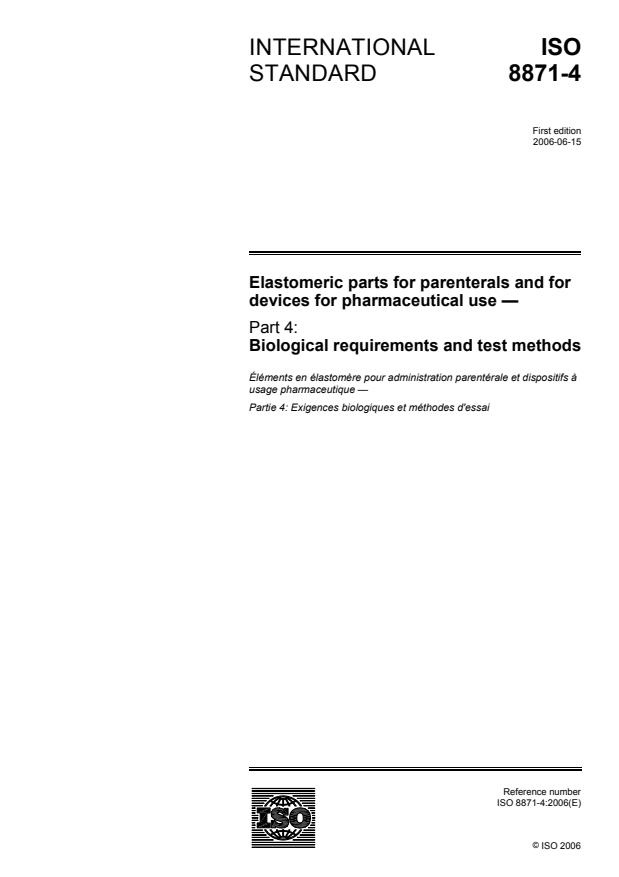
(Main)Elastomeric parts for parenterals and for devices for pharmaceutical use — Part 4: Biological requirements and test methods
General Information
- Abstract
ISO 8871-4:2006 specifies biological requirements for elastomeric parts for parenterals and for devices for pharmaceutical use. It also specifies the test methods, i.e. it offers the extraction procedures for elastomeric parts, and it makes reference to relevant biological test instructions in Pharmacopoeias and standards.
- Status
- Published
- Publication Date
- 13-Jun-2006
- Current Stage
- 9092 - International Standard to be revised
- Start Date
- 13-Oct-2025
- Completion Date
- 29-Aug-2026
Buy Documents
ISO 8871-4:2006 - Elastomeric parts for parenterals and for devices for pharmaceutical use — Part 4: Biological requirements and test methods Released:6/14/2006
ISO 8871-4:2006 - Elastomeric parts for parenterals and for devices for pharmaceutical use — Part 4: Biological requirements and test methods Released:7/15/2008
Overview
ISO 8871-4:2006 - "Elastomeric parts for parenterals and for devices for pharmaceutical use - Part 4: Biological requirements and test methods" defines the biological safety requirements and test methods for elastomeric components used in direct contact with parenteral and pharmaceutical products. It specifies extraction procedures, references pharmacopoeial and ISO biological test instructions, and complements other parts of ISO 8871 that cover extractables, identification, particle release and functional testing.
Key topics and requirements
- Biological requirements: Materials shall not release substances that adversely affect therapeutic effectiveness or safety, including toxic or pyrogenic agents.
- Test selection and interpretation: Choice of tests depends on material composition and exposure conditions (nature, frequency, duration).
- Hierarchical toxicity testing:
- In vitro cytotoxicity (Annex B): Primary screen performed per USP <87> or ISO 10993-5. If non-cytotoxic, no further in vivo testing is required.
- In vivo testing (Annex C & D): If cytotoxicity is observed, perform intracutaneous (local) and systemic toxicity tests following USP <88>.
- Endotoxins and bioburden:
- Extractable bacterial endotoxins (Annex A): Extraction in endotoxin-free water and measurement using LAL methods as per USP <85> or Ph.Eur. 2.6.14. Limits (EU/cm2 or EU/ml) are to be agreed between supplier and user; methods must be validated.
- Bioburden monitoring: Colony-forming unit (cfu) limits are agreed between supplier and user; ISO 11737-1 provides guidance on method validation.
- Extraction procedures: The standard supplies extraction guidance (e.g., surface-area-based extraction, handling of complex cavities) and notes when cutting parts may be necessary to ensure adequate recovery.
- Validation & reference methods: All analytical and biological methods used should be validated and assessed against USP/Ph.Eur. and ISO biological test criteria.
Applications
ISO 8871-4:2006 is applied to elastomeric closures and components such as:
- Rubber stoppers and vial closures for parenteral drugs
- Syringe seals, needle shields, freeze-drying closures, and other elastomeric parts in pharmaceutical devices
- Quality control and release testing of primary packaging in sterile drug manufacturing
Who should use this standard
- Pharmaceutical manufacturers and quality assurance teams
- Elastomer/rubber component suppliers and formulators
- Medical device and parenteral packaging manufacturers
- Analytical and biological testing laboratories
- Regulatory affairs and compliance specialists assessing primary packaging safety
Related standards
- ISO 8871 (Parts 1–5) - full suite on elastomeric parts
- ISO 10993-5 - in vitro cytotoxicity
- ISO 11737-1 - bioburden determination guidance
- USP chapters <85>, <87>, <88> and Ph.Eur. bacterial endotoxins chapter - referenced test methods
Keywords: ISO 8871-4:2006, elastomeric parts, parenterals, biological requirements, test methods, cytotoxicity, endotoxins, bioburden, USP, Ph.Eur., LAL, extraction procedures.
Relations
- Effective Date
- 25-Aug-2026
- Effective Date
- 25-Aug-2026
- Effective Date
- 25-Aug-2026
- Effective Date
- 25-Aug-2026
- Effective Date
- 25-Aug-2026
- Effective Date
- 25-Aug-2026
- Effective Date
- 12-Feb-2026
- Effective Date
- 06-Jun-2022
- Effective Date
- 15-Apr-2008
- Revises
ISO 8871:1990/Amd 1:1995 - Elastomeric parts for aqueous parenteral preparations — Amendment 1 - Effective Date
- 15-Apr-2008
Buy Documents
ISO 8871-4:2006 - Elastomeric parts for parenterals and for devices for pharmaceutical use — Part 4: Biological requirements and test methods Released:6/14/2006
ISO 8871-4:2006 - Elastomeric parts for parenterals and for devices for pharmaceutical use — Part 4: Biological requirements and test methods Released:7/15/2008
Get Certified
Connect with accredited certification bodies for this standard

BSI Group
BSI (British Standards Institution) is the business standards company that helps organizations make excellence a habit.

TÜV Rheinland
TÜV Rheinland is a leading international provider of technical services.

TÜV SÜD
TÜV SÜD is a trusted partner of choice for safety, security and sustainability solutions.
Sponsored listings
Frequently Asked Questions
ISO 8871-4:2006 is a standard published by the International Organization for Standardization (ISO). Its full title is "Elastomeric parts for parenterals and for devices for pharmaceutical use — Part 4: Biological requirements and test methods". This standard covers: ISO 8871-4:2006 specifies biological requirements for elastomeric parts for parenterals and for devices for pharmaceutical use. It also specifies the test methods, i.e. it offers the extraction procedures for elastomeric parts, and it makes reference to relevant biological test instructions in Pharmacopoeias and standards.
ISO 8871-4:2006 specifies biological requirements for elastomeric parts for parenterals and for devices for pharmaceutical use. It also specifies the test methods, i.e. it offers the extraction procedures for elastomeric parts, and it makes reference to relevant biological test instructions in Pharmacopoeias and standards.
ISO 8871-4:2006 is classified under the following ICS (International Classification for Standards) categories: 11.040.20 - Transfusion, infusion and injection equipment. The ICS classification helps identify the subject area and facilitates finding related standards.
ISO 8871-4:2006 has the following relationships with other standards: It is inter standard links to EN ISO 8362-5:2016, EN ISO 8362-2:2010, EN ISO 8536-2:2010, EN ISO 8536-2:2023, EN ISO 8362-2:2024, EN ISO 8362-2:2015, EN ISO 8871-4:2006, ISO 7975:1996, ISO 8871:1990, ISO 8871:1990/Amd 1:1995. Understanding these relationships helps ensure you are using the most current and applicable version of the standard.
ISO 8871-4:2006 is available in PDF format for immediate download after purchase. The document can be added to your cart and obtained through the secure checkout process. Digital delivery ensures instant access to the complete standard document.
Standards Content (Sample)
INTERNATIONAL ISO
STANDARD 8871-4
First edition
2006-06-15
Elastomeric parts for parenterals and for
devices for pharmaceutical use —
Part 4:
Biological requirements and test methods
Éléments en élastomère pour administration parentérale et dispositifs à
usage pharmaceutique —
Partie 4: Exigences biologiques et méthodes d'essai
Reference number
©
ISO 2006
PDF disclaimer
This PDF file may contain embedded typefaces. In accordance with Adobe's licensing policy, this file may be printed or viewed but
shall not be edited unless the typefaces which are embedded are licensed to and installed on the computer performing the editing. In
downloading this file, parties accept therein the responsibility of not infringing Adobe's licensing policy. The ISO Central Secretariat
accepts no liability in this area.
Adobe is a trademark of Adobe Systems Incorporated.
Details of the software products used to create this PDF file can be found in the General Info relative to the file; the PDF-creation
parameters were optimized for printing. Every care has been taken to ensure that the file is suitable for use by ISO member bodies. In
the unlikely event that a problem relating to it is found, please inform the Central Secretariat at the address given below.
© ISO 2006
All rights reserved. Unless otherwise specified, no part of this publication may be reproduced or utilized in any form or by any means,
electronic or mechanical, including photocopying and microfilm, without permission in writing from either ISO at the address below or
ISO's member body in the country of the requester.
ISO copyright office
Case postale 56 • CH-1211 Geneva 20
Tel. + 41 22 749 01 11
Fax + 41 22 749 09 47
E-mail copyright@iso.org
Web www.iso.org
Published in Switzerland
ii © ISO 2006 – All rights reserved
Foreword
ISO (the International Organization for Standardization) is a worldwide federation of national standards bodies
(ISO member bodies). The work of preparing International Standards is normally carried out through ISO
technical committees. Each member body interested in a subject for which a technical committee has been
established has the right to be represented on that committee. International organizations, governmental and
non-governmental, in liaison with ISO, also take part in the work. ISO collaborates closely with the
International Electrotechnical Commission (IEC) on all matters of electrotechnical standardization.
International Standards are drafted in accordance with the rules given in the ISO/IEC Directives, Part 2.
The main task of technical committees is to prepare International Standards. Draft International Standards
adopted by the technical committees are circulated to the member bodies for voting. Publication as an
International Standard requires approval by at least 75 % of the member bodies casting a vote.
Attention is drawn to the possibility that some of the elements of this document may be the subject of patent
rights. ISO shall not be held responsible for identifying any or all such patent rights.
ISO 8871-4 was prepared by Technical Committee ISO/TC 76, Transfusion, infusion and injection equipment
for medical and pharmaceutical use.
This first edition, together with parts 1, 2, 3 and 5, cancels and replaces ISO 8871:1990 and
ISO 8871:1990/Amd.1:1995, which has been technically revised.
ISO 8871 consists of the following parts, under the general title Elastomeric parts for parenterals and for
devices for pharmaceutical use:
⎯ Part 1: Extractables in aqueous autoclavates
⎯ Part 2: Identification and characterization
⎯ Part 3: Determination of released-particle count
⎯ Part 4: Biological requirements and test methods
⎯ Part 5: Functional requirements and testing
Introduction
The pharmaceutical industry requires, to an increasing extent, concrete details from the rubber manufacturer
about the biological status of rubber closures as far as elastomeric closures are used as primary packaging
materials in direct contact with the medicinal products. This request has been taken into account by preparing
Annexes A to D of this part of ISO 8871.
Tests presented in this part of ISO 8871 can be taken into account as a guideline if the question of biological
safety arises in context with primary packaging materials for pharmaceutical products. The use of certain tests
of Annex A to Annex D in case of special applications of the packaging material should be agreed upon
between users and manufacturers.
iv © ISO 2006 – All rights reserved
INTERNATIONAL STANDARD ISO 8871-4:2006(E)
Elastomeric parts for parenterals and for devices
for pharmaceutical use —
Part 4:
Biological requirements and test methods
1 Scope
This part of ISO 8871 specifies biological requirements for elastomeric parts for parenterals and for devices
for pharmaceutical use. It also specifies the test methods, i.e. it offers the extraction procedures for
elastomeric parts, and it makes reference to relevant biological test instructions in Pharmacopoeias and
standards.
2 Normative references
The following referenced documents are indispensable for the application of this document. For dated
references, only the edition cited applies. For undated references, the latest edition of the referenced
document (including any amendments) applies.
ISO 10993-5, Biological evaluation of medical devices — Part 5: Tests for in vitro cytotoxicity
USP, The United States Pharmacopeia, United States Pharmacopeial Convention, Inc., Rockville, MD, USA
3 Terms and definitions
For the purposes of this document, the following terms and definitions apply.
3.1
bacterial endotoxins
lipo-polysaccharides from gram-negative bacteria
3.2
bioburden
population of viable microorganisms on or in product and/or a package
[ISO 11737-1:—, definition 3.1]
3.3
cytotoxicity
biological response of mammalian cell cultures in vitro using appropriate biological parameters to extracts of
elastomeric parts
3.4
intracutaneous toxicity
local response to extracts of elastomeric parts after intracutaneous injections into rabbits
3.5
systemic toxicity
systemic response to extracts of elastomeric parts after injection into mice
4 Biological requirements
4.1 General
The elastomeric parts shall not release any substances that may adversely affect the therapeutic
effectiveness and safety of the pharmaceutical solution, including those substances which can exhibit toxic or
pyrogenic reactions.
Selection of tests and their interpretation to be used in biological evaluations should take into account the
chemical composition of the materials, including the conditions of exposure as well as the nature, degree,
frequency and duration of exposure of the material.
Cytotoxicity, systemic toxicity and intracutaneous toxicity shall be considered for type testing as material
characteristics. Endotoxins and bioburden shall be considered for monitoring purposes.
4.2 Extractable bacterial endoto
...
МЕЖДУНАРОДНЫЙ ISO
СТАНДАРТ 8871-4
Первое издание
2006-06-15
Резиновые детали для парентеральных
устройств и для приборов
фармацевтического назначения.
Часть 4.
Биологические требования и методы
тестирования
Elastomeric parts for parenterals and for devices for pharmaceutical
use —
Part 4: Biological requirements and test methods
Ответственность за подготовку русской версии несёт GOST R
(Российская Федерация) в соответствии со статьёй 18.1 Устава ISO
Ссылочный номер
©
ISO 2006
Отказ от ответственности при работе в PDF
Настоящий файл PDF может содержать интегрированные шрифты. В соответствии с условиями лицензирования, принятыми
фирмой Adobe, этот файл можно распечатать или смотреть на экране, но его нельзя изменить, пока не будет получена
лицензия на интегрированные шрифты и они не будут установлены на компьютере, на котором ведется редактирование. В
случае загрузки настоящего файла заинтересованные стороны принимают на себя ответственность за соблюдение
лицензионных условий фирмы Adobe. Центральный секретариат ISO не несет никакой ответственности в этом отношении.
Adobe - торговый знак фирмы Adobe Systems Incorporated.
Подробности, относящиеся к программным продуктам, использованные для создания настоящего файла PDF, можно найти в
рубрике General Info файла; параметры создания PDF были оптимизированы для печати. Были приняты во внимание все
меры предосторожности с тем, чтобы обеспечить пригодность настоящего файла для использования комитетами-членами
ISO. В редких случаях возникновения проблемы, связанной со сказанным выше, просьба проинформировать Центральный
секретариат по адресу, приведенному ниже.
ДОКУМЕНТ ЗАЩИЩЕН АВТОРСКИМ ПРАВОМ
Все права сохраняются. Если не указано иное, никакую часть настоящей публикации нельзя копировать или использовать в
какой-либо форме или каким-либо электронным или механическим способом, включая фотокопии и микрофильмы, без
предварительного письменного согласия ISO, которое должно быть получено после запроса о разрешении, направленного по
адресу, приведенному ниже, или в комитет-член ISO в стране запрашивающей стороны.
ISO copyright office
Case postale 56 • CH-1211 Geneva 20
Tel. + 41 22 749 01 11
Fax + 41 22 749 09 47
E-mail copyright@iso.org
Web www.iso.org
Опубликовано в Швейцарии
ii © ISO 2006 – Все права сохраняются
Предисловие
Международная организация по стандартизации (ISO) является всемирной федерацией национальных
организаций по стандартизации (комитетов-членов ISO). Разработка международных стандартов
обычно осуществляется техническими комитетами ISO. Каждый комитет-член, заинтересованный в
деятельности, для которой был создан технический комитет, имеет право быть представленным в этом
комитете. Международные правительственные и неправительственные организации, имеющие связи с
ISO, также принимают участие в работах. Что касается стандартизации в области электротехники, то
ISO работает в тесном сотрудничестве с Международной электротехнической комиссией (IEC).
Проекты международных стандартов разрабатываются в соответствии с правилами Директив ISO/IEC,
Часть 2.
Основная задача технических комитетов заключается в подготовке международных стандартов.
Проекты международных стандартов, принятые техническими комитетами, рассылаются комитетам-
членам на голосование. Их опубликование в качестве международных стандартов требует одобрения
не менее 75 % комитетов-членов, принимающих участие в голосовании.
Следует иметь в виду, что некоторые элементы настоящего международного стандарта могут быть
объектом патентных прав. ISO не может нести ответственность за идентификацию какого-либо одного
или всех патентных прав.
ISO 8871-4 был подготовлен Техническим комитетом ISO/TC 76, Медицинское оборудование и
оборудование фармацевтического назначения для переливаний, вливаний и инъекций.
Данное первое издание совместно с частями 1, 2, 3 и 5 отменяет и замещает ISO 8871:1990 и
ISO 8871:1990/Amd.1:1995, которые были технически исправлены.
ISO 8871 состоит из следующих частей под общим заголовком Резиновые детали для
парентеральных устройств и для приборов фармацевтического назначения:
Часть 1. Извлекаемые части водных автоклавов
Часть 2. Идентификация и описание
Часть 3. Определение числа отделившихся частиц
Часть 4. Биологические требования и методы тестирования
Часть 5. Функциональные требования и испытания
Введение
Фармацевтическая промышленность требует для увеличения срока хранения, чтобы производитель
обеспечивал застывание резиновых деталей в пределах биологического статуса резиновых крышек,
поскольку резиновые крышки используются как первичный упаковочный материал в непосредственном
контакте с медицинским продуктом. Эти требования были приняты во внимание при подготовке
Приложений с А по D данной части ISO 8871.
Испытания, представленные в данной части ISO 8871, могут быть приняты во внимание как
руководящее указание, если вопрос биологической безопасности связан с первичными упаковочным
материалами для фармацевтической промышленности. Использование тестов, определенных в
Приложениях с А по D в случае специального применения упаковочного материала должно
согласовываться между пользователем и производителем.
iv © ISO 2006 – Все права сохраняются
МЕЖДУНАРОДНЫЙ СТАНДАРТ ISO 8871-4:2006(R)
Резиновые детали для парентеральных
устройств и для приборов
фармацевтического назначения.
Часть 4.
Биологические требования и методы тестирования
1 Область применения
Данная часть ISO 8871 устанавливает биологические требования к резиновым деталям для
парентеральных устройств и для приборов фармацевтического назначения. Она также определяет
методы тестирования, т.е. в ней она предлагаются процедуры отбора резиновых частей и даются
ссылки на соответствующие инструкции по биологическому тестированию в Фармакопеях и стандартах.
2 Нормативные ссылки
Ссылка на следующий документ обязательна при использовании данного документа. Для жестких
ссылок применяются только указанное по тексту издание. Для плавающих ссылок необходимо
использовать самое последнее издание нормативного ссылочного документа (включая любые
изменения).
ISO 10993-5, Биологическая оценка медицинских устройств. Часть 5. Тестирование на
цитотоксичность in vitro
USP, Фармакопея Соединенных Штатов, Конвенция Фармакопей Соединенных Штатов, Inc.,
Rockville, MD, USA
3 Термины и определения
В рамках данного документа приняты следующие термины и определения.
3.1
бактериальные эндотоксины
bacterial endotoxins
липо-полисахариды грамотрицательных бактерий
3.2
микрофлора
bioburden
популяция жизнеспособных микроорганизмов на или в продукте и/или упаковке
[ISO 11737-1:—, определение 3.1]
3.3
цитотоксичность
cytotoxicity
биологическая реакция культуры клеток млекопитающих in vitro, использующая соответствующие
биологические параметры, на вытяжку резиновых частей
3.4
внутрикожная токсичность
intracutaneous toxicity
локальная реакция на вытяжку резиновых частей после ее внутрикожного впрыскивания в кролика
3.5
системная токсичность
systemic toxicity
системная реакция на вытяжку резиновых частей после впрыскивания в мышь
4 Биологические требования
4.1 Общее
Резиновые части не должны высвобождать любых субстанций, которые могут негативно влиять на
эффективность и безопасность фармацевтических растворов, включая такие субстанции, которые
могут вызывать токсические или пирогенные реакции.
Выбор и интерпретация испытаний, используемых в биологической оценке, должны принимать во
внимание химический состав материала, включая условия облучения, такие как природа, порядок,
частота и продолжительность облучения материала.
Цитотоксичность, системная токсичность и внутрикожная токсичность при проведении типовых
испытаний должны
...