

ISO/IEC 10746-3:2009
(Main)Information technology — Open distributed processing — Reference model: Architecture — Part 3:
General Information
- Abstract
ISO/IEC 10746 provides a coordinating framework for the standardization of open distributed processing (ODP). This supports distribution, interworking, portability, and platform and technology independence. It establishes an enterprise architecture framework for the specification of ODP systems. ISO/IEC 10746 defines the essential concepts necessary to specify open distributed processing systems from five prescribed viewpoints. It provides a well-developed framework for the structuring of specifications for large-scale, distributed systems. The framework for system specification provided by ISO/IEC 10746 has four fundamental elements: an object modelling approach to system specification; the specification of a system in terms of separate but interrelated viewpoint specifications; the definition of a system infrastructure providing distribution transparencies for system applications; a framework for assessing system conformance. ISO/IEC 10746-3:2009 specifies the required characteristics that qualify distributed processing as open, i.e. the constraints to which ODP standards must conform. It uses the descriptive techniques from ISO/IEC 10746-2 to define five ISO/IEC 10746 viewpoints. These viewpoints are subdivisions of the specification of a whole system, established to bring together the particular pieces of information relevant to some stakeholder or particular area of concern. ISO/IEC 10746-3:2009 also defines a taxonomy for functions and structures to realize distribution transparencies.
- Status
- Published
- Publication Date
- 14-Dec-2009
- Technical Committee
- ISO/IEC JTC 1/SC 7 - Software and systems engineering
- Drafting Committee
- ISO/IEC JTC 1/SC 7 - Software and systems engineering
- Current Stage
- 9093 - International Standard confirmed
- Start Date
- 03-Jan-2019
- Completion Date
- 29-Aug-2026

Overview
ISO/IEC 10746-3:2009 - “Information technology - Open distributed processing - Reference model: Architecture” defines the architectural characteristics that qualify distributed systems as open distributed processing (ODP). As Part 3 of the ISO/IEC 10746 series, it specifies the constraints and architectural semantics that ODP standards must satisfy, using the descriptive techniques introduced in Part 2. The standard establishes an enterprise architecture framework and a taxonomy of functions and structures to realize distribution transparencies for large-scale, platform-independent systems.
Key topics and technical requirements
- Five ODP viewpoints: enterprise, information, computational, engineering and technology - each viewpoint captures concerns relevant to particular stakeholders and supports modular specification of a whole system.
- Distribution transparencies: defines types of transparency that hide distribution complexity, including access, failure, location, migration, persistence, relocation, replication, and transaction transparencies.
- ODP functions taxonomy: categorized functions for realizing ODP, including management functions (node, object, cluster, capsule), coordination functions (events, checkpoint/recovery, transactions, replication, migration), repository functions (storage, type repository, trading) and security functions (authentication, access control, integrity, confidentiality, non-repudiation, key management).
- Four fundamental elements: an object modelling approach; specification by separate but interrelated viewpoint specifications; system infrastructure providing distribution transparencies; and a framework for assessing conformance.
- Viewpoint languages & consistency rules: descriptive languages and rules to ensure correspondence between viewpoints (e.g., computational ↔ engineering ↔ technology).
- Conformance and assessment: criteria and reference points for judging whether systems and standards conform to ODP principles.
- Supporting annexes: formal computational typing rules and guidance on human–computer interactions (informative/ normative context provided in the document).
Applications and who uses it
ISO/IEC 10746-3 is practical for:
- Systems and enterprise architects designing large-scale, distributed systems requiring portability, interoperability and platform independence.
- Middleware and platform vendors implementing distribution transparencies (replication, migration, transaction management).
- Standards developers and compliance teams defining or assessing conformance criteria for ODP-compliant technologies.
- Integrators and IT managers planning enterprise-wide distributed deployments, security architectures, or migration strategies.
Typical uses include architecture specification for multi-vendor, heterogeneous environments; middleware design guidance; and a reference model for interoperability and conformance testing.
Related standards
- ISO/IEC 10746-1 (Overview), ISO/IEC 10746-2 (Foundations), ISO/IEC 10746-4 (Architectural semantics) - collectively form the ODP reference model.
- Equivalent ITU‑T Recommendations: X.901 to X.904.
Keywords: ISO/IEC 10746-3, ODP, Open Distributed Processing, reference model, architecture, distribution transparencies, viewpoints, conformance, interoperability, enterprise architecture.
Relations
- Effective Date
- 09-Feb-2026
- Effective Date
- 09-Feb-2026
- Effective Date
- 09-Feb-2026
- Effective Date
- 09-Feb-2026
- Effective Date
- 12-Dec-2009
Get Certified
Connect with accredited certification bodies for this standard

BSI Group
BSI (British Standards Institution) is the business standards company that helps organizations make excellence a habit.

BSCIC Certifications Pvt. Ltd.
Established 2006, accredited by NABCB, JAS-ANZ, EIAC, IAS. CDSCO Notified Body.

Intertek India Pvt. Ltd.
Delivers Assurance, Testing, Inspection & Certification since 1993 with 26 labs and 32 offices.
Sponsored listings
Frequently Asked Questions
ISO/IEC 10746-3:2009 is a standard published by the International Organization for Standardization (ISO). Its full title is "Information technology — Open distributed processing — Reference model: Architecture — Part 3:". This standard covers: ISO/IEC 10746 provides a coordinating framework for the standardization of open distributed processing (ODP). This supports distribution, interworking, portability, and platform and technology independence. It establishes an enterprise architecture framework for the specification of ODP systems. ISO/IEC 10746 defines the essential concepts necessary to specify open distributed processing systems from five prescribed viewpoints. It provides a well-developed framework for the structuring of specifications for large-scale, distributed systems. The framework for system specification provided by ISO/IEC 10746 has four fundamental elements: an object modelling approach to system specification; the specification of a system in terms of separate but interrelated viewpoint specifications; the definition of a system infrastructure providing distribution transparencies for system applications; a framework for assessing system conformance. ISO/IEC 10746-3:2009 specifies the required characteristics that qualify distributed processing as open, i.e. the constraints to which ODP standards must conform. It uses the descriptive techniques from ISO/IEC 10746-2 to define five ISO/IEC 10746 viewpoints. These viewpoints are subdivisions of the specification of a whole system, established to bring together the particular pieces of information relevant to some stakeholder or particular area of concern. ISO/IEC 10746-3:2009 also defines a taxonomy for functions and structures to realize distribution transparencies.
ISO/IEC 10746 provides a coordinating framework for the standardization of open distributed processing (ODP). This supports distribution, interworking, portability, and platform and technology independence. It establishes an enterprise architecture framework for the specification of ODP systems. ISO/IEC 10746 defines the essential concepts necessary to specify open distributed processing systems from five prescribed viewpoints. It provides a well-developed framework for the structuring of specifications for large-scale, distributed systems. The framework for system specification provided by ISO/IEC 10746 has four fundamental elements: an object modelling approach to system specification; the specification of a system in terms of separate but interrelated viewpoint specifications; the definition of a system infrastructure providing distribution transparencies for system applications; a framework for assessing system conformance. ISO/IEC 10746-3:2009 specifies the required characteristics that qualify distributed processing as open, i.e. the constraints to which ODP standards must conform. It uses the descriptive techniques from ISO/IEC 10746-2 to define five ISO/IEC 10746 viewpoints. These viewpoints are subdivisions of the specification of a whole system, established to bring together the particular pieces of information relevant to some stakeholder or particular area of concern. ISO/IEC 10746-3:2009 also defines a taxonomy for functions and structures to realize distribution transparencies.
ISO/IEC 10746-3:2009 is classified under the following ICS (International Classification for Standards) categories: 35.080 - Software. The ICS classification helps identify the subject area and facilitates finding related standards.
ISO/IEC 10746-3:2009 has the following relationships with other standards: It is inter standard links to EN ISO 17573-1:2019, CEN ISO/TS 17427:2014, EN ISO 23903:2021, EN ISO 12967-1:2020, ISO/IEC 10746-3:1996. Understanding these relationships helps ensure you are using the most current and applicable version of the standard.
ISO/IEC 10746-3:2009 is available in PDF format for immediate download after purchase. The document can be added to your cart and obtained through the secure checkout process. Digital delivery ensures instant access to the complete standard document.
Standards Content (Sample)
INTERNATIONAL ISO/IEC
STANDARD 10746-3
Second edition
2009-12-15
Information technology — Open
distributed processing — Reference
model: Architecture
Technologies de l'information — Traitement réparti ouvert — Modèle de
référence: Architecture
Reference number
©
ISO/IEC 2009
PDF disclaimer
This PDF file may contain embedded typefaces. In accordance with Adobe's licensing policy, this file may be printed or viewed but
shall not be edited unless the typefaces which are embedded are licensed to and installed on the computer performing the editing. In
downloading this file, parties accept therein the responsibility of not infringing Adobe's licensing policy. The ISO Central Secretariat
accepts no liability in this area.
Adobe is a trademark of Adobe Systems Incorporated.
Details of the software products used to create this PDF file can be found in the General Info relative to the file; the PDF-creation
parameters were optimized for printing. Every care has been taken to ensure that the file is suitable for use by ISO member bodies. In
the unlikely event that a problem relating to it is found, please inform the Central Secretariat at the address given below.
© ISO/IEC 2009
All rights reserved. Unless otherwise specified, no part of this publication may be reproduced or utilized in any form or by any means,
electronic or mechanical, including photocopying and microfilm, without permission in writing from either ISO at the address below or
ISO's member body in the country of the requester.
ISO copyright office
Case postale 56 • CH-1211 Geneva 20
Tel. + 41 22 749 01 11
Fax + 41 22 749 09 47
E-mail copyright@iso.org
Web www.iso.org
Published by ISO in 2010
Published in Switzerland
ii © ISO/IEC 2009 – All rights reserved
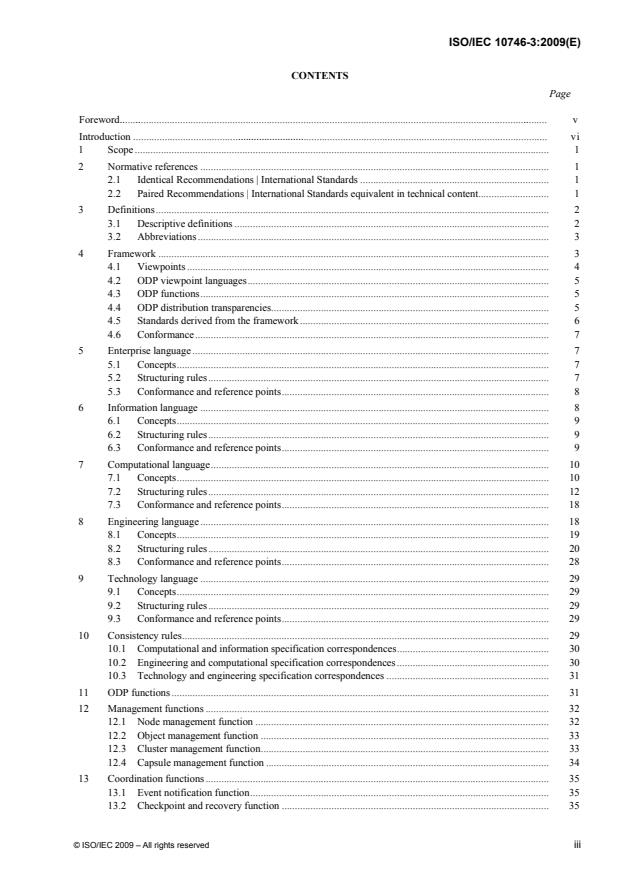
CONTENTS
Page
Foreword. v
Introduction . vi
1 Scope . 1
2 Normative references . 1
2.1 Identical Recommendations | International Standards. 1
2.2 Paired Recommendations | International Standards equivalent in technical content. 1
3 Definitions. 2
3.1 Descriptive definitions . 2
3.2 Abbreviations. 3
4 Framework . 3
4.1 Viewpoints . 4
4.2 ODP viewpoint languages. 5
4.3 ODP functions. 5
4.4 ODP distribution transparencies. 5
4.5 Standards derived from the framework . 6
4.6 Conformance. 7
5 Enterprise language . 7
5.1 Concepts. 7
5.2 Structuring rules. 7
5.3 Conformance and reference points. 8
6 Information language . 8
6.1 Concepts. 9
6.2 Structuring rules. 9
6.3 Conformance and reference points. 9
7 Computational language. 10
7.1 Concepts. 10
7.2 Structuring rules. 12
7.3 Conformance and reference points. 18
8 Engineering language . 18
8.1 Concepts. 19
8.2 Structuring rules. 20
8.3 Conformance and reference points. 28
9 Technology language . 29
9.1 Concepts. 29
9.2 Structuring rules. 29
9.3 Conformance and reference points. 29
10 Consistency rules. 29
10.1 Computational and information specification correspondences. 30
10.2 Engineering and computational specification correspondences. 30
10.3 Technology and engineering specification correspondences. 31
11 ODP functions . 31
12 Management functions . 32
12.1 Node management function . 32
12.2 Object management function . 33
12.3 Cluster management function. 33
12.4 Capsule management function . 34
13 Coordination functions. 35
13.1 Event notification function. 35
13.2 Checkpoint and recovery function . 35
© ISO/IEC 2009 – All rights reserved iii
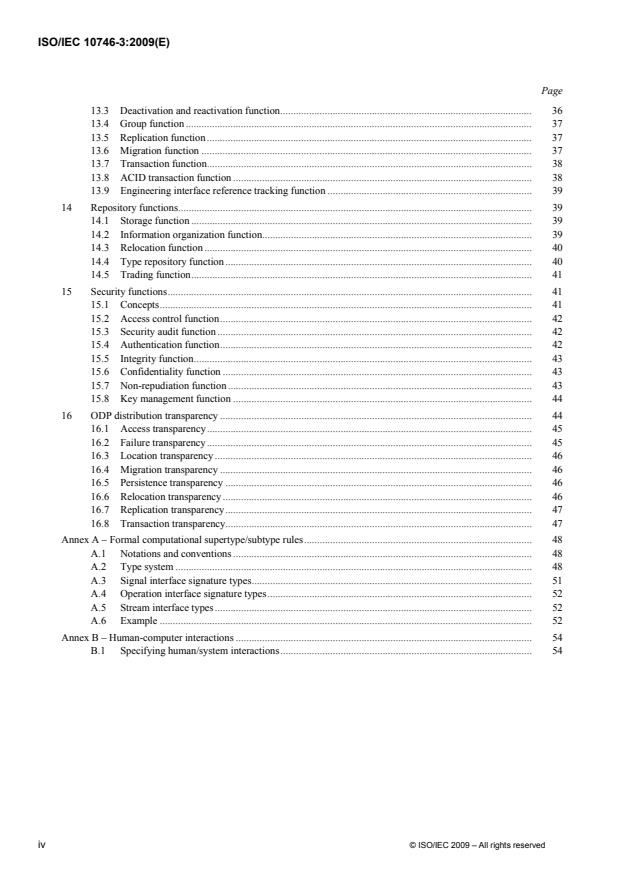
Page
13.3 Deactivation and reactivation function. 36
13.4 Group function . 37
13.5 Replication function. 37
13.6 Migration function . 37
13.7 Transaction function. 38
13.8 ACID transaction function . 38
13.9 Engineering interface reference tracking function . 39
14 Repository functions. 39
14.1 Storage function . 39
14.2 Information organization function. 39
14.3 Relocation function . 40
14.4 Type repository function . 40
14.5 Trading function. 41
15 Security functions. 41
15.1 Concepts. 41
15.2 Access control function. 42
15.3 Security audit function . 42
15.4 Authentication function. 42
15.5 Integrity function. 43
15.6 Confidentiality function . 43
15.7 Non-repudiation function . 43
15.8 Key management function . 44
16 ODP distribution transparency . 44
16.1 Access transparency. 45
16.2 Failure transparency. 45
16.3 Location transparency . 46
16.4 Migration transparency . 46
16.5 Persistence transparency . 46
16.6 Relocation transparency . 46
16.7 Replication transparency. 47
16.8 Transaction transparency. 47
Annex A – Formal computational supertype/subtype rules. 48
A.1 Notations and conventions . 48
A.2 Type system . 48
A.3 Signal interface signature types. 51
A.4 Operation interface signature types. 52
A.5 Stream interface types. 52
A.6 Example . 52
Annex B – Human-computer interactions . 54
B.1 Specifying human/system interactions. 54
iv © ISO/IEC 2009 – All rights reserved
Foreword
ISO (the International Organization for Standardization) and IEC (the International Electrotechnical
Commission) form the specialized system for worldwide standardization. National bodies that are members of
ISO or IEC participate in the development of International Standards through technical committees
established by the respective organization to deal with particular fields of technical activity. ISO and IEC
technical committees collaborate in fields of mutual interest. Other international organizations, governmental
and non-governmental, in liaison with ISO and IEC, also take part in the work. In the field of information
technology, ISO and IEC have established a joint technical committee, ISO/IEC JTC 1.
International Standards are drafted in accordance with the rules given in the ISO/IEC Directives, Part 2.
The main task of the joint technical committee is to prepare International Standards. Draft International
Standards adopted by the joint technical committee are circulated to national bodies for voting. Publication as
an International Standard requires approval by at least 75 % of the national bodies casting a vote.
Attention is drawn to the possibility that some of the elements of this document may be the subject of patent
rights. ISO and IEC shall not be held responsible for identifying any or all such patent rights.
ISO/IEC 10746-3 was prepared by Joint Technical Committee ISO/IEC JTC 1, Information technology,
Subcommittee SC 7, Software and systems engineering, in collaboration with ITU-T. The identical text is
published as Rec. ITU-T X.903 (10/2009).
This second edition cancels and replaces the first edition (ISO/IEC 10746-3:1996), which has been technically
revised.
ISO/IEC 10746 consists of the following parts, under the general title Information technology — Open
distributed processing — Reference model:
⎯ Part 1: Overview
⎯ Part 2: Foundations
⎯ Part 3: Architecture
⎯ Part 4: Architectural semantics
© ISO/IEC 2009 – All rights reserved v
Introduction
The rapid growth of distributed processing has led to a need for a coordinating framework for the standardization of
open distributed processing (ODP). This reference model provides such a framework. It creates an architecture within
which support of distribution, interworking and portability can be integrated.
The reference model of open distributed processing, Recommendations ITU-T X.901 | ISO/IEC 10746-1 to X.904 |
ISO/IEC 10746-4, is based on precise concepts derived from current distributed processing developments and, as far as
possible, on the use of formal description techniques for specification of the architecture.
The reference model consists of:
– Recommendation ITU-T X.901 | ISO/IEC 10746-1: Overview: Contains a motivational overview of
ODP giving scoping, justification and explanation of key concepts, and an outline of the ODP
architecture. It contains explanatory material on how this reference model is to be interpreted and applied
by its users, who may include standards writers and architects of ODP systems. It also contains a
categorization of required areas of standardization expressed in terms of the reference points for
conformance identified in this Recommendation | International Standard. This part is not normative.
– Recommendation ITU-T X.902 | ISO/IEC 10746-2: Foundations: Contains the definition of the concepts
and analytical framework for normalized description of (arbitrary) distributed processing systems. It
introduces the principles of conformance to ODP standards and the way in which they are applied. This
is only to a level of detail sufficient to support this Recommendation | International Standard and to
establish requirements for new specification techniques. This part is normative.
– Recommendation ITU-T X.903 | ISO/IEC 10746-3: Architecture: Contains the specification of the
required characteristics that qualify distributed processing as open. These are the constraints to which
ODP standards must conform. It uses the descriptive techniques from Recommendation ITU-T X.902 |
ISO/IEC 10746-2. This part is normative.
– Recommendation ITU-T X.904 | ISO/IEC 10746-4: Architectural semantics: Contains a formalization of
the ODP modelling concepts defined in Recommendation ITU-T X.902 | ISO/IEC 10746-2, clauses 8
and 9. The formalization is achieved by interpreting each concept in terms of the constructs of the
different standardized formal description techniques. This part is normative.
This Recommendation | International Standard contains two annexes:
– Annex A – Formal computational supertype/subtype rules.
– Annex B – Human-computer interactions
Annex A forms an integral part of the reference model. Annex B does not form an integral part of the reference model.
vi © ISO/IEC 2009 – All rights reserved
INTERNATIONAL STANDARD
RECOMMENDATION ITU-T
Information technology – Open distributed processing – Reference model: Architecture
1 Scope
This Recommendation | International Standard:
– defines how ODP systems are specified, making use of concepts in Rec. ITU-T X.902 |
ISO/IEC 10746-2;
– identifies the characteristics that qualify systems as ODP systems.
It establishes a framework for coordinating the development of existing and future standards for ODP systems and is
provided for reference by those standards.
2 Normative references
The following Recommendations and International Standards contain provisions which, through reference in this text,
constitute provisions of this Recommendation | International Standard. At the time of publication, the editions indicated
were valid. All Recommendations and Standards are subject to revision, and parties to agreements based on this
Recommendation | International Standard are encouraged to investigate the possibility of applying the most recent
edition of the Recommendations and Standards listed below. Members of IEC and ISO maintain registers of currently
valid International Standards. The Telecommunication Standardization Bureau of the ITU maintains a list of currently
valid ITU-T Recommendations.
2.1 Identical Recommendations | International Standards
– Recommendation ITU-T X.200 (1994) | ISO/IEC 7498-1:1994, Information technology – Open Systems
Interconnection – Basic Reference Model: The basic model.
– Recommendation ITU-T X.810 (1995) | ISO/IEC 10181-1:1996, Information technology – Open Systems
Interconnection – Security frameworks for open systems: Overview.
– Recommendation ITU-T X.811 (1995) | ISO/IEC 10181-2:1996, Information technology – Open Systems
Interconnection – Security frameworks for open systems: Authentication framework.
– Recommendation ITU-T X.812 (1995) | ISO/IEC 10181-3:1996, Information technology – Open Systems
Interconnection – Security frameworks for open systems: Access control framework.
– Recommendation ITU-T X.813 (1996) | ISO/IEC 10181-4:1997, Information technology – Open Systems
Interconnection – Security frameworks for open systems: Non-repudiation framework.
– Recommendation ITU-T X.814 (1995) | ISO/IEC 10181-5:1996, Information technology – Open Systems
Interconnection – Security frameworks for open systems: Confidentiality framework.
– Recommendation ITU-T X.815 (1995) | ISO/IEC 10181-6:1996, Information technology – Open Systems
Interconnection – Security frameworks for open systems: Integrity framework.
– Recommendation ITU-T X.816 (1995) | ISO/IEC 10181-7:1996, Information technology – Open Systems
Interconnection – Security frameworks for open systems: Security audit and alarms framework.
– Recommendation ITU-T X.851 (1997) | ISO/IEC 9804:1998; Information technology – Open Systems
Interconnection – Service definition for the Commitment, Concurrency and Recovery service element.
– Recommendation ITU-T X.902 (2009) | ISO/IEC 10746-2:2010, Information technology – Open
distributed processing – Reference model: Foundations.
– ISO/IEC 11770-1:1996, Information technology – Security techniques – Key management – Part 1:
Framework.
2.2 Paired Recommendations | International Standards equivalent in technical content
– Recommendation ITU-T X.800 (1991), Security architecture for Open Systems Interconnection for
CCITT applications.
ISO 7498-2:1989, Information processing systems – Open Systems Interconnection – Basic Reference
Model – Part 2: Security Architecture.
Rec. ITU-T X.903 (10/2009) 1
3 Definitions
For the purposes of this Recommendation | International Standard, the following definitions apply.
3.1 Descriptive definitions
This reference model makes use of the following term defined in Rec. ITU-T X.200 | ISO/IEC 7498-1:
– transfer syntax.
This Recommendation | International Standard makes use of the following terms defined in Rec. ITU-T X.810 |
ISO/IEC 10181-1:
– trusted third party.
This Recommendation | International Standard makes use of the following terms defined in Rec. ITU-T X.811 |
ISO/IEC 10181-2:
– claimant;
– exchange authentication information;
– principal.
This Recommendation | International Standard makes use of the following terms defined in Rec. ITU-T X.812 |
ISO/IEC 10181-3:
– access control information;
– access control decision function;
– access control enforcement function;
– initiator;
– target.
This Recommendation | International Standard makes use of the following terms defined in Rec. ITU-T X.813 |
ISO/IEC 10181-4:
– evidence generator;
– evidence user;
– evidence verifier;
– (non-repudiable data) originator;
– (non-repudiable data) recipient;
– non-repudiation evidence;
– non-repudiation service requester;
– notary;
– originator;
– recipient.
This Recommendation | International Standard makes use of the following terms defined in Rec. ITU-T X.814 |
ISO/IEC 10181-5:
– confidentiality-protected data;
– hide;
– reveal.
This Recommendation | International Standard makes use of the following terms defined in Rec. ITU-T X.815 |
ISO/IEC 10181-6:
– integrity-protected data;
– shield;
– validate.
2 Rec. ITU-T X.903 (10/2009)
This Recommendation | International Standard makes use of the following terms defined in Rec. ITU-T X.816 |
ISO/IEC 10181-7:
– audit recorder function;
– audit trail examiner function;
– audit trail collector function.
This Recommendation | International Standard makes use of the following terms defined in Rec. ITU-T X.851 |
ISO/IEC 9804:
– atomicity;
– consistency;
– durability;
– isolation.
This Recommendation | International Standard makes use of the following terms defined in ISO/IEC 11770-1 Key
Management Framework:
– certification authority;
– key distribution centre;
– key management;
– key translation centre;
– public key.
This reference model makes use of the terms defined in Rec. ITU-T X.902 | ISO/IEC 10746-2, shown in Figure 1.
3.2 Abbreviations
For the purposes of this Recommendation | International Standard, the following abbreviations apply:
ACID Atomicity, Consistency, Isolation and Durability
ODP Open Distributed Processing
OSI Open Systems Interconnection
4 Framework
This reference model defines a framework comprising:
– five viewpoints, called enterprise, information, computational, engineering and technology which provide
a basis for the specification of ODP systems;
– a viewpoint language for each viewpoint, defining concepts and rules for specifying ODP systems from
the corresponding viewpoint;
– specifications of the functions required to support ODP systems;
– transparency prescriptions showing how to use the ODP functions to achieve distribution transparency.
The architecture for ODP systems and the composition of functions is determined by the combination of the
computational language, the engineering language and the transparency prescriptions.
Rec. ITU-T X.903 (10/2009) 3
abstraction; fault; persistence;
action; factory; policy;
action signature: group; producer object;
activity; identifier; programmatic reference point;
architecture; information; prohibition;
atomicity; initiating object; Quality of Service;
behaviour; instance; reference point;
binding; instantiation; refinement;
class; interaction; role;
client object; interchange reference point; rule;
communication; interface; server object;
communication management; interface signature; spawn action;
composition; interworking reference point; specification;
component; introduction; stability;
configuration; invariant; state;
conformance point; liaison; subdomain;
consumer object; location in space; subtype;
contract; location in time; supertype;
creation; name; system;
data; naming context; template;
decomposition; naming domain; term;
deletion; notification; thread;
distributed processing; object; trading;
distribution transparency; obligation; type;
domain; ODP standards; viewpoint.
entity; ODP system;
environment; open distributed processing;
error; perceptual reference point;
establishing behaviour; permission;
failure;
Figure 1 – Terms taken from Rec. ITU-T X.902 | ISO/IEC 10746-2
4.1 Viewpoints
4.1.1 Concepts
4.1.1.1 enterprise viewpoint: A viewpoint on an ODP system and its environment that focuses on the purpose, scope
and policies for that system.
4.1.1.2 information viewpoint: A viewpoint on an ODP system and its environment that focuses on the semantics of
information and information processing.
4.1.1.3 computational viewpoint: A viewpoint on an ODP system and its environment which enables distribution
through functional decomposition of the system into objects which interact at interfaces.
4.1.1.4 engineering viewpoint: A viewpoint on an ODP system and its environment that focuses on the mechanisms
and functions required to support distributed interaction between objects in the system.
4.1.1.5 technology viewpoint: A viewpoint on an ODP system and its environment that focuses on the choice of
technology in that system.
4.1.2 Using viewpoints
The enterprise, information, computational, engineering and technology viewpoints have been chosen as a necessary
and sufficient set to meet the needs of ODP standards. Viewpoints can be applied, at an appropriate level of abstraction,
4 Rec. ITU-T X.903 (10/2009)
to a complete ODP system, in which case the environment defines the context in which the ODP system operates.
Viewpoints can also be applied to individual components of an ODP system, in which case the component's
environment will include some abstraction of both the system's environment and other system components.
NOTE – The process of abstraction might be such that the system's environment and the other system components are composed
into a single object.
4.2 ODP viewpoint languages
4.2.1 Concepts
4.2.1.1 language: Definitions of concepts and rules for the specification of an ODP system from the
viewpoint; thus: engineering language: definitions of concepts and rules for the specification of an ODP
system from the engineering viewpoint.
4.2.2 Using viewpoint languages
This reference model defines a set of five languages, each corresponding to one of the viewpoints defined in 4.1.1. Each
language is used for the specification of an ODP system from the corresponding viewpoint. These languages are:
– the enterprise language (defined in clause 5);
– the information language (defined in clause 6);
– the computational language (defined in clause 7);
– the engineering language (defined in clause 8);
– the technology language (defined in clause 9).
Each language uses concepts taken from Rec. ITU-T X.902 | ISO/IEC 10746-2, and introduces refinements of those
concepts, prescriptive rules and additional viewpoint-specific concepts relevant to the nature of the specifications
concerned. These additional concepts are, in turn, defined using concepts from Rec. ITU-T X.902 | ISO/IEC 10746-2.
A system specification comprises one or more viewpoint specifications. These specifications must be mutually
consistent. Rules for the consistent structuring of viewpoint specifications are given in clause 10. The specifier must
demonstrate by other means that terms in the specifications are used consistently. A specification of a system using
several viewpoint specifications will often restrict implementations more than a specification using fewer viewpoint
specifications. Objects identified in one viewpoint can be specified using the viewpoint language associated with that
viewpoint or using the viewpoint languages associated with other viewpoints. It is not necessary to specify an object
fully from every viewpoint in order to achieve a mutually consistent set of viewpoint specifications.
NOTE 1 – The qualification of a term from Rec. ITU-T X.902 | ISO/IEC 10746-2 by the name of a viewpoint (e.g., as in
"computational object") is interpreted as using the term from Rec. ITU-T X.902 | ISO/IEC 10746-2, subject to whatever
additional provisions are specified in the identified viewpoint language.
NOTE 2 – The unqualified use of a term from Rec. ITU-T X.902 | ISO/IEC 10746-2 in a viewpoint specification (e.g.,
"interface") is interpreted as if the term had been qualified by the name of the viewpoint (i.e., "computational interface"), if the
associated viewpoint language places additional constraints on the term.
4.3 ODP functions
4.3.1 ODP function: A function required to support open distributed processing.
4.3.2 Using ODP functions
This reference model specifies, in clauses 11 to 15, the functions required to achieve open distributed processing.
Each ODP function description contains:
– an explanation of the use of the function for open distributed processing;
– prescriptive statements, about the structure and behaviour of the function, sufficient to ensure the overall
integrity of the reference model;
– a statement of other ODP functions upon which it depends.
4.4 ODP distribution transparencies
4.4.1 Concepts
4.4.1.1 access transparency: A distribution transparency which masks differences in data representation and
invocation mechanisms to enable interworking between objects.
Rec. ITU-T X.903 (10/2009) 5
4.4.1.2 failure transparency: A distribution transparency which masks, from an object, the failure and possible
recovery of other objects (or itself), to enable fault tolerance.
4.4.1.3 location transparency: A distribution transparency which masks the use of information about location in
space when identifying and binding to interfaces.
4.4.1.4 migration transparency: A distribution transparency which masks, from an object, the ability of a system to
change the location of that object. Migration is often used to achieve load balancing and reduce latency.
4.4.1.5 relocation transparency: A distribution transparency which masks relocation of an interface from other
interfaces bound to it.
4.4.1.6 replication transparency: A distribution transparency which masks the use of a group of mutually
behaviourally compatible objects to support an interface. Replication is often used to enhance performance and
availability.
4.4.1.7 persistence transparency: A distribution transparency which masks, from an object, the deactivation and
reactivation of other objects (or itself). Deactivation and reactivation are often used to maintain the persistence of an
object when a system is unable to provide it with processing, storage and communication functions continuously.
4.4.1.8 transaction transparency: A distribution transparency which masks coordination of activities amongst a
configuration of objects to achieve consistency.
4.4.2 Using distribution transparency
Distribution transparency is an important end-user requirement in distributed systems. This reference model defines a
set of distribution transparencies which make it possible to implement ODP systems which are distribution transparent
from the point of view of users of those systems. Distribution transparency is selective; the reference model includes
rules for selecting and combining distribution transparencies in ODP systems.
This reference model requires, for each distribution transparency defined in 4.4.1.1 to 4.4.1.8, definitions of both:
– a transparency schema for expressing requirements for the particular transparency – the schema is
specified in the enterprise, information computational specifications;
– a refinement process for transforming a specification which contains requirements for the particular
distribution transparency to a specification which explicitly realizes the masking implied by that
transparency – the refinement process is specified in the engineering specification.
NOTE 1 – In some cases (e.g., access transparency) the schema is null; in others (e.g., transaction transparency) the schema
contains one or more parameters dictating the precise form of transparency required.
NOTE 2 – The refinement process typically involves introducing additional behaviour, including the use of one or more ODP
functions, into the specification.
The specifications of the refinement processes in clause 16 are prescriptive to the level required to ensure overall
integrity of the reference model.
4.5 Standards derived from the framework
This reference model provides a framework for the definition of new standards and the use of existing standards as ODP
standards.
ODP standards are any of:
– standards for components of ODP systems;
– standards for composing ODP system components;
– standards for modelling and specifying ODP systems.
ODP standards:
– use the enterprise language to specify policies;
– use the information language to specify consistent use and interpretation of information in, and between,
standards;
– use the computational language to specify the configuration and behaviour of interfaces;
– use the engineering language to specify the infrastructures they require;
– use the technology language to specify conformance to international, private, or consensual
specifications.
6 Rec. ITU-T X.903 (10/2009)
Standards for methodology, modelling, programming, implementation and testing of ODP systems use the framework
as a whole.
ODP standards can be based on a subset of this reference model (e.g., by excluding some forms of interaction, particular
functions or transparencies). Such standards can also extend this reference model, provided that the extensions they
introduce do not change or contradict its provisions. Extensions will relate new terms to terms defined in this reference
model: for example, by introducing new types and new type rules.
ODP standards comply with all the prescriptive statements in this reference model.
4.6 Conformance
The enterprise, information, computational and engineering languages are used to specify the conformance
requirements for ODP systems. The technology language can be used to assert conformance to ODP standards in ODP
systems. Each interface which is defined as a conformance point has an information specification to enable
interpretation of interactions of that interface. The rules for identifying conformance points are given in the
computational and engineering languages.
An ODP system conforms to an ODP standard if it satisfies the conformance requirements of that standard.
5 Enterprise language
The enterprise language comprises concepts, rules and structures for the specification of an ODP system from the
enterprise viewpoint.
An enterprise specification defines the purpose, scope and policies of an ODP system.
In this reference model, prescription in the enterprise viewpoint is restricted to a basic set of concepts and rules
addressing the scope and nature of enterprise specifications.
5.1 Concepts
The enterprise language contains the concepts of Rec. ITU-T X.902 | ISO/IEC 10746-2 and those defined here, subject
to the rules of 5.2.
5.1.1 community: A configuration of objects formed to meet an objective. The objective is expressed in a contract,
which expresses how this objective can be met by defining roles and interactions required, assignments of objects to the
roles, and policies governing the collective behaviour.
5.1.2 federation: A community of domains.
5.2 Structuring rules
An enterprise specification defines, and the enterprise language is able to express, the purpose, scope and policies of an
ODP system in terms of each of the following items:
– roles played by the system;
– activities undertaken by the system;
– policy statements about the system, including those relating to environment contracts.
In an enterprise specification, an ODP system and the environment in which it operates are represented as a community.
At some level of description the ODP system is represented as an enterprise object in the community. The objectives
and scope of the ODP system are defined in terms of the roles it fulfils within the community of which it is part, and
policy statements about those roles. A community is defined in terms of each of the following elements:
– the enterprise objects comprising the community;
– the roles fulfilled by each of those objects;
– policies governing interactions between enterprise objects fulfilling roles;
– policies governing the creation, usage and deletion of resources by enterprise objects fulfilling roles;
– policies governing the configuration of enterprise objects and assignment of roles to enterprise objects;
– policies relating to environment contracts governing the system.
NOTE 1 – Enterprise policies may constrain some of the distribution transparencies defined in the computational specifications.
For example, an enterprise policy on avoidance of single points of hardware failure might imply a requirement for migration
transparency for all computational objects, irrespective of their individual constraints in the computational specification.
Rec. ITU-T X.903 (10/2009) 7
A role is defined in terms of the permissions, obligations, prohibitions and behaviour of the enterprise object fulfilling
the role. An enterprise object can fulfil one or more roles in a community, and the roles which it can fulfil are
determined by the contract on which the community is based. While it is part of one community, the enterprise object
can continue to fulfil roles in other communities, subject to the provisions in the contracts of the communities involved.
The enterprise object can fulfil different roles in different communities. Interactions between enterprise objects
fulfilling appropriate roles within different communities can be considered as interactions between those communities.
NOTE 2 – Examples of roles include policy administrator, president, service provider, owner, manager, shareholder, consumer.
NOTE 3 – Examples of environment contracts in enterprise specifications include safety requirements, legislative requirements
and codes of practice.
NOTE 4 – In an enterprise specification the term " object", where is a role, is interpreted as meaning "an enterprise
object fulfilling an role"; where an enterprise object fulfils multiple roles, the names can be concatenated, e.g., "owner driver
object".
When fulfilling a role, an object becomes subject to permissions, obligations and prohibitions by delegation or transfer.
In some roles, objects are permitted to change policy. There are five fundamental types of actions with respect to
contractual matters:
– an object incurs an obligation to another object (it must currently be permitted to incur the obligation);
– an object fulfils an obligation to another object;
– an object waives an obligation to another object;
– an object acquires permission from another object to perform some action it was previously forbidden to
perform;
– an object is forbidden to perform an action it was previously permitted to perform.
NOTE 5 – An important special case of acquisition is where the permitted action is performative, i.e., when an object in a
subordinate role is enabled to issue further permissions or obligations on behalf of an object fulfilling a superior role. This leads
to the notion of agency or delegation.
Obligations include accounting and charging for the use of resources. Billing and payment is modelled as the
reassignment of resources between objects in accordance with the roles they fulfil.
A
...