

ISO 20581:2016
(Main)Workplace air — General requirements for the performance of procedures for the measurement of chemical agents
General Information
- Abstract
ISO 20581:2016 specifies general performance requirements for procedures for the determination of the concentration of chemical agents in workplace atmospheres. These requirements apply to all steps of measuring procedures regardless of the physical form of the chemical agent (gas, vapour, airborne particles), measuring procedures with separate sampling and analytical methods, and direct-reading devices. ISO 20581:2016 specifies requirements that have to be fulfilled by measuring procedures when tested under prescribed laboratory conditions due to a wide range of environmental conditions encountered in practice.
- Status
- Published
- Publication Date
- 31-Oct-2016
- Technical Committee
- ISO/TC 146/SC 2 - Workplace atmospheres
- Drafting Committee
- ISO/TC 146/SC 2 - Workplace atmospheres
- Current Stage
- 9093 - International Standard confirmed
- Start Date
- 14-Mar-2022
- Completion Date
- 29-Aug-2026
Buy Documents

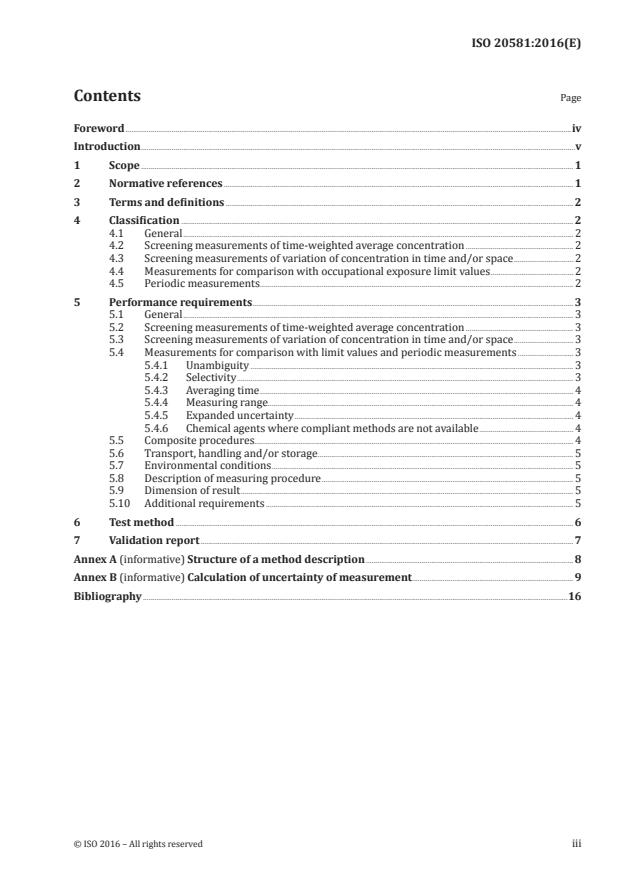
ISO 20581:2016 - Workplace air -- General requirements for the performance of procedures for the measurement of chemical agents

ISO 20581:2016 - Workplace air — General requirements for the performance of procedures for the measurement of chemical agents/1/2016
Overview
ISO 20581:2016 - Workplace air - General requirements for the performance of procedures for the measurement of chemical agents defines general performance requirements for procedures used to determine concentrations of chemical agents in workplace atmospheres. It applies to all steps of a measuring procedure (sampling, analysis, or direct-reading devices) and to all physical forms of contaminants (gas, vapour, airborne particles). The standard specifies the performance a method must demonstrate under prescribed laboratory conditions to be considered suitable for the diverse environmental conditions encountered at workplaces.
Key topics and technical requirements
- Scope and classification
- Measurement purposes are classified: screening time-weighted averages (TWA), screening for temporal/spatial variation, measurements for comparison with occupational exposure limit values (OELVs), and periodic measurements.
- Performance requirements (vary by purpose)
- Selectivity: methods must address potential interferences and provide sufficient specificity for the target chemical.
- Averaging time: must be appropriate to the measurement purpose (e.g., TWA or short-term variation).
- Measuring range: must include relevant limit values (OELVs) and be fit for purpose.
- Expanded uncertainty: uncertainty of measurement must be quantified and acceptable for the intended use.
- Unambiguity: analytical results should correspond to a single concentration within a known uncertainty.
- Additional procedural elements
- Requirements for composite procedures, transport/handling/storage of samples, environmental condition testing, and full method descriptions.
- Test methods and validation reporting requirements are specified, with informative annexes on method structure and uncertainty calculation.
Practical applications and users
ISO 20581:2016 is intended for professionals involved in occupational exposure assessment and workplace air monitoring:
- Industrial hygienists and occupational health practitioners who select or validate measurement procedures.
- Testing laboratories and research groups conducting method validation and uncertainty assessment.
- Manufacturers of samplers and direct‑reading instruments who need to demonstrate performance compliance.
- Regulators, employers and consultants using validated procedures to compare concentrations with OELVs and to plan control measures.
Practical uses include selecting suitable sampling/analysis methods, validating new measurement procedures, documenting method performance for compliance, and designing monitoring programmes for worker protection.
Related standards
ISO 20581 references and complements other ISO/EN workplace-atmosphere standards, for example:
- ISO 13137, ISO 16107, ISO 17621
- EN 838, EN 1076, EN 13205, EN 13890, EN 13936, EN 45544
Keywords: ISO 20581:2016, workplace air, measurement of chemical agents, occupational exposure limits, time-weighted average, selectivity, uncertainty, direct-reading devices, sampling methods.
Relations
- Effective Date
- 11-Feb-2026
- Effective Date
- 09-Feb-2026
- Effective Date
- 09-Feb-2026
- Effective Date
- 09-Feb-2026
- Effective Date
- 09-Feb-2026
Buy Documents
ISO 20581:2016 - Workplace air -- General requirements for the performance of procedures for the measurement of chemical agents
ISO 20581:2016 - Workplace air — General requirements for the performance of procedures for the measurement of chemical agents/1/2016
Get Certified
Connect with accredited certification bodies for this standard

CIS Institut d.o.o.
Personal Protective Equipment (PPE) certification body. Notified Body NB-2890 for EU Regulation 2016/425 PPE.

Kiwa BDA Testing
Building and construction product certification.
Kmetijski inštitut Slovenije
Agricultural Institute of Slovenia. Soil testing, plant health, agricultural product analysis.
Sponsored listings
Frequently Asked Questions
ISO 20581:2016 is a standard published by the International Organization for Standardization (ISO). Its full title is "Workplace air — General requirements for the performance of procedures for the measurement of chemical agents". This standard covers: ISO 20581:2016 specifies general performance requirements for procedures for the determination of the concentration of chemical agents in workplace atmospheres. These requirements apply to all steps of measuring procedures regardless of the physical form of the chemical agent (gas, vapour, airborne particles), measuring procedures with separate sampling and analytical methods, and direct-reading devices. ISO 20581:2016 specifies requirements that have to be fulfilled by measuring procedures when tested under prescribed laboratory conditions due to a wide range of environmental conditions encountered in practice.
ISO 20581:2016 specifies general performance requirements for procedures for the determination of the concentration of chemical agents in workplace atmospheres. These requirements apply to all steps of measuring procedures regardless of the physical form of the chemical agent (gas, vapour, airborne particles), measuring procedures with separate sampling and analytical methods, and direct-reading devices. ISO 20581:2016 specifies requirements that have to be fulfilled by measuring procedures when tested under prescribed laboratory conditions due to a wide range of environmental conditions encountered in practice.
ISO 20581:2016 is classified under the following ICS (International Classification for Standards) categories: 13.040.30 - Workplace atmospheres. The ICS classification helps identify the subject area and facilitates finding related standards.
ISO 20581:2016 has the following relationships with other standards: It is inter standard links to EN ISO 22065:2019, EN ISO 23320:2022, EN ISO 22065:2020, EN ISO 21832:2020, EN ISO 23861:2022. Understanding these relationships helps ensure you are using the most current and applicable version of the standard.
ISO 20581:2016 is available in PDF format for immediate download after purchase. The document can be added to your cart and obtained through the secure checkout process. Digital delivery ensures instant access to the complete standard document.
Standards Content (Sample)
INTERNATIONAL ISO
STANDARD 20581
First edition
2016-11-01
Workplace air — General
requirements for the performance of
procedures for the measurement of
chemical agents
Air des lieux de travail — Exigences générales concernant les
performances des procédures de mesure des agents chimiques
Reference number
©
ISO 2016
© ISO 2016, Published in Switzerland
All rights reserved. Unless otherwise specified, no part of this publication may be reproduced or utilized otherwise in any form
or by any means, electronic or mechanical, including photocopying, or posting on the internet or an intranet, without prior
written permission. Permission can be requested from either ISO at the address below or ISO’s member body in the country of
the requester.
ISO copyright office
Ch. de Blandonnet 8 • CP 401
CH-1214 Vernier, Geneva, Switzerland
Tel. +41 22 749 01 11
Fax +41 22 749 09 47
copyright@iso.org
www.iso.org
ii © ISO 2016 – All rights reserved
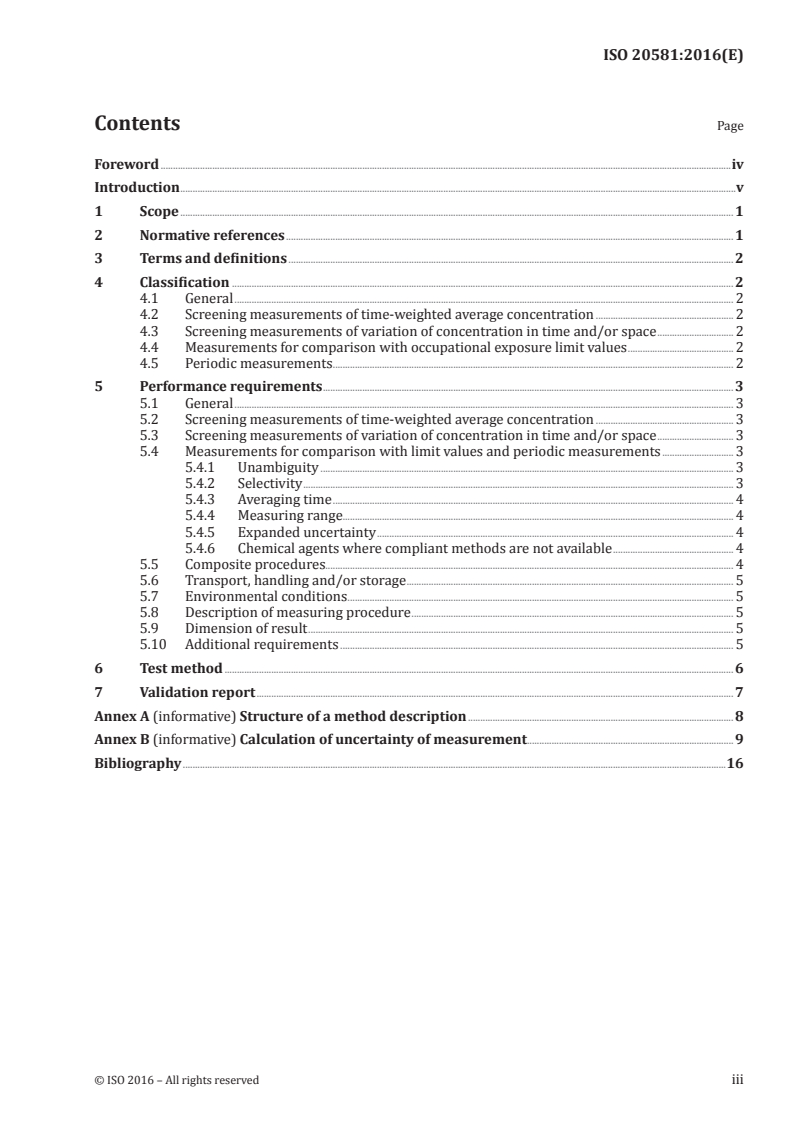
Contents Page
Foreword .iv
Introduction .v
1 Scope . 1
2 Normative references . 1
3 Terms and definitions . 2
4 Classification . 2
4.1 General . 2
4.2 Screening measurements of time-weighted average concentration . 2
4.3 Screening measurements of variation of concentration in time and/or space . 2
4.4 Measurements for comparison with occupational exposure limit values . 2
4.5 Periodic measurements . 2
5 Performance requirements . 3
5.1 General . 3
5.2 Screening measurements of time-weighted average concentration . 3
5.3 Screening measurements of variation of concentration in time and/or space . 3
5.4 Measurements for comparison with limit values and periodic measurements . 3
5.4.1 Unambiguity . 3
5.4.2 Selectivity . 3
5.4.3 Averaging time . 4
5.4.4 Measuring range. 4
5.4.5 Expanded uncertainty . 4
5.4.6 Chemical agents where compliant methods are not available . 4
5.5 Composite procedures. 4
5.6 Transport, handling and/or storage . 5
5.7 Environmental conditions . 5
5.8 Description of measuring procedure . 5
5.9 Dimension of result . 5
5.10 Additional requirements . 5
6 Test method . 6
7 Validation report . 7
Annex A (informative) Structure of a method description . 8
Annex B (informative) Calculation of uncertainty of measurement . 9
Bibliography .16
Foreword
ISO (the International Organization for Standardization) is a worldwide federation of national standards
bodies (ISO member bodies). The work of preparing International Standards is normally carried out
through ISO technical committees. Each member body interested in a subject for which a technical
committee has been established has the right to be represented on that committee. International
organizations, governmental and non-governmental, in liaison with ISO, also take part in the work.
ISO collaborates closely with the International Electrotechnical Commission (IEC) on all matters of
electrotechnical standardization.
The procedures used to develop this document and those intended for its further maintenance are
described in the ISO/IEC Directives, Part 1. In particular the different approval criteria needed for the
different types of ISO documents should be noted. This document was drafted in accordance with the
editorial rules of the ISO/IEC Directives, Part 2 (see www.iso.org/directives).
Attention is drawn to the possibility that some of the elements of this document may be the subject of
patent rights. ISO shall not be held responsible for identifying any or all such patent rights. Details of
any patent rights identified during the development of the document will be in the Introduction and/or
on the ISO list of patent declarations received (see www.iso.org/patents).
Any trade name used in this document is information given for the convenience of users and does not
constitute an endorsement.
For an explanation on the meaning of ISO specific terms and expressions related to conformity assessment,
as well as information about ISO’s adherence to the World Trade Organization (WTO) principles in the
Technical Barriers to Trade (TBT) see the following URL: www.iso.org/iso/foreword.html.
The committee responsible for this document is ISO/TC 146, Air quality, Subcommittee SC 2, Workplace
atmospheres.
iv © ISO 2016 – All rights reserved
Introduction
National laws and regulations require the assessment of the potential exposure of a worker to chemical
agents in workplace atmospheres. One way of assessing such exposure is to measure the concentration of
a chemical agent in the air in the worker’s breathing zone. The procedures used for such measurements
should provide reliable and valid results for the comparison purpose of exposure measurements with
occupational exposure limit values and for the provision of acceptable control strategies.
This document is based on EN 482:2012, amended by Amendment 1:2015, and introduces general
requirements to fulfil the measurement procedures in the process of quantitative exposure assessment.
Specific International Standards and European Standards have been prepared for different types of
measuring procedures and measuring devices. These include standards for airborne particle samplers
[EN 13205 (all parts)], diffusive samplers (ISO 16107 and EN 838), pumped samplers (EN 1076),
short-term detector tubes (ISO 17621), personal sampling pumps (ISO 13137), metals and metalloids
in airborne particles (EN 13890), mixtures of airborne particles and vapour (EN 13936) and direct
reading instruments for toxic gases and vapours [EN 45544 (all parts)]. In these specific standards,
additional requirements have been included for the procedure or device in question, so that the general
requirements of this document are not compromised. Where no specific International and/or European
Standard exists, only the general requirements apply.
Performance requirements given in this document are intended to apply under environmental
conditions present at the workplace. However, because a wide range of environmental conditions is
encountered in practice, this document specifies requirements that have to be fulfilled by measuring
procedures when tested under prescribed laboratory conditions.
It is the user’s responsibility to choose the appropriate procedures or devices that meet the
requirements of this document. One way of doing this is to obtain information or confirmation from the
provider of a procedure or the manufacturer of a device. Type-testing or, more generally, assessment of
the performance of procedures or devices, can be undertaken by the manufacturer, user, testing house
or research and development laboratory, as is most appropriate. A number of existing procedures for
workplace measurements have either been tested over a part of the required minimum measuring
range, but not over the entire range, or have not been tested for all environmental influences and
potential interferences. If these partially validated procedures meet the performance requirements of
this document, they can be used at present. Nevertheless, these procedures should be tested over the
full ranges as soon as is reasonably practicable.
INTERNATIONAL STANDARD ISO 20581:2016(E)
Workplace air — General requirements for the
performance of procedures for the measurement of
chemical agents
1 Scope
This document specifies general performance requirements for procedures for the determination of
the concentration of chemical agents in workplace atmospheres. These requirements apply to all steps
of measuring procedures regardless of the physical form of the chemical agent (gas, vapour, airborne
particles), measuring procedures with separate sampling and analytical methods, and direct-reading
devices.
This document specifies requirements that have to be fulfilled by measuring procedures when tested
under prescribed laboratory conditions due to a wide range of environmental conditions encountered
in practice.
2 Normative references
The following documents are referred to in the text in such a way that some or all of their content
constitutes requirements of this document. For dated references, only the edition cited applies. For
undated references, the latest edition of the referenced document (including any amendments) applies.
ISO 78-2, Chemistry — Layouts for standards — Part 2: Methods of chemical analysis
ISO 7708, Air quality — Particle size fraction definitions for health-related sampling
ISO 13137, Workplace atmospheres — Pumps for personal sampling of chemical and biological agents —
Requirements and test methods
ISO 16107, Workplace atmospheres — Protocol for evaluating the performance of diffusive samplers
ISO 17621, Workplace atmospheres — Short term detector tube measurement systems — Requirements
and test methods
EN 838, Workplace exposure — Procedures for measuring gases and vapours using diffusive samplers —
Requirements and test methods
EN 1076, Workplace exposure — Procedures for measuring gases and vapours using pumped samplers —
Requirements and test methods
EN 13205 (all parts), Workplace exposure — Assessment of sampler performance for measurement of
airborne particle concentrations
EN 13890, Workplace exposure — Procedures for measuring metals and metalloids in airborne particles —
Requirements and test methods
EN 13936, Workplace exposure — Procedures for measuring a chemical agent present as a mixture of
airborne particles and vapour — Requirements and test methods
EN 45544 (all parts), Workplace atmospheres — Electrical apparatus used for the direct detection and
direct concentration measurement of toxic gases and vapours
3 Terms and definitions
For the purposes of this document, the terms and definitions given in ISO 18158 apply.
ISO and IEC maintain terminological databases for use in standardization at the following addresses:
— IEC Electropedia: available at http://www.electropedia.org/
— ISO Online browsing platform: available at http://www.iso.org/obp
4 Classification
4.1 General
In this document, measurements are classified according to their purposes. These classifications are
based upon the measurement strategy in EN 689.
4.2 Screening measurements of time-weighted average concentration
Screening measurements of time-weighted average concentration are performed to obtain
semiquantitative information on exposure levels. Such information is used to identify potential health
hazards, and to estimate the risk to health based on the likely severity of harm and the probability of
its occurrence. These measurements can also determine if the exposure is significantly below or above
the occupational exposure limit value (OELV). Apparatus intended for detection and concentration
measurements of chemical agents, that meets the requirements of this document and is capable of
reporting the time-weighted average, can be used.
4.3 Screening measurements of variation of concentration in time and/or space
Screening measurements of variation of concentration in time and/or space are used to provide
information on the likely pattern of the concentration of chemical agents in the air and to identify
locations and periods of elevated exposure. The screening measurements also provide information on
the location and intensity of emission sources and to estimate the effectiveness of ventilation or other
technical measures. Apparatus intended for detection and concentration measurements of chemical
agents, that meets the requirements of this document, can be used.
4.4 Measurements for comparison with occupational exposure limit values
Provided the method meets established acceptable uncertainty criteria, measurements can be made
for comparison with OELVs. Measurements can be taken to determine whether a worker’s exposure
exceeds the OELV initially and repeated after any significant change in working conditions, industrial
process, products or chemicals, or OELV.
4.5 Periodic measurements
Periodic measurements are used to determine whether exposure conditions have changed since the
measurements for comparison with OELVs were performed, or whether control measures remain
effective. The interval between measurements should be established based on the initial occupational
exposure assessment or subsequent amendments to it.
NOTE Since the composition of the workplace atmosphere will have been investigated during the initial
occupational exposure assessment and the composition is known not to vary over time, it can be appropriate for
periodic measurements to use procedures with lower selectivity.
2 © ISO 2016 – All rights reserved
5 Performance requirements
5.1 General
Performance requirements for measuring procedures depend on the purpose for which they are used.
The performance requirements for screening measurements are less stringent than for measurements
for the comparison with limit values and periodic measurements. Therefore, the performance
requirements for screening measurements in 5.2 and 5.3 are only given in general terms.
5.2 Screening measurements of time-weighted average concentration
The purpose of these measurements is described in 4.2. The measurement procedures shall have
a) adequate selectivity for the chemical agent,
b) averaging time less than or equal to the limit value reference period,
c) measuring range that includes the limit value, and
d) expanded uncertainty that is fit for purpose.
5.3 Screening measurements of variation of concentration in time and/or space
The purpose of these measurements is described in 4.3. The measuring procedures shall have
a) adequate selectivity for the chemical agent,
b) short averaging time (for variation of concentration in time ≤5 min; for variation of concentration
in space ≤15 min),
c) measuring range that is fit for purpose (see 4.3), and
d) expanded uncertainty that is fit for purpose.
5.4 Measurements for comparison with limit values and periodic measurements
5.4.1 Unambiguity
A measuring procedure shall produce an unambiguous result for the concentration of the chemical
agent being measured in the specified measuring range, i.e. an analytically determined value shall
correspond to one concentration only within a known uncertainty.
5.4.2 Selectivity
The measuring procedure shall contain appropriate information about the nature and magnitude of
any interference.
NOTE 1 Selectivity requirements vary from case to case, depending on what is known in advance about the
workplace air. If the identity of all contaminants present is not known in advance, then the measuring procedure
will need to have a high selectivity. If the identity of all contaminants is known prior to measurement and there
are no interferents present, then it might be possible to use a measurement procedure with a low or adequate
selectivity.
Where a particle size fraction, as defined in ISO 7708, is specified for an OELV, procedures for measuring
chemical agents present as airborne particles shall prescribe a method for sampling the specified
particle size fraction.
NOTE 2 In addition to samplers meeting the requirements of ISO 7708, there are samplers which themselves
define the sample [see ISO 13205 (all parts)].
If different limit values are set for different species of a chemical agent, then the measuring procedure
shall determine the individual species concerned.
5.4.3 Averaging time
The averaging time is equal to the sampling time, which shall be less than or equal to the limit value
reference period. Depending on the sampling techniques, the sampling time can vary.
NOTE A full shift average concentration, typically the 8 h time-weighted concentration, gives a representative
description of the occupational exposure situation.
Exposure peaks which may occur systematically or randomly during the shift should fulfil the short-
term exposure limit conditions, if any.
5.4.4 Measuring range
The measuring range of the procedure listed in Table 1 shall cover at least the concentrations from
0,1 times to 2 times the limit value for long-term measurements, and from 0,5 times to 2 times the limit
value for short-term measurements. The relevant OELV shall be determined by the proper authorities
where the measuring procedure is to be used.
NOTE Reference [10] provides a list of limit values from many jurisdictions.
5.4.5 Expanded uncertainty
The requirements for expanded uncertainty are given in Table 1.
Table 1 — Expanded uncertainty requirements for measurements for comparison with limit
values and periodic measurements
Relative expanded
Relative
Reference uncertainty
Measuring range expanded
period (mixtures of airborne
uncertainty
particles and vapour)
Short-term
0,5 times to 2 times limit value ≤50 % ≤50 %
(e.g. 15 min)
Long-term 0,1 times to <0,5 times limit value ≤50 % ≤50 %
Long-term 0,5 times to 2 times limit value ≤30 % ≤50 %
NOTE Variation of exposure to chemical agents in the workplace can be significantly greater than indicated
by the uncertainty of a single measurement calculated according to this document. This is due to the temporal
and spatial variability of workplace exposure.
5.4.6 Chemical agents where compliant methods are not available
Limit values are determined by authorities independently from those developing measuring procedures.
If a measuring procedure is not available for a given limit value which meets the requirements given in
5.4.4 and 5.4.5, a measuring procedure should be used whose performance is closest to the requirements.
The method employed should clearly state its limitations when measuring at the exposure limit.
5.5 Composite procedures
The performance requirements detailed in 5.2, 5.3 and 5.4 shall be fulfilled for the whole measuring
procedure even if the measuring procedure consists of several distinct steps, e.g. preparation of
equipment, sampling, transport and storage, sample preparation and analysis. Each step of the
measuring procedure may be tested individually and can be combined as a whole.
4 © ISO 2016 – All rights reserved
5.6 Transport, handling and/or storage
Transport, handling and/or storage of samples, if appropriate, shall be carried out in such a way that
the physical and chemical integrity is maintained between sampling and analysis.
5.7 Environmental conditions
The effect of environmental conditions (e.g. temperature, humidity, atmospheric pressure, and/or air
speed) on the performance of the method shall be tested in the laboratory. Performance requirements
concerning unambiguity, selectivity, expanded uncertainty, minimum measuring range and averaging
time shall be fulfilled under the conditions likely to be encountered in the workplace.
NOTE Due to the time, cost, and effort involved, it is not practicable to carry out a comprehensive evaluation
of environmental influences in the field and therefore laboratory tests are specified in this document. However,
field tests can provide valuable information on the performance of measurement methods (e.g. interferences
from nearby workplaces).
The range of environmental conditions under which the performance requirements of 5.2 to 5.5 are
fulfilled shall be specified in the measuring procedure.
5.8 Description of measuring procedure
The measuring procedure shall be documented in accordance with ISO 78-2. Any clause or subclause
which is unnecessary in a particular case may be omitted, and others, if required, may be added in
the most appropriate places. The description shall contain all necessary information to perform the
measuring procedure, including information about the attainable expanded uncertainty, measuring
range, averaging time, interferences, and environmental or other conditions that can influence the
performance of the measuring procedure.
If correction factors are applied, e.g. for a known and explainable bias due to environmental influences,
these shall be justified in the measuring procedure.
NOTE An example for the structure of a method description based on ISO 78-2 is given in Annex A.
5.9 Dimension of result
The final measurement result shall be expressed in the same units as those of the limit value. This can
be achieved directly or by means of a suitable conversion.
This requirement is not obligatory for screening measurements of the variation of concentration in
time and/or space.
5.10 Additional requirements
In addition to the requirements given in 5.2 to 5.9, further requirements specified in ISO 13137, ISO 16107,
ISO 17621, EN 838, EN 1076, EN 13205 (all parts), EN 13890, EN 13936 and EN 45544 (all parts) shall be
met for particular types of measuring procedures and devices, as appropriate.
Table 2 lists additional requirements of testing parameters.
Table 2 — Additional requirements of testing parameters
Standard Required testing parameters
ISO 13137 Features and mass of pumps, design safety, operating time, start-up and long-term
performance, short-term interruption of air flow, mechanical strength, timer accura-
cy, electromagnetic compatibility, explosion hazard, charger, and marking
ISO 16107 Bias relative to manufacturer-specified sampling rate, variation in sampling rate (e.g.
from poor sampler dimension tolerance), effects of: wind, temperature, humidity,
target concentration itself, and diffusive loss from sampler
ISO 17621 Scale, packing of the tubes, interferences, overloading, evaluation of stain, shelf life,
marking and mechanical strength for detector tubes; Explosion hazard, stroke vol-
ume, leakage, and mechanical strength and durability for detector tube pumps
EN 838 Quantification limit of the measuring procedure, analytical recovery, nominal uptake
rate, air velocity/sampler orientation, sampler leak test, shelf life, and marking
EN 1076 Quantification limit of the measuring procedure, analytical recovery, sampler leak
test, shelf life, marking, flow resistance, and sampler breakthrough test
EN 13205 (all parts) Specimen variability, pump design safety and electrical safety, and sampler evaluation
EN 13890 Pump design safety and electrical safety, sampler evaluation, detection and quantifi-
cation limit of the measuring procedure, analytical recovery, and interferences
EN 13936 Comply with the requirements of this document, ISO 13137, EN 1076, EN 13205 (all
parts), and EN 13890
EN 45544 (all parts) Instrument vibration and drop test, measurement of deviations, alarm system
including audible alarm, set point(s), and response time, flow failure warning, warm-
up time, time of response and recovery, addition of sampling probe, field verification
kit, gas concentrations above the measuring range, electrical fault signal, extended
operation under standard test gas, orientation, electrical tests including battery
capacity, mains power supply, time-weighted average function, and electromagnetic
compatibility, and instrument drift tests
6 Test method
6.1 Estimate the expanded uncertainty of results obtained using the measuring procedure by carrying
out the tests prescribed in the relevant International Standards or European Standards specific to the
type of procedure or device concerned, as listed in Clause 2.
Carry out measurements at the lower and upper ends of the measuring range specified in Table 1, and
for at least one intermediate concentration.
Prepare at least six replicate samples for each set of tests and analyse the samples under repeatability
conditions.
Calculate the expanded uncertainty, expressed as a percentage, according to the following procedure
(see, for example, References [11], [12],
...
INTERNATIONAL ISO
STANDARD 20581
First edition
2016-11-01
Workplace air — General
requirements for the performance of
procedures for the measurement of
chemical agents
Air des lieux de travail — Exigences générales concernant les
performances des procédures de mesure des agents chimiques
Reference number
©
ISO 2016
© ISO 2016, Published in Switzerland
All rights reserved. Unless otherwise specified, no part of this publication may be reproduced or utilized otherwise in any form
or by any means, electronic or mechanical, including photocopying, or posting on the internet or an intranet, without prior
written permission. Permission can be requested from either ISO at the address below or ISO’s member body in the country of
the requester.
ISO copyright office
Ch. de Blandonnet 8 • CP 401
CH-1214 Vernier, Geneva, Switzerland
Tel. +41 22 749 01 11
Fax +41 22 749 09 47
copyright@iso.org
www.iso.org
ii © ISO 2016 – All rights reserved
Contents Page
Foreword .iv
Introduction .v
1 Scope . 1
2 Normative references . 1
3 Terms and definitions . 2
4 Classification . 2
4.1 General . 2
4.2 Screening measurements of time-weighted average concentration . 2
4.3 Screening measurements of variation of concentration in time and/or space . 2
4.4 Measurements for comparison with occupational exposure limit values . 2
4.5 Periodic measurements . 2
5 Performance requirements . 3
5.1 General . 3
5.2 Screening measurements of time-weighted average concentration . 3
5.3 Screening measurements of variation of concentration in time and/or space . 3
5.4 Measurements for comparison with limit values and periodic measurements . 3
5.4.1 Unambiguity . 3
5.4.2 Selectivity . 3
5.4.3 Averaging time . 4
5.4.4 Measuring range. 4
5.4.5 Expanded uncertainty . 4
5.4.6 Chemical agents where compliant methods are not available . 4
5.5 Composite procedures. 4
5.6 Transport, handling and/or storage . 5
5.7 Environmental conditions . 5
5.8 Description of measuring procedure . 5
5.9 Dimension of result . 5
5.10 Additional requirements . 5
6 Test method . 6
7 Validation report . 7
Annex A (informative) Structure of a method description . 8
Annex B (informative) Calculation of uncertainty of measurement . 9
Bibliography .16
Foreword
ISO (the International Organization for Standardization) is a worldwide federation of national standards
bodies (ISO member bodies). The work of preparing International Standards is normally carried out
through ISO technical committees. Each member body interested in a subject for which a technical
committee has been established has the right to be represented on that committee. International
organizations, governmental and non-governmental, in liaison with ISO, also take part in the work.
ISO collaborates closely with the International Electrotechnical Commission (IEC) on all matters of
electrotechnical standardization.
The procedures used to develop this document and those intended for its further maintenance are
described in the ISO/IEC Directives, Part 1. In particular the different approval criteria needed for the
different types of ISO documents should be noted. This document was drafted in accordance with the
editorial rules of the ISO/IEC Directives, Part 2 (see www.iso.org/directives).
Attention is drawn to the possibility that some of the elements of this document may be the subject of
patent rights. ISO shall not be held responsible for identifying any or all such patent rights. Details of
any patent rights identified during the development of the document will be in the Introduction and/or
on the ISO list of patent declarations received (see www.iso.org/patents).
Any trade name used in this document is information given for the convenience of users and does not
constitute an endorsement.
For an explanation on the meaning of ISO specific terms and expressions related to conformity assessment,
as well as information about ISO’s adherence to the World Trade Organization (WTO) principles in the
Technical Barriers to Trade (TBT) see the following URL: www.iso.org/iso/foreword.html.
The committee responsible for this document is ISO/TC 146, Air quality, Subcommittee SC 2, Workplace
atmospheres.
iv © ISO 2016 – All rights reserved
Introduction
National laws and regulations require the assessment of the potential exposure of a worker to chemical
agents in workplace atmospheres. One way of assessing such exposure is to measure the concentration of
a chemical agent in the air in the worker’s breathing zone. The procedures used for such measurements
should provide reliable and valid results for the comparison purpose of exposure measurements with
occupational exposure limit values and for the provision of acceptable control strategies.
This document is based on EN 482:2012, amended by Amendment 1:2015, and introduces general
requirements to fulfil the measurement procedures in the process of quantitative exposure assessment.
Specific International Standards and European Standards have been prepared for different types of
measuring procedures and measuring devices. These include standards for airborne particle samplers
[EN 13205 (all parts)], diffusive samplers (ISO 16107 and EN 838), pumped samplers (EN 1076),
short-term detector tubes (ISO 17621), personal sampling pumps (ISO 13137), metals and metalloids
in airborne particles (EN 13890), mixtures of airborne particles and vapour (EN 13936) and direct
reading instruments for toxic gases and vapours [EN 45544 (all parts)]. In these specific standards,
additional requirements have been included for the procedure or device in question, so that the general
requirements of this document are not compromised. Where no specific International and/or European
Standard exists, only the general requirements apply.
Performance requirements given in this document are intended to apply under environmental
conditions present at the workplace. However, because a wide range of environmental conditions is
encountered in practice, this document specifies requirements that have to be fulfilled by measuring
procedures when tested under prescribed laboratory conditions.
It is the user’s responsibility to choose the appropriate procedures or devices that meet the
requirements of this document. One way of doing this is to obtain information or confirmation from the
provider of a procedure or the manufacturer of a device. Type-testing or, more generally, assessment of
the performance of procedures or devices, can be undertaken by the manufacturer, user, testing house
or research and development laboratory, as is most appropriate. A number of existing procedures for
workplace measurements have either been tested over a part of the required minimum measuring
range, but not over the entire range, or have not been tested for all environmental influences and
potential interferences. If these partially validated procedures meet the performance requirements of
this document, they can be used at present. Nevertheless, these procedures should be tested over the
full ranges as soon as is reasonably practicable.
INTERNATIONAL STANDARD ISO 20581:2016(E)
Workplace air — General requirements for the
performance of procedures for the measurement of
chemical agents
1 Scope
This document specifies general performance requirements for procedures for the determination of
the concentration of chemical agents in workplace atmospheres. These requirements apply to all steps
of measuring procedures regardless of the physical form of the chemical agent (gas, vapour, airborne
particles), measuring procedures with separate sampling and analytical methods, and direct-reading
devices.
This document specifies requirements that have to be fulfilled by measuring procedures when tested
under prescribed laboratory conditions due to a wide range of environmental conditions encountered
in practice.
2 Normative references
The following documents are referred to in the text in such a way that some or all of their content
constitutes requirements of this document. For dated references, only the edition cited applies. For
undated references, the latest edition of the referenced document (including any amendments) applies.
ISO 78-2, Chemistry — Layouts for standards — Part 2: Methods of chemical analysis
ISO 7708, Air quality — Particle size fraction definitions for health-related sampling
ISO 13137, Workplace atmospheres — Pumps for personal sampling of chemical and biological agents —
Requirements and test methods
ISO 16107, Workplace atmospheres — Protocol for evaluating the performance of diffusive samplers
ISO 17621, Workplace atmospheres — Short term detector tube measurement systems — Requirements
and test methods
EN 838, Workplace exposure — Procedures for measuring gases and vapours using diffusive samplers —
Requirements and test methods
EN 1076, Workplace exposure — Procedures for measuring gases and vapours using pumped samplers —
Requirements and test methods
EN 13205 (all parts), Workplace exposure — Assessment of sampler performance for measurement of
airborne particle concentrations
EN 13890, Workplace exposure — Procedures for measuring metals and metalloids in airborne particles —
Requirements and test methods
EN 13936, Workplace exposure — Procedures for measuring a chemical agent present as a mixture of
airborne particles and vapour — Requirements and test methods
EN 45544 (all parts), Workplace atmospheres — Electrical apparatus used for the direct detection and
direct concentration measurement of toxic gases and vapours
3 Terms and definitions
For the purposes of this document, the terms and definitions given in ISO 18158 apply.
ISO and IEC maintain terminological databases for use in standardization at the following addresses:
— IEC Electropedia: available at http://www.electropedia.org/
— ISO Online browsing platform: available at http://www.iso.org/obp
4 Classification
4.1 General
In this document, measurements are classified according to their purposes. These classifications are
based upon the measurement strategy in EN 689.
4.2 Screening measurements of time-weighted average concentration
Screening measurements of time-weighted average concentration are performed to obtain
semiquantitative information on exposure levels. Such information is used to identify potential health
hazards, and to estimate the risk to health based on the likely severity of harm and the probability of
its occurrence. These measurements can also determine if the exposure is significantly below or above
the occupational exposure limit value (OELV). Apparatus intended for detection and concentration
measurements of chemical agents, that meets the requirements of this document and is capable of
reporting the time-weighted average, can be used.
4.3 Screening measurements of variation of concentration in time and/or space
Screening measurements of variation of concentration in time and/or space are used to provide
information on the likely pattern of the concentration of chemical agents in the air and to identify
locations and periods of elevated exposure. The screening measurements also provide information on
the location and intensity of emission sources and to estimate the effectiveness of ventilation or other
technical measures. Apparatus intended for detection and concentration measurements of chemical
agents, that meets the requirements of this document, can be used.
4.4 Measurements for comparison with occupational exposure limit values
Provided the method meets established acceptable uncertainty criteria, measurements can be made
for comparison with OELVs. Measurements can be taken to determine whether a worker’s exposure
exceeds the OELV initially and repeated after any significant change in working conditions, industrial
process, products or chemicals, or OELV.
4.5 Periodic measurements
Periodic measurements are used to determine whether exposure conditions have changed since the
measurements for comparison with OELVs were performed, or whether control measures remain
effective. The interval between measurements should be established based on the initial occupational
exposure assessment or subsequent amendments to it.
NOTE Since the composition of the workplace atmosphere will have been investigated during the initial
occupational exposure assessment and the composition is known not to vary over time, it can be appropriate for
periodic measurements to use procedures with lower selectivity.
2 © ISO 2016 – All rights reserved
5 Performance requirements
5.1 General
Performance requirements for measuring procedures depend on the purpose for which they are used.
The performance requirements for screening measurements are less stringent than for measurements
for the comparison with limit values and periodic measurements. Therefore, the performance
requirements for screening measurements in 5.2 and 5.3 are only given in general terms.
5.2 Screening measurements of time-weighted average concentration
The purpose of these measurements is described in 4.2. The measurement procedures shall have
a) adequate selectivity for the chemical agent,
b) averaging time less than or equal to the limit value reference period,
c) measuring range that includes the limit value, and
d) expanded uncertainty that is fit for purpose.
5.3 Screening measurements of variation of concentration in time and/or space
The purpose of these measurements is described in 4.3. The measuring procedures shall have
a) adequate selectivity for the chemical agent,
b) short averaging time (for variation of concentration in time ≤5 min; for variation of concentration
in space ≤15 min),
c) measuring range that is fit for purpose (see 4.3), and
d) expanded uncertainty that is fit for purpose.
5.4 Measurements for comparison with limit values and periodic measurements
5.4.1 Unambiguity
A measuring procedure shall produce an unambiguous result for the concentration of the chemical
agent being measured in the specified measuring range, i.e. an analytically determined value shall
correspond to one concentration only within a known uncertainty.
5.4.2 Selectivity
The measuring procedure shall contain appropriate information about the nature and magnitude of
any interference.
NOTE 1 Selectivity requirements vary from case to case, depending on what is known in advance about the
workplace air. If the identity of all contaminants present is not known in advance, then the measuring procedure
will need to have a high selectivity. If the identity of all contaminants is known prior to measurement and there
are no interferents present, then it might be possible to use a measurement procedure with a low or adequate
selectivity.
Where a particle size fraction, as defined in ISO 7708, is specified for an OELV, procedures for measuring
chemical agents present as airborne particles shall prescribe a method for sampling the specified
particle size fraction.
NOTE 2 In addition to samplers meeting the requirements of ISO 7708, there are samplers which themselves
define the sample [see ISO 13205 (all parts)].
If different limit values are set for different species of a chemical agent, then the measuring procedure
shall determine the individual species concerned.
5.4.3 Averaging time
The averaging time is equal to the sampling time, which shall be less than or equal to the limit value
reference period. Depending on the sampling techniques, the sampling time can vary.
NOTE A full shift average concentration, typically the 8 h time-weighted concentration, gives a representative
description of the occupational exposure situation.
Exposure peaks which may occur systematically or randomly during the shift should fulfil the short-
term exposure limit conditions, if any.
5.4.4 Measuring range
The measuring range of the procedure listed in Table 1 shall cover at least the concentrations from
0,1 times to 2 times the limit value for long-term measurements, and from 0,5 times to 2 times the limit
value for short-term measurements. The relevant OELV shall be determined by the proper authorities
where the measuring procedure is to be used.
NOTE Reference [10] provides a list of limit values from many jurisdictions.
5.4.5 Expanded uncertainty
The requirements for expanded uncertainty are given in Table 1.
Table 1 — Expanded uncertainty requirements for measurements for comparison with limit
values and periodic measurements
Relative expanded
Relative
Reference uncertainty
Measuring range expanded
period (mixtures of airborne
uncertainty
particles and vapour)
Short-term
0,5 times to 2 times limit value ≤50 % ≤50 %
(e.g. 15 min)
Long-term 0,1 times to <0,5 times limit value ≤50 % ≤50 %
Long-term 0,5 times to 2 times limit value ≤30 % ≤50 %
NOTE Variation of exposure to chemical agents in the workplace can be significantly greater than indicated
by the uncertainty of a single measurement calculated according to this document. This is due to the temporal
and spatial variability of workplace exposure.
5.4.6 Chemical agents where compliant methods are not available
Limit values are determined by authorities independently from those developing measuring procedures.
If a measuring procedure is not available for a given limit value which meets the requirements given in
5.4.4 and 5.4.5, a measuring procedure should be used whose performance is closest to the requirements.
The method employed should clearly state its limitations when measuring at the exposure limit.
5.5 Composite procedures
The performance requirements detailed in 5.2, 5.3 and 5.4 shall be fulfilled for the whole measuring
procedure even if the measuring procedure consists of several distinct steps, e.g. preparation of
equipment, sampling, transport and storage, sample preparation and analysis. Each step of the
measuring procedure may be tested individually and can be combined as a whole.
4 © ISO 2016 – All rights reserved
5.6 Transport, handling and/or storage
Transport, handling and/or storage of samples, if appropriate, shall be carried out in such a way that
the physical and chemical integrity is maintained between sampling and analysis.
5.7 Environmental conditions
The effect of environmental conditions (e.g. temperature, humidity, atmospheric pressure, and/or air
speed) on the performance of the method shall be tested in the laboratory. Performance requirements
concerning unambiguity, selectivity, expanded uncertainty, minimum measuring range and averaging
time shall be fulfilled under the conditions likely to be encountered in the workplace.
NOTE Due to the time, cost, and effort involved, it is not practicable to carry out a comprehensive evaluation
of environmental influences in the field and therefore laboratory tests are specified in this document. However,
field tests can provide valuable information on the performance of measurement methods (e.g. interferences
from nearby workplaces).
The range of environmental conditions under which the performance requirements of 5.2 to 5.5 are
fulfilled shall be specified in the measuring procedure.
5.8 Description of measuring procedure
The measuring procedure shall be documented in accordance with ISO 78-2. Any clause or subclause
which is unnecessary in a particular case may be omitted, and others, if required, may be added in
the most appropriate places. The description shall contain all necessary information to perform the
measuring procedure, including information about the attainable expanded uncertainty, measuring
range, averaging time, interferences, and environmental or other conditions that can influence the
performance of the measuring procedure.
If correction factors are applied, e.g. for a known and explainable bias due to environmental influences,
these shall be justified in the measuring procedure.
NOTE An example for the structure of a method description based on ISO 78-2 is given in Annex A.
5.9 Dimension of result
The final measurement result shall be expressed in the same units as those of the limit value. This can
be achieved directly or by means of a suitable conversion.
This requirement is not obligatory for screening measurements of the variation of concentration in
time and/or space.
5.10 Additional requirements
In addition to the requirements given in 5.2 to 5.9, further requirements specified in ISO 13137, ISO 16107,
ISO 17621, EN 838, EN 1076, EN 13205 (all parts), EN 13890, EN 13936 and EN 45544 (all parts) shall be
met for particular types of measuring procedures and devices, as appropriate.
Table 2 lists additional requirements of testing parameters.
Table 2 — Additional requirements of testing parameters
Standard Required testing parameters
ISO 13137 Features and mass of pumps, design safety, operating time, start-up and long-term
performance, short-term interruption of air flow, mechanical strength, timer accura-
cy, electromagnetic compatibility, explosion hazard, charger, and marking
ISO 16107 Bias relative to manufacturer-specified sampling rate, variation in sampling rate (e.g.
from poor sampler dimension tolerance), effects of: wind, temperature, humidity,
target concentration itself, and diffusive loss from sampler
ISO 17621 Scale, packing of the tubes, interferences, overloading, evaluation of stain, shelf life,
marking and mechanical strength for detector tubes; Explosion hazard, stroke vol-
ume, leakage, and mechanical strength and durability for detector tube pumps
EN 838 Quantification limit of the measuring procedure, analytical recovery, nominal uptake
rate, air velocity/sampler orientation, sampler leak test, shelf life, and marking
EN 1076 Quantification limit of the measuring procedure, analytical recovery, sampler leak
test, shelf life, marking, flow resistance, and sampler breakthrough test
EN 13205 (all parts) Specimen variability, pump design safety and electrical safety, and sampler evaluation
EN 13890 Pump design safety and electrical safety, sampler evaluation, detection and quantifi-
cation limit of the measuring procedure, analytical recovery, and interferences
EN 13936 Comply with the requirements of this document, ISO 13137, EN 1076, EN 13205 (all
parts), and EN 13890
EN 45544 (all parts) Instrument vibration and drop test, measurement of deviations, alarm system
including audible alarm, set point(s), and response time, flow failure warning, warm-
up time, time of response and recovery, addition of sampling probe, field verification
kit, gas concentrations above the measuring range, electrical fault signal, extended
operation under standard test gas, orientation, electrical tests including battery
capacity, mains power supply, time-weighted average function, and electromagnetic
compatibility, and instrument drift tests
6 Test method
6.1 Estimate the expanded uncertainty of results obtained using the measuring procedure by carrying
out the tests prescribed in the relevant International Standards or European Standards specific to the
type of procedure or device concerned, as listed in Clause 2.
Carry out measurements at the lower and upper ends of the measuring range specified in Table 1, and
for at least one intermediate concentration.
Prepare at least six replicate samples for each set of tests and analyse the samples under repeatability
conditions.
Calculate the expanded uncertainty, expressed as a percentage, according to the following procedure
(see, for example, References [11], [12],
...