

ISO 6993-2:2006
(Main)Buried, high-impact poly(vinyl chloride) (PVC-HI) piping systems for the supply of gaseous fuels — Part 2: Fittings for a maximum operating pressure of 200 mbar (20 kPa)
General Information
- Abstract
ISO 6993-2:2005 gives the requirements for non-end load-bearing fittings made of high-impact poly(vinyl chloride) (PVC-HI) intended to be used for the supply of gaseous fuels through buried pipelines having an operating temperature range of 0 degrees Celsius up to and including +30 degrees Celsius and a maximum operating pressure of 200 mbar (20 kPa).
- Status
- Published
- Publication Date
- 13-Jun-2006
- Current Stage
- 9093 - International Standard confirmed
- Start Date
- 02-Sep-2026
- Completion Date
- 05-Sep-2026
Overview
ISO 6993-2:2006 specifies requirements for buried, high‑impact poly(vinyl chloride) (PVC‑HI) fittings used to supply gaseous fuels in underground distribution systems. It covers non‑end load‑bearing fittings with elastomeric sealing elements for pipelines operating between 0 °C and +30 °C and a maximum operating pressure of 200 mbar (20 kPa). The standard applies to fittings manufactured from PVC‑HI compositions (PVC‑A, PVC‑CPE, PVC‑EPR) and defines material, dimensional, mechanical and performance requirements plus relevant test methods.
Key topics and technical requirements
- Scope and application: Buried PVC‑HI fittings for gaseous fuels - non‑end load‑bearing, pressure ≤ 200 mbar (20 kPa).
- Materials: Fittings must be made of high‑impact PVC with an impact modifier ≥ 7% by mass; acceptable compositions include mixtures, blends, copolymers or combinations.
- Long‑term strength: Injection‑moulding material MRS (minimum required strength) ≥ 14 MPa, verified by long‑term testing in accordance with ISO 9080 (tests at 20 °C, 40 °C and 60 °C).
- Thermal resistance: Vicat softening temperature ≥ 74 °C (ISO 2507).
- Elastomeric seals: Sealing elements must conform to EN 682:2002 (type G) and must not adversely affect fittings.
- Dimensional and geometric requirements: Measurements per ISO 3126; detailed socket/spigot diameters, wall thicknesses and engagement depths (nominal sizes shown in the standard, typically DN 50–400).
- Manufacturing and appearance: No contaminants > 50 µm; surfaces free from defects that impair function.
- Performance and testing: Includes oven/thermal tests (injection‑moulded fittings tested at 150 °C), leaktightness (Annex B/C), resistance to gas constituents (Annex A), mechanical and physical testing (ISO 3127, ISO 580 and others). Limits on crack/delamination depths and blister size are specified.
Applications and who uses it
- Utility companies and gas network operators specifying buried plastic fittings for low‑pressure gas distribution.
- Manufacturers and designers of PVC‑HI fittings and injection‑moulded components for underground gas pipelines.
- Installers, engineers and procurement teams who need to ensure compliance with material, dimensional and performance criteria for safe low‑pressure gas supply.
- Test laboratories and conformity assessors performing required material and joint tests.
Related standards
- ISO 6993 series: Part 1 (pipes, 1 bar), Part 3 (fittings/saddles, 1 bar), Part 4 (code of practice).
- ISO 9080 (long‑term hydrostatic strength), ISO 3126 (dimensions), ISO 2507 (Vicat), ISO 3127 (impact resistance), ISO 580 (visual heating effects), EN 682 (elastomeric seals), EN 922 (K‑value).
ISO 6993-2 is essential for safe, compliant design and manufacture of PVC‑HI fittings used in buried, low‑pressure gas distribution systems. Keywords: ISO 6993-2, PVC-HI fittings, buried PVC piping, gaseous fuels, 200 mbar, elastomeric seals, underground gas distribution.
Relations
- Effective Date
- 15-Apr-2008
Get Certified
Connect with accredited certification bodies for this standard

DIN CERTCO
DIN Group product certification.

Element Materials Technology
Materials testing and product certification.
ABS Group Brazil
ABS Group certification services in Brazil.
Sponsored listings
Frequently Asked Questions
ISO 6993-2:2006 is a standard published by the International Organization for Standardization (ISO). Its full title is "Buried, high-impact poly(vinyl chloride) (PVC-HI) piping systems for the supply of gaseous fuels — Part 2: Fittings for a maximum operating pressure of 200 mbar (20 kPa)". This standard covers: ISO 6993-2:2005 gives the requirements for non-end load-bearing fittings made of high-impact poly(vinyl chloride) (PVC-HI) intended to be used for the supply of gaseous fuels through buried pipelines having an operating temperature range of 0 degrees Celsius up to and including +30 degrees Celsius and a maximum operating pressure of 200 mbar (20 kPa).
ISO 6993-2:2005 gives the requirements for non-end load-bearing fittings made of high-impact poly(vinyl chloride) (PVC-HI) intended to be used for the supply of gaseous fuels through buried pipelines having an operating temperature range of 0 degrees Celsius up to and including +30 degrees Celsius and a maximum operating pressure of 200 mbar (20 kPa).
ISO 6993-2:2006 is classified under the following ICS (International Classification for Standards) categories: 75.200 - Petroleum products and natural gas handling equipment; 83.140.30 - Plastics pipes and fittings for non fluid use. The ICS classification helps identify the subject area and facilitates finding related standards.
ISO 6993-2:2006 has the following relationships with other standards: It is inter standard links to ISO 6993:2001. Understanding these relationships helps ensure you are using the most current and applicable version of the standard.
ISO 6993-2:2006 is available in PDF format for immediate download after purchase. The document can be added to your cart and obtained through the secure checkout process. Digital delivery ensures instant access to the complete standard document.
Standards Content (Sample)
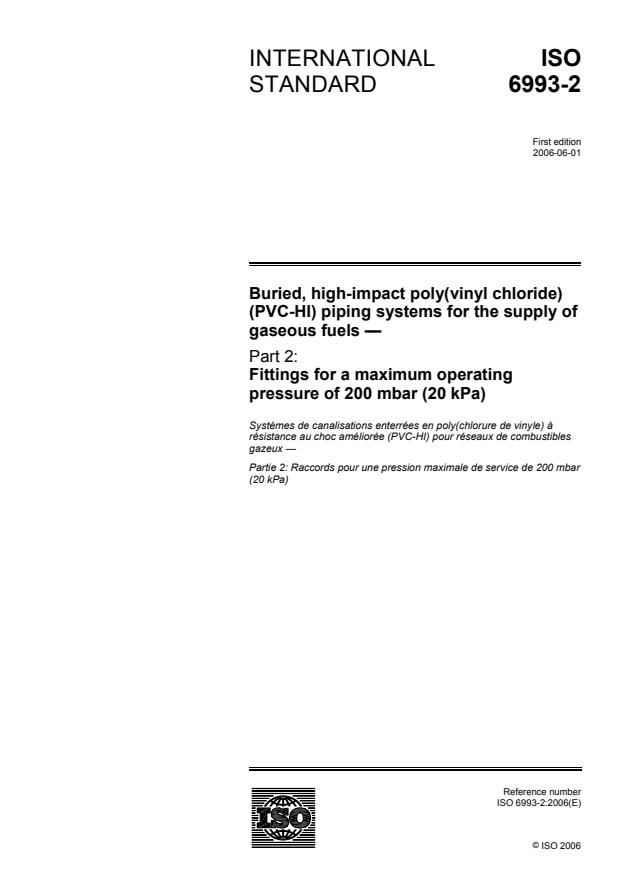
INTERNATIONAL ISO
STANDARD 6993-2
First edition
2006-06-01
Buried, high-impact poly(vinyl chloride)
(PVC-HI) piping systems for the supply of
gaseous fuels —
Part 2:
Fittings for a maximum operating
pressure of 200 mbar (20 kPa)
Systèmes de canalisations enterrées en poly(chlorure de vinyle) à
résistance au choc améliorée (PVC-HI) pour réseaux de combustibles
gazeux —
Partie 2: Raccords pour une pression maximale de service de 200 mbar
(20 kPa)
Reference number
©
ISO 2006
PDF disclaimer
This PDF file may contain embedded typefaces. In accordance with Adobe's licensing policy, this file may be printed or viewed but
shall not be edited unless the typefaces which are embedded are licensed to and installed on the computer performing the editing. In
downloading this file, parties accept therein the responsibility of not infringing Adobe's licensing policy. The ISO Central Secretariat
accepts no liability in this area.
Adobe is a trademark of Adobe Systems Incorporated.
Details of the software products used to create this PDF file can be found in the General Info relative to the file; the PDF-creation
parameters were optimized for printing. Every care has been taken to ensure that the file is suitable for use by ISO member bodies. In
the unlikely event that a problem relating to it is found, please inform the Central Secretariat at the address given below.
© ISO 2006
All rights reserved. Unless otherwise specified, no part of this publication may be reproduced or utilized in any form or by any means,
electronic or mechanical, including photocopying and microfilm, without permission in writing from either ISO at the address below or
ISO's member body in the country of the requester.
ISO copyright office
Case postale 56 • CH-1211 Geneva 20
Tel. + 41 22 749 01 11
Fax + 41 22 749 09 47
E-mail copyright@iso.org
Web www.iso.org
Published in Switzerland
ii © ISO 2006 – All rights reserved
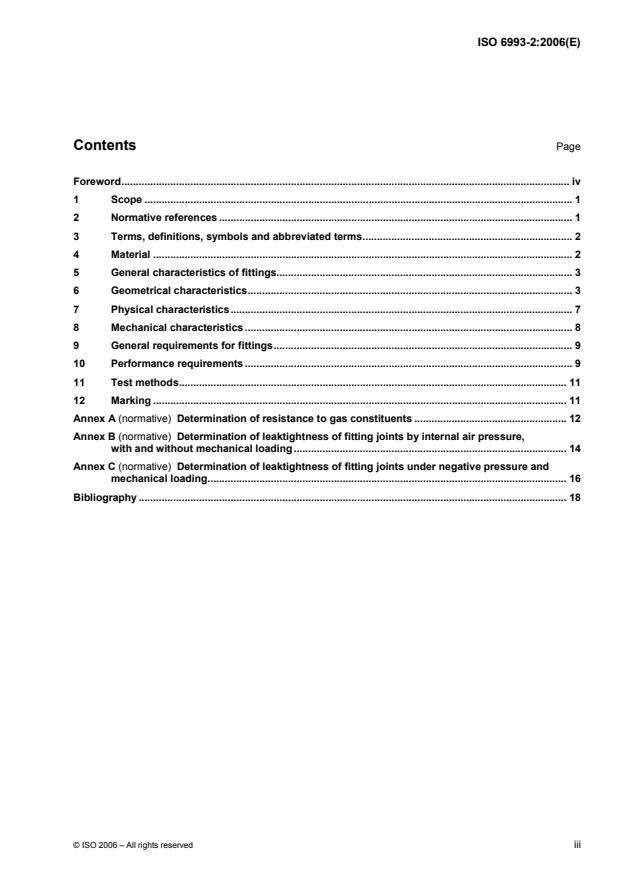
Contents Page
Foreword. iv
1 Scope . 1
2 Normative references . 1
3 Terms, definitions, symbols and abbreviated terms. 2
4 Material . 2
5 General characteristics of fittings. 3
6 Geometrical characteristics. 3
7 Physical characteristics. 7
8 Mechanical characteristics . 8
9 General requirements for fittings. 9
10 Performance requirements . 9
11 Test methods. 11
12 Marking . 11
Annex A (normative) Determination of resistance to gas constituents . 12
Annex B (normative) Determination of leaktightness of fitting joints by internal air pressure,
with and without mechanical loading. 14
Annex C (normative) Determination of leaktightness of fitting joints under negative pressure and
mechanical loading. 16
Bibliography . 18
Foreword
ISO (the International Organization for Standardization) is a worldwide federation of national standards bodies
(ISO member bodies). The work of preparing International Standards is normally carried out through ISO
technical committees. Each member body interested in a subject for which a technical committee has been
established has the right to be represented on that committee. International organizations, governmental and
non-governmental, in liaison with ISO, also take part in the work. ISO collaborates closely with the
International Electrotechnical Commission (IEC) on all matters of electrotechnical standardization.
International Standards are drafted in accordance with the rules given in the ISO/IEC Directives, Part 2.
The main task of technical committees is to prepare International Standards. Draft International Standards
adopted by the technical committees are circulated to the member bodies for voting. Publication as an
International Standard requires approval by at least 75 % of the member bodies casting a vote.
Attention is drawn to the possibility that some of the elements of this document may be the subject of patent
rights. ISO shall not be held responsible for identifying any or all such patent rights.
ISO 6993-2 was prepared by Technical Committee ISO/TC 138, Plastics pipes, fittings and valves for the
transport of fluids, Subcommittee SC 4, Plastics pipes and fittings for the supply of gaseous fuels.
This first edition of ISO 6993-2, together with ISO 6993-1, ISO 6993-3 and ISO 6993-4, cancels and replaces
ISO 6993:2001, of which it constitutes a technical revision.
ISO 6993 consists of the following parts, under the general title Buried, high-impact poly(vinyl chloride)
(PVC-HI) piping systems for the supply of gaseous fuels:
⎯ Part 1: Pipes for a maximum operating pressure of 1 bar (100 kPa)
⎯ Part 2: Fittings for a maximum operating pressure of 200 mbar (20 kPa)
⎯ Part 3: Fittings and saddles for a maximum operating pressure of 1 bar (100 kPa)
⎯ Part 4: Code of practice for design, handling and installation
iv © ISO 2006 – All rights reserved
INTERNATIONAL STANDARD ISO 6993-2:2006(E)
Buried, high-impact poly(vinyl chloride) (PVC-HI) piping
systems for the supply of gaseous fuels —
Part 2:
Fittings for a maximum operating pressure of 200 mbar (20 kPa)
1 Scope
This part of ISO 6993 gives the requirements for non-end load-bearing fittings made of high-impact poly(vinyl
chloride) (PVC-HI) intended to be used for the supply of gaseous fuels through buried pipelines having an
operating temperature range of 0 °C up to and including +30 °C and a maximum operating pressure of
1)
200 mbar (20 kPa) .
It is applicable only to fittings manufactured from the high-impact PVC materials PVC-A, PVC-CPE and
PVC-EPR and having joints with elastomeric sealing elements. The fittings are suitable for those gases not
containing potentially damaging components in such concentrations as to impair the properties of the fitting
material.
2 Normative references
The following referenced documents are indispensable for the application of this document. For dated
references, only the edition cited applies. For undated references, the latest edition of the referenced
document (including any amendments) applies.
ISO 580:2005, Plastics piping and ducting systems — Injection-moulded thermoplastics fittings — Methods for
visually assessing the effects of heating
ISO 2507-1, Thermoplastics pipes and fittings — Vicat softening temperature — Part 1: General test method
ISO 2507-2, Thermoplastics pipes and fittings — Vicat softening temperature — Part 2: Test conditions for
unplasticized poly(vinyl chloride) (PVC-U) or chlorinated poly(vinyl chloride) (PVC-C) pipes and fittings and for
high impact resistance poly(vinyl chloride) (PVC-HI) pipes
ISO 3126, Plastics piping systems — Plastics components — Determination of dimensions
ISO 3127, Thermoplastics pipes — Determination of resistance to external blows — Round-the-clock method
ISO 6993-1, Buried, high-impact poly(vinyl chloride) (PVC-HI) piping systems for the supply of gaseous
fuels — Part 1: Pipes for a maximum operating pressure of 1 bar (100 kPa)
ISO 9080, Plastics piping and ducting systems — Determination of the long-term hydrostatic strength of
thermoplastics materials in pipe form by extrapolation
EN 682:2002, Elastomeric seals — Material requirements for seals used in pipes and fittings carrying gas and
hydrocarbon fluids
EN 922:1994, Plastics piping and ducting systems — Pipes and fittings of unplasticized poly(vinyl chloride)
(PVC-U) — Specimen preparation for determination of the viscosity number and calculation of the K-value
5 2
1) 1 bar = 0,1 MPa = 10 Pa; 1 MPa = 1 N/mm
3 Terms, definitions, symbols and abbreviated terms
For the purposes of this document, the terms, definitions, symbols and abbreviated terms given in ISO 6993-1
and the following terms, definitions and symbols apply.
3.1 Terms and definitions
3.1.1
fitting
component, other than a pipe, used in a pipeline
EXAMPLE Bend, tee, coupler, end cap.
3.1.2
joint
connection between the ends of two components (with smooth spigot-ends and/or sockets)
NOTE In this part of ISO 6993, only joints with elastomeric sealing elements are considered.
3.1.3
socket
end of the fitting in which the elastomeric sealing element is fixed and into which a smooth spigot-end can be
inserted
3.2 Symbols
d depth/total depth of cracks, delaminations, blisters, or open yield seam, as applicable
d mean inside diameter of socket-end
im
e , e , e , e minimum wall thicknesses of fitting
1 2 3 4
T depth of engagement
s
L crack/blister length
L maximum length of depth of engagement of socket
max
L minimum length of spigot-end
min
4 Material
4.1 Material for fittings
4.1.1 Composition
The fittings shall be made of high-impact PVC, to which only such additives are added that are necessary to
facilitate conformity of the components to this part of ISO 6993.
The impact-resistant modified PVC shall be one of the following compositions:
a) a mixture based on PVC;
b) a blend based on PVC;
c) a copolymer based on PVC;
d) a combination of these types.
The proportion of the impact modifier in the composition shall be at least 7 % by mass.
2 © ISO 2006 – All rights reserved
4.1.2 Long-term strength
The MRS value of the injection-moulding material shall be at least 14 MPa. Conformity to this requirement
shall be proven using a long-term evaluation in accordance with ISO 9080. Testing is to be carried out at
20 °C, 40 °C and 60 °C, for periods up to 10 000 h. At 60 °C no knee shall occur before 5 000 h.
For injection-moulding compounds, this test shall be carried out on test pieces in the form of an injection
moulded or extruded sample in solid wall pipe form made from the relevant injection-moulding material.
NOTE The MRS evaluation is used for a material qualification and is not intended to be used for a pressure rating.
4.1.3 Vicat softening temperature
The Vicat softening temperature of the injection-moulding material shall be not less than 74 °C when
determined in accordance with ISO 2507-1 and ISO 2507-2.
4.1.4 K-value
The K-value of the unplasticized polyvinyl chloride (PVC-U) resin in the injection-moulding material shall
exceed 57, when measured in accordance with EN 922.
4.2 Material for elastomeric sealing elements
The material of the elastomeric sealing elements shall conform to EN 682:2002, type G.
The elastomeric sealing element shall have no detrimental effects on the properties of the components.
5 General characteristics of fittings
5.1 Contaminants
The material of the fitting shall not be shown to contain any contaminants, such as inorganic particles or
agglomerations thereof, exceeding 50 µm in size, when measured in accordance with 11.1 and 11.2.
5.2 Appearance and finish
The appearance and finish of the fittings shall be examined visually without magnification.
Internal and external surfaces shall be free from grooves, pits, blisters, indications of burning, an unacceptable
form of cold-flow and other irregularities that could have a detrimental effect on the mechanical properties of
the material and/or on the functional quality of the component.
Transitions in the form shall be smooth, in order to avoid notch influence. The corners in the grooves, in
particular for the fixing of the elastomeric sealing elements, shall be rounded.
6 Geometrical characteristics
6.1 Measurements
All dimensions shall be measured in accordance with ISO 3126.
6.2 Fittings
6.2.1 Fittings with socket-ends
6.2.1.1 Mean inside diameter of socket-end
The mean inside diameter of the socket-end, d , shall be in accordance with Table 1.
im
Table 1 — Minimum values of mean inside diameter of socket-end
Mean inside diameter of socket-end
Nominal outside diameter of
d
connecting pipe im
d
n
Minimum
mm
50 50,4
63 63,4
75,5
90 90,5
110 110,6
125 125,6
140,7
160 160,7
180 180,8
200 200,8
225,9
250 251,0
280 281,1
315 316,3
356,3
400 401,3
6.2.1.2 Out-of-roundness of socket-end
The difference between the greatest and the smallest measured inside diameter in the socket-end shall be, in
any cross-section, not greater than 0,007 × d , where d is the nominal outside diameter of the connecting
n n
pipe, expressed in millimetres. The calculated value shall be rounded off to the next higher 0,1 mm.
6.2.1.3 Height of stop shoulder or dead stop
At installation or at maximum allowable angular deflection, fittings with a stop shoulder or dead stop shall not
allow any further pushing of the connecting pipe.
The minimum and maximum inside diameter of the socket at the stop shoulder or dead stop shall not be less
than the values according to Table 2.
4 © ISO 2006 – All rights reserved
Table 2 — Mean inside diameter of socket at stop shoulder or dead stop
Dimensions in millimetres
Nominal outside diameter of
Mean inside diameter of socket at stop shoulder or dead stop
connecting pipe
d
n
Minimum Maximum
50 45,2 47,2
63 56,9 60,2
67,8 72,3
90 81,3 87,0
110 99,4 106,3
125 112,9 120,7
126,4 135,3
160 144,5 154,5
200 180,6 193,2
225 203,2 217,4
225,8 241,5
280 252,7 270,5
315 284,5 304,4
355 320,5 342,9
361,0 386,3
6.2.1.4 Wall thickness and depth of engagement
The minimum wall thickness, and the depth of engagement, T , as shown in Figure 1, shall be in accordance
s
with Table 3.
The lengths, L and L , as shown in Figure 1, shall be less than or equal to the values according to
min max
Table 3.
6.2.2 Fittings with smooth spigot-ends
The lengths, L and L , as shown in Figure 1, shall be greater than or equal to the values according to
min max
Table 3.
The minimum wall thicknesses, e , e , e and e , of a fitting fabricated from pipe or of an injection moulded
1 2 3 4
fitting shall be in accordance with Table 3.
The dimensions of fittings with a spigot-end shall be in accordance with the requirements of 6.2 for connecting
pipes, over a length L (see Table 3 and Figure 1).
min
Figure 1 — Dimensions of fittings (see Table 3)
Table 3 — Wall thickness and depth of engagement of fittings
Dimensions in millimetres
Fittings fabricated from pipes Injection moulded fittings T L
s max
d
n
Minimum wall thickness
Minimum L
min
e , e , e e e , e , e e
1 2 3 4 1 2 3 4
50 2,0 1,5 2,5 2,0 38 89
63 2,0 1,5 2,5 2,0 40 96
2,0 1,5 2,9 2,3 42 102
90 2,2 1,7 3,5 2,8 44 108
110 2,7 2,1 4,3 3,4 47 115
125 3,1 2,4 4,9 3,9 49 123
3,5 2,6 5,4 4,3 52 127
160 3,9 3,0 6,2 4,9 54 131
180 4,4 3,3 6,9 5,5 57 136
200 4,9 3,7 7,8 6,2 60 143
5,5 4,
...