

ISO 21819-1:2018
(Main)Fine ceramics (advanced ceramics, advanced technical ceramics) — Characteristic of piezoelectric properties under high-load conditions — Part 1: Resonant-antiresonant method under high-temperature conditions
General Information
- Abstract
This document specifies a method of measuring piezoelectric properties of piezoelectric fine ceramics and other piezoelectric devices under high-temperature conditions, where the electromechanical coupling coefficient is determined based on measurements of resonance/antiresonance frequencies using impedance analysers.
- Status
- Published
- Publication Date
- 08-Aug-2018
- Technical Committee
- ISO/TC 206 - Fine ceramics
- Drafting Committee
- ISO/TC 206/WG 11 - Electrical and optical applications
- Current Stage
- 9093 - International Standard confirmed
- Start Date
- 04-Oct-2024
- Completion Date
- 29-Aug-2026
Buy Documents


ISO 21819-1:2018 - Fine ceramics (advanced ceramics, advanced technical ceramics) -- Characteristic of piezoelectric properties under high-load conditions
ISO 21819-1:2018 - Fine ceramics (advanced ceramics, advanced technical ceramics) — Characteristic of piezoelectric properties under high-load conditions — Part 1: Resonant-antiresonant method under high-temperature conditions/9/2018
Overview
ISO 21819-1:2018 specifies a standardized measurement method for assessing piezoelectric properties of fine (advanced) ceramics and devices under high‑temperature conditions. The standard defines how to determine the electromechanical coupling coefficient by measuring resonance and antiresonance frequencies with an impedance analyser while the specimen is held at elevated temperatures. It addresses test setup, measurement conditions, procedures, calculations and required test reporting.
Key Topics and Requirements
- Scope: Applies to piezoelectric fine ceramics and piezoelectric devices intended for high‑temperature operation (test temperature ≥ 100 °C and below Curie point).
- Measurement principle: Resonant‑antiresonant method - determine coupling via resonance/antiresonance frequency measurements using an impedance analyser.
- Equipment:
- Impedance analyser capable of frequency scans and admittance/impedance measurement.
- Thermostatic chamber suitable from ambient to test temperature with ±5 °C (or better) stability and internal circulation recommended.
- Thermocouples complying with IEC 60584‑1/2 and continuous temperature recorder.
- Test piece holder that does not affect the target vibration mode.
- Measurement conditions & procedure:
- Start at ambient (25 ± 5 °C), raise to test temperature at ≤ ±10 °C/min.
- Record temperature when specimen reaches test temperature ±2 °C, measure after 1 min, and at further intervals (examples: 1, 10, 100, 1 000 min).
- Calibrate to remove lead/fixture impedance effects; use short leads to minimize artefacts.
- After hold period, cool back to ambient and record final values and elapsed times.
- Data handling & calculations:
- Round resonance/antiresonance frequencies to three decimal places; electromechanical coupling coefficient and admittance values to two decimals; relative permittivity to integer.
- Compute rate of change of coupling coefficient over time and include in report.
- Reporting: Must include standard reference, specimen details (type, material, geometry), apparatus models, temperature sensor details and full measurement timeline/results.
Applications and Users
Who benefits:
- Materials scientists and R&D teams developing high‑temperature piezoelectric ceramics.
- Quality assurance and testing laboratories verifying high‑temperature stability of piezoelectric sensors, actuators and transducers.
- Manufacturers of aerospace, automotive, energy and industrial sensors where piezoelectric components operate at elevated temperatures. Practical uses:
- Validate long‑term retention of piezoelectric performance at operating temperatures.
- Compare material grades or processing conditions for thermal stability.
- Provide traceable test data for product qualification and design margins.
Related Standards
- IEC 60584‑1 / IEC 60584‑2 (thermocouples)
- EN 50324‑1, EN 50324‑2, EN 50324‑3 (terms and measurement methods for piezoelectric ceramics)
Keywords: ISO 21819-1:2018, piezoelectric, fine ceramics, high‑temperature testing, resonant‑antiresonant method, impedance analyser, electromechanical coupling coefficient, measurement procedure.
Buy Documents
ISO 21819-1:2018 - Fine ceramics (advanced ceramics, advanced technical ceramics) -- Characteristic of piezoelectric properties under high-load conditions
ISO 21819-1:2018 - Fine ceramics (advanced ceramics, advanced technical ceramics) — Characteristic of piezoelectric properties under high-load conditions — Part 1: Resonant-antiresonant method under high-temperature conditions/9/2018
Frequently Asked Questions
ISO 21819-1:2018 is a standard published by the International Organization for Standardization (ISO). Its full title is "Fine ceramics (advanced ceramics, advanced technical ceramics) — Characteristic of piezoelectric properties under high-load conditions — Part 1: Resonant-antiresonant method under high-temperature conditions". This standard covers: This document specifies a method of measuring piezoelectric properties of piezoelectric fine ceramics and other piezoelectric devices under high-temperature conditions, where the electromechanical coupling coefficient is determined based on measurements of resonance/antiresonance frequencies using impedance analysers.
This document specifies a method of measuring piezoelectric properties of piezoelectric fine ceramics and other piezoelectric devices under high-temperature conditions, where the electromechanical coupling coefficient is determined based on measurements of resonance/antiresonance frequencies using impedance analysers.
ISO 21819-1:2018 is classified under the following ICS (International Classification for Standards) categories: 81.060.30 - Advanced ceramics. The ICS classification helps identify the subject area and facilitates finding related standards.
ISO 21819-1:2018 is available in PDF format for immediate download after purchase. The document can be added to your cart and obtained through the secure checkout process. Digital delivery ensures instant access to the complete standard document.
Standards Content (Sample)
INTERNATIONAL ISO
STANDARD 21819-1
First edition
2018-08
Fine ceramics (advanced ceramics,
advanced technical ceramics) —
Characteristic of piezoelectric
properties under high-load
conditions —
Part 1:
Resonant-antiresonant method under
high-temperature conditions
Céramiques techniques (céramiques avancées, céramiques techniques
avancées) — Caractéristique des propriétés piézoélectriques en
conditions de charge élevée —
Partie 1: Méthode résonante-antirésonante à des températures élevées
Reference number
©
ISO 2018
© ISO 2018
All rights reserved. Unless otherwise specified, or required in the context of its implementation, no part of this publication may
be reproduced or utilized otherwise in any form or by any means, electronic or mechanical, including photocopying, or posting
on the internet or an intranet, without prior written permission. Permission can be requested from either ISO at the address
below or ISO’s member body in the country of the requester.
ISO copyright office
CP 401 • Ch. de Blandonnet 8
CH-1214 Vernier, Geneva
Phone: +41 22 749 01 11
Fax: +41 22 749 09 47
Email: copyright@iso.org
Website: www.iso.org
Published in Switzerland
ii © ISO 2018 – All rights reserved
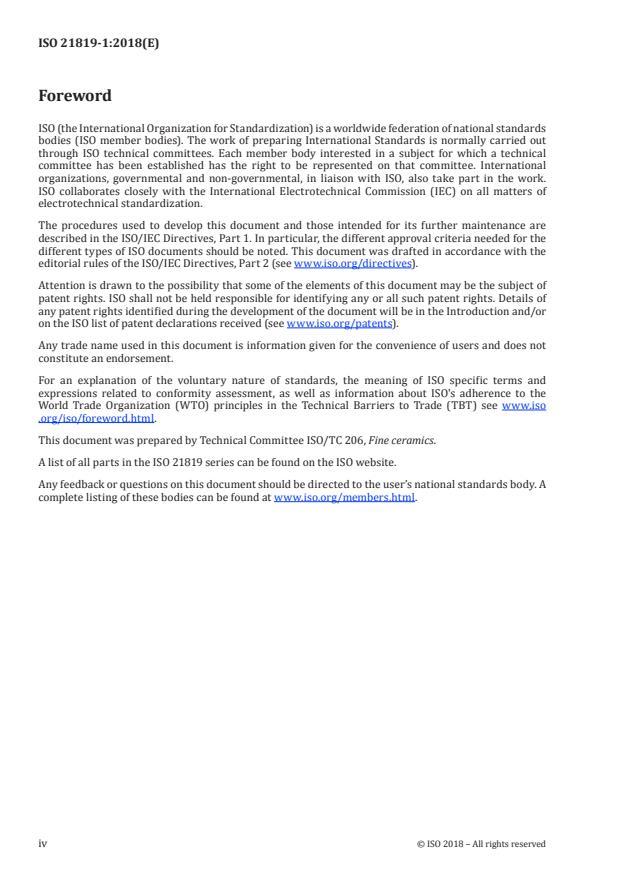
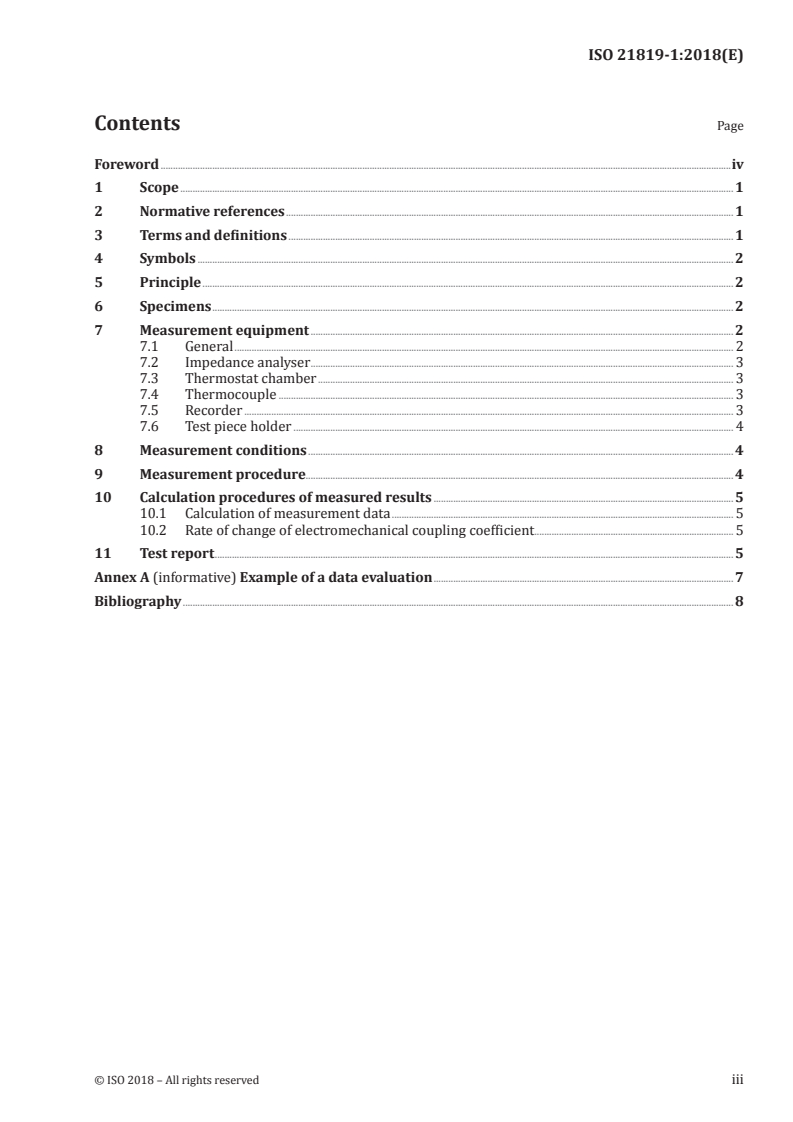
Contents Page
Foreword .iv
1 Scope . 1
2 Normative references . 1
3 Terms and definitions . 1
4 Symbols . 2
5 Principle . 2
6 Specimens . 2
7 Measurement equipment . 2
7.1 General . 2
7.2 Impedance analyser . 3
7.3 Thermostat chamber . 3
7.4 Thermocouple . 3
7.5 Recorder . 3
7.6 Test piece holder . 4
8 Measurement conditions . 4
9 Measurement procedure . 4
10 Calculation procedures of measured results . 5
10.1 Calculation of measurement data . 5
10.2 Rate of change of electromechanical coupling coefficient . . 5
11 Test report . 5
Annex A (informative) Example of a data evaluation . 7
Bibliography . 8
Foreword
ISO (the International Organization for Standardization) is a worldwide federation of national standards
bodies (ISO member bodies). The work of preparing International Standards is normally carried out
through ISO technical committees. Each member body interested in a subject for which a technical
committee has been established has the right to be represented on that committee. International
organizations, governmental and non-governmental, in liaison with ISO, also take part in the work.
ISO collaborates closely with the International Electrotechnical Commission (IEC) on all matters of
electrotechnical standardization.
The procedures used to develop this document and those intended for its further maintenance are
described in the ISO/IEC Directives, Part 1. In particular, the different approval criteria needed for the
different types of ISO documents should be noted. This document was drafted in accordance with the
editorial rules of the ISO/IEC Directives, Part 2 (see www .iso .org/directives).
Attention is drawn to the possibility that some of the elements of this document may be the subject of
patent rights. ISO shall not be held responsible for identifying any or all such patent rights. Details of
any patent rights identified during the development of the document will be in the Introduction and/or
on the ISO list of patent declarations received (see www .iso .org/patents).
Any trade name used in this document is information given for the convenience of users and does not
constitute an endorsement.
For an explanation of the voluntary nature of standards, the meaning of ISO specific terms and
expressions related to conformity assessment, as well as information about ISO's adherence to the
World Trade Organization (WTO) principles in the Technical Barriers to Trade (TBT) see www .iso
.org/iso/foreword .html.
This document was prepared by Technical Committee ISO/TC 206, Fine ceramics.
A list of all parts in the ISO 21819 series can be found on the ISO website.
Any feedback or questions on this document should be directed to the user’s national standards body. A
complete listing of these bodies can be found at www .iso .org/members .html.
iv © ISO 2018 – All rights reserved
INTERNATIONAL STANDARD ISO 21819-1:2018(E)
Fine ceramics (advanced ceramics, advanced technical
ceramics) — Characteristic of piezoelectric properties
under high-load conditions —
Part 1:
Resonant-antiresonant method under high-temperature
conditions
1 Scope
This document specifies a method of measuring piezoelectric properties of piezoelectric fine ceramics
and other piezoelectric devices under high-temperature conditions, where the electromechanical
coupling coefficient is determined based on measurements of resonance/antiresonance frequencies
using impedance analysers.
2 Normative references
The following documents are referred to in the text in such a way that some or all of their content
constitutes requirements of this document. For dated references, only the edition cited applies. For
undated references, the latest edition of the referenced document (including any amendments) applies.
IEC 60584-1, Thermocouples — Part 1: Reference tables
IEC 60584-2, Thermocouples — Part 2: Tolerances
EN 50324-1, Piezoelectric properties of ceramic materials and components — Part 1: Terms and definitions
EN 50324-2, Piezoelectric properties of ceramic materials and components — Part 2: Method of
measurement — Low power
EN 50324-3, Piezoelectric properties of ceramic materials and components — Part 3: Method of
measurement — High power
3 Terms and definitions
For the purposes of this document, the terms and definitions given in EN 50324-1, EN 50324-2 and
EN 50324-3 and the following apply.
ISO and IEC maintain terminological databases for use in standardization at the following addresses:
— ISO Online browsing platform: available at https: //www .iso .org/obp
— IEC Electropedia: available at http: //www .electropedia .org/
3.1
resonant-antiresonant method
method where the ratio of mutual conversion between electrical energy and mechanical energy is
measured based on the resonance frequency and antiresonance frequency of piezoelectric fine ceramics
and other piezoelectric devices
3.2
resonance frequency
f
r
lower of two frequencies at which admittance or impedance between electrodes of a transducer
achieves zero phase in the vicinity of the target vibration mode
3.3
antiresonance frequency
f
a
higher of two frequencies at which admittance or impedance between electrodes of a transducer
achieves zero phase in the vicinity of the target vibration mode
4 Symbols
Δk(t) Rate of change of electromechanical coupling coefficient (%)
k Electromechanical coupling coefficient after holding for t min after the test piece reaches
t
the test temperature ± 2 °C
k Electro
...
INTERNATIONAL ISO
STANDARD 21819-1
First edition
2018-08
Fine ceramics (advanced ceramics,
advanced technical ceramics) —
Characteristic of piezoelectric
properties under high-load
conditions —
Part 1:
Resonant-antiresonant method under
high-temperature conditions
Céramiques techniques (céramiques avancées, céramiques techniques
avancées) — Caractéristique des propriétés piézoélectriques en
conditions de charge élevée —
Partie 1: Méthode résonante-antirésonante à des températures élevées
Reference number
©
ISO 2018
© ISO 2018
All rights reserved. Unless otherwise specified, or required in the context of its implementation, no part of this publication may
be reproduced or utilized otherwise in any form or by any means, electronic or mechanical, including photocopying, or posting
on the internet or an intranet, without prior written permission. Permission can be requested from either ISO at the address
below or ISO’s member body in the country of the requester.
ISO copyright office
CP 401 • Ch. de Blandonnet 8
CH-1214 Vernier, Geneva
Phone: +41 22 749 01 11
Fax: +41 22 749 09 47
Email: copyright@iso.org
Website: www.iso.org
Published in Switzerland
ii © ISO 2018 – All rights reserved
Contents Page
Foreword .iv
1 Scope . 1
2 Normative references . 1
3 Terms and definitions . 1
4 Symbols . 2
5 Principle . 2
6 Specimens . 2
7 Measurement equipment . 2
7.1 General . 2
7.2 Impedance analyser . 3
7.3 Thermostat chamber . 3
7.4 Thermocouple . 3
7.5 Recorder . 3
7.6 Test piece holder . 4
8 Measurement conditions . 4
9 Measurement procedure . 4
10 Calculation procedures of measured results . 5
10.1 Calculation of measurement data . 5
10.2 Rate of change of electromechanical coupling coefficient . . 5
11 Test report . 5
Annex A (informative) Example of a data evaluation . 7
Bibliography . 8
Foreword
ISO (the International Organization for Standardization) is a worldwide federation of national standards
bodies (ISO member bodies). The work of preparing International Standards is normally carried out
through ISO technical committees. Each member body interested in a subject for which a technical
committee has been established has the right to be represented on that committee. International
organizations, governmental and non-governmental, in liaison with ISO, also take part in the work.
ISO collaborates closely with the International Electrotechnical Commission (IEC) on all matters of
electrotechnical standardization.
The procedures used to develop this document and those intended for its further maintenance are
described in the ISO/IEC Directives, Part 1. In particular, the different approval criteria needed for the
different types of ISO documents should be noted. This document was drafted in accordance with the
editorial rules of the ISO/IEC Directives, Part 2 (see www .iso .org/directives).
Attention is drawn to the possibility that some of the elements of this document may be the subject of
patent rights. ISO shall not be held responsible for identifying any or all such patent rights. Details of
any patent rights identified during the development of the document will be in the Introduction and/or
on the ISO list of patent declarations received (see www .iso .org/patents).
Any trade name used in this document is information given for the convenience of users and does not
constitute an endorsement.
For an explanation of the voluntary nature of standards, the meaning of ISO specific terms and
expressions related to conformity assessment, as well as information about ISO's adherence to the
World Trade Organization (WTO) principles in the Technical Barriers to Trade (TBT) see www .iso
.org/iso/foreword .html.
This document was prepared by Technical Committee ISO/TC 206, Fine ceramics.
A list of all parts in the ISO 21819 series can be found on the ISO website.
Any feedback or questions on this document should be directed to the user’s national standards body. A
complete listing of these bodies can be found at www .iso .org/members .html.
iv © ISO 2018 – All rights reserved
INTERNATIONAL STANDARD ISO 21819-1:2018(E)
Fine ceramics (advanced ceramics, advanced technical
ceramics) — Characteristic of piezoelectric properties
under high-load conditions —
Part 1:
Resonant-antiresonant method under high-temperature
conditions
1 Scope
This document specifies a method of measuring piezoelectric properties of piezoelectric fine ceramics
and other piezoelectric devices under high-temperature conditions, where the electromechanical
coupling coefficient is determined based on measurements of resonance/antiresonance frequencies
using impedance analysers.
2 Normative references
The following documents are referred to in the text in such a way that some or all of their content
constitutes requirements of this document. For dated references, only the edition cited applies. For
undated references, the latest edition of the referenced document (including any amendments) applies.
IEC 60584-1, Thermocouples — Part 1: Reference tables
IEC 60584-2, Thermocouples — Part 2: Tolerances
EN 50324-1, Piezoelectric properties of ceramic materials and components — Part 1: Terms and definitions
EN 50324-2, Piezoelectric properties of ceramic materials and components — Part 2: Method of
measurement — Low power
EN 50324-3, Piezoelectric properties of ceramic materials and components — Part 3: Method of
measurement — High power
3 Terms and definitions
For the purposes of this document, the terms and definitions given in EN 50324-1, EN 50324-2 and
EN 50324-3 and the following apply.
ISO and IEC maintain terminological databases for use in standardization at the following addresses:
— ISO Online browsing platform: available at https: //www .iso .org/obp
— IEC Electropedia: available at http: //www .electropedia .org/
3.1
resonant-antiresonant method
method where the ratio of mutual conversion between electrical energy and mechanical energy is
measured based on the resonance frequency and antiresonance frequency of piezoelectric fine ceramics
and other piezoelectric devices
3.2
resonance frequency
f
r
lower of two frequencies at which admittance or impedance between electrodes of a transducer
achieves zero phase in the vicinity of the target vibration mode
3.3
antiresonance frequency
f
a
higher of two frequencies at which admittance or impedance between electrodes of a transducer
achieves zero phase in the vicinity of the target vibration mode
4 Symbols
Δk(t) Rate of change of electromechanical coupling coefficient (%)
k Electromechanical coupling coefficient after holding for t min after the test piece reaches
t
the test temperature ± 2 °C
k Electro
...