

ISO 18719:2025
(Main)Fine ceramics (advanced ceramics, advanced technical ceramics) — Methods for chemical analysis of impurities in yttrium oxide powders using inductively coupled plasma-optical emission spectrometry
General Information
- Abstract
This document specifies methods for chemical analysis of impurities in refined high-purity yttrium oxide (Y2O3) powders used as a raw material for fine ceramics. This document is applicable for determination of aluminium (Al), calcium (Ca), cobalt (Co), iron (Fe) and silicon (Si) in yttrium oxide powders. Yttrium oxide powders are decomposed by microwave decomposition method. The aluminium (Al), calcium (Ca), cobalt (Co), iron (Fe) and silicon (Si) contents are determined by using inductively coupled plasma-optical emission spectrometry (ICP-OES). This document does not apply to coarse unrefined powders from mineral extraction and processing operations, which are covered by ISO 24181-1.
- Status
- Published
- Publication Date
- 13-Oct-2025
- Technical Committee
- ISO/TC 206 - Fine ceramics
- Drafting Committee
- ISO/TC 206 - Fine ceramics
- Current Stage
- 6060 - International Standard published
- Start Date
- 14-Oct-2025
- Due Date
- 21-Oct-2025
- Completion Date
- 14-Oct-2025
Buy Documents
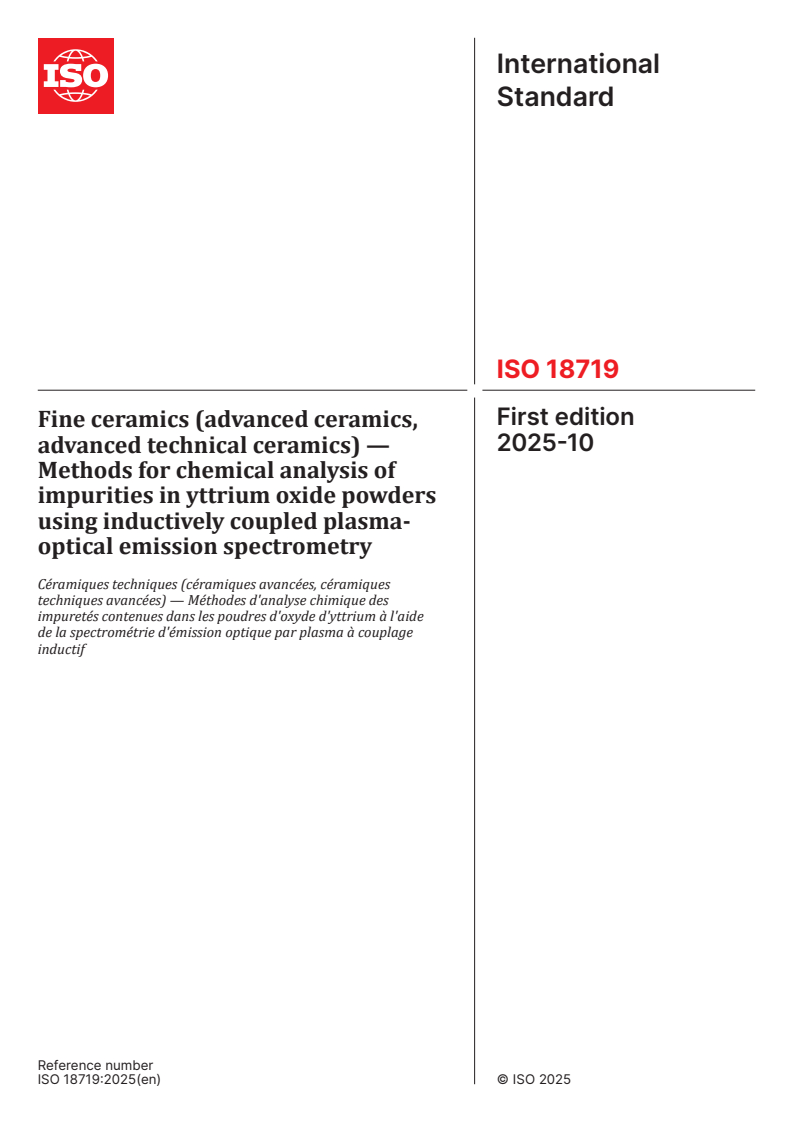
ISO 18719:2025 - Fine ceramics (advanced ceramics, advanced technical ceramics) — Methods for chemical analysis of impurities in yttrium oxide powders using inductively coupled plasma-optical emission spectrometry Released:10/14/2025
Overview
ISO 18719:2025 specifies validated analytical methods for determining trace impurities in refined high‑purity yttrium oxide (Y2O3) powders used as raw material for fine ceramics. The standard describes sample preparation, microwave decomposition, and quantification by inductively coupled plasma‑optical emission spectrometry (ICP‑OES) to measure aluminium (Al), calcium (Ca), cobalt (Co), iron (Fe) and silicon (Si) in Y2O3. It applies to refined powders only and excludes coarse unrefined mineral concentrates (see ISO 24181-1).
Key topics and technical requirements
- Analytes and ranges: Al, Ca, Co, Fe, Si - each with a working range of 1.0 mg/kg to 100 mg/kg.
- Sample preparation: Follow ISO 8656-1 sampling; dry 10 g at 110 °C ± 5 °C for ≥2 h, cool in a desiccator, then weigh 0.5 g ± 0.1 mg for analysis.
- Decomposition method: Closed‑vessel microwave digestion using PTFE/PFA vessels. Use diluted HCl (1+1) for Al and Si, and diluted HNO3 (1+1) for Ca, Co and Fe. Typical digestion example: 300 W for 20 min (laboratories may use manufacturer‑recommended programs).
- Reagents and cleanliness: Use analytical‑grade reagents and water to ISO 3696 Grade 1. Cleanware soak in diluted nitric acid (1+2) for ≥4 h and rinse thoroughly.
- Instrumental determination: Quantify impurities by ICP‑OES with blank correction and mixed calibration standards at element‑specific wavelengths; prepare calibration curves and apply blank tests.
- Quality control and reporting: Run each sample in duplicate; follow tolerance criteria (±5 mg/kg for <50 mg/kg, ±25 mg/kg for ≥50 mg/kg). If duplicates exceed tolerance, perform two additional analyses and report the averaged or median value per the standard’s rules. Laboratories should meet competence requirements (ISO/IEC 17025).
Applications and users
ISO 18719:2025 is primarily for:
- Manufacturers of fine ceramics / advanced ceramics using high‑purity Y2O3 feedstock.
- Materials testing and QC laboratories performing impurity analysis on Y2O3 raw materials.
- R&D teams developing ceramic formulations that are sensitive to trace metal and silicon contamination.
- Suppliers certifying chemical purity of yttria powders for electronics, optics, and high‑performance ceramic applications.
Benefits include standardized ICP‑OES procedures, comparable impurity data across suppliers, and improved process control for ceramic manufacturing.
Related standards
- ISO 24181-1 - coarse unrefined powders (not covered by ISO 18719)
- ISO 3696 - water for analytical laboratory use
- ISO 8656-1 - sampling of raw materials and unshaped products
- ISO/IEC 17025 - laboratory competence and calibration
Keywords: ISO 18719:2025, yttrium oxide, Y2O3, ICP‑OES, microwave digestion, impurity analysis, fine ceramics, aluminium, calcium, cobalt, iron, silicon.
Buy Documents
ISO 18719:2025 - Fine ceramics (advanced ceramics, advanced technical ceramics) — Methods for chemical analysis of impurities in yttrium oxide powders using inductively coupled plasma-optical emission spectrometry Released:10/14/2025
Frequently Asked Questions
ISO 18719:2025 is a standard published by the International Organization for Standardization (ISO). Its full title is "Fine ceramics (advanced ceramics, advanced technical ceramics) — Methods for chemical analysis of impurities in yttrium oxide powders using inductively coupled plasma-optical emission spectrometry". This standard covers: This document specifies methods for chemical analysis of impurities in refined high-purity yttrium oxide (Y2O3) powders used as a raw material for fine ceramics. This document is applicable for determination of aluminium (Al), calcium (Ca), cobalt (Co), iron (Fe) and silicon (Si) in yttrium oxide powders. Yttrium oxide powders are decomposed by microwave decomposition method. The aluminium (Al), calcium (Ca), cobalt (Co), iron (Fe) and silicon (Si) contents are determined by using inductively coupled plasma-optical emission spectrometry (ICP-OES). This document does not apply to coarse unrefined powders from mineral extraction and processing operations, which are covered by ISO 24181-1.
This document specifies methods for chemical analysis of impurities in refined high-purity yttrium oxide (Y2O3) powders used as a raw material for fine ceramics. This document is applicable for determination of aluminium (Al), calcium (Ca), cobalt (Co), iron (Fe) and silicon (Si) in yttrium oxide powders. Yttrium oxide powders are decomposed by microwave decomposition method. The aluminium (Al), calcium (Ca), cobalt (Co), iron (Fe) and silicon (Si) contents are determined by using inductively coupled plasma-optical emission spectrometry (ICP-OES). This document does not apply to coarse unrefined powders from mineral extraction and processing operations, which are covered by ISO 24181-1.
ISO 18719:2025 is classified under the following ICS (International Classification for Standards) categories: 81.060.30 - Advanced ceramics. The ICS classification helps identify the subject area and facilitates finding related standards.
ISO 18719:2025 is available in PDF format for immediate download after purchase. The document can be added to your cart and obtained through the secure checkout process. Digital delivery ensures instant access to the complete standard document.
Standards Content (Sample)
International
Standard
ISO 18719
First edition
Fine ceramics (advanced ceramics,
2025-10
advanced technical ceramics) —
Methods for chemical analysis of
impurities in yttrium oxide powders
using inductively coupled plasma-
optical emission spectrometry
Céramiques techniques (céramiques avancées, céramiques
techniques avancées) — Méthodes d'analyse chimique des
impuretés contenues dans les poudres d'oxyde d'yttrium à l'aide
de la spectrométrie d'émission optique par plasma à couplage
inductif
Reference number
© ISO 2025
All rights reserved. Unless otherwise specified, or required in the context of its implementation, no part of this publication may
be reproduced or utilized otherwise in any form or by any means, electronic or mechanical, including photocopying, or posting on
the internet or an intranet, without prior written permission. Permission can be requested from either ISO at the address below
or ISO’s member body in the country of the requester.
ISO copyright office
CP 401 • Ch. de Blandonnet 8
CH-1214 Vernier, Geneva
Phone: +41 22 749 01 11
Email: copyright@iso.org
Website: www.iso.org
Published in Switzerland
ii
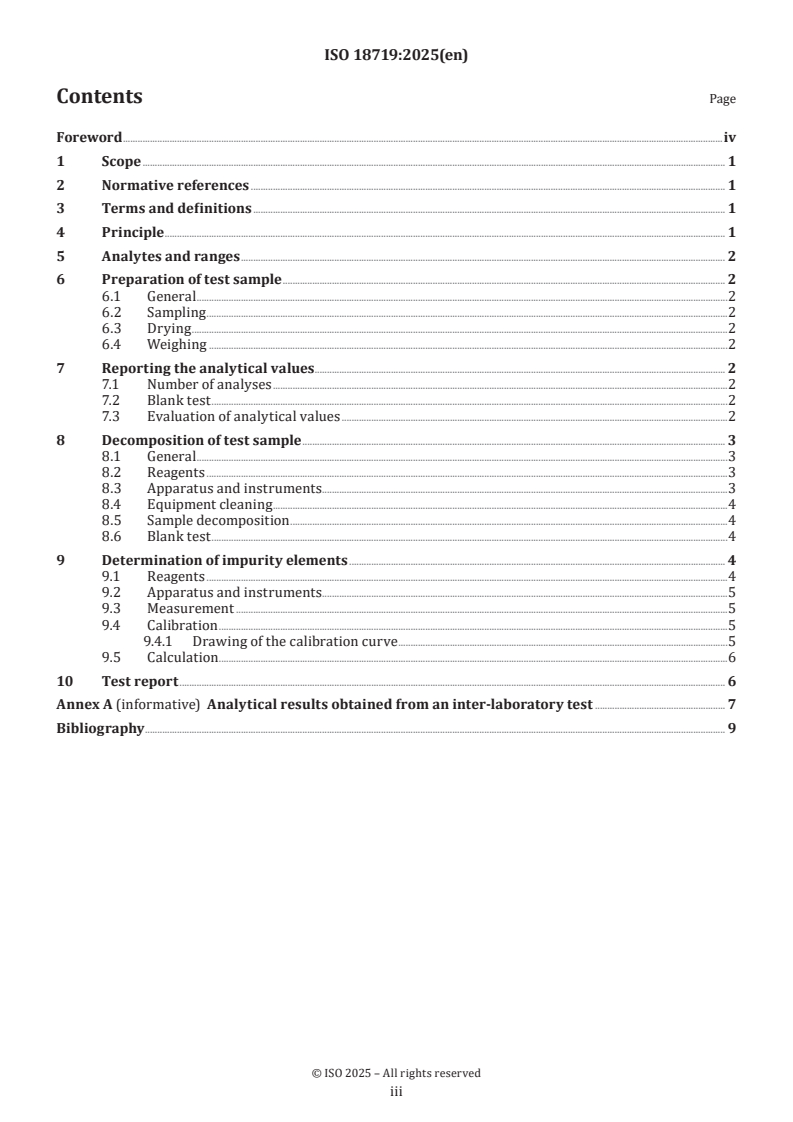
Contents Page
Foreword .iv
1 Scope . 1
2 Normative references . 1
3 Terms and definitions . 1
4 Principle . 1
5 Analytes and ranges . 2
6 Preparation of test sample . 2
6.1 General .2
6.2 Sampling .2
6.3 Drying .2
6.4 Weighing .2
7 Reporting the analytical values . . 2
7.1 Number of analyses .2
7.2 Blank test .2
7.3 Evaluation of analytical values .2
8 Decomposition of test sample . 3
8.1 General .3
8.2 Reagents .3
8.3 Apparatus and instruments.3
8.4 Equipment cleaning .4
8.5 Sample decomposition .4
8.6 Blank test .4
9 Determination of impurity elements . 4
9.1 Reagents .4
9.2 Apparatus and instruments.5
9.3 Measurement .5
9.4 Calibration .5
9.4.1 Drawing of the calibration curve .5
9.5 Calculation .6
10 Test report . 6
Annex A (informative) Analytical results obtained from an inter-laboratory test . 7
Bibliography . 9
iii
Foreword
ISO (the International Organization for Standardization) is a worldwide federation of national standards
bodies (ISO member bodies). The work of preparing International Standards is normally carried out through
ISO technical committees. Each member body interested in a subject for which a technical committee
has been established has the right to be represented on that committee. International organizations,
governmental and non-governmental, in liaison with ISO, also take part in the work. ISO collaborates closely
with the International Electrotechnical Commission (IEC) on all matters of electrotechnical standardization.
The procedures used to develop this document and those intended for its further maintenance are described
in the ISO/IEC Directives, Part 1. In particular, the different approval criteria needed for the different types
of ISO document should be noted. This document was drafted in accordance with the editorial rules of the
ISO/IEC Directives, Part 2 (see www.iso.org/directives).
ISO draws attention to the possibility that the implementation of this document may involve the use of (a)
patent(s). ISO takes no position concerning the evidence, validity or applicability of any claimed patent
rights in respect thereof. As of the date of publication of this document, ISO had not received notice of (a)
patent(s) which may be required to implement this document. However, implementers are cautioned that
this may not represent the latest information, which may be obtained from the patent database available at
www.iso.org/patents. ISO shall not be held responsible for identifying any or all such patent rights.
Any trade name used in this document is information given for the convenience of users and does not
constitute an endorsement.
For an explanation of the voluntary nature of standards, the meaning of ISO specific terms and expressions
related to conformity assessment, as well as information about ISO's adherence to the World Trade
Organization (WTO) principles in the Technical Barriers to Trade (TBT), see www.iso.org/iso/foreword.html.
This document was prepared by Technical Committee ISO/TC 206, fine ceramics.
Any feedback or questions on this document should be directed to the user’s national standards body. A
complete listing of these bodies can be found at www.iso.org/members.html.
iv
International Standard ISO 18719:2025(en)
Fine ceramics (advanced ceramics, advanced technical
ceramics) — Methods for chemical analysis of impurities in
yttrium oxide powders using inductively coupled plasma-
optical emission spectrometry
WARNING — Suitable health and safety procedures should be followed. Persons using this document
should be familiar with normal laboratory practice. This document does not purport to address all
of the safety problems, if any, associated with its use. It is the responsibility of the user to establish
appropriate safety and health practices and to determine applicability of any national regulatory
conditions.
1 Scope
This document specifies methods for chemical analysis of impurities in refined high-purity yttrium oxide
(Y O ) powders used as a raw material for fine ceramics.
2 3
This document is applicable for determination of aluminium (Al), calcium (Ca), cobalt (Co), iron (Fe) and
silicon (Si) in yttrium oxide powders. Yttrium oxide powders are decomposed by microwave decomposition
method. The aluminium (Al), calcium (Ca), cobalt (Co), iron (Fe) and silicon (Si) contents are determined by
using inductively coupled plasma-optical emission spectrometry (ICP-OES).
This document does not apply to coarse unrefined powders from mineral extraction and processing
operations, which are covered by ISO 24181-1.
2 Normative references
The following documents are referred to in the text in such a way that some or all of their content constitutes
requirements of this document. For dated references, only the edition cited applies. For undated references,
the latest edition of the referenced document (including any amendments) applies.
ISO 3696, Water for analytical laboratory use — Specification and test methods
ISO 8656-1, Refractory products — Sampling of raw materials and unshaped products — Part 1: Sampling scheme
ISO/IEC 17025, General requirements for the competence of testing and calibration laboratories
3 Terms and definitions
No terms and definitions are listed in this document.
ISO and IEC maintain terminology databases for use in standardization at the following addresses:
— ISO Online browsing platform: available at https:// www .iso .org/ obp
— IEC Electropedia: available at https:// www .electropedia .org/
4 Principle
The samples are digested by hydrochloric acid (1+1) or nitric acid (1+1) in closed vessels using a microwave
digestion system, and the test solution is diluted with water. In order to determine the contents of impurities
in yttrium oxide with an ICP-OES, the effect of the main component, i.e. yttrium, is corrected with a blank
standard solution and mixed standard solutions at the optimum wavelength of each element. Create a
----------------
...