

ISO/IEC 13818-1:2022
(Main)Information technology — Generic coding of moving pictures and associated audio information — Part 1: Systems
General Information
- Abstract
This document specifies the system layer of the coding. It was developed principally to support the combination of the video and audio coding methods defined in Parts 2 and 3 of ISO/IEC 13818. The system layer supports six basic functions: 1) the synchronization of multiple compressed streams on decoding; 2) the interleaving of multiple compressed streams into a single stream; 3) the initialization of buffering for decoding start up; 4) continuous buffer management; 5) time identification; 6) multiplexing and signalling of various components in a system stream. A Rec. ITU-T H.222.0 | ISO/IEC 13818-1 multiplexed bit stream is either a transport stream or a program stream. Both streams are constructed from PES packets and packets containing other necessary information. Both stream types support multiplexing of video and audio compressed streams from one program with a common time base. The transport stream additionally supports the multiplexing of video and audio compressed streams from multiple programs with independenttime bases. For almost error-free environments the program stream is generally more appropriate, supporting software processing of program information. The transport stream is more suitable for use in environments where errors are likely. A Rec. ITU-T H.222.0 | ISO/IEC 13818-1 multiplexed bit stream, whether a transport stream or a program stream, is constructed in two layers: the outermost layer is the system layer, and the innermost is the compression layer. The system layer provides the functions necessary for using one or more compressed data streams in a system. The video and audio parts of this Specification define the compression coding layer for audio and video data. Coding of other types of data is not defined by this Specification, but is supported by the system layer provided that the other types of data adhere to the constraints defined in 2.7.
- Status
- Withdrawn
- Publication Date
- 29-Sep-2022
- Technical Committee
- ISO/IEC JTC 1/SC 29 - Coding of audio, picture, multimedia and hypermedia information
- Drafting Committee
- ISO/IEC JTC 1/SC 29/WG 3 - MPEG Systems
- Current Stage
- 9599 - Withdrawal of International Standard
- Start Date
- 07-Dec-2023
- Completion Date
- 29-Aug-2026


Overview
ISO/IEC 13818-1:2022 (also published as Rec. ITU‑T H.222.0) defines the system layer for generic coding of moving pictures and associated audio (commonly known as MPEG‑2 Systems). This edition (eighth, 2022) specifies how multiple compressed streams are packaged, synchronized, signalled and delivered as either transport streams or program streams. The standard is essential for building interoperable delivery systems that combine video, audio and auxiliary data in a single multiplexed bitstream.
Key topics and technical requirements
- System functions: synchronization of multiple compressed streams, interleaving into a single stream, buffer initialization for decoder start-up, continuous buffer management, time identification, and multiplexing/signalling of program components.
- Stream types: definition and use-cases of transport streams (robust for error-prone networks; supports multiple programs with independent time bases) and program streams (better for near error‑free environments and software processing for single-program content).
- Packet structure: both stream types are constructed from PES (Packetized Elementary Stream) packets plus system information packets and descriptors.
- Timing and buffering: timing model, PCR/PTS/DTS semantics and buffer models to ensure synchronized decoding and playback across audio/video streams.
- Program-specific information (PSI): tables, descriptors and mechanisms for signalling program composition, PID allocation and program metadata.
- Compatibility and carriage: rules for carrying other compressed formats and metadata-explicit support and carriage guidelines for standards such as H.264 | ISO/IEC 14496-10, HEVC, VVC, EVC, JPEG 2000, ISO/IEC 14496, ISO/IEC 15938, MPEG‑H 3D audio and related elements.
- Annexes and conformance: CRC/decoder models, DSM‑CC, splicing rules, real‑time interfaces and registration procedures for private data formats and identifiers.
Applications and who uses it
- Broadcast and cable system designers implementing DVB, ATSC or similar systems.
- Streaming and OTT platform engineers packaging live or on‑demand content.
- Hardware and software codec, multiplexer and demultiplexer vendors ensuring interoperable decoders.
- Digital storage and disc authoring tools using program streams for near‑error‑free media.
- Systems integrators handling carriage of multiple programs, subtitles, metadata and ancillary data.
Related standards
- ISO/IEC 13818-2 (Video) and ISO/IEC 13818-3 (Audio) - compression layers that the system layer is designed to multiplex.
- Rec. ITU‑T H.222.0 - equivalent recommendation describing MPEG‑2 Systems.
- Other referenced carriage mappings: ISO/IEC 14496 (MPEG‑4), ISO/IEC 23008 (HEVC/other), ISO/IEC 15938 (MPEG‑7) - for integration scenarios.
Keywords: ISO/IEC 13818-1:2022, MPEG‑2 Systems, transport stream, program stream, PES packets, synchronization, multiplexing, buffering, ITU‑T H.222.0.
Relations
- Effective Date
- 28-Aug-2021
- Effective Date
- 06-Jun-2022
- Effective Date
- 19-Aug-2023
- Effective Date
- 24-Jul-2021
- Effective Date
- 24-Jul-2021
- Effective Date
- 24-Jul-2021
Get Certified
Connect with accredited certification bodies for this standard

BSI Group
BSI (British Standards Institution) is the business standards company that helps organizations make excellence a habit.

NYCE
Mexican standards and certification body.
Sponsored listings
Frequently Asked Questions
ISO/IEC 13818-1:2022 is a standard published by the International Organization for Standardization (ISO). Its full title is "Information technology — Generic coding of moving pictures and associated audio information — Part 1: Systems". This standard covers: This document specifies the system layer of the coding. It was developed principally to support the combination of the video and audio coding methods defined in Parts 2 and 3 of ISO/IEC 13818. The system layer supports six basic functions: 1) the synchronization of multiple compressed streams on decoding; 2) the interleaving of multiple compressed streams into a single stream; 3) the initialization of buffering for decoding start up; 4) continuous buffer management; 5) time identification; 6) multiplexing and signalling of various components in a system stream. A Rec. ITU-T H.222.0 | ISO/IEC 13818-1 multiplexed bit stream is either a transport stream or a program stream. Both streams are constructed from PES packets and packets containing other necessary information. Both stream types support multiplexing of video and audio compressed streams from one program with a common time base. The transport stream additionally supports the multiplexing of video and audio compressed streams from multiple programs with independenttime bases. For almost error-free environments the program stream is generally more appropriate, supporting software processing of program information. The transport stream is more suitable for use in environments where errors are likely. A Rec. ITU-T H.222.0 | ISO/IEC 13818-1 multiplexed bit stream, whether a transport stream or a program stream, is constructed in two layers: the outermost layer is the system layer, and the innermost is the compression layer. The system layer provides the functions necessary for using one or more compressed data streams in a system. The video and audio parts of this Specification define the compression coding layer for audio and video data. Coding of other types of data is not defined by this Specification, but is supported by the system layer provided that the other types of data adhere to the constraints defined in 2.7.
This document specifies the system layer of the coding. It was developed principally to support the combination of the video and audio coding methods defined in Parts 2 and 3 of ISO/IEC 13818. The system layer supports six basic functions: 1) the synchronization of multiple compressed streams on decoding; 2) the interleaving of multiple compressed streams into a single stream; 3) the initialization of buffering for decoding start up; 4) continuous buffer management; 5) time identification; 6) multiplexing and signalling of various components in a system stream. A Rec. ITU-T H.222.0 | ISO/IEC 13818-1 multiplexed bit stream is either a transport stream or a program stream. Both streams are constructed from PES packets and packets containing other necessary information. Both stream types support multiplexing of video and audio compressed streams from one program with a common time base. The transport stream additionally supports the multiplexing of video and audio compressed streams from multiple programs with independenttime bases. For almost error-free environments the program stream is generally more appropriate, supporting software processing of program information. The transport stream is more suitable for use in environments where errors are likely. A Rec. ITU-T H.222.0 | ISO/IEC 13818-1 multiplexed bit stream, whether a transport stream or a program stream, is constructed in two layers: the outermost layer is the system layer, and the innermost is the compression layer. The system layer provides the functions necessary for using one or more compressed data streams in a system. The video and audio parts of this Specification define the compression coding layer for audio and video data. Coding of other types of data is not defined by this Specification, but is supported by the system layer provided that the other types of data adhere to the constraints defined in 2.7.
ISO/IEC 13818-1:2022 is classified under the following ICS (International Classification for Standards) categories: 35.040.40 - Coding of audio, video, multimedia and hypermedia information. The ICS classification helps identify the subject area and facilitates finding related standards.
ISO/IEC 13818-1:2022 has the following relationships with other standards: It is inter standard links to ISO/IEC 13818-1:2022/Amd 1:2023, ISO/IEC 13818-1:2022/Cor 1:2023, ISO/IEC 13818-1:2023, ISO/IEC 13818-1:2019/Cor 1:2020, ISO/IEC 13818-1:2019, ISO/IEC 13818-1:2019/Amd 1:2020. Understanding these relationships helps ensure you are using the most current and applicable version of the standard.
ISO/IEC 13818-1:2022 is available in PDF format for immediate download after purchase. The document can be added to your cart and obtained through the secure checkout process. Digital delivery ensures instant access to the complete standard document.
Standards Content (Sample)
INTERNATIONAL ISO/IEC
STANDARD 13818-1
Eighth edition
2022-09
Information technology — Generic
coding of moving pictures and
associated audio information —
Part 1:
Systems
Technologies de l'information — Codage générique des images
animées et du son associé —
Partie 1: Systèmes
Reference number
© ISO/IEC 2022
© ISO/IEC 2022
All rights reserved. Unless otherwise specified, or required in the context of its implementation, no part of this publication may
be reproduced or utilized otherwise in any form or by any means, electronic or mechanical, including photocopying, or posting on
the internet or an intranet, without prior written permission. Permission can be requested from either ISO at the address below
or ISO’s member body in the country of the requester.
ISO copyright office
CP 401 • Ch. de Blandonnet 8
CH-1214 Vernier, Geneva
Phone: +41 22 749 01 11
Email: copyright@iso.org
Website: www.iso.org
Published in Switzerland
ii
© ISO/IEC 2022 – All rights reserved
Foreword
ISO (the International Organization for Standardization) and IEC (the International Electrotechnical
Commission) form the specialized system for worldwide standardization. National bodies that are
members of ISO or IEC participate in the development of International Standards through technical
committees established by the respective organization to deal with particular fields of technical activity.
ISO and IEC technical committees collaborate in fields of mutual interest. Other international
organizations, governmental and non-governmental, in liaison with ISO and IEC, also take part in the
work.
The procedures used to develop this document and those intended for its further maintenance are
described in the ISO/IEC Directives, Part 1. In particular, the different approval criteria needed for the
different types of document should be noted (see www.iso.org/directives or
www.iec.ch/members_experts/refdocs).
Attention is drawn to the possibility that some of the elements of this document may be the subject of
patent rights. ISO and IEC shall not be held responsible for identifying any or all such patent rights. Details
of any patent rights identified during the development of the document will be in the Introduction and/or
on the ISO list of patent declarations received (see www.iso.org/patents) or the IEC list of patent
declarations received (see https://patents.iec.ch).
Any trade name used in this document is information given for the convenience of users and does not
constitute an endorsement.
For an explanation of the voluntary nature of standards, the meaning of ISO specific terms and
expressions related to conformity assessment, as well as information about ISO's adherence to the World
Trade Organization (WTO) principles in the Technical Barriers to Trade (TBT)
see www.iso.org/iso/foreword.html. In the IEC, see www.iec.ch/understanding-standards.
This document was prepared by ITU-T as Rec. ITU-T H.222.0 (06/2021) and drafted in accordance with
its editorial rules, in collaboration with Joint Technical Committee ISO/IEC JTC 1, Information technology,
Subcommittee SC 29, Coding of audio, picture, multimedia and hypermedia information.
This eighth edition cancels and replaces the seventh edition (ISO/IEC 3818-1:2019), which has been
technically revised. It also incorporates the Amendment ISO/IEC 13818-1:2019/Amd 1:2020 and the
Technical Corrigendum ISO/IEC 13818-1:2019/Cor 1:2020.
A list of all parts in the ISO/IEC 13818 series can be found on the ISO and IEC websites.
Any feedback or questions on this document should be directed to the user’s national standards body. A
complete listing of these bodies can be found at www.iso.org/members.html and www.iec.ch/national-
committees.
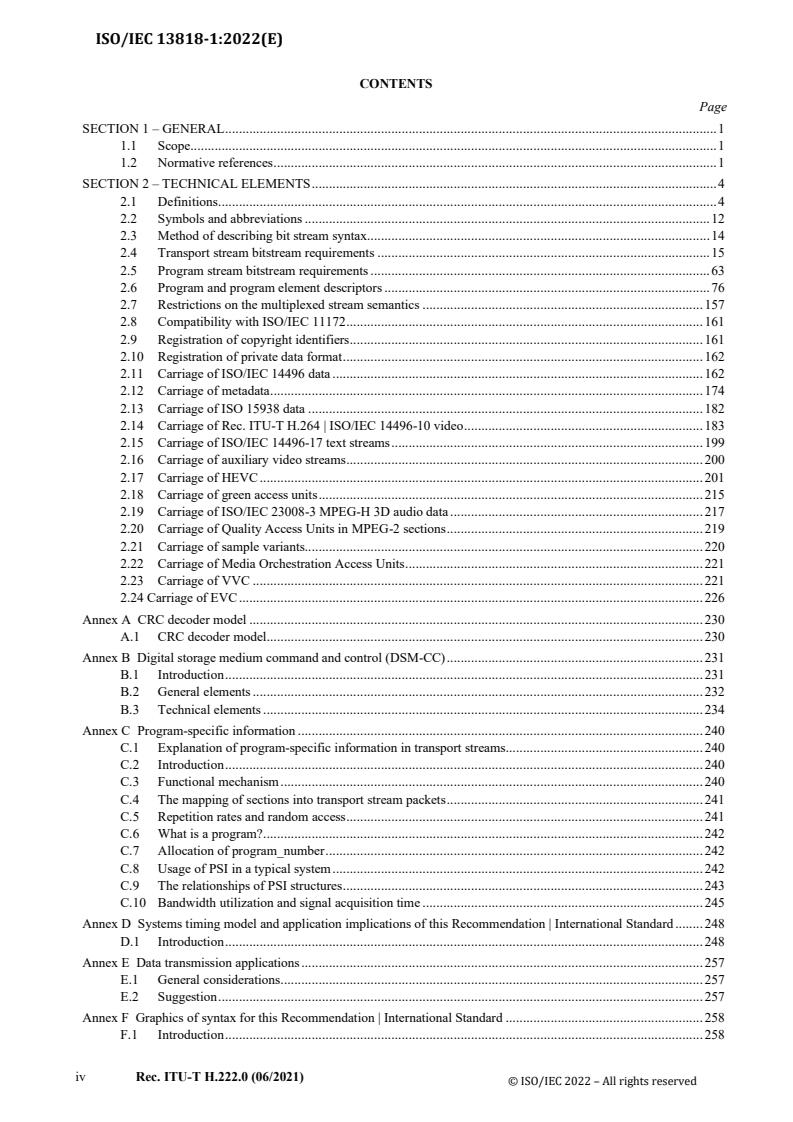
CONTENTS
Page
SECTION 1 – GENERAL . 1
1.1 Scope. 1
1.2 Normative references . 1
SECTION 2 – TECHNICAL ELEMENTS . 4
2.1 Definitions . 4
2.2 Symbols and abbreviations . 12
2.3 Method of describing bit stream syntax. 14
2.4 Transport stream bitstream requirements . 15
2.5 Program stream bitstream requirements . 63
2.6 Program and program element descriptors . 76
2.7 Restrictions on the multiplexed stream semantics . 157
2.8 Compatibility with ISO/IEC 11172 . 161
2.9 Registration of copyright identifiers . 161
2.10 Registration of private data format . 162
2.11 Carriage of ISO/IEC 14496 data . 162
2.12 Carriage of metadata . 174
2.13 Carriage of ISO 15938 data . 182
2.14 Carriage of Rec. ITU-T H.264 | ISO/IEC 14496-10 video . 183
2.15 Carriage of ISO/IEC 14496-17 text streams . 199
2.16 Carriage of auxiliary video streams . 200
2.17 Carriage of HEVC . 201
2.18 Carriage of green access units . 215
2.19 Carriage of ISO/IEC 23008-3 MPEG-H 3D audio data . 217
2.20 Carriage of Quality Access Units in MPEG-2 sections . 219
2.21 Carriage of sample variants. 220
2.22 Carriage of Media Orchestration Access Units . 221
2.23 Carriage of VVC . 221
2.24 Carriage of EVC . 226
Annex A CRC decoder model . 230
A.1 CRC decoder model. 230
Annex B Digital storage medium command and control (DSM-CC) . 231
B.1 Introduction . 231
B.2 General elements . 232
B.3 Technical elements . 234
Annex C Program-specific information . 240
C.1 Explanation of program-specific information in transport streams. 240
C.2 Introduction . 240
C.3 Functional mechanism . 240
C.4 The mapping of sections into transport stream packets . 241
C.5 Repetition rates and random access . 241
C.6 What is a program? . 242
C.7 Allocation of program_number . 242
C.8 Usage of PSI in a typical system . 242
C.9 The relationships of PSI structures . 243
C.10 Bandwidth utilization and signal acquisition time . 245
Annex D Systems timing model and application implications of this Recommendation | International Standard . 248
D.1 Introduction . 248
Annex E Data transmission applications . 257
E.1 General considerations. 257
E.2 Suggestion . 257
Annex F Graphics of syntax for this Recommendation | International Standard . 258
F.1 Introduction . 258
iv Rec. ITU-T H.222.0 (06/2021)
© ISO/IEC 2022 – All rights reserved
Annex G General information . 262
G.1 General information . 262
Annex H Private data. 263
H.1 Private data . 263
Annex I Systems conformance and real-time interface . 264
I.1 Systems conformance and real-time interface . 264
Annex J Interfacing jitter-inducing networks to MPEG-2 decoders . 265
J.1 Introduction . 265
J.2 Network compliance models . 265
J.3 Network specification for jitter smoothing . 266
J.4 Example decoder implementations. 267
Annex K Splicing transport streams . 268
K.1 Introduction . 268
K.2 The different types of splicing point . 268
K.3 Decoder behaviour on splices . 269
Annex L Registration procedure (see 2.9) . 271
L.1 Procedure for the request of a Registered Identifier (RID) . 271
L.2 Responsibilities of the Registration Authority . 271
L.3 Responsibilities of parties requesting an RID . 271
L.4 Appeal procedure for denied applications . 271
Annex M Registration application form (see 2.9) . 273
M.1 Contact information of organization requesting a Registered Identifier (RID) . 273
M.2 Statement of an intention to apply the assigned RID . 273
M.3 Date of intended implementation of the RID . 273
M.4 Authorized representative . 273
M.5 For official use only of the Registration Authority . 273
Annex N Registration Authority Diagram of administration structure (see 2.9) . 274
Annex O Registration procedure (see 2.10). 275
O.1 Procedure for the request of an RID . 275
O.2 Responsibilities of the Registration Authority . 275
O.3 Contact information for the Registration Authority . 275
O.4 Responsibilities of parties requesting an RID . 275
O.5 Appeal procedure for denied applications . 275
Annex P Registration application form . 277
P.1 Contact information of organization requesting an RID . 277
P.2 Request for a specific RID . 277
P.3 Short description of RID that is in use and date system that was implemented . 277
P.4 Statement of an intention to apply the assigned RID . 277
P.5 Date of intended implementation of the RID . 277
P.6 Authorized representative . 277
P.7 For official use of the Registration Authority . 277
Annex Q T-STD and P-STD buffer models for ISO/IEC 13818-7 ADTS . 278
Q.1 Introduction . 278
Q.2 Leak rate from transport buffer . 278
Q.3 Buffer size . 278
Q.4 Conclusion . 279
Annex R Carriage of ISO/IEC 14496 scenes in Rec. ITU-T H.222.0 | ISO/IEC 13818-1 . 281
R.1 Content access procedure for ISO/IEC 14496 program components within a program stream . 281
R.2 Content access procedure for ISO/IEC 14496 program components within a transport stream . 282
Annex S Carriage of JPEG 2000 part 1 video over MPEG-2 transport streams . 286
S.1 Introduction . 286
S.2 J2K video access unit, J2K video elementary stream, J2K video sequence and J2K still picture . 286
S.3 Optional J2K block mode for high resolution support . 286
Rec. ITU-T H.222.0 (06/2021) v
© ISO/IEC 2022 – All rights reserved
Page
S.4 Optional J2K stripe mode for Ultra-Low Latency . 287
S.5 Elementary stream header (elsm) and mapping to PES packets . 287
S.6 J2K transport constraints . 290
S.7 Interpretation of flags in adaptation and PES headers for J2K video elementary streams . 291
S.8 T-STD extension for J2K video elementary streams . 291
Annex T MIME type for MPEG-2 transport streams. 294
T.1 Introduction . 294
T.2 MIME type and subtype . 294
T.3 Security considerations . 295
T.4 Parameters . 295
Annex U Carriage of timeline and external media information over MPEG-2 transport streams . 297
U.1 Introduction . 297
U.2 TEMI access unit and TEMI elementary stream . 298
U.3 AF descriptors . 299
Annex V Transport of HEVC tiles . 308
V.1 Introduction . 308
V.2 HEVC tile substream identification example. 309
V.3 Subregion layout example. 309
Annex W Carriage of JPEG XS part 1 video over MPEG-2 Transport Streams . 311
W.1 Introduction . 311
W.2 JPEG XS video access unit, JPEG XS video elementary stream, JPEG XS video sequence and JPEG XS
still picture. 311
W.3 Elementary stream header (jxes) and mapping to PES packets . 311
W.4 JPEG XS transport constraints . 312
W.5 Interpretation of flags in adaptation field and PES packet for JPEG XS video elementary streams . 313
W.6 T-STD extension for JPEG XS video elementary streams . 313
vi Rec. ITU-T H.222.0 (06/2021)
© ISO/IEC 2022 – All rights reserved
List of Tables
Page
Table 2-1 – Transport stream . 26
Table 2-2 – Transport packet of this Recommendation | International Standard . 26
Table 2-3 – PID table . 27
Table 2-4 – Scrambling control values . 27
Table 2-5 – Adaptation field control values . 28
Table 2-6 – Transport stream adaptation field . 28
Table 2-7 – Splice parameters Table 1 Simple Profile Main Level, Main Profile Main Level, SNR Profile Main Level
(both layers), Spatial Profile High-1440 Level (base layer), High Profile Main Level (middle + base layers), Multi-view
Profile Main Level (base layer) Video . 35
Table 2-8 – Splice parameters Table 2 Main Profile Low Level, SNR Profile Low Level (both layers), High Profile
Main Level (base layer), Multi-view Profile Low Level (base layer) Video . 36
Table 2-9 – Splice parameters Table 3 Main Profile High-1440 Level, Spatial Profile High-1440 Level (all layers), High
Profile High-1440 Level (middle + base layers), Multi-view Profile High-1440 Level (base layer) Video . 36
Table 2-10 – Splice parameters Table 4 Main Profile High Level, High Profile High-1440 Level (all layers), High
Profile High Level (middle + base layers), Multi-view Profile High Level (base layer) Video . 36
Table 2-11 – Splice parameters Table 5 SNR Profile Low Level (base layer) Video . 36
Table 2-12 – Splice parameters Table 6 SNR Profile Main Level (base layer) Video . 37
Table 2-13 – Splice parameters Table 7 Spatial Profile High-1440 Level (middle + base layers) Video . 37
Table 2-14 – Splice parameters Table 8 High Profile Main Level (all layers), High Profile High-1440 Level (base layer)
Video . 37
Table 2-15 – Splice parameters Table 9 High Profile High Level (base layer), Multi-view Profile Main Level (both
layers) Video . 37
Table 2-16 – Splice parameters Table 10 High Profile High Level (all layers), Multi-view Profile High-1440 Level (both
layers) Video . 38
Table 2-17 – Splice parameters Table 11 4:2:2 Profile Main Level Video . 38
Table 2-18 – Splice parameters Table 12 Multi-view Profile Low Level (both layers) Video . 38
Table 2-19 – Splice parameters Table 13 Multi-view Profile High Level (both layers) Video . 38
Table 2-20 – Splice parameters Table 14 4:2:2 Profile High Level Video . 39
Table 2-21 – PES packet . 39
Table 2-22 – Stream_id assignments. 42
Table 2-23 – PES scrambling control values . 43
Table 2-24 – Trick mode control values . 48
Table 2-25 – Field_id field control values . 49
Table 2-26 – Coefficient selection values . 49
Table 2-27 – Stream_id_extension assignments . 51
Table 2-28 – Program-specific information . 52
Table 2-29 – Program-specific information pointer . 54
Table 2-30 – Program association section . 54
Table 2-31 – table_id assignment values . 55
Table 2-32 – Conditional access section . 56
Table 2-33 – Transport stream program map section . 57
Table 2-34 – Stream type assignments . 58
Table 2-35 – Private section . 61
Table 2-36 – The transport stream description table . 62
Table 2-37 – Program stream . 68
Table 2-38 – Program stream pack . 68
Table 2-39 – Program stream pack header . 68
Table 2-40 – Program stream system header . 69
Table 2-41 – Program stream map . 72
Table 2-42 – Program stream directory packet . 74
Table 2-43 – Intra_coded indicator . 76
Table 2-44 – Coding_parameters indicator . 76
Table 2-45 – Program and program element descriptors . 77
Table 2-46 – Video stream descriptor . 78
Rec. ITU-T H.222.0 (06/2021) vii
© ISO/IEC 2022 – All rights reserved
Page
Table 2-47 – Frame rate code . 78
Table 2-48 – Audio stream descriptor . 79
Table 2-49 – Hierarchy descriptor . 80
Table 2-50 – Hierarchy_type field values . 81
Table 2-51 – Registration descriptor . 81
Table 2-52 – Data stream alignment descriptor . 82
Table 2-53 – Video stream alignment values . 82
Table 2-54 – AVC video stream alignment values . 83
Table 2-55 – HEVC video stream alignment values . 83
Table 2-56 – Audio stream alignment values . 83
Table 2-57 – VVC video stream alignment values . 84
Table 2-58 – EVC video stream alignment values. 84
Table 2-59 – Target background grid descriptor . 85
Table 2-60 – Video window descriptor . 85
Table 2-61 – Conditional access descriptor . 86
Table 2-62 – ISO 639 language descriptor . 86
Table 2-63 – Audio type values . 87
Table 2-64 – System clock descriptor . 88
Table 2-65 – Multiplex buffer utilization descriptor . 88
Table 2-66 – Copyright descriptor . 89
Table 2-67 – Maximum bitrate descriptor . 89
Table 2-68 – Private data indicator descriptor . 90
Table 2-69 – Smoothing buffer descriptor . 90
Table 2-70 – STD descriptor . 91
Table 2-71 – IBP descriptor . 91
Table 2-72 – MPEG-4 video descriptor . 92
Table 2-73 – MPEG-4 audio descriptor . 92
Table 2-75 – IOD descriptor . 95
Table 2-76 – SL descriptor . 95
Table 2-77 – FMC descriptor . 96
Table 2-78 – External_ES_ID descriptor . 96
Table 2-79 – Muxcode descriptor . 97
Table 2-80 – FmxBufferSize descriptor . 97
Table 2-81 – MultiplexBuffer descriptor. 98
Table 2-82 – FlexMuxTiming descriptor . 98
Table 2-83 – Content labelling descriptor . 99
Table 2-84 – Metadata_application_format . 99
Table 2-85 – Content_time_base_indicator values . 100
Table 2-86 – Metadata pointer descriptor. 101
Table 2-87 – Metadata format values . 101
Table 2-88 – MPEG_carriage_flags . 102
Table 2-89 – Metadata descriptor . 103
Table 2-90 – decoder_config_flags . 104
Table 2-91 – Metadata STD descriptor . 105
Table 2-92 – AVC video descriptor . 105
Table 2-93 – AVC timing and HRD descriptor . 107
Table 2-94 – MPEG-2 AAC_audio_descriptor . 108
Table 2-95 – MPEG-2_AAC_additional_information field values . 109
Table 2-96 – MPEG-4 text descriptor . 109
Table 2-97 – MPEG-4 audio extension descriptor . 109
Table 2-98 – Auxiliary video stream descriptor . 110
Table 2-99 – SVC extension descriptor. 111
Table 2-100 – MVC extension descriptor . 112
Table 2-101 – J2K video descriptor . 113
viii Rec. ITU-T H.222.0 (06/2021)
© ISO/IEC 2022 – All rights reserved
Page
Table 2-102 – Example frame rates based on DEN_frame_rate and NUM_frame_rate values. 115
Table 2-103 – MVC operation point descriptor . 117
Table 2-104 – MPEG2_stereoscopic_video_format_descriptor syntax . 118
Table 2-105 – Stereoscopic_program_info_descriptor syntax . 118
Table 2-106 – Stereoscopic_service_type values . 119
Table 2-107 – Stereoscopic_video_info_descriptor syntax . 119
Table 2-108 – Upsampling factor values . 120
Table 2-109 – Extension descriptor . 120
Table 2-110 – Extension descriptor tag values . . 123
Table 2-111 – Transport_profile_descriptor syntax . 124
Table 2-112 – Transport_profile values . 124
Table 2-113 – HEVC video descriptor . 125
Table 2-115 – HEVC timing and HRD descriptor . 127
Table 2-116 – Adaptation field extension descriptor . 128
Table 2-117 – HEVC operation point descriptor . 129
Table 2-118 – HEVC hierarchy extension descriptor . 131
Table 2-119 – Semantics of extension dimension bits . 131
Table 2-120 – Green extension descriptor . 132
Table 2-121 – MPEG-H 3D audio descriptor . 133
Table 2-122 – MPEG-H 3D audio config descriptor . 133
Table 2-123 – MPEG-H 3D audio scene descriptor . 134
Table 2-124 – MPEG-H 3D audio text label descriptor . 137
Table 2-125 – MPEG-H 3D audio multi-stream descriptor . 139
Table 2-126 – MPEG-H 3D audio DRC and Loudness descriptor() .
...