

ISO/IEC 13818-1:2022/Amd 1:2023
(Amendment)Information technology — Generic coding of moving pictures and associated audio information — Part 1: Systems — Amendment 1: Carriage of LCEVC and other improvements
General Information
- Abstract
- Status
- Withdrawn
- Publication Date
- 02-Apr-2023
- Technical Committee
- ISO/IEC JTC 1/SC 29 - Coding of audio, picture, multimedia and hypermedia information
- Drafting Committee
- ISO/IEC JTC 1/SC 29/WG 3 - MPEG Systems
- Current Stage
- 9599 - Withdrawal of International Standard
- Start Date
- 07-Dec-2023
- Completion Date
- 29-Aug-2026
Buy Documents
ISO/IEC 13818-1:2022/Amd 1:2023 - Information technology — Generic coding of moving pictures and associated audio information — Part 1: Systems — Amendment 1: Carriage of LCEVC and other improvements Released:3. 04. 2023
Overview
ISO/IEC 13818-1:2022/Amd 1:2023 is an important amendment to the internationally recognized standard ISO/IEC 13818-1, also known as ITU-T H.222.0. This standard provides the framework for the generic coding of moving pictures and associated audio information, focusing specifically on systems for multiplexing and transport.
This 2023 amendment introduces several enhancements, most notably the support for Low Complexity Enhancement Video Coding (LCEVC) as specified in ISO/IEC 23094-2. It also adds improvements related to metadata signaling and clarifies the carriage of JPEG XS streams. The amendment ensures backward compatibility with existing codecs, maintaining interoperability across diverse multimedia systems.
Key Topics
LCEVC Integration
ISO/IEC 13818-1:2022/Amd 1 defines how LCEVC streams are carried over MPEG-2 transport streams. LCEVC offers a low-complexity enhancement layer for video compression, enabling improved video quality and bitrate efficiency in broadcasting and streaming applications.Descriptor Signaling Enhancements
The amendment introduces new descriptors to signal the kind of media service and its usage, improving identification and management of multimedia services within transport streams.Compatibility and Clarifications
The document clarifies the handling of JPEG XS video streams and extends delay constraints to include streams compliant with ISO/IEC 23094-2 alongside existing codecs like H.264, H.265, and EVC. This ensures smooth transport and synchronization in complex multimedia workflows.Updated Technical Details
Updates include new definitions for LCEVC access units and video sequences in system contexts, updated packet timing requirements for presentation time stamps (PTS), and specification of packetized elementary stream (PES) handling tailored to LCEVC's presentation order.
Applications
Broadcasting
Enhances MPEG-2 based transport streams in digital broadcasting environments by enabling the carriage of advanced codecs like LCEVC alongside legacy video and audio streams.Streaming Services
Supports efficient streaming of multimedia content over networks by incorporating low complexity video enhancements, reducing bandwidth requirements while improving visual quality.Digital Video Recorders and Set-Top Boxes
Ensures seamless decoding and synchronization of diverse video and audio streams, including new LCEVC-based formats, for reliable user experience.Professional Media Production
Facilitates interoperability and metadata management in workflows involving multiple codec standards and complex media services.
Related Standards
ISO/IEC 23094-2:2021 (LCEVC)
Defines the low complexity enhancement video coding technology integrated by this amendment for enhanced video compression.ISO/IEC 13818-2
Specifies the video coding layer typically used in MPEG-2 systems, which works in conjunction with Part 1 for system-level multiplexing.IETF RFC 4647 and RFC 5646
Language tag standards referenced for media service signaling enhancements.ANSI/SCTE 35 (2019)
Describes digital program insertion cueing messages relevant to signaling improvements.JPEG XS Standards
Clarifications on the carriage of JPEG XS streams within MPEG transport ensure support for low-latency image compression formats.
Practical Benefits
Improved Codec Support
Enables deployment of next-generation video coding enhancements while maintaining compatibility with existing MPEG-2 systems.Enhanced Metadata Signaling
More precise media service descriptors aid in service management, discovery, and targeting in broadcast and OTT platforms.Reduced Latency and Efficient Buffering
Updated constraints on buffering delays optimize real-time applications such as live streaming and interactive media.Robust Standards Compliance
Aligns with ongoing international collaboration through ISO, IEC, and ITU-T, ensuring widespread acceptance and conformance.
Implementing ISO/IEC 13818-1:2022/Amd 1:2023 allows organizations involved in multimedia distribution and processing to leverage advanced coding technologies like LCEVC, improve service interoperability, and future-proof their systems while adhering to leading international standards.
Relations
- Effective Date
- 28-Aug-2021
- Effective Date
- 19-Aug-2023
Buy Documents
ISO/IEC 13818-1:2022/Amd 1:2023 - Information technology — Generic coding of moving pictures and associated audio information — Part 1: Systems — Amendment 1: Carriage of LCEVC and other improvements Released:3. 04. 2023
Get Certified
Connect with accredited certification bodies for this standard

BSI Group
BSI (British Standards Institution) is the business standards company that helps organizations make excellence a habit.

NYCE
Mexican standards and certification body.
Sponsored listings
Frequently Asked Questions
ISO/IEC 13818-1:2022/Amd 1:2023 is a standard published by the International Organization for Standardization (ISO). Its full title is "Information technology — Generic coding of moving pictures and associated audio information — Part 1: Systems — Amendment 1: Carriage of LCEVC and other improvements". This standard covers: Information technology — Generic coding of moving pictures and associated audio information — Part 1: Systems — Amendment 1: Carriage of LCEVC and other improvements
Information technology — Generic coding of moving pictures and associated audio information — Part 1: Systems — Amendment 1: Carriage of LCEVC and other improvements
ISO/IEC 13818-1:2022/Amd 1:2023 is classified under the following ICS (International Classification for Standards) categories: 35.040.40 - Coding of audio, video, multimedia and hypermedia information. The ICS classification helps identify the subject area and facilitates finding related standards.
ISO/IEC 13818-1:2022/Amd 1:2023 has the following relationships with other standards: It is inter standard links to ISO/IEC 13818-1:2022, ISO/IEC 13818-1:2023. Understanding these relationships helps ensure you are using the most current and applicable version of the standard.
ISO/IEC 13818-1:2022/Amd 1:2023 is available in PDF format for immediate download after purchase. The document can be added to your cart and obtained through the secure checkout process. Digital delivery ensures instant access to the complete standard document.
Standards Content (Sample)
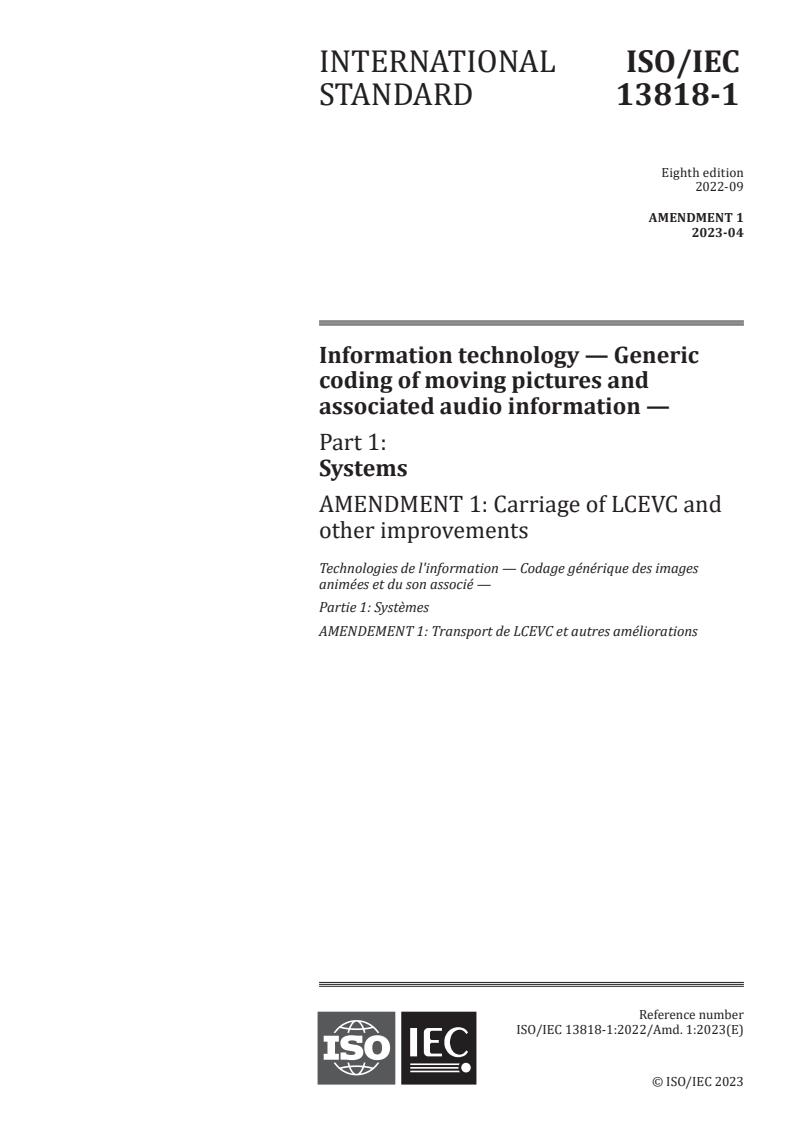
INTERNATIONAL ISO/IEC
STANDARD 13818-1
Eighth edition
2022-09
AMENDMENT 1
2023-04
Information technology — Generic
coding of moving pictures and
associated audio information —
Part 1:
Systems
AMENDMENT 1: Carriage of LCEVC and
other improvements
Technologies de l'information — Codage générique des images
animées et du son associé —
Partie 1: Systèmes
AMENDEMENT 1: Transport de LCEVC et autres améliorations
Reference number
ISO/IEC 13818-1:2022/Amd. 1:2023(E)
© ISO/IEC 2023
ISO/IEC 13818-1:2022/Amd. 1:2023(E)
© ISO/IEC 2023
All rights reserved. Unless otherwise specified, or required in the context of its implementation, no part of this publication may
be reproduced or utilized otherwise in any form or by any means, electronic or mechanical, including photocopying, or posting on
the internet or an intranet, without prior written permission. Permission can be requested from either ISO at the address below
or ISO’s member body in the country of the requester.
ISO copyright office
CP 401 • Ch. de Blandonnet 8
CH-1214 Vernier, Geneva
Phone: +41 22 749 01 11
Email: copyright@iso.org
Website: www.iso.org
Published in Switzerland
ii
© ISO/IEC 2023 – All rights reserved
ISO/IEC 13818-1:2022/Amd.1:2023(E)
Foreword
ISO (the International Organization for Standardization) and IEC (the International Electrotechnical
Commission) form the specialized system for worldwide standardization. National bodies that are
members of ISO or IEC participate in the development of International Standards through technical
committees established by the respective organization to deal with particular fields of technical activity.
ISO and IEC technical committees collaborate in fields of mutual interest. Other international
organizations, governmental and non-governmental, in liaison with ISO and IEC, also take part in the
work.
The procedures used to develop this document and those intended for its further maintenance are
described in the ISO/IEC Directives, Part 1. In particular, the different approval criteria needed for the
different types of document should be noted.
Attention is drawn to the possibility that some of the elements of this document may be the subject of
patent rights. ISO and IEC shall not be held responsible for identifying any or all such patent rights. Details
of any patent rights identified during the development of the document will be in the Introduction and/or
on the ISO list of patent declarations received (see www.iso.org/patents) or the IEC list of patent
declarations received (see https://patents.iec.ch).
Any trade name used in this document is information given for the convenience of users and does not
constitute an endorsement.
For an explanation of the voluntary nature of standards, the meaning of ISO specific terms and
expressions related to conformity assessment, as well as information about ISO's adherence to the World
Trade Organization (WTO) principles in the Technical Barriers to Trade (TBT)
see www.iso.org/iso/foreword.html. In the IEC, see www.iec.ch/understanding-standards.
This document was prepared by ITU-T as Amendment 1 to ITU-T H.222.0 (06/2021) and drafted in
accordance with its editorial rules, in collaboration with Joint Technical Committee ISO/IEC JTC 1,
Information technology, Subcommittee SC 29, Coding of audio, picture, multimedia and hypermedia
information.
A list of all parts in the ISO/IEC 13818 series can be found on the ISO and IEC websites.
Any feedback or questions on this document should be directed to the user’s national standards body. A
complete listing of these bodies can be found at www.iso.org/members.html and www.iec.ch/national-
committees.
© ISO/IEC 2023 – All rights reserved iii
ISO/IEC 13818-1:2022/Amd. 1:2023(E)
INTERNATIONAL STANDARD ISO/IEC 13818-1
RECOMMENDATION ITU-T H.222.0
Information technology – Generic coding of moving pictures and associated
audio information: Systems
Amendment 1
Carriage of LCEVC and other improvements
Summary
Rec. ITU-T H.222.0 | ISO/IEC 13818-1 was developed in 1994 to principally support the combination and synchronization
of video and audio coding methods defined in ISO/IEC 13818 Part 2 (Rec. ITU-T H.262) and Part 3. It has since then been
extended to support additional video and audio coding specifications as well as multiple kinds of metadata.
Amendment 1 to ITU-T H.222.0 (2021) | ISO/IEC 13818-1:2022 extends the specification by defining how LCEVC
(ISO/IEC 23094-2) is carried over MPEG-2 systems. It also defines an additional descriptor signalling the kind of media
service and its usage. Further, it includes clarifications for the specification of carriage of JPEG XS.
All of this is done in a way that is compatible with the existing support for other codecs.
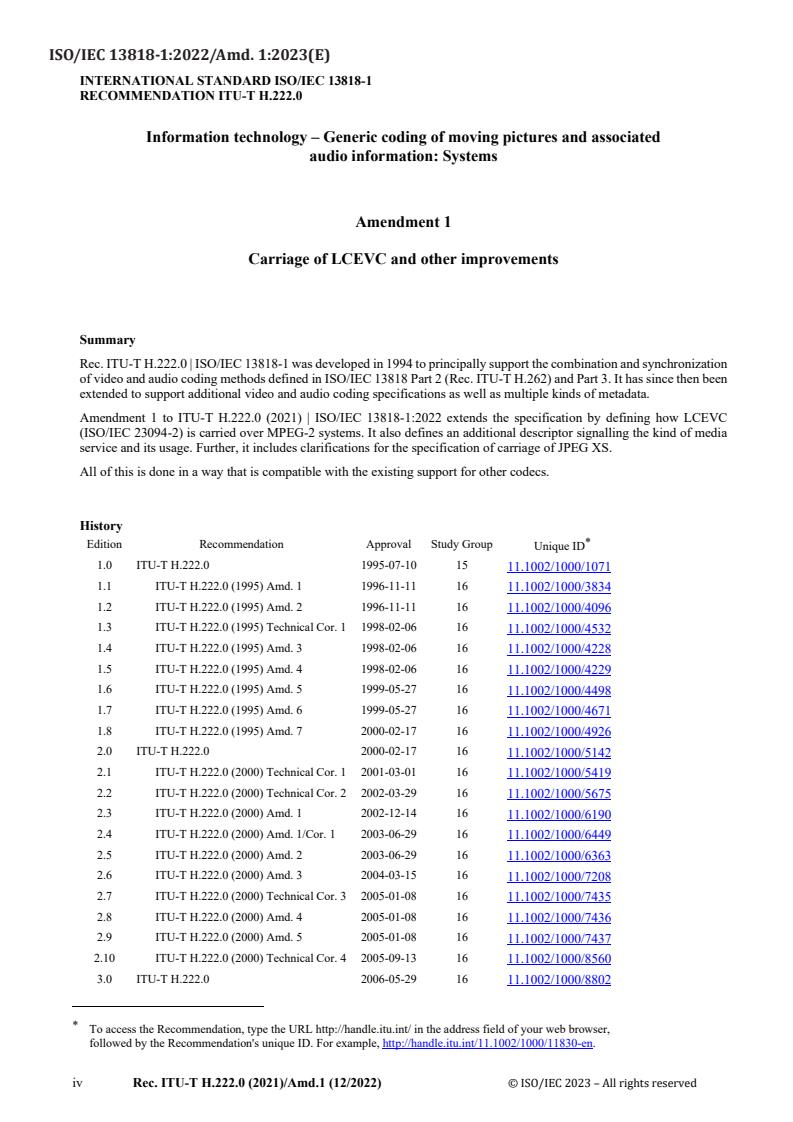
History
*
Edition Recommendation Approval Study Group
Unique ID
1.0 ITU-T H.222.0 1995-07-10 15
11.1002/1000/1071
1.1 ITU-T H.222.0 (1995) Amd. 1 1996-11-11 16
11.1002/1000/3834
1.2 ITU-T H.222.0 (1995) Amd. 2 1996-11-11 16
11.1002/1000/4096
1.3 ITU-T H.222.0 (1995) Technical Cor. 1 1998-02-06 16
11.1002/1000/4532
1.4 ITU-T H.222.0 (1995) Amd. 3 1998-02-06 16
11.1002/1000/4228
1.5 ITU-T H.222.0 (1995) Amd. 4 1998-02-06 16
11.1002/1000/4229
1.6 ITU-T H.222.0 (1995) Amd. 5 1999-05-27 16
11.1002/1000/4498
1.7 ITU-T H.222.0 (1995) Amd. 6 1999-05-27 16
11.1002/1000/4671
1.8 ITU-T H.222.0 (1995) Amd. 7 2000-02-17 16
11.1002/1000/4926
2.0 ITU-T H.222.0 2000-02-17 16
11.1002/1000/5142
2.1 ITU-T H.222.0 (2000) Technical Cor. 1 2001-03-01 16
11.1002/1000/5419
2.2 ITU-T H.222.0 (2000) Technical Cor. 2 2002-03-29 16
11.1002/1000/5675
2.3 ITU-T H.222.0 (2000) Amd. 1 2002-12-14 16
11.1002/1000/6190
2.4 ITU-T H.222.0 (2000) Amd. 1/Cor. 1 2003-06-29 16
11.1002/1000/6449
2.5 ITU-T H.222.0 (2000) Amd. 2 2003-06-29 16
11.1002/1000/6363
2.6 ITU-T H.222.0 (2000) Amd. 3 2004-03-15 16
11.1002/1000/7208
2.7 ITU-T H.222.0 (2000) Technical Cor. 3 2005-01-08 16
11.1002/1000/7435
2.8 ITU-T H.222.0 (2000) Amd. 4 2005-01-08 16
11.1002/1000/7436
2.9 ITU-T H.222.0 (2000) Amd. 5 2005-01-08 16
11.1002/1000/7437
2.10 ITU-T H.222.0 (2000) Technical Cor. 4 2005-09-13 16
11.1002/1000/8560
3.0 ITU-T H.222.0 2006-05-29 16
11.1002/1000/8802
*
To access the Recommendation, type the URL http://handle.itu.int/ in the address field of your web browser,
followed by the Recommendation's unique ID. For example, http://handle.itu.int/11.1002/1000/11830-en.
iv Rec. ITU-T H.222.0 (2021)/Amd.1 (12/2022) © ISO/IEC 2023 – All rights reserved
ISO/IEC 13818-1:2022/Amd.1:2023(E)
3.1 ITU-T H.222.0 (2006) Amd. 1 2007-01-13 16
11.1002/1000/9024
3.2 ITU-T H.222.0 (2006) Amd. 2 2007-08-29 16
11.1002/1000/9214
3.3 ITU-T H.222.0 (2006) Cor. 1 2008-06-13 16
11.1002/1000/9471
3.4 ITU-T H.222.0 (2006) Cor. 2 2009-03-16 16
11.1002/1000/9692
3.5 ITU-T H.222.0 (2006) Amd. 3 2009-03-16 16
11.1002/1000/9691
3.6 ITU-T H.222.0 (2006) Cor. 3 2009-12-14 16
11.1002/1000/10621
3.7 ITU-T H.222.0 (2006) Cor. 4 2009-12-14 16
11.1002/1000/10622
3.8 ITU-T H.222.0 (2006) Amd. 4 2009-12-14 16
11.1002/1000/10623
3.9 ITU-T H.222.0 (2006) Amd. 5 2011-05-14 16
11.1002/1000/11287
3.10 ITU-T H.222.0 (2006) Amd. 6 2011-05-14 16
11.1002/1000/11288
4.0 ITU-T H.222.0 2012-06-29 16
11.1002/1000/11655
4.1 ITU-T H.222.0 (2012) Amd. 1 2014-01-13 16
11.1002/1000/12054
4.2 ITU-T H.222.0 (2012) Amd. 2 2014-01-13 16
11.1002/1000/12055
4.3 ITU-T H.222.0 (2012) Amd. 3 2014-01-13 16
11.1002/1000/12056
4.4 ITU-T H.222.0 (2012) Amd. 4 2014-01-13 16
11.1002/1000/12057
4.5 ITU-T H.222.0 (2012) Amd. 5 2014-10-14 16
11.1002/1000/12306
5.0 ITU-T H.222.0 2014-10-14 16
11.1002/1000/12359
5.1 ITU-T H.222.0 (2014) Amd. 1 2015-04-29 16
11.1002/1000/12452
5.2 ITU-T H.222.0 (2014) Amd. 1 Cor. 1 2015-11-29 16
11.1002/1000/12625
5.3 ITU-T H.222.0 (2014) Amd. 2 2015-12-14 16
11.1002/1000/12632
5.4 ITU-T H.222.0 (2014) Amd. 3 2015-12-14 16
11.1002/1000/12633
5.5 ITU-T H.222.0 (2014) Amd. 1 Cor. 2 2016-07-14 16
11.1002/1000/12899
5.5 ITU-T H.222.0 (2014) Cor. 1 2016-07-14 16
11.1002/1000/12903
5.7 ITU-T H.222.0 (2014) Amd. 4 2016-07-14 16
11.1002/1000/12900
5.8 ITU-T H.222.0 (2014) Amd. 5 2016-07-14 16
11.1002/1000/12901
5.9 ITU-T H.222.0 (2014) Amd. 6 2016-07-14 16
11.1002/1000/12902
5.10 ITU-T H.222.0 (2014) Amd. 3 Cor. 1 2017-03-01 16
11.1002/1000/13184
5.10 ITU-T H.222.0 (2014) Cor. 2 2017-03-01 16
11.1002/1000/13188
5.12 ITU-T H.222.0 (2014) Amd. 7 2017-03-01 16
11.1002/1000/13186
5.13 ITU-T H.222.0 (2014) Amd. 8 2017-03-01 16
11.1002/1000/13187
6.0 ITU-T H.222.0 2017-03-01 16
11.1002/1000/13269
6.1 ITU-T H.222.0 (2017) Amd. 1 2017-12-14 16
11.1002/1000/13431
7.0 ITU-T H.222.0 2018-08-29 16
11.1002/1000/13664
7.1 ITU-T H.222.0 (2018) Cor. 1 2019-11-29 16
11.1002/1000/14106
7.2 ITU-T H.222.0 (2018) Amd. 1 2019-11-29 16
11.1002/1000/14105
8.0 ITU-T H.222.0 (V8) 2021-06-13 16
11.1002/1000/14658
8.1 ITU-T H.222.0 (2021) Cor. 1 2022-12-14 16
11.1002/1000/15172
8.2 ITU-T H.222.0 (2021) Amd. 1 2022-12-14 16
11.1002/1000/15171
© ISO/IEC 2023 – All rights reserved Rec. ITU-T H.222.0 (2021)/Amd.1 (12/2022) v
ISO/IEC 13818-1:2022/Amd. 1:2023(E)
FOREWORD
The International Telecommunication Union (ITU) is the United Nations specialized agency in the field of
telecommunications, information and communication technologies (ICTs). The ITU Telecommunication
Standardization Sector (ITU-T) is a permanent organ of ITU. ITU-T is responsible for studying technical,
operating and tariff questions and issuing Recommendations on them with a view to standardizing
telecommunications on a worldwide basis.
The World Telecommunication Standardization Assembly (WTSA), which meets every four years, establishes
the topics for study by the ITU-T study groups which, in turn, produce Recommendations on these topics.
The approval of ITU-T Recommendations is covered by the procedure laid down in WTSA Resolution 1.
In some areas of information technology which fall within ITU-T's purview, the necessary standards are
prepared on a collaborative basis with ISO and IEC.
NOTE
In this Recommendation, the expression "Administration" is used for conciseness to indicate both a
telecommunication administration and a recognized operating agency.
Compliance with this Recommendation is voluntary. However, the Recommendation may contain certain
mandatory provisions (to ensure, e.g., interoperability or applicability) and compliance with the
Recommendation is achieved when all of these mandatory provisions are met. The words "shall" or some other
obligatory language such as "must" and the negative equivalents are used to express requirements. The use of
such words does not suggest that compliance with the Recommendation is required of any party.
INTELLECTUAL PROPERTY RIGHTS
ITU draws attention to the possibility that the practice or implementation of this Recommendation may involve
the use of a claimed Intellectual Property Right. ITU takes no position concerning the evidence, validity or
applicability of claimed Intellectual Property Rights, whether asserted by ITU members or others outside of
the Recommendation development process.
As of the date of approval of this Recommendation, ITU had received notice of intellectual property, protected
by patents/software copyrights, which may be required to implement this Recommendation. However,
implementers are cautioned that this may not represent the latest information and are therefore strongly urged
to consult the appropriate ITU-T databases available via the ITU-T website at http://www.itu.int/ITU-T/ipr/.
© ITU 2023
All rights reserved. No part of this publication may be reproduced, by any means whatsoever, without the prior
written permission of ITU.
vi Rec. ITU-T H.222.0 (2021)/Amd.1 (12/2022) © ISO/IEC 2023 – All rights reserved
ISO/IEC 13818-1:2022/Amd.1:2023(E)
CONTENTS
Page
1) Clause 1.2.3 . 1
2) Clauses 2.1.90bis to 2.1.90ter . 1
3) Clause 2.4.2.7 . 1
4) Clause 2.4.3.7 . 2
5) Clause 2.4.4.10 . 2
6) Clause 2.6.90 . 2
7) Clause 2.6.91 . 3
8) Clause 2.6.127 . 3
9) Clauses 2.6.137 to 2.6.142 . 3
10) Clause 2.25 . 11
11) Annex W, clause W.2 . 12
12) Annex W, clause W.3 . 12
13) Bibliography . 12
© ISO/IEC 2023 – All rights reserved Rec. ITU-T H.222.0 (2021)/Amd.1 (12/2022) vii
ISO/IEC 13818-1:2022/Amd.1:2023(E)
INTERNATIONAL STANDARD ISO/IEC 13818-1
RECOMMENDATION ITU-T H.222.0
Information technology – Generic coding of moving pictures and associated
audio information: Systems
Amendment 1
Carriage of LCEVC and other improvements
Scope
This amendment extends 13818-1 by defining:
• how LCEVC (ISO/IEC 23094-2) is carried over MPEG-2 systems (ITU-T H.222.0 | ISO/IEC 13818-1);
• an additional descriptor signalling the kind of media service and its usage.
It does this in a compatible way with existing support for other codecs.
It includes clarifications for the specification of carriage of JPEG XS.
1) Clause 1.2.3
In 1.2.3, Additional references, add the following references:
– ISO/IEC 23094-2:2021, Information technology – General video coding – Part 2: Low complexity
enhancement video coding.
– IETF BCP 47: IETF RFC 4647 (2006) Matching of Language Tags combined with IETF RFC 5646 (2009),
Tags for Identifying Languages.
– ANSI/SCTE 35 (2019), Digital Program Insertion Cueing Message for Cable.
2) Clauses 2.1.90bis to 2.1.90ter
After clause 2.1.90, add the following clauses 2.1.90bis to 2.1.90ter:
2.1.90bis LCEVC access unit (system): An access unit as defined for byte streams in ISO/IEC 23094-2 with the
constraints specified in clause 2.25.1.
2.1.90ter LCEVC video sequence (system): Coded video sequence as defined in ISO/IEC 23094-2.
3) Clause 2.4.2.7
In clause 2.4.2.7, replace the sixth paragraph:
The delay of any data through the system target decoder buffers shall be less than or equal to one second except for still
picture video data, ISO/IEC 14496 streams, ISO/IEC 23008-2 streams, ISO/IEC 23090-3 streams and ISO/IEC 23094-1
streams. Specifically: td (j) – t(i) ≤ 1 second for all j, and all bytes i in access unit A (j).
n n
with:
The delay of any data through the system target decoder buffers shall be less than or equal to one second except for still
picture video data, ISO/IEC 14496, ISO/IEC 23008-2, ISO/IEC 23090-3, ISO/IEC 23094-1 and ISO/IEC 23094-2
streams. Specifically: td (j) – t(i) ≤ 1 second for all j, and all bytes i in access unit A (j).
n n
Further replace the eighth paragraph:
For ISO/IEC 14496, ISO/IEC 23008-2, ISO/IEC 23090-3 and ISO/IEC 23094-1 streams, the delay is constrained by td (j)
n
– t(i) ≤ 10 seconds for all j, and all bytes i in access unit A (j).
n
with:
For ISO/IEC 14496, ISO/IEC 23008-2, ISO/IEC 23090-3, ISO/IEC 23094-1 and ISO/IEC 23094-2 streams, the delay is
constrained by td (j) – t(i) ≤ 10 seconds for all j, and all bytes i in access unit A (j).
n n
Rec. ITU-T H.222.0 (2021)/Amd.1 (12/2022) 1
© ISO/IEC 2023 – All rights reserved
ISO/IEC 13818-1:2022/Amd.1:2023(E)
4) Clause 2.4.3.7
In clause 2.4.3.7, in Table 2-22, replace:
1110 xxxx Rec. ITU-T H.262 | ISO/IEC 13818-2, ISO/IEC 11172-2, ISO/IEC 14496-2, Rec. ITU-T H.264 |
ISO/IEC 14496-10, Rec. ITU-T H.265 | ISO/IEC 23008-2, Rec. ITU-T H.266 | ISO/IEC 23090-3
or ISO/IEC 23094-1 video stream number xxxx
with:
1110 xxxx Rec. ITU-T H.262 | ISO/IEC 13818-2, ISO/IEC 11172-2, ISO/IEC 14496-2, Rec. ITU-T H.264 |
ISO/IEC 14496-10, Rec. ITU-T H.265 | ISO/IEC 23008-2, Rec. ITU-T H.266 | ISO/IEC 23090-3,
ISO/IEC 23094-1 or ISO/IEC 23094-2 video stream number xxxx
Further, in the PTS (presentation time stamp) section, insert the following new paragraph after the paragraph starting
with "For EVC video streams …":
For LCEVC video streams, the PTS shall be present in the PES packet header, and it shall refer to only one LCEVC
access unit that commences in this PES packet. To achieve consistency between the STD model and the HRD model
defined in Annex C of ISO/IEC 23094-2, for each LCEVC access unit the PTS value in the STD shall, within its accuracy,
indicate the same instant in time as the nominal DPB output time in the HRD, as defined in Annex C of ISO/IEC 23094-2.
Further, in the DTS (decoding time stamp) section, insert the following new paragraph after the paragraph starting with
"For EVC video streams …":
For LCEVC video streams, the DTS shall not be present in the PES packet header because the LCEVC decoding process
is strictly in presentation order. This restriction on the strict coincidence of decoding order and presentation order of the
access units refers exclusively to the LCEVC video stream. On the other hand, the base video stream that the LCEVC
video stream enhances has no such restriction, which means that in this case the decoding order and the presentation order
can be different.
5) Clause 2.4.4.10
In 2.4.4.10 in Table 2-34, replace:
0x36 . 0x7E Rec. ITU-T H.222.0 | ISO/IEC 13818-1 reserved
with:
0x36 LCEVC video stream conforming to one or more profiles defined in ISO/IEC 23094-2
0x37 . 0x7E Rec. ITU-T H.222.0 | ISO/IEC 13818-1 reserved
6) Clause 2.6.90
In 2.6.90 in Table 2-109, replace:
else if ( extension_descriptor_tag == 0x16) {
EVC_timing_and_HRD_descriptor()
}
with:
else if ( extension_descriptor_tag == 0x16) {
EVC_timing_and_HRD_descriptor()
}
else if ( extension_descriptor_tag == 0x17) {
LCEVC_video_descriptor ()
}
else if ( extension_descriptor_tag == 0x18) {
LCEVC_linkage_descriptor()
}
2 Rec. ITU-T H.222.0 (2021)/Amd.1 (12/2022)
© ISO/IEC 2023 – All rights reserved
ISO/IEC 13818-1:2022/Amd.1:2023(E)
else if ( extension_descriptor_tag == 0x19) {
Media_service_kind_descriptor()
}
7) Clause 2.6.91
In clause 2.6.91, right before Table 2-110, add:
LCEVC_video_descriptor() – This structure is defined in 2.6.137 and 2.6.138.
LCEVC_linkage_descriptor() – This structure is defined in 2.6.139 and 2.6.140.
Media_service_kind_descriptor() – This structure is defined in 2.6.141 and 2.6.142
Further, in Table 2-110, replace:
0x17 . 0xFF n/a n/a Rec. ITU-T H.222.0 | ISO/IEC 13818-1 Reserved
with
0x17 X X LCEVC_video_descriptor()
0x18 X X LCEVC_linkage_descriptor()
0x19 X X Media_service_kind_descriptor()
0x1A . 0xFF n/a n/a Rec. ITU-T H.222.0 | ISO/IEC 13818-1 Reserved
8) Clause 2.6.127
In clause 2.6.127, in Table 2-132, remove the descriptor_tag and descriptor_length fields.
9) Clauses 2.6.137 to 2.6.142
After 2.6.136, add the following clauses 2.6.137 to 2.6.142:
2.6.137 LCEVC video descriptor
Table 2-141bis provides a description of the LCEVC video descriptor.
Table 2-141bis – LCEVC video descriptor
Syntax No. of bits Mnemonic
LCEVC_video_descriptor() {
lcevc_stream_tag 8 uimsbf
profile_idc 4 uimsbf
level_idc 4 uimsbf
sublevel_idc 2 uimsbf
processed_planes_type_flag 1 bslbf
picture_type_bit_flag 1 bslbf
field_type_bit_flag 1 bslbf
reserved 3 bslbf
HDR_WCG_idc 2 uimsbf
reserved_zero_2bit 2 bslbf
video_properties_tag 4 uimsbf
}
2.6.138 Semantic definition of fields of LCEVC video descriptor
lcevc_stream_tag – This is an 8-bit field specifying the identifier of an association between base and enhancement
streams of an LCEVC encoding.
Rec. ITU-T H.222.0 (2021)/Amd.1 (12/2022) 3
© ISO/IEC 2023 – All rights reserved
ISO/IEC 13818-1:2022/Amd.1:2023(E)
profile_idc, level_idc, sublevel_idc – These fields shall be coded according to the semantics defined for profile_idc,
level_idc, sublevel_idc in clause 7.3.4 (SC, sequence_configuration) of ISO/IEC 23094-2.
processed_planes_type_flag – This field shall be coded according to the semantics defined for
processed_planes_type_flag in clause 7.3.5 (GC, global_configuration) of ISO/IEC 23094-2.
picture_type_bit_flag, field_type_bit_flag – These fields shall be coded according to the semantics defined for
picture_type_bit_flag, field_type_bit_flag in clause 7.3.6 (PC, picture_configuration) of ISO/IEC 23094-2.
HDR_WCG_idc – This 2-bit field indicates the presence or absence of high dynamic range (HDR) and/or wide colour
gamut (WCG) video components in the associated PID according to Table 2-134.
video_properties_tag – This 4-bit field is used to indicate specific widely used video property CICP combinations as
indicated by ITU-T H.Sup. 19 | ISO/IEC 23091-4 for SDR, WCG, or HDR/WCG streams depending on the value of
HDR_WCG_idc. When HDR_WCG_idc is equal to 0, Table 2-135 applies. When HDR_WCG_idc is equal to 1,
Table 2-136 applies. When HDR_WCG_idc is equal to 2, Table 2-137 applies. When HDR_WCG_idc is equal to 3,
Table 2138 applies.
NOTE 1 – Since the LCEVC enhancement stream and the base video stream that is enhanced are encoded separately, there can be
separate values for HDR_WCG_idc and HDR_WCG_idc in the base and in the enhancement streams, and such values are not
necessarily identical.
NOTE 2 – There is no Buffering Period SEI and Picture Timing SEI messages defined for LCEVC because the ones from the base
encoding are used. For this reason, LCEVC timing and HRD descriptors are not needed.
2.6.139 LCEVC linkage descriptor
Table 2-141ter provides a description of the LCEVC linkage descriptor.
Table 2-141ter – LCEVC linkage descriptor
Syntax No. of bits Mnemonic
LCEVC_linkage_descriptor() {
num_lcevc_stream_tags 8 uimsbf
for (i=0; i
lcevc_stream_tag 8 uimsbf
}
}
2.6.140 Semantic definition of fields of LCEVC linkage descriptor
num_lcevc_stream_tags – The number of lcevc_stream_tag items that will follow.
lcevc_stream_tag – Tag value that allows indicating this video elementary stream as the base of an LCEVC video stream
that carries the same tag value in its LCEVC video descriptor.
2.6.141 Media service kind descriptor
The media_service_kind_descriptor can read on the program or PID ES stream itself or can read on auxiliary PID ES that
are dependent on the principal PID media component ES (i.e., in most cases the principal media component is video).
The media service kind descriptor can also read upon the entire program to describe content with a single principal media
component. Multiple data elements (N) can be included in the descriptor, each with one or more language
code/media_service_type pairs.
If the same media component is described at a program level and at an elementary level, then the elementary stream
media_service_kind description shall take precedence.
Table 2-141quater provides a description of the media service kind descriptor.
4 Rec. ITU-T H.222.0 (2021)/Amd.1 (12/2022)
© ISO/IEC 2023 – All rights reserved
ISO/IEC 13818-1:2022/Amd.1:2023(E)
Table 2-141quater – Media service kind descriptor
Syntax No. of bits Mnemonic
Media_service_kind_descriptor() {
for (i=0; i
media_description_flag 1 bslbf
identifier_flag 1 bslbf
lang_pairs
...