


ISO 6941
(Main)Textile fabrics — Burning behaviour — Measurement of flame spread properties of vertically oriented specimens
Textile fabrics — Burning behaviour — Measurement of flame spread properties of vertically oriented specimens
This document specifies a method for the measurement of flame spread times of vertically oriented textile fabrics and industrial products in the form of single or multi-component textile fabrics (coated, quilted, multilayered, sandwich combinations, and similar combinations) when subjected to a small, defined flame.
Étoffes — Comportement au feu — Détermination des propriétés de propagation de flamme d'éprouvettes orientées verticalement
Le présent document spécifie une méthode permettant de mesurer les durées de propagation de flamme des étoffes et produits industriels orientés verticalement par rapport à une flamme définie de petite taille; il peut s'agir d'étoffes simples ou complexes (textiles enduits, ouatés, multicouches, en sandwich et autres structures).
General Information
- Status
- Not Published
- Technical Committee
- ISO/TC 38 - Textiles
- Drafting Committee
- ISO/TC 38 - Textiles
- Current Stage
- 6000 - International Standard under publication
- Start Date
- 28-Mar-2026
- Completion Date
- 09-May-2026
Relations
- Effective Date
- 12-Feb-2026
- Effective Date
- 21-Sep-2024
Overview
ISO 6941:2026 specifies a standardized method for measuring the flame spread properties of vertically oriented textile fabrics when exposed to a small, defined flame. This international standard addresses single and multi-component textiles, including coated, quilted, multilayered, and sandwich constructions. Developed by the International Organization for Standardization (ISO), ISO 6941 enables consistent evaluation of the burning behavior and fire performance of textile products intended for various industrial and consumer applications.
Understanding flame spread times is crucial in assessing textile safety, supporting manufacturers, testing laboratories, and regulatory bodies in meeting fire safety requirements. The method serves as an essential reference for product development, quality assurance, and certification for fire-resistant fabrics.
Key Topics
- Flame Spread Measurement: Describes procedures for assessing flame spread rates, using vertically mounted specimens and a precisely controlled ignition flame.
- Test Specimen Preparation: Outlines requirements for sampling, specimen size, orientation, and pre-test conditioning in a controlled atmosphere.
- Apparatus Specifications: Details on mounting frames, gas burners, specimen holders, marker threads, and essential setup to ensure reliability and repeatability.
- Testing Procedures:
- Surface Ignition: Application of flame to the fabric’s surface.
- Bottom Edge Ignition: Application of flame to the bottom edge.
- Safety and Precautions: Addresses safe operation, proper ventilation, use of non-corrosive materials for equipment, and operator health protection when testing potentially toxic or smoky substances.
- Reporting Requirements: Specifies documentation of apparatus, test conditions, specimen details, and observed flame spread times for transparency and reproducibility.
Applications
ISO 6941 is widely used in the global textile industry for:
- Product Development: Ensuring textile fabrics meet specific flame retardancy and fire-protection goals, especially in high-risk environments such as transportation, public buildings, or protective clothing.
- Regulatory Compliance: Meeting industry and governmental standards for fire safety in textiles, including furniture, curtains, uniforms, and technical textiles.
- Quality Assurance and Certification: Providing a rigorous, internationally recognized method for comparing flame spread properties of various textile types, supporting product certification and market access.
- Research and Testing Services: Used by laboratories to benchmark material performance, investigate textile fire behavior, and validate claims of flame resistance.
- Safety Assessment: Useful in evaluating the fire risk posed by textile components in composite structures, and in assessing how seams, trimmings, and multilayered assemblies respond under flame exposure.
Related Standards
Organizations and users requiring comprehensive fire performance evaluation of textiles may refer to the following standards related to ISO 6941:
- ISO 4880: Burning behaviour of textiles and textile products - Vocabulary - Defines key terms for understanding burning characteristics.
- ISO 6940 / EN ISO 6940: Textile fabrics – Burning behaviour – Determination of ease of ignition of vertically oriented specimens - Focuses on ignition properties distinct from flame spread.
- ISO 2768-1: General tolerances – Part 1: Tolerances for linear and angular dimensions - Referenced for manufacturing precision of test equipment.
By employing ISO 6941 and referenced standards, manufacturers and laboratories can assure safety, performance, and marketability of textile products in applications where fire resistance is critical. This supports innovation and compliance across industries while prioritizing public and occupational health and safety.
Buy Documents

ISO/FDIS 6941 - Textile fabrics — Burning behaviour — Measurement of flame spread properties of vertically oriented specimens Released:16. 01. 2026
REDLINE ISO/FDIS 6941 - Textile fabrics — Burning behaviour — Measurement of flame spread properties of vertically oriented specimens Released:16. 01. 2026
ISO/FDIS 6941 - Étoffes — Comportement au feu — Détermination des propriétés de propagation de flamme d'éprouvettes orientées verticalement/7/2026
Get Certified
Connect with accredited certification bodies for this standard

Control Union Certifications
Global certification for agriculture and sustainability.

Hohenstein Institut
Textile testing and certification.

Bureau Veritas Bangladesh
Bureau Veritas certification services in Bangladesh.
Sponsored listings
Frequently Asked Questions
ISO 6941 is a draft published by the International Organization for Standardization (ISO). Its full title is "Textile fabrics — Burning behaviour — Measurement of flame spread properties of vertically oriented specimens". This standard covers: This document specifies a method for the measurement of flame spread times of vertically oriented textile fabrics and industrial products in the form of single or multi-component textile fabrics (coated, quilted, multilayered, sandwich combinations, and similar combinations) when subjected to a small, defined flame.
This document specifies a method for the measurement of flame spread times of vertically oriented textile fabrics and industrial products in the form of single or multi-component textile fabrics (coated, quilted, multilayered, sandwich combinations, and similar combinations) when subjected to a small, defined flame.
ISO 6941 is classified under the following ICS (International Classification for Standards) categories: 13.220.40 - Ignitability and burning behaviour of materials and products; 59.080.30 - Textile fabrics. The ICS classification helps identify the subject area and facilitates finding related standards.
ISO 6941 has the following relationships with other standards: It is inter standard links to FprEN ISO 6941, ISO 6941:2003. Understanding these relationships helps ensure you are using the most current and applicable version of the standard.
ISO 6941 is available in PDF format for immediate download after purchase. The document can be added to your cart and obtained through the secure checkout process. Digital delivery ensures instant access to the complete standard document.
Standards Content (Sample)
FINAL DRAFT
International
Standard
ISO/FDIS 6941
ISO/TC 38
Textile fabrics — Burning behaviour
Secretariat: SAC
— Measurement of flame spread
Voting begins on:
properties of vertically oriented
2026-01-30
specimens
Voting terminates on:
2026-03-27
Étoffes textiles — Comportement au feu — Détermination des
propriétés de propagation de flamme d'éprouvettes orientées
verticalement
RECIPIENTS OF THIS DRAFT ARE INVITED TO SUBMIT,
WITH THEIR COMMENTS, NOTIFICATION OF ANY
RELEVANT PATENT RIGHTS OF WHICH THEY ARE AWARE
AND TO PROVIDE SUPPOR TING DOCUMENTATION.
IN ADDITION TO THEIR EVALUATION AS
BEING ACCEPTABLE FOR INDUSTRIAL, TECHNO
ISO/CEN PARALLEL PROCESSING LOGICAL, COMMERCIAL AND USER PURPOSES, DRAFT
INTERNATIONAL STANDARDS MAY ON OCCASION HAVE
TO BE CONSIDERED IN THE LIGHT OF THEIR POTENTIAL
TO BECOME STAN DARDS TO WHICH REFERENCE MAY BE
MADE IN NATIONAL REGULATIONS.
Reference number
ISO/FDIS 6941:2026(en) © ISO 2026
FINAL DRAFT
ISO/FDIS 6941:2026(en)
International
Standard
ISO/FDIS 6941
ISO/TC 38
Textile fabrics — Burning behaviour
Secretariat: SAC
— Measurement of flame spread
Voting begins on:
properties of vertically oriented
specimens
Voting terminates on:
Étoffes textiles — Comportement au feu — Détermination des
propriétés de propagation de flamme d'éprouvettes orientées
verticalement
RECIPIENTS OF THIS DRAFT ARE INVITED TO SUBMIT,
WITH THEIR COMMENTS, NOTIFICATION OF ANY
RELEVANT PATENT RIGHTS OF WHICH THEY ARE AWARE
AND TO PROVIDE SUPPOR TING DOCUMENTATION.
© ISO 2026
IN ADDITION TO THEIR EVALUATION AS
All rights reserved. Unless otherwise specified, or required in the context of its implementation, no part of this publication may
BEING ACCEPTABLE FOR INDUSTRIAL, TECHNO
ISO/CEN PARALLEL PROCESSING
LOGICAL, COMMERCIAL AND USER PURPOSES, DRAFT
be reproduced or utilized otherwise in any form or by any means, electronic or mechanical, including photocopying, or posting on
INTERNATIONAL STANDARDS MAY ON OCCASION HAVE
the internet or an intranet, without prior written permission. Permission can be requested from either ISO at the address below
TO BE CONSIDERED IN THE LIGHT OF THEIR POTENTIAL
or ISO’s member body in the country of the requester.
TO BECOME STAN DARDS TO WHICH REFERENCE MAY BE
MADE IN NATIONAL REGULATIONS.
ISO copyright office
CP 401 • Ch. de Blandonnet 8
CH-1214 Vernier, Geneva
Phone: +41 22 749 01 11
Email: copyright@iso.org
Website: www.iso.org
Published in Switzerland Reference number
ISO/FDIS 6941:2026(en) © ISO 2026
ii
ISO/FDIS 6941:2026(en)
Contents Page
Foreword .iv
Introduction .v
1 Scope . 1
2 Normative references . 1
3 Terms and definitions . 1
4 Principle . 1
5 Apparatus . 2
5.6 Timing device .2
6 Precautions . 4
6.1 Construction of testing equipment . .4
6.2 Location of test apparatus.5
6.3 Health and safety of operators .5
7 Sampling . 5
7.1 Number of test specimens .5
7.2 Test specimen holder pin location marks .5
7.3 Test specimen size .5
8 Conditioning and testing atmosphere. 5
8.1 Conditioning.5
8.2 Testing atmosphere .6
9 Setting up the apparatus . 6
9.1 Procedures A (Surface ignition) .6
9.1.1 Mounting of the test specimen .6
9.1.2 Operating position of the burner .6
9.1.3 Flame adjustment — Horizontal reach .6
9.1.4 Flame position .6
9.2 Procedure B (Bottom edge ignition) .6
9.2.1 Mounting of the test specimen .6
9.2.2 Operating position of the burner .6
9.2.3 Flame adjustment — Vertical flame height .7
9.2.4 Flame position .7
10 Test procedure . 9
10.1 Surface ignition .9
10.2 Bottom edge ignition.9
11 Precision . 9
12 Test report . 10
Annex A (normative) Description and construction of the burner .11
Annex B (informative) Experimental techniques .12
Bibliography .13
iii
ISO/FDIS 6941:2026(en)
Foreword
ISO (the International Organization for Standardization) is a worldwide federation of national standards
bodies (ISO member bodies). The work of preparing International Standards is normally carried out through
ISO technical committees. Each member body interested in a subject for which a technical committee
has been established has the right to be represented on that committee. International organizations,
governmental and non-governmental, in liaison with ISO, also take part in the work. ISO collaborates closely
with the International Electrotechnical Commission (IEC) on all matters of electrotechnical standardization.
The procedures used to develop this document and those intended for its further maintenance are described
in the ISO/IEC Directives, Part 1. In particular, the different approval criteria needed for the different types
of ISO document should be noted. This document was drafted in accordance with the editorial rules of the
ISO/IEC Directives, Part 2 (see www.iso.org/directives).
ISO draws attention to the possibility that the implementation of this document may involve the use of (a)
patent(s). ISO takes no position concerning the evidence, validity or applicability of any claimed patent
rights in respect thereof. As of the date of publication of this document, ISO had not received notice of (a)
patent(s) which may be required to implement this document. However, implementers are cautioned that
this may not represent the latest information, which may be obtained from the patent database available at
www.iso.org/patents. ISO shall not be held responsible for identifying any or all such patent rights.
Any trade name used in this document is information given for the convenience of users and does not
constitute an endorsement.
For an explanation of the voluntary nature of standards, the meaning of ISO specific terms and expressions
related to conformity assessment, as well as information about ISO's adherence to the World Trade
Organization (WTO) principles in the Technical Barriers to Trade (TBT), see www.iso.org/iso/foreword.html.
This document was prepared by Technical Committee ISO/TC 38, Textiles, in collaboration with the European
Committee for Standardization (CEN) Technical Committee CEN/TC 248, Textiles and textile products, in
accordance with the Agreement on technical cooperation between ISO and CEN (Vienna Agreement).
This third edition cancels and replaces the second edition (ISO 6941:2003), which has been technically
revised.
The main changes are as follows:
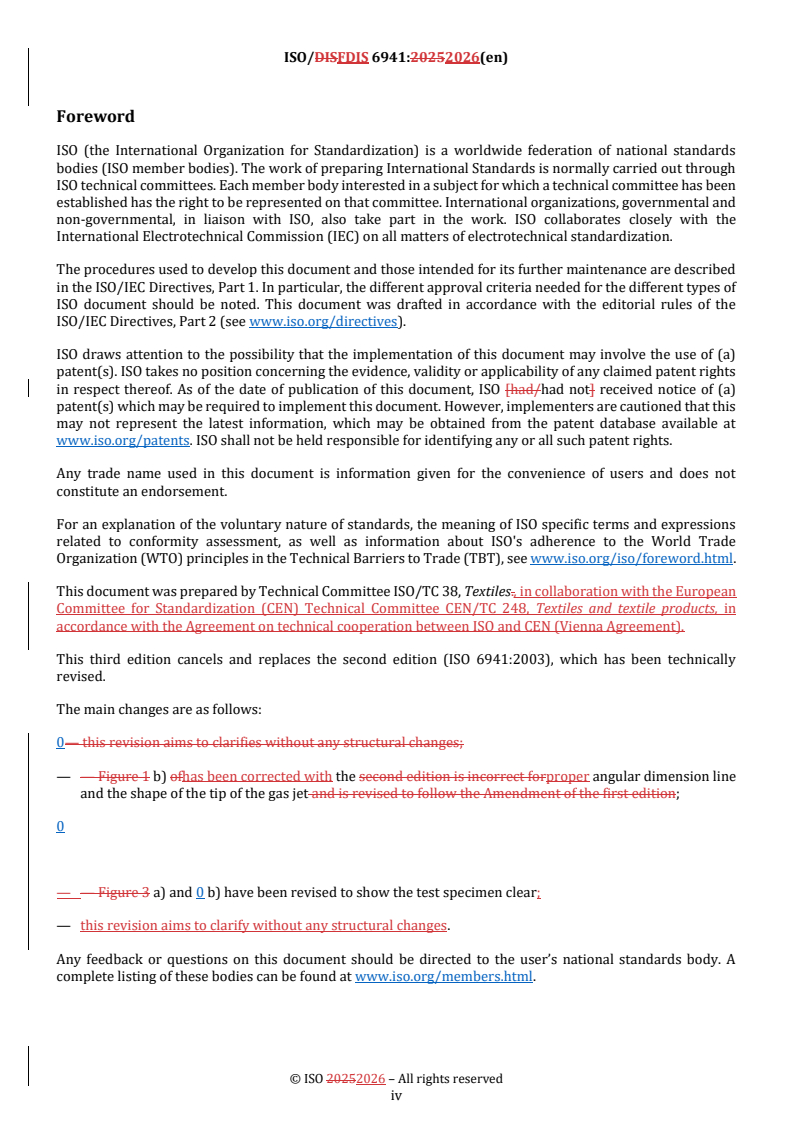
— Figure 1 b) has been corrected with the proper angular dimension line and the shape of the tip of the gas
jet;
— Figure 3 a) and Figure 3 b) have been revised to show the test specimen clear;
— this revision aims to clarify without any structural changes.
Any feedback or questions on this document should be directed to the user’s national standards body. A
complete listing of these bodies can be found at www.iso.org/members.html.
iv
ISO/FDIS 6941:2026(en)
Introduction
This method is one of two closely related methods of test for the inflammability of textile fabrics. This
[1]
method determines the “flame spread time” as defined in ISO 4880 . The other method observes and
[2]
measures “ease of ignition” (see ISO ISO 6940 ).
The method given in this document assesses the properties of textile fabrics in response to flame contact
under controlled conditions. There is a possibility that results do not apply the situations where there is
restricted air supply or exposure to large sources of intense heat.
The influence of seams on the behaviour of textile fabrics can be determined by this method, the seam being
positioned within the test specimen so as to be subjected to the test flame. Whenever practicable, trimmings
are tested as part of the textile fabric assembly on which they are or will be used.
v
FINAL DRAFT International Standard ISO/FDIS 6941:2026(en)
Textile fabrics — Burning behaviour — Measurement of flame
spread properties of vertically oriented specimens
1 Scope
This document specifies a method for the measurement of flame spread times of vertically oriented textile
fabrics and industrial products in the form of single or multi-component textile fabrics (coated, quilted,
multilayered, sandwich combinations, and similar combinations) when subjected to a small, defined flame.
2 Normative references
The following documents are referred to in the text in such a way that some or all of their content constitutes
requirements of this document. For dated references, only the edition cited applies. For undated references,
the latest edition of the referenced document (including any amendments) applies.
ISO 4880, Burning behaviour of textiles and textile products — Vocabulary
ISO 6940, Textile fabrics — Burning behaviour — Determination of ease of ignition of vertically oriented
specimens
3 Terms and definitions
For the purposes of this document, the terms and definitions given in ISO 4880 and the following apply.
ISO and IEC maintain terminological databases for use in standardization at the following addresses:
— ISO Online browsing platform: available at http:// www .iso .org/ obp
— IEC Electropedia: available at http:// www .electropedia .org/
3.1
flame application time
time for which the ignition flame is applied to the test specimen
3.2
flame spread time
time taken by a flame on a burning material to travel a specified distance under specified test conditions
4 Principle
A defined flame from a specified burner is applied for 10 s to the surface or the bottom edge of test specimens
which are vertically oriented. The flame spread times in seconds for the flame front to travel between
marker threads positioned adjacent to the surface of the test specimen and located at three distances from
the igniting flame, are recorded.
ISO/FDIS 6941:2026(en)
5 Apparatus
5.1 Mounting frame, constructed to a design capable of holding the gas burner (5.2), see Figure 1, and the
test specimen holder (5.2), see Figure 2, in the specified relative orientation, see Figure 3.
The design shall also permit three marker threads (5.7) to be attached in the positions shown in Figure 2. At
each location the marker thread is mounted as a loop so that the two segments are spaced 1 mm and 5 mm
from the plane of the front of the test specimen. Each loop is attached to a different timing device (5.6.2).
5.2 Gas burner, as shown in Figure 1 and described in Annex A, capable of being moved from a standby
position, where the tip of the burner is at least 75 mm from the test specimen to either the horizontal or
inclined operating position, see Figure 3.
5.3 Test specimen holder, consisting of a rectangular metal frame having 12 test specimen support pins
mounted along the longer edge of the rectangle of length 560 mm by width 150 mm, see Figure 2. The pins
for supporting the test specimen are 5 mm, 10 mm, 190 mm, 370 mm, 550 mm and 555 mm above the bottom
edge of the frame and have a minimum length of 26 mm.
NOTE Longer pins can be needed for mounting thick or multilayer test specimens.
For the purpose of locating the test specimen in a plane at least 20 mm away from the fr
...
ISO/DISFDIS 6941
ISO/TC 38
Secretariat: JISCSAC
Date: 2025-12-082026-01-16
Textile fabrics — Burning behaviour — Measurement of flame spread
properties of vertically oriented specimens
DISÉtoffes textiles — Comportement au feu — Détermination des propriétés de propagation de flamme
d'éprouvettes orientées verticalement
FDIS stage
ThiThiThis drs drs drafafaft is t is t is submitted tsubmitted tsubmitted tooo a a a p p parallel arallel arallel vovovote in ISOte in ISOte in ISO, CE, CE, CEN.N.N.
Voting begins on: 2025-05-19
Voting terminates on: 2025-08-11
ISO/DISFDIS 6941:20252026(en)
All rights reserved. Unless otherwise specified, or required in the context of its implementation, no part of this publication
may be reproduced or utilized otherwise in any form or by any means, electronic or mechanical, including photocopying,
or posting on the internet or an intranet, without prior written permission. Permission can be requested from either ISO
at the address below or ISO’s member body in the country of the requester.
ISO copyright office
CP 401 • Ch. de Blandonnet 8
CH-1214 Vernier, Geneva
Phone: + 41 22 749 01 11
E-mail: copyright@iso.org
Website: www.iso.org
Published in Switzerland
ii
ISO/DISFDIS 6941:20252026(en)
Contents
Foreword . iv
Introduction . v
1 Scope . 1
2 Normative references . 1
3 Terms and definitions . 1
4 Principle . 1
5 Apparatus . 1
5.6 Timing device . 2
6 Precautions . 6
6.1 Construction of testing equipment . 6
6.2 Location of test apparatus . 6
6.3 Health and safety of operators . 7
7 Sampling . 7
7.1 Number of test specimens . 7
7.2 Test specimen holder pin location marks . 7
7.3 Test specimen size . 7
8 Conditioning and testing atmosphere . 7
8.1 Conditioning . 7
8.2 Testing atmosphere . 7
9 Setting up the apparatus . 8
9.1 Procedures A (Surface ignition) . 8
9.2 Procedure B (Bottom edge ignition) . 8
10 Test procedure . 12
10.1 Surface ignition . 12
10.2 Bottom edge ignition . 12
11 Precision . 12
12 Test report . 13
Annex A (normative) Description and construction of the burner . 14
Annex B (informative) Experimental techniques . 15
Bibliography . 16
iii
ISO/DISFDIS 6941:20252026(en)
Foreword
ISO (the International Organization for Standardization) is a worldwide federation of national standards
bodies (ISO member bodies). The work of preparing International Standards is normally carried out through
ISO technical committees. Each member body interested in a subject for which a technical committee has been
established has the right to be represented on that committee. International organizations, governmental and
non-governmental, in liaison with ISO, also take part in the work. ISO collaborates closely with the
International Electrotechnical Commission (IEC) on all matters of electrotechnical standardization.
The procedures used to develop this document and those intended for its further maintenance are described
in the ISO/IEC Directives, Part 1. In particular, the different approval criteria needed for the different types of
ISO document should be noted. This document was drafted in accordance with the editorial rules of the
ISO/IEC Directives, Part 2 (see www.iso.org/directives).
ISO draws attention to the possibility that the implementation of this document may involve the use of (a)
patent(s). ISO takes no position concerning the evidence, validity or applicability of any claimed patent rights
in respect thereof. As of the date of publication of this document, ISO [had/had not] received notice of (a)
patent(s) which may be required to implement this document. However, implementers are cautioned that this
may not represent the latest information, which may be obtained from the patent database available at
www.iso.org/patents. ISO shall not be held responsible for identifying any or all such patent rights.
Any trade name used in this document is information given for the convenience of users and does not
constitute an endorsement.
For an explanation of the voluntary nature of standards, the meaning of ISO specific terms and expressions
related to conformity assessment, as well as information about ISO's adherence to the World Trade
Organization (WTO) principles in the Technical Barriers to Trade (TBT), see www.iso.org/iso/foreword.html.
This document was prepared by Technical Committee ISO/TC 38, Textiles., in collaboration with the European
Committee for Standardization (CEN) Technical Committee CEN/TC 248, Textiles and textile products, in
accordance with the Agreement on technical cooperation between ISO and CEN (Vienna Agreement).
This third edition cancels and replaces the second edition (ISO 6941:2003), which has been technically
revised.
The main changes are as follows:
0— this revision aims to clarifies without any structural changes;
— — Figure 1 b) ofhas been corrected with the second edition is incorrect forproper angular dimension line
and the shape of the tip of the gas jet and is revised to follow the Amendment of the first edition;
— — Figure 3 a) and 0 b) have been revised to show the test specimen clear;
— this revision aims to clarify without any structural changes.
Any feedback or questions on this document should be directed to the user’s national standards body. A
complete listing of these bodies can be found at www.iso.org/members.html.
iv
ISO/DISFDIS 6941:20252026(en)
Introduction
This method is one of two closely related methods of test for the inflammability of textile fabrics. This method
determines the “flame spread time” — vocabulary in relation to the termas defined in 0ISO 4880 — the. The
other method observes and measures “ease of ignition” (see ISO 06940).).
ThisThe method given in this document assesses the properties of textile fabrics in response to flame contact
under controlled conditions. There is a possibility that results do not apply the situations where there is
restricted air supply or exposure to large sources of intense heat.
The influence of seams on the behaviour of textile fabrics can be determined by this method, the seam being
positioned within the test specimen so as to be subjected to the test flame. Whenever practicable, trimmings
are tested as part of the textile fabric assembly on which they are or will be used.
v
ISO/DISFDIS 6941:20252026(en)
Textile fabrics — Burning behaviour — Measurement of flame spread
properties of vertically oriented specimens
1 Scope
This document specifies a method for the measurement of flame spread times of vertically oriented textile
fabrics and industrial products in the form of single or multi-component textile fabrics (coated, quilted,
multilayered, sandwich combinations, and similar combinations) when subjected to a small, defined flame.
2 Normative references
The following documents are referred to in the text in such a way that some or all of their content constitutes
requirements of this document. For dated references, only the edition cited applies. For undated references,
the latest edition of the referenced document (including any amendments) applies.
ISO 4880, Burning behaviour of textiles and textile products — Vocabulary
EN ISO 6940, Textile fabrics -— Burning behaviour -— Determination of ease of ignition of vertically oriented
specimens (ISO 6940:2004)
3 Terms and definitions
For the purposes of this document, the terms and definitions given in ISO 4880 and the following apply.
ISO and IEC maintain terminological databases for use in standardization at the following addresses:
— ISO Online browsing platform: available at http://www.iso.org/obp
— IEC Electropedia: available at http://www.electropedia.org/
— ISO Online browsing platform: available at http://www.iso.org/obp
3.1
flame application time
time for which the ignition flame is applied to the test specimen
3.2
flame spread time
time taken by a flame on a burning material to travel a specified distance under specified test conditions
4 Principle
A defined flame from a specified burner is applied for 10 s to the surface or the bottom edge of test specimens
which are vertically oriented. The flame spread times in seconds for the flame front to travel between marker
threads positioned adjacent to the surface of the test specimen and located at three distances from the igniting
flame, are recorded.
5 Apparatus
5.1 Mounting frame, constructed to a design capable of holding the gas burner (5.2(5.2),), see 0Figure 1,,
and the test specimen holder (5.2(5.3),), see 0Figure 2,, in the specified relative orientation, see 0Figure 3.
ISO/DISFDIS 6941:20252026(en)
The design shall also permit three marker threads (5.7(see 5.7)) to be attached in the positions shown in
0Figure 2. At each location the marker thread is mounted as a loop so that the two segments are spaced 1 mm
and 5 mm from the plane of the front of the test specimen. Each loop is attached to a different timing device
(5.6.2(5.6.2).).
5.2 Gas burner, as shown in 0Figure 1 and described in Annex AAnnex A,, capable of being moved from a
standby position, where the tip of the burner is at least 75 mm from the test specimen to either the horizontal
or inclined operating position, see 0Figure 3.
5.3 testTest specimen holder, consisting of a rectangular metal frame having 12 test specimen support
pins mounted along the longer edge of the rectangle of length 560 mm by width 150 mm, see 0Figure 2. The
pins for supporting the test specimen are 5 mm, 10 mm, 190 mm, 370 mm, 550 mm and 555 mm above the
bottom edge of the frame and have a minimum length of 26 mm.
NOTE Longer pins can be needed for mounting thick or multilayer test specimens.
For the purpose of locating the test specimen in a plane at least 20 mm away from the frame (see 9.1.19.1.1
and 9.2.19.2.1),), a spacer stub of 2 mm diameter and a length of at least 20 mm shall be positioned adjacent
to each of the pins, except for the upper and lower pins on each side.
5.4 Template, flat rigid, made of a suitable material and of a size corresponding to the size of the test
specimen (560 mm × 170 mm) shall be used.
Twelve holes, approximately 4 mm in diameter, are drilled along the edges of the template and positioned so
that the distances between the centres of the holes correspond to the distance between the pins on the test
specimen holder (see 0Figure 2).). The holes should be located equidistant about the vertical centreline of the
template.
5.5 Gas, commercial grade propane or butane or butane/propane mixtures.
NOTE Commercial grade propane gas is generally used.
5.6 Timing device
5.6.1 A timing device to control and measure the flame application time and which can be set at 1 s and
adjusted at 1 s intervals with an accuracy of 0,2 s or better.
5.6.2 Three timing devices reading to 0,2 s or better are required to measure the flame spread times. These
devices are started simultaneously when the igniting flame is applied and are stopped automatically when the
individual marker threads are severed.
5.7 Marker threads, white mercerized cotton thread having a linear density of 45 tex to 50 tex.
ISO/DISFDIS 6941:20252026(en)
Dimensions in millimetres
ISO/DISFDIS 6941:20252026(en)
Key
1 gas jet
2 burner tube
3 flame stabilizer
4 choke tube
5 notch
6 gas mixing zone
7 diffusion zone
8 air chamber
9 gas outlet
Tolerance according to if not otherwise indicated.
a Fitted during assembly
b Deburring
NOTE Tolerance according to ISO 2768-1-m (see 0) if not otherwise indicated.
Figure 1 — Gas burner
ISO/DISFDIS 6941:20252026(en)
Dimensions in millimetres
ISO/DISFDIS 6941:20252026(en)
Key
1 third marker thread
2 second marker thread
3 fabric test specimen
4 first marker thread
5 mounting pins
6 spacer stubs (optional)
7 burner (oriented for surface ignition)
NOTE Tolerance according to ISO 2768-1-m (see 0.).
Figure 2 — Test specimen holde
...
PROJET FINAL
Norme
internationale
ISO/FDIS 6941
ISO/TC 38
Étoffes — Comportement
Secrétariat: SAC
au feu — Détermination des
Début de vote:
propriétés de propagation de
2026-01-30
flamme d'éprouvettes orientées
Vote clos le:
verticalement
2026-03-27
Textile fabrics — Burning behaviour — Measurement of flame
spread properties of vertically oriented specimens
LES DESTINATAIRES DU PRÉSENT PROJET SONT
INVITÉS À PRÉSENTER, AVEC LEURS OBSERVATIONS,
NOTIFICATION DES DROITS DE PROPRIÉTÉ DONT ILS
AURAIENT ÉVENTUELLEMENT CONNAISSANCE ET À
FOURNIR UNE DOCUMENTATION EXPLICATIVE.
OUTRE LE FAIT D’ÊTRE EXAMINÉS POUR
ÉTABLIR S’ILS SONT ACCEPTABLES À DES FINS
INDUSTRIELLES, TECHNOLOGIQUES ET COM-MERCIALES,
AINSI QUE DU POINT DE VUE DES UTILISATEURS, LES
PROJETS DE NORMES
TRAITEMENT PARALLÈLE ISO/CEN
INTERNATIONALES DOIVENT PARFOIS ÊTRE CONSIDÉRÉS
DU POINT DE VUE DE LEUR POSSI BILITÉ DE DEVENIR DES
NORMES POUVANT
SERVIR DE RÉFÉRENCE DANS LA RÉGLEMENTATION
NATIONALE.
Numéro de référence
ISO/FDIS 6941:2026(fr) © ISO 2026
PROJET FINAL
ISO/FDIS 6941:2026(fr)
Norme
internationale
ISO/FDIS 6941
ISO/TC 38
Étoffes — Comportement
Secrétariat: SAC
au feu — Détermination des
Début de vote:
propriétés de propagation de
2026-01-30
flamme d'éprouvettes orientées
Vote clos le:
verticalement
2026-03-27
Textile fabrics — Burning behaviour — Measurement of flame
spread properties of vertically oriented specimens
LES DESTINATAIRES DU PRÉSENT PROJET SONT
INVITÉS À PRÉSENTER, AVEC LEURS OBSERVATIONS,
NOTIFICATION DES DROITS DE PROPRIÉTÉ DONT ILS
AURAIENT ÉVENTUELLEMENT CONNAISSANCE ET À
FOURNIR UNE DOCUMENTATION EXPLICATIVE.
DOCUMENT PROTÉGÉ PAR COPYRIGHT
OUTRE LE FAIT D’ÊTRE EXAMINÉS POUR
ÉTABLIR S’ILS SONT ACCEPTABLES À DES FINS
© ISO 2026 INDUSTRIELLES, TECHNOLOGIQUES ET COM-MERCIALES,
AINSI QUE DU POINT DE VUE DES UTILISATEURS, LES
Tous droits réservés. Sauf prescription différente ou nécessité dans le contexte de sa mise en œuvre, aucune partie de cette
PROJETS DE NORMES
TRAITEMENT PARALLÈLE ISO/CEN
INTERNATIONALES DOIVENT PARFOIS ÊTRE CONSIDÉRÉS
publication ne peut être reproduite ni utilisée sous quelque forme que ce soit et par aucun procédé, électronique ou mécanique,
DU POINT DE VUE DE LEUR POSSI BILITÉ DE DEVENIR DES
y compris la photocopie, ou la diffusion sur l’internet ou sur un intranet, sans autorisation écrite préalable. Une autorisation peut
NORMES POUVANT
être demandée à l’ISO à l’adresse ci-après ou au comité membre de l’ISO dans le pays du demandeur.
SERVIR DE RÉFÉRENCE DANS LA RÉGLEMENTATION
NATIONALE.
ISO copyright office
Case postale 401 • Ch. de Blandonnet 8
CH-1214 Vernier, Genève
Tél.: +41 22 749 01 11
E-mail: copyright@iso.org
Web: www.iso.org
Publié en Suisse Numéro de référence
ISO/FDIS 6941:2026(fr) © ISO 2026
ii
ISO/FDIS 6941:2026(fr)
Sommaire Page
Avant-propos .iv
Introduction .v
1 Domaine d’application . 1
2 Références normatives . 1
3 Termes et définitions . 1
4 Principe. 1
5 Appareillage . 2
6 Précautions . 4
6.1 Construction de l’appareillage .4
6.2 Emplacement de l'appareillage.5
6.3 Santé et sécurité des personnes chargées des essais .5
7 Échantillonnage . 5
7.1 Nombre d’éprouvettes .5
7.2 Marquage de l’emplacement des picots sur le porte-éprouvette .5
7.3 Dimensions des éprouvettes .5
8 Atmosphère de conditionnement et d’essai . 5
8.1 Conditionnement .5
8.2 Atmosphère d'essai .6
9 Mise en place de l’appareillage . 6
9.1 Méthode A (Allumage par la surface) .6
9.1.1 Montage de l’éprouvette .6
9.1.2 Position de fonctionnement du brûleur .6
9.1.3 Réglage de la flamme — Portée horizontale .6
9.1.4 Placement de la flamme .6
9.2 Méthode B (Allumage par la tranche) .6
9.2.1 Montage de l’éprouvette .6
9.2.2 Position de fonctionnement du brûleur .7
9.2.3 Réglage de la flamme — Portée verticale .7
9.2.4 Placement de la flamme .7
10 Mode opératoire d’essai . 8
10.1 Allumage par la surface .8
10.2 Allumage par la tranche .9
11 Fidélité . 9
12 Rapport d'essai . 10
Annexe A (normative) Description et construction du brûleur .11
Annexe B (informative) Techniques expérimentales .12
Bibliographie .13
iii
ISO/FDIS 6941:2026(fr)
Avant-propos
L’ISO (Organisation internationale de normalisation) est une fédération mondiale d’organismes nationaux
de normalisation (comités membres de l’ISO). L’élaboration des Normes internationales est en général
confiée aux comités techniques de l’ISO. Chaque comité membre intéressé par une étude a le droit de faire
partie du comité technique créé à cet effet. Les organisations internationales, gouvernementales et non
gouvernementales, en liaison avec l’ISO participent également aux travaux. L’ISO collabore étroitement avec
la Commission électrotechnique internationale (IEC) en ce qui concerne la normalisation électrotechnique.
Les procédures utilisées pour élaborer le présent document et celles destinées à sa mise à jour sont
décrites dans les Directives ISO/IEC, Partie 1. Il convient, en particulier, de prendre note des différents
critères d’approbation requis pour les différents types de documents ISO. Le présent document
a été rédigé conformément aux règles de rédaction données dans les Directives ISO/IEC, Partie 2
(voir www.iso.org/directives).
L’ISO attire l’attention sur le fait que la mise en application du présent document peut entraîner l’utilisation
d’un ou de plusieurs brevets. L’ISO ne prend pas position quant à la preuve, à la validité et à l’applicabilité
de tout droit de brevet revendiqué à cet égard. À la date de publication du présent document, l’ISO n’avait
pas reçu notification qu’un ou plusieurs brevets pouvaient être nécessaires à sa mise en application.
Toutefois, il y a lieu d’avertir les responsables de la mise en application du présent document que des
informations plus récentes sont susceptibles de figurer dans la base de données de brevets, disponible à
l’adresse www.iso.org/brevets. L’ISO ne saurait être tenue pour responsable de ne pas avoir identifié tout ou
partie de tels droits de brevet.
Les appellations commerciales éventuellement mentionnées dans le présent document sont données pour
information, par souci de commodité, à l’intention des utilisateurs et ne sauraient constituer un engagement.
Pour une explication de la signification des termes et expressions spécifiques de l’ISO liés à l’évaluation
de la conformité, ou pour toute information au sujet de l’adhésion de l’ISO aux principes de l’Organisation
mondiale du commerce (OMC) concernant les obstacles techniques au commerce (OTC), voir le lien
suivant: www.iso.org/iso/fr/avant-propos.html.
Le présent document a été élaboré par le comité technique ISO/TC 38, Textiles, en collaboration avec le
comité technique CEN/TC 248, Textiles et produits textiles, du Comité européen de normalisation (CEN)
conformément à l’Accord de coopération technique entre l’ISO et le CEN (Accord de Vienne).
Cette troisième édition annule et remplace la deuxième édition (ISO 6941:2003), qui a fait l’objet d’une
révision technique.
Les principaux changements sont les suivants:
— la Figure 1 b) a été corrigée avec la ligne de cote angulaire adéquate et la forme de l'extrémité de la buse
du jet de gaz;
— Les Figures 3 a) et b) ont été révisées pour montrer précisément l’éprouvette;
— cette révision vise à clarifier sans aucune modification structurelle.
Il convient que l’utilisateur adresse tout retour d’information ou toute question concernant le présent
document à l’organisme national de normalisation de son pays. Une liste exhaustive desdits organismes se
trouve à l’adresse www.iso.org/fr/members.html.
iv
ISO/FDIS 6941:2026(fr)
Introduction
La méthode décrite dans le présent document est l’une des deux méthodes très proches utilisées pour les
essais d'inflammabilité des étoffes. Elle permet de déterminer la «durée de propagation de flamme» dont
[1] [2]
le terme est défini dans l’ISO 4880. L’autre méthode mesurant la «facilité d’allumage» (voir l'ISO 6940 ).
La méthode décrite dans le présent document permet d’évaluer les propriétés des étoffes en réaction
à un contact avec une flamme dans des conditions maîtrisées. Il se peut que les résultats ne soient pas
transposables aux situations avec apport d’air réduit ou d’exposition à des sources importantes de chaleur
intense.
L’influence des coutures sur le comportement des étoffes peut être déterminée à l’aide de cette méthode,
en incluant la couture dans l’éprouvette de façon à la soumettre à la flamme d’essai. Il convient autant que
possible de soumettre les passementeries à l’essai comme éléments de l’assemblage d’étoffe avec lequel elles
sont ou seront utilisées.
v
PROJET FINAL Norme internationale ISO/FDIS 6941:2026(fr)
Étoffes — Comportement au feu — Détermination des
propriétés de propagation de flamme d'éprouvettes orientées
verticalement
1 Domaine d’application
Le présent document spécifie une méthode permettant de mesurer les durées de propagation de flamme
des étoffes et produits industriels orientés verticalement par rapport à une flamme définie de petite taille;
il peut s'agir d'étoffes simples ou complexes (textiles enduits, ouatés, multicouches, en sandwich et autres
structures).
2 Références normatives
Les documents suivants sont cités dans le texte de sorte qu’ils constituent, pour tout ou partie de leur
contenu, des exigences du présent document. Pour les références datées, seule l’édition citée s’applique. Pour
les références non datées, la dernière édition du document de référence s'applique (y compris les éventuels
amendements).
ISO 4880, Comportement au feu des textiles et des produits textiles — Vocabulaire
ISO 6940, Textiles — Comportement au feu — Détermination de la facilité d’allumage d’éprouvettes orientées
verticalement
3 Termes et définitions
Pour les besoins du présent document, les termes et définitions de l’ISO 4880 ainsi que les suivants
s’appliquent.
L’ISO et l’IEC tiennent à jour des bases de données terminologiques destinées à être utilisées en normalisation,
consultables aux adresses suivantes:
— ISO Online browsing platform: disponible à l’adresse https:// www .iso .org/ obp
— IEC Electropedia: disponible à l’adresse https:// www .electropedia .org/
3.1
durée d’application de flamme
durée pendant laquelle la flamme d'allumage est appliquée à l'éprouvette
3.2
durée de propagation de flamme
temps que met une flamme à se propager sur une distance spécifiée d'un matériau en combustion dans des
conditions d'essai spécifiées
4 Principe
Une flamme définie provenant d'un brûleur spécifié est mise en contact durant 10 s avec la surface ou le bord
inférieur d'éprouvettes textiles en position verticale. Les durées de propagation de flamme, en secondes,
pour que le front des flammes se déplace entre des fils de marquage qui jouxtent la surface de l'éprouvette à
trois distances de la flamme d'allumage sont enregistrées.
ISO/FDIS 6941:2026(fr)
5 Appareillage
5.1 Support, conçu et construit pour maintenir le brûleur à gaz (5.2), voir Figure 1, et le porte-
éprouvette (5.3), voir Figure 2, dans l'orientation relative spécifiée, voir Figure 3.
Le support doit également permettre de fixer trois fils de marquage (5.7) aux emplacements indiqués à
la Figure 2. À chaque emplacement, le fil de marquage forme une boucle de manière que les deux parties
se trouvent à 1 mm et à 5 mm du plan frontal de l'éprouvette. Chaque boucle est reliée à un dispositif de
chronométrage différent (5.6.2).
5.2 Brûleur à gaz, conforme à la Figure 1 et à la description de l'Annexe A, pouvant être déplacé de sa
position d'attente, dans laquelle son extrémité se trouve à au moins 75 mm de l'éprouvette, à sa position de
fonctionnement, horizontale ou inclinée, voir Figure 3.
5.3 Porte-éprouvette, constitué d'un cadre rectangulaire en métal muni de 12 picots de maintien répartis
le long des grands côtés du rectangle de 560 mm de longueur et 150 mm de largeur (voir Figure 2). Les picots
de maintien de l'éprouvette ont une longueur minimale de 26 mm et sont distants de 5 mm, 10 mm, 190 mm,
370 mm, 550 mm et 555 mm du bord inférieur de l'éprouvette.
NOTE Il peut être nécessaire d'utiliser des picots plus longs pour fixer des éprouvettes plus épaisses ou à
multicouches.
Pour que l'éprouvette se trouve dans un plan à au moins 20 mm du cadre (voir 9.1.1 et 9.2.1), placer une
entretoise de 2 mm de diamètre et d'au moins 20 mm de longueur à coté de chacun des picots, le long de
chaque long côté du cadre, sauf à côté des picots supérieur et inférieur.
5.4 Gabarit, plat, en matériau rigide approprié et de dimensions correspondant à celles de l'éprouvette
(560 mm × 170 mm).
Douze trous d'environ 4 mm de diamètre sont réalisées le long des bords du gabarit à des emplacements
tels que les distances entre le centre des trous correspondent aux écartements entre les picots du porte-
éprouvette (voir Figure 2). Il convient que les trous soient situés à égale distance de part et d'autre de l'axe
média
...
Questions, Comments and Discussion
Ask us and Technical Secretary will try to provide an answer. You can facilitate discussion about the standard in here.
Loading comments...