

ISO 8400:1985
(Main)Cinematography — Position of emulsion surface of 16 mm motion-picture prints — Identification
General Information
- Abstract
This International Standard describes a method for identifying the relationship of the image geometry to the emulsion surface of 16 mm motion-picture prints.
- Status
- Published
- Publication Date
- 03-Apr-1985
- Technical Committee
- ISO/TC 36 - Cinematography
- Drafting Committee
- ISO/TC 36/WG 2 - Laboratory and distribution services technology
- Current Stage
- 9093 - International Standard confirmed
- Start Date
- 10-Jul-2023
- Completion Date
- 29-Aug-2026
Buy Documents

ISO 8400:1985 - Cinematography — Position of emulsion surface of 16 mm motion-picture prints — Identification Released:4/4/1985

ISO 8400:1985 - Cinématographie — Position de la face portant la couche photosensible sur tirages cinématographiques 16 mm — Identification Released:4/4/1985

ISO 8400:1985 - Cinématographie — Position de la face portant la couche photosensible sur tirages cinématographiques 16 mm — Identification Released:4/4/1985
Overview
ISO 8400:1985 is an international standard developed by the International Organization for Standardization (ISO) addressing the position of the emulsion surface on 16 mm motion-picture prints. This standard specifies a method for identifying the relationship between the image geometry and the photosensitive emulsion surface on 16 mm film prints. Ensuring correct identification of the emulsion position is essential for accurate film handling, projection, and processing within the cinematography industry.
This standard plays a critical role in maintaining consistency and uniformity in the production, duplication, and exhibition of 16 mm motion-picture films - a widely used format in professional and amateur filmmaking.
Key Topics
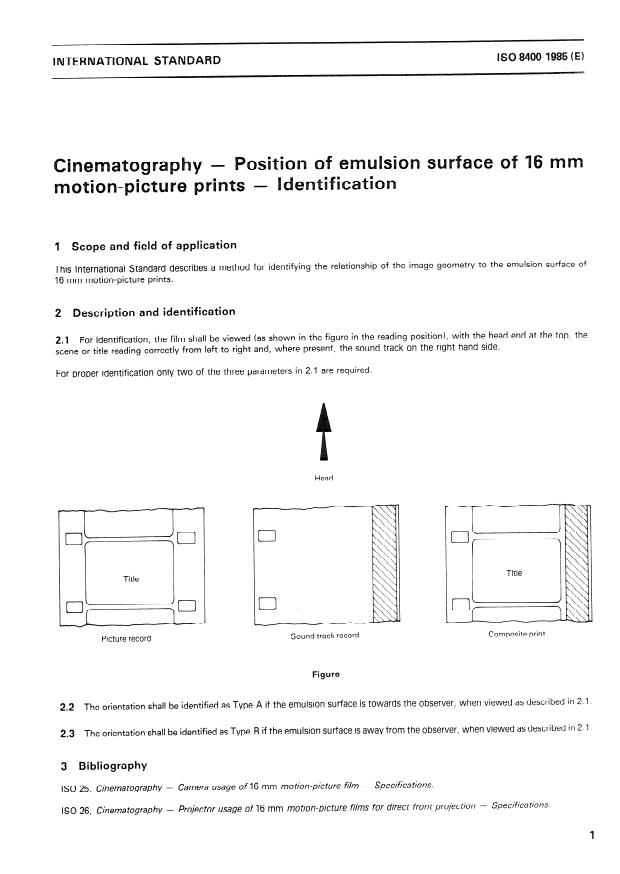
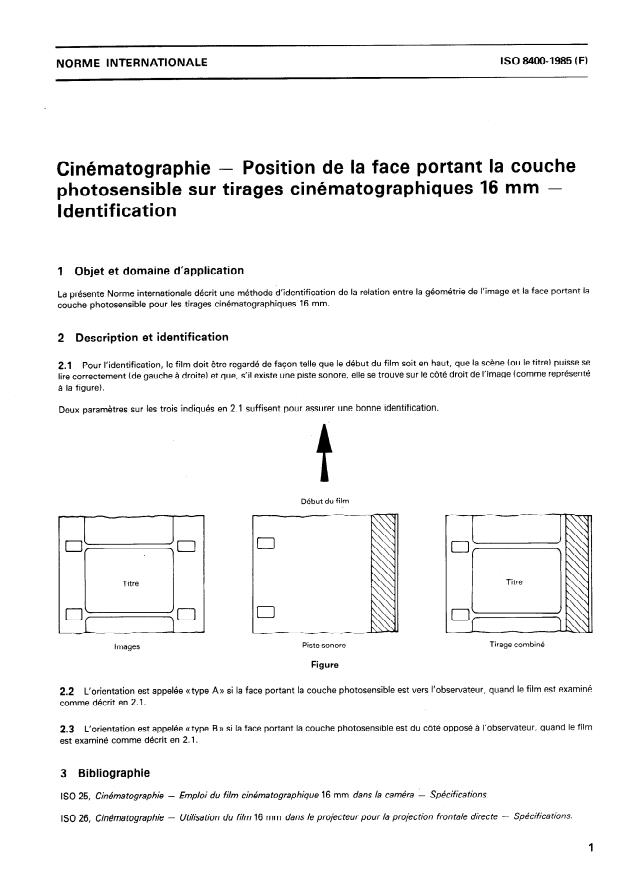
Identification Method: The standard outlines a clear procedure for inspecting 16 mm film prints. When viewed with the film's start positioned at the top and the scene or title easily readable from left to right, the sound track should be placed on the right side of the image. This orientation allows reliable determination of the emulsion surface position.
Types of Emulsion Positions:
- Type A: Emulsion surface faces the observer under the viewing conditions described.
- Type B: Emulsion surface is on the side opposite the observer.
Orientation and Labeling:
The standard recommends indicating the emulsion type on the film cassette or packaging, using clear symbols or phrases such as "Emulsion side toward lens" or "Emulsion side toward lamp" to assist projectionists and technicians in handling and projecting films correctly.Projection Considerations:
Detailed guidance is provided on how these two types affect normal front projection, specifying which surface should face the projector lens or the light source for optimal image quality.Film Processing Impact:
The emulsion type impacts how film negatives and positives are handled during duplication and printing processes. The standard includes tables summarizing typical combining methods for sound and image when producing 16 mm combined prints.
Applications
Film Production and Editing:
Producers, editors, and laboratory technicians use ISO 8400 to ensure print orientation matches the intended projection and processing methods.Projection and Exhibition:
Cinemas and projectionists rely on accurate emulsion position identification to prevent display errors caused by incorrect film orientation, ensuring consistent image quality and sound synchronization during playback.Film Archiving and Preservation:
Archivists and conservators reference this standard to catalog and store 16 mm films properly, preserving original characteristics and preventing damage due to mishandling.Technical Communication:
Equipment manufacturers, film labs, and distributors adopt this uniform method for labeling and describing 16 mm prints, facilitating international compatibility and reducing misinterpretations in film handling instructions.
Related Standards
ISO 25: Cinematography - Specifications for usage of 16 mm camera film. This standard complements ISO 8400 by defining requirements for film use within 16 mm cameras.
ISO 26: Cinematography - Specifications for 16 mm projectors for direct front projection. It supports ISO 8400 by detailing the projection equipment standards that correspond to the identified emulsion surface positions.
Summary
ISO 8400:1985 establishes a standardized approach to identifying the emulsion surface position on 16 mm motion-picture prints, a vital factor in preserving film integrity and ensuring proper projection alignment. By adopting this standard, the film industry benefits from improved interoperability, reduced errors during screening, and enhanced management of film materials throughout production and distribution chains.
Keywords: ISO 8400, 16 mm motion-picture prints, emulsion surface identification, film projection, cinematography standards, film handling, film emulsion position, ISO cinematography standards.
Buy Documents
ISO 8400:1985 - Cinematography — Position of emulsion surface of 16 mm motion-picture prints — Identification Released:4/4/1985
ISO 8400:1985 - Cinématographie — Position de la face portant la couche photosensible sur tirages cinématographiques 16 mm — Identification Released:4/4/1985
ISO 8400:1985 - Cinématographie — Position de la face portant la couche photosensible sur tirages cinématographiques 16 mm — Identification Released:4/4/1985
Frequently Asked Questions
ISO 8400:1985 is a standard published by the International Organization for Standardization (ISO). Its full title is "Cinematography — Position of emulsion surface of 16 mm motion-picture prints — Identification". This standard covers: This International Standard describes a method for identifying the relationship of the image geometry to the emulsion surface of 16 mm motion-picture prints.
This International Standard describes a method for identifying the relationship of the image geometry to the emulsion surface of 16 mm motion-picture prints.
ISO 8400:1985 is classified under the following ICS (International Classification for Standards) categories: 37.060.20 - Motion picture films. Cartridges. The ICS classification helps identify the subject area and facilitates finding related standards.
ISO 8400:1985 is available in PDF format for immediate download after purchase. The document can be added to your cart and obtained through the secure checkout process. Digital delivery ensures instant access to the complete standard document.
Standards Content (Sample)
INTERNATIONAL ORGANIZATION FOR STANDARDIZATION*ME)KJIYHAPO~HAR OPrAHM3AL&lR fl0 CTAHL1APTM3ALWlVl~ORGANISATlON INTERNATIONALE DE NORMALISATION
Position de Ia face portant la couche photosensible sur tirages cinkma tographiques 16 mm - lden tifica tion
Cinema tographie -
First edition - 1985-04-01
UQC 778.5 Wef. No. BSQ 84004985 (E)
Descriptors : cinematography, motion-picture film, motion-picture film 16 mm, photographic emulsions, Position (location).
Price based on 2 paqes
orewor
ISO (the International Organization for Standardization) is a worldwide federation of
national Standards bodies HS0 member bedies). The work of preparing lnternational
Standards is normally carried out through ISO technical committees. Esch member
body interested in a subject for which a technical committee has been established has
the right to be represented on that committee. International organizations, govern-
mental and non-governmental, in liaison with ISO, also take part in the work.
Draft International Standards adopted by the technical committees are circulated to
the member bodies for approval before their acceptance as International Standards by
the ISO Council. They are approved in accordance with ISO procedures requiring at
least 75 % approval by the member bodies voting.
International Standard ISO 8400 was prepared by Vechnical Committee ISO/TC 36,
Cinema tograph y.
0 International Organkation dar Standardkation, 1985 0
Printed in Switzerland
ce 0
1 Scope and field of application
This International Standard describes a method for identifying the relationship of the image geometry to the emulsion surface of
16 mm motion-picture prints.
2 Description and identification
with the head end at the top, the
2.1 For identification, the film shall be viewed (as shown in the figure in the reading Position),
the Sound track on the right hand side.
Scene or title reading correctly from left to right and, where present,
For proper identification only two of the three Parameters in 2.1 are required.
Head
Composite print
Picture record Sound trab record
Figure
when viewed as described in 2.1.
2.
...
Norme internationale
INTERNATIONAL ORGANIZATION FOR STANDARDIZATION.MEX,IJYHAPOAHAfi OPrAHM3AQMR Il0 CTAH~APTM3A~MM.ORGANlSATlON INTERNATIONALE DE NORMALISATION
Cinématographie - Position de la face portant la couche
photosensible sur tirages cinématographiques 16 mm -
Identification
Cinema tograph y - Position of emulsion surface of 16 mm motion-picture prints - Identification
Première édition - 1985-04-01
Réf. no : ISO 84004985 (FI
CDU 778.5
Descripteurs : cinématographie, film cinématographique, film cinématographique 16 mm, émulsion photographique,. position.
Prix basé sur 2 pages
Avant-propos
LYS0 (Organisation internationale de normalisation) est une fédération mondiale
d’organismes nationaux de normalisation (comités membres de I’ISO). L’élaboration
des Normes internationales est confiée aux comités techniques de I’ISO. Chaque
comité membre intéressé par une étude a le droit de faire partie du comité technique
créé à cet effet. Les organisations internationales, gouvernementales et non gouverne-
mentales, en liaison avec I’ISO, participent également aux travaux.
Les projets de Normes internationales adoptés par les comités techniques sont soumis
aux comités membres pour approbation, avant leur acceptation comme Normes inter-
nationales par le Conseil de I’ISO. Les Normes internationales sont approuvées confor-
mément aux procédures de I’ISO qui requièrent l’approbation de 75 % au moins des
comités membres votants.
La Norme internationale ISO 8400 a été élaborée par le comité technique ISO/TC 36,
Cinématographie.
0 Organisation internationale de normalisation, 1985
Imprimé en Suisse
ISO 8400-1985 (FI
NORME INTERNATIONALE
Position de la face portant la couche
Cinématographie -
photosensible sur tirages cinématographiques 16 mm -
Identification
1 Objet et domaine d’application
La présente Norme internationale décrit une méthode d’identification de la relation entre la géométrie de l’image et la face portant la
couche photosensible pour les tirages cinématographiques 16 mm.
2 Description et identification
2.1 Pour l’identification, le film doit être regardé de facon telle que le début du film soit en haut, que la scène (ou le titre) puisse se
(comme représenté
lire correctement (de gauche à droite) et que, s’il existe une piste sonore, elle se trouve sur le côté droit de l’image
à la figure).
Deux paramètres sur les trois indiqués en 2.1 suffisent pour assurer une bonne identification.
t
Début du film
Piste sonore Tirage combiné
Images
Figure
2.2 L’orientation est appelée ((type A» si la face portant la couche photosensible est vers l’observateur,. quand le film est
...
Norme internationale
INTERNATIONAL ORGANIZATION FOR STANDARDIZATION.MEX,IJYHAPOAHAfi OPrAHM3AQMR Il0 CTAH~APTM3A~MM.ORGANlSATlON INTERNATIONALE DE NORMALISATION
Cinématographie - Position de la face portant la couche
photosensible sur tirages cinématographiques 16 mm -
Identification
Cinema tograph y - Position of emulsion surface of 16 mm motion-picture prints - Identification
Première édition - 1985-04-01
Réf. no : ISO 84004985 (FI
CDU 778.5
Descripteurs : cinématographie, film cinématographique, film cinématographique 16 mm, émulsion photographique,. position.
Prix basé sur 2 pages
Avant-propos
LYS0 (Organisation internationale de normalisation) est une fédération mondiale
d’organismes nationaux de normalisation (comités membres de I’ISO). L’élaboration
des Normes internationales est confiée aux comités techniques de I’ISO. Chaque
comité membre intéressé par une étude a le droit de faire partie du comité technique
créé à cet effet. Les organisations internationales, gouvernementales et non gouverne-
mentales, en liaison avec I’ISO, participent également aux travaux.
Les projets de Normes internationales adoptés par les comités techniques sont soumis
aux comités membres pour approbation, avant leur acceptation comme Normes inter-
nationales par le Conseil de I’ISO. Les Normes internationales sont approuvées confor-
mément aux procédures de I’ISO qui requièrent l’approbation de 75 % au moins des
comités membres votants.
La Norme internationale ISO 8400 a été élaborée par le comité technique ISO/TC 36,
Cinématographie.
0 Organisation internationale de normalisation, 1985
Imprimé en Suisse
ISO 8400-1985 (FI
NORME INTERNATIONALE
Position de la face portant la couche
Cinématographie -
photosensible sur tirages cinématographiques 16 mm -
Identification
1 Objet et domaine d’application
La présente Norme internationale décrit une méthode d’identification de la relation entre la géométrie de l’image et la face portant la
couche photosensible pour les tirages cinématographiques 16 mm.
2 Description et identification
2.1 Pour l’identification, le film doit être regardé de facon telle que le début du film soit en haut, que la scène (ou le titre) puisse se
(comme représenté
lire correctement (de gauche à droite) et que, s’il existe une piste sonore, elle se trouve sur le côté droit de l’image
à la figure).
Deux paramètres sur les trois indiqués en 2.1 suffisent pour assurer une bonne identification.
t
Début du film
Piste sonore Tirage combiné
Images
Figure
2.2 L’orientation est appelée ((type A» si la face portant la couche photosensible est vers l’observateur,. quand le film est
...