

ISO/TR 9769:2018
(Main)Steel and iron — Review of available methods of analysis
General Information
- Abstract
This document gives guidelines for the determination of the chemical composition of steel and iron by reference to published International Standards, including their range of application and principles of the methods. Graphical representation of the precision data precision data for the methods is given in Annex A. The list of International Standards is summarized in Annex B.
- Status
- Published
- Publication Date
- 12-Dec-2018
- Technical Committee
- ISO/TC 17/SC 1 - Methods of determination of chemical composition
- Drafting Committee
- ISO/TC 17/SC 1 - Methods of determination of chemical composition
- Current Stage
- 6060 - International Standard published
- Start Date
- 13-Dec-2018
- Completion Date
- 29-Aug-2026
Buy Documents


ISO/TR 9769:2018 - Steel and iron — Review of available methods of analysis Released:12/13/2018

ISO/TR 9769:2018 - Steel and iron — Review of available methods of analysis/13/2018
Overview
ISO/TR 9769:2018 - Steel and iron: Review of available methods of analysis is a Technical Report from ISO/TC 17 that compiles and summarizes published International Standards for determining the chemical composition of steel and iron. The document lists mono‑elemental and multi‑elemental analytical methods, states their range of application and principles, and provides precision information (graphically in Annex A) and a summary listing of referenced standards (in Annex B). This fourth edition updates earlier editions to reflect current standardized methods for elemental analysis in steel and iron.
Key topics
- Scope and purpose: Guidelines for determining chemical composition of steel and iron by reference to ISO standards.
- Mono‑elemental methods: Element‑by‑element review (examples in the report include aluminium, antimony, arsenic, boron, calcium, carbon, chromium, nickel, sulfur, silicon, etc.). For each element the report gives:
- applicable ISO document reference,
- range of application (mass fraction limits where provided),
- principle of the method (e.g., flame atomic absorption spectrometry, electrothermal AAS, spectrophotometry, infrared absorption after combustion).
- Multi‑elemental methods: Overview of combined analyses for groups of elements using techniques suitable for simultaneous determination.
- Precision and traceability: Annex A provides graphical representations of precision data; Annex B summarizes referenced International Standards.
- Terminology: Definitions relevant to routine methods and calibration practices.
Practical applications
ISO/TR 9769:2018 is a practical reference for professionals who need to select or compare standardized analytical methods for steel and iron composition:
- Metallurgical and steel production laboratories - choose appropriate standardized methods for process control and product certification.
- Independent testing and inspection labs - verify method suitability and trace precision/limits for requested analyses.
- Quality assurance / QC managers - define routine methods, sampling and calibration strategies in contracts and internal procedures.
- Standards developers and regulators - reference for harmonizing test method requirements in specifications and procurement.
- Materials engineers and R&D teams - select methods for alloy development and failure analysis.
Related standards & resources
- Annex B of ISO/TR 9769 lists the specific ISO standards for each element (e.g., ISO 9658 for aluminium by flame AAS; ISO 10698 for antimony by electrothermal AAS; ISO 9556 for carbon by IR after combustion).
- Precision data and method comparison are provided in Annex A to support method selection and performance expectation.
Keywords: ISO/TR 9769:2018, steel analysis, chemical composition, methods of analysis, atomic absorption, spectrophotometric, infrared absorption, multi‑elemental methods, precision data.
Relations
- Referred By
EN 13261:2020 - Railway applications - Wheelsets and bogies - Axles - Product requirements - Effective Date
- 25-Aug-2026
- Effective Date
- 25-Aug-2026
- Effective Date
- 25-Aug-2026
- Referred By
EN 13262:2020 - Railway applications - Wheelsets and bogies - Wheels - Product requirements - Effective Date
- 01-Jul-2026
- Referred By
EN 13261:2024 - Railway applications - Wheelsets and bogies - Axles - Product requirements - Effective Date
- 06-May-2026
- Effective Date
- 15-Apr-2026
- Effective Date
- 06-Jun-2022
- Effective Date
- 21-Oct-2017
Buy Documents
ISO/TR 9769:2018 - Steel and iron — Review of available methods of analysis Released:12/13/2018
ISO/TR 9769:2018 - Steel and iron — Review of available methods of analysis/13/2018
Get Certified
Connect with accredited certification bodies for this standard

Element Materials Technology
Materials testing and product certification.

Inštitut za kovinske materiale in tehnologije
Institute of Metals and Technology. Materials testing, metallurgical analysis, NDT.
Sponsored listings
Frequently Asked Questions
ISO/TR 9769:2018 is a technical report published by the International Organization for Standardization (ISO). Its full title is "Steel and iron — Review of available methods of analysis". This standard covers: This document gives guidelines for the determination of the chemical composition of steel and iron by reference to published International Standards, including their range of application and principles of the methods. Graphical representation of the precision data precision data for the methods is given in Annex A. The list of International Standards is summarized in Annex B.
This document gives guidelines for the determination of the chemical composition of steel and iron by reference to published International Standards, including their range of application and principles of the methods. Graphical representation of the precision data precision data for the methods is given in Annex A. The list of International Standards is summarized in Annex B.
ISO/TR 9769:2018 is classified under the following ICS (International Classification for Standards) categories: 77.080.01 - Ferrous metals in general. The ICS classification helps identify the subject area and facilitates finding related standards.
ISO/TR 9769:2018 has the following relationships with other standards: It is inter standard links to EN 13261:2020, EN ISO 683-3:2019, EN ISO 683-5:2021, EN 13262:2020, EN 13261:2024, EN ISO 683-3:2022, ISO 5167-5:2022, ISO/TR 9769:1991. Understanding these relationships helps ensure you are using the most current and applicable version of the standard.
ISO/TR 9769:2018 is available in PDF format for immediate download after purchase. The document can be added to your cart and obtained through the secure checkout process. Digital delivery ensures instant access to the complete standard document.
Standards Content (Sample)
TECHNICAL ISO/TR
REPORT 9769
Fourth edition
2018-12
Steel and iron — Review of available
methods of analysis
Aciers et fontes — Vue d'ensemble des méthodes d'analyse disponibles
Reference number
©
ISO 2018
© ISO 2018
All rights reserved. Unless otherwise specified, or required in the context of its implementation, no part of this publication may
be reproduced or utilized otherwise in any form or by any means, electronic or mechanical, including photocopying, or posting
on the internet or an intranet, without prior written permission. Permission can be requested from either ISO at the address
below or ISO’s member body in the country of the requester.
ISO copyright office
CP 401 • Ch. de Blandonnet 8
CH-1214 Vernier, Geneva
Phone: +41 22 749 01 11
Fax: +41 22 749 09 47
Email: copyright@iso.org
Website: www.iso.org
Published in Switzerland
ii © ISO 2018 – All rights reserved
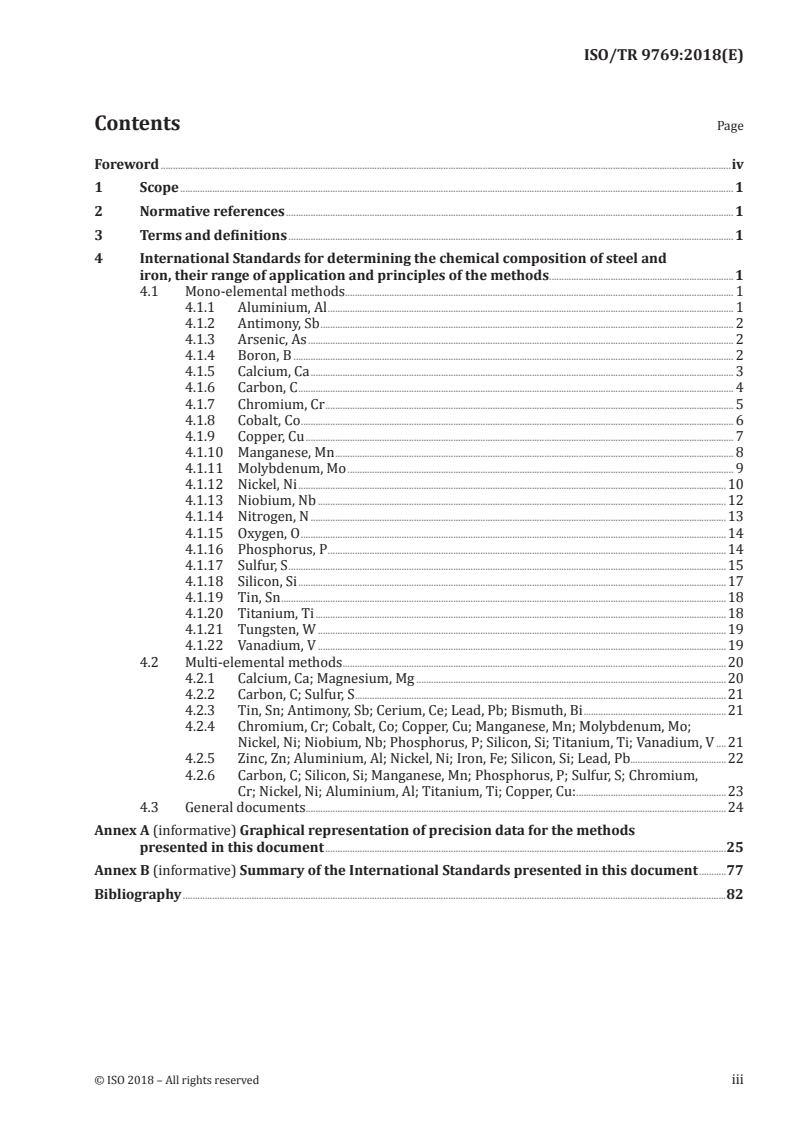
Contents Page
Foreword .iv
1 Scope . 1
2 Normative references . 1
3 Terms and definitions . 1
4 International Standards for determining the chemical composition of steel and
iron, their range of application and principles of the methods . 1
4.1 Mono-elemental methods. 1
4.1.1 Aluminium, Al . 1
4.1.2 Antimony, Sb . 2
4.1.3 Arsenic, As . 2
4.1.4 Boron, B . 2
4.1.5 Calcium, Ca . 3
4.1.6 Carbon, C . 4
4.1.7 Chromium, Cr . 5
4.1.8 Cobalt, Co . 6
4.1.9 Copper, Cu . 7
4.1.10 Manganese, Mn . 8
4.1.11 Molybdenum, Mo . 9
4.1.12 Nickel, Ni .10
4.1.13 Niobium, Nb .12
4.1.14 Nitrogen, N .13
4.1.15 Oxygen, O .14
4.1.16 Phosphorus, P .14
4.1.17 Sulfur, S .15
4.1.18 Silicon, Si .17
4.1.19 Tin, Sn .18
4.1.20 Titanium, Ti .18
4.1.21 Tungsten, W .19
4.1.22 Vanadium, V .19
4.2 Multi-elemental methods .20
4.2.1 Calcium, Ca; Magnesium, Mg .20
4.2.2 Carbon, C; Sulfur, S .21
4.2.3 Tin, Sn; Antimony, Sb; Cerium, Ce; Lead, Pb; Bismuth, Bi .21
4.2.4 Chromium, Cr; Cobalt, Co; Copper, Cu; Manganese, Mn; Molybdenum, Mo;
Nickel, Ni; Niobium, Nb; Phosphorus, P; Silicon, Si; Titanium, Ti; Vanadium, V .21
4.2.5 Zinc, Zn; Aluminium, Al; Nickel, Ni; Iron, Fe; Silicon, Si; Lead, Pb . .22
4.2.6 Carbon, C; Silicon, Si; Manganese, Mn; Phosphorus, P; Sulfur, S; Chromium,
Cr; Nickel, Ni; Aluminium, Al; Titanium, Ti; Copper, Cu: .23
4.3 General documents.24
Annex A (informative) Graphical representation of precision data for the methods
presented in this document .25
Annex B (informative) Summary of the International Standards presented in this document .77
Bibliography .82
Foreword
ISO (the International Organization for Standardization) is a worldwide federation of national standards
bodies (ISO member bodies). The work of preparing International Standards is normally carried out
through ISO technical committees. Each member body interested in a subject for which a technical
committee has been established has the right to be represented on that committee. International
organizations, governmental and non-governmental, in liaison with ISO, also take part in the work.
ISO collaborates closely with the International Electrotechnical Commission (IEC) on all matters of
electrotechnical standardization.
The procedures used to develop this document and those intended for its further maintenance are
described in the ISO/IEC Directives, Part 1. In particular, the different approval criteria needed for the
different types of ISO documents should be noted. This document was drafted in accordance with the
editorial rules of the ISO/IEC Directives, Part 2 (see www .iso .org/directives).
Attention is drawn to the possibility that some of the elements of this document may be the subject of
patent rights. ISO shall not be held responsible for identifying any or all such patent rights. Details of
any patent rights identified during the development of the document will be in the Introduction and/or
on the ISO list of patent declarations received (see www .iso .org/patents).
Any trade name used in this document is information given for the convenience of users and does not
constitute an endorsement.
For an explanation of the voluntary nature of standards, the meaning of ISO specific terms and
expressions related to conformity assessment, as well as information about ISO's adherence to the
World Trade Organization (WTO) principles in the Technical Barriers to Trade (TBT) see www .iso
.org/iso/foreword .html.
This document was prepared by Technical Committee ISO/TC 17, Steel, Subcommittee SC 1, Methods of
determination of chemical composition.
This fourth edition cancels and replaces the third edition (ISO/TR 9769:1991), which has been
technically revised to update all the standard methods for the determination of chemical composition
of steel and iron.
Any feedback or questions on this document should be directed to the user’s national standards body. A
complete listing of these bodies can be found at www .iso .org/members .html.
iv © ISO 2018 – All rights reserved
TECHNICAL REPORT ISO/TR 9769:2018(E)
Steel and iron — Review of available methods of analysis
1 Scope
This document gives guidelines for the determination of the chemical composition of steel and iron by
reference to published International Standards, including their range of application and principles of
the methods.
Graphical representation of the precision data precision data for the methods is given in Annex A.
The list of International Standards is summarized in Annex B.
2 Normative references
There are no normative references in this document.
3 Terms and definitions
For the purposes of this document, the following terms and definitions apply.
ISO and IEC maintain terminological databases for use in standardization at the following addresses:
— ISO Online browsing platform: available at https: //www .iso .org/obp
— IEC Electropedia: available at http: //www .electropedia .org/
3.1
routine method
method calibrated against reference materials, certified reference materials or against standard
solutions commercially available that is widely used for control purposes (day-to-day analysis)
4 International Standards for determining the chemical composition of steel and
iron, their range of application and principles of the methods
4.1 Mono-elemental methods
4.1.1 Aluminium, Al
Document: ISO 9658:1990, Steel — Determination of aluminium content — Flame atomic absorption
spectrometric method.
Range of application:
— determination of acid-soluble and/or total aluminium contents between a mass fraction of
0,005 % and a mass fraction of 0,20 % in non-alloyed steel.
Principle of the method:
a) dissolution of a test portion in dilute hydrochloric and nitric acids;
b) fusion of the acid-insoluble material with a mixture of orthoboric acid and potassium carbonate;
c) spraying of the solution into a dinitrogen monoxide-acetylene flame;
d) spectrometric measurement of the atomic absorption of the 309,3 nm spectral line emitted by an
aluminium hollow cathode lamp.
4.1.2 Antimony, Sb
Document: ISO 10698:1994, Steel — Determination of antimony content — Electrothermal atomic
absorption spectrometric method.
Range of application:
— determination of the antimony content between a mass fraction of 0,000 5 % and a mass fraction of
0,010 % in steel.
Principle of the method:
a) dissolution of a test portion in hydrochloric and nitric acids and dilution of the solution to a
known volume;
b) introduction of a known volume of the solution into an electrothermal atomizer of an atomic
absorption spectrometer;
c) measurement of the atomic absorption of the 217,6 nm spectral resonance line energy emitted by
an antimony lamp, using background correction;
d) calibration by the standard additions technique.
4.1.3 Arsenic, As
Document: ISO 17058:2004, Steel and iron — Determination of arsenic content — Spectrophotometric
method.
Range of application:
— determination of the arsenic content between 0,000 5 % (mass fraction) and 0,10 % (mass fraction)
in steel and iron.
Principle of the method:
a) dissolution of a test portion in a hydrochloric acid and nitric acid mixture;
b) prolonged heating with sulfuric acid until white fumes are given off;
c) reduction of arsenic in the presence of hydrazine sulfate and potassium bromide, then separation
by distillation as the trivalent chloride, absorbed in the nitric acid solution, in which the As(III) is
oxidized back to the pentavalent state As(V);
d) formation of the molybdenum blue complex between ammonium molybdate and arsenic, which is
reduced by hydrazine sulfate;
e) spectrophotometric measurement at a wavelength of approximately 840 nm.
4.1.4 Boron, B
4.1.4.1 Document: ISO 10153:1997, Steel — Determination of boron content — Curcumin
spectrophotometric method.
Range of application:
— determination of the boron content between a mass fraction of 0,000 1 % and a mass fraction of
0,000 5 % only in unalloyed steel, and between a mass fraction of 0,000 5 % and a mass fraction of
0,012 % in steel.
2 © ISO 2018 – All rights reserved
Principle of the method:
a) dissolution of a test portion in hydrochloric and nitric acids;
b) decomposition of boron compounds (nitrides etc.) with orthophosphoric and sulfuric acids at a
temperature of 290 °C;
c) formation of a coloured complex between orthoboric acid and curcumin in a buffered acetic medium;
d) spectrophotometric measurement at a wavelength of about 543 nm.
4.1.4.2 Document: ISO 13900:1997, Steel — Determination of boron content — Curcumin
spectrophotometric method after distillation.
Range of application:
— determination of the boron content between a mass fraction of 0,000 05 % and a mass fraction of
0,001 0 % in steel.
Principle of the method:
a) dissolution of a test portion in hydrochloric and nitric acids;
b) decomposition of boron compounds (nitrides etc.) with orthophosphoric and sulfuric acids at a
temperature of 290 °C;
c) distillation of the solution after the addition of methanol and collection of methylborate in a
receiver containing sodium hydroxide solution;
d) evaporation of the solution to dryness; formation of a coloured complex between orthoboric acid
and curcumin in a methanol medium;
e) spectrophotometric measurement at a wavelength of about 550 nm.
4.1.5 Calcium, Ca
4.1.5.1 Document: ISO 10697-1:1992, Steel — Determination of calcium content by flame atomic
absorption spectrometry — Part 1: Determination of acid-soluble calcium content.
Range of application:
— determination of acid-soluble calcium content between a mass fraction of 0,000 5 % and a mass
fraction of 0,003 % in steel.
Principle of the method:
a) dissolution of a test portion in hydrochloric and nitric acids;
b) addition of potassium chloride/lanthanum nitrate solution as a spectrochemical buffer;
c) spraying of the solution into a dinitrogen monoxide-acetylene flame;
d) spectrometric measurement of the atomic absorption of the 422,7 nm spectral line emitted by a
calcium hollow cathode lamp.
4.1.5.2 Document: ISO 10697-2:1994, Steel — Determination of calcium content by flame atomic
absorption spectrometry — Part 2: Determination of total calcium content.
Range of application:
— determination of the total calcium content between a mass fraction of 0,000 5 % and a mass fraction
of 0,005 % in steel.
Principle of the method:
a) dissolution of a test portion in hydrochloric and nitric acids;
b) fusion of the acid-insoluble residue with sodium carbonate;
c) addition of potassium chloride/lanthanum nitrate solution as a spectrochemical buffer;
d) spraying of the solution into a dinitrogen monoxide-acetylene flame;
e) spectrometric measurement of the atomic absorption of the 422,7 nm spectral line emitted by a
calcium hollow cathode lamp.
4.1.6 Carbon, C
4.1.6.1 Document: ISO 9556:1989, Steel and iron — Determination of total carbon content — Infrared
absorption method after combustion in an induction furnace.
Range of application:
— determination of the total carbon content between a mass fraction of 0,003 % and a mass fraction
of 4,5 % in steel and iron.
Principle of the method:
a) combustion of a test portion with accelerator at a high temperature in a high-frequency induction
furnace in a current of pure oxygen; transformation of carbon into carbon dioxide and/or carbon
monoxide;
b) measurement by infrared absorption of the carbon dioxide and/or carbon monoxide carried by a
current of oxygen.
4.1.6.2 Document: ISO 15349-2:1999, Unalloyed steel — Determination of low carbon content — Part 2:
Infrared absorption method after combustion in an induction furnace (with preheating).
Range of application:
— determination of the carbon contents between a mass fraction of 0,000 3 % and a mass fraction of
0,010 % in unalloyed steel.
Principle of the method:
a) preheating of a test portion at low temperature and combustion of a test portion with accelerator at
a high temperature in an induction furnace in a current of pure oxygen; transformation of carbon
into carbon dioxide and/or carbon monoxide;
b) measurement of infrared absorption of the carbon dioxide or carbon dioxide/carbon monoxide
evolved from steel and carried by a current of pure oxygen;
c) calibration graph is established using sucrose or calcium carbonate.
4.1.6.3 Document: ISO/TS 10719:2016, Cast irons — Determination of non-combined carbon content —
lnfrared absorption method after combustion in an induction furnace.
Range of application:
— determination of non-combined carbon content between a mass fraction of 1,0 % and a mass fraction
of 3,0 % in cast irons.
NOTE Elements ordinarily present do not interfere. However, some alloyed cast irons, when extensively
heat treated, contain carbides that are not soluble when using this method and can give high values for non-
combined carbon.
4 © ISO 2018 – All rights reserved
Principle of the method:
a) decomposition of a test portion with nitric acid in the presence of methanol and treatment with
hydrofluoric acid; removal of the non-combined carbon by filtering through a glass-fibre filter;
b) combustion of the glass-fibre filter containing the non-combined carbon in a flow of oxygen at a
high temperature, using a high-frequency induction furnace, in the presence of pure iron and an
accelerator; transformation of carbon into carbon dioxide and/or carbon monoxide;
c) measurement by infrared absorption of the carbon dioxide and/or carbon monoxide, carried by the
current of oxygen.
4.1.7 Chromium, Cr
4.1.7.1 Document: ISO 4937:1986, Steel and iron — Determination of chromium content —
Potentiometric or visual titration method.
Range of application:
— determination of chromium contents between a mass fraction of 0,25 % and a mass fraction of 35 %
in steel and iron.
NOTE If vanadium is present, the visual titration is applicable only to test portions containing less than 3 mg
of vanadium.
Principle of the method:
a) dissolution of a test portion with appropriate acids;
b) oxidation of chromium in an acid medium to chromium(Vl) by ammonium peroxydisulfate in the
presence of silver sulfate; reduction of manganese(VII) by hydrochloric acid;
c) reduction of chromium(VI) by ammonium iron(ll) sulfate standard solution;
d) in the case of potentiometric detection, determination of the equivalence point by measurement of
the potential variation when the ammonium iron(ll) sulfate standard solution is being added;
e) in the case of visual detection, titration of the excess ammonium iron(ll) sulfate by potassium
permanganate standard solution, which also acts as the indicator.
4.1.7.2 Document: ISO 10138:1991, Steel and iron — Determination of chromium content — Flame
atomic absorption spectrometric method.
Range of application:
— determination of chromium contents between a mass fraction of 0,002 % and a mass fraction of
2,0 % in non-alloy and low-alloy steels and iron.
Principle of the method:
a) dissolution of a test portion in hydrochloric acid, followed by oxidation with nitric acid;
b) filtration and ignition of the acid insoluble residue; removal of silica with hydrofluoric acid;
c) fusion of the residue with potassium hydrogen sulfate, extraction of the melt in acid and addition of
the extract to the reserved filtrate;
d) spraying the solution into a dinitrogen monoxide-acetylene flame;
e) spectrometric measurement of the atomic absorption of the 357,9 nm or 425,4 nm spectral line
emitted by a chromium hollow cathode lamp.
4.1.7.3 Document: ISO 15355:1999, Steel and iron — Determination of chromium content — Indirect
titration method.
Range of application:
— determination of chromium content between a mass fraction of 1 % and a mass fraction of 35 % in
steel and iron.
Vanadium contents in steel and iron should be less than a mass fraction of 1 % for chromium contents
higher than a mass fraction of 10 % and less than a mass fraction of 0,2 % for chromium contents less
than a mass fraction of 10 %.
Principle of the method:
a) fusion of the sample with sodium peroxide followed by acidification with sulfuric acid;
b) oxidization of chromium(III) to dichromate with peroxodisulfate using silver as a catalyst;
c) reduction of the dichromate with an excess of a solid iron(II) salt and potentiometric back titration
of the excess with a dichromate solution;
d) any interference from vanadium is corrected mathematically.
4.1.8 Cobalt, Co
4.1.8.1 Document: ISO 11652:1997, Steel and iron — Determination of cobalt content — Flame atomic
absorption spectrometric method.
Range of application:
— determination of the cobalt content between a mass fraction of 0,003 % and a mass fraction of 5,0 %
in steel and iron.
Principle of the method:
a) dissolution of a test portion in hydrochloric, nitric and perchloric acids;
b) spraying of the solution into an air-acetylene flame;
c) spectrometric measurement of the atomic absorption of the 240,7 nm spectral line emitted by a
cobalt hollow cathode lamp.
4.1.8.2 Document: ISO 11653:1997, Steel — Determination of high cobalt content — Potentiometric
titration method after separation by ion exchange.
Range of application:
— determination of cobalt content between a mass fraction of 5,0 % and a mass fraction of 17,0 % in steel.
Principle of the method:
a) dissolution of a test portion in a mixture of nitric and hydrochloric acids;
b) separation of cobalt from interfering elements by selective elusion from an anion exchange column
using hydrochloric acid;
c) oxidation with perchloric acid; removal of dissolved chlorine and oxygen with a stream of nitrogen;
d) addition of the test solution to a solution containing ammonium citrate, ammonium hydroxide and
an excess of potassium hexacyanoferrate(lll) standard solution and titration of the excess with a
standard cobalt solution using potentiometric end-point detection.
6 © ISO 2018 – All rights reserved
4.1.8.3 Document: ISO 13898-4:1997, Steel and iron — Determination of nickel, copper and cobalt
contents — Inductively coupled plasma atomic emission spectrometric method — Part 4: Determination of
cobalt content.
Range of application:
— determination of cobalt content between a mass fraction of 0,001 % and a mass fraction of 0,10 %
in unalloyed steel and unalloyed iron.
Principle of the method:
a) dissolution of a test portion in a mixture of hydrochloric and nitric acids and dilution of the solution
to known volume;
b) if necessary, addition of scandium or yttrium as internal standard;
c) nebulization of the solution into an inductively coupled plasma atomic emission spectrometer (ICP-
AES) and measurement of the intensity of the emitted light from each element, or with emitted
light from scandium or yttrium, simultaneously; examples of the analytical lines are given in
ISO 13898-1:1997, Table 2.
4.1.9 Copper, Cu
4.1.9.1 Document: ISO 4943:1985, Steel and cast iron — Determination of copper content — Flame
atomic absorption spectrometric method.
Range of application:
— determination of copper contents in the range of a mass fraction of 0,004 % to a mass fraction of
0,5 % in steel and cast iron.
Principle of the method:
a) dissolution of a test portion in a mixture of hydrochloric, nitric and perchloric acids;
b) spraying of the solution into an air-acetylene flame; spectrometric measurement of the atomic
absorption of the 324,7 nm spectral line emitted by a copper hollow cathode lamp.
4.1.9.2 Document: ISO 4946:2016, Steel and cast iron — Determination of copper — 2,2'-Biquinoline
spectrophotometric method.
Range of application:
— determination of copper mass fraction in the range of 0,02 % and 5 % in steel and cast iron.
Principle of the method:
a) dissolution of a test portion in appropriate acids;
b) fuming with perchloric acid to remove hydrochloric and nitric acids and dehydrate silicic acid;
c) reduction of copper(II) to copper(I) in hydrochloric acid solution by means of ascorbic acid;
formation of a coloured compound of copper(I) with 2,2′-biquinoline;
d) spectrophotometric measurement at a wavelength of about 545 nm.
4.1.9.3 Document: ISO 13898-3:1997, Steel and iron — Determination of nickel, copper and cobalt
contents — Inductively coupled plasma atomic emission spectrometric method — Part 3: Determination of
copper content.
Range of application:
— determination of copper content between a mass fraction of 0,001 % and a mass fraction of 0,40 %
in unalloyed steel and unalloyed iron.
Principle of the method:
a) dissolution of a test portion in a mixture of hydrochloric and nitric acids and dilution of the solution
to known volume;
b) if necessary, addition of scandium or yttrium as internal standard;
c) nebulization of the solution into an ICP-AES and measurement of the intensity of the emitted light
from each element, or with emitted light from scandium or yttrium, simultaneously; examples of
the analytical lines are given in ISO 13898-1:1997, Table 2.
4.1.10 Manganese, Mn
4.1.10.1 Document: ISO 629:1982, Steel and cast iron — Determination of manganese content —
Spectrophotometric method.
Range of application:
— determination of manganese contents between a mass fraction of 0,001 % and a mass fraction of
4 % in steel and cast iron.
Principle of the method:
a) dissolution of a test portion in sulfuric-phosphoric acid mixture and nitric acid; treatment of the
test solution with perchloric acid; formation of the permanganate ion by sodium periodate;
b) spectrophotometric measurement of the test solution at wavelength of about 545 nm.
4.1.10.2 Document: ISO 10700:1994, Steel and iron — Determination of manganese content — Flame
atomic absorption spectrometric method.
Range of application:
— determination of manganese content between a mass fraction of 0,002 % and a mass fraction of
2,0 % in steel and iron.
Principle of the method:
a) dissolution of a test portion in hydrochloric and nitric acids followed by evaporation with perchloric
acid until white fumes appear;
b) spraying of the solution into an air-acetylene flame;
c) spectrometric measurement of the atomic absorption of the 279,5 nm spectral line emitted by a
manganese hollow cathode lamp.
8 © ISO 2018 – All rights reserved
4.1.10.3 Document: ISO 10278:1995, Steel — Determination of manganese content — Inductively coupled
plasma atomic emission spectrometric method.
Range of application:
— determination of the manganese content between a mass fraction of 0,002 % and a mass fraction of
1,5 % in unalloyed steels.
Principle of the method:
a) dissolution of a test portion in a mixture of hydrochloric and nitric acids and dilution of the solution
to a known volume;
b) if necessary, addition of scandium or yttrium as an internal standard;
c) nebulization of the solution into an ICP-AES and measurement of the intensity of the emitted light
from manganese at 257,61 nm and, optionally, emitted light from scandium at 361,38 nm or yttrium
at 371,03 nm, simultaneously.
4.1.10.4 Document: ISO 18632:2018, Alloyed steels — Determination of manganese — Potentiometric or
visual titration method.
Range of application:
— determination of the mass fraction of manganese between 2 % and 25 % in alloyed steels.
NOTE Vanadium and cerium interfere with the determination. If the mass fraction of cerium in the sample
is less than 0,01 %, or the mass fraction of vanadium in the sample is less than 0,005 %, the interference is
negligible, otherwise theoretical corrections are necessary.
Principle of the method:
a) dissolution of a test portion in appropriate acids;
b) addition of phosphoric acid; oxidation of manganese to manganese(III) in phosphoric acid medium
with ammonium nitrate;
c) visual titration of manganese(III) with ferroammoniumdisulfate standard solution with
N-phenylanthranilic acid as the indicator;
d) alternatively, potentiometric titration with ferroammoniumdisulfate standard solution; if the
sample contains vanadium and cerium, the mass fraction of manganese is corrected.
4.1.11 Molybdenum, Mo
4.1.11.1 Document: ISO 4941:1994, Steel and iron — Determination of molybdenum content —
Thiocyanate spectrophotometric method.
Range of application:
— determination of the molybdenum content between a mass fraction of 0,005 % and a mass fraction
of 0,125 % in steel and iron.
NOTE 1 Vanadium and tungsten interfere with the measurement if, because of their contents, the V/Mo ratio
is greater than 16 or the W/Mo ratio is greater than 8 (see NOTE 2).
NOTE 2 Greater V/Mo or W/Mo ratios (up to 300) can occur, but in such cases it is necessary to carry out the
measurement very quickly after the extraction.
Principle of the method:
a) dissolution of a test portion in an appropriate mixture of acids and decomposition of the carbides
by oxidation;
b) quantitative formation of a coloured compound of molybdenum, in the presence of thiocyanate,
iron(ll) and/or copper(ll) ions and extraction of this compound using butyl acetate;
c) spectrophotometric measurement of the coloured compound at a wavelength of about 470 nm.
4.1.11.2 Document: ISO/TS 13899-1:2004, Steel — Determination of Mo, Nb and W contents in alloyed
steel — Inductively coupled plasma atomic emission spectrometric method — Part 1: Determination of Mo
content.
Range of application:
— determination of molybdenum content between a mass fraction of 0,03 % and a mass fraction of
8,5 % in steel.
Principle of the method:
a) dissolution of a test portion in a mixture of hydrochloric, nitric and phosphoric acid and fuming
with a mixture of phosphoric and perchloric acids;
b) addition of hydrofluoric acid and, if necessary, an internal reference element and dilution of the
solution to known volume;
c) nebulization of the solution into an ICP-AES and measurement of the intensity of the emitted light
from molybdenum, or with emitted light from the internal reference element, simultaneously.
NOTE 1 The method uses a calibration graph based on a very close matrix matching of the calibration solutions
to the sample and close bracketing of the contents around the approximate concentration of molybdenum in the
sample to be analysed. The concentrations of all elements in the sample have to be, therefore, approximately
known. If the concentrations are not known, the sample has to be analysed by some semi-quantitative method.
NOTE 2 The advantage with this procedure is that all possible interferences from the matrix are automatically
compensated, which results in high accuracy. This is most important for spectral interferences, which can be
severe in very highly alloyed steels. However, all possible interferences have to be kept on a minimum level.
Therefore, it is essential that the spectrometer used meets the performance criteria specified in the method for
the selected analytical lines.
4.1.12 Nickel, Ni
4.1.12.1 Document: ISO 4940:1985, Steel and cast iron — Determination of nickel content — Flame
atomic absorption spectrometric method.
Range of application:
— determination of nickel contents in the range of a mass fraction of 0,002 % to a mass fraction of
0,5 % in steel and cast iron.
Principle of the method:
a) dissolution of a test portion in a mixture of appropriate acids followed by evaporation to fuming
with perchloric acid;
b) spraying of the solution into an air-acetylene flame; spectrometric measurement of the atomic
absorption of the 352,5 nm spectral line emitted by a nickel hollow cathode lamp.
NOTE 1 With some instruments it is not possible to obtain sufficient sensitivity at the wavelength of 352,5 nm
for low concentrations of nickel near the bottom end of the application range. In such cases, the alternative
wavelength of 232,0 nm is used.
10 © ISO 2018 – All rights reserved
NOTE 2 At the wavelength of 352,5 nm, the signal-to-noise ratio is higher than at a wavelength of 232,0 nm. In
general, use of the 352,5 nm line will give better reproducibility.
4.1.12.2 Document: ISO 4938:2016, Steel and iron — Determination of nickel content — Gravimetric or
titrimetric method.
Range of application:
— determination of nickel contents from a mass fraction of 1 % to a mass fraction of 30 % in steel
and iron.
Principle of the method:
a) dissolution of a test portion with appropriate acids;
b) precipitation of the nickel as nickel-dimethylglyoxime;
— cobalt, if present, is oxidized by potassium hexacyanoferrate(lll);
— copper, if present with cobalt, preferably is removed by controlled potential electrolysis;
c) acid dissolution of the precipitate and filtration of the solution, followed by a second precipitation
of the nickel as nickel dimethylglyoxime;
d) in the case of the gravimetric determination, weighing the dried dimethylglyoxime precipitate;
e) in the case of the titrimetric determination, acid dissolution of the precipitate, addition of excess
EDTA.Na solution and back titration of the excess EDTA.Na by zinc solution using xylenol orange
2 2
as an indicator;
f) in both cases, determination of residual nickel in the filtrate(s) by atomic absorption spectrometry.
4.1.12.3 Document: ISO 4939:2016, Steel — Determination of nickel — Dimethylglyoxime
spectrophotometric method.
Range of application:
— determination of nickel mass fractions in the range of 0,10 % and 2,0 % in steel.
NOTE Cobalt, copper and manganese can cause interferences.
Principle of the method:
a) dissolution of a test portion in hydrochloric, nitric and perchloric acids;
b) formation of a coloured complex of nickel(lll) with dimethylglyoxime in ammoniacal solution
containing iodine and potassium iodide;
c) spectrophotometric measurement at a wavelength of about 535 nm.
4.1.12.4 Document: ISO 13898-2:1997, Steel and iron — Determination of nickel, copper and cobalt
contents — Inductively coupled plasma atomic emission spectrometric method — Part 2: Determination of
nickel content.
Range of application:
— determination of nickel content between a mass fraction of 0,001 % and a mass fraction of 0,30 %
in unalloyed steel and unalloyed iron.
Principle of the method:
a) dissolution of a test portion in a mixture of hydrochloric and nitric acids and dilution of the solution
to known volume;
b) if necessary, addition of scandium or yttrium as internal standard;
c) nebulization of the solution into an ICP-AES and measurement of the intensity of the emitted light
from each element, or with emitted light from scandium or yttrium, simultaneously; examples of
the analytical lines are given in ISO 13898-1:1997, Table 2.
4.1.13 Niobium, Nb
4.1.13.1 Document: ISO 9441:1988, Steel — Determination of niobium content — PAR
spectrophotometric method.
Range of application:
— determination of niobium content between a mass fraction of 0,005 % and a mass fraction of 1,3 %
in steel.
Principle of the method:
a) dissolution of a test portion in hydrochloric acid followed by oxidation with hydrogen peroxide;
b) precipitation of niobium and tantalum with phenylarsonic acid, using zirconium as a carrier;
c) formation of a complex of niobium with 4(2-pyridylazo)-resorcinol (PAR) in a sodium tartrate
medium buffered by sodium acetate solution adjusted to pH 6,3;
d) spectrophotometric measurement of the coloured compound at a wavelength of about 500 nm.
4.1.13.2 Document: ISO 13899-2:2005, Steel — Determination of Mo, Nb and W contents in alloyed
steel — Inductively coupled plasma atomic emission spectrometric method — Part 2: Determination of Nb
content.
Range of application:
— determination of niobium content contents between a mass fraction of 0,005 and a mass fraction of
5 % in steel.
Principle of the method:
a) the sample is dissolved in a hydrochloric, nitric and hydrofluoric acid mixture and fumed with a
phosphoric and perchloric acid mixture; hydrofluoric acid and an internal standard element (if
used) are added and the solution is diluted to known volume; the solution is filtered and nebulized
into an inductively coupled plasma (ICP) and the intensity of the emitted light from each element is
measured simultaneously with the light emitted from the internal standard element;
b) the method uses a calibration based on close matrix matching of the calibration solutions to the
sample and close bracketing of the niobium content around the approximate concentration of
niobium in the sample to be analysed; this compensates for matrix interferences and provides high
accuracy, even in highly alloyed steels where spectral interferences can be severe; nonetheless, all
interferences have to be kept to a minimum and it is therefore essential that the spectrometer used
meets the performance criteria specified in the method for the selected analytical lines;
c) in order to accurately matrix match, it is necessary to know the concentration of all elements in the
sample (to the nearest per cent); to this end, it may be necessary to carry out a preliminary analysis
of the sample by some semi-quantitative method.
12 © ISO 2018 – All rights reserved
4.1.14 Nitrogen, N
4.1.14.1 Document: ISO 4945:2018, Steel — Determination of nitrogen — Spectrophotometric method.
Range of application:
— determination of nitrogen mass fraction between 0,000 6 % and 0,050 % in low alloy steels and
between 0,010 % and 0,050 % in high alloy steels.
NOTE The method does not apply to samples containing silicon nitrides or having silicon contents higher
than 0,6 %.
Principle of the method:
a) dissolution of a test portion in dilute sulfuric acid;
b) fuming of the acid-insoluble residue in sulfuric acid with potassium sulfate and copper(lI) sulfate;
c) distillation of the solution made alkaline with sodium hydroxide, and collection of ammonia in a
receiver containing diluted sulfuric acid;
d) formation of a blue-coloured complex between the ammonium ions and phenol in the presence of
sodium hypochlorite and disodium pentacyanonitrosylferrate(III) (sodium nitroprusside);
e) spectrophotometric measurement of the complex at a wavelength of about 640 nm.
4.1.14.2 Document: ISO 10702:1993, Steel and iron — Determination of nitrogen content — Titrimetric
method after distillation.
Range of application:
— determination of nitrogen contents from a mass fraction of 0,002 % to a mass fraction of 0,5 % in
steel and iron;
— the method does not apply to samples containing silicon nitride.
Principle of the method:
a) dissolution of a test portion in hydrochloric acid followed by oxidation with hydrogen peroxide;
b) fuming of the acid-insoluble residue in sulfuric acid with potassium sulfate and copper(II) sulfate;
c) distillation of the solution made alkaline with sodium hydroxide, and collection of ammonia in a
receiver containing orthoboric acid solution;
d) titration of the ammonium ion with amidosulfuric acid.
4.1.14.3 Document: ISO 10720:1997, Steel and iron — Determination of nitrogen content — Thermal
conductimetric method after fusion in a current of inert gas.
Range of application:
— determination of nitrogen contents between a mass fraction of 0,000 8 % and a mass fraction of
0,5 % in steel and iron.
Principle of the method:
a) fusion of a test portion in a single-use graphite crucible under helium gas at a high temperature
(e.g. 2 200 °C);
b) extraction of the nitrogen in the form of molecular nitrogen in the stream of helium;
c) separation from the other gaseous extracts and measurement by thermal conductimetric method.
4.1.14.4 Document: ISO 15351:1999, Steel and iron — Determination of nitrogen content — Thermal
conductimetric method after fusion in a current of inert gas (Routine method).
Range of application:
— determination of nitrogen contents between a mass fraction of 0,002 % and a mass fraction of 0,6 %
in steel and iron.
Principle of the method:
a) fusion of a test portion in a single-use graphite crucible under helium gas at a high temperature
(e.g. 2 200 °C);
b) extraction of the nitrogen in the form of molecular nitrogen in the stream of helium;
c) separation from the other gaseous extracts and measurement by thermal conductimetric method;
d) calibration graph established using steel or iron certified reference materials (CRMs).
NOTE The accuracy of the method is largely dependent on the accuracy of the method used to certify the
nitrogen concentration of CRMs as well as on their homogeneity. The calibration specimens used are ECRM, NIST,
JK, JSS, CMSI and other national or international CRMs.
4.1.15 Oxygen, O
Document: ISO 17053:2005, Steel and iron — Determination of oxygen — Infrared method after fusion
under inert gas.
Range of application:
— determination of mass fractions of oxygen betw
...
TECHNICAL ISO/TR
REPORT 9769
Fourth edition
2018-12
Steel and iron — Review of available
methods of analysis
Aciers et fontes — Vue d'ensemble des méthodes d'analyse disponibles
Reference number
©
ISO 2018
© ISO 2018
All rights reserved. Unless otherwise specified, or required in the context of its implementation, no part of this publication may
be reproduced or utilized otherwise in any form or by any means, electronic or mechanical, including photocopying, or posting
on the internet or an intranet, without prior written permission. Permission can be requested from either ISO at the address
below or ISO’s member body in the country of the requester.
ISO copyright office
CP 401 • Ch. de Blandonnet 8
CH-1214 Vernier, Geneva
Phone: +41 22 749 01 11
Fax: +41 22 749 09 47
Email: copyright@iso.org
Website: www.iso.org
Published in Switzerland
ii © ISO 2018 – All rights reserved
Contents Page
Foreword .iv
1 Scope . 1
2 Normative references . 1
3 Terms and definitions . 1
4 International Standards for determining the chemical composition of steel and
iron, their range of application and principles of the methods . 1
4.1 Mono-elemental methods. 1
4.1.1 Aluminium, Al . 1
4.1.2 Antimony, Sb . 2
4.1.3 Arsenic, As . 2
4.1.4 Boron, B . 2
4.1.5 Calcium, Ca . 3
4.1.6 Carbon, C . 4
4.1.7 Chromium, Cr . 5
4.1.8 Cobalt, Co . 6
4.1.9 Copper, Cu . 7
4.1.10 Manganese, Mn . 8
4.1.11 Molybdenum, Mo . 9
4.1.12 Nickel, Ni .10
4.1.13 Niobium, Nb .12
4.1.14 Nitrogen, N .13
4.1.15 Oxygen, O .14
4.1.16 Phosphorus, P .14
4.1.17 Sulfur, S .15
4.1.18 Silicon, Si .17
4.1.19 Tin, Sn .18
4.1.20 Titanium, Ti .18
4.1.21 Tungsten, W .19
4.1.22 Vanadium, V .19
4.2 Multi-elemental methods .20
4.2.1 Calcium, Ca; Magnesium, Mg .20
4.2.2 Carbon, C; Sulfur, S .21
4.2.3 Tin, Sn; Antimony, Sb; Cerium, Ce; Lead, Pb; Bismuth, Bi .21
4.2.4 Chromium, Cr; Cobalt, Co; Copper, Cu; Manganese, Mn; Molybdenum, Mo;
Nickel, Ni; Niobium, Nb; Phosphorus, P; Silicon, Si; Titanium, Ti; Vanadium, V .21
4.2.5 Zinc, Zn; Aluminium, Al; Nickel, Ni; Iron, Fe; Silicon, Si; Lead, Pb . .22
4.2.6 Carbon, C; Silicon, Si; Manganese, Mn; Phosphorus, P; Sulfur, S; Chromium,
Cr; Nickel, Ni; Aluminium, Al; Titanium, Ti; Copper, Cu: .23
4.3 General documents.24
Annex A (informative) Graphical representation of precision data for the methods
presented in this document .25
Annex B (informative) Summary of the International Standards presented in this document .77
Bibliography .82
Foreword
ISO (the International Organization for Standardization) is a worldwide federation of national standards
bodies (ISO member bodies). The work of preparing International Standards is normally carried out
through ISO technical committees. Each member body interested in a subject for which a technical
committee has been established has the right to be represented on that committee. International
organizations, governmental and non-governmental, in liaison with ISO, also take part in the work.
ISO collaborates closely with the International Electrotechnical Commission (IEC) on all matters of
electrotechnical standardization.
The procedures used to develop this document and those intended for its further maintenance are
described in the ISO/IEC Directives, Part 1. In particular, the different approval criteria needed for the
different types of ISO documents should be noted. This document was drafted in accordance with the
editorial rules of the ISO/IEC Directives, Part 2 (see www .iso .org/directives).
Attention is drawn to the possibility that some of the elements of this document may be the subject of
patent rights. ISO shall not be held responsible for identifying any or all such patent rights. Details of
any patent rights identified during the development of the document will be in the Introduction and/or
on the ISO list of patent declarations received (see www .iso .org/patents).
Any trade name used in this document is information given for the convenience of users and does not
constitute an endorsement.
For an explanation of the voluntary nature of standards, the meaning of ISO specific terms and
expressions related to conformity assessment, as well as information about ISO's adherence to the
World Trade Organization (WTO) principles in the Technical Barriers to Trade (TBT) see www .iso
.org/iso/foreword .html.
This document was prepared by Technical Committee ISO/TC 17, Steel, Subcommittee SC 1, Methods of
determination of chemical composition.
This fourth edition cancels and replaces the third edition (ISO/TR 9769:1991), which has been
technically revised to update all the standard methods for the determination of chemical composition
of steel and iron.
Any feedback or questions on this document should be directed to the user’s national standards body. A
complete listing of these bodies can be found at www .iso .org/members .html.
iv © ISO 2018 – All rights reserved
TECHNICAL REPORT ISO/TR 9769:2018(E)
Steel and iron — Review of available methods of analysis
1 Scope
This document gives guidelines for the determination of the chemical composition of steel and iron by
reference to published International Standards, including their range of application and principles of
the methods.
Graphical representation of the precision data precision data for the methods is given in Annex A.
The list of International Standards is summarized in Annex B.
2 Normative references
There are no normative references in this document.
3 Terms and definitions
For the purposes of this document, the following terms and definitions apply.
ISO and IEC maintain terminological databases for use in standardization at the following addresses:
— ISO Online browsing platform: available at https: //www .iso .org/obp
— IEC Electropedia: available at http: //www .electropedia .org/
3.1
routine method
method calibrated against reference materials, certified reference materials or against standard
solutions commercially available that is widely used for control purposes (day-to-day analysis)
4 International Standards for determining the chemical composition of steel and
iron, their range of application and principles of the methods
4.1 Mono-elemental methods
4.1.1 Aluminium, Al
Document: ISO 9658:1990, Steel — Determination of aluminium content — Flame atomic absorption
spectrometric method.
Range of application:
— determination of acid-soluble and/or total aluminium contents between a mass fraction of
0,005 % and a mass fraction of 0,20 % in non-alloyed steel.
Principle of the method:
a) dissolution of a test portion in dilute hydrochloric and nitric acids;
b) fusion of the acid-insoluble material with a mixture of orthoboric acid and potassium carbonate;
c) spraying of the solution into a dinitrogen monoxide-acetylene flame;
d) spectrometric measurement of the atomic absorption of the 309,3 nm spectral line emitted by an
aluminium hollow cathode lamp.
4.1.2 Antimony, Sb
Document: ISO 10698:1994, Steel — Determination of antimony content — Electrothermal atomic
absorption spectrometric method.
Range of application:
— determination of the antimony content between a mass fraction of 0,000 5 % and a mass fraction of
0,010 % in steel.
Principle of the method:
a) dissolution of a test portion in hydrochloric and nitric acids and dilution of the solution to a
known volume;
b) introduction of a known volume of the solution into an electrothermal atomizer of an atomic
absorption spectrometer;
c) measurement of the atomic absorption of the 217,6 nm spectral resonance line energy emitted by
an antimony lamp, using background correction;
d) calibration by the standard additions technique.
4.1.3 Arsenic, As
Document: ISO 17058:2004, Steel and iron — Determination of arsenic content — Spectrophotometric
method.
Range of application:
— determination of the arsenic content between 0,000 5 % (mass fraction) and 0,10 % (mass fraction)
in steel and iron.
Principle of the method:
a) dissolution of a test portion in a hydrochloric acid and nitric acid mixture;
b) prolonged heating with sulfuric acid until white fumes are given off;
c) reduction of arsenic in the presence of hydrazine sulfate and potassium bromide, then separation
by distillation as the trivalent chloride, absorbed in the nitric acid solution, in which the As(III) is
oxidized back to the pentavalent state As(V);
d) formation of the molybdenum blue complex between ammonium molybdate and arsenic, which is
reduced by hydrazine sulfate;
e) spectrophotometric measurement at a wavelength of approximately 840 nm.
4.1.4 Boron, B
4.1.4.1 Document: ISO 10153:1997, Steel — Determination of boron content — Curcumin
spectrophotometric method.
Range of application:
— determination of the boron content between a mass fraction of 0,000 1 % and a mass fraction of
0,000 5 % only in unalloyed steel, and between a mass fraction of 0,000 5 % and a mass fraction of
0,012 % in steel.
2 © ISO 2018 – All rights reserved
Principle of the method:
a) dissolution of a test portion in hydrochloric and nitric acids;
b) decomposition of boron compounds (nitrides etc.) with orthophosphoric and sulfuric acids at a
temperature of 290 °C;
c) formation of a coloured complex between orthoboric acid and curcumin in a buffered acetic medium;
d) spectrophotometric measurement at a wavelength of about 543 nm.
4.1.4.2 Document: ISO 13900:1997, Steel — Determination of boron content — Curcumin
spectrophotometric method after distillation.
Range of application:
— determination of the boron content between a mass fraction of 0,000 05 % and a mass fraction of
0,001 0 % in steel.
Principle of the method:
a) dissolution of a test portion in hydrochloric and nitric acids;
b) decomposition of boron compounds (nitrides etc.) with orthophosphoric and sulfuric acids at a
temperature of 290 °C;
c) distillation of the solution after the addition of methanol and collection of methylborate in a
receiver containing sodium hydroxide solution;
d) evaporation of the solution to dryness; formation of a coloured complex between orthoboric acid
and curcumin in a methanol medium;
e) spectrophotometric measurement at a wavelength of about 550 nm.
4.1.5 Calcium, Ca
4.1.5.1 Document: ISO 10697-1:1992, Steel — Determination of calcium content by flame atomic
absorption spectrometry — Part 1: Determination of acid-soluble calcium content.
Range of application:
— determination of acid-soluble calcium content between a mass fraction of 0,000 5 % and a mass
fraction of 0,003 % in steel.
Principle of the method:
a) dissolution of a test portion in hydrochloric and nitric acids;
b) addition of potassium chloride/lanthanum nitrate solution as a spectrochemical buffer;
c) spraying of the solution into a dinitrogen monoxide-acetylene flame;
d) spectrometric measurement of the atomic absorption of the 422,7 nm spectral line emitted by a
calcium hollow cathode lamp.
4.1.5.2 Document: ISO 10697-2:1994, Steel — Determination of calcium content by flame atomic
absorption spectrometry — Part 2: Determination of total calcium content.
Range of application:
— determination of the total calcium content between a mass fraction of 0,000 5 % and a mass fraction
of 0,005 % in steel.
Principle of the method:
a) dissolution of a test portion in hydrochloric and nitric acids;
b) fusion of the acid-insoluble residue with sodium carbonate;
c) addition of potassium chloride/lanthanum nitrate solution as a spectrochemical buffer;
d) spraying of the solution into a dinitrogen monoxide-acetylene flame;
e) spectrometric measurement of the atomic absorption of the 422,7 nm spectral line emitted by a
calcium hollow cathode lamp.
4.1.6 Carbon, C
4.1.6.1 Document: ISO 9556:1989, Steel and iron — Determination of total carbon content — Infrared
absorption method after combustion in an induction furnace.
Range of application:
— determination of the total carbon content between a mass fraction of 0,003 % and a mass fraction
of 4,5 % in steel and iron.
Principle of the method:
a) combustion of a test portion with accelerator at a high temperature in a high-frequency induction
furnace in a current of pure oxygen; transformation of carbon into carbon dioxide and/or carbon
monoxide;
b) measurement by infrared absorption of the carbon dioxide and/or carbon monoxide carried by a
current of oxygen.
4.1.6.2 Document: ISO 15349-2:1999, Unalloyed steel — Determination of low carbon content — Part 2:
Infrared absorption method after combustion in an induction furnace (with preheating).
Range of application:
— determination of the carbon contents between a mass fraction of 0,000 3 % and a mass fraction of
0,010 % in unalloyed steel.
Principle of the method:
a) preheating of a test portion at low temperature and combustion of a test portion with accelerator at
a high temperature in an induction furnace in a current of pure oxygen; transformation of carbon
into carbon dioxide and/or carbon monoxide;
b) measurement of infrared absorption of the carbon dioxide or carbon dioxide/carbon monoxide
evolved from steel and carried by a current of pure oxygen;
c) calibration graph is established using sucrose or calcium carbonate.
4.1.6.3 Document: ISO/TS 10719:2016, Cast irons — Determination of non-combined carbon content —
lnfrared absorption method after combustion in an induction furnace.
Range of application:
— determination of non-combined carbon content between a mass fraction of 1,0 % and a mass fraction
of 3,0 % in cast irons.
NOTE Elements ordinarily present do not interfere. However, some alloyed cast irons, when extensively
heat treated, contain carbides that are not soluble when using this method and can give high values for non-
combined carbon.
4 © ISO 2018 – All rights reserved
Principle of the method:
a) decomposition of a test portion with nitric acid in the presence of methanol and treatment with
hydrofluoric acid; removal of the non-combined carbon by filtering through a glass-fibre filter;
b) combustion of the glass-fibre filter containing the non-combined carbon in a flow of oxygen at a
high temperature, using a high-frequency induction furnace, in the presence of pure iron and an
accelerator; transformation of carbon into carbon dioxide and/or carbon monoxide;
c) measurement by infrared absorption of the carbon dioxide and/or carbon monoxide, carried by the
current of oxygen.
4.1.7 Chromium, Cr
4.1.7.1 Document: ISO 4937:1986, Steel and iron — Determination of chromium content —
Potentiometric or visual titration method.
Range of application:
— determination of chromium contents between a mass fraction of 0,25 % and a mass fraction of 35 %
in steel and iron.
NOTE If vanadium is present, the visual titration is applicable only to test portions containing less than 3 mg
of vanadium.
Principle of the method:
a) dissolution of a test portion with appropriate acids;
b) oxidation of chromium in an acid medium to chromium(Vl) by ammonium peroxydisulfate in the
presence of silver sulfate; reduction of manganese(VII) by hydrochloric acid;
c) reduction of chromium(VI) by ammonium iron(ll) sulfate standard solution;
d) in the case of potentiometric detection, determination of the equivalence point by measurement of
the potential variation when the ammonium iron(ll) sulfate standard solution is being added;
e) in the case of visual detection, titration of the excess ammonium iron(ll) sulfate by potassium
permanganate standard solution, which also acts as the indicator.
4.1.7.2 Document: ISO 10138:1991, Steel and iron — Determination of chromium content — Flame
atomic absorption spectrometric method.
Range of application:
— determination of chromium contents between a mass fraction of 0,002 % and a mass fraction of
2,0 % in non-alloy and low-alloy steels and iron.
Principle of the method:
a) dissolution of a test portion in hydrochloric acid, followed by oxidation with nitric acid;
b) filtration and ignition of the acid insoluble residue; removal of silica with hydrofluoric acid;
c) fusion of the residue with potassium hydrogen sulfate, extraction of the melt in acid and addition of
the extract to the reserved filtrate;
d) spraying the solution into a dinitrogen monoxide-acetylene flame;
e) spectrometric measurement of the atomic absorption of the 357,9 nm or 425,4 nm spectral line
emitted by a chromium hollow cathode lamp.
4.1.7.3 Document: ISO 15355:1999, Steel and iron — Determination of chromium content — Indirect
titration method.
Range of application:
— determination of chromium content between a mass fraction of 1 % and a mass fraction of 35 % in
steel and iron.
Vanadium contents in steel and iron should be less than a mass fraction of 1 % for chromium contents
higher than a mass fraction of 10 % and less than a mass fraction of 0,2 % for chromium contents less
than a mass fraction of 10 %.
Principle of the method:
a) fusion of the sample with sodium peroxide followed by acidification with sulfuric acid;
b) oxidization of chromium(III) to dichromate with peroxodisulfate using silver as a catalyst;
c) reduction of the dichromate with an excess of a solid iron(II) salt and potentiometric back titration
of the excess with a dichromate solution;
d) any interference from vanadium is corrected mathematically.
4.1.8 Cobalt, Co
4.1.8.1 Document: ISO 11652:1997, Steel and iron — Determination of cobalt content — Flame atomic
absorption spectrometric method.
Range of application:
— determination of the cobalt content between a mass fraction of 0,003 % and a mass fraction of 5,0 %
in steel and iron.
Principle of the method:
a) dissolution of a test portion in hydrochloric, nitric and perchloric acids;
b) spraying of the solution into an air-acetylene flame;
c) spectrometric measurement of the atomic absorption of the 240,7 nm spectral line emitted by a
cobalt hollow cathode lamp.
4.1.8.2 Document: ISO 11653:1997, Steel — Determination of high cobalt content — Potentiometric
titration method after separation by ion exchange.
Range of application:
— determination of cobalt content between a mass fraction of 5,0 % and a mass fraction of 17,0 % in steel.
Principle of the method:
a) dissolution of a test portion in a mixture of nitric and hydrochloric acids;
b) separation of cobalt from interfering elements by selective elusion from an anion exchange column
using hydrochloric acid;
c) oxidation with perchloric acid; removal of dissolved chlorine and oxygen with a stream of nitrogen;
d) addition of the test solution to a solution containing ammonium citrate, ammonium hydroxide and
an excess of potassium hexacyanoferrate(lll) standard solution and titration of the excess with a
standard cobalt solution using potentiometric end-point detection.
6 © ISO 2018 – All rights reserved
4.1.8.3 Document: ISO 13898-4:1997, Steel and iron — Determination of nickel, copper and cobalt
contents — Inductively coupled plasma atomic emission spectrometric method — Part 4: Determination of
cobalt content.
Range of application:
— determination of cobalt content between a mass fraction of 0,001 % and a mass fraction of 0,10 %
in unalloyed steel and unalloyed iron.
Principle of the method:
a) dissolution of a test portion in a mixture of hydrochloric and nitric acids and dilution of the solution
to known volume;
b) if necessary, addition of scandium or yttrium as internal standard;
c) nebulization of the solution into an inductively coupled plasma atomic emission spectrometer (ICP-
AES) and measurement of the intensity of the emitted light from each element, or with emitted
light from scandium or yttrium, simultaneously; examples of the analytical lines are given in
ISO 13898-1:1997, Table 2.
4.1.9 Copper, Cu
4.1.9.1 Document: ISO 4943:1985, Steel and cast iron — Determination of copper content — Flame
atomic absorption spectrometric method.
Range of application:
— determination of copper contents in the range of a mass fraction of 0,004 % to a mass fraction of
0,5 % in steel and cast iron.
Principle of the method:
a) dissolution of a test portion in a mixture of hydrochloric, nitric and perchloric acids;
b) spraying of the solution into an air-acetylene flame; spectrometric measurement of the atomic
absorption of the 324,7 nm spectral line emitted by a copper hollow cathode lamp.
4.1.9.2 Document: ISO 4946:2016, Steel and cast iron — Determination of copper — 2,2'-Biquinoline
spectrophotometric method.
Range of application:
— determination of copper mass fraction in the range of 0,02 % and 5 % in steel and cast iron.
Principle of the method:
a) dissolution of a test portion in appropriate acids;
b) fuming with perchloric acid to remove hydrochloric and nitric acids and dehydrate silicic acid;
c) reduction of copper(II) to copper(I) in hydrochloric acid solution by means of ascorbic acid;
formation of a coloured compound of copper(I) with 2,2′-biquinoline;
d) spectrophotometric measurement at a wavelength of about 545 nm.
4.1.9.3 Document: ISO 13898-3:1997, Steel and iron — Determination of nickel, copper and cobalt
contents — Inductively coupled plasma atomic emission spectrometric method — Part 3: Determination of
copper content.
Range of application:
— determination of copper content between a mass fraction of 0,001 % and a mass fraction of 0,40 %
in unalloyed steel and unalloyed iron.
Principle of the method:
a) dissolution of a test portion in a mixture of hydrochloric and nitric acids and dilution of the solution
to known volume;
b) if necessary, addition of scandium or yttrium as internal standard;
c) nebulization of the solution into an ICP-AES and measurement of the intensity of the emitted light
from each element, or with emitted light from scandium or yttrium, simultaneously; examples of
the analytical lines are given in ISO 13898-1:1997, Table 2.
4.1.10 Manganese, Mn
4.1.10.1 Document: ISO 629:1982, Steel and cast iron — Determination of manganese content —
Spectrophotometric method.
Range of application:
— determination of manganese contents between a mass fraction of 0,001 % and a mass fraction of
4 % in steel and cast iron.
Principle of the method:
a) dissolution of a test portion in sulfuric-phosphoric acid mixture and nitric acid; treatment of the
test solution with perchloric acid; formation of the permanganate ion by sodium periodate;
b) spectrophotometric measurement of the test solution at wavelength of about 545 nm.
4.1.10.2 Document: ISO 10700:1994, Steel and iron — Determination of manganese content — Flame
atomic absorption spectrometric method.
Range of application:
— determination of manganese content between a mass fraction of 0,002 % and a mass fraction of
2,0 % in steel and iron.
Principle of the method:
a) dissolution of a test portion in hydrochloric and nitric acids followed by evaporation with perchloric
acid until white fumes appear;
b) spraying of the solution into an air-acetylene flame;
c) spectrometric measurement of the atomic absorption of the 279,5 nm spectral line emitted by a
manganese hollow cathode lamp.
8 © ISO 2018 – All rights reserved
4.1.10.3 Document: ISO 10278:1995, Steel — Determination of manganese content — Inductively coupled
plasma atomic emission spectrometric method.
Range of application:
— determination of the manganese content between a mass fraction of 0,002 % and a mass fraction of
1,5 % in unalloyed steels.
Principle of the method:
a) dissolution of a test portion in a mixture of hydrochloric and nitric acids and dilution of the solution
to a known volume;
b) if necessary, addition of scandium or yttrium as an internal standard;
c) nebulization of the solution into an ICP-AES and measurement of the intensity of the emitted light
from manganese at 257,61 nm and, optionally, emitted light from scandium at 361,38 nm or yttrium
at 371,03 nm, simultaneously.
4.1.10.4 Document: ISO 18632:2018, Alloyed steels — Determination of manganese — Potentiometric or
visual titration method.
Range of application:
— determination of the mass fraction of manganese between 2 % and 25 % in alloyed steels.
NOTE Vanadium and cerium interfere with the determination. If the mass fraction of cerium in the sample
is less than 0,01 %, or the mass fraction of vanadium in the sample is less than 0,005 %, the interference is
negligible, otherwise theoretical corrections are necessary.
Principle of the method:
a) dissolution of a test portion in appropriate acids;
b) addition of phosphoric acid; oxidation of manganese to manganese(III) in phosphoric acid medium
with ammonium nitrate;
c) visual titration of manganese(III) with ferroammoniumdisulfate standard solution with
N-phenylanthranilic acid as the indicator;
d) alternatively, potentiometric titration with ferroammoniumdisulfate standard solution; if the
sample contains vanadium and cerium, the mass fraction of manganese is corrected.
4.1.11 Molybdenum, Mo
4.1.11.1 Document: ISO 4941:1994, Steel and iron — Determination of molybdenum content —
Thiocyanate spectrophotometric method.
Range of application:
— determination of the molybdenum content between a mass fraction of 0,005 % and a mass fraction
of 0,125 % in steel and iron.
NOTE 1 Vanadium and tungsten interfere with the measurement if, because of their contents, the V/Mo ratio
is greater than 16 or the W/Mo ratio is greater than 8 (see NOTE 2).
NOTE 2 Greater V/Mo or W/Mo ratios (up to 300) can occur, but in such cases it is necessary to carry out the
measurement very quickly after the extraction.
Principle of the method:
a) dissolution of a test portion in an appropriate mixture of acids and decomposition of the carbides
by oxidation;
b) quantitative formation of a coloured compound of molybdenum, in the presence of thiocyanate,
iron(ll) and/or copper(ll) ions and extraction of this compound using butyl acetate;
c) spectrophotometric measurement of the coloured compound at a wavelength of about 470 nm.
4.1.11.2 Document: ISO/TS 13899-1:2004, Steel — Determination of Mo, Nb and W contents in alloyed
steel — Inductively coupled plasma atomic emission spectrometric method — Part 1: Determination of Mo
content.
Range of application:
— determination of molybdenum content between a mass fraction of 0,03 % and a mass fraction of
8,5 % in steel.
Principle of the method:
a) dissolution of a test portion in a mixture of hydrochloric, nitric and phosphoric acid and fuming
with a mixture of phosphoric and perchloric acids;
b) addition of hydrofluoric acid and, if necessary, an internal reference element and dilution of the
solution to known volume;
c) nebulization of the solution into an ICP-AES and measurement of the intensity of the emitted light
from molybdenum, or with emitted light from the internal reference element, simultaneously.
NOTE 1 The method uses a calibration graph based on a very close matrix matching of the calibration solutions
to the sample and close bracketing of the contents around the approximate concentration of molybdenum in the
sample to be analysed. The concentrations of all elements in the sample have to be, therefore, approximately
known. If the concentrations are not known, the sample has to be analysed by some semi-quantitative method.
NOTE 2 The advantage with this procedure is that all possible interferences from the matrix are automatically
compensated, which results in high accuracy. This is most important for spectral interferences, which can be
severe in very highly alloyed steels. However, all possible interferences have to be kept on a minimum level.
Therefore, it is essential that the spectrometer used meets the performance criteria specified in the method for
the selected analytical lines.
4.1.12 Nickel, Ni
4.1.12.1 Document: ISO 4940:1985, Steel and cast iron — Determination of nickel content — Flame
atomic absorption spectrometric method.
Range of application:
— determination of nickel contents in the range of a mass fraction of 0,002 % to a mass fraction of
0,5 % in steel and cast iron.
Principle of the method:
a) dissolution of a test portion in a mixture of appropriate acids followed by evaporation to fuming
with perchloric acid;
b) spraying of the solution into an air-acetylene flame; spectrometric measurement of the atomic
absorption of the 352,5 nm spectral line emitted by a nickel hollow cathode lamp.
NOTE 1 With some instruments it is not possible to obtain sufficient sensitivity at the wavelength of 352,5 nm
for low concentrations of nickel near the bottom end of the application range. In such cases, the alternative
wavelength of 232,0 nm is used.
10 © ISO 2018 – All rights reserved
NOTE 2 At the wavelength of 352,5 nm, the signal-to-noise ratio is higher than at a wavelength of 232,0 nm. In
general, use of the 352,5 nm line will give better reproducibility.
4.1.12.2 Document: ISO 4938:2016, Steel and iron — Determination of nickel content — Gravimetric or
titrimetric method.
Range of application:
— determination of nickel contents from a mass fraction of 1 % to a mass fraction of 30 % in steel
and iron.
Principle of the method:
a) dissolution of a test portion with appropriate acids;
b) precipitation of the nickel as nickel-dimethylglyoxime;
— cobalt, if present, is oxidized by potassium hexacyanoferrate(lll);
— copper, if present with cobalt, preferably is removed by controlled potential electrolysis;
c) acid dissolution of the precipitate and filtration of the solution, followed by a second precipitation
of the nickel as nickel dimethylglyoxime;
d) in the case of the gravimetric determination, weighing the dried dimethylglyoxime precipitate;
e) in the case of the titrimetric determination, acid dissolution of the precipitate, addition of excess
EDTA.Na solution and back titration of the excess EDTA.Na by zinc solution using xylenol orange
2 2
as an indicator;
f) in both cases, determination of residual nickel in the filtrate(s) by atomic absorption spectrometry.
4.1.12.3 Document: ISO 4939:2016, Steel — Determination of nickel — Dimethylglyoxime
spectrophotometric method.
Range of application:
— determination of nickel mass fractions in the range of 0,10 % and 2,0 % in steel.
NOTE Cobalt, copper and manganese can cause interferences.
Principle of the method:
a) dissolution of a test portion in hydrochloric, nitric and perchloric acids;
b) formation of a coloured complex of nickel(lll) with dimethylglyoxime in ammoniacal solution
containing iodine and potassium iodide;
c) spectrophotometric measurement at a wavelength of about 535 nm.
4.1.12.4 Document: ISO 13898-2:1997, Steel and iron — Determination of nickel, copper and cobalt
contents — Inductively coupled plasma atomic emission spectrometric method — Part 2: Determination of
nickel content.
Range of application:
— determination of nickel content between a mass fraction of 0,001 % and a mass fraction of 0,30 %
in unalloyed steel and unalloyed iron.
Principle of the method:
a) dissolution of a test portion in a mixture of hydrochloric and nitric acids and dilution of the solution
to known volume;
b) if necessary, addition of scandium or yttrium as internal standard;
c) nebulization of the solution into an ICP-AES and measurement of the intensity of the emitted light
from each element, or with emitted light from scandium or yttrium, simultaneously; examples of
the analytical lines are given in ISO 13898-1:1997, Table 2.
4.1.13 Niobium, Nb
4.1.13.1 Document: ISO 9441:1988, Steel — Determination of niobium content — PAR
spectrophotometric method.
Range of application:
— determination of niobium content between a mass fraction of 0,005 % and a mass fraction of 1,3 %
in steel.
Principle of the method:
a) dissolution of a test portion in hydrochloric acid followed by oxidation with hydrogen peroxide;
b) precipitation of niobium and tantalum with phenylarsonic acid, using zirconium as a carrier;
c) formation of a complex of niobium with 4(2-pyridylazo)-resorcinol (PAR) in a sodium tartrate
medium buffered by sodium acetate solution adjusted to pH 6,3;
d) spectrophotometric measurement of the coloured compound at a wavelength of about 500 nm.
4.1.13.2 Document: ISO 13899-2:2005, Steel — Determination of Mo, Nb and W contents in alloyed
steel — Inductively coupled plasma atomic emission spectrometric method — Part 2: Determination of Nb
content.
Range of application:
— determination of niobium content contents between a mass fraction of 0,005 and a mass fraction of
5 % in steel.
Principle of the method:
a) the sample is dissolved in a hydrochloric, nitric and hydrofluoric acid mixture and fumed with a
phosphoric and perchloric acid mixture; hydrofluoric acid and an internal standard element (if
used) are added and the solution is diluted to known volume; the solution is filtered and nebulized
into an inductively coupled plasma (ICP) and the intensity of the emitted light from each element is
measured simultaneously with the light emitted from the internal standard element;
b) the method uses a calibration based on close matrix matching of the calibration solutions to the
sample and close bracketing of the niobium content around the approximate concentration of
niobium in the sample to be analysed; this compensates for matrix interferences and provides high
accuracy, even in highly alloyed steels where spectral interferences can be severe; nonetheless, all
interferences have to be kept to a minimum and it is therefore essential that the spectrometer used
meets the performance criteria specified in the method for the selected analytical lines;
c) in order to accurately matrix match, it is necessary to know the concentration of all elements in the
sample (to the nearest per cent); to this end, it may be necessary to carry out a preliminary analysis
of the sample by some semi-quantitative method.
12 © ISO 2018 – All rights reserved
4.1.14 Nitrogen, N
4.1.14.1 Document: ISO 4945:2018, Steel — Determination of nitrogen — Spectrophotometric method.
Range of application:
— determination of nitrogen mass fraction between 0,000 6 % and 0,050 % in low alloy steels and
between 0,010 % and 0,050 % in high alloy steels.
NOTE The method does not apply to samples containing silicon nitrides or having silicon contents higher
than 0,6 %.
Principle of the method:
a) dissolution of a test portion in dilute sulfuric acid;
b) fuming of the acid-insoluble residue in sulfuric acid with potassium sulfate and copper(lI) sulfate;
c) distillation of the solution made alkaline with sodium hydroxide, and collection of ammonia in a
receiver containing diluted sulfuric acid;
d) formation of a blue-coloured complex between the ammonium ions and phenol in the presence of
sodium hypochlorite and disodium pentacyanonitrosylferrate(III) (sodium nitroprusside);
e) spectrophotometric measurement of the complex at a wavelength of about 640 nm.
4.1.14.2 Document: ISO 10702:1993, Steel and iron — Determination of nitrogen content — Titrimetric
method after distillation.
Range of application:
— determination of nitrogen contents from a mass fraction of 0,002 % to a mass fraction of 0,5 % in
steel and iron;
— the method does not apply to samples containing silicon nitride.
Principle of the method:
a) dissolution of a test portion in hydrochloric acid followed by oxidation with hydrogen peroxide;
b) fuming of the acid-insoluble residue in sulfuric acid with potassium sulfate and copper(II) sulfate;
c) distillation of the solution made alkaline with sodium hydroxide, and collection of ammonia in a
receiver containing orthoboric acid solution;
d) titration of the ammonium ion with amidosulfuric acid.
4.1.14.3 Document: ISO 10720:1997, Steel and iron — Determination of nitrogen content — Thermal
conductimetric method after fusion in a current of inert gas.
Range of application:
— determination of nitrogen contents between a mass fraction of 0,000 8 % and a mass fraction of
0,5 % in steel and iron.
Principle of the method:
a) fusion of a test portion in a single-use graphite crucible under helium gas at a high temperature
(e.g. 2 200 °C);
b) extraction of the nitrogen in the form of molecular nitrogen in the stream of helium;
c) separation from the other gaseous extracts and measurement by thermal conductimetric method.
4.1.14.4 Document: ISO 15351:1999, Steel and iron — Determination of nitrogen content — Thermal
conductimetric method after fusion in a current of inert gas (Routine method).
Range of application:
— determination of nitrogen contents between a mass fraction of 0,002 % and a mass fraction of 0,6 %
in steel and iron.
Principle of the method:
a) fusion of a test portion in a single-use graphite crucible under helium gas at a high temperature
(e.g. 2 200 °C);
b) extraction of the nitrogen in the form of molecular nitrogen in the stream of helium;
c) separation from the other gaseous extracts and measurement by thermal conductimetric method;
d) calibration graph established using steel or iron certified reference materials (CRMs).
NOTE The accuracy of the method is largely dependent on the accuracy of the method used to certify the
nitrogen concentration of CRMs as well as on their homogeneity. The calibration specimens used are ECRM, NIST,
JK, JSS, CMSI and other national or international CRMs.
4.1.15 Oxygen, O
Document: ISO 17053:2005, Steel and iron — Determination of oxygen — Infrared method after fusion
under inert gas.
Range of application:
— determination of mass fractions of oxygen betw
...