

ISO 24476:2024
(Main)Steel — Determination of oxygen — Infrared absorption method after fusion under inert gas (Routine method)
General Information
- Abstract
This document specifies a routine method after fusion under inert gas for the determination of oxygen in steel. The method is applicable to contents of oxygen between 0,001 % (mass fraction) and 0,02 % (mass fraction).
- Status
- Published
- Publication Date
- 08-Apr-2024
- Technical Committee
- ISO/TC 17/SC 1 - Methods of determination of chemical composition
- Drafting Committee
- ISO/TC 17/SC 1 - Methods of determination of chemical composition
- Current Stage
- 6060 - International Standard published
- Start Date
- 09-Apr-2024
- Due Date
- 22-Apr-2024
- Completion Date
- 09-Apr-2024


Overview
ISO 24476:2024 - Steel - Determination of oxygen - Infrared absorption method after fusion under inert gas (Routine method) specifies a routine laboratory method for measuring oxygen in steel by fusing a test portion in a single‑use graphite crucible under an inert gas (He or Ar) stream and detecting evolved carbon monoxide/carbon dioxide using infrared absorption. The method covers oxygen contents from 0.001 % to 0.02 % (mass fraction) and uses calibration against steel certified reference materials (CRMs).
Key topics and requirements
- Principle: Fusion of a weighted test portion at very high temperature (minimum ~2 000 °C) in graphite crucible under ultra‑high‑purity inert gas (He or Ar, ≥99.999 % by volume, total impurities ≤0.0005 % mass fraction). Oxygen released reacts with carbon to form CO (optionally oxidized to CO2) which is measured by an infrared detector.
- Applicable range: 0.001 % to 0.02 % oxygen (mass fraction).
- Sample preparation: Use solid, uniform samples (slice thickness ~3–4 mm); weigh ~1 g to nearest 1 mg; remove surface oxide by dry filing/grinding (avoid overheating); avoid contact with fingers; analyze promptly or store in desiccator for oxidation‑prone alloys.
- Reagents and materials: Ultra‑high‑purity He or Ar; copper(II) oxide (if instrument oxidizes CO to CO2); magnesium perchlorate for moisture; sodium hydroxide on clay (ascarite) for CO2 absorption; high‑purity acetone for cleaning; single‑use high‑purity graphite crucibles.
- Apparatus: Commercial oxygen analyzers (follow manufacturer instructions), resistive electrode furnaces/graphite crucibles, glass‑wool filters; features of instruments discussed in Annex A.
- Quality controls: Perform duplicate blank tests (degassing at >2 100 °C for blanks), ensure mean blank is acceptably low, subtract blank from readings, build calibration curve using CRMs that bracket expected oxygen levels, run RMs/CRMs periodically to monitor drift.
- Safety: High burn and electrical hazards-use crucible tongs and follow manufacturer safety guidance.
Applications and users
- Routine quality control and process monitoring in steel production and processing
- Metallurgical and chemical analysis laboratories performing oxygen determination in steels
- Third‑party testing labs, certification bodies, and instrument manufacturers validating analyzer performance
- Useful where accurate low‑level oxygen quantification (ppm level) is required for product specification, process optimization, and material certification
Related standards
- ISO 14284 - Steel and iron - Sampling and preparation of samples for the determination of chemical composition (referenced for sampling and sample prep)
- Instrument manufacturers’ manuals and national laboratory practice standards for measurement traceability and safety
Keywords: ISO 24476:2024, oxygen determination in steel, infrared absorption method, fusion under inert gas, oxygen analysis, graphite crucible, helium argon ultra‑high purity, certified reference materials, calibration curve, blank test.
Get Certified
Connect with accredited certification bodies for this standard

Element Materials Technology
Materials testing and product certification.

Inštitut za kovinske materiale in tehnologije
Institute of Metals and Technology. Materials testing, metallurgical analysis, NDT.
Sponsored listings
Frequently Asked Questions
ISO 24476:2024 is a standard published by the International Organization for Standardization (ISO). Its full title is "Steel — Determination of oxygen — Infrared absorption method after fusion under inert gas (Routine method)". This standard covers: This document specifies a routine method after fusion under inert gas for the determination of oxygen in steel. The method is applicable to contents of oxygen between 0,001 % (mass fraction) and 0,02 % (mass fraction).
This document specifies a routine method after fusion under inert gas for the determination of oxygen in steel. The method is applicable to contents of oxygen between 0,001 % (mass fraction) and 0,02 % (mass fraction).
ISO 24476:2024 is classified under the following ICS (International Classification for Standards) categories: 77.080.01 - Ferrous metals in general. The ICS classification helps identify the subject area and facilitates finding related standards.
ISO 24476:2024 is available in PDF format for immediate download after purchase. The document can be added to your cart and obtained through the secure checkout process. Digital delivery ensures instant access to the complete standard document.
Standards Content (Sample)
International
Standard
ISO 24476
First edition
Steel — Determination of oxygen
2024-04
— Infrared absorption method
after fusion under inert gas
(Routine method)
Aciers — Détermination de l'oxygène — Méthode par absorption
dans l'infrarouge après fusion sous gaz inerte (Méthode de
routine)
Reference number
© ISO 2024
All rights reserved. Unless otherwise specified, or required in the context of its implementation, no part of this publication may
be reproduced or utilized otherwise in any form or by any means, electronic or mechanical, including photocopying, or posting on
the internet or an intranet, without prior written permission. Permission can be requested from either ISO at the address below
or ISO’s member body in the country of the requester.
ISO copyright office
CP 401 • Ch. de Blandonnet 8
CH-1214 Vernier, Geneva
Phone: +41 22 749 01 11
Email: copyright@iso.org
Website: www.iso.org
Published in Switzerland
ii
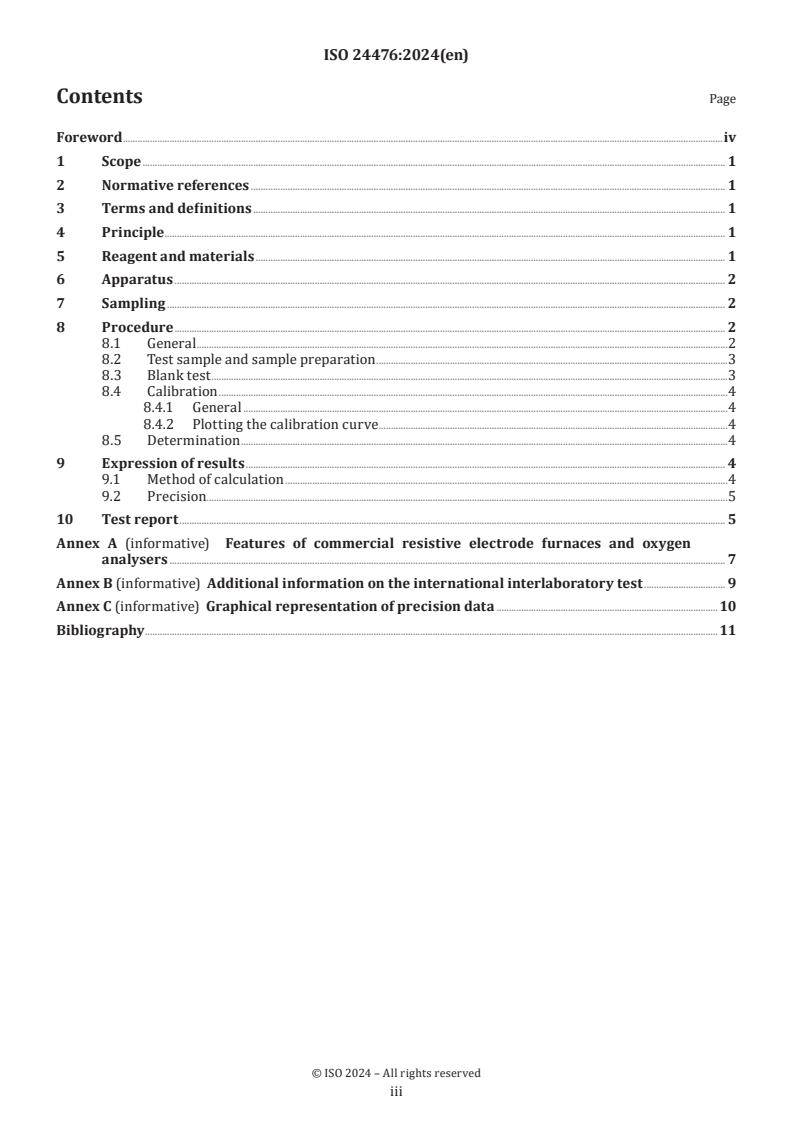
Contents Page
Foreword .iv
1 Scope . 1
2 Normative references . 1
3 Terms and definitions . 1
4 Principle . 1
5 Reagent and materials . 1
6 Apparatus . 2
7 Sampling . 2
8 Procedure . 2
8.1 General .2
8.2 Test sample and sample preparation .3
8.3 Blank test .3
8.4 Calibration .4
8.4.1 General .4
8.4.2 Plotting the calibration curve .4
8.5 Determination .4
9 Expression of results . 4
9.1 Method of calculation .4
9.2 Precision . . .5
10 Test report . 5
Annex A (informative) Features of commercial resistive electrode furnaces and oxygen
analysers . 7
Annex B (informative) Additional information on the international interlaboratory test . 9
Annex C (informative) Graphical representation of precision data .10
Bibliography .11
iii
Foreword
ISO (the International Organization for Standardization) is a worldwide federation of national standards
bodies (ISO member bodies). The work of preparing International Standards is normally carried out through
ISO technical committees. Each member body interested in a subject for which a technical committee
has been established has the right to be represented on that committee. International organizations,
governmental and non-governmental, in liaison with ISO, also take part in the work. ISO collaborates closely
with the International Electrotechnical Commission (IEC) on all matters of electrotechnical standardization.
The procedures used to develop this document and those intended for its further maintenance are described
in the ISO/IEC Directives, Part 1. In particular, the different approval criteria needed for the different types
of ISO document should be noted. This document was drafted in accordance with the editorial rules of the
ISO/IEC Directives, Part 2 (see www.iso.org/directives).
ISO draws attention to the possibility that the implementation of this document may involve the use of (a)
patent(s). ISO takes no position concerning the evidence, validity or applicability of any claimed patent
rights in respect thereof. As of the date of publication of this document, ISO had not received notice of (a)
patent(s) which may be required to implement this document. However, implementers are cautioned that
this may not represent the latest information, which may be obtained from the patent database available at
www.iso.org/patents. ISO shall not be held responsible for identifying any or all such patent rights.
Any trade name used in this document is information given for the convenience of users and does not
constitute an endorsement.
For an explanation of the voluntary nature of standards, the meaning of ISO specific terms and expressions
related to conformity assessment, as well as information about ISO's adherence to the World Trade
Organization (WTO) principles in the Technical Barriers to Trade (TBT), see www.iso.org/iso/foreword.html.
This document was prepared by Technical Committee ISO/TC 17, Steel, Subcommittee SC 1, Methods of
determination of chemical composition.
Any feedback or questions on this document should be directed to the user’s national standards body. A
complete listing of these bodies can be found at www.iso.org/members.html.
iv
International Standard ISO 24476:2024(en)
Steel — Determination of oxygen — Infrared absorption
method after fusion under inert gas (Routine method)
1 Scope
This document specifies a routine method after fusion under inert gas for the determination of oxygen in steel.
The method is applicable to contents of oxygen between 0,001 % (mass fraction) and 0,02 % (mass fraction).
2 Normative references
The following documents are referred to in the text in such a way that some or all of their content constitutes
requirements of this document. For dated references, only the edition cited applies. For undated references,
the latest edition of the referenced document (including any amendments) applies.
ISO 14284, Steel and iron — Sampling and preparation of samples for the determination of chemical composition
3 Terms and definitions
No terms and definitions are listed in this document.
ISO and IEC maintain terminology databases for use in standardization at the following addresses:
— ISO Online browsing platform: available at https:// www .iso .org/ obp
— IEC Electropedia: available at https:// www .electropedia .org/
4 Principle
Fusing of a test portion in a single-use graphite crucible under an inert gas stream (He or Ar) at a minimum
temperature of 2 000 °C. The sample is melted in a graphite crucible. The released oxygen combines with
carbon to form carbon monoxide.
Depending on the instrument design, the carbon monoxide is oxidized to carbon dioxide or left as carbon
monoxide and swept by the inert gas stream to an infrared detector.
The detector output is compared to that obtained from similar certified reference materials and is displayed
as oxygen content of the sample.
The calibration curve is established using steel certified reference materials (CRMs).
5 Reagent and materials
During the analysis, unless otherwise stated, use only reagents of recognized analytical grade.
5.1 Helium or argon, of ultra-high purity, total impurity content 0,000 5 % (mass fraction) (99,999 %
purity minimum by volume).
5.2 Copper(II) oxide, on granulated support.
This reagent is used in some instruments to oxidize carbon monoxide to carbon dioxide. Use the purity
specified by the instrument's manufacturer.
5.3 Magnesium perchlorate, (commercial designation: anhydrone), particle size: from 1,2 mm to 2,0 mm.
This reagent is used in the instrument to absorb water. Use the purity specified by the instrument's
manufacturer.
5.4 Sodium hydroxide on clay (commercial designation: ascarite), particle size from 0,6 mm to
1,2 mm, for example.
This reagent is used in some instruments to absorb carbon dioxide. Use the purity specified by the
instrument's manufacturer.
5.5 Appropriate solvent, suitable for washing greasy or dirty test samples, e.g. high-purity acetone
5.6 Steel reference materials (RMs), material, sufficiently homogeneous and stable with respect to one
or more specified properties, which has been established to be fit for its intended use in a measurement
process.
5.7 Steel certified reference materials (CRMs), reference material (RM) characterized by a
metrologically valid procedure for one or more specified properties, accompanied a certificate that provides
the value of the specified property, its associated uncertainty, and a statement of metrological traceability.
6 Apparatus
6.1 Oxygen analyser, may be obtained commercially from a number of manufacturers. Follow the
manufacturer's instructions for the operation of the instrument.
Features of commercial instruments are given in Annex A.
6.2 Graphite crucible, single use. Use high-purity graphite crucibles suitable for use with the instrument.
6.3 Crucible tongs, for handling the graphite crucibles used.
6.4 Glass-wool filters.
7 Sampling
Carry out sampling in accordance with ISO 14284 or appropriate national standards for steel.
8 Procedure
WARNING — The risks involved when using an apparatus for fusing a test portion are mainly burn risks.
It is therefore essential to use crucible tongs (6.3) and appropriate containers for the crucibles used.
8.1 General
Assemble the apparatus as recommended by the manufacturer. Make the required power, gas and water
connections. Switch on the instrument and allow sufficient warm up time to stabilize.
After changing the filter and/or reagents, or when the apparatus has been inoperative for a period, stabilize
the instrument by carrying out trial analyses, the results of which are to be disregarded. Then proceed with
blank, calibration and preparation tests as indicated in 8.3 and 8.4 before analysing the sample.
Place a graphite crucible (6.2) on the furnace pedestal and then degas by heating above the degassing
temperature of the sample.
The samples are weighed and the mass is transferred automatically or manually to a computer connected
to the analyser. The sample is placed in the loading head above the empty degassed graphite crucible
...