

ISO 4940:2025
(Main)Steel and cast iron — Determination of nickel content — Flame atomic absorption spectrometric method
General Information
- Abstract
This document specifies a flame atomic absorption spectrometric method (FAAS) for the determination of nickel content in steel and cast iron. The method is applicable to nickel contents in the range of 0,002 % (mass fraction) to 0,5 % (mass fraction).
- Status
- Published
- Publication Date
- 24-Jul-2025
- Technical Committee
- ISO/TC 17/SC 1 - Methods of determination of chemical composition
- Drafting Committee
- ISO/TC 17/SC 1 - Methods of determination of chemical composition
- Current Stage
- 6060 - International Standard published
- Start Date
- 25-Jul-2025
- Due Date
- 03-Jul-2025
- Completion Date
- 25-Jul-2025
Overview
ISO 4940:2025 specifies a flame atomic absorption spectrometric (FAAS) method for the determination of nickel content in steel and cast iron. The method covers nickel mass fractions from 0.002% to 0.5% and defines sample preparation, reagents, instrument performance criteria, calibration and reporting requirements. This second edition updates references, adds guidance on solution preparation and a bibliography, and replaces ISO 4940:1985.
Key Topics and Requirements
- Principle: Dissolve the test portion in appropriate acids, evaporate to fuming with perchloric acid, nebulize the final test solution into an air/acetylene flame, and measure atomic absorption of nickel at 232.0 nm or 352.5 nm (use 232.0 nm when sensitivity at 352.5 nm is insufficient).
- Scope: Applicable to nickel contents of 0.002% to 0.5% (mass fraction).
- Reagents and standards: Prescribes preparation of acid mixtures, a 1 g/L and 0.04 g/L nickel standard, and an iron base solution (40 g/L) to match matrix effects.
- Sample size: Test portion typically about 1.0 g; perform parallel blank tests using pure iron.
- Instrument performance criteria:
- Limit of detection for nickel in a similar matrix: < 0.15 µg/mL.
- Characteristic concentration: < 0.40 µg/mL.
- Precision: specified standard-deviation limits for repeated absorbance measurements.
- Calibration linearity: slope requirements across concentration ranges; bracketing or calibration curves are described.
- Safety: Handling and evaporation of perchloric acid must be in suitable fume cupboards; follow manufacturer instructions for flame operation and wear eye protection.
- Annexes: Annex A (precision data) and Annex B (procedures for instrumental criteria).
Applications and Who Uses It
ISO 4940:2025 is intended for:
- Metallurgical and chemical testing laboratories performing compositional analysis of steels and cast irons.
- Steel and foundry quality-control teams verifying nickel content for alloy specification, heat treatment behavior, corrosion resistance and material certification.
- Third‑party inspection and certification bodies that require standardized, traceable nickel determinations. Practical use includes routine batch testing, production monitoring, acceptance testing, and regulatory compliance where accurate nickel quantification is required.
Related Standards
- ISO 14284 - Sampling and preparation of samples for determination of chemical composition (referenced for sampling/sample prep)
- ISO 3696 - Water for analytical laboratory use
- ISO 648, ISO 1042 - Laboratory glassware specifications
Keywords: ISO 4940:2025, FAAS, nickel determination, steel testing, cast iron analysis, flame atomic absorption spectrometry, nickel content, analytical method, laboratory quality control.
Relations
- Effective Date
- 08-Jul-2023
Get Certified
Connect with accredited certification bodies for this standard

Element Materials Technology
Materials testing and product certification.

Inštitut za kovinske materiale in tehnologije
Institute of Metals and Technology. Materials testing, metallurgical analysis, NDT.
Sponsored listings
Frequently Asked Questions
ISO 4940:2025 is a standard published by the International Organization for Standardization (ISO). Its full title is "Steel and cast iron — Determination of nickel content — Flame atomic absorption spectrometric method". This standard covers: This document specifies a flame atomic absorption spectrometric method (FAAS) for the determination of nickel content in steel and cast iron. The method is applicable to nickel contents in the range of 0,002 % (mass fraction) to 0,5 % (mass fraction).
This document specifies a flame atomic absorption spectrometric method (FAAS) for the determination of nickel content in steel and cast iron. The method is applicable to nickel contents in the range of 0,002 % (mass fraction) to 0,5 % (mass fraction).
ISO 4940:2025 is classified under the following ICS (International Classification for Standards) categories: 77.080.01 - Ferrous metals in general. The ICS classification helps identify the subject area and facilitates finding related standards.
ISO 4940:2025 has the following relationships with other standards: It is inter standard links to ISO 4940:1985. Understanding these relationships helps ensure you are using the most current and applicable version of the standard.
ISO 4940:2025 is available in PDF format for immediate download after purchase. The document can be added to your cart and obtained through the secure checkout process. Digital delivery ensures instant access to the complete standard document.
Standards Content (Sample)
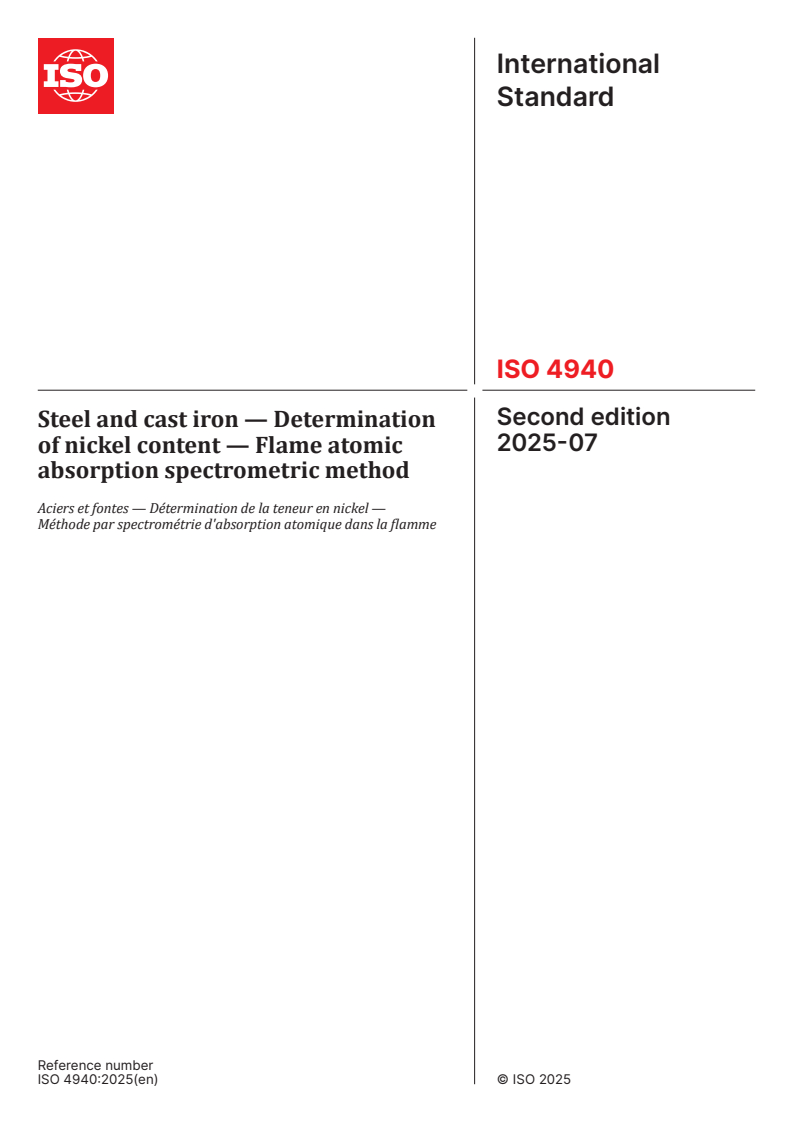
International
Standard
ISO 4940
Second edition
Steel and cast iron — Determination
2025-07
of nickel content — Flame atomic
absorption spectrometric method
Aciers et fontes — Détermination de la teneur en nickel —
Méthode par spectrométrie d'absorption atomique dans la flamme
Reference number
© ISO 2025
All rights reserved. Unless otherwise specified, or required in the context of its implementation, no part of this publication may
be reproduced or utilized otherwise in any form or by any means, electronic or mechanical, including photocopying, or posting on
the internet or an intranet, without prior written permission. Permission can be requested from either ISO at the address below
or ISO’s member body in the country of the requester.
ISO copyright office
CP 401 • Ch. de Blandonnet 8
CH-1214 Vernier, Geneva
Phone: +41 22 749 01 11
Email: copyright@iso.org
Website: www.iso.org
Published in Switzerland
ii
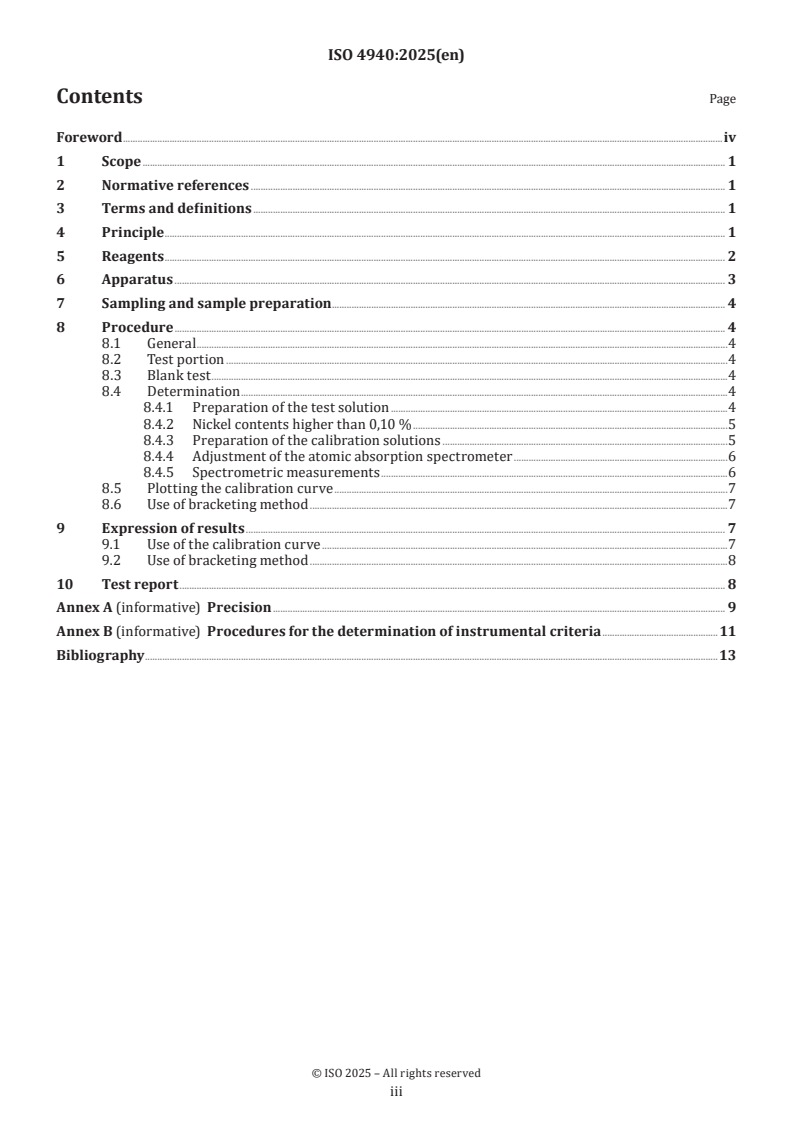
Contents Page
Foreword .iv
1 Scope . 1
2 Normative references . 1
3 Terms and definitions . 1
4 Principle . 1
5 Reagents . 2
6 Apparatus . 3
7 Sampling and sample preparation . 4
8 Procedure . 4
8.1 General .4
8.2 Test portion .4
8.3 Blank test .4
8.4 Determination .4
8.4.1 Preparation of the test solution .4
8.4.2 Nickel contents higher than 0,10 % .5
8.4.3 Preparation of the calibration solutions .5
8.4.4 Adjustment of the atomic absorption spectrometer .6
8.4.5 Spectrometric measurements .6
8.5 Plotting the calibration curve .7
8.6 Use of bracketing method .7
9 Expression of results . 7
9.1 Use of the calibration curve .7
9.2 Use of bracketing method .8
10 Test report . 8
Annex A (informative) Precision . 9
Annex B (informative) Procedures for the determination of instrumental criteria .11
Bibliography .13
iii
Foreword
ISO (the International Organization for Standardization) is a worldwide federation of national standards
bodies (ISO member bodies). The work of preparing International Standards is normally carried out through
ISO technical committees. Each member body interested in a subject for which a technical committee
has been established has the right to be represented on that committee. International organizations,
governmental and non-governmental, in liaison with ISO, also take part in the work. ISO collaborates closely
with the International Electrotechnical Commission (IEC) on all matters of electrotechnical standardization.
The procedures used to develop this document and those intended for its further maintenance are described
in the ISO/IEC Directives, Part 1. In particular, the different approval criteria needed for the different types
of ISO document should be noted. This document was drafted in accordance with the editorial rules of the
ISO/IEC Directives, Part 2 (see www.iso.org/directives).
ISO draws attention to the possibility that the implementation of this document may involve the use of (a)
patent(s). ISO takes no position concerning the evidence, validity or applicability of any claimed patent
rights in respect thereof. As of the date of publication of this document, ISO had not received notice of (a)
patent(s) which may be required to implement this document. However, implementers are cautioned that
this may not represent the latest information, which may be obtained from the patent database available at
www.iso.org/patents. ISO shall not be held responsible for identifying any or all such patent rights.
Any trade name used in this document is information given for the convenience of users and does not
constitute an endorsement.
For an explanation of the voluntary nature of standards, the meaning of ISO specific terms and expressions
related to conformity assessment, as well as information about ISO's adherence to the World Trade
Organization (WTO) principles in the Technical Barriers to Trade (TBT), see www.iso.org/iso/foreword.html.
This document was prepared by Technical Committee ISO/TC 17, Steel, Subcommittee SC 1, Methods of
determination of chemical composition.
This second edition cancels and replaces the first edition (ISO 4940:1985), which has been technically
revised.
The main changes are as follows:
— the normative references have been updated;
— some notes that can contribute to a better accuracy of the method like preparation of the iron base
solution and the test solution have been added;
— a Bibliography has been added.
Any feedback or questions on this document should be directed to the user’s national standards body. A
complete listing of these bodies can be found at www.iso.org/members.html.
iv
International Standard ISO 4940:2025(en)
Steel and cast iron — Determination of nickel content —
Flame atomic absorption spectrometric method
1 Scope
This document specifies a flame atomic absorption spectrometric method (FAAS) for the determination of
nickel content in steel and cast iron.
The method is applicable to nickel contents in the range of 0,002 % (mass fraction) to 0,5 % (mass fraction).
2 Normative references
The following documents are referred to in the text in such a way that some or all of their content constitutes
requirements of this document. For dated references, only the edition cited applies. For undated references,
the latest edition of the referenced document (including any amendments) applies.
ISO 648, Laboratory glassware — Single-volume pipettes
ISO 1042, Laboratory glassware — One-mark volumetric flasks
ISO 3696, Water for analytical laboratory use — Specification and test methods
ISO 14284, Steel and iron — Sampling and preparation of samples for the determination of chemical composition
3 Terms and definitions
No terms and definitions are listed in this document.
ISO and IEC maintain terminology databases for use in standardization at the following addresses:
— ISO Online browsing platform: available at https:// www .iso .org/ obp
— IEC Electropedia: available at https:// www .electropedia .org/
4 Principle
Dissolution of a test portion in a mixture of appropriate acids followed by evaporation to fuming with
perchloric acid.
Nebulization of the test solution into an air/acetylene flame of an atomic absorption spectrometer.
Spectrometric measurement of the atomic absorption of the 232,0 nm or 352,5 nm spectral line emitted by a
nickel hollow cathode lamp.
With some instruments it is not possible to obtain sufficient sensitivity at the wavelength of 352,5 nm for
low concentrations of nickel near the bottom end of the application range and in such cases the alternative
wavelength of 232,0 nm shall be used.
At the wavelength of 352,5 nm, the signal-to-noise ratio is higher than at the wavelength of 232,0 nm. In
general, the use of the 352,5 nm line will give better reproducibility.
NOTE Other suitable radiation sources can also be used, provided the criteria in 6.1.1 to 6.1.4 are still met.
In Annex A, the composition of the test samples used in the precision test is given in Table A.1, and the
related results are given in Table A.2.
The procedures for the determination of instrumental criteria is given in Annex B.
5 Reagents
Unless otherwise stated, use only reagents of recognized analytical grade and only grade 2 water as
specified in ISO 3696.
5.1 Pure iron, nickel content less than 0,000 5 % (mass fraction).
5.2 Hydrochloric-nitric acids mixture.
Mix three volumes of hydrochloric acid (ρ approximately 1,19 g/ml), one volume of nitric acid (ρ
approximately 1,40 g/ml) and two volumes of water.
This mixture shall be prepared immediately before use.
5.3 Nitric-perchloric acids mixture.
Mix 100 ml of nitric acid (ρ approximately 1,40 g/ml) with 800 ml of perchloric acid (ρ approximately
1,54 g/ml). Dilute to 1 000 ml with water and mix.
Perchloric acid (ρ approximately 1,67 g/ml) can also be used. 100 ml of perchloric acid (ρ approximately
1,54 g/ml) are equivalent to 79 ml of perchloric acid (ρ approximately 1,67 g/ml).
5.4 Nickel standard solution, 1 g/l.
Weigh, to the nearest 0,001 g, 0,500 g of high purity nickel [Ni ≥ 99,9 % (mass fraction)] and transfer into a
heat-resistant glassware of suitable size. Add 25 ml of nitric acid (ρ approximately 1,40 g/ml, diluted 1 + 1).
Cover with a watch glass, and, heat gently to assist dissolution. When dissolution is complete, boil to remove
nitrogen oxides. Allow to cool to room temperature and transfer the solution quantitatively into a 500 ml
one-mark volumetric flask. Dilute to the mark with water and mix.
1 ml of this solution contains 1,0 mg of nickel.
5.5 Nickel standard solution, 0,04 g/l.
Transfer 10,0 ml of nickel standard solution (5.4) into a 250 ml one-mark volumetric flask. Dilute to the
mark with water and mix.
1 ml of this solution contains 0,04 mg of nickel.
Prepare this solution immediately prior to use.
5.6 Iron base solution, 40 g/l.
Weigh, to the nearest 0,01 g, 10,00 g of pure iron (5.1) and transfer into an 800 ml beaker. Add 100 ml of the
hydrochloric-nitric acids mixture (5.2), cover the beaker with a watch glass and heat gently until the iron is
dissolved.
When dissolution is complete, add 150 ml of the nitric-perchloric acids mixture (5.3) and heat until dense
white fumes of perchloric acid appear. Continue heating for 1 min and allow to cool.
In order to get a better mastery of the acidity (volume of free perchloric acid) of the sample solutions and of
the calibration solutions, perchloric fumes may be maintained until iron crystallizes.
Add 100 ml of water and heat gently to dissolve the salts. Cool again and transfer the solution quantitatively
into a 250 ml one-mark volumetric flask. Dilute to the mark with water and mix.
6 Apparatus
All laboratory glassware shall be class A, in accordance with ISO 648 or ISO 1042 as appropriate.
All glassware shall first be washed in hydrochloric acid (ρ about 1,19 g/ml, diluted 1 + 1), and then in water.
The quantity of nickel present in the beakers and flasks can be checked by measuring the absorption of
distilled water introduced in the glassware after the acid wash.
Ordinary laboratory apparatus and the following shall be used.
6.1 Atomic absorption spectrometer
WARNING — Follow the manufacturer’s instructions for igniting and extinguishing the air/acetylene
flame to avoid possible explosion hazards. Wear tinted safety glasses whenever the burner is in
operation.
The spectrometer shall be equipped with a nickel hollow-cathode lamp or other suitable radiation source
and supplied with air and acetylene sufficiently pure to give a steady clear fuel-lean flame, free from water
and oil, and free from nickel.
The atomic absorption spectrometer used will be satisfactory if, after optimization according to 8.4.3, the
limit of detection and characteristic concentration are in reasonable agreement with the values given by the
manufacturer and it meets the performance criteria given in 6.1.1 to 6.1.3.
The instrument should also conform to the additional performance requirement given in 6.1.4.
6.1.1 Minimum precision
The standard deviation of 10 measurements of the absorbance of the most concentrated calibration solution
shall not exceed 1,0 % of the mean absorbance of this solution.
The standard deviation of 10 measurements of the absorbance of the least concentrated calibration solution
(excluding the zero member) shall not exceed 0,5 % of the mean absorbance of the most concentrated
calibration solution.
6.1.2 Limit of detection
The limit of detection is a number, expressed in units of concentration (or amount) that describes the lowest
concentration level (or amount) of an element that can be determined to be statistically different from an
analytical blank.
The limit of detection of nickel in a matrix similar to the final test solution shall be less than 0,15 μg/ml.
6.1.3 Calibration linearity
The slope of the calibration curve covering the top 20 % of the concentr
...