


ISO 9073-18:2007
(Main)Textiles — Test methods for nonwovens — Part 18: Determination of breaking strength and elongation of nonwoven materials using the grab tensile test
Textiles — Test methods for nonwovens — Part 18: Determination of breaking strength and elongation of nonwoven materials using the grab tensile test
ISO 9073-18:2007 specifies a grab tensile test procedure for determining the breaking strength and elongation of most nonwoven materials. It includes instructions for the testing of wet specimens. This grab tensile test procedure is applicable for most nonwovens, but is not recommended for nonwovens which have a high percentage of stretch.
Textiles — Méthodes d'essai pour nontissés — Partie 18: Détermination de la résistance à la rupture et de l'allongement de matériaux nontissés par l'essai de traction à l'arrachement
L'ISO 9073-18:2007 spécifie l'essai de traction à l'arrachement et permet de déterminer la résistance à la rupture et l'allongement de la plupart des matériaux nontissés. Elle inclut des instructions relatives aux essais d'éprouvettes mouillées. Ce mode opératoire d'essai de traction à l'arrachement est applicable à la plupart des nontissés, mais il est déconseillé pour les nontissés ayant un pourcentage élevé d'allongement.
General Information
- Status
- Withdrawn
- Publication Date
- 01-Apr-2007
- Technical Committee
- ISO/TC 38 - Textiles
- Drafting Committee
- ISO/TC 38 - Textiles
- Current Stage
- 9599 - Withdrawal of International Standard
- Start Date
- 17-Nov-2023
- Completion Date
- 14-Feb-2026
Relations
- Effective Date
- 06-Jun-2022
Get Certified
Connect with accredited certification bodies for this standard

Control Union Certifications
Global certification for agriculture and sustainability.

Bureau Veritas Bangladesh
Bureau Veritas certification services in Bangladesh.

ECOCERT France
Leader in organic and sustainability certification worldwide.
Sponsored listings
Frequently Asked Questions
ISO 9073-18:2007 is a standard published by the International Organization for Standardization (ISO). Its full title is "Textiles — Test methods for nonwovens — Part 18: Determination of breaking strength and elongation of nonwoven materials using the grab tensile test". This standard covers: ISO 9073-18:2007 specifies a grab tensile test procedure for determining the breaking strength and elongation of most nonwoven materials. It includes instructions for the testing of wet specimens. This grab tensile test procedure is applicable for most nonwovens, but is not recommended for nonwovens which have a high percentage of stretch.
ISO 9073-18:2007 specifies a grab tensile test procedure for determining the breaking strength and elongation of most nonwoven materials. It includes instructions for the testing of wet specimens. This grab tensile test procedure is applicable for most nonwovens, but is not recommended for nonwovens which have a high percentage of stretch.
ISO 9073-18:2007 is classified under the following ICS (International Classification for Standards) categories: 59.080.30 - Textile fabrics. The ICS classification helps identify the subject area and facilitates finding related standards.
ISO 9073-18:2007 has the following relationships with other standards: It is inter standard links to ISO 9073-18:2023. Understanding these relationships helps ensure you are using the most current and applicable version of the standard.
ISO 9073-18:2007 is available in PDF format for immediate download after purchase. The document can be added to your cart and obtained through the secure checkout process. Digital delivery ensures instant access to the complete standard document.
Standards Content (Sample)
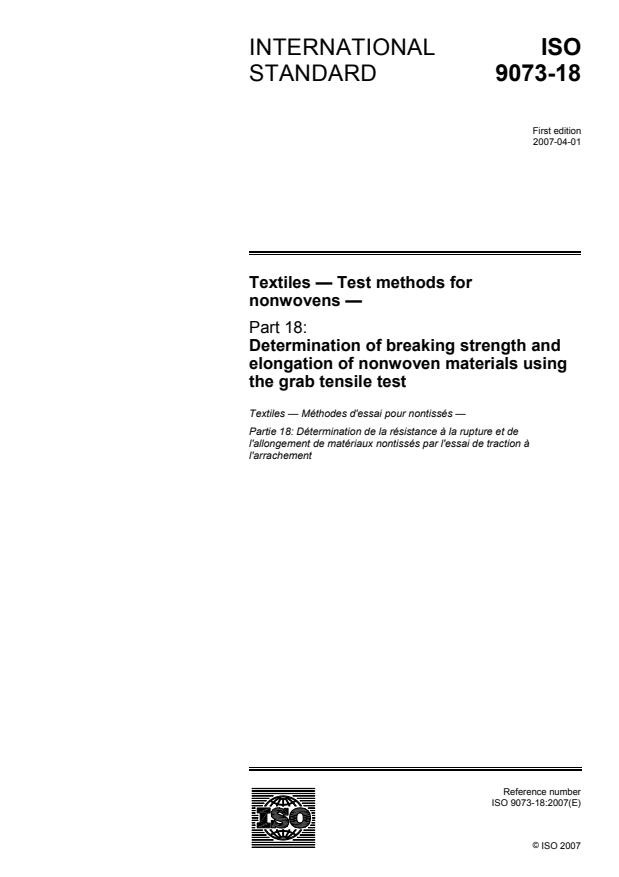
INTERNATIONAL ISO
STANDARD 9073-18
First edition
2007-04-01
Textiles — Test methods for
nonwovens —
Part 18:
Determination of breaking strength and
elongation of nonwoven materials using
the grab tensile test
Textiles — Méthodes d'essai pour nontissés —
Partie 18: Détermination de la résistance à la rupture et de
l'allongement de matériaux nontissés par l'essai de traction à
l'arrachement
Reference number
©
ISO 2007
PDF disclaimer
This PDF file may contain embedded typefaces. In accordance with Adobe's licensing policy, this file may be printed or viewed but
shall not be edited unless the typefaces which are embedded are licensed to and installed on the computer performing the editing. In
downloading this file, parties accept therein the responsibility of not infringing Adobe's licensing policy. The ISO Central Secretariat
accepts no liability in this area.
Adobe is a trademark of Adobe Systems Incorporated.
Details of the software products used to create this PDF file can be found in the General Info relative to the file; the PDF-creation
parameters were optimized for printing. Every care has been taken to ensure that the file is suitable for use by ISO member bodies. In
the unlikely event that a problem relating to it is found, please inform the Central Secretariat at the address given below.
© ISO 2007
All rights reserved. Unless otherwise specified, no part of this publication may be reproduced or utilized in any form or by any means,
electronic or mechanical, including photocopying and microfilm, without permission in writing from either ISO at the address below or
ISO's member body in the country of the requester.
ISO copyright office
Case postale 56 • CH-1211 Geneva 20
Tel. + 41 22 749 01 11
Fax + 41 22 749 09 47
E-mail copyright@iso.org
Web www.iso.org
Published in Switzerland
ii © ISO 2007 – All rights reserved
Contents Page
Foreword. iv
1 Scope . 1
2 Normative references . 1
3 Terms and definitions. 1
4 Principle. 2
5 Material and reagents. 2
6 Apparatus . 2
7 Procedure . 3
8 Calculation. 4
9 Test report . 4
Annex A (informative) Possible reasons for low precision of grab tensile test . 6
Foreword
ISO (the International Organization for Standardization) is a worldwide federation of national standards bodies
(ISO member bodies). The work of preparing International Standards is normally carried out through ISO
technical committees. Each member body interested in a subject for which a technical committee has been
established has the right to be represented on that committee. International organizations, governmental and
non-governmental, in liaison with ISO, also take part in the work. ISO collaborates closely with the
International Electrotechnical Commission (IEC) on all matters of electrotechnical standardization.
International Standards are drafted in accordance with the rules given in the ISO/IEC Directives, Part 2.
The main task of technical committees is to prepare International Standards. Draft International Standards
adopted by the technical committees are circulated to the member bodies for voting. Publication as an
International Standard requires approval by at least 75 % of the member bodies casting a vote.
Attention is drawn to the possibility that some of the elements of this document may be the subject of patent
rights. ISO shall not be held responsible for identifying any or all such patent rights.
ISO 9073-18 was prepared by Technical Committee ISO/TC 38, Textiles.
ISO 9073 consists of the following parts, under the general title Textiles — Test methods for nonwovens:
⎯ Part 1: Determination of mass per unit area
⎯ Part 2: Determination of thickness
⎯ Part 3: Determination of tensile strength and elongation
⎯ Part 4: Determination of tear resistance
⎯ Part 5: Resistance to mechanical penetration (ball burst procedure)
⎯ Part 6: Absorption
⎯ Part 7: Determination of bending length
⎯ Part 8: Determination of liquid strike-through time (simulated urine)
⎯ Part 9: Evaluation of drapability including drape
⎯ Part 10: Lint and other particles generation in the dry state
⎯ Part 11: Run-off
⎯ Part 12: Demand absorbency
⎯ Part 13: Repeated liquid strike-through time
⎯ Part 14: Coverstock wetback
⎯ Part 15: Determination of air permeability
⎯ Part 16: Determination of resistance to penetration by water (hydrostatic pressure)
iv © ISO 2007 – All rights reserved
⎯ Part 17: Determination of water penetration (spray impact)
⎯ Part 18: Determination of breaking strength and elongation of nonwoven materials using the grab tensile
test
INTERNATIONAL STANDARD ISO 9073-18:2007(E)
Textiles — Test methods for nonwovens —
Part 18:
Determination of breaking strength and elongation of
nonwoven materials using the grab tensile test
1 Scope
This part of ISO 9073 specifies a grab tensile test procedure for determining the breaking strength and
elongation of most nonwoven materials. It includes instructions for the testing of wet specimens.
This grab tensile test procedure is applicable for most nonwovens, but is not recommended for nonwovens
which have a high percentage of stretch.
2 Normative references
The following referenced documents are indispensable for the application of this document. For dated
references, only the edition cited applies. For undated references, the latest edition of the referenced
document (including any amendments) applies.
ISO 139, Textiles ― Standard atmospheres for conditioning and testing
ISO 186, Paper and board ― Sampling to determine average quality
ISO 10012:2003, Measurement management systems ― Requirements for measurement processes and
measuring equipment
3 Terms and definitions
For the purposes of this document, the following terms and definitions apply.
3.1
grab test
tensile test in which only the centre part of the test specimen is gripped in the jaws of the testing machine
NOTE Normally, the grab tensile strength is determined using a 100 mm wide strip of material. This tensile load is
applied at the midpoint of the 100 mm specimen. This is done using 25 mm wide jaw faces that are used to clamp the
specimen at each end.
3.2
elongation
deformation in the direction of load caused by a tensile force
NOTE Elongation is generally expressed as a percentage, as a ratio of the length of the stretched material to the
length of the unstretched material. Elongation may be determined by the degree of stretch under a specific load, or the
point where the stretched material breaks.
3.3
breaking force
maximum force applied to a material when it is carried to rupture
NOTE Materials that are brittle usually rupture at the maximum force. Materials that are ductile usually experience a
maximum force before rupturing.
3.4
tensile strength
strength of a material when subjected to either pulling or compressive stress
NOTE It measures the stress a material can bear without breaking or tearing.
4 Principle
Using a tensile testing machine, mount a 100 mm wide specimen centrally with 25 mm clamps at each end of
the specimen. The tensile testing machine applies force until the specimen breaks. Values for the breaking
force and the elongation of the test specimen are obtained from tensile test instruments by recording charts,
or a computer interface.
This test is performed to simulate the stress a medical doctor would place on the elbow of his surgical gown or
other similar pressure points. This stress on the elbow of the surgical gown is not replicated by a strip tensile
test because, in the grab tensile test, the adjacent material is providing added strength.
The grab test procedure is applicable to the determination of the operative strength of the nonwoven material.
There is no straightforward relationship between grab tests and strip tests.
5 Material
...
NORME ISO
INTERNATIONALE 9073-18
Première édition
2007-04-01
Textiles — Méthodes d'essai pour
nontissés —
Partie 18:
Détermination de la résistance à la
rupture et de l'allongement de matériaux
nontissés par l'essai de traction à
l'arrachement
Textiles — Test methods for nonwovens —
Part 18: Determination of breaking strength and elongation of nonwoven
materials using the grab tensile test
Numéro de référence
©
ISO 2007
PDF – Exonération de responsabilité
Le présent fichier PDF peut contenir des polices de caractères intégrées. Conformément aux conditions de licence d'Adobe, ce fichier
peut être imprimé ou visualisé, mais ne doit pas être modifié à moins que l'ordinateur employé à cet effet ne bénéficie d'une licence
autorisant l'utilisation de ces polices et que celles-ci y soient installées. Lors du téléchargement de ce fichier, les parties concernées
acceptent de fait la responsabilité de ne pas enfreindre les conditions de licence d'Adobe. Le Secrétariat central de l'ISO décline toute
responsabilité en la matière.
Adobe est une marque déposée d'Adobe Systems Incorporated.
Les détails relatifs aux produits logiciels utilisés pour la création du présent fichier PDF sont disponibles dans la rubrique General Info
du fichier; les paramètres de création PDF ont été optimisés pour l'impression. Toutes les mesures ont été prises pour garantir
l'exploitation de ce fichier par les comités membres de l'ISO. Dans le cas peu probable où surviendrait un problème d'utilisation,
veuillez en informer le Secrétariat central à l'adresse donnée ci-dessous.
DOCUMENT PROTÉGÉ PAR COPYRIGHT
© ISO 2007
Droits de reproduction réservés. Sauf prescription différente, aucune partie de cette publication ne peut être reproduite ni utilisée sous
quelque forme que ce soit et par aucun procédé, électronique ou mécanique, y compris la photocopie et les microfilms, sans l'accord écrit
de l'ISO à l'adresse ci-après ou du comité membre de l'ISO dans le pays du demandeur.
ISO copyright office
Case postale 56 • CH-1211 Geneva 20
Tel. + 41 22 749 01 11
Fax. + 41 22 749 09 47
E-mail copyright@iso.org
Web www.iso.org
Publié en Suisse
ii © ISO 2007 – Tous droits réservés
Sommaire Page
Avant-propos. iv
1 Domaine d'application. 1
2 Références normatives . 1
3 Termes et définitions. 1
4 Principe. 2
5 Matériel et réactifs . 2
6 Appareillage . 2
7 Mode opératoire . 3
8 Calcul . 4
9 Rapport d'essai . 4
Annex A (informative) Causes possibles d'imprécision de l'essai de traction à l'arrachement. 6
Avant-propos
L'ISO (Organisation internationale de normalisation) est une fédération mondiale d'organismes nationaux de
normalisation (comités membres de l'ISO). L'élaboration des Normes internationales est en général confiée
aux comités techniques de l'ISO. Chaque comité membre intéressé par une étude a le droit de faire partie du
comité technique créé à cet effet. Les organisations internationales, gouvernementales et non
gouvernementales, en liaison avec l'ISO participent également aux travaux. L'ISO collabore étroitement avec
la Commission électrotechnique internationale (CEI) en ce qui concerne la normalisation électrotechnique.
Les Normes internationales sont rédigées conformément aux règles données dans les Directives ISO/CEI,
Partie 2.
La tâche principale des comités techniques est d'élaborer les Normes internationales. Les projets de Normes
internationales adoptés par les comités techniques sont soumis aux comités membres pour vote. Leur
publication comme Normes internationales requiert l'approbation de 75 % au moins des comités membres
votants.
L'attention est appelée sur le fait que certains des éléments du présent document peuvent faire l'objet de
droits de propriété intellectuelle ou de droits analogues. L'ISO ne saurait être tenue pour responsable de ne
pas avoir identifié de tels droits de propriété et averti de leur existence.
L'ISO 9073-18 a été élaborée par le comité technique ISO/TC 38, Textiles.
L'ISO 9073 comprend les parties suivantes, présentées sous le titre général Textiles — Méthodes d'essai
pour nontissés:
⎯ Partie 1: Détermination de la masse surfacique
⎯ Partie 2: Détermination de l'épaisseur
⎯ Partie 3: Détermination de la résistance à la traction et de l'allongement
⎯ Partie 4: Détermination de la résistance à la déchirure
⎯ Partie 5: Résistance à la pénétration mécanique
⎯ Partie 6: Absorption
⎯ Partie 7: Détermination de la longueur de flexion
⎯ Partie 8: Détermination du temps de transpercement des liquides (urine artificielle)
⎯ Partie 9: Évaluation du drapé et détermination du coefficient de drapé
⎯ Partie 10: Relargage de peluches et autres particules à l'état sec
⎯ Partie 11: Écoulement sur plan incliné
⎯ Partie 12: Absorption par contact unifacial
⎯ Partie 13: Temps de transpercement successifs des liquides
⎯ Partie 14: Remouillage de l'enveloppe
iv © ISO 2007 – Tous droits réservés
⎯ Partie 15: Détermination de la perméabilité à l'air
⎯ Partie 16: Détermination de la résistance à la pénétration de l'eau (pression hydrostatique)
⎯ Partie 17: Détermination de la pénétration de l'eau (impact d'aérosol)
⎯ Partie 18: Détermination de la résistance à la rupture et de l'allongement des matériaux nontissés par
l'essai de traction à l'arrachement
NORME INTERNATIONALE ISO 9073-18:2007(F)
Textiles — Méthodes d'essai pour nontissés —
Partie 18:
Détermination de la résistance à la rupture et de l'allongement
de matériaux nontissés par l'essai de traction à l'arrachement
1 Domaine d'application
La présente partie de l'ISO 9073 spécifie l'essai de traction à l'arrachement et permet de déterminer la
résistance à la rupture et l'allongement de la plupart des matériaux nontissés. Elle inclut des instructions
relatives aux essais d'éprouvettes mouillées.
Ce mode opératoire d'essai de traction à l'arrachement est applicable à la plupart des nontissés, mais il est
déconseillé pour les nontissés ayant un pourcentage élevé d'allongement.
2 Références normatives
Les documents de référence suivants sont indispensables pour l'application du présent document. Pour les
références datées, seule l'édition citée s'applique. Pour les références non datées, la dernière édition du
document de référence s'applique (y compris les éventuels amendements).
ISO 139, Textiles — Atmosphères normales de conditionnement et d'essai
ISO 186, Papier et carton — Échantillonnage pour déterminer la qualité moyenne
ISO 10012:2003, Systèmes de management de la mesure — Exigences pour les processus et les
équipements de mesure
3 Termes et définitions
Pour les besoins du présent document, les termes et définitions suivants s'appliquent.
3.1
essai d'arrachement
essai de traction dans lequel seule la partie centrale de l'éprouvette est prise dans les mâchoires de la
machine d'essai
NOTE Normalement, la résistance à la traction à l'arrachement est déterminée à l'aide d'une bande de matériau de
100 mm de largeur. La charge en traction est appliquée au milieu de l'éprouvette de 100 mm, cette dernière étant saisie à
chaque extrémité dans des mâchoires de 25 mm de largeur.
3.2
allongement
déformation dans le sens de la charge liée à une force de traction
NOTE L'allongement est généralement exprimé en pourcentage, comme le rapport de la longueur du matériau étiré à
celle du matériau non étiré. L'allongement peut être déterminé par le degré d'étirement sous l'action d'une charge
spécifique, ou par le point de rupture du matériau étiré.
3.3
force à la rupture
force maximale appliquée à un matériau entraînant la rupture
NOTE Les matériaux cassants se rompent généralement à la force maximale. Les matériaux ductiles supportent
généralement une force maximale avant rupture.
3.4
résistance à la traction
résistance d'un matériau soumis à une contrainte de traction ou de compression
NOTE Elle mesure la contrainte qu'un matériau peut supporter sans rupture ni déchirure.
4 Principe
Sur une machine d'essai de traction, monter une éprouvette de 100 mm de largeur, centrée à l'aide de princes
de 25 mm disposées à chaque extrémité. La machine d'essai de traction applique la force jusqu'à rupture de
l'éprouvette. Les valeurs de force de rupture et d'allongement de l'éprouvette sont obtenues à l'aide
d'instruments d'essai de traction, sous forme de diagrammes ou d'interface informatique.
Cet essai est réalisé pour simuler la contrainte qu'exercerait un médecin sur le coude de sa blouse ou sur
d'autres points de pression similaires. Cette contrainte exercée sur le coude de la blouse n'est pas reproduite
par un essai de traction sur bande car, dans le cas de l'essai de traction à l'arrachement, le matériau adjacent
apporte un complément de résistance.
Le mode opératoire d'essai d'arrachement est applicable à la détermination de la résistance du matériau
nontissé. Il n'existe pas de relation directe entre les essais d'arrachement et les essais de traction sur bande.
5 Matériel et réactifs
5.1 Eau distillée, pour l'essai à l'état humide.
5.2 Agent mouillant non ionique, pour l'essai à l'état humide.
5.3 Récipient, pou
...
Questions, Comments and Discussion
Ask us and Technical Secretary will try to provide an answer. You can facilitate discussion about the standard in here.
Loading comments...