


ISO/TR 17370:2013
(Main)Application Guideline on Data Carriers for Supply Chain Management
Application Guideline on Data Carriers for Supply Chain Management
ISO 17370:2013 specifies a method to establish compatibility among various data carriers such as linear symbols, two-dimensional symbols and RFID, as well as their one-to-one relationship by illustrating the structure supporting the basic ISO-compliant supply chain control system. In particular, it specifies the relationship of various global standards related to the supply chain, illustrates the types and data structures in the layered supply chain network, specifies the relationship among the layered structure of the supply chain, specifies the management of serial numbers in supply chain management, specifies data storage on the named data carriers, specifies the required data volume for each data carrier, specifies the data structure between the data carrier and the reader (interrogator), specifies the data structure between the host system (computer) and the reader (interrogator), and illustrates complex data carriers (rewritable hybrid media, etc.).
Directive d'application sur des supports d'informations pour le supply chain management
General Information
- Status
- Published
- Publication Date
- 09-Jun-2013
- Technical Committee
- ISO/TC 122 - Packaging
- Drafting Committee
- ISO/TC 122 - Packaging
- Current Stage
- 6060 - International Standard published
- Start Date
- 10-Jun-2013
- Due Date
- 27-Jul-2014
- Completion Date
- 27-Jul-2014
Overview
ISO/TR 17370:2013 - "Application Guideline on Data Carriers for Supply Chain Management" provides practical guidance to ensure compatibility and effective use of data carriers across the supply chain. It addresses how to align linear symbols, two-dimensional (2D) symbols, RFID, and rewritable hybrid media (RHM) with ISO-compliant supply chain control systems. The report illustrates layered supply chain structures, data storage and transmission rules, serial-number management, and how data carriers map one-to-one across physical packaging layers to enable traceability and automated identification.
Key Topics and Requirements
- Compatibility among data carriers: Methods to establish one-to-one relationships and interoperability between linear, 2D symbologies and various RFID technologies.
- Layered supply chain model: Definition of supply chain layers (item, package, transport unit, RTI, freight container, movement vehicle) and how data carriers are applied at each layer.
- Data structure and volume: Guidance on required data volume per carrier, field structures, character sets and data compaction to address limited RFID memory.
- Data transmission interfaces: Specification of data structure between data carrier ↔ reader (interrogator) and reader ↔ host computer.
- Serial-number and identifier management: Rules for unique identifier (UII) handling across packaging levels for traceability.
- RFID considerations: Frequency diversity, air-interface and memory-structure differences, and middleware implications for multi-protocol environments.
- Complex carriers: Treatment of rewritable hybrid media (RHM) and high-capacity automatic data capture formats.
- Informative annexes: Practical examples including container types, automotive/electrical industry layered models, memory maps (ISO/IEC 18000-63/18000-3), AFI assignments and coding schemes.
Practical Applications and Users
ISO/TR 17370 is useful for practitioners who design, implement or operate automated identification and traceability systems:
- Packaging and logistics engineers selecting appropriate data carriers for each packaging layer
- Supply chain managers establishing traceability and serial-number governance
- AIDC/RFID integrators and system architects implementing reader-to-host interfaces and middleware
- Software developers mapping data formats and compaction schemes for limited-memory tags
- Standards and compliance teams aligning operations to ISO supply chain frameworks
Practical benefits include improved interoperability, reliable item-to-container mapping, optimized use of RFID memory, and standard-aligned data exchange for logistics, retail, manufacturing and reverse logistics.
Related Standards
ISO/TR 17370 references and aligns with several ISO/IEC standards, including:
- ISO/IEC 19762 (AIDC harmonized vocabulary)
- ISO 445 (pallet vocabulary)
- ISO 21067 (packaging vocabulary)
- ISO/IEC 18000 series (RFID air interfaces and memory structures)
- Other ISO packaging and identification standards cited in annexes
Keywords: ISO/TR 17370, supply chain management, data carriers, RFID, linear symbols, 2D symbols, traceability, AIDC, rewritable hybrid media, data structure.


Get Certified
Connect with accredited certification bodies for this standard

BRCGS (Brand Reputation Compliance Global Standards)
Global food safety and quality standards owner.
Sponsored listings
Frequently Asked Questions
ISO/TR 17370:2013 is a technical report published by the International Organization for Standardization (ISO). Its full title is "Application Guideline on Data Carriers for Supply Chain Management". This standard covers: ISO 17370:2013 specifies a method to establish compatibility among various data carriers such as linear symbols, two-dimensional symbols and RFID, as well as their one-to-one relationship by illustrating the structure supporting the basic ISO-compliant supply chain control system. In particular, it specifies the relationship of various global standards related to the supply chain, illustrates the types and data structures in the layered supply chain network, specifies the relationship among the layered structure of the supply chain, specifies the management of serial numbers in supply chain management, specifies data storage on the named data carriers, specifies the required data volume for each data carrier, specifies the data structure between the data carrier and the reader (interrogator), specifies the data structure between the host system (computer) and the reader (interrogator), and illustrates complex data carriers (rewritable hybrid media, etc.).
ISO 17370:2013 specifies a method to establish compatibility among various data carriers such as linear symbols, two-dimensional symbols and RFID, as well as their one-to-one relationship by illustrating the structure supporting the basic ISO-compliant supply chain control system. In particular, it specifies the relationship of various global standards related to the supply chain, illustrates the types and data structures in the layered supply chain network, specifies the relationship among the layered structure of the supply chain, specifies the management of serial numbers in supply chain management, specifies data storage on the named data carriers, specifies the required data volume for each data carrier, specifies the data structure between the data carrier and the reader (interrogator), specifies the data structure between the host system (computer) and the reader (interrogator), and illustrates complex data carriers (rewritable hybrid media, etc.).
ISO/TR 17370:2013 is classified under the following ICS (International Classification for Standards) categories: 55.020 - Packaging and distribution of goods in general. The ICS classification helps identify the subject area and facilitates finding related standards.
ISO/TR 17370:2013 is available in PDF format for immediate download after purchase. The document can be added to your cart and obtained through the secure checkout process. Digital delivery ensures instant access to the complete standard document.
Standards Content (Sample)
TECHNICAL ISO/TR
REPORT 17370
First edition
2013-06-15
Application Guideline on Data Carriers
for Supply Chain Management
Directive d’application sur des supports d’informations pour le supply
chain management
Reference number
©
ISO 2013
© ISO 2013
All rights reserved. Unless otherwise specified, no part of this publication may be reproduced or utilized otherwise in any form
or by any means, electronic or mechanical, including photocopying, or posting on the internet or an intranet, without prior
written permission. Permission can be requested from either ISO at the address below or ISO’s member body in the country of
the requester.
ISO copyright office
Case postale 56 • CH-1211 Geneva 20
Tel. + 41 22 749 01 11
Fax + 41 22 749 09 47
E-mail copyright@iso.org
Web www.iso.org
Published in Switzerland
ii © ISO 2013 – All rights reserved
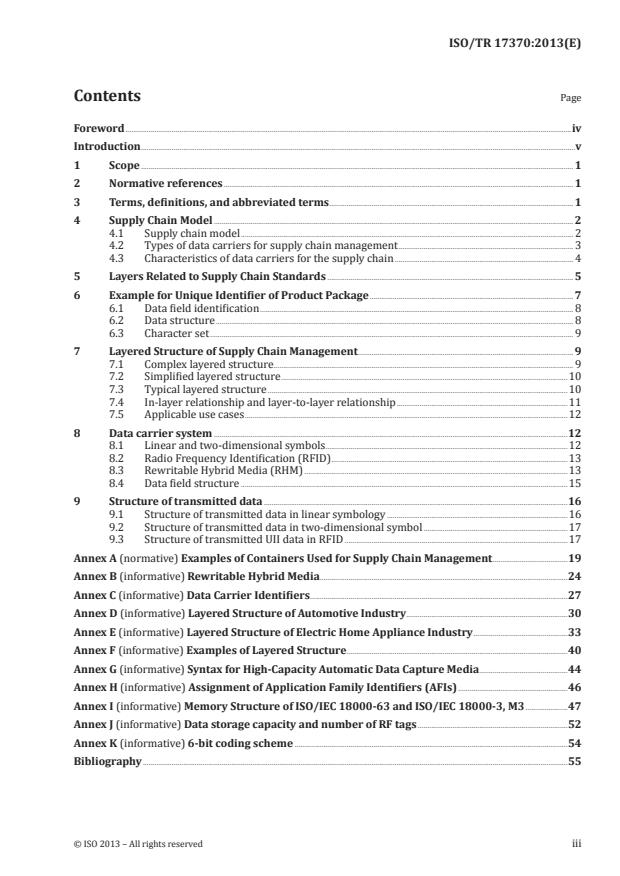
Contents Page
Foreword .iv
Introduction .v
1 Scope . 1
2 Normative references . 1
3 Terms, definitions, and abbreviated terms . 1
4 Supply Chain Model . 2
4.1 Supply chain model . 2
4.2 Types of data carriers for supply chain management . 3
4.3 Characteristics of data carriers for the supply chain . 4
5 Layers Related to Supply Chain Standards . 5
6 Example for Unique Identifier of Product Package . 7
6.1 Data field identification . 8
6.2 Data structure . 8
6.3 Character set . 9
7 Layered Structure of Supply Chain Management . 9
7.1 Complex layered structure . 9
7.2 Simplified layered structure .10
7.3 Typical layered structure .10
7.4 In-layer relationship and layer-to-layer relationship .11
7.5 Applicable use cases .12
8 Data carrier system .12
8.1 Linear and two-dimensional symbols .12
8.2 Radio Frequency Identification (RFID) .13
8.3 Rewritable Hybrid Media (RHM) .13
8.4 Data field structure .15
9 Structure of transmitted data .16
9.1 Structure of transmitted data in linear symbology .16
9.2 Structure of transmitted data in two-dimensional symbol .17
9.3 Structure of transmitted UII data in RFID .17
Annex A (normative) Examples of Containers Used for Supply Chain Management .19
Annex B (informative) Rewritable Hybrid Media .24
Annex C (informative) Data Carrier Identifiers .27
Annex D (informative) Layered Structure of Automotive Industry .30
Annex E (informative) Layered Structure of Electric Home Appliance Industry .33
Annex F (informative) Examples of Layered Structure .40
Annex G (informative) Syntax for High-Capacity Automatic Data Capture Media .44
Annex H (informative) Assignment of Application Family Identifiers (AFIs) .46
Annex I (informative) Memory Structure of ISO/IEC 18000-63 and ISO/IEC 18000-3, M3 .47
Annex J (informative) Data storage capacity and number of RF tags .52
Annex K (informative) 6-bit coding scheme .54
Bibliography .55
Foreword
ISO (the International Organization for Standardization) is a worldwide federation of national standards
bodies (ISO member bodies). The work of preparing International Standards is normally carried out
through ISO technical committees. Each member body interested in a subject for which a technical
committee has been established has the right to be represented on that committee. International
organizations, governmental and non-governmental, in liaison with ISO, also take part in the work.
ISO collaborates closely with the International Electrotechnical Commission (IEC) on all matters of
electrotechnical standardization.
International Standards are drafted in accordance with the rules given in the ISO/IEC Directives, Part 2.
The main task of technical committees is to prepare International Standards. Draft International
Standards adopted by the technical committees are circulated to the member bodies for voting.
Publication as an International Standard requires approval by at least 75 % of the member bodies
casting a vote. Attention is drawn to the possibility that some of the elements of this document may be
the subject of patent rights. ISO shall not be held responsible for identifying any or all such patent rights.
In exceptional circumstances, when the technical committee has collected data of a different kind from
that which is normally published as an International Standard (“state of the art”, for example), it may
decide to publish a Technical Report. A Technical Report is entirely informative in nature and shall be
subject to review every five years in the same manner as an International Standard.
Attention is drawn to the possibility that some of the elements of this document may be the subject of
patent rights. ISO shall not be held responsible for identifying any or all such patent rights.
ISO/TR 17370 was prepared by Technical Committee ISO/TC 122, Packaging.
iv © ISO 2013 – All rights reserved
Introduction
Supply chain management makes use of a variety of data carriers, including linear symbols, two-
dimensional symbols and Radio Frequency Identification (RFID). Care should be taken when using these
data carriers in combination because the data structure of RFID is different from that of the other data
carriers. This Technical Report outlines the basic structure of the supply chain layers defined in ISO
standards. It describes how to store data in linear symbols, two-dimensional symbols and in RFID. In
addition, this document shows the structure of the data transmitted from an interrogator to a host
computer. This Technical Report is provided as a guideline for the effective use of these data carriers.
RFID technology, especially when equipped with the ability to additionally write data, is essential to
traceability in Supply Chain Management (SCM). However, consideration should be given to the following
issues for the use of RFID:
a) Approximately 10 standards, each having its own air interface and memory structure, have been
developed for the RFID technology. Work on the standardization of middleware is currently in
progress in order to achieve compatibility among these standards, but middleware that supports
various RFID air interfaces is not available at this time. And in addition, operators who handle only
one type of RFID do not necessarily need to use middleware.
b) The memory size of commonly available RFID is relatively small compared to the size of EDI data
requiring standardized compaction methods to address this issue.
c) The structure of the data transmitted from a linear or two-dimensional symbol to the host computer
is different from the one transmitted from an RFID interrogator.
This Technical Report provides a potential solution for dealing with these challenging issues. Those
wishing to understand the GS1 approach to similar issues are invited to contact GS1.
This document has 11 annexes, A, B, C, D, E, F, G, H, I, J and K, all which provide informative information.
— Annex A – Examples of Containers Used for Supply Chain Management
— Annex B – Rewritable Hybrid Media
— Annex C – Data Carrier Identifiers
— Annex D – Layered Structure of Automotive Industry
— Annex E – Layered Structure of Electric Home Appliance Industry
— Annex F – Layered Structure of Medical Industry
— Annex G – Syntax for High-Capacity Automatic Data Capture Med
— Annex H – Assignment of Application Family Identifiers (AFIs)
— Annex I – Memory Structure of ISO/IEC 18000-63 and ISO/IEC 18000-3, M3
— Annex J – Data storage capacity and number of RF tag
— Annex K – 6-bit coding scheme
TECHNICAL REPORT ISO/TR 17370:2013(E)
Application Guideline on Data Carriers for Supply Chain
Management
1 Scope
This Technical Report specifies a method to establish compatibility among various data carriers such as
linear symbols, two-dimensional symbols and RFID, as well as their one-to-one relationship by illustrating
the structure supporting the basic ISO-compliant supply chain control system. In particular, it
— specifies the relationship of various global standards related to the supply chain,
— illustrates the types and data structures in the layered supply chain network,
— specifies the relationship among the layered structure of the supply chain,
— specifies the management of serial numbers in supply chain management,
— specifies data storage on the named data carriers,
— specifies the required data volume for each data carrier,
— specifies the data structure between the data carrier and the reader (interrogator),
— specifies the data structure between the host system (computer) and the reader (interrogator), and
— illustrates complex data carriers (rewritable hybrid media, etc).
2 Normative references
The following documents, in whole or in part, are normatively referenced in this document and are
indispensable for its application. For dated references, only the edition cited applies. For undated
references, the latest edition of the referenced document (including any amendments) applies.
ISO 445, Pallets for materials handling — Vocabulary
ISO/IEC 19762 (all parts), Information technology — Automatic identification and data capture (AIDC)
techniques — Harmonized vocabulary
ISO 21067, Packaging — Vocabulary
3 Terms, definitions, and abbreviated terms
For the purposes of this document, the terms, definitions, and abbreviations given in ISO/IEC 19762 (all
parts), ISO 445, ISO 21067 and the following apply.
3.1
RHM
rewritable hybrid media
4 Supply Chain Model
4.1 Supply chain model
The “supply chain” is a multi-level concept that covers all stages of a product, from the management of
raw material to the final product process, including shipping the product to the point-of-sale, the use and
maintenance of the product and, depending on the application, to the point of disposal. This supply chain
further includes reverse logistics and the handling of returned goods. Each of these levels is unique, but
the levels overlap.
Figure 1 below is a basic concept of “supply chain” that illustrates the correlative relationship of the
supply chain, not a “one-to-one” representation of physical objects. Figure 1a shows the supply chain
model for radio frequency identification (RFID) and Figure 1b shows the supply chain model for optically
readable media (ORM). Although several layers in Figure 1 have clear physical counterparts, some
items are categorized into more than one layer, depending on their usage. In Figure 1, RPI represents
“Returnable Packaging Items”. In Figure 1, RTI represents “Returnable Transport Items”, defined in
ISO/IEC 15459-5. The use cases of these items introduced to the supply chain management are specified
in Annex A.
Layer 5
Movement Vehicle
Movement Vehicle Level
De‘ined by Transport Mode
(truck, ship, train, airplane)
(Movement vehicle)
Returnable Packaging Item
Layer 4
L
Freight Container Level
ISO 17363
Container
F
433 MHz or 2,45 GHz
20/40 Foot Marine and Muli-Modal Container
(8802-15-4 or 18000-7 TPA))
(Freight containers)
R Returnable Packaging Item
Layer 3
RTI Level
ISO 17364 Returnable Transport Returnable Transport
ON1M C B1 A
Item (RTI) Item (RTI)
(860-960 MHz)
(Various 18000 with TPA)
I
(Tertiary packaging)
U Returnable Packaging Item
Layer 2
Transport Unit Level
Transport Transport
Transport Transport
ISO 17365 T1 S H1 G Unit
Unit Unit Unit
(Various 18000 with TPA)
(Tertiary packaging)
Returnable Packaging Item
Layer 1
Q1
W1 K1 E1
Product Package Level
ISO 17366 Prod
Prod Prod Prod Prod Prod Prod Prod
V P J D
Pkg Pkg Pkg Pkg Pkg Pkg Pkg
(860-960 MHz with TPA) Pkg
(13,56 MHz with TPA)
N2 K2
(Secondary packaging)
Returnable Packaging Item
W2 T2 Q2 H2 E2 B2
Layer 0
Item Level
ISO 17367
Item Item Item Item Item Item Item Item Item Item Item Item Item Item Item Item
(860-960 MHz with TPA)
(13,56 MHz with TPA)
(Primary packaging)
Components, Parts, Materials, Subassemblies, etc.
Figure 1a — Supply chain model for radio frequency identification (RFID)
2 © ISO 2013 – All rights reserved
Movement Vehicle
Level 5
Movement Vehicle Level
(truck, ship, train, airplane)
(Movement vehicle)
Returnable Packaging Item
L
Level 4
Freight Container Level
Container
F
ISO 6346 (OCR)
20/40 Foot Marine and Muli-Modal Container
(Freight containers)
Returnable Packaging Item
R
Level 3
RTI Level
Returnable Transport Returnable Transport
ISO 15394
ON1M C B1 A
Item (RTI) Item (RTI)
GS1 Gen Spec (GRAI)
(Tertiary packaging)
I
Returnable Packaging Item
U
Level 2
Transport Unit Level
Transport
Transport Transport Transport
ISO 15394
Unit
Unit
T1 S Unit Unit H1 G
GS1 Gen Spec (SSCC)
(Tertiary packaging)
Returnable Packaging Item
Level 1
K1
W1 Q1 E1
Product Package Level
Prod Prod Prod Prod Prod Prod Prod
Prod
ISO 22742
V P J D
Pkg Pkg Pkg Pkg
Pkg Pkg Pkg Pkg
GS1 Gen Spec (GTIN)
(Secondary packaging)
N2 K2
Returnable Packaging Item
W2 T2 Q2 H2 E2 B2
Level 0
Item Level
Item Item Item Item Item Item Item Item Item Item Item Item
Item Item Item Item
ISO 28219
GS1 Gen Spec (GTIN)
(Primary packaging)
Components, Parts, Materials, Subassemblies, etc.
Figure 1b — Supply chain model for optically readable media (ORM)
Key
Alphabetic reference Associated annex Associated example
B2, B1 F 1
E2, E1 F 2
N , N1, L F 3
K2, K1, I, F F 4
Q2, Q1, O, L F 5, 6, 7
G, F D 1, 2, 3
W2, W1, Q2, Q1, K2, K1, E2, E1, T2 E 1, 4, 5, 8
V, P, J, D E 2, 3, 6, 7
G, F E 9
A E 10
Figure 1 — Physical layer of supply chain model
4.2 Types of data carriers for supply chain management
Data carriers such as linear symbols, two-dimensional symbols and RFID, used for supply chain
management should be selected based on their respective characteristics. Most readers available in
today’s market have the ability to automatically distinguish and read various types of linear and two-
dimensional symbols, allowing the use of these symbologies without restriction.
RFID can be used at various frequencies: 135 kHz or lower, 13,56 MHz, 433 MHz, 860 MHz to 960 MHz
or 2,45 GHz, and each frequency can have a separate memory structure and communication protocol,
making it difficult for existing interrogators to automatically distinguish among the various frequencies.
Although the appropriate air interface can be selected depending on the specific layer of the supply chain
in Figure 1, more than one interrogator should be available when using a variety of air interfaces. As
this will increase the cost, the number of air interfaces should be limited to the fewest possible number.
This Technical Report uses the data carriers shown in Figure 1 as examples, including the linear
symbols Code 128 (ISO/IEC 15417) and Code 39 (ISO/IEC 16388), the two-dimensional symbols QR
Code (ISO/IEC 18004) and Data Matrix (ISO/IEC 16022), and RFID at 13,56 MHz (ISO/IEC 18000-3, Mode
3) and 860 to 960 MHz (ISO/IEC 18000-63) as well as a hybrid media (ISO/IEC 29133). A description of
rewritable hybrid media is found in Annex B. Table 1 below is a list of the data carriers supported by this
Technical Report.
Table 1 — Examples of data carriers for the supply chain
Data carrier Type
Code 39 (ISO/IEC 16388)
Linear symbol
Code 128 (ISO/IEC 15417)
QR Code (ISO/IEC 18004)
2D symbol
Data Matrix (ISO/IEC 16022)
13.56 MHz (ISO/IEC 18000-3, Mode 3)
RFID
860 - 960 MHz (ISO/IEC 18000-63)
Complex data carrier (ISO/IEC 29133) in which linear
Rewritable hybrid media and/or 2D symbols printed on a paper-based rewritable
media are combined with RFID.
4.3 Characteristics of data carriers for the supply chain
In a linear or two-dimensional symbol used in the supply chain structure, the type of symbol, label or
direct marking is usually selected according to the layer of the supply chain (see Figure 2 below). In the
delivery process, a distributor may be required to read not only the transport label but also the product
package label attached to the transport unit. In this operation, the type of label is manually identified.
In the supply chain layers shown in Figure 2, the distributor usually attaches the RF tags on the transport
units. If Tags A in Layer 0, Tags B in Layer 1 and Tags C in Layer 2 use the same type of RF tag, all of the
tags will be read, even if the information needed is contained only in Tags C. A mechanism should be
established for selecting and reading only the intended tags.
4 © ISO 2013 – All rights reserved
Figure 2 — Supply chain layers and RFID
5 Layers Related to Supply Chain Standards
Table 2 below outlines the layered structure of the types of standards related to supply chain management
and Table 3 lists the specific standards corresponding to the layers that meet the supply chain standards
identified in Table 2. The standard in Layer 0 is a data carrier standard supported by the supply chain
standard. Table 1 above is a list of data carriers supported by this Technical Report.
Table 2 — Supply chain standard layers
Layer Standards
3 Supply chain (application) standard
Data carrier identification standard, Data storage standard, Com-
munication data structure standard
1 Identification standard of products and parts
0 Data carrier standard
Table 3 — Standard numbers
Layer Standard number
ISO 15394, ISO 22742, ISO 28219, ISO 17363, ISO 17364, ISO 17365,
0, 1, 2, 3, 4
ISO 17366, ISO 17367
0, 1, 2, 3 ISO/IEC 15418, ISO/IEC 15434, ISO/IEC 15962
0, 1, 2, 3 ISO/IEC 15459 Series
ISO/IEC 15417, ISO/IEC 16388, ISO/IEC 16022, ISO/IEC 18004, ISO/
0, 1, 2, 3
IEC 18000-3, ISO/IEC 18000-63
The standards in Layer 1 of Table 2 are based on ISO/IEC 15418 to uniquely specify individual items and
parts (components) of the layers of Figure 1. Some of the identifiers in ISO/IEC 15418 are defined in the
ISO/IEC 15459 series of standards. The cross relationship of these standards is shown in Figure 3 below.
ISO/IEC 15418 specifies the Data Identifiers widely implemented in the manufacturing industry alongside
the Application Identifiers and the data structures commonly implemented in the logistics industry.
Figure 3 — Relationship of product/part identification codes
— ISO/IEC 15459-1 is a standard developed for the unique identification of items and parts.
— ISO/IEC 15459-4 for the unique identification of returnable transport items intended for delivery
and transportation.
— ISO/IEC 15459-5 is a standard for unique identification of RPIs and RTIs introduced to supply
chain management.
— ISO/IEC 15459-6 is a standard used for the identification of items and parts, which generally come
in a liquid or power form and are controlled by a lot or batch number.
The data treated in Layer 1 is stored in the corresponding data carriers pursuant to the standards in
Layer 2. The ISO/IEC 15418 (ISO/IEC 15459 Series) standards stipulating the data structure can also be
referenced when storing data in a linear or two-dimensional symbol and the data structure specified
in ISO/IEC 15418 is directly applied to the symbol without any changes. The method for storing large
amounts of data in a two-dimensional symbol or an RF tag is defined in ISO/IEC 15434 and the method
for storing data in RFID is found in ISO/IEC 15962.
Of the standards in Layer 3, ISO 15394, ISO 22742 and ISO 28219 support linear and two-dimensional
symbols, whereas ISO 17363, ISO 17364, ISO 17365, ISO 17366 and ISO 17367 apply to RFID. Table 4 is a
list of standards that correspond to each of the supply chain layers in Figure 1.
Table 4 — Standard numbers corresponding to the layers in Figure 1
Layer Basic data structure Linear/2D symbol RFID
4 ISO 10374 ― ISO 17363
ISO/IEC 15459-1 ISO 17365
2, 3 ISO 15394
(ISO/IEC 15459-5) (ISO 17364)
ISO/IEC 15459-4 ISO 17366
1 ISO 22742
(ISO/IEC 15459-5) (ISO 17364)
ISO/IEC 15459-4
ISO 17367
0 ISO/IEC 15459-6 ISO 28219
(ISO 17364)
(ISO/IEC 15459-5)
NOTE Parenthetical references are shown to illustrate situations where an RTI might
be considered as a product (ISO 28219) by the RTI manufacturer, or product packaging
(ISO 22742).
In this supply chain model, Layers from 0 to 3 are divided into two categories:
— transport units
— RTI and/or RPI
6 © ISO 2013 – All rights reserved
No standards exist for the basic data structure supporting containers in Layer 4 nor for those specifying
linear and two-dimensional symbols for Layer 4 applications. It is therefore critical for the user to
understand the relationship of the standards listed in Table 4.
In the standards that support both linear and two-dimensional symbols, such as ISO 15394, ISO 22742
and ISO 28219, the data structure in the ISO/IEC 15459 standards is used for linear symbols, while the
structure of two-dimensional symbols is based on the ISO/IEC 15459 Series or ISO/IEC 15434. See Table 5.
Table 5 — Data storage structure of linear and two-dimensional symbols
Layer Basic standard Linear symbol storage structure 2D symbol storage structure
3 ISO 15394 ISO/IEC 15459-5 ISO/IEC 15459-5
2 ISO 15394 ISO/IEC 15459-1 ISO/IEC 15459-1
1 ISO 22742 ISO/IEC 15459-4 ISO/IEC 15459-4 ISO/IEC 15434
ISO/IEC 15459-4 ISO/IEC 15459-4
0 ISO 28219
ISO/IEC 15459-6 ISO/IEC 15459-6
Examples of identifiers defined in ISO/IEC 15459 Series are provided in Table 6.
Table 6 — Examples of ISO/IEC 15459 Series identifiers
Layer Standard number Data Identifier Application Identifier EPC Identifier
3 ISO/IEC 15459-5 25B or 55B 8003 or 8004 GRAI or GIAI
2 ISO/IEC 15459-1 J to 6J 00 SSCC
25S or 3I 8004 GIAI
(for a serialized (for a serialized compo- (for a serialized compo-
component) nent) nent)
1 ISO/IEC 15459-4
25P+S 01+21 SGTIN (GTIN+S/N)
(for a separate seri- (for a separate serialized (for a serialized serial com-
alized component) component) ponent)
25S or 3I 8004 GIAI
(for a serialized (for a serialized compo- (for a serialized compo-
component) nent) nent)
0 ISO/IEC 15459-4
25P+S 01+21 SGTIN (GTIN+S/N)
(for a separate seri- (for a separate serialized (for a serialized serial com-
alized component) component) ponent)
NOTE ISO/IEC 15459-5 predates the assignment of “55B” for RPIs. The next edition of ISO/IEC 15459-5 will be requested
to include “55B”.
The Data Identifiers stored in linear symbols, two-dimensional symbols and RFID should be compatible
and the data format used for reading and transmitting the data in these data carriers from a reader to a
host computer should be uniform throughout the supply chain.
6 Example for Unique Identifier of Product Package
Examples of identifiers defined in the ISO/IEC 15459 Series of standards are provided in Table 6. This
clause describes examples of the data structure of the identifier “25S” defined in ISO/IEC 15459-4. The
identifier and data supported here are stored in linear symbols, two-dimensional symbols or in RF tags
and are used for online electronic commerce. To effectively use various types of data carriers in the
same application, there should be a match between the data in the data carrier and the data stored in
the database of the host computer.
6.1 Data field identification
The Data Identifier “25S” defined in ISO/IEC 15459-4 and ANS MH 10.8.2 should be used for the
identification of product packages. Refer to Table 7 for the data structure of the Data Identifier.
6.2 Data structure
Table 7 shows the data structure of the Unique Identifier of a package.
Table 7 — Data structure
25S IAC CIN SN
6.2.1 Issuing Agency Code (IAC)
The Issuing Agency Code (IAC) is used to identify the entity, organization and/or company authorized
by the appropriate registration authority as an issuing agency in accordance with ISO/IEC 15459-2.
Following are examples of issuing agencies and their associated codes:
— UN (Dun and Bradstreet)
— OD (Odette Europe)
— LA (JIPDEC/CII)
— D (NATO AC135)
6.2.2 Company Identification Number (CIN)
The Company Identification Number (CIN) is a unique code assigned by the issuing agency to each
individual company. Each issuing agency has its own format for the CIN. The CIN code may be partly
determined by the company, i.e. Factory Identification Code (FIC). In Table 9 the FIC is illustrated as part
of the Object Sequence Number.
6.2.3 Serial Number (SN)
When the Serial Number (SN) is combined with IAC and CIN, the combination constitutes a globally
unique identifier for the product package. Once created and attached to the product package, the IAC,
CIN and SN combination is intended to be fixed and unchangeable for that specific product package
throughout its lifetime.
The Serial Number may be composed of numeric characters, alphabetic characters or a combination of
both. The data significant to the package should be regarded as part of the Serial Number, as illustrated
in Table 8. In this case, the data with significance is called Object Data (OD) and the identifier is called
the Object Sequence Number (OSN).
Table 8 — Example of Serial Number data structure
Serial Number (SN)
Object Data (OD) Object Sequence Number (OSN)
In general, the Object Data are a code indicating the product or component number and it does not need
to be a sequence number. The Object Sequence Number may have a structure, as illustrated in Table 9.
It should be noted that the number of digits can be decreased by using a simple sequence number, if the
amount of data in the data carrier is comparatively small.
8 © ISO 2013 – All rights reserved
Table 9 — Example of Object Sequence Number
Object Sequence Number (OSN)
Factory Identification Data of manufac- Time of manufac- Simple Serial
Code ture ture Number
3 digits 8 digits 4 digits 5 digits
6.3 Character set
The character set used in the ISO/IEC 15459 Series standards consists of upper-case alphabetic
characters and numbers from the 7-bit ASCII characters defined in ISO/IEC 646.
7 Layered Structure of Supply Chain Management
7.1 Complex layered structure
Figure 4 is a tree diagram showing the supply chain structure consisting of the container, transport
unit, Returnable Transport Item (RTI) and Returnable Packaging Item (RPI) loaded on a movement
vehicle for the scenarios “O”, “N”, “L” and “H” (see Figure 1). In Figure 4, the identification number of the
container complies with ISO 10374, the RPI and the RTI comply with ISO/IEC 15459-5 and the transport
unit complies with ISO/IEC 15459-1. Likewise, the product package conforms to ISO/IEC 15459-4 and
the product itself to either ISO/IEC 15459-4 or ISO/IEC 15459-6.
Figure 4 — Complex layered structure
Unlike the case in Figure 4 in which RPI and RTI are used, neither of them is included in the structure
in Figure 5.
Figure 5 — Complex layered structure without RPI and RTI
7.2 Simplified layered structure
Figure 6 illustrates the simplest form of the structure (“A”) for the supply chain model in Figure 1.
Figure 6 — Simplified layered structure
The structure of Figure 6 can be simplified as shown in Figure 7 when RPIs are not used. For example,
a vehicle loaded on a dedicated cargo ship can be identified from its VIN number. If there are five
hundred vehicles on the cargo ship, five hundred VIN numbers should be affixed to the lower part of the
movement vehicles.
Figure 7 — Simplified layered structure without RPI
7.3 Typical layered structure
Most of the RPIs and RTIs introduced in commercial transactions are not fully controlled or managed.
For example, EDI data on RPIs and RTIs is not normally included in the information exchanged between
customers and suppliers, as specified in ISO/IEC 15418. In global business trading, the RPIs and RTIs
are handled differently country-by-country and they are reported separately from the contents of the
cargo at Customs. In the same way, separate applications for export permits are required for RPIs and
RTIs when they are returned to the cargo owner (shipper). The duty tariff imposed on the cargo is then
refunded following approval of the export. Figure 8 is a tree diagram showing the layered structure of
this business transaction and Figure 4 is its transformed version. In contrast to Figure 8 where RPIs
and RTIs are in a subordinated relation (structure) to the transport unit, RPIs and RTIs are independent
from the transport unit in Figure 4.
10 © ISO 2013 – All rights reserved
Figure 8 — Typical layered structure
7.4 In-layer relationship and layer-to-layer relationship
Figure 1 is a graphical representation of a simplified structure for supply chain management. Multiple
layers are usually handled in the operations in Layer 2. In Figure 9, five transport units of like products
are grouped together to form a larger transport unit that comes at the upper level. This transport unit
may assume the structure as shown below.
Figure 9 — Example of strucure consisting of multiple layers
Figure 10 shows the layered structure of Figure 9. There are five transport units, each composed of a
product and a product package.
Figure 10 — Example of multi-layered strucure
More than one layer is usually involved when handling a large sized refrigerator. For instance, the
refrigerator is first provided with a label in Layer 0 and then it is stored in a corrugated cardboard box
on which a label in Layer 1 is applied. This cardboard package is also treated as a transport unit that
belongs to Layer 2 and thus a label in Layer 3 should also be used.
7.5 Applicable use cases
Use cases currently seen in the actual applications are described in Annex D, Annex E and Annex F.
8 Data carrier system
Data Carrier system can be classified into groups of linear symbols, two-dimensional symbols, RFID or RHM.
8.1 Linear and two-dimensional symbols
Figure 11 illustrates a data carrier system using QR Code. QR Code is encoded (printed on the label etc.)
from a host computer to a printer. Control commands from a host computer to a printer differ from one
printer to another due to nonstandardized control commands. When readers read the QR Codes, the
encoded data are sent straight to the host computer without any changes by 8 bits in most cases. In this
case, adding 0 to MSB of 7 bits ASCII codes specified in ISO/IEC 646 adds up to the characters codes.
To identity the types of linear symbols or two-dimensional symbols, add the data carrier identification
specified in ISO/IEC 15424 at the beginning of data. Annex C shows the main data carrier identification
specified in ISO/IEC 15424.
12 © ISO 2013 – All rights reserved
Figure 11 — Example of linear symbol and two-dimensional symbol systems
8.2 Radio Frequency Identification (RFID)
Figure 12 shows a data carrier system using RFID. The ISO/IEC 15961 series defines the application
command or the response between a host computer and an interrogator. ISO/IEC 15962 specifies the
data protocol, the tag driver and the mapping rule of an interrogator. The ISO/IEC 18000 series specifies
the air interface between an interrogator and a RF tag. The system becomes more complex if these
standards are applied, although the ISO/IEC 15961 series and ISO/IEC 15962 support all the RF tags
that standardize interfaces (ISO/IEC 18000 series). It is possible to establish a system based on the air
interface standard if the types of RF tags applied are limited.
Figure 12 — Example of RFID system
The Data protocol and the mapping rule become identical when RF tags are limited to those of
ISO/IEC 18000-3, Mode 3 and ISO/IEC 18000-63, which simplifies the system, allowing the method of
data storage to be unified.
8.3 Rewritable Hybrid Media (RHM)
Figures 13 and 14 show the data carrier system of RHM. Figure 13 shows that the RHM printer integrates
with the RF tag interrogator while the QR Code reader integrates with an RF tag interrogator. With the
existing system, control commands from a host computer to a printer differ from one printer to another
due to unstandardized control commands.
Figure 13 — Example of RHM system
Figure 14 — Example of RHM system
Figure 14 shows an example of the RHM structure that separates the system of linear and two-
dimensional symbols from that of RFID. Figure 14 illustrates a system that is able to operate with linear
symbols, two-dimensional symbols and RFID separately. Problems arise when RFID is introduced to a
system in which linear and two-dimensional symbols are already implemented. The system shown in
Figure 14 would not be a major problem even if the application command/response to an interrogator
differs. However, it would pose problems if the data format of the symbol reader is not the same as
the format from the RF interrogator. It is important that the data formats are the same when the data
specified in Figure 7 are stored in the symbols and RF tags. The problems stated above may not be
resolvable if additional middleware is implemented between a host computer and an RF tag interrogator.
It would be unsolvable following the rule of the ISO/IEC 15961 series and ISO/IEC 15962. Having said
that, standardization of middleware has not been advancing.
It is vital to ensure consistency between widely available linear and two-dimensional symbols and RFID
in order to make an extensive use of RFID as follows.
a) The data from the readers of linear and two-dimensional symbols and those from an RFID
interrogator should be identical when the same data are stored in both the symbols and RF tags.
b) Data from an RF tag interrogator should be compliant with ISO/IEC 15418 and ISO/IEC 15434.
c) A method should be established to identify if the data are sent from RFID. RFID should also be
compliant with ISO/IEC 15424, which is already applied to linear and two-dimensional symbols.
d) Unique RFID identifiers including AFIs should be excluded in the data from RF tag interrogators.
14 © ISO 2013 – All rights reserved
8.4 Data field structure
8.4.1 Data field structure of linear symbols
The Data Identifiers defined in both the ISO/IEC 15459 series and ANS MH10.8.2 should precede data
encoded in the Code 39 (ISO/IEC 16388) or Code 128 (ISO/IEC 15417) symbols.
Table 10 — Storage data structure of linear symbol
DI IAC CIN SN
When concatenating data in a linear symbol, the entire length of the symbol, excluding its Data
Identifiers (DIs) and concatenation characters, should not exceed the number of characters specified in
the ISO/IEC 15459 series. However, this does not include symbology overhead characters.
a) Specific Data Identifiers should be assigned to accommodate concatenation of specific fixed
length data fields.
b) When variable length data fields need to be concatenated when encoding a Code 39 symbol, the
plus (“+”) character (ISO/IEC 646 Decimal 43) should be used to delineate between data fields, per
ISO/IEC 15418 (ANS MH10.8.2).
c) When multiple variable length data fields are concatenated when encoding a Code 128 symbol that
has Data Identifiers, the plus (“+”) character (ISO/IEC 646 Decimal 43) should be used to delineate
between the data fields as per ISO/IEC 15418.
If the resultant symbol is longer than the maximum message length specified in the ISO/IEC 15459
Series, the use of a two-dimensional symbol is recommended.
8.4.2 Data field structure of two-dimensional symbols
8.4.2.1 Data field structure specified in ISO/IEC 15459 Series
Subclause 8.1 provides information on the interaction between the host computer and the machine-
readable media for linear and two-dimensional symbols. The amount of data to be encoded in a two-
dimensional symbol is less limited than in linear bar code symbols.
8.4.2.2 Data field structure using ISO/IEC 15434
The use of syntax identified in ISO/IEC 15434 is recommended when encoding a large volume of data
R G
or an EDI message. The Message Header (first 7 characters; [) > 06 ) and Message Trailer (the last
S S
R E E
2 characters; O ) that meet the ISO/IEC 15434 standard are fixed for this application. The “ O ”
S T T
character is ISO/IEC 646 Decimal 04. A single codeword can be used for some of the symbologies in
encoding the message header and message trailer character strings. More details are given in Annex G.
8.4.3 RFID data field structure
As for RFID, this Technical Report describes only the data carriers supported by ISO/IEC 18000-3,
Mode 3 and ISO/IEC 18000-63 (see Table 1). The memory bank structure of an RF tag is defined in
ISO/IEC 18000-3, Mode 3 and ISO/IEC 18000-63 and is illustrated in Figure I.1 in Annex I. Tags with
data encoded only in the memory banks MB00 , MB01 and MB10 and no user memory (MB11 ) are
2 2 2 2
considered to have no syntax. These tags are referred to as “identity-only tags”, while tags that have
data encoded into MB11 are called “item-attendant tags”. The definition of data storage for RF tags
complies with the ISO standards from 17364 to 17367.
If MB11 is used (including structured data), PC bit 0x15 in MB01 is set to “1 ”. When PC bit 0x15 in
2 2 2
MB01 is set to “0 ”, MB11 is not used (excluding structured data).
2 2 2
When PC bit 0x17 in MB01 is set to “1 ” this indicates that the data in MB01 is an ISO-compliant AFI
2 2 2
(Application Family Identifier), and the assignment is specified in Annex H. Setting PC bit 0x17 in MB01
to “0 ” indicates that the data encoded in MB01 will be EPC-compliant.
2 2
If possible, encoded data should be stored to the memory banks MB01 and MB11 using the ISO/IEC 15459
2 2
Series and ISO/IEC 15434, respectively. The 6-bit compaction table used for ISO/IEC 15434 messages
can be found in Annex K.
Table 10 shows the structure of data stored in UII (Unique Item Identifier) data (0x20 or more). The
Data Identifier can be clearly identified from the AFI designated by a PC bit in MB01 . For ISO 1736x
standards MB01 should include the appropriate Data Identifier.
Annex J describes the required number of RF tag bits for storing the Unique Identifier and data (see
Table 10) to the UII data (0x20 or more).
8.4.4 Rewritable hybrid media data field structure
8.4.4.1 Linear symbol data field structure
Refer to 8.4.1 for the structure of the l
...
Questions, Comments and Discussion
Ask us and Technical Secretary will try to provide an answer. You can facilitate discussion about the standard in here.
Loading comments...