

ISO 17562:2016
(Main)Fine ceramics (advanced ceramics, advanced technical ceramics) — Test method for linear thermal expansion of monolithic ceramics by push-rod technique
General Information
- Abstract
ISO 17562:2016 specifies a method for the determination of the linear thermal expansion and the linear thermal expansion coefficient of monolithic ceramics from near liquid nitrogen temperature up to a maximum temperature of 2 000 °C.
- Status
- Published
- Publication Date
- 25-Apr-2016
- Technical Committee
- ISO/TC 206 - Fine ceramics
- Drafting Committee
- ISO/TC 206/WG 7 - Monolithic ceramics/Physical and thermal properties
- Current Stage
- 9020 - International Standard under periodical review
- Start Date
- 15-Jul-2026
- Completion Date
- 15-Jul-2026
Buy Documents

ISO 17562:2016 - Fine ceramics (advanced ceramics, advanced technical ceramics) -- Test method for linear thermal expansion of monolithic ceramics by push-rod technique

ISO 17562:2016 - Fine ceramics (advanced ceramics, advanced technical ceramics) — Test method for linear thermal expansion of monolithic ceramics by push-rod technique/26/2016



ISO 17562:2016 - Céramiques techniques -- Détermination du coefficient de dilatation thermique linéique des céramiques monolithiques par la méthode de la tige poussoir

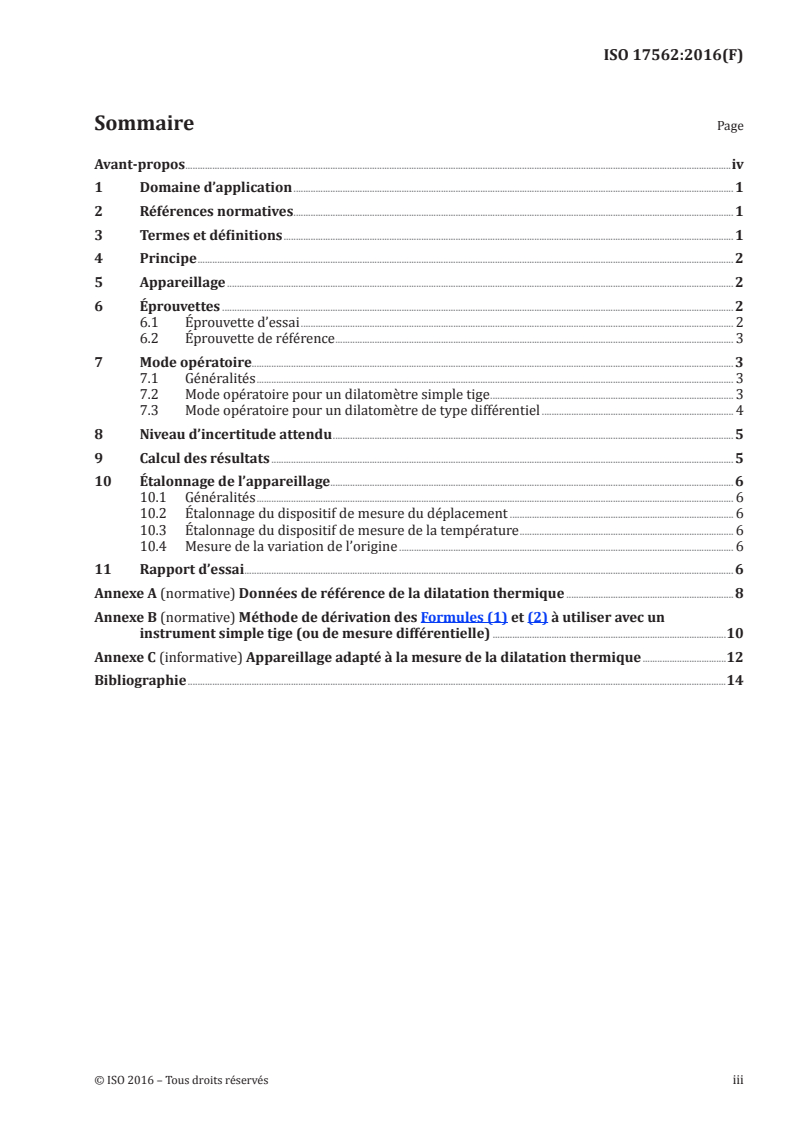
ISO 17562:2016 - Céramiques techniques — Détermination du coefficient de dilatation thermique linéique des céramiques monolithiques par la méthode de la tige poussoir/8/2016
Overview
ISO 17562:2016 defines a standardized test method for measuring the linear thermal expansion and the linear thermal expansion coefficient of monolithic fine ceramics (advanced/technical ceramics) using the push‑rod (dilatometer) technique. The method covers a wide temperature range-from near liquid nitrogen temperature up to a maximum of 2000 °C-and specifies the principles, apparatus, specimen preparation, measurement procedure, calibration and reporting required to produce reliable, comparable CTE data.
Key topics and technical requirements
- Measurement principle: Record specimen length change versus temperature under controlled heating/cooling and minimal mechanical load; calculate mean and instantaneous linear thermal expansion coefficients.
- Temperature range & control: Applicable from cryogenic (near liquid nitrogen) to 2000 °C. Temperature control should enable controlled rates (typically ≤ 5 °C/min) or step changes; homogeneity requirements are tighter below 1000 °C (±2 °C) and relaxed above (±5 °C up to 2000 °C).
- Apparatus: Use a push‑rod dilatometer (single‑rod or differential) with:
- Displacement measurement capability with high sensitivity (device selection matched to specimen length).
- Adjustable push‑rod contact force typically 0.1 N to 1 N.
- Temperature measurement (thermocouple) with uncertainty < 2 °C and tip close to specimen.
- Specimens: Monolithic rod specimens (circular or square cross‑section), typical cross‑section ~5 mm; length sufficient relative to instrument sensitivity; prepare at least two specimens.
- Reference specimen & baseline: Use a reference material with known expansion (e.g., high‑purity alumina or fine‑grained isotropic graphite) similar in size to the test specimen to calibrate and correct measured data.
- Procedure: Clean specimens, mount to ensure stability, apply minimal contact force, run at least two thermal cycles without removing specimen, record continuous length and temperature data.
- Atmosphere: Air is standard; use inert gas or vacuum if oxidation affects results. Note safety/chemical cautions (e.g., nitrogen with graphite at very high temperatures).
- Calibration & uncertainty: Clause details for displacement and temperature calibration, baseline variation measurement and expected uncertainty levels.
Applications and users
ISO 17562:2016 is used by:
- Materials scientists and ceramic engineers characterizing coefficient of thermal expansion (CTE).
- R&D and quality control laboratories validating thermal properties of fine ceramics.
- Manufacturers of ceramic components for aerospace, electronics, optics, refractories and high‑temperature engines where CTE matching and thermal shock resistance are critical.
- Dilatometer and furnace equipment manufacturers for device validation and calibration. Practical uses include CTE data for component design, thermal stress analysis, composite design, and material selection for multi‑material assemblies.
Related standards
- ISO 17139 (thermophysical properties of ceramic composites)
- ISO 7991 (glass thermal expansion)
- IEC 60584 (thermocouple reference/tolerances)
- BS 1902-5.14 (refractory thermal expansion methods)
Keywords: ISO 17562:2016, linear thermal expansion, push-rod technique, dilatometer, monolithic ceramics, fine ceramics, thermal expansion coefficient, CTE testing.
Relations
- Effective Date
- 04-May-2013
Buy Documents
ISO 17562:2016 - Fine ceramics (advanced ceramics, advanced technical ceramics) -- Test method for linear thermal expansion of monolithic ceramics by push-rod technique
ISO 17562:2016 - Fine ceramics (advanced ceramics, advanced technical ceramics) — Test method for linear thermal expansion of monolithic ceramics by push-rod technique/26/2016
ISO 17562:2016 - Céramiques techniques -- Détermination du coefficient de dilatation thermique linéique des céramiques monolithiques par la méthode de la tige poussoir
ISO 17562:2016 - Céramiques techniques — Détermination du coefficient de dilatation thermique linéique des céramiques monolithiques par la méthode de la tige poussoir/8/2016
Frequently Asked Questions
ISO 17562:2016 is a standard published by the International Organization for Standardization (ISO). Its full title is "Fine ceramics (advanced ceramics, advanced technical ceramics) — Test method for linear thermal expansion of monolithic ceramics by push-rod technique". This standard covers: ISO 17562:2016 specifies a method for the determination of the linear thermal expansion and the linear thermal expansion coefficient of monolithic ceramics from near liquid nitrogen temperature up to a maximum temperature of 2 000 °C.
ISO 17562:2016 specifies a method for the determination of the linear thermal expansion and the linear thermal expansion coefficient of monolithic ceramics from near liquid nitrogen temperature up to a maximum temperature of 2 000 °C.
ISO 17562:2016 is classified under the following ICS (International Classification for Standards) categories: 81.060.30 - Advanced ceramics. The ICS classification helps identify the subject area and facilitates finding related standards.
ISO 17562:2016 has the following relationships with other standards: It is inter standard links to ISO 17562:2001. Understanding these relationships helps ensure you are using the most current and applicable version of the standard.
ISO 17562:2016 is available in PDF format for immediate download after purchase. The document can be added to your cart and obtained through the secure checkout process. Digital delivery ensures instant access to the complete standard document.
Standards Content (Sample)
INTERNATIONAL ISO
STANDARD 17562
Second edition
2016-05-01
Fine ceramics (advanced ceramics,
advanced technical ceramics) — Test
method for linear thermal expansion
of monolithic ceramics by push-rod
technique
Céramiques techniques — Détermination du coefficient de dilatation
thermique linéique des céramiques monolithiques par la méthode de
la tige poussoir
Reference number
©
ISO 2016
© ISO 2016, Published in Switzerland
All rights reserved. Unless otherwise specified, no part of this publication may be reproduced or utilized otherwise in any form
or by any means, electronic or mechanical, including photocopying, or posting on the internet or an intranet, without prior
written permission. Permission can be requested from either ISO at the address below or ISO’s member body in the country of
the requester.
ISO copyright office
Ch. de Blandonnet 8 • CP 401
CH-1214 Vernier, Geneva, Switzerland
Tel. +41 22 749 01 11
Fax +41 22 749 09 47
copyright@iso.org
www.iso.org
ii © ISO 2016 – All rights reserved
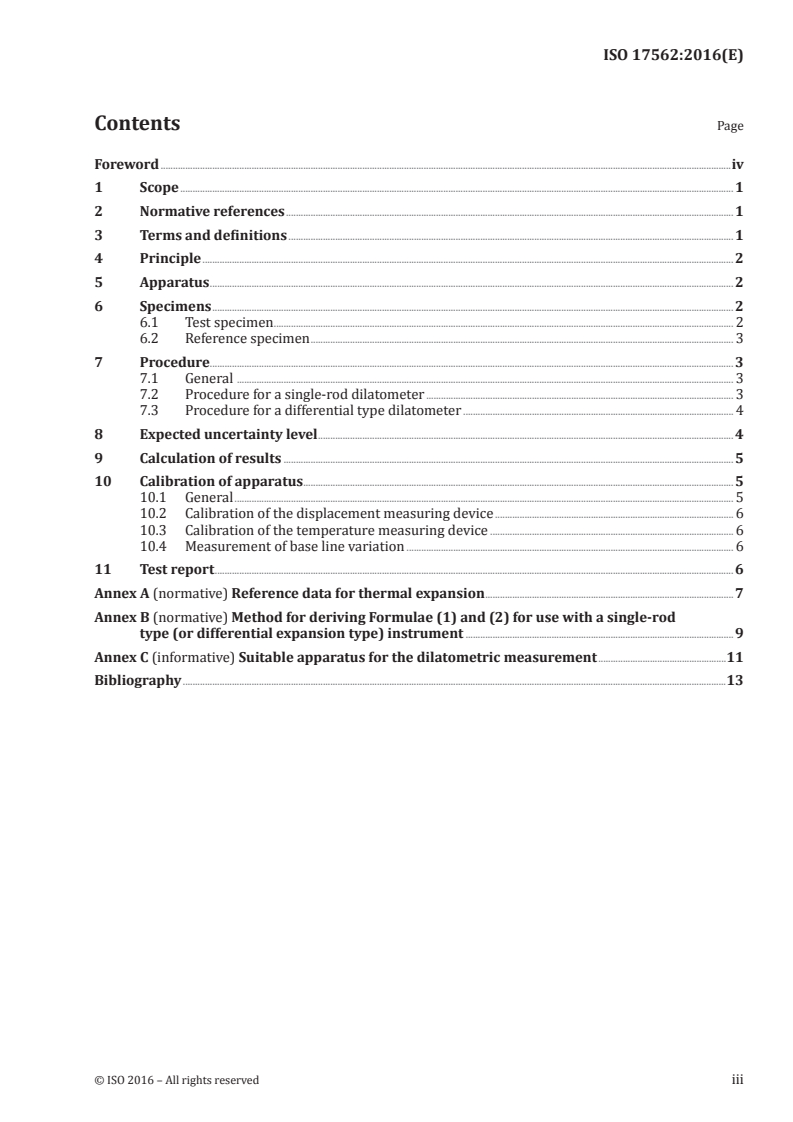
Contents Page
Foreword .iv
1 Scope . 1
2 Normative references . 1
3 Terms and definitions . 1
4 Principle . 2
5 Apparatus . 2
6 Specimens . 2
6.1 Test specimen . 2
6.2 Reference specimen . 3
7 Procedure. 3
7.1 General . 3
7.2 Procedure for a single-rod dilatometer . 3
7.3 Procedure for a differential type dilatometer . 4
8 Expected uncertainty level . 4
9 Calculation of results . 5
10 Calibration of apparatus . 5
10.1 General . 5
10.2 Calibration of the displacement measuring device . 6
10.3 Calibration of the temperature measuring device . 6
10.4 Measurement of base line variation . 6
11 Test report . 6
Annex A (normative) Reference data for thermal expansion . 7
Annex B (normative) Method for deriving Formulae (1) and (2) for use with a single-rod
type (or differential expansion type) instrument . 9
Annex C (informative) Suitable apparatus for the dilatometric measurement .11
Bibliography .13
Foreword
ISO (the International Organization for Standardization) is a worldwide federation of national standards
bodies (ISO member bodies). The work of preparing International Standards is normally carried out
through ISO technical committees. Each member body interested in a subject for which a technical
committee has been established has the right to be represented on that committee. International
organizations, governmental and non-governmental, in liaison with ISO, also take part in the work.
ISO collaborates closely with the International Electrotechnical Commission (IEC) on all matters of
electrotechnical standardization.
The procedures used to develop this document and those intended for its further maintenance are
described in the ISO/IEC Directives, Part 1. In particular the different approval criteria needed for the
different types of ISO documents should be noted. This document was drafted in accordance with the
editorial rules of the ISO/IEC Directives, Part 2 (see www.iso.org/directives).
Attention is drawn to the possibility that some of the elements of this document may be the subject of
patent rights. ISO shall not be held responsible for identifying any or all such patent rights. Details of
any patent rights identified during the development of the document will be in the Introduction and/or
on the ISO list of patent declarations received (see www.iso.org/patents).
Any trade name used in this document is information given for the convenience of users and does not
constitute an endorsement.
For an explanation on the meaning of ISO specific terms and expressions related to conformity
assessment, as well as information about ISO’s adherence to the WTO principles in the Technical
Barriers to Trade (TBT) see the following URL: Foreword - Supplementary information
The committee responsible for this document is ISO/TC 206, Fine ceramics.
This second edition cancels and replaces the first edition (ISO 17562:2001), which has been technically
revised.
iv © ISO 2016 – All rights reserved
INTERNATIONAL STANDARD ISO 17562:2016(E)
Fine ceramics (advanced ceramics, advanced technical
ceramics) — Test method for linear thermal expansion of
monolithic ceramics by push-rod technique
1 Scope
This International Standard specifies a method for the determination of the linear thermal expansion
and the linear thermal expansion coefficient of monolithic ceramics from near liquid nitrogen
temperature up to a maximum temperature of 2 000 °C.
2 Normative references
The following documents, in whole or in part, are normatively referenced in this document and are
indispensable for its application. For dated references, only the edition cited applies. For undated
references, the latest edition of the referenced document (including any amendments) applies.
ISO 3611:2010, Geometrical product specifications (GPS) — Dimensional measuring equipment:
Micrometers for external measurements — Design and metrological characteristics
IEC 13385-1, Geometrical product specifications (GPS) — Dimensional measuring equipment —
Part 1: Callipers; Design and metrological characteristics
IEC 13385-2, Geometrical product specifications (GPS) — Dimensional measuring equipment —
Part 2: Calliper depth gauges; Design and metrological characteristics
3 Terms and definitions
For the purposes of this document, the following terms and definitions apply.
3.1
linear thermal expansion
between temperatures T and T is the ratio ΔL/L , where ΔL = (L – L ) and L = specimen length at
1 2 0 2 1 0
room temperature
Note 1 to entry: When the temperature has changed from T to T assume that the length of specimen changes
1 2,
from L to L .
1 2
3.2
mean linear thermal expansion coefficient
α
linear thermal expansion (3.1) divided by ΔT = (T – T ) to produce the quotient α =⋅ΔΔLL/( T)
2 1
3.3
instantaneous linear thermal expansion coefficient
α
value of α (3.2) at the limit of T → T
2 1
αα= lim
TT→
4 Principle
A specimen of known size is heated/cooled to a specific temperature at a controlled temperature
rate in a known atmosphere under a minimal load. During the heating and cooling, the length and the
temperature of the specimen are monitored. The change in dimension of the specimen across a given
temperature region is used to calculate a linear thermal expansion coefficient or an instantaneous
linear thermal expansion coefficient against temperature.
5 Apparatus
5.1 Micrometer callipers, in accordance with ISO 3611 or vernier callipers in accordance with
IEC 13385-1 and IEC 13385-2 for measuring the specimen length, L , to an uncertainty of 0,1 % at 20 °C,
(see ISO 3611:2010, Clause 2).
5.2 Displacement measuring device, for determining the specimen length change accompanying the
−5
temperature change having a sensitivity of 1 × 10 × L (see 6.1). The contact force of the push-rod to
the specimen shall be adjustable. Typical values for the contact force are between 0,1 N and 1 N.
5.3 Specimen support system, to ensure that the specimen is held firmly in position by a contact force
not exceeding 1 N [see Clause 7 c)], in order to maintain mechanical stability throughout measurement.
5.4 Heating or cooling device, having the capability of attaining a temperature homogeneity within
±2 °C below 1 000 °C and ±5 °C between 1 000 °C and 2 000 °C over the whole specimen length.
NOTE There is no device available that covers the full temperature range from near liquid nitrogen
temperature up to a maximum temperature of 2 000 °C. It is necessary to choose the equipment according the
required temperature range. Furnaces are available for different temperature ranges as from −150 °C to 1 000 °C
and from room temperature to 1 500 °C or to 2 000 °C.
Liquid nitrogen is the most practical coolant for the cooling device. To realize defined heating or cooling
rates, the furnace should be equipped with a cooling coil and a heating element. By means of the cooling
coil, a constant cooling can be achieved and by means of the heating element, defined heating or cooling
rates can be realized.
5.5 Temperature controlling device, to enable the temperature of the specimen to be controlled,
upon heating or cooling to 5 °C/min or preferably lower rate or step-wise temperature changes (see
[Clause 7 e)] over the whole measurement range.
5.6 Temperature measuring device, to allow the temperature of the specimen to be measured
with an uncertainty of less than 2 °C within the measurement range. A thermocouple of appropriate
type is usually used. Care shall be taken to ensure that the thermocouple tip is in close proximity to the
specimen.
The contact force of the push-rod to the specimen shall be adjustable between 0,1 N and 1 N.
6 Specimens
6.1 Test specimen
The shape and dimension of the test specimen usually depend on the type of specimen support
system. However, its shape is usually in the form of a square or circular rod. For the case of a square
rod, the width and thickness shall be approximately 5 mm. If a circular rod is being used, the diameter
shall be approximately 5 mm. In both cases, the length of the rod shall be at least 1 × 10 times the
sensitivity of the displacement measuring device (see 5.2) calculated as at least 10 mm in the case
of 0,1 μm sensitivity device. The end faces of the test specimen shall be appropriate to the design of
the measurement apparatus and should either be flat, parallel and perpendicular to length or gently
2 © ISO 2016 – All rights reserved
rounded to provide localized contact with the test system to minimize off-axis movement. At least two
test specimens should be prepared.
6.2 Reference specimen
A reference specimen is used to obtain the calibration data to correct the measured change in length of
an unknown test specimen. α of the reference specimen shall be known over the test temperature
range. The correction to be applied to the unknown test specimen is obtained by calibration using a
reference specimen.
Reference specimens are usually prepared from materials with high purity (99,99 %;
crystallographically cubic and thus have isotropic thermal expansivity), pure crystalline alumina (at
least 99,8 % Al O , density >3,70 g/cm ), or fine-grained isotropic graphite as shown in Annex A. The
2 3
shape and the dimensions of the reference specimen shall be similar within ±0,2 mm to those of the
unknown test specimen.
Alumina is not a good reference because the thermal expansion characteristics can vary with source
because of crystallographic texturing from the process method used to manufacture it. Any test-pieces
used shall be independently certified. There are several varieties of fine-grained isotropic graphite
available from different suppliers. So, also graphite can only be used as a reference with certification of
the specific grade.
7 Procedure
7.1 General
Care should be taken to select push-rod and hold materials that will not react with the test specimen.
Reference to phase diagrams or similar technical literature is advised. If there is any indication of
remarkable reaction, the test results should be discarded.
7.2 Procedure for a single-rod dilatometer
a) Remove surface contamination and adherent debris from the surface of the test specimen. Using
the micrometer callipers (5.1), determine the length L of the test specimen to an accuracy of 0,1 %
or ±0,005 mm (whichever is smaller) at room temperature, and determine room temperature to an
accuracy of ±0,5 °C.
b) Remove surface contamination and adherent debris from the mounting base, and place the test
specimen in the specimen holder to ensure mechanical stability.
c) Contact the push-rod gently on the end of the test specimen and apply a load of between 0,1 N and
1 N to the test specimen.
NOTE 1 It is advised to use a test load, as low as possible to avoid possible confounding errors due to test
part deformation or creep at high temperatures.
d) The measurement atmosphere is air under a constant flow rate. If oxidation of the
...
INTERNATIONAL ISO
STANDARD 17562
Second edition
2016-05-01
Fine ceramics (advanced ceramics,
advanced technical ceramics) — Test
method for linear thermal expansion
of monolithic ceramics by push-rod
technique
Céramiques techniques — Détermination du coefficient de dilatation
thermique linéique des céramiques monolithiques par la méthode de
la tige poussoir
Reference number
©
ISO 2016
© ISO 2016, Published in Switzerland
All rights reserved. Unless otherwise specified, no part of this publication may be reproduced or utilized otherwise in any form
or by any means, electronic or mechanical, including photocopying, or posting on the internet or an intranet, without prior
written permission. Permission can be requested from either ISO at the address below or ISO’s member body in the country of
the requester.
ISO copyright office
Ch. de Blandonnet 8 • CP 401
CH-1214 Vernier, Geneva, Switzerland
Tel. +41 22 749 01 11
Fax +41 22 749 09 47
copyright@iso.org
www.iso.org
ii © ISO 2016 – All rights reserved
Contents Page
Foreword .iv
1 Scope . 1
2 Normative references . 1
3 Terms and definitions . 1
4 Principle . 2
5 Apparatus . 2
6 Specimens . 2
6.1 Test specimen . 2
6.2 Reference specimen . 3
7 Procedure. 3
7.1 General . 3
7.2 Procedure for a single-rod dilatometer . 3
7.3 Procedure for a differential type dilatometer . 4
8 Expected uncertainty level . 4
9 Calculation of results . 5
10 Calibration of apparatus . 5
10.1 General . 5
10.2 Calibration of the displacement measuring device . 6
10.3 Calibration of the temperature measuring device . 6
10.4 Measurement of base line variation . 6
11 Test report . 6
Annex A (normative) Reference data for thermal expansion . 7
Annex B (normative) Method for deriving Formulae (1) and (2) for use with a single-rod
type (or differential expansion type) instrument . 9
Annex C (informative) Suitable apparatus for the dilatometric measurement .11
Bibliography .13
Foreword
ISO (the International Organization for Standardization) is a worldwide federation of national standards
bodies (ISO member bodies). The work of preparing International Standards is normally carried out
through ISO technical committees. Each member body interested in a subject for which a technical
committee has been established has the right to be represented on that committee. International
organizations, governmental and non-governmental, in liaison with ISO, also take part in the work.
ISO collaborates closely with the International Electrotechnical Commission (IEC) on all matters of
electrotechnical standardization.
The procedures used to develop this document and those intended for its further maintenance are
described in the ISO/IEC Directives, Part 1. In particular the different approval criteria needed for the
different types of ISO documents should be noted. This document was drafted in accordance with the
editorial rules of the ISO/IEC Directives, Part 2 (see www.iso.org/directives).
Attention is drawn to the possibility that some of the elements of this document may be the subject of
patent rights. ISO shall not be held responsible for identifying any or all such patent rights. Details of
any patent rights identified during the development of the document will be in the Introduction and/or
on the ISO list of patent declarations received (see www.iso.org/patents).
Any trade name used in this document is information given for the convenience of users and does not
constitute an endorsement.
For an explanation on the meaning of ISO specific terms and expressions related to conformity
assessment, as well as information about ISO’s adherence to the WTO principles in the Technical
Barriers to Trade (TBT) see the following URL: Foreword - Supplementary information
The committee responsible for this document is ISO/TC 206, Fine ceramics.
This second edition cancels and replaces the first edition (ISO 17562:2001), which has been technically
revised.
iv © ISO 2016 – All rights reserved
INTERNATIONAL STANDARD ISO 17562:2016(E)
Fine ceramics (advanced ceramics, advanced technical
ceramics) — Test method for linear thermal expansion of
monolithic ceramics by push-rod technique
1 Scope
This International Standard specifies a method for the determination of the linear thermal expansion
and the linear thermal expansion coefficient of monolithic ceramics from near liquid nitrogen
temperature up to a maximum temperature of 2 000 °C.
2 Normative references
The following documents, in whole or in part, are normatively referenced in this document and are
indispensable for its application. For dated references, only the edition cited applies. For undated
references, the latest edition of the referenced document (including any amendments) applies.
ISO 3611:2010, Geometrical product specifications (GPS) — Dimensional measuring equipment:
Micrometers for external measurements — Design and metrological characteristics
IEC 13385-1, Geometrical product specifications (GPS) — Dimensional measuring equipment —
Part 1: Callipers; Design and metrological characteristics
IEC 13385-2, Geometrical product specifications (GPS) — Dimensional measuring equipment —
Part 2: Calliper depth gauges; Design and metrological characteristics
3 Terms and definitions
For the purposes of this document, the following terms and definitions apply.
3.1
linear thermal expansion
between temperatures T and T is the ratio ΔL/L , where ΔL = (L – L ) and L = specimen length at
1 2 0 2 1 0
room temperature
Note 1 to entry: When the temperature has changed from T to T assume that the length of specimen changes
1 2,
from L to L .
1 2
3.2
mean linear thermal expansion coefficient
α
linear thermal expansion (3.1) divided by ΔT = (T – T ) to produce the quotient α =⋅ΔΔLL/( T)
2 1
3.3
instantaneous linear thermal expansion coefficient
α
value of α (3.2) at the limit of T → T
2 1
αα= lim
TT→
4 Principle
A specimen of known size is heated/cooled to a specific temperature at a controlled temperature
rate in a known atmosphere under a minimal load. During the heating and cooling, the length and the
temperature of the specimen are monitored. The change in dimension of the specimen across a given
temperature region is used to calculate a linear thermal expansion coefficient or an instantaneous
linear thermal expansion coefficient against temperature.
5 Apparatus
5.1 Micrometer callipers, in accordance with ISO 3611 or vernier callipers in accordance with
IEC 13385-1 and IEC 13385-2 for measuring the specimen length, L , to an uncertainty of 0,1 % at 20 °C,
(see ISO 3611:2010, Clause 2).
5.2 Displacement measuring device, for determining the specimen length change accompanying the
−5
temperature change having a sensitivity of 1 × 10 × L (see 6.1). The contact force of the push-rod to
the specimen shall be adjustable. Typical values for the contact force are between 0,1 N and 1 N.
5.3 Specimen support system, to ensure that the specimen is held firmly in position by a contact force
not exceeding 1 N [see Clause 7 c)], in order to maintain mechanical stability throughout measurement.
5.4 Heating or cooling device, having the capability of attaining a temperature homogeneity within
±2 °C below 1 000 °C and ±5 °C between 1 000 °C and 2 000 °C over the whole specimen length.
NOTE There is no device available that covers the full temperature range from near liquid nitrogen
temperature up to a maximum temperature of 2 000 °C. It is necessary to choose the equipment according the
required temperature range. Furnaces are available for different temperature ranges as from −150 °C to 1 000 °C
and from room temperature to 1 500 °C or to 2 000 °C.
Liquid nitrogen is the most practical coolant for the cooling device. To realize defined heating or cooling
rates, the furnace should be equipped with a cooling coil and a heating element. By means of the cooling
coil, a constant cooling can be achieved and by means of the heating element, defined heating or cooling
rates can be realized.
5.5 Temperature controlling device, to enable the temperature of the specimen to be controlled,
upon heating or cooling to 5 °C/min or preferably lower rate or step-wise temperature changes (see
[Clause 7 e)] over the whole measurement range.
5.6 Temperature measuring device, to allow the temperature of the specimen to be measured
with an uncertainty of less than 2 °C within the measurement range. A thermocouple of appropriate
type is usually used. Care shall be taken to ensure that the thermocouple tip is in close proximity to the
specimen.
The contact force of the push-rod to the specimen shall be adjustable between 0,1 N and 1 N.
6 Specimens
6.1 Test specimen
The shape and dimension of the test specimen usually depend on the type of specimen support
system. However, its shape is usually in the form of a square or circular rod. For the case of a square
rod, the width and thickness shall be approximately 5 mm. If a circular rod is being used, the diameter
shall be approximately 5 mm. In both cases, the length of the rod shall be at least 1 × 10 times the
sensitivity of the displacement measuring device (see 5.2) calculated as at least 10 mm in the case
of 0,1 μm sensitivity device. The end faces of the test specimen shall be appropriate to the design of
the measurement apparatus and should either be flat, parallel and perpendicular to length or gently
2 © ISO 2016 – All rights reserved
rounded to provide localized contact with the test system to minimize off-axis movement. At least two
test specimens should be prepared.
6.2 Reference specimen
A reference specimen is used to obtain the calibration data to correct the measured change in length of
an unknown test specimen. α of the reference specimen shall be known over the test temperature
range. The correction to be applied to the unknown test specimen is obtained by calibration using a
reference specimen.
Reference specimens are usually prepared from materials with high purity (99,99 %;
crystallographically cubic and thus have isotropic thermal expansivity), pure crystalline alumina (at
least 99,8 % Al O , density >3,70 g/cm ), or fine-grained isotropic graphite as shown in Annex A. The
2 3
shape and the dimensions of the reference specimen shall be similar within ±0,2 mm to those of the
unknown test specimen.
Alumina is not a good reference because the thermal expansion characteristics can vary with source
because of crystallographic texturing from the process method used to manufacture it. Any test-pieces
used shall be independently certified. There are several varieties of fine-grained isotropic graphite
available from different suppliers. So, also graphite can only be used as a reference with certification of
the specific grade.
7 Procedure
7.1 General
Care should be taken to select push-rod and hold materials that will not react with the test specimen.
Reference to phase diagrams or similar technical literature is advised. If there is any indication of
remarkable reaction, the test results should be discarded.
7.2 Procedure for a single-rod dilatometer
a) Remove surface contamination and adherent debris from the surface of the test specimen. Using
the micrometer callipers (5.1), determine the length L of the test specimen to an accuracy of 0,1 %
or ±0,005 mm (whichever is smaller) at room temperature, and determine room temperature to an
accuracy of ±0,5 °C.
b) Remove surface contamination and adherent debris from the mounting base, and place the test
specimen in the specimen holder to ensure mechanical stability.
c) Contact the push-rod gently on the end of the test specimen and apply a load of between 0,1 N and
1 N to the test specimen.
NOTE 1 It is advised to use a test load, as low as possible to avoid possible confounding errors due to test
part deformation or creep at high temperatures.
d) The measurement atmosphere is air under a constant flow rate. If oxidation of the
...
NORME ISO
INTERNATIONALE 17562
Deuxième édition
2016-05-01
Céramiques techniques —
Détermination du coefficient de
dilatation thermique linéique des
céramiques monolithiques par la
méthode de la tige poussoir
Fine ceramics (advanced ceramics, advanced technical ceramics) —
Test method for linear thermal expansion of monolithic ceramics by
push-rod technique
Numéro de référence
©
ISO 2016
DOCUMENT PROTÉGÉ PAR COPYRIGHT
© ISO 2016, Publié en Suisse
Droits de reproduction réservés. Sauf indication contraire, aucune partie de cette publication ne peut être reproduite ni utilisée
sous quelque forme que ce soit et par aucun procédé, électronique ou mécanique, y compris la photocopie, l’affichage sur
l’internet ou sur un Intranet, sans autorisation écrite préalable. Les demandes d’autorisation peuvent être adressées à l’ISO à
l’adresse ci-après ou au comité membre de l’ISO dans le pays du demandeur.
ISO copyright office
Ch. de Blandonnet 8 • CP 401
CH-1214 Vernier, Geneva, Switzerland
Tel. +41 22 749 01 11
Fax +41 22 749 09 47
copyright@iso.org
www.iso.org
ii © ISO 2016 – Tous droits réservés
Sommaire Page
Avant-propos .iv
1 Domaine d’application . 1
2 Références normatives . 1
3 Termes et définitions . 1
4 Principe . 2
5 Appareillage . 2
6 Éprouvettes . 2
6.1 Éprouvette d’essai . 2
6.2 Éprouvette de référence . 3
7 Mode opératoire. 3
7.1 Généralités . 3
7.2 Mode opératoire pour un dilatomètre simple tige . 3
7.3 Mode opératoire pour un dilatomètre de type différentiel . 4
8 Niveau d’incertitude attendu . 5
9 Calcul des résultats . 5
10 Étalonnage de l’appareillage . 6
10.1 Généralités . 6
10.2 Étalonnage du dispositif de mesure du déplacement . 6
10.3 Étalonnage du dispositif de mesure de la température . 6
10.4 Mesure de la variation de l’origine . 6
11 Rapport d’essai . 6
Annexe A (normative) Données de référence de la dilatation thermique . 8
Annexe B (normative) Méthode de dérivation des Formules (1) et (2) à utiliser avec un
instrument simple tige (ou de mesure différentielle) .10
Annexe C (informative) Appareillage adapté à la mesure de la dilatation thermique .12
Bibliographie .14
Avant-propos
L’ISO (Organisation internationale de normalisation) est une fédération mondiale d’organismes
nationaux de normalisation (comités membres de l’ISO). L’élaboration des Normes internationales est
en général confiée aux comités techniques de l’ISO. Chaque comité membre intéressé par une étude
a le droit de faire partie du comité technique créé à cet effet. Les organisations internationales,
gouvernementales et non gouvernementales, en liaison avec l’ISO participent également aux travaux.
L’ISO collabore étroitement avec la Commission électrotechnique internationale (IEC) en ce qui
concerne la normalisation électrotechnique.
Les procédures utilisées pour élaborer le présent document et celles destinées à sa mise à jour sont
décrites dans les Directives ISO/IEC, Partie 1. Il convient, en particulier, de prendre note des différents
critères d’approbation requis pour les différents types de documents ISO. Le présent document a été
rédigé conformément aux règles de rédaction données dans les Directives ISO/IEC, Partie 2 (voir www.
iso.org/directives).
L’attention est appelée sur le fait que certains des éléments du présent document peuvent faire l’objet de
droits de propriété intellectuelle ou de droits analogues. L’ISO ne saurait être tenue pour responsable
de ne pas avoir identifié de tels droits de propriété et averti de leur existence. Les détails concernant
les références aux droits de propriété intellectuelle ou autres droits analogues identifiés lors de
l’élaboration du document sont indiqués dans l’Introduction et/ou dans la liste des déclarations de
brevets reçues par l’ISO (voir www.iso.org/brevets).
Les appellations commerciales éventuellement mentionnées dans le présent document sont données
pour information, par souci de commodité, à l’intention des utilisateurs et ne sauraient constituer un
engagement.
Pour une explication de la signification des termes et expressions spécifiques de l’ISO liés à
l’évaluation de la conformité, ou pour toute information au sujet de l’adhésion de l’ISO aux principes
de l’OMC concernant les obstacles techniques au commerce (OTC), voir le lien suivant: Avant-propos —
Informations supplémentaires.
Le comité chargé de l’élaboration du présent document est l’ISO/TC 206, Céramiques techniques.
Cette deuxième édition annule et remplace la première édition (ISO 17562:2001), qui a fait l’objet d’une
révision technique.
iv © ISO 2016 – Tous droits réservés
NORME INTERNATIONALE ISO 17562:2016(F)
Céramiques techniques — Détermination du coefficient
de dilatation thermique linéique des céramiques
monolithiques par la méthode de la tige poussoir
1 Domaine d’application
La présente Norme internationale spécifie une méthode pour déterminer la dilatation thermique
linéique, ainsi que le coefficient de dilatation thermique linéique, des céramiques monolithiques à des
températures allant d’une température proche de celle de l’azote liquide à une température maximale
de 2 000 °C.
2 Références normatives
Les documents ci-après, dans leur intégralité ou non, sont des références normatives indispensables à
l’application du présent document. Pour les références datées, seule l’édition citée s’applique. Pour les
références non datées, la dernière édition du document de référence s’applique (y compris les éventuels
amendements).
ISO 3611:2010, Spécification géométrique des produits (GPS) — Équipement de mesurage dimensionnel:
Micromètres d’extérieur — Caractéristiques de conception et caractéristiques métrologiques
IEC 13385-1, Spécification géométrique des produits (GPS) — Équipement de mesurage dimensionnel —
Partie 1: Pieds à coulisse — Caractéristiques de conception et caractéristiques métrologiques
IEC 13385-2, Spécification géométrique des produits (GPS) — Équipement de mesurage dimensionnel —
Partie 2: Jauges de profondeur — Caractéristiques de conception et caractéristiques métrologiques
3 Termes et définitions
Pour les besoins du présent document, les termes et définitions suivants s’appliquent.
3.1
dilatation thermique linéique
rapport ΔL/L , lorsque la température passe de T à T , avec ΔL = (L − L ) et L = longueur de
0 1 2 2 1 0
l’éprouvette à température ambiante
Note 1 à l’article: On suppose que lorsque la température est passée de T à T la longueur de l’éprouvette est
1 2,
passée de L à L .
1 2
3.2
coefficient moyen de dilatation thermique linéique
α
dilatation thermique linéique (3.1) divisée par ΔT = (T − T ), soit α =⋅ΔΔLL/( T)
2 1
3.3
coefficient instantané de dilatation thermique linéique
α
valeur limite de α (3.2) lorsque T tend vers T
2 1
αα= lim
TT→
4 Principe
Dans une atmosphère connue et sous une charge minimale, une éprouvette de taille connue est
chauffée/refroidie jusqu’à une température spécifique, à une vitesse contrôlée. La longueur et la
température de l’éprouvette sont enregistrées pendant le chauffage et le refroidissement. La variation
de dimension de l’éprouvette sur un domaine de température donné est utilisée pour calculer le
coefficient de dilatation thermique linéique ou un coefficient instantané de dilatation thermique
linéique en fonction de la température.
5 Appareillage
5.1 Micromètre, selon l’ISO 3611 ou vernier, selon l’IEC 13385-1 et l’IEC 13385-2 permettant de
mesurer la longueur de l’éprouvette, L , avec une incertitude de 0,1 % à 20 °C, (voir l’ISO 3611:2010,
Article 2).
5.2 Dispositif de mesure du déplacement, permettant de déterminer la variation de longueur de
−5
l’éprouvette qui accompagne la variation de température, ayant une sensibilité de 1 × 10 × L (voir
6.1). La force de contact de la tige poussoir sur l’éprouvette doit être ajustable. Les valeurs types pour la
force de contact sont comprises entre 0,1 N et 1 N.
5.3 Système de support d’éprouvette, assurant que l’éprouvette est fermement maintenue en place,
grâce à une force de contact de 1 N maximum [voir l’Article 7 c)], afin de maintenir la stabilité mécanique
tout au long de la mesure.
5.4 Dispositif de chauffage ou de refroidissement, permettant à l’éprouvette d’avoir une
température homogène sur toute sa longueur, avec une tolérance de ± 2 °C lorsqu’elle est chauffée en
dessous de 1 000 °C et de ± 5 °C entre 1 000 °C et 2 000 °C.
NOTE Aucun dispositif ne permet actuellement de couvrir l’ensemble de la plage de température allant de
la température proche de celle de l’azote liquide à une température maximale de 2 000 °C. Il est nécessaire de
choisir l’équipement en fonction de la plage de température requise. Il existe des fours pour différentes plages de
températures comprises entre −150 °C et 1 000 °C et entre la température ambiante et 1 500 °C ou 2 000 °C.
Pour le dispositif de refroidissement, l’azote liquide est le produit réfrigérant le plus pratique. Pour
obtenir les vitesses de chauffe ou de refroidissement définies, il convient que le four soit équipé d’un
serpentin de refroidissement ou d’un élément chauffant. Le serpentin de refroidissement permet
d’obtenir un refroidissement constant et l’élément chauffant permet d’atteindre les vitesses de chauffe
ou de refroidissement définies.
5.5 Dispositif de contrôle de la température, permettant de contrôler la température de l’éprouvette,
qu’elle soit chauffée ou refroidie à une vitesse de 5 °C/min ou à une vitesse de préférence inférieure ou
par paliers [voir l’Article 7 e)] sur toute la plage de mesure.
5.6 Dispositif de mesure de la température, permettant de mesurer la température de l’éprouvette
avec une incertitude de moins de 2 °C dans la plage de mesure. Un thermocouple adapté est généralement
utilisé. Des précautions doivent être prises pour faire en sorte que la pointe du thermocouple se trouve à
proximité immédiate de l’éprouvette.
La force de contact de la tige poussoir sur l’éprouvette doit pouvoir être ajustée entre 0,1 N et 1 N.
6 Éprouvettes
6.1 Éprouvette d’essai
La forme et les dimensions de l’éprouvette d’essai dépendent généralement du type de système de
support d’éprouvette. Toutefois, elle a généralement la forme d’une tige carrée ou ronde. Dans le cas
2 © ISO 2016 – Tous droits réservés
d’une tige carrée, la largeur et l’épaisseur doivent être d’environ 5 mm. Si une tige circulaire est utilisée,
son diamètre doit être d’environ 5 mm. Dans les deux cas, la tige doit avoir une longueur d’au moins
1 × 10 fois la sensibilité du dispositif de mesure du déplacement (voir 5.2), calculée comme équivalant
à au moins 10 mm dans le cas d’un dispositif avec une sensibilité de 0,1 μm. Les faces de l’éprouvette
d’essai situées à l’extrémité doivent être adaptées à la conception de l’appareillage de mesure. Il convient
qu’elles soient plates, parallèles et perpendiculaires à la longueur ou légèrement arrondies pour fournir
un contact localisé avec le système d’essai permettant de réduire le plus possible le mouvement en
dehors de l’axe. Il convient de préparer au moins deux autres éprouvettes d’essai.
6.2 Éprouvette de référence
Une éprouvette de référence est utilisée pour obtenir les données d’étalonnage permettant de corriger
la variation mesurée de longueur d’une éprouvette d’essai inconnue. Le coefficient moyen de dilatation
thermique linéique α de l’éprouvette de référence doit être connu pour la plage de température d’essai.
La correction à appliquer à l’éprouvette d’essai inconnue est obtenue par étalonnage à l’aide d’une
éprouvette de référence.
Les éprouvettes de référence sont généralement préparées à partir de matériaux d’une grande pureté
(cristallographiquement cubiques à 99,99 % et présentant de ce fait une dilatation thermique isotrope)
tels que de l’alumine cristalline pure (au moins 99,8 % Al O , masse volumique > 3,70 g/cm ), ou du
2 3
graphite isotrope à grains fins tel qu’indiqué à l’Annexe A. La forme et les dimensions de l’éprouvette de
référence doivent être similaires à ± 0,2 mm à celles de l’éprouvette d’essai inconnue.
L’alumine ne constitue pas un étalon adapté, car les caractéristiques de dilatation thermique peuvent
varier avec la source compte tenu de la texturation cristallographique liée à la méthode de traitement
utilisée pour la fabriquer. Toutes les éprouvettes utilisées doivent être certifiées de façon indépendante.
Il existe plusieurs variétés de graphite isotrope à grains fins disponibles auprès de différents
fournisseurs. Le graphite ne peut donc être utilisé comme étalon que s’il possède la certification de
qualité spécifique.
7 Mode opératoire
7.1 Généralités
Il convient de veiller à sélectionner une tige poussoir et des matériaux qui ne réagiront pas avec
l’éprouvette d’essai. Il est conseillé de se référer à des diagrammes de phase ou à de la littérature
technique similaire. En l’absence d’indication d’une réaction visible, il convient de rejeter les résultats
d’essai.
7.2 Mode opératoire pour un dilatomètre simple tige
a) Éliminer la contamination superficielle et les débris collants sur la surface de l’éprouvette d’essai.
À l’aide du micromètre (5.1), déterminer à température ambiante la longueur L de l’éprouvette
d’essai avec une exactitude de 0,1 % ou ± 0,005 mm (prendre la plus petite des deux valeurs) et
déterminer la température ambiante avec une exactitude de ± 0,5 °C.
b) Éliminer la contamination superficielle et les débris collants sur le socle et mettre l’éprouvette
d’essai en place dans le porte-éprouvette, de manière à assurer la stabilité mécanique.
c) Placer délicatement la tige poussoir à l’extrémité de l’éprouvette d’essai et appliquer à l’éprouvette
d’essai une charge comprise entre 0,1 N et 1 N.
NOTE 1 Il est conseillé d’utiliser une charge d’essai aussi faible que possible afin d’éviter toute erreur liée
à la déformation ou au fluage de l’éprouvette à des températures élevées.
d) L’atmosphère de mesure est de l’air à débit constant. Si l’oxydation de l’éprouvette d’essai et/ou du
porte-ép
...
NORME ISO
INTERNATIONALE 17562
Deuxième édition
2016-05-01
Céramiques techniques —
Détermination du coefficient de
dilatation thermique linéique des
céramiques monolithiques par la
méthode de la tige poussoir
Fine ceramics (advanced ceramics, advanced technical ceramics) —
Test method for linear thermal expansion of monolithic ceramics by
push-rod technique
Numéro de référence
©
ISO 2016
DOCUMENT PROTÉGÉ PAR COPYRIGHT
© ISO 2016, Publié en Suisse
Droits de reproduction réservés. Sauf indication contraire, aucune partie de cette publication ne peut être reproduite ni utilisée
sous quelque forme que ce soit et par aucun procédé, électronique ou mécanique, y compris la photocopie, l’affichage sur
l’internet ou sur un Intranet, sans autorisation écrite préalable. Les demandes d’autorisation peuvent être adressées à l’ISO à
l’adresse ci-après ou au comité membre de l’ISO dans le pays du demandeur.
ISO copyright office
Ch. de Blandonnet 8 • CP 401
CH-1214 Vernier, Geneva, Switzerland
Tel. +41 22 749 01 11
Fax +41 22 749 09 47
copyright@iso.org
www.iso.org
ii © ISO 2016 – Tous droits réservés
Sommaire Page
Avant-propos .iv
1 Domaine d’application . 1
2 Références normatives . 1
3 Termes et définitions . 1
4 Principe . 2
5 Appareillage . 2
6 Éprouvettes . 2
6.1 Éprouvette d’essai . 2
6.2 Éprouvette de référence . 3
7 Mode opératoire. 3
7.1 Généralités . 3
7.2 Mode opératoire pour un dilatomètre simple tige . 3
7.3 Mode opératoire pour un dilatomètre de type différentiel . 4
8 Niveau d’incertitude attendu . 5
9 Calcul des résultats . 5
10 Étalonnage de l’appareillage . 6
10.1 Généralités . 6
10.2 Étalonnage du dispositif de mesure du déplacement . 6
10.3 Étalonnage du dispositif de mesure de la température . 6
10.4 Mesure de la variation de l’origine . 6
11 Rapport d’essai . 6
Annexe A (normative) Données de référence de la dilatation thermique . 8
Annexe B (normative) Méthode de dérivation des Formules (1) et (2) à utiliser avec un
instrument simple tige (ou de mesure différentielle) .10
Annexe C (informative) Appareillage adapté à la mesure de la dilatation thermique .12
Bibliographie .14
Avant-propos
L’ISO (Organisation internationale de normalisation) est une fédération mondiale d’organismes
nationaux de normalisation (comités membres de l’ISO). L’élaboration des Normes internationales est
en général confiée aux comités techniques de l’ISO. Chaque comité membre intéressé par une étude
a le droit de faire partie du comité technique créé à cet effet. Les organisations internationales,
gouvernementales et non gouvernementales, en liaison avec l’ISO participent également aux travaux.
L’ISO collabore étroitement avec la Commission électrotechnique internationale (IEC) en ce qui
concerne la normalisation électrotechnique.
Les procédures utilisées pour élaborer le présent document et celles destinées à sa mise à jour sont
décrites dans les Directives ISO/IEC, Partie 1. Il convient, en particulier, de prendre note des différents
critères d’approbation requis pour les différents types de documents ISO. Le présent document a été
rédigé conformément aux règles de rédaction données dans les Directives ISO/IEC, Partie 2 (voir www.
iso.org/directives).
L’attention est appelée sur le fait que certains des éléments du présent document peuvent faire l’objet de
droits de propriété intellectuelle ou de droits analogues. L’ISO ne saurait être tenue pour responsable
de ne pas avoir identifié de tels droits de propriété et averti de leur existence. Les détails concernant
les références aux droits de propriété intellectuelle ou autres droits analogues identifiés lors de
l’élaboration du document sont indiqués dans l’Introduction et/ou dans la liste des déclarations de
brevets reçues par l’ISO (voir www.iso.org/brevets).
Les appellations commerciales éventuellement mentionnées dans le présent document sont données
pour information, par souci de commodité, à l’intention des utilisateurs et ne sauraient constituer un
engagement.
Pour une explication de la signification des termes et expressions spécifiques de l’ISO liés à
l’évaluation de la conformité, ou pour toute information au sujet de l’adhésion de l’ISO aux principes
de l’OMC concernant les obstacles techniques au commerce (OTC), voir le lien suivant: Avant-propos —
Informations supplémentaires.
Le comité chargé de l’élaboration du présent document est l’ISO/TC 206, Céramiques techniques.
Cette deuxième édition annule et remplace la première édition (ISO 17562:2001), qui a fait l’objet d’une
révision technique.
iv © ISO 2016 – Tous droits réservés
NORME INTERNATIONALE ISO 17562:2016(F)
Céramiques techniques — Détermination du coefficient
de dilatation thermique linéique des céramiques
monolithiques par la méthode de la tige poussoir
1 Domaine d’application
La présente Norme internationale spécifie une méthode pour déterminer la dilatation thermique
linéique, ainsi que le coefficient de dilatation thermique linéique, des céramiques monolithiques à des
températures allant d’une température proche de celle de l’azote liquide à une température maximale
de 2 000 °C.
2 Références normatives
Les documents ci-après, dans leur intégralité ou non, sont des références normatives indispensables à
l’application du présent document. Pour les références datées, seule l’édition citée s’applique. Pour les
références non datées, la dernière édition du document de référence s’applique (y compris les éventuels
amendements).
ISO 3611:2010, Spécification géométrique des produits (GPS) — Équipement de mesurage dimensionnel:
Micromètres d’extérieur — Caractéristiques de conception et caractéristiques métrologiques
IEC 13385-1, Spécification géométrique des produits (GPS) — Équipement de mesurage dimensionnel —
Partie 1: Pieds à coulisse — Caractéristiques de conception et caractéristiques métrologiques
IEC 13385-2, Spécification géométrique des produits (GPS) — Équipement de mesurage dimensionnel —
Partie 2: Jauges de profondeur — Caractéristiques de conception et caractéristiques métrologiques
3 Termes et définitions
Pour les besoins du présent document, les termes et définitions suivants s’appliquent.
3.1
dilatation thermique linéique
rapport ΔL/L , lorsque la température passe de T à T , avec ΔL = (L − L ) et L = longueur de
0 1 2 2 1 0
l’éprouvette à température ambiante
Note 1 à l’article: On suppose que lorsque la température est passée de T à T la longueur de l’éprouvette est
1 2,
passée de L à L .
1 2
3.2
coefficient moyen de dilatation thermique linéique
α
dilatation thermique linéique (3.1) divisée par ΔT = (T − T ), soit α =⋅ΔΔLL/( T)
2 1
3.3
coefficient instantané de dilatation thermique linéique
α
valeur limite de α (3.2) lorsque T tend vers T
2 1
αα= lim
TT→
4 Principe
Dans une atmosphère connue et sous une charge minimale, une éprouvette de taille connue est
chauffée/refroidie jusqu’à une température spécifique, à une vitesse contrôlée. La longueur et la
température de l’éprouvette sont enregistrées pendant le chauffage et le refroidissement. La variation
de dimension de l’éprouvette sur un domaine de température donné est utilisée pour calculer le
coefficient de dilatation thermique linéique ou un coefficient instantané de dilatation thermique
linéique en fonction de la température.
5 Appareillage
5.1 Micromètre, selon l’ISO 3611 ou vernier, selon l’IEC 13385-1 et l’IEC 13385-2 permettant de
mesurer la longueur de l’éprouvette, L , avec une incertitude de 0,1 % à 20 °C, (voir l’ISO 3611:2010,
Article 2).
5.2 Dispositif de mesure du déplacement, permettant de déterminer la variation de longueur de
−5
l’éprouvette qui accompagne la variation de température, ayant une sensibilité de 1 × 10 × L (voir
6.1). La force de contact de la tige poussoir sur l’éprouvette doit être ajustable. Les valeurs types pour la
force de contact sont comprises entre 0,1 N et 1 N.
5.3 Système de support d’éprouvette, assurant que l’éprouvette est fermement maintenue en place,
grâce à une force de contact de 1 N maximum [voir l’Article 7 c)], afin de maintenir la stabilité mécanique
tout au long de la mesure.
5.4 Dispositif de chauffage ou de refroidissement, permettant à l’éprouvette d’avoir une
température homogène sur toute sa longueur, avec une tolérance de ± 2 °C lorsqu’elle est chauffée en
dessous de 1 000 °C et de ± 5 °C entre 1 000 °C et 2 000 °C.
NOTE Aucun dispositif ne permet actuellement de couvrir l’ensemble de la plage de température allant de
la température proche de celle de l’azote liquide à une température maximale de 2 000 °C. Il est nécessaire de
choisir l’équipement en fonction de la plage de température requise. Il existe des fours pour différentes plages de
températures comprises entre −150 °C et 1 000 °C et entre la température ambiante et 1 500 °C ou 2 000 °C.
Pour le dispositif de refroidissement, l’azote liquide est le produit réfrigérant le plus pratique. Pour
obtenir les vitesses de chauffe ou de refroidissement définies, il convient que le four soit équipé d’un
serpentin de refroidissement ou d’un élément chauffant. Le serpentin de refroidissement permet
d’obtenir un refroidissement constant et l’élément chauffant permet d’atteindre les vitesses de chauffe
ou de refroidissement définies.
5.5 Dispositif de contrôle de la température, permettant de contrôler la température de l’éprouvette,
qu’elle soit chauffée ou refroidie à une vitesse de 5 °C/min ou à une vitesse de préférence inférieure ou
par paliers [voir l’Article 7 e)] sur toute la plage de mesure.
5.6 Dispositif de mesure de la température, permettant de mesurer la température de l’éprouvette
avec une incertitude de moins de 2 °C dans la plage de mesure. Un thermocouple adapté est généralement
utilisé. Des précautions doivent être prises pour faire en sorte que la pointe du thermocouple se trouve à
proximité immédiate de l’éprouvette.
La force de contact de la tige poussoir sur l’éprouvette doit pouvoir être ajustée entre 0,1 N et 1 N.
6 Éprouvettes
6.1 Éprouvette d’essai
La forme et les dimensions de l’éprouvette d’essai dépendent généralement du type de système de
support d’éprouvette. Toutefois, elle a généralement la forme d’une tige carrée ou ronde. Dans le cas
2 © ISO 2016 – Tous droits réservés
d’une tige carrée, la largeur et l’épaisseur doivent être d’environ 5 mm. Si une tige circulaire est utilisée,
son diamètre doit être d’environ 5 mm. Dans les deux cas, la tige doit avoir une longueur d’au moins
1 × 10 fois la sensibilité du dispositif de mesure du déplacement (voir 5.2), calculée comme équivalant
à au moins 10 mm dans le cas d’un dispositif avec une sensibilité de 0,1 μm. Les faces de l’éprouvette
d’essai situées à l’extrémité doivent être adaptées à la conception de l’appareillage de mesure. Il convient
qu’elles soient plates, parallèles et perpendiculaires à la longueur ou légèrement arrondies pour fournir
un contact localisé avec le système d’essai permettant de réduire le plus possible le mouvement en
dehors de l’axe. Il convient de préparer au moins deux autres éprouvettes d’essai.
6.2 Éprouvette de référence
Une éprouvette de référence est utilisée pour obtenir les données d’étalonnage permettant de corriger
la variation mesurée de longueur d’une éprouvette d’essai inconnue. Le coefficient moyen de dilatation
thermique linéique α de l’éprouvette de référence doit être connu pour la plage de température d’essai.
La correction à appliquer à l’éprouvette d’essai inconnue est obtenue par étalonnage à l’aide d’une
éprouvette de référence.
Les éprouvettes de référence sont généralement préparées à partir de matériaux d’une grande pureté
(cristallographiquement cubiques à 99,99 % et présentant de ce fait une dilatation thermique isotrope)
tels que de l’alumine cristalline pure (au moins 99,8 % Al O , masse volumique > 3,70 g/cm ), ou du
2 3
graphite isotrope à grains fins tel qu’indiqué à l’Annexe A. La forme et les dimensions de l’éprouvette de
référence doivent être similaires à ± 0,2 mm à celles de l’éprouvette d’essai inconnue.
L’alumine ne constitue pas un étalon adapté, car les caractéristiques de dilatation thermique peuvent
varier avec la source compte tenu de la texturation cristallographique liée à la méthode de traitement
utilisée pour la fabriquer. Toutes les éprouvettes utilisées doivent être certifiées de façon indépendante.
Il existe plusieurs variétés de graphite isotrope à grains fins disponibles auprès de différents
fournisseurs. Le graphite ne peut donc être utilisé comme étalon que s’il possède la certification de
qualité spécifique.
7 Mode opératoire
7.1 Généralités
Il convient de veiller à sélectionner une tige poussoir et des matériaux qui ne réagiront pas avec
l’éprouvette d’essai. Il est conseillé de se référer à des diagrammes de phase ou à de la littérature
technique similaire. En l’absence d’indication d’une réaction visible, il convient de rejeter les résultats
d’essai.
7.2 Mode opératoire pour un dilatomètre simple tige
a) Éliminer la contamination superficielle et les débris collants sur la surface de l’éprouvette d’essai.
À l’aide du micromètre (5.1), déterminer à température ambiante la longueur L de l’éprouvette
d’essai avec une exactitude de 0,1 % ou ± 0,005 mm (prendre la plus petite des deux valeurs) et
déterminer la température ambiante avec une exactitude de ± 0,5 °C.
b) Éliminer la contamination superficielle et les débris collants sur le socle et mettre l’éprouvette
d’essai en place dans le porte-éprouvette, de manière à assurer la stabilité mécanique.
c) Placer délicatement la tige poussoir à l’extrémité de l’éprouvette d’essai et appliquer à l’éprouvette
d’essai une charge comprise entre 0,1 N et 1 N.
NOTE 1 Il est conseillé d’utiliser une charge d’essai aussi faible que possible afin d’éviter toute erreur liée
à la déformation ou au fluage de l’éprouvette à des températures élevées.
d) L’atmosphère de mesure est de l’air à débit constant. Si l’oxydation de l’éprouvette d’essai et/ou du
porte-ép
...