


ISO 16422:2014
(Main)Pipes and joints made of oriented unplasticized poly(vinyl chloride) (PVC-O) for the conveyance of water under pressure - Specifications
Pipes and joints made of oriented unplasticized poly(vinyl chloride) (PVC-O) for the conveyance of water under pressure - Specifications
ISO 16422:2014 specifies the requirements of pipes and joints made of oriented unplasticized poly(vinyl chloride) (PVC-O), for piping systems intended to be used underground or above-ground where not exposed to direct sunlight, for water mains and services, pressurized sewer systems and irrigation systems. The piping system according to ISO 16422:2014 is intended for the conveyance of cold water under pressure, for drinking water and for general purposes up to and including 45 °C, and especially in those applications where special performance requirements are needed, such as impact loads and pressure fluctuations, up to pressure of 25 bars[1]. Joints constructed of other materials should meet their own relevant standards in addition to the fitness-for-purpose requirements of ISO 16422:2014. [1] 1 bar = 0,1 MPa = 105 Pa; 1 MPa = 1 N/mm2
Tubes et assemblages en poly(chlorure de vinyle) non plastifié orienté (PVC-O) pour le transport de l'eau sous pression — Spécifications
General Information
Relations
Frequently Asked Questions
ISO 16422:2014 is a standard published by the International Organization for Standardization (ISO). Its full title is "Pipes and joints made of oriented unplasticized poly(vinyl chloride) (PVC-O) for the conveyance of water under pressure - Specifications". This standard covers: ISO 16422:2014 specifies the requirements of pipes and joints made of oriented unplasticized poly(vinyl chloride) (PVC-O), for piping systems intended to be used underground or above-ground where not exposed to direct sunlight, for water mains and services, pressurized sewer systems and irrigation systems. The piping system according to ISO 16422:2014 is intended for the conveyance of cold water under pressure, for drinking water and for general purposes up to and including 45 °C, and especially in those applications where special performance requirements are needed, such as impact loads and pressure fluctuations, up to pressure of 25 bars[1]. Joints constructed of other materials should meet their own relevant standards in addition to the fitness-for-purpose requirements of ISO 16422:2014. [1] 1 bar = 0,1 MPa = 105 Pa; 1 MPa = 1 N/mm2
ISO 16422:2014 specifies the requirements of pipes and joints made of oriented unplasticized poly(vinyl chloride) (PVC-O), for piping systems intended to be used underground or above-ground where not exposed to direct sunlight, for water mains and services, pressurized sewer systems and irrigation systems. The piping system according to ISO 16422:2014 is intended for the conveyance of cold water under pressure, for drinking water and for general purposes up to and including 45 °C, and especially in those applications where special performance requirements are needed, such as impact loads and pressure fluctuations, up to pressure of 25 bars[1]. Joints constructed of other materials should meet their own relevant standards in addition to the fitness-for-purpose requirements of ISO 16422:2014. [1] 1 bar = 0,1 MPa = 105 Pa; 1 MPa = 1 N/mm2
ISO 16422:2014 is classified under the following ICS (International Classification for Standards) categories: 23.040.20 - Plastics pipes; 23.040.45 - Plastics fittings; 91.140.60 - Water supply systems. The ICS classification helps identify the subject area and facilitates finding related standards.
ISO 16422:2014 has the following relationships with other standards: It is inter standard links to ISO 16422-2:2024, ISO 16422-5:2024, ISO 16422-1:2024, ISO 16422:2006. Understanding these relationships helps ensure you are using the most current and applicable version of the standard.
You can purchase ISO 16422:2014 directly from iTeh Standards. The document is available in PDF format and is delivered instantly after payment. Add the standard to your cart and complete the secure checkout process. iTeh Standards is an authorized distributor of ISO standards.
Standards Content (Sample)
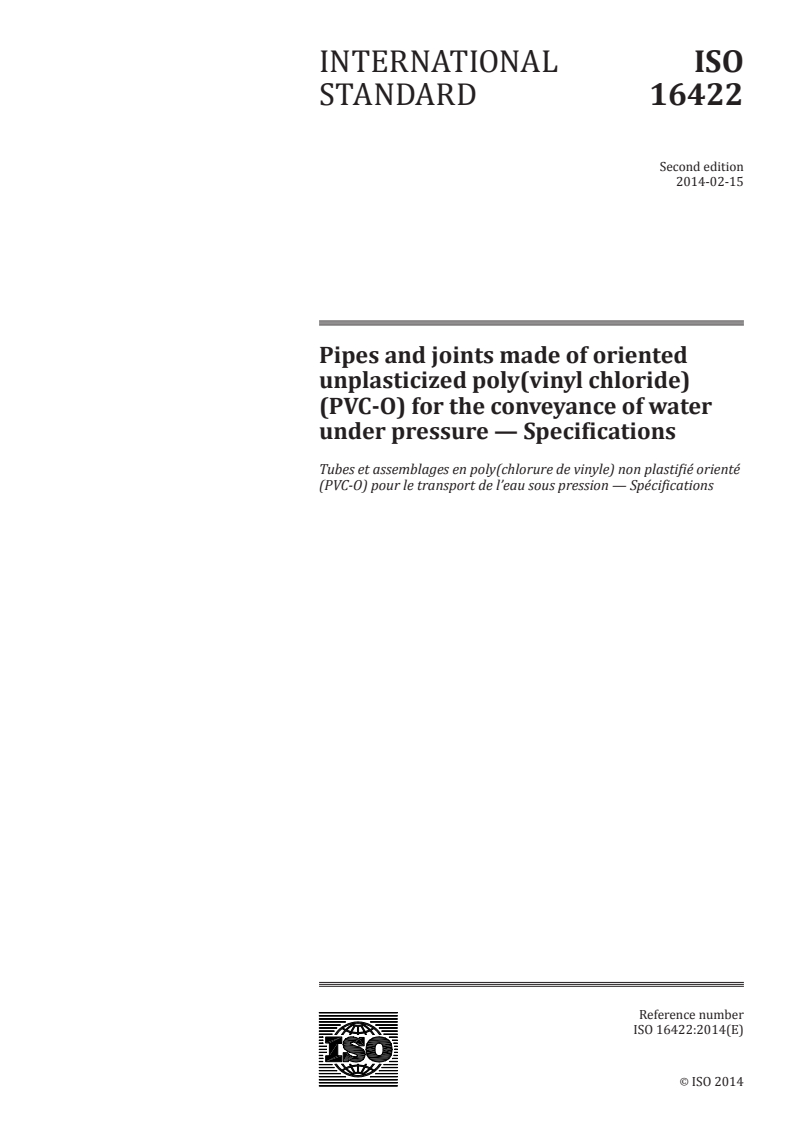
INTERNATIONAL ISO
STANDARD 16422
Second edition
2014-02-15
Pipes and joints made of oriented
unplasticized poly(vinyl chloride)
(PVC-O) for the conveyance of water
under pressure — Specifications
Tubes et assemblages en poly(chlorure de vinyle) non plastifié orienté
(PVC-O) pour le transport de l’eau sous pression — Spécifications
Reference number
©
ISO 2014
© ISO 2014
All rights reserved. Unless otherwise specified, no part of this publication may be reproduced or utilized otherwise in any form
or by any means, electronic or mechanical, including photocopying, or posting on the internet or an intranet, without prior
written permission. Permission can be requested from either ISO at the address below or ISO’s member body in the country of
the requester.
ISO copyright office
Case postale 56 • CH-1211 Geneva 20
Tel. + 41 22 749 01 11
Fax + 41 22 749 09 47
E-mail copyright@iso.org
Web www.iso.org
Published in Switzerland
ii © ISO 2014 – All rights reserved
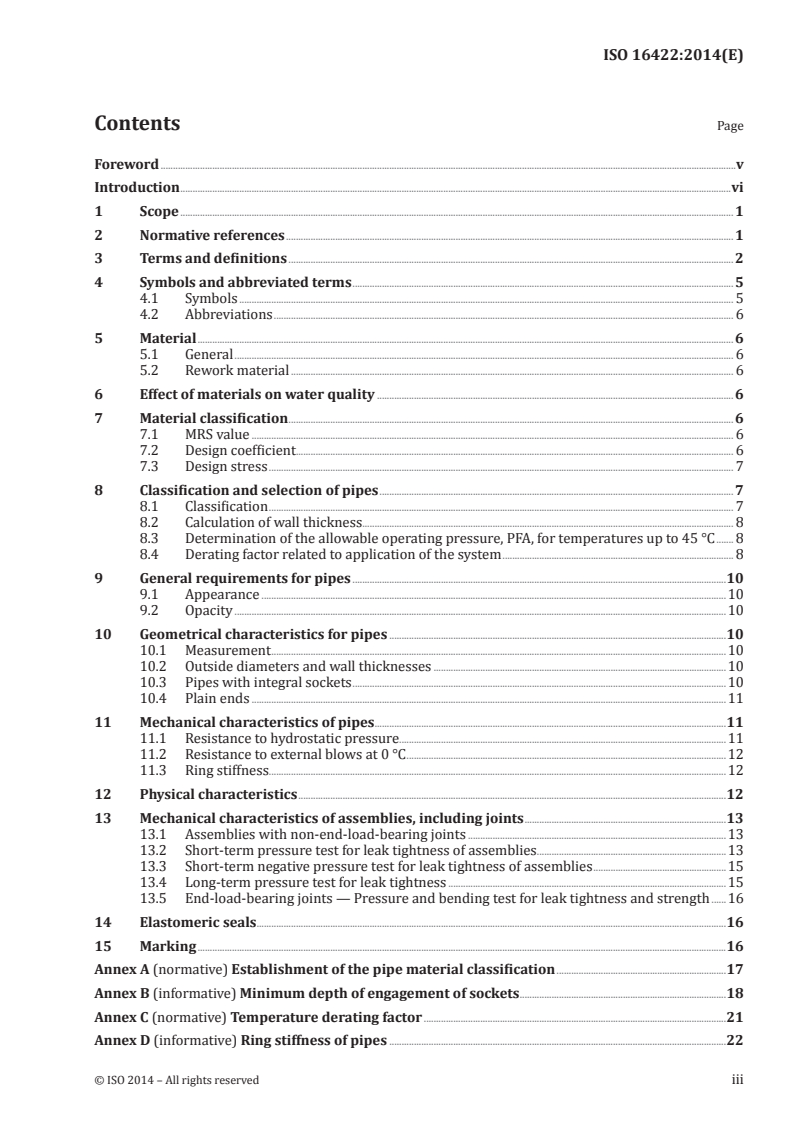
Contents Page
Foreword .v
Introduction .vi
1 Scope . 1
2 Normative references . 1
3 Terms and definitions . 2
4 Symbols and abbreviated terms . 5
4.1 Symbols . 5
4.2 Abbreviations . 6
5 Material . 6
5.1 General . 6
5.2 Rework material . 6
6 Effect of materials on water quality . 6
7 Material classification . 6
7.1 MRS value . 6
7.2 Design coefficient. 6
7.3 Design stress . 7
8 Classification and selection of pipes . 7
8.1 Classification . 7
8.2 Calculation of wall thickness . 8
8.3 Determination of the allowable operating pressure, PFA, for temperatures up to 45 °C . 8
8.4 Derating factor related to application of the system . 8
9 General requirements for pipes .10
9.1 Appearance .10
9.2 Opacity .10
10 Geometrical characteristics for pipes .10
10.1 Measurement .10
10.2 Outside diameters and wall thicknesses .10
10.3 Pipes with integral sockets .10
10.4 Plain ends .11
11 Mechanical characteristics of pipes .11
11.1 Resistance to hydrostatic pressure .11
11.2 Resistance to external blows at 0 °C .12
11.3 Ring stiffness . .12
12 Physical characteristics .12
13 Mechanical characteristics of assemblies, including joints .13
13.1 Assemblies with non-end-load-bearing joints .13
13.2 Short-term pressure test for leak tightness of assemblies .13
13.3 Short-term negative pressure test for leak tightness of assemblies .15
13.4 Long-term pressure test for leak tightness .15
13.5 End-load-bearing joints — Pressure and bending test for leak tightness and strength .16
14 Elastomeric seals .16
15 Marking .16
Annex A (normative) Establishment of the pipe material classification .17
Annex B (informative) Minimum depth of engagement of sockets .18
Annex C (normative) Temperature derating factor .21
Annex D (informative) Ring stiffness of pipes .22
Annex E (informative) Determination of the long-term test pressure by creep consideration .24
Annex F (informative) Determination of axial and tangential orientation factor .25
iv © ISO 2014 – All rights reserved
Foreword
ISO (the International Organization for Standardization) is a worldwide federation of national standards
bodies (ISO member bodies). The work of preparing International Standards is normally carried out
through ISO technical committees. Each member body interested in a subject for which a technical
committee has been established has the right to be represented on that committee. International
organizations, governmental and non-governmental, in liaison with ISO, also take part in the work.
ISO collaborates closely with the International Electrotechnical Commission (IEC) on all matters of
electrotechnical standardization.
The procedures used to develop this document and those intended for its further maintenance are
described in the ISO/IEC Directives, Part 1. In particular the different approval criteria needed for the
different types of ISO documents should be noted. This document was drafted in accordance with the
editorial rules of the ISO/IEC Directives, Part 2 (see www.iso.org/directives).
Attention is drawn to the possibility that some of the elements of this document may be the subject of
patent rights. ISO shall not be held responsible for identifying any or all such patent rights. Details of
any patent rights identified during the development of the document will be in the Introduction and/or
on the ISO list of patent declarations received (see www.iso.org/patents).
Any trade name used in this document is information given for the convenience of users and does not
constitute an endorsement.
For an explanation on the meaning of ISO specific terms and expressions related to conformity
assessment, as well as information about ISO’s adherence to the WTO principles in the Technical Barriers
to Trade (TBT) see the following URL: Foreword - Supplementary information
The committee responsible for this document is ISO/TC 138, Plastics pipes, fittings and valves for the
transport of fluids, Subcommittee SC 2, Plastics pipes and fittings for water supplies.
This second edition cancels and replaces the first edition (ISO 16422:2006), of which it constitutes a
minor revision with the following changes:
— Table 4: Physical characteristics: Resistance to dichloromethane and alternative tests.
— Annex A: Determination of pipe material classification: Procedures for classified and non-classified
feedstock material.
— Annex F: Determination of axial and tangential orientation factor.
Introduction
Molecular orientation of thermoplastics results in improvement of physical and mechanical properties.
Orientation is carried out at temperatures well above the glass transition temperature.
Orientation of PVC-U pipe-material can be induced by different processes.
In general the following production process is common. A thick-wall tube is extruded (feedstock) and
conditioned at the desired temperature. The orientation process is activated in circumferential and
axial directions under controlled conditions.
After the orientation process, the pipe is cooled down quickly to ambient temperature.
The orientation of the molecules creates a laminar structure in the material of the pipe wall. This
structure gives the ability to withstand brittle failure emanating from minor flaws in the material matrix
or from scratches at the surface of the pipe wall. PVC-O can therefore be considered as highly resistant
to notches and no testing is needed. Because of the morphology of oriented PVC-U pipe-material, there
is no risk of long-line rapid crack propagation.
Improved hoop strength, allows reduced wall thickness with material and energy savings. Improved
resistance to impact and fatigue also result.
The classification depends on material compound/formulation and stretch ratios used. Therefore, with
the classification, these characteristics may be specified or determined.
Variations in stretch ratios should be within 10 % of the value determined on the pipes used for
classification. The determination of the stretch ratios may be carried out as shown in Annex F.
vi © ISO 2014 – All rights reserved
INTERNATIONAL STANDARD ISO 16422:2014(E)
Pipes and joints made of oriented unplasticized poly(vinyl
chloride) (PVC-O) for the conveyance of water under
pressure — Specifications
1 Scope
This International Standard specifies the requirements of pipes and joints made of oriented unplasticized
poly(vinyl chloride) (PVC-O), for piping systems intended to be used underground or above-ground
where not exposed to direct sunlight, for water mains and services, pressurized sewer systems and
irrigation systems.
The piping system according to this International Standard is intended for the conveyance of cold water
under pressure, for drinking water and for general purposes up to and including 45 °C, and especially
in those applications where special performance requirements are needed, such as impact loads and
1)
pressure fluctuations, up to pressure of 25 bars .
Joints constructed of other materials should meet their own relevant standards in addition to the fitness-
for-purpose requirements of this International Standard.
2 Normative references
The following documents, in whole or in part, are normatively referenced in this document and are
indispensable for its application. For dated references, only the edition cited applies. For undated
references, the latest edition of the referenced document (including any amendments) applies.
ISO 3:1973, Preferred numbers — Series of preferred numbers
ISO 161-1, Thermoplastics pipes for the conveyance of fluids — Nominal outside diameters and nominal
pressures — Part 1: Metric series
ISO 1167-1, Thermoplastics pipes, fittings and assemblies for the conveyance of fluids — Determination of
the resistance to internal pressure — Part 1: General method
ISO 1167-2, Thermoplastics pipes, fittings and assemblies for the conveyance of fluids — Determination of
the resistance to internal pressure — Part 2: Preparation of pipe test pieces
ISO 1167-4, Thermoplastics pipes, fittings and assemblies for the conveyance of fluids — Determination of
the resistance to internal pressure — Part 4: Preparation of assemblies
ISO 1452-2:2009, Plastics piping systems for water supply and for buried and above-ground drainage and
sewerage under pressure — Unplasticized poly(vinyl chloride) (PVC-U) — Part 2: Pipes
ISO 1452-5:2009, Plastics piping systems for water supply and for buried and above-ground drainage and
sewerage under pressure — Unplasticized poly(vinyl chloride) (PVC-U) — Part 5: Fitness for purpose of the
system
ISO 1628-2, Plastics — Determination of the viscosity of polymers in dilute solution using capillary
viscometers — Part 2: Poly(vinyl chloride) resins
ISO 2505, Thermoplastics pipes — Longitudinal reversion — Test method and parameters
ISO 2507-1, Thermoplastics pipes and fittings — Vicat softening temperature — Part 1: General test method
5 2
1) 1 bar = 0,1 MPa = 10 Pa; 1 MPa = 1 N/mm
ISO 2507-2, Thermoplastics pipes and fittings — Vicat softening temperature — Part 2: Test conditions for
unplasticized poly(vinyl chloride) (PVC-U) or chlorinated poly(vinyl chloride) (PVC-C) pipes and fittings and
for high impact resistance poly (vinyl chloride) (PVC-HI) pipes
ISO 2531, Ductile iron pipes, fittings, accessories and their joints for water applications
ISO 3126, Plastics piping systems — Plastics components — Determination of dimensions
ISO 3127, Thermoplastics pipes — Determination of resistance to external blows — Round-the-clock method
ISO 4065, Thermoplastics pipes — Universal wall thickness table
ISO 4633, Rubber seals — Joint rings for water supply, drainage and sewerage pipelines — Specification for
materials
ISO 6259-2, Thermoplastics pipes — Determination of tensile properties — Part 2: Pipes made of
unplasticized poly(vinyl chloride) (PVC-U), chlorinated poly (vinyl chloride) (PVC-C) and high-impact poly
(vinyl chloride) (PVC-HI)
ISO 7686, Plastics pipes and fittings — Determination of opacity
ISO 9080, Plastics piping and ducting systems — Determination of the long-term hydrostatic strength of
thermoplastics materials in pipe form by extrapolation
ISO 9852, Unplasticized poly(vinyl chloride) (PVC-U) pipes — Dichloromethane resistance at specified
temperature (DCMT) — Test method
ISO 9969, Thermoplastics pipes — Determination of ring stiffness
ISO 11922-1:1997, Thermoplastics pipes for the conveyance of fluids — Dimensions and tolerances — Part 1:
Metric series
ISO 12162, Thermoplastics materials for pipes and fittings for pressure applications — Classification,
designation and design coefficient
ISO 13783, Plastics piping systems — Unplasticized poly(vinyl chloride) (PVC-U) end-load-bearing double-
socket joints — Test method for leaktightness and strength while subjected to bending and internal pressure
ISO 13844, Plastics piping systems — Elastomeric-sealing-ring-type socket joints for use with plastic
pipes — Test method for leaktightness under negative pressure, angular deflection and deformation
ISO 13845, Plastics piping systems — Elastomeric-sealing-ring-type socket joints for use with thermoplastic
pipes — Test method for leaktightness under internal pressure and with angular deflection
ISO 13846, Plastics piping systems — End-load-bearing and non-end-load-bearing assemblies and joints for
thermoplastics pressure piping — Test method for long-term leaktightness under internal water pressure
ISO 18373-1, Rigid PVC pipes — Differential scanning calorimetry (DSC) method — Part 1: Measurement of
the processing temperature
3 Terms and definitions
For the purposes of this document, the following terms and definitions apply.
3.1
nominal outside diameter
d
n
numerical designation of size which is common to all components in a thermoplastics piping system
other than flanges and components designated by thread size
Note 1 to entry: It is a convenient round number for reference purposes.
2 © ISO 2014 – All rights reserved
Note 2 to entry: For pipe conforming to ISO 161-1, the nominal outside diameter, expressed in millimetres, is the
minimum mean outside diameter d .
em, min
3.2
nominal wall thickness
e
n
specified wall thickness, in millimetres
Note 1 to entry: It is identical to the specified minimum wall thickness at any point e .
y, min
3.3
nominal pressure
PN
alphanumeric designation related to the mechanical characteristics of the components of a piping
system and used for reference purposes
3.4
hydrostatic pressure
p
internal pressure applied to a piping system
3.5
working pressure
maximum pressure which a piping system can sustain in continuous use under given service conditions
without pressure surge
Note 1 to entry: For thermoplastics piping systems, the value of the nominal pressure is equal to the working
pressure at a temperature of 20 °C, expressed in bar.
3.6
hydrostatic stress
σ
stress, expressed in megapascals, induced in the wall of a pipe when it is subjected to internal water
pressure
Note 1 to entry: It is calculated using the following approximate equation:
()de−
nn
σ =p
20e
n
where
p is the applied internal pressure, in bar;
d is the nominal outside diameter of the pipe, in millimetres;
n
e is the nominal wall thickness, in millimetres.
n
Note 2 to entry: If σ and p are given in the same units, the denominator becomes 2e
n
3.7
long-term hydrostatic strength for 50 years at 20 °C
σ
LTHS
quantity with the unit of stress, i.e. MPa, which can be considered to be a property of the material under
consideration
Note 1 to entry: It represents the 97,5 % lower confidence limit for the long-term hydrostatic strength and equals
the predicted average strength at a temperature of 20 °C and for a time of 50 years with internal water pressure.
3.8
lower confidence limit of the predicted hydrostatic strength
σ
LPL
quantity with the dimension of stress, which represents the 97,5 % lower confidence limit of the
predicted hydrostatic strength for a single value at a temperature T and a time t
Note 1 to entry: It is denoted as σ = σ(T,t,0,975).
LPL
Note 2 to entry: The value of this quantity is determined by the method given in ISO 9080.
3.9
minimum required strength
MRS
required value of σ for a temperature T of 20 °C and a time t of 50 years
LPL
Note 1 to entry: For a particular material, its MRS is established from the value of σ rounded to the next lower
LPL
value of the R 10 series from ISO 3:1973, when σ is less than 10 MPa, or to the next lower value of the R 20 series
LPL
when σ is greater than 10 MPa.
LPL
Note 2 to entry: See also ISO 1452-2:2009, Clause 7.
3.10
design coefficient
C
coefficient with a value greater than one, which takes into consideration service conditions as well as
properties of the components of a piping system other than those represented in σ .
LPL
3.11
pipe series
S
dimensionless number for pipe designation
Note 1 to entry: See ISO 4065
3.12
standard dimension ratio
SDR
numerical designation of a pipe series which is a convenient round number approximately equal to the
dimension ratio of the nominal outside diameter, d , and the nominal wall thickness e
n n
Note 1 to entry: According to ISO 4065, the standard dimension ratio, SDR, and the pipe series S are related, as
expressed in the following equation:
SDR =2S + 1
3.13
orientation factor
factor related to the stretch ratio used in orientation processing
4 © ISO 2014 – All rights reserved
4 Symbols and abbreviated terms
4.1 Symbols
C overall service (design) coefficient
d outside diameter (at any point)
e
d mean outside diameter
em
d inside diameter (at any point)
i
d mean inside diameter of socket
im
d nominal (outside or inside) diameter
n
e wall thickness (at any point)
e mean wall thickness
m
e nominal wall thickness
n
f derating (or uprating) factor for application
A
f derating factor for temperatures
T
K K-value
p internal hydrostatic pressure
p test pressure
T
PN nominal pressure
δ material density
σ hydrostatic stress
σ design stress
s
λ axial orientation factor
a
λ circumferential orientation factor
c
σ Lower predicted confidence limit
LPL
4.2 Abbreviations
DN nominal size
MRS minimum required strength
PFA allowable operating pressure
PVC-O oriented unplasticized poly(vinyl chloride)
PVC-U unplasticized poly(vinyl chloride)
S pipe series
S calc calculated value of the pipe series
SDR standard dimension ratio
5 Material
5.1 General
The material from which the pipes are made shall be PVC-U compound/formulation. This
compound/formulation shall consist substantially of PVC-U resin/powder to which shall be added
only those additives necessary to facilitate the production of pipes and fittings in accordance with this
International Standard. All additives shall be uniformly dispersed.
5.2 Rework material
The use of the manufacturer’s own reprocessed material, produced during the manufacture and works
testing of products and conforming to the material requirements of this International Standard, is
permitted. Reprocessed or recycled material obtained from external sources shall not be used.
6 Effect of materials on water quality
All plastics and non-plastic materials for components of the PVC piping system, e.g. pipes, fittings,
valves, elastomeric sealing rings, solvent cement, and lubricants, when in permanent or in temporary
contact with water which is intended for human consumption, shall not adversely affect the quality of
the drinking water. Where applicable, all materials for components shall conform to the current national
regulations concerning materials in contact with drinking water.
7 Material classification
7.1 MRS value
Oriented pipes made from a defined PVC-U compound and with a well-defined orientation level in
circumferential and axial direction, shall be evaluated according to the procedures of Annex A. The
minimum required strength (MRS) values shall be classified in accordance with 7.3 and Table 1.
7.2 Design coefficient
The design coefficient of oriented PVC-U pipes shall be a minimum of 1,6. Alternatively, 1,4 is permitted
for MRS 450 and MRS 500, provided that axial contraction of the pipe (due to higher design stress) does
not result in pull-out of the joints. In this case, evidence shall be given according to Annex B.
6 © ISO 2014 – All rights reserved
7.3 Design stress
The design stress shall be based on the value of the lower confidence limit σ of the long term hydrostatic
LPL
strength for the resistance to internal pressure as determined in accordance with ISO 9080. This σ
LPL
value shall be converted into a minimum required strength (MRS) in accordance with ISO 12162. The
MRS shall be divided by an overall service (design) coefficient C to give the design stress σ , which is
s
expressed by the following equation:
MRS
σ = (1)
s
C
Table 1 — Material classification
Pipe material classification
315 355 400 450 500
number
a
MRS MPa 31,5 35,5 40 45 50
C 1,6 2 1,6 2 1,6 2 1,4 1,6 2 1,4 1,6 2
σ MPa 20 16 22 18 25 20 32 28 23 36 32 25
s
a
Higher MRS classes can be chosen, provided they fall in the R20 range of ISO 3:1973.
8 Classification and selection of pipes
8.1 Classification
Pipes shall be classified to their nominal pressure PN.
The nominal pressure PN, the pipe series S and the design stress, σ , are connected by the following
s
relationship.
10σ
s
PN≅ (2)
S
SDR−1
S= (3)
d
n
SDR= (4)
e
n
MRS
σ = (5)
s
C
where
e is expressed in millimetres (mm);
n
PN is expressed in megapascals (MPa);
MRS is expressed in megapascals (MPa);
C is nondimensional.
8.2 Calculation of wall thickness
The relationship between the nominal wall thickness e and the nominal outside diameter d is specified
n n
in ISO 4065. The values for nominal pipe wall thickness e for nominal pressure ratings PN, can be
n
calculated by substituting the values for MRS, C, and d in the formula
n
d
n
e = (6)
n
21S +
o
where
S is the calculated preferred value of the nominal S series number of the pipe from 8.1.
o
Values shall be rounded to one decimal place according to the rules of ISO 4065.
NOTE Nominal S numbers and their calculated values are given in ISO 4065 for the R10 series of preferred
...
Questions, Comments and Discussion
Ask us and Technical Secretary will try to provide an answer. You can facilitate discussion about the standard in here.
Loading comments...