

ISO 16422-1:2024
(Main)Pipes and joints made of oriented unplasticized poly(vinyl chloride) (PVC-O) for the conveyance of water under pressure — Part 1: General
General Information
- Abstract
This document specifies the general characteristics of solid-wall pipes made of oriented unplasticized poly(vinyl chloride) (PVC-O) for piping systems intended to be used underground or above-ground (where protected from direct sunlight), for water supply, buried drainage, sewerage, treated waste water and irrigation under pressure. In conjunction with ISO 16422-2, ISO/TS 16422-3, ISO 16422-5 and ISO 1452-4, this document is applicable to PVC-O pipes and PVC-O fittings, as well as to valves, their joints and to joints with components of other plastics and non-plastics materials intended to be used for the following: a) water mains and services lines; b) conveyance of water for both outside and inside buildings; c) drainage, sewerage and treated wastewater under pressure; d) irrigation under pressure. This document is applicable to piping systems intended for the supply of water under pressure up to and including 25 °C (cold water), intended for human consumption and for general purposes as well as for wastewater under pressure. This document is also applicable to components for the conveyance of water and wastewater up to and including 45 °C. For temperatures between 25 °C and 45 °C, see ISO 16422-2:2023, Figure C.1. The piping system according to this document is intended for the conveyance of cold water up to pressures of 25 bar[1] and especially in those applications where special performance requirements are needed, such as impact loads and pressure fluctuations, up to pressure of 25 bar. [1] 1 bar = 0,1 MPa = 105 Pa; 1 MPa = 1 N/mm2
- Status
- Published
- Publication Date
- 31-Jan-2024
- Technical Committee
- ISO/TC 138/SC 2 - Plastics pipes and fittings for water supplies
- Drafting Committee
- ISO/TC 138/SC 2 - Plastics pipes and fittings for water supplies
- Current Stage
- 6060 - International Standard published
- Start Date
- 01-Feb-2024
- Due Date
- 28-Sep-2023
- Completion Date
- 01-Feb-2024
Overview
ISO 16422-1:2024 establishes the general requirements for pipes and joints made of oriented unplasticized poly(vinyl chloride) (PVC-O), specifically engineered for the conveyance of water under pressure. Developed by the International Organization for Standardization (ISO), this standard focuses on solid-wall PVC-O piping systems suitable for underground or above-ground use (where protected from direct sunlight). These systems are designed for applications such as water supply (including potable water), buried drainage, sewerage, treated wastewater, and irrigation under pressure.
Part 1 of the ISO 16422 series outlines the key material properties, classification criteria, and performance parameters required for PVC-O pipes, fittings, valves, and compatible joints, ensuring reliability for end users and manufacturers.
Key Topics
- Material and Composition:
PVC-O compounds must be unplasticized, with strict controls on additives to avoid toxicity, contamination, or negative impacts on mechanical properties. - Pipe and Fitting Classification:
Provides criteria for classifying pipes based on minimum required strength (MRS) and design stress, and fittings based on PN (Nominal Pressure) class. - Design Parameters:
Addresses material strength, wall thickness, and dimension ratios, supporting the design of high-performance, pressure-rated water systems. - Service Conditions:
Suitable for cold water up to 25 °C (intended for human consumption and general use) and wastewater under pressure. Components may also be used up to 45 °C as referenced in ISO 16422-2. - System Compatibility:
Applies to connections between PVC-O pipes, fittings, and valves, as well as joints with other plastic and non-plastic piping components. - Use of Reprocessed Material:
Allows the use of manufacturer’s own reprocessed feedstock but prohibits externally-sourced recycled materials for safety and performance. - National Regulatory Compliance:
Special considerations for compounds in contact with drinking water to align with applicable national regulations and health requirements.
Applications
Piping systems conforming to ISO 16422-1 are widely used in:
- Water Mains and Service Lines:
Infrastructure for transmitting potable water in municipal and private water networks, both underground and above-ground (provided protection from direct sunlight). - Building Water Supply:
Conveying water outside and inside buildings, ensuring safe and reliable delivery for human consumption and utility purposes. - Pressurized Drainage and Sewerage:
Transporting wastewater and treated effluent under pressure, contributing to municipal and industrial sanitation and waste management. - Irrigation Systems:
High-strength, impact-resistant piping for agricultural and landscape irrigation operating at pressures up to 25 bar. - Special Environments:
Applications requiring elevated resistance to impact loading or pressure fluctuations, such as fluctuating demand or challenging installation conditions.
Related Standards
ISO 16422-1:2024 forms part of a series of standards and references essential documents for comprehensive system specification and performance:
- ISO 16422-2: Pipes and joints made of PVC-O for the conveyance of water under pressure – Part 2: Pipes
- ISO/TS 16422-3: Pipes and joints made of PVC-O for the conveyance of water under pressure – Part 3: Fittings
- ISO 16422-5: Fitness for purpose of PVC-O piping systems
- ISO 1452-4: Plastics piping systems for water supply – PVC-U – Part 4: Valves
- ISO 472: Plastics – Vocabulary
- ISO 9080: Determination of the long-term hydrostatic strength of thermoplastic materials
- ISO 12162: Classification and design coefficient for thermoplastics materials
- ISO 1043-1: Symbols and abbreviated terms for plastics
By implementing requirements from ISO 16422-1:2024, users and manufacturers can ensure their PVC-O piping systems meet recognized international standards for safety, performance, and durability in demanding water conveyance applications.
Relations
- Effective Date
- 06-Jun-2022
Get Certified
Connect with accredited certification bodies for this standard

DIBt (Deutsches Institut für Bautechnik)
German Institute for Building Technology.
DIN CERTCO
DIN Group product certification.

Aboma Certification B.V.
Specialized in construction, metal, and transport sectors.
Sponsored listings
Frequently Asked Questions
ISO 16422-1:2024 is a standard published by the International Organization for Standardization (ISO). Its full title is "Pipes and joints made of oriented unplasticized poly(vinyl chloride) (PVC-O) for the conveyance of water under pressure — Part 1: General". This standard covers: This document specifies the general characteristics of solid-wall pipes made of oriented unplasticized poly(vinyl chloride) (PVC-O) for piping systems intended to be used underground or above-ground (where protected from direct sunlight), for water supply, buried drainage, sewerage, treated waste water and irrigation under pressure. In conjunction with ISO 16422-2, ISO/TS 16422-3, ISO 16422-5 and ISO 1452-4, this document is applicable to PVC-O pipes and PVC-O fittings, as well as to valves, their joints and to joints with components of other plastics and non-plastics materials intended to be used for the following: a) water mains and services lines; b) conveyance of water for both outside and inside buildings; c) drainage, sewerage and treated wastewater under pressure; d) irrigation under pressure. This document is applicable to piping systems intended for the supply of water under pressure up to and including 25 °C (cold water), intended for human consumption and for general purposes as well as for wastewater under pressure. This document is also applicable to components for the conveyance of water and wastewater up to and including 45 °C. For temperatures between 25 °C and 45 °C, see ISO 16422-2:2023, Figure C.1. The piping system according to this document is intended for the conveyance of cold water up to pressures of 25 bar[1] and especially in those applications where special performance requirements are needed, such as impact loads and pressure fluctuations, up to pressure of 25 bar. [1] 1 bar = 0,1 MPa = 105 Pa; 1 MPa = 1 N/mm2
This document specifies the general characteristics of solid-wall pipes made of oriented unplasticized poly(vinyl chloride) (PVC-O) for piping systems intended to be used underground or above-ground (where protected from direct sunlight), for water supply, buried drainage, sewerage, treated waste water and irrigation under pressure. In conjunction with ISO 16422-2, ISO/TS 16422-3, ISO 16422-5 and ISO 1452-4, this document is applicable to PVC-O pipes and PVC-O fittings, as well as to valves, their joints and to joints with components of other plastics and non-plastics materials intended to be used for the following: a) water mains and services lines; b) conveyance of water for both outside and inside buildings; c) drainage, sewerage and treated wastewater under pressure; d) irrigation under pressure. This document is applicable to piping systems intended for the supply of water under pressure up to and including 25 °C (cold water), intended for human consumption and for general purposes as well as for wastewater under pressure. This document is also applicable to components for the conveyance of water and wastewater up to and including 45 °C. For temperatures between 25 °C and 45 °C, see ISO 16422-2:2023, Figure C.1. The piping system according to this document is intended for the conveyance of cold water up to pressures of 25 bar[1] and especially in those applications where special performance requirements are needed, such as impact loads and pressure fluctuations, up to pressure of 25 bar. [1] 1 bar = 0,1 MPa = 105 Pa; 1 MPa = 1 N/mm2
ISO 16422-1:2024 is classified under the following ICS (International Classification for Standards) categories: 23.040.20 - Plastics pipes; 23.040.45 - Plastics fittings; 91.140.60 - Water supply systems. The ICS classification helps identify the subject area and facilitates finding related standards.
ISO 16422-1:2024 has the following relationships with other standards: It is inter standard links to ISO 16422:2014. Understanding these relationships helps ensure you are using the most current and applicable version of the standard.
ISO 16422-1:2024 is available in PDF format for immediate download after purchase. The document can be added to your cart and obtained through the secure checkout process. Digital delivery ensures instant access to the complete standard document.
Standards Content (Sample)
International
Standard
ISO 16422-1
First edition
Pipes and joints made of oriented
2024-02
unplasticized poly(vinyl chloride)
(PVC-O) for the conveyance of water
under pressure —
Part 1:
General
Tubes et assemblages en poly(chlorure de vinyle) non plastifié
orienté (PVC-O) pour le transport de l'eau sous pression —
Partie 1: Généralités
Reference number
© ISO 2024
All rights reserved. Unless otherwise specified, or required in the context of its implementation, no part of this publication may
be reproduced or utilized otherwise in any form or by any means, electronic or mechanical, including photocopying, or posting on
the internet or an intranet, without prior written permission. Permission can be requested from either ISO at the address below
or ISO’s member body in the country of the requester.
ISO copyright office
CP 401 • Ch. de Blandonnet 8
CH-1214 Vernier, Geneva
Phone: +41 22 749 01 11
Email: copyright@iso.org
Website: www.iso.org
Published in Switzerland
ii
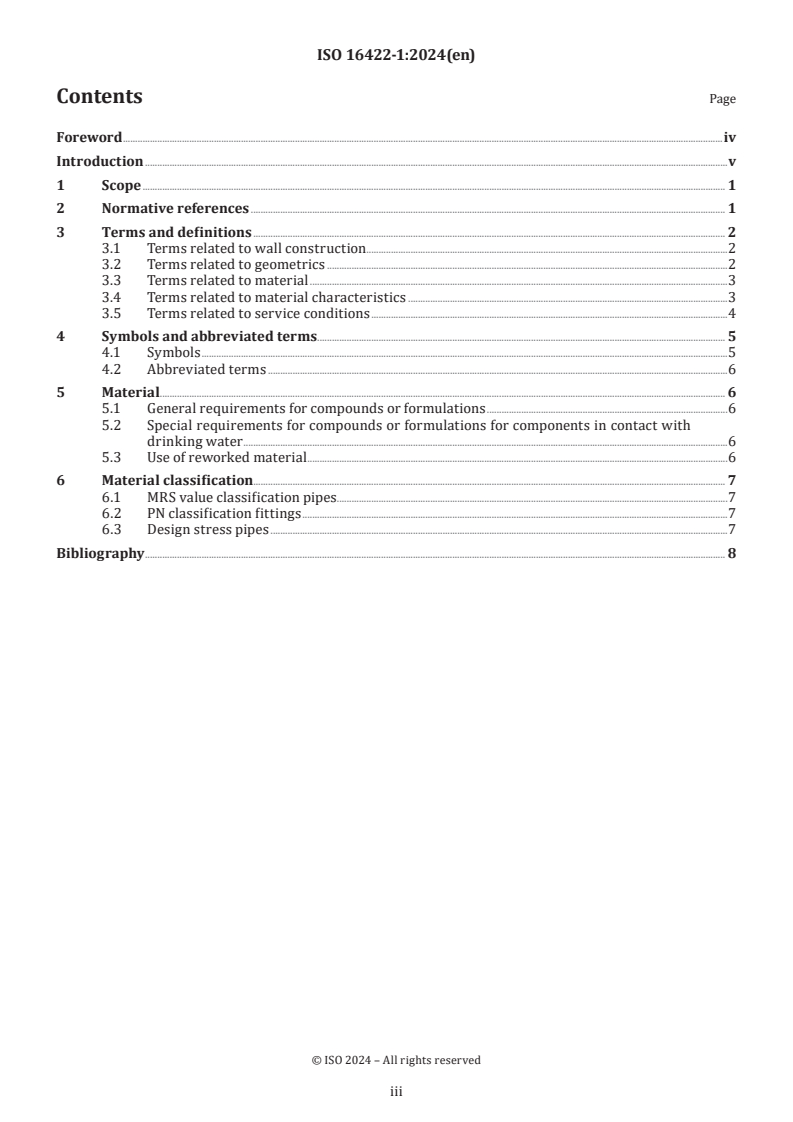
Contents Page
Foreword .iv
Introduction .v
1 Scope . 1
2 Normative references . 1
3 Terms and definitions . 2
3.1 Terms related to wall construction.2
3.2 Terms related to geometrics .2
3.3 Terms related to material .3
3.4 Terms related to material characteristics .3
3.5 Terms related to service conditions .4
4 Symbols and abbreviated terms. 5
4.1 Symbols .5
4.2 Abbreviated terms .6
5 Material. 6
5.1 General requirements for compounds or formulations .6
5.2 Special requirements for compounds or formulations for components in contact with
drinking water .6
5.3 Use of reworked material .6
6 Material classification. 7
6.1 MRS value classification pipes.7
6.2 PN classification fittings .7
6.3 Design stress pipes .7
Bibliography . 8
iii
Foreword
ISO (the International Organization for Standardization) is a worldwide federation of national standards
bodies (ISO member bodies). The work of preparing International Standards is normally carried out through
ISO technical committees. Each member body interested in a subject for which a technical committee
has been established has the right to be represented on that committee. International organizations,
governmental and non-governmental, in liaison with ISO, also take part in the work. ISO collaborates closely
with the International Electrotechnical Commission (IEC) on all matters of electrotechnical standardization.
The procedures used to develop this document and those intended for its further maintenance are described
in the ISO/IEC Directives, Part 1. In particular, the different approval criteria needed for the different types
of ISO document should be noted. This document was drafted in accordance with the editorial rules of the
ISO/IEC Directives, Part 2 (see www.iso.org/directives).
ISO draws attention to the possibility that the implementation of this document may involve the use of (a)
patent(s). ISO takes no position concerning the evidence, validity or applicability of any claimed patent
rights in respect thereof. As of the date of publication of this document, ISO had not received notice of (a)
patent(s) which may be required to implement this document. However, implementers are cautioned that
this may not represent the latest information, which may be obtained from the patent database available at
www.iso.org/patents. ISO shall not be held responsible for identifying any or all such patent rights.
Any trade name used in this document is information given for the convenience of users and does not
constitute an endorsement.
For an explanation of the voluntary nature of standards, the meaning of ISO specific terms and expressions
related to conformity assessment, as well as information about ISO's adherence to the World Trade
Organization (WTO) principles in the Technical Barriers to Trade (TBT), see www.iso.org/iso/foreword.html.
This document was prepared by Technical Committee ISO/TC 138, Plastics pipes, fittings and valves for the
transport of fluids, Subcommittee SC 2, Plastics pipes and fittings for water supplies.
This first edition of ISO 16422-1, together with ISO 16422-2 and ISO 16422-5, cancels and replaces the second
edition of ISO 16422:2014, which has been technically revised.
The main changes are as follows:
— ISO 16422:2014 has been split into several parts, under the general title “Pipes and joints made of oriented
unplasticized poly(vinyl chloride) (PVC-O) for the conveyance of water under pressure”. The information
previously included in ISO 16422:2014 has been divided into ISO 16422-1 (this document), ISO 16422-2
and ISO 16422-5.
A list of all parts in the ISO 16422 series can be found on the ISO website.
Any feedback or questions on this document should be directed to the user’s national standards body. A
complete listing of these bodies can be found at www.iso.org/members.html.
iv
Introduction
Molecular orientation of thermoplastics results in the improvement of physical and mechanical properties.
Orientation is carried out at temperatures well above the glass transition temperature.
Orientation of PVC-U pipe-material can be induced by different processes.
In general, the following production process is common.
— A thick-wall tube is extruded (feedstock) and conditioned at the desired temperature.
— The orientation process is activated primarily in circumferential direction under controlled conditions.
Axial orientation can also be activated in the product.
— After the orientation process, the pipe is cooled down quickly to ambient temperature.
The orientation of the molecules creates a laminar structure in the material of the pipe wall. This structure
gives the ability to withstand brittle failure emanating from minor flaws in the material matrix or from
scratches at the surface of the pipe wall.
Improved hoop strength allows reduced wall thickness with material and energy savings. It also results in
improved resistance to impact and fatigue.
The classification of the material depends on material compound/formulation and stretch ratios used.
Therefore, with the classification, these characteristics may be specified or determined.
Regarding potential adverse effects on the quality of water intended for human consumption caused by
the products covered by this document, this document provides no information as to whether or not the
products can be used without restriction.
Requirements and test methods for PVC-O components are specified in this document, as well as in
ISO 16422-2 and ISO/TS 16422-3.
v
International Standard ISO 16422-1:2024(en)
Pipes and joints made of oriented unplasticized poly(vinyl
chloride) (PVC-O) for the conveyance of water under
pressure —
Part 1:
General
1 Scope
This document specifies the general characteristics of solid-wall pipes made of oriented unplasticized
poly(vinyl chloride) (PVC-O) for piping systems intended to be used underground or above-ground (where
protected from direct sunlight), for water supply, buried drainage, sewerage, treated waste water and
irrigation under pressure.
In conjunction with ISO 16422-2, ISO/TS 16422-3, ISO 16422-5 and ISO 1452-4, this document is applicable
to PVC-O pipes and PVC-O fittings, as well as to valves, their joints and to joints with components of other
plastics and non-plastics materials intended to be used for the following:
a) water mains and services lines;
b) conveyance of water for both outside and inside buildings;
c) drainage, sewerage and treated wastewater under pressure;
d) irrigation under pressure.
This document is applicable to piping systems intended for the supply of water under pressure up to and
including 25 °C (cold water), intended for human consumption and for general purposes as well as for
wastewater under pressure.
This document is also applicable to components for the conveyance of water and wastewater up to and
including 45 °C. For temperatures between 25 °C and 45 °C, see ISO 16422-2:2023, Figure C.1.
The piping system according to this document is intended for the conveyance of cold water up to pressures
1)
of 25 bar and especially in those applications where special performance requirements are needed, such as
impact loads and pressure fluctuations, up to pressure of 25 bar.
2 Normative references
The following documents are referred to in the text in such a way that some or all of their content constitutes
requirements of this document. For
...