

ISO 11296-4:2018
(Main)Plastics piping systems for renovation of underground non-pressure drainage and sewerage networks — Part 4: Lining with cured-in-place pipes
- Abstract
ISO 11296-4:2018, in conjunction with ISO 11296‑1, specifies requirements and test methods for cured-in-place pipes and fittings used for the renovation of underground non-pressure drainage and sewerage networks with service temperatures up to 50 °C. ISO 11296-4:2018 applies to the use of various thermosetting resin systems, in combination with compatible fibrous carrier materials, reinforcement, and other process-related plastics components (see 5.3).
- Status
- Withdrawn
- Publication Date
- 24-Jan-2018
- Technical Committee
- ISO/TC 138/SC 8 - Rehabilitation of pipeline systems
- Current Stage
- 9599 - Withdrawal of International Standard
- Start Date
- 07-Oct-2026
- Completion Date
- 10-Oct-2026
Buy Documents


ISO 11296-4:2018 - Plastics piping systems for renovation of underground non-pressure drainage and sewerage networks

ISO 11296-4:2018 - Plastics piping systems for renovation of underground non-pressure drainage and sewerage networks — Part 4: Lining with cured-in-place pipes/25/2018

ISO 11296-4:2018 - Systemes de canalisations en plastique pour la rénovation des réseaux de branchements et de collecteurs d'assainissement enterrés sans pression

ISO 11296-4:2018 - Systèmes de canalisations en plastique pour la rénovation des réseaux de branchements et de collecteurs d'assainissement enterrés sans pression — Partie 4: Tubage continu par tubes polymérisés sur place/25/2018
Overview
ISO 11296-4:2018 specifies requirements and test methods for cured‑in‑place pipes (CIPP) used to renovate underground non‑pressure drainage and sewerage networks. Intended to be used together with ISO 11296‑1 (General), this part covers CIPP materials and components, on‑site installation (the “I” stage), and the relevant laboratory tests for service temperatures up to 50 °C. The standard applies to thermosetting resin systems combined with compatible fibrous carrier materials, reinforcements and other process‑related plastics components.
Key topics and technical requirements
- Materials and “M” stage: Definitions and criteria for resin systems, carrier fabrics, reinforcements and membranes before installation.
- Installed “I” stage: Requirements for the cured composite as installed, including geometric, mechanical and physical characteristics (wall structure, thickness, ring stiffness, strain capacity and creep).
- Mechanical testing: Procedures for short‑term flexural properties, long‑term flexural modulus, long‑term flexural strength and stress‑corrosion testing (Annexes B–D). Options for ring tests and wet creep factor measurements are included.
- Reference conditions and temperature re‑rating: Specification of reference temperatures for testing and guidance to determine temperature re‑rating factors where needed.
- Installation practice: Preparatory work, storage, handling, equipment, environmental precautions, simulated installations, in‑process inspection, lining termination and reconnections to laterals/manholes.
- Documentation and quality: Requirements for installation manuals that document technique‑specific procedures, environmental precautions and sealing/reconnection methods; sampling and final inspection records.
Practical applications
- Rehabilitation and relining of buried sewers, drainage conduits and house laterals without excavation (trenchless renewal).
- Projects seeking to extend asset life, control infiltration/inflow, and reduce disruption and construction cost compared with open‑cut replacement.
- Use of various CIPP techniques where service temperatures do not exceed 50 °C and reliable long‑term mechanical performance is required.
Who should use this standard
- Municipal engineers, asset owners and wastewater utilities specifying sewer rehabilitation works.
- CIPP system manufacturers and component suppliers verifying materials and declaring compliance.
- Contractors and installation teams preparing technique‑specific installation manuals and carrying out on‑site curing and testing.
- Testing laboratories performing flexural, creep and stress‑corrosion evaluations.
- Specifiers and regulators developing procurement and conformity criteria for trenchless renovation.
Related standards
- ISO 11296‑1 (General requirements for renovation) - to be used in conjunction with this part.
- Other ISO 11296 series parts for alternate lining techniques (Parts 2–10).
- ISO 14125 (composite testing/classification) is referenced for composite class declaration.
Keywords: ISO 11296-4:2018, CIPP, cured‑in‑place pipes, plastics piping systems, sewer rehabilitation, non‑pressure drainage, testing methods, trenchless renewal.
Relations
- Effective Date
- 25-Aug-2026
- Effective Date
- 25-Aug-2026
- Effective Date
- 25-Aug-2026
- Effective Date
- 25-Aug-2026
- Effective Date
- 12-Feb-2026
- Effective Date
- 06-Jun-2022
- Effective Date
- 26-Nov-2021
- Effective Date
- 05-Nov-2022
- Effective Date
- 14-Nov-2015
Buy Documents
ISO 11296-4:2018 - Plastics piping systems for renovation of underground non-pressure drainage and sewerage networks
ISO 11296-4:2018 - Plastics piping systems for renovation of underground non-pressure drainage and sewerage networks — Part 4: Lining with cured-in-place pipes/25/2018
ISO 11296-4:2018 - Systemes de canalisations en plastique pour la rénovation des réseaux de branchements et de collecteurs d'assainissement enterrés sans pression
ISO 11296-4:2018 - Systèmes de canalisations en plastique pour la rénovation des réseaux de branchements et de collecteurs d'assainissement enterrés sans pression — Partie 4: Tubage continu par tubes polymérisés sur place/25/2018
Get Certified
Connect with accredited certification bodies for this standard

DIBt (Deutsches Institut für Bautechnik)
German Institute for Building Technology.
DIN CERTCO
DIN Group product certification.
Zavod za gradbeništvo Slovenije (ZAG) - Inšpekcija
ZAG inspection body for construction products, structures, and materials.
Sponsored listings
Frequently Asked Questions
ISO 11296-4:2018 is a standard published by the International Organization for Standardization (ISO). Its full title is "Plastics piping systems for renovation of underground non-pressure drainage and sewerage networks — Part 4: Lining with cured-in-place pipes". This standard covers: ISO 11296-4:2018, in conjunction with ISO 11296‑1, specifies requirements and test methods for cured-in-place pipes and fittings used for the renovation of underground non-pressure drainage and sewerage networks with service temperatures up to 50 °C. ISO 11296-4:2018 applies to the use of various thermosetting resin systems, in combination with compatible fibrous carrier materials, reinforcement, and other process-related plastics components (see 5.3).
ISO 11296-4:2018, in conjunction with ISO 11296‑1, specifies requirements and test methods for cured-in-place pipes and fittings used for the renovation of underground non-pressure drainage and sewerage networks with service temperatures up to 50 °C. ISO 11296-4:2018 applies to the use of various thermosetting resin systems, in combination with compatible fibrous carrier materials, reinforcement, and other process-related plastics components (see 5.3).
ISO 11296-4:2018 is classified under the following ICS (International Classification for Standards) categories: 23.040.20 - Plastics pipes; 23.040.45 - Plastics fittings; 91.140.80 - Drainage systems; 93.030 - External sewage systems. The ICS classification helps identify the subject area and facilitates finding related standards.
ISO 11296-4:2018 has the following relationships with other standards: It is inter standard links to EN ISO 11296-7:2019, EN ISO 11296-9:2022, EN ISO 11297-4:2018, CEN ISO/TS 23818-2:2022, EN ISO 11296-4:2018, ISO 4032:2012, ISO 11296-4:2018/Amd 1:2021, ISO 11300-2:2026, ISO 11296-4:2009. Understanding these relationships helps ensure you are using the most current and applicable version of the standard.
ISO 11296-4:2018 is available in PDF format for immediate download after purchase. The document can be added to your cart and obtained through the secure checkout process. Digital delivery ensures instant access to the complete standard document.
Standards Content (Sample)
INTERNATIONAL ISO
STANDARD 11296-4
Second edition
2018-02
Plastics piping systems for renovation
of underground non-pressure
drainage and sewerage networks —
Part 4:
Lining with cured-in-place pipes
Systèmes de canalisations en plastique pour la rénovation des réseaux
de branchements et de collecteurs d'assainissement enterrés sans
pression —
Partie 4: Tubage continu par tubes polymérisés sur place
Reference number
©
ISO 2018
© ISO 2018, Published in Switzerland
All rights reserved. Unless otherwise specified, no part of this publication may be reproduced or utilized otherwise in any form
or by any means, electronic or mechanical, including photocopying, or posting on the internet or an intranet, without prior
written permission. Permission can be requested from either ISO at the address below or ISO’s member body in the country of
the requester.
ISO copyright office
Ch. de Blandonnet 8 • CP 401
CH-1214 Vernier, Geneva, Switzerland
Tel. +41 22 749 01 11
Fax +41 22 749 09 47
copyright@iso.org
www.iso.org
ii © ISO 2018 – All rights reserved
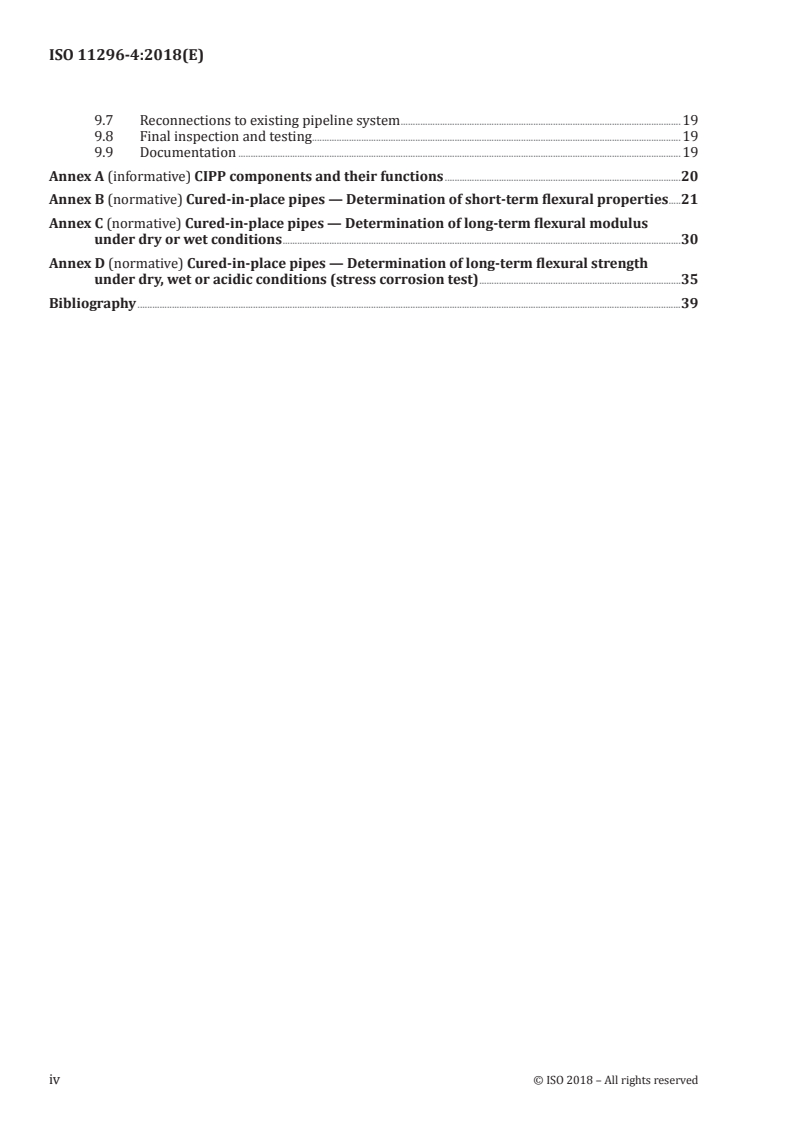
Contents Page
Foreword .v
Introduction .vii
1 Scope . 1
2 Normative references . 1
3 Terms and definitions . 2
4 Symbols and abbreviated terms . 4
4.1 Symbols . 4
4.2 Abbreviated terms . 6
5 Pipes at the “M” stage . 6
5.1 Materials . 6
5.2 General characteristics . 8
5.3 Material characteristics . 8
5.4 Geometric characteristics . 8
5.5 Mechanical characteristics. 8
5.6 Physical characteristics . 8
5.7 Jointing . 9
5.8 Marking . 9
6 Fittings at the “M” stage . 9
6.1 Materials . 9
6.2 General characteristics . 9
6.3 Material characteristics . 9
6.4 Geometric characteristics . 9
6.5 Mechanical characteristics.10
6.6 Physical characteristics .10
6.7 Jointing .10
6.8 Marking .10
7 Ancillary components .11
8 Fitness for purpose of the installed lining system at the “I” stage .11
8.1 Materials .11
8.2 General characteristics .11
8.3 Material characteristics .11
8.4 Geometric characteristics .11
8.4.1 General.11
8.4.2 CIPP wall structure .11
8.4.3 Wall thickness .12
8.5 Mechanical characteristics.12
8.5.1 Reference conditions for testing .12
8.5.2 Test requirements .12
8.6 Physical characteristics .15
8.7 Additional characteristics .15
8.8 Sampling .16
9 Installation practice .17
9.1 Preparatory work .17
9.2 Storage, handling and transport of pipe components .17
9.3 Equipment .17
9.4 Installation .17
9.4.1 Environmental precautions .17
9.4.2 Installation procedures .17
9.4.3 Simulated installations .18
9.5 Process-related inspection and testing .18
9.6 Lining termination .18
9.7 Reconnections to existing pipeline system .19
9.8 Final inspection and testing .19
9.9 Documentation .19
Annex A (informative) CIPP components and their functions .20
Annex B (normative) Cured-in-place pipes — Determination of short-term flexural properties .21
Annex C (normative) Cured-in-place pipes — Determination of long-term flexural modulus
under dry or wet conditions .30
Annex D (normative) Cured-in-place pipes — Determination of long-term flexural strength
under dry, wet or acidic conditions (stress corrosion test) .35
Bibliography .39
iv © ISO 2018 – All rights reserved
Foreword
ISO (the International Organization for Standardization) is a worldwide federation of national standards
bodies (ISO member bodies). The work of preparing International Standards is normally carried out
through ISO technical committees. Each member body interested in a subject for which a technical
committee has been established has the right to be represented on that committee. International
organizations, governmental and non-governmental, in liaison with ISO, also take part in the work.
ISO collaborates closely with the International Electrotechnical Commission (IEC) on all matters of
electrotechnical standardization.
The procedures used to develop this document and those intended for its further maintenance are
described in the ISO/IEC Directives, Part 1. In particular the different approval criteria needed for the
different types of ISO documents should be noted. This document was drafted in accordance with the
editorial rules of the ISO/IEC Directives, Part 2 (see www .iso .org/ directives).
Attention is drawn to the possibility that some of the elements of this document may be the subject of
patent rights. ISO shall not be held responsible for identifying any or all such patent rights. Details of
any patent rights identified during the development of the document will be in the Introduction and/or
on the ISO list of patent declarations received (see www .iso .org/ patents).
Any trade name used in this document is information given for the convenience of users and does not
constitute an endorsement.
For an explanation on the voluntary nature of standards, the meaning of ISO specific terms and
expressions related to conformity assessment, as well as information about ISO's adherence to the
World Trade Organization (WTO) principles in the Technical Barriers to Trade (TBT) see the following
URL: www .iso .org/ iso/ foreword .html.
This document was prepared by Technical Committee ISO/TC 138, Plastics pipes, fittings and valves for
the transport of fluids, Subcommittee SC 8, Rehabilitation of pipeline systems
This second edition cancels and replaces the first edition (ISO 11296-4:2009), which has been
technically revised.
The main changes compared to the previous edition are as follows:
— the service temperature range has been explicitly stated in the scope;
— in Clause 3, new definitions have been added for temporary, permanent and semi-permanent
membranes, with Annex A and the definition of preliner updated accordingly; for nominal wall
thickness specialized for CIPP; and for service temperature and type testing adopted from other
standards;
— type “R” and “E-CR” glass fibres have been added to Table 1;
— the requirements on “M” stage strength characteristics of the neat resin system have been removed
in Table 2, as they have been effectively covered in Table 5 by the “I” stage requirements on
mechanical characteristics of the cured composite;
— new requirements for the nature of the bond of any semi-permanent internal membrane to the
underlying composite, and for declaration of class of composite in accordance with ISO 14125, have
been added in 8.1;
— a new subclause has been added to 8.5 to specify reference temperature for testing, and procedure
for determining temperature re-rating factors where required;
— separate tables for short and long-term mechanical characteristics have been created in 8.5, and
minima for declared values removed except for ring stiffness, strain capacity and creep factor;
— the following have been added to Table 6:
a) option of ring test for wet creep factor;
b) test for long-term flexural strength under dry or wet conditions by the method detailed in the
new Annex D;
— a test for stress corrosion (new Annex D test in acid environment) has been added to Table 7;
— further requirements for documenting specific installation parameters and procedures, and the
related environmental precautions, in the installation manual for each individual CIPP technique,
have been added in 9.4;
— requirements for documentation in the installation manual of technique-specific methods for
sealing liner connections at manholes and laterals have been added in 9.7;
— Annex B has been revised to relax curvature restriction on 3-point bend test samples, and to
include a full new procedure for calculation and reporting of test results without partial reference
to ISO 178;
— the previous Annexes C and D has been merged into a single new Annex C specifying a common
procedure for determination of long-term modulus under either dry or wet conditions.
A list of all the parts in the ISO 11296 series can be found on the ISO website.
vi © ISO 2018 – All rights reserved
Introduction
System standards dealing with the following applications are either available or in preparation:
— ISO 11296, Plastics piping systems for renovation of underground non-pressure drainage and sewerage
networks (this document);
— ISO 11297, Plastics piping systems for renovation of underground drainage and sewerage networks
under pressure;
— ISO 11298, Plastics piping systems for renovation of underground water supply networks;
— ISO 11299, Plastics piping systems for renovation of underground gas supply networks.
These system standards are distinguished from those for conventionally installed plastics piping
systems because they set requirements for certain characteristics in the “as-installed” condition after
site processing. This is in addition to specifying requirements for plastics piping system components,
“as manufactured”.
This document (system standard) comprises a
— Part 1: General
and the following technique family-related parts:
— Part 2: Lining with continuous pipes;
— Part 3: Lining with close-fit pipes;
— Part 4: Lining with cured-in-place pipes;
— Part 5: Lining with discrete pipes;
— Part 7: Lining with spirally-wound pipes;
— Part 8: Lining with pipe segments;
— Part 9: Lining with a rigidly anchored plastics inner layer;
— Part 10: Lining with sprayed polymeric materials.
The requirements for any given renovation technique family are given in ISO 11296-1 applied in
conjunction with the other relevant parts. For example, both ISO 11296-1 and this document together
specify the requirements relating to lining with cured-in-place pipes. For complementary information,
see ISO 11295. Not all technique families are applicable to every area of application and this is reflected
in the part numbers included in each system standard.
A consistent structure of clause headings has been adopted for all parts to facilitate direct comparisons
across renovation technique families.
Figure 1 shows the common structure and the relationship between ISO 11296 and the system
standards for other application areas.
Figure 1 — Format of the renovation system standards
viii © ISO 2018 – All rights reserved
INTERNATIONAL STANDARD ISO 11296-4:2018(E)
Plastics piping systems for renovation of underground
non-pressure drainage and sewerage networks —
Part 4:
Lining with cured-in-place pipes
1 Scope
This document, in conjunction with ISO 11296-1, specifies requirements and test methods for cured-in-
place pipes and fittings used for the renovation of underground non-pressure drainage and sewerage
networks with service temperatures up to 50 °C.
It applies to the use of various thermosetting resin systems, in combination with compatible fibrous
carrier materials, reinforcement, and other process-related plastics components (see 5.3).
2 Normative references
The following documents are referred to in the text in such a way that some or all of their content
constitutes requirements of this document. For dated references, only the edition cited applies. For
undated references, the latest edition of the referenced document (including any amendments) applies.
ISO 75-2:2013, Plastics — Determination of temperature of deflection under load — Part 2: Plastics
and ebonite
I S O 178:2010 +A 1: 2013, Plastics — Determination of flexural properties
ISO 899-2:2003, Plastics — Determination of creep behaviour — Part 2: Flexural creep by three-point loading
ISO 3126, Plastics piping systems — Plastics components — Determination of dimensions
ISO 4435, Plastics piping systems for non-pressure underground drainage and sewerage — Unplasticized
poly(vinyl chloride) (PVC-U)
ISO 7684, Plastics piping systems — Glass-reinforced thermosetting plastics (GRP) pipes — Determination
of the creep factor under dry conditions
ISO 7685:1998, Plastics piping systems — Glass-reinforced thermosetting plastics (GRP) pipes —
Determination of initial specific ring stiffness
ISO 8513:2016, Plastics piping systems — Glass-reinforced thermosetting plastics (GRP) pipes — Test
methods for the determination of the initial longitudinal tensile strength
ISO 8773, Plastics piping systems for non-pressure underground drainage and sewerage — Polypropylene (PP)
1)
ISO 10467:— , Plastics piping systems for drainage and sewerage with or without pressure — Glass-
reinforced thermosetting plastics (GRP) based on unsaturated polyester resin (UP) — Specifications for
pipes, fittings and joints
ISO 10468, Glass-reinforced thermosetting plastics (GRP) pipes — Determination of the long-term specific
ring creep stiffness under wet conditions and calculation of the wet creep factor
ISO 10928:2016, Plastics piping systems — Glass-reinforced thermosetting plastics (GRP) pipes and
fittings — Methods for regression analysis and their use
1) To be published. (Revises ISO 10467:2004)
ISO 10952, Plastics piping systems — Glass-reinforced thermosetting plastics (GRP) pipes and fittings —
Determination of the resistance to chemical attack for the inside of a section in a deflected condition
ISO 11296-1:2018, Plastics piping systems for renovation of underground non-pressure drainage and
sewerage networks — Part 1: General
ISO 13002, Carbon fibre — Designation system for filament yarns
I S O 14125:19 98 +A 1: 2011, Fibre-reinforced plastic composites — Determination of flexural properties
EN 14364:2013, Plastics piping systems for drainage and sewerage with or without pressure. Glass-
reinforced thermosetting plastics (GRP) based on unsaturated polyester resin (UP). Specifications for pipes,
fittings and joints
3 Terms and definitions
For the purposes of this document the terms and definitions given in ISO 11296-1 and the following apply.
ISO and IEC maintain terminological databases for use in standardization at the following addresses:
— IEC Electropedia: available at https:// www .electropedia .org/
— ISO Online browsing platform: available at https:// www .iso .org ./ obp
3.1 General terms
3.1.1
abrasion layer
inner layer of composite of declared thickness provided as a sacrificial layer for anticipated abrasion of
the CIPP product (3.1.3) in service
3.1.2
carrier material
porous component of the liner, which carries the liquid resin system (3.1.16) during insertion into the
pipe being renovated and forms part of the installed lining system once the resin has been cured
3.1.3
CIPP product
cured-in-place pipe product
cured-in-place pipe of a particular design, produced from a liner of specified materials, with a wall
structure which is uniquely defined for each diameter/wall thickness combination, and which is
impregnated with a specific resin system (3.1.16) and installed by a specific process
3.1.4
CIPP unit
specific cured-in-place pipe produced from a continuous liner, which has been impregnated in one
process and installed as a single length
3.1.5
close fit
situation of the outside of the installed liner relative to the inside of the existing pipeline, which can
either be an interference fit or include a small annular gap resulting from shrinkage and tolerances only
3.1.6
composite
combination of cured resin system (3.1.16), carrier material (3.1.2) and/or reinforcement (3.1.15),
excluding any internal or external membranes
2 © ISO 2018 – All rights reserved
3.1.7
curing
process of resin polymerization, which may be initiated or accelerated by the use of heat or exposure
to light
3.1.8
design thickness
required wall thickness of the composite (3.1.6), excluding any abrasion layer (3.1.1), as determined by
structural design
3.1.9
first break
elastic limit or first major discontinuity of the stress-strain curve associated with local failure of the
resin matrix or reinforcing fibres
3.1.10
lateral connection collar
fitting for reconnecting a lined main pipe to an existing or renovated lateral pipe
3.1.11
lining tube
flexible tube, consisting of carrier material (3.1.2) , resin system (3.1.16) and any membranes and/or
reinforcement (3.1.15), as combined prior to insertion in the pipe to be lined
3.1.12
nominal CIPP wall thickness
one of a range of discrete lining tube wall thicknesses dictated by the sum of the thicknesses of the
individual layers of materials used for tube construction at the “M” stage
3.1.13
permanent membrane
internal or external membrane designed to retain its integrity through the processes of lining tube
insertion and resin system (3.1.16) cure, and to provide functions for the operational life of the CIPP liner
3.1.14
preliner
permanent or semi-permanent external membrane which is installed separately before the insertion of
the resin-impregnated lining tube (3.1.11)
3.1.15
reinforcement
fibres incorporated in the liner which enhance the dimensional stability of the liner and/or the
structural properties of the cured composite (3.1.6)
Note 1 to entry: The reinforcement can be incorporated in the carrier material (3.1.2), constitute the carrier
material, or can be a separate layer.
3.1.16
resin system
thermosetting resin including the curing (3.1.7) agent(s) and any fillers or other additives in specified
proportions
3.1.17
semi-permanent membrane
internal or external membrane designed to retain its integrity through the processes of lining tube
(3.1.11) insertion and resin system (3.1.16) cure, but not relied on to retain its integrity at the “I” stage
3.1.18
service temperature
maximum sustained temperature at which a system is expected to operate
Note 1 to entry: Service temperature is expressed in degrees Celsius (°C).
3.1.19
temporary membrane
membrane forming the internal or external surface of the pipe at the “M” stage, with functions at
the “M” stage only
Note 1 to entry: It is removed during or after the installation.
3.1.20
total thickness
thickness of CIPP at the "I" stage comprising the composite (3.1.6) and any semi-permanent (3.1.17) and
permanent membranes (3.1.13)
3.1.21
type testing
testing performed to prove that the material, product, joint or assembly is capable of conforming to the
requirements given in the relevant standard
3.2 Techniques
3.2.1
inversion
process of turning a flexible tube or hose inside out by the use of fluid (water or air) pressure
3.2.2
inverted-in-place insertion
method whereby the impregnated lining tube is introduced by inversion (3.2.1) to achieve simultaneous
insertion and inflation
3.2.3
winched-in-place insertion
method whereby the flat impregnated lining tube is first pulled into the pipe to be lined and then
inflated to bring it up to size
Note 1 to entry: With some techniques, inflation is achieved by inversion (3.2.1) through the pulled-in lining tube
(3.1.11) of a separate impregnated tube or dry hose, which is either withdrawn after resin cure or left in place as
a permanent internal membrane.
4 Symbols and abbreviated terms
4.1 Symbols
b width of test piece
C correction factor on 3-point flexural modulus for curvature of test piece
E
C correction factor on 3-point flexural stress for curvature of test piece
σ
d mean diameter of pipe sample at mid-thickness of the composite (= 2R )
m 2
d nominal outside diameter
n
E short-term flexural modulus
4 © ISO 2018 – All rights reserved
E apparent flexural modulus of curved 3-point bend test piece before correction for curvature
c
E apparent flexural modulus of flat 3-point bend test piece
f
E long-term flexural modulus at x years
x
E flexural creep modulus at time, t
t
e thickness of the internal membrane
e thickness of the external membrane
e thickness of the composite
c
e total thickness
tot
e mean thickness of the composite
c,m
e minimum thickness of the composite
c,min
F force applied in flexural test
h total thickness of the test piece
h mean total thickness of the test piece
m
I moment of inertia (the second moment of area) per unit length of the pipe wall
L distance between supports in flexural test
L distance between points of contact of curved flexural test piece with supports
L true span of the curved flexural test piece
L total chord length of the curved flexural test piece
r radius of the support
R radius of curvature of the test piece at mid-thickness of the composite
R radius of curvature of the inside surface of test piece
V rise of centre of the curved flexural test piece above its points of contact with supports
s deflection measured in flexural test
s deflection of flexural test piece at time, t
t
S initial specific ring stiffness
t elapsed time in long-term test
x time to which long-term test results are extrapolated for design purposes
α creep factor at x years
x
ε apparent flexural strain in curved 3-point bend test piece before correction for curvature
c
ε initial flexural strain at zero stress
f0
ε flexural strain at first break
fb
ε flexural strain at maximum applied load
fM
σ required flexural stress in creep test
σ apparent flexural stress in curved 3-point bend test piece before correction for curvature
c
σ flexural stress in flat 3-point bend test piece
f
σ flexural stress at first break
fb
σ flexural stress at maximum applied load
fM
σ ultimate longitudinal tensile stress
L
σ long-term flexural strength at x years
x
ϕ half-angle of arc of a 3-point bend test piece between its points of contact with the supports
4.2 Abbreviated terms
CIPP Cured-in-place pipe
EP Epoxy resin
GRP Glass-reinforced thermosetting plastics
PA Polyamide
PAN Polyacrylonitrile
PE Polyethylene
PEN Poly(ethylene naphthate)
PET Poly(ethylene terephthalate)
PVC-U Unplasticized poly(vinyl chloride)
PPTA Aramid
UP Unsaturated polyester resin
VE Vinyl ester resin
5 Pipes at the “M” stage
NOTE This clause specifies requirements for the lining tube (i.e. all components before resin cure).
Requirements for the cured composite are specified in Clause 8.
5.1 Materials
Lining tubes shall comprise at least the following components:
— resin system;
— carrier material.
6 © ISO 2018 – All rights reserved
In addition, they may optionally comprise
— a reinforcement,
— an internal membrane (permanent, semi-permanent or temporary), and
— an external membrane (permanent, semi-permanent or temporary).
For the relationship between these components, see Figure 2.
NOTE 1 Various components can have an end product or purely process-related functions dependent on the
specific method used. The possible functions of components are given in Table A.1.
NOTE 2 The carrier material can itself have a reinforcing effect.
Key
1 internal membrane
2 composite (resin in carrier material/reinforcement, including any abrasion layer)
3 external membrane
4 existing pipeline
Figure 2 — Typical wall construction of lining tube
Lining tube components shall comprise materials conforming to Table 1 and the material used for each
component shall be declared.
Table 1 — Materials for lining tube components
Lining tube component Materials
Resin system:
a
— resin type UP, VE or EP
— filler type None, inorganic or organic
— curing agent type Heat-initiated, light-initiated or ambient cure
Carrier material/reinforcement Polymeric fibres: PA, PAN, PEN, PET, PP or PPTA
Glass fibres of types “E”, ”C” , “R” and/or “E-CR” conforming to
ISO 10467:—
Carbon fibres of declared designation conforming to ISO 13002
b
Combinations of the above fibres
c
Membranes Unrestricted
a
Other resin systems are current state of the art and, although excluded from the scope, can in principle be tested in
accordance with this document.
b
Where a combination of fibres is used, the proportions by mass of each fibre type shall be declared to within 5 %.
c
As there are no requirements for membranes, there are also no restrictions on the choice of thermoplastic materials
used for membranes.
5.2 General characteristics
Colouration may be used for resin mix and/or impregnation control.
5.3 Material characteristics
When tested in accordance with the methods given in Table 2, the resin system, cast singly without filler,
carrier material or reinforcement, shall, after cure, conform to the material requirements specified in
Table 2, according to resin type.
Table 2 — Material characteristics of resin systems
Characteristic Requirement Test parameter Test method
Parameter Value
Temperature of For UP and VE ≥85 °C Orientation of test piece Edgewise ISO 75-2:2013,
deflection under Method A
For EP: ≥70 °C Number of test pieces 3
load
5.4 Geometric characteristics
No geometric requirements apply at the “M” stage.
The perimeter of the lining tube should be dimensioned such that when installed, it forms a close fit to
the existing sewer wall or as otherwise required by the design. The manufactured length and thickness
of the lining tube should include allowances for any longitudinal and circumferential stretch during
installation.
5.5 Mechanical characteristics
There can be technique and/or project-specific strength and stiffness requirements for the installation
of the lining tube (see 9.4.2).
5.6 Physical characteristics
No physical requirements apply.
8 © ISO 2018 – All rights reserved
5.7 Jointing
The lining tube after impregnation shall be provided in lengths such that no jointing is required
between points of access to the sewer.
5.8 Marking
The marking shall conform to ISO 11296-1:2018, 5.8. It shall be applied to the outside of the lining tube
as delivered to the installation site or in the case of pre-packaged lining tubes, on the outside of the
packaging.
For compliance with ISO 11296-1:2018, 5.8 c), the dimension marked shall be the nominal outside
diameter or, in the case of lining tubes to be installed in non-circular sewers, the diameter of the circle
having the same outside perimeter as the lining tube.
For compliance with ISO 11296-1:2018, 5.8 d), the dimension marked shall be the nominal CIPP wall
thickness.
For compliance with ISO 11296-1:2018, 5.8 f), the manufacturer's information shall enable the
identification of the lining tube structure and (if pre-impregnated) the resin system used.
6 Fittings at the “M” stage
NOTE This clause describes the various materials which a cured-in-place fitting conforming to this
document can comprise, and specifies requirements relating to those materials and intermediate fabrications at
the “M” stage. For “I” stage requirements, see Clause 8.
6.1 Materials
The only cured-in-place fittings covered by this document are lateral connection collars. Such collars
can be an integral part of a complete lining of a lateral pipe. External saddle connections between cured-
in-place main pipes and lateral pipes can also be made with standard thermoplastic or GRP fittings.
Lateral connection collars shall comprise cured-in-place components conforming to 5.1, but may also
include additional thermoplastic components of declared composition.
External saddles shall be of PP, PVC-U or GRP-UP, conforming to ISO 4435, ISO 8773 or EN 14364:2013, 6.5,
as applicable.
6.2 General characteristics
No general requirements apply.
6.3 Material characteristics
The resin system of cured-in-place fittings shall conform to 5.3.
6.4 Geometric characteristics
Cured-in-place lateral connection collars shall be classified, as indicated in Table 3, according to the
minimum distance extended into the lateral pipe.
Table 3 — Classification of cured-in-place lateral connection collars
a
Class Minimum extension into lateral pipe
A 1 000 mm
B 400 mm and at least 150 mm beyond first joint in existing lateral pipe
C 100 mm
a
This classification applies where the diameter of the lateral pipe is less than or equal to DN 200.
In addition, the rim of any cured-in-place lateral connection collar shall overlap the main pipe by not
less than 50 mm (see Figure 3).
a) Top-hat b) Tee piece
Key
1 lateral pipe
2 main pipe
a
Extension of colllar.
b
Rim of collar.
Figure 3 — Schematic of cured-in-place lateral connection collars
6.5 Mechanical characteristics
No mechanical requirements apply to cured-in-place fittings at the “M” stage.
6.6 Physical characteristics
No physical requirements apply to cured-in-place fittings.
6.7 Jointing
Joints shall be either mechanical or adhesive.
6.8 Marking
The marking shall conform to ISO 11296-1:2018, 6.8. It shall be applied to the outside of the lining tube
as delivered to the installation site or, in the case of pre-packaged lining tubes, on the outside of the
packaging.
As specified in ISO 11296-1:2018, 6.8 c), the dimension marked shall be the nominal outside diameter of
the part of the lateral connection collar which fits into the lateral pipe.
10 © ISO 2018 – All rights reserved
As specified in ISO 11296-1:2018, 6.8 d), the dimension marked shall be the nominal CIPP wall thickness.
As specified in ISO 11296-1:2018, 6.8 f), the manufacturer's information shall enable the identification
of the lining tube structure and (if pre-impregnated) the resin system used.
7 Ancillary components
This document does not apply to any ancillary components.
8 Fitness for purpose of the installed lining system at the “I” stage
NOTE This clause includes the requirements for the finished CIPP system, the manufacture of which, by
definition, is not completed until the resin is cured at the “I” stage.
8.1 Materials
The pipe and any fittings may consist of different mutually compatible material components selected
from the ranges defined in 5.1 and 6.1. The nature of the bond of any semi-permanent internal
membrane to the underlying composite shall be such as to prevent large pieces becoming detached and
risking blockage of the sewer as a result of abrasion or jetting in service.
NOTE This document does not specify requirements for any end product functions of internal membranes
(see Annex A).
The material class of the composite in accordance with ISO 14125:1998+A1: 2011, Table 3 shall be
declared.
8.2 General characteristics
In straight lengths of pipe of constant internal perimeter, the CIPP shall not introduce surface
irregularities in addition to those of the existing pipeline, which exceed 2 % of the nominal diameter or
6 mm, whichever is greater.
NOTE 1 This requirement can be changed, where appropriate, to meet hydraulic performance requirements of
the lined pipe.
NOTE 2 A feature of cured-in-place pipes is that they generally conform to the surface features of the existing
pipeline. At bends and at irregularities in the existing pipeline, including local reductions of internal perimeter,
folding generally occurs.
8.3 Material characteristics
Resin cure shall be demonstrated by conformity to 8.5.
8.4 Geometric characteristics
8.4.1 General
NOTE The likelihood of local folding of CIPP at bends, changes of cross-section or stepped joints in the
existing pipe (see 8.2) can affect the minimum free bore attainable in the renovated pipeline.
8.4.2 CIPP wall structure
The thicknesses and relative positions of each component layer of the CIPP wall, including tolerances,
shall be specified as declared values. The maximum proportional volume of any entrained air and/or
evolved gas shall likewise be specified. The wall structure shall be verified by visual examination of the
edge of a cut section of a pipe, with magnification as necessary, and use of a scale or caliper capable of
measuring to within 0,1 mm.
NOTE For the purposes of verifying that any entrained air and/or evolved gas does not exceed the declared
maximum proportional volume, microscopic examination of a thin section can be carried out. For uniform
composites only, measurement of test piece density can also provide a useful guide.
8.4.3 Wall thickness
When measured in a laboratory in accordance with the relevant test method specified, the wall
thickness of the installed pipe shall conform to the requirements of Table 4.
NOTE Wall thickness measured along the cut edge of the CIPP at manholes or lateral openings might not be
representative of the main body of the liner.
Table 4 — Geometric characteristics
Characteristic Requirement Test method
Mean wall thickness, e , Not less than the design thickness
c,m
of the composite (plus the thickness of any abrasion
layer) B.4.1
Minimum wall thickness, Not less than 80 % of the design
e , of the composite thickness (plus the thickness of
c,min
any abrasion layer), or 3 mm,
a
whichever is greater
a
The e requirement does not apply to points where local wall thickness reduction is caused by irregularity in the
c,min
existing pipeline.
8.5 Mechanical characteristics
8.5.1 Reference conditions for testing
All mechanical characteristics specified in this document shall, unless otherwise specified, be
determined at a temperature of (23 ± 2) °C. For long term service temperatures greater than 35 °C
and up to and including 50 °C, type tests shall, unless otherwise specified, be carried out within 5 °C
of, but at not less than, the design service temperature, to establish re-rating factors for all long-term
characteristics to be used in design.
NOTE 1 Re-rating factors can also be determined for service temperatures of 35 °C or less, if required by
the client.
NOTE 2 For municipal applications, the operating temperature in DN ≤ 200 including house connections is
typically up to 45 °C, but for sizes DN > 200 is up to 35 °C.
Unless otherwise specified, or in case of dispute, test pieces shall be preconditioned by storing in air at
the specified test temperature for at least 24 h prior to testing.
8.5.2 Test requirements
When tested in accordance with the methods given in Tables 5 and 6, the mechanical characteristics
of pipe samples taken from actual or simulated installations in accordance with 8.8 shall conform to
these tables. The extensions into the lateral pipe of Class A and B lateral connection collars as defined in
Table 3 shall be considered as pipes.
Where requireme
...
INTERNATIONAL ISO
STANDARD 11296-4
Second edition
2018-02
Plastics piping systems for renovation
of underground non-pressure
drainage and sewerage networks —
Part 4:
Lining with cured-in-place pipes
Systèmes de canalisations en plastique pour la rénovation des réseaux
de branchements et de collecteurs d'assainissement enterrés sans
pression —
Partie 4: Tubage continu par tubes polymérisés sur place
Reference number
©
ISO 2018
© ISO 2018, Published in Switzerland
All rights reserved. Unless otherwise specified, no part of this publication may be reproduced or utilized otherwise in any form
or by any means, electronic or mechanical, including photocopying, or posting on the internet or an intranet, without prior
written permission. Permission can be requested from either ISO at the address below or ISO’s member body in the country of
the requester.
ISO copyright office
Ch. de Blandonnet 8 • CP 401
CH-1214 Vernier, Geneva, Switzerland
Tel. +41 22 749 01 11
Fax +41 22 749 09 47
copyright@iso.org
www.iso.org
ii © ISO 2018 – All rights reserved
Contents Page
Foreword .v
Introduction .vii
1 Scope . 1
2 Normative references . 1
3 Terms and definitions . 2
4 Symbols and abbreviated terms . 4
4.1 Symbols . 4
4.2 Abbreviated terms . 6
5 Pipes at the “M” stage . 6
5.1 Materials . 6
5.2 General characteristics . 8
5.3 Material characteristics . 8
5.4 Geometric characteristics . 8
5.5 Mechanical characteristics. 8
5.6 Physical characteristics . 8
5.7 Jointing . 9
5.8 Marking . 9
6 Fittings at the “M” stage . 9
6.1 Materials . 9
6.2 General characteristics . 9
6.3 Material characteristics . 9
6.4 Geometric characteristics . 9
6.5 Mechanical characteristics.10
6.6 Physical characteristics .10
6.7 Jointing .10
6.8 Marking .10
7 Ancillary components .11
8 Fitness for purpose of the installed lining system at the “I” stage .11
8.1 Materials .11
8.2 General characteristics .11
8.3 Material characteristics .11
8.4 Geometric characteristics .11
8.4.1 General.11
8.4.2 CIPP wall structure .11
8.4.3 Wall thickness .12
8.5 Mechanical characteristics.12
8.5.1 Reference conditions for testing .12
8.5.2 Test requirements .12
8.6 Physical characteristics .15
8.7 Additional characteristics .15
8.8 Sampling .16
9 Installation practice .17
9.1 Preparatory work .17
9.2 Storage, handling and transport of pipe components .17
9.3 Equipment .17
9.4 Installation .17
9.4.1 Environmental precautions .17
9.4.2 Installation procedures .17
9.4.3 Simulated installations .18
9.5 Process-related inspection and testing .18
9.6 Lining termination .18
9.7 Reconnections to existing pipeline system .19
9.8 Final inspection and testing .19
9.9 Documentation .19
Annex A (informative) CIPP components and their functions .20
Annex B (normative) Cured-in-place pipes — Determination of short-term flexural properties .21
Annex C (normative) Cured-in-place pipes — Determination of long-term flexural modulus
under dry or wet conditions .30
Annex D (normative) Cured-in-place pipes — Determination of long-term flexural strength
under dry, wet or acidic conditions (stress corrosion test) .35
Bibliography .39
iv © ISO 2018 – All rights reserved
Foreword
ISO (the International Organization for Standardization) is a worldwide federation of national standards
bodies (ISO member bodies). The work of preparing International Standards is normally carried out
through ISO technical committees. Each member body interested in a subject for which a technical
committee has been established has the right to be represented on that committee. International
organizations, governmental and non-governmental, in liaison with ISO, also take part in the work.
ISO collaborates closely with the International Electrotechnical Commission (IEC) on all matters of
electrotechnical standardization.
The procedures used to develop this document and those intended for its further maintenance are
described in the ISO/IEC Directives, Part 1. In particular the different approval criteria needed for the
different types of ISO documents should be noted. This document was drafted in accordance with the
editorial rules of the ISO/IEC Directives, Part 2 (see www .iso .org/ directives).
Attention is drawn to the possibility that some of the elements of this document may be the subject of
patent rights. ISO shall not be held responsible for identifying any or all such patent rights. Details of
any patent rights identified during the development of the document will be in the Introduction and/or
on the ISO list of patent declarations received (see www .iso .org/ patents).
Any trade name used in this document is information given for the convenience of users and does not
constitute an endorsement.
For an explanation on the voluntary nature of standards, the meaning of ISO specific terms and
expressions related to conformity assessment, as well as information about ISO's adherence to the
World Trade Organization (WTO) principles in the Technical Barriers to Trade (TBT) see the following
URL: www .iso .org/ iso/ foreword .html.
This document was prepared by Technical Committee ISO/TC 138, Plastics pipes, fittings and valves for
the transport of fluids, Subcommittee SC 8, Rehabilitation of pipeline systems
This second edition cancels and replaces the first edition (ISO 11296-4:2009), which has been
technically revised.
The main changes compared to the previous edition are as follows:
— the service temperature range has been explicitly stated in the scope;
— in Clause 3, new definitions have been added for temporary, permanent and semi-permanent
membranes, with Annex A and the definition of preliner updated accordingly; for nominal wall
thickness specialized for CIPP; and for service temperature and type testing adopted from other
standards;
— type “R” and “E-CR” glass fibres have been added to Table 1;
— the requirements on “M” stage strength characteristics of the neat resin system have been removed
in Table 2, as they have been effectively covered in Table 5 by the “I” stage requirements on
mechanical characteristics of the cured composite;
— new requirements for the nature of the bond of any semi-permanent internal membrane to the
underlying composite, and for declaration of class of composite in accordance with ISO 14125, have
been added in 8.1;
— a new subclause has been added to 8.5 to specify reference temperature for testing, and procedure
for determining temperature re-rating factors where required;
— separate tables for short and long-term mechanical characteristics have been created in 8.5, and
minima for declared values removed except for ring stiffness, strain capacity and creep factor;
— the following have been added to Table 6:
a) option of ring test for wet creep factor;
b) test for long-term flexural strength under dry or wet conditions by the method detailed in the
new Annex D;
— a test for stress corrosion (new Annex D test in acid environment) has been added to Table 7;
— further requirements for documenting specific installation parameters and procedures, and the
related environmental precautions, in the installation manual for each individual CIPP technique,
have been added in 9.4;
— requirements for documentation in the installation manual of technique-specific methods for
sealing liner connections at manholes and laterals have been added in 9.7;
— Annex B has been revised to relax curvature restriction on 3-point bend test samples, and to
include a full new procedure for calculation and reporting of test results without partial reference
to ISO 178;
— the previous Annexes C and D has been merged into a single new Annex C specifying a common
procedure for determination of long-term modulus under either dry or wet conditions.
A list of all the parts in the ISO 11296 series can be found on the ISO website.
vi © ISO 2018 – All rights reserved
Introduction
System standards dealing with the following applications are either available or in preparation:
— ISO 11296, Plastics piping systems for renovation of underground non-pressure drainage and sewerage
networks (this document);
— ISO 11297, Plastics piping systems for renovation of underground drainage and sewerage networks
under pressure;
— ISO 11298, Plastics piping systems for renovation of underground water supply networks;
— ISO 11299, Plastics piping systems for renovation of underground gas supply networks.
These system standards are distinguished from those for conventionally installed plastics piping
systems because they set requirements for certain characteristics in the “as-installed” condition after
site processing. This is in addition to specifying requirements for plastics piping system components,
“as manufactured”.
This document (system standard) comprises a
— Part 1: General
and the following technique family-related parts:
— Part 2: Lining with continuous pipes;
— Part 3: Lining with close-fit pipes;
— Part 4: Lining with cured-in-place pipes;
— Part 5: Lining with discrete pipes;
— Part 7: Lining with spirally-wound pipes;
— Part 8: Lining with pipe segments;
— Part 9: Lining with a rigidly anchored plastics inner layer;
— Part 10: Lining with sprayed polymeric materials.
The requirements for any given renovation technique family are given in ISO 11296-1 applied in
conjunction with the other relevant parts. For example, both ISO 11296-1 and this document together
specify the requirements relating to lining with cured-in-place pipes. For complementary information,
see ISO 11295. Not all technique families are applicable to every area of application and this is reflected
in the part numbers included in each system standard.
A consistent structure of clause headings has been adopted for all parts to facilitate direct comparisons
across renovation technique families.
Figure 1 shows the common structure and the relationship between ISO 11296 and the system
standards for other application areas.
Figure 1 — Format of the renovation system standards
viii © ISO 2018 – All rights reserved
INTERNATIONAL STANDARD ISO 11296-4:2018(E)
Plastics piping systems for renovation of underground
non-pressure drainage and sewerage networks —
Part 4:
Lining with cured-in-place pipes
1 Scope
This document, in conjunction with ISO 11296-1, specifies requirements and test methods for cured-in-
place pipes and fittings used for the renovation of underground non-pressure drainage and sewerage
networks with service temperatures up to 50 °C.
It applies to the use of various thermosetting resin systems, in combination with compatible fibrous
carrier materials, reinforcement, and other process-related plastics components (see 5.3).
2 Normative references
The following documents are referred to in the text in such a way that some or all of their content
constitutes requirements of this document. For dated references, only the edition cited applies. For
undated references, the latest edition of the referenced document (including any amendments) applies.
ISO 75-2:2013, Plastics — Determination of temperature of deflection under load — Part 2: Plastics
and ebonite
I S O 178:2010 +A 1: 2013, Plastics — Determination of flexural properties
ISO 899-2:2003, Plastics — Determination of creep behaviour — Part 2: Flexural creep by three-point loading
ISO 3126, Plastics piping systems — Plastics components — Determination of dimensions
ISO 4435, Plastics piping systems for non-pressure underground drainage and sewerage — Unplasticized
poly(vinyl chloride) (PVC-U)
ISO 7684, Plastics piping systems — Glass-reinforced thermosetting plastics (GRP) pipes — Determination
of the creep factor under dry conditions
ISO 7685:1998, Plastics piping systems — Glass-reinforced thermosetting plastics (GRP) pipes —
Determination of initial specific ring stiffness
ISO 8513:2016, Plastics piping systems — Glass-reinforced thermosetting plastics (GRP) pipes — Test
methods for the determination of the initial longitudinal tensile strength
ISO 8773, Plastics piping systems for non-pressure underground drainage and sewerage — Polypropylene (PP)
1)
ISO 10467:— , Plastics piping systems for drainage and sewerage with or without pressure — Glass-
reinforced thermosetting plastics (GRP) based on unsaturated polyester resin (UP) — Specifications for
pipes, fittings and joints
ISO 10468, Glass-reinforced thermosetting plastics (GRP) pipes — Determination of the long-term specific
ring creep stiffness under wet conditions and calculation of the wet creep factor
ISO 10928:2016, Plastics piping systems — Glass-reinforced thermosetting plastics (GRP) pipes and
fittings — Methods for regression analysis and their use
1) To be published. (Revises ISO 10467:2004)
ISO 10952, Plastics piping systems — Glass-reinforced thermosetting plastics (GRP) pipes and fittings —
Determination of the resistance to chemical attack for the inside of a section in a deflected condition
ISO 11296-1:2018, Plastics piping systems for renovation of underground non-pressure drainage and
sewerage networks — Part 1: General
ISO 13002, Carbon fibre — Designation system for filament yarns
I S O 14125:19 98 +A 1: 2011, Fibre-reinforced plastic composites — Determination of flexural properties
EN 14364:2013, Plastics piping systems for drainage and sewerage with or without pressure. Glass-
reinforced thermosetting plastics (GRP) based on unsaturated polyester resin (UP). Specifications for pipes,
fittings and joints
3 Terms and definitions
For the purposes of this document the terms and definitions given in ISO 11296-1 and the following apply.
ISO and IEC maintain terminological databases for use in standardization at the following addresses:
— IEC Electropedia: available at https:// www .electropedia .org/
— ISO Online browsing platform: available at https:// www .iso .org ./ obp
3.1 General terms
3.1.1
abrasion layer
inner layer of composite of declared thickness provided as a sacrificial layer for anticipated abrasion of
the CIPP product (3.1.3) in service
3.1.2
carrier material
porous component of the liner, which carries the liquid resin system (3.1.16) during insertion into the
pipe being renovated and forms part of the installed lining system once the resin has been cured
3.1.3
CIPP product
cured-in-place pipe product
cured-in-place pipe of a particular design, produced from a liner of specified materials, with a wall
structure which is uniquely defined for each diameter/wall thickness combination, and which is
impregnated with a specific resin system (3.1.16) and installed by a specific process
3.1.4
CIPP unit
specific cured-in-place pipe produced from a continuous liner, which has been impregnated in one
process and installed as a single length
3.1.5
close fit
situation of the outside of the installed liner relative to the inside of the existing pipeline, which can
either be an interference fit or include a small annular gap resulting from shrinkage and tolerances only
3.1.6
composite
combination of cured resin system (3.1.16), carrier material (3.1.2) and/or reinforcement (3.1.15),
excluding any internal or external membranes
2 © ISO 2018 – All rights reserved
3.1.7
curing
process of resin polymerization, which may be initiated or accelerated by the use of heat or exposure
to light
3.1.8
design thickness
required wall thickness of the composite (3.1.6), excluding any abrasion layer (3.1.1), as determined by
structural design
3.1.9
first break
elastic limit or first major discontinuity of the stress-strain curve associated with local failure of the
resin matrix or reinforcing fibres
3.1.10
lateral connection collar
fitting for reconnecting a lined main pipe to an existing or renovated lateral pipe
3.1.11
lining tube
flexible tube, consisting of carrier material (3.1.2) , resin system (3.1.16) and any membranes and/or
reinforcement (3.1.15), as combined prior to insertion in the pipe to be lined
3.1.12
nominal CIPP wall thickness
one of a range of discrete lining tube wall thicknesses dictated by the sum of the thicknesses of the
individual layers of materials used for tube construction at the “M” stage
3.1.13
permanent membrane
internal or external membrane designed to retain its integrity through the processes of lining tube
insertion and resin system (3.1.16) cure, and to provide functions for the operational life of the CIPP liner
3.1.14
preliner
permanent or semi-permanent external membrane which is installed separately before the insertion of
the resin-impregnated lining tube (3.1.11)
3.1.15
reinforcement
fibres incorporated in the liner which enhance the dimensional stability of the liner and/or the
structural properties of the cured composite (3.1.6)
Note 1 to entry: The reinforcement can be incorporated in the carrier material (3.1.2), constitute the carrier
material, or can be a separate layer.
3.1.16
resin system
thermosetting resin including the curing (3.1.7) agent(s) and any fillers or other additives in specified
proportions
3.1.17
semi-permanent membrane
internal or external membrane designed to retain its integrity through the processes of lining tube
(3.1.11) insertion and resin system (3.1.16) cure, but not relied on to retain its integrity at the “I” stage
3.1.18
service temperature
maximum sustained temperature at which a system is expected to operate
Note 1 to entry: Service temperature is expressed in degrees Celsius (°C).
3.1.19
temporary membrane
membrane forming the internal or external surface of the pipe at the “M” stage, with functions at
the “M” stage only
Note 1 to entry: It is removed during or after the installation.
3.1.20
total thickness
thickness of CIPP at the "I" stage comprising the composite (3.1.6) and any semi-permanent (3.1.17) and
permanent membranes (3.1.13)
3.1.21
type testing
testing performed to prove that the material, product, joint or assembly is capable of conforming to the
requirements given in the relevant standard
3.2 Techniques
3.2.1
inversion
process of turning a flexible tube or hose inside out by the use of fluid (water or air) pressure
3.2.2
inverted-in-place insertion
method whereby the impregnated lining tube is introduced by inversion (3.2.1) to achieve simultaneous
insertion and inflation
3.2.3
winched-in-place insertion
method whereby the flat impregnated lining tube is first pulled into the pipe to be lined and then
inflated to bring it up to size
Note 1 to entry: With some techniques, inflation is achieved by inversion (3.2.1) through the pulled-in lining tube
(3.1.11) of a separate impregnated tube or dry hose, which is either withdrawn after resin cure or left in place as
a permanent internal membrane.
4 Symbols and abbreviated terms
4.1 Symbols
b width of test piece
C correction factor on 3-point flexural modulus for curvature of test piece
E
C correction factor on 3-point flexural stress for curvature of test piece
σ
d mean diameter of pipe sample at mid-thickness of the composite (= 2R )
m 2
d nominal outside diameter
n
E short-term flexural modulus
4 © ISO 2018 – All rights reserved
E apparent flexural modulus of curved 3-point bend test piece before correction for curvature
c
E apparent flexural modulus of flat 3-point bend test piece
f
E long-term flexural modulus at x years
x
E flexural creep modulus at time, t
t
e thickness of the internal membrane
e thickness of the external membrane
e thickness of the composite
c
e total thickness
tot
e mean thickness of the composite
c,m
e minimum thickness of the composite
c,min
F force applied in flexural test
h total thickness of the test piece
h mean total thickness of the test piece
m
I moment of inertia (the second moment of area) per unit length of the pipe wall
L distance between supports in flexural test
L distance between points of contact of curved flexural test piece with supports
L true span of the curved flexural test piece
L total chord length of the curved flexural test piece
r radius of the support
R radius of curvature of the test piece at mid-thickness of the composite
R radius of curvature of the inside surface of test piece
V rise of centre of the curved flexural test piece above its points of contact with supports
s deflection measured in flexural test
s deflection of flexural test piece at time, t
t
S initial specific ring stiffness
t elapsed time in long-term test
x time to which long-term test results are extrapolated for design purposes
α creep factor at x years
x
ε apparent flexural strain in curved 3-point bend test piece before correction for curvature
c
ε initial flexural strain at zero stress
f0
ε flexural strain at first break
fb
ε flexural strain at maximum applied load
fM
σ required flexural stress in creep test
σ apparent flexural stress in curved 3-point bend test piece before correction for curvature
c
σ flexural stress in flat 3-point bend test piece
f
σ flexural stress at first break
fb
σ flexural stress at maximum applied load
fM
σ ultimate longitudinal tensile stress
L
σ long-term flexural strength at x years
x
ϕ half-angle of arc of a 3-point bend test piece between its points of contact with the supports
4.2 Abbreviated terms
CIPP Cured-in-place pipe
EP Epoxy resin
GRP Glass-reinforced thermosetting plastics
PA Polyamide
PAN Polyacrylonitrile
PE Polyethylene
PEN Poly(ethylene naphthate)
PET Poly(ethylene terephthalate)
PVC-U Unplasticized poly(vinyl chloride)
PPTA Aramid
UP Unsaturated polyester resin
VE Vinyl ester resin
5 Pipes at the “M” stage
NOTE This clause specifies requirements for the lining tube (i.e. all components before resin cure).
Requirements for the cured composite are specified in Clause 8.
5.1 Materials
Lining tubes shall comprise at least the following components:
— resin system;
— carrier material.
6 © ISO 2018 – All rights reserved
In addition, they may optionally comprise
— a reinforcement,
— an internal membrane (permanent, semi-permanent or temporary), and
— an external membrane (permanent, semi-permanent or temporary).
For the relationship between these components, see Figure 2.
NOTE 1 Various components can have an end product or purely process-related functions dependent on the
specific method used. The possible functions of components are given in Table A.1.
NOTE 2 The carrier material can itself have a reinforcing effect.
Key
1 internal membrane
2 composite (resin in carrier material/reinforcement, including any abrasion layer)
3 external membrane
4 existing pipeline
Figure 2 — Typical wall construction of lining tube
Lining tube components shall comprise materials conforming to Table 1 and the material used for each
component shall be declared.
Table 1 — Materials for lining tube components
Lining tube component Materials
Resin system:
a
— resin type UP, VE or EP
— filler type None, inorganic or organic
— curing agent type Heat-initiated, light-initiated or ambient cure
Carrier material/reinforcement Polymeric fibres: PA, PAN, PEN, PET, PP or PPTA
Glass fibres of types “E”, ”C” , “R” and/or “E-CR” conforming to
ISO 10467:—
Carbon fibres of declared designation conforming to ISO 13002
b
Combinations of the above fibres
c
Membranes Unrestricted
a
Other resin systems are current state of the art and, although excluded from the scope, can in principle be tested in
accordance with this document.
b
Where a combination of fibres is used, the proportions by mass of each fibre type shall be declared to within 5 %.
c
As there are no requirements for membranes, there are also no restrictions on the choice of thermoplastic materials
used for membranes.
5.2 General characteristics
Colouration may be used for resin mix and/or impregnation control.
5.3 Material characteristics
When tested in accordance with the methods given in Table 2, the resin system, cast singly without filler,
carrier material or reinforcement, shall, after cure, conform to the material requirements specified in
Table 2, according to resin type.
Table 2 — Material characteristics of resin systems
Characteristic Requirement Test parameter Test method
Parameter Value
Temperature of For UP and VE ≥85 °C Orientation of test piece Edgewise ISO 75-2:2013,
deflection under Method A
For EP: ≥70 °C Number of test pieces 3
load
5.4 Geometric characteristics
No geometric requirements apply at the “M” stage.
The perimeter of the lining tube should be dimensioned such that when installed, it forms a close fit to
the existing sewer wall or as otherwise required by the design. The manufactured length and thickness
of the lining tube should include allowances for any longitudinal and circumferential stretch during
installation.
5.5 Mechanical characteristics
There can be technique and/or project-specific strength and stiffness requirements for the installation
of the lining tube (see 9.4.2).
5.6 Physical characteristics
No physical requirements apply.
8 © ISO 2018 – All rights reserved
5.7 Jointing
The lining tube after impregnation shall be provided in lengths such that no jointing is required
between points of access to the sewer.
5.8 Marking
The marking shall conform to ISO 11296-1:2018, 5.8. It shall be applied to the outside of the lining tube
as delivered to the installation site or in the case of pre-packaged lining tubes, on the outside of the
packaging.
For compliance with ISO 11296-1:2018, 5.8 c), the dimension marked shall be the nominal outside
diameter or, in the case of lining tubes to be installed in non-circular sewers, the diameter of the circle
having the same outside perimeter as the lining tube.
For compliance with ISO 11296-1:2018, 5.8 d), the dimension marked shall be the nominal CIPP wall
thickness.
For compliance with ISO 11296-1:2018, 5.8 f), the manufacturer's information shall enable the
identification of the lining tube structure and (if pre-impregnated) the resin system used.
6 Fittings at the “M” stage
NOTE This clause describes the various materials which a cured-in-place fitting conforming to this
document can comprise, and specifies requirements relating to those materials and intermediate fabrications at
the “M” stage. For “I” stage requirements, see Clause 8.
6.1 Materials
The only cured-in-place fittings covered by this document are lateral connection collars. Such collars
can be an integral part of a complete lining of a lateral pipe. External saddle connections between cured-
in-place main pipes and lateral pipes can also be made with standard thermoplastic or GRP fittings.
Lateral connection collars shall comprise cured-in-place components conforming to 5.1, but may also
include additional thermoplastic components of declared composition.
External saddles shall be of PP, PVC-U or GRP-UP, conforming to ISO 4435, ISO 8773 or EN 14364:2013, 6.5,
as applicable.
6.2 General characteristics
No general requirements apply.
6.3 Material characteristics
The resin system of cured-in-place fittings shall conform to 5.3.
6.4 Geometric characteristics
Cured-in-place lateral connection collars shall be classified, as indicated in Table 3, according to the
minimum distance extended into the lateral pipe.
Table 3 — Classification of cured-in-place lateral connection collars
a
Class Minimum extension into lateral pipe
A 1 000 mm
B 400 mm and at least 150 mm beyond first joint in existing lateral pipe
C 100 mm
a
This classification applies where the diameter of the lateral pipe is less than or equal to DN 200.
In addition, the rim of any cured-in-place lateral connection collar shall overlap the main pipe by not
less than 50 mm (see Figure 3).
a) Top-hat b) Tee piece
Key
1 lateral pipe
2 main pipe
a
Extension of colllar.
b
Rim of collar.
Figure 3 — Schematic of cured-in-place lateral connection collars
6.5 Mechanical characteristics
No mechanical requirements apply to cured-in-place fittings at the “M” stage.
6.6 Physical characteristics
No physical requirements apply to cured-in-place fittings.
6.7 Jointing
Joints shall be either mechanical or adhesive.
6.8 Marking
The marking shall conform to ISO 11296-1:2018, 6.8. It shall be applied to the outside of the lining tube
as delivered to the installation site or, in the case of pre-packaged lining tubes, on the outside of the
packaging.
As specified in ISO 11296-1:2018, 6.8 c), the dimension marked shall be the nominal outside diameter of
the part of the lateral connection collar which fits into the lateral pipe.
10 © ISO 2018 – All rights reserved
As specified in ISO 11296-1:2018, 6.8 d), the dimension marked shall be the nominal CIPP wall thickness.
As specified in ISO 11296-1:2018, 6.8 f), the manufacturer's information shall enable the identification
of the lining tube structure and (if pre-impregnated) the resin system used.
7 Ancillary components
This document does not apply to any ancillary components.
8 Fitness for purpose of the installed lining system at the “I” stage
NOTE This clause includes the requirements for the finished CIPP system, the manufacture of which, by
definition, is not completed until the resin is cured at the “I” stage.
8.1 Materials
The pipe and any fittings may consist of different mutually compatible material components selected
from the ranges defined in 5.1 and 6.1. The nature of the bond of any semi-permanent internal
membrane to the underlying composite shall be such as to prevent large pieces becoming detached and
risking blockage of the sewer as a result of abrasion or jetting in service.
NOTE This document does not specify requirements for any end product functions of internal membranes
(see Annex A).
The material class of the composite in accordance with ISO 14125:1998+A1: 2011, Table 3 shall be
declared.
8.2 General characteristics
In straight lengths of pipe of constant internal perimeter, the CIPP shall not introduce surface
irregularities in addition to those of the existing pipeline, which exceed 2 % of the nominal diameter or
6 mm, whichever is greater.
NOTE 1 This requirement can be changed, where appropriate, to meet hydraulic performance requirements of
the lined pipe.
NOTE 2 A feature of cured-in-place pipes is that they generally conform to the surface features of the existing
pipeline. At bends and at irregularities in the existing pipeline, including local reductions of internal perimeter,
folding generally occurs.
8.3 Material characteristics
Resin cure shall be demonstrated by conformity to 8.5.
8.4 Geometric characteristics
8.4.1 General
NOTE The likelihood of local folding of CIPP at bends, changes of cross-section or stepped joints in the
existing pipe (see 8.2) can affect the minimum free bore attainable in the renovated pipeline.
8.4.2 CIPP wall structure
The thicknesses and relative positions of each component layer of the CIPP wall, including tolerances,
shall be specified as declared values. The maximum proportional volume of any entrained air and/or
evolved gas shall likewise be specified. The wall structure shall be verified by visual examination of the
edge of a cut section of a pipe, with magnification as necessary, and use of a scale or caliper capable of
measuring to within 0,1 mm.
NOTE For the purposes of verifying that any entrained air and/or evolved gas does not exceed the declared
maximum proportional volume, microscopic examination of a thin section can be carried out. For uniform
composites only, measurement of test piece density can also provide a useful guide.
8.4.3 Wall thickness
When measured in a laboratory in accordance with the relevant test method specified, the wall
thickness of the installed pipe shall conform to the requirements of Table 4.
NOTE Wall thickness measured along the cut edge of the CIPP at manholes or lateral openings might not be
representative of the main body of the liner.
Table 4 — Geometric characteristics
Characteristic Requirement Test method
Mean wall thickness, e , Not less than the design thickness
c,m
of the composite (plus the thickness of any abrasion
layer) B.4.1
Minimum wall thickness, Not less than 80 % of the design
e , of the composite thickness (plus the thickness of
c,min
any abrasion layer), or 3 mm,
a
whichever is greater
a
The e requirement does not apply to points where local wall thickness reduction is caused by irregularity in the
c,min
existing pipeline.
8.5 Mechanical characteristics
8.5.1 Reference conditions for testing
All mechanical characteristics specified in this document shall, unless otherwise specified, be
determined at a temperature of (23 ± 2) °C. For long term service temperatures greater than 35 °C
and up to and including 50 °C, type tests shall, unless otherwise specified, be carried out within 5 °C
of, but at not less than, the design service temperature, to establish re-rating factors for all long-term
characteristics to be used in design.
NOTE 1 Re-rating factors can also be determined for service temperatures of 35 °C or less, if required by
the client.
NOTE 2 For municipal applications, the operating temperature in DN ≤ 200 including house connections is
typically up to 45 °C, but for sizes DN > 200 is up to 35 °C.
Unless otherwise specified, or in case of dispute, test pieces shall be preconditioned by storing in air at
the specified test temperature for at least 24 h prior to testing.
8.5.2 Test requirements
When tested in accordance with the methods given in Tables 5 and 6, the mechanical characteristics
of pipe samples taken from actual or simulated installations in accordance with 8.8 shall conform to
these tables. The extensions into the lateral pipe of Class A and B lateral connection collars as defined in
Table 3 shall be considered as pipes.
Where requireme
...
NORME ISO
INTERNATIONALE 11296-4
Deuxième édition
2018-02
Systèmes de canalisations en plastique
pour la rénovation des réseaux de
branchements et de collecteurs
d'assainissement enterrés sans
pression —
Partie 4:
Tubage continu par tubes polymérisés
sur place
Plastics piping systems for renovation of underground non-pressure
drainage and sewerage networks —
Part 4: Lining with cured-in-place pipes
Numéro de référence
©
ISO 2018
DOCUMENT PROTÉGÉ PAR COPYRIGHT
© ISO 2018, Publié en Suisse
Droits de reproduction réservés. Sauf indication contraire, aucune partie de cette publication ne peut être reproduite ni utilisée
sous quelque forme que ce soit et par aucun procédé, électronique ou mécanique, y compris la photocopie, l’affichage sur
l’internet ou sur un Intranet, sans autorisation écrite préalable. Les demandes d’autorisation peuvent être adressées à l’ISO à
l’adresse ci-après ou au comité membre de l’ISO dans le pays du demandeur.
ISO copyright office
Ch. de Blandonnet 8 • CP 401
CH-1214 Vernier, Geneva, Switzerland
Tel. +41 22 749 01 11
Fax +41 22 749 09 47
copyright@iso.org
www.iso.org
ii © ISO 2018 – Tous droits réservés
Sommaire Page
Avant-propos .v
Introduction .vii
1 Domaine d’application . 1
2 Références normatives . 1
3 Termes et définitions . 2
3.1 Termes généraux . 2
3.2 Techniques . 4
4 Symboles et abréviations . 5
4.1 Symboles . 5
4.2 Abréviations . 6
5 Tuyaux au stade «M» . 7
5.1 Matériaux . 7
5.2 Caractéristiques générales. 9
5.3 Caractéristiques des matériaux . 9
5.4 Caractéristiques géométriques . 9
5.5 Caractéristiques mécaniques . 9
5.6 Caractéristiques physiques . 9
5.7 Assemblage . 9
5.8 Marquage . 9
6 Raccords au stade «M» .10
6.1 Matériaux .10
6.2 Caractéristiques générales.10
6.3 Caractéristiques des matériaux .10
6.4 Caractéristiques géométriques .10
6.5 Caractéristiques mécaniques .11
6.6 Caractéristiques physiques .11
6.7 Assemblage .11
6.8 Marquage .11
7 Accessoires .11
8 Aptitude à l’emploi du système de rénovation installé au stade «I» .12
8.1 Matériaux .12
8.2 Caractéristiques générales.12
8.3 Caractéristiques des matériaux .12
8.4 Caractéristiques géométriques .12
8.4.1 Généralités .12
8.4.2 Structure de la paroi d’un CIPP .12
8.4.3 Épaisseur de paroi .13
8.5 Caractéristiques mécaniques .13
8.5.1 Conditions de référence pour les essais .13
8.5.2 Spécifications d’essai .13
8.6 Caractéristiques physiques .16
8.7 Caractéristiques supplémentaires .16
8.8 Échantillonnage .17
9 Pratique d’installation .18
9.1 Travaux préparatoires .18
9.2 Stockage, manutention et transport des composants du tubage.18
9.3 Équipement .18
9.4 Installation .19
9.4.1 Précautions environnementales .19
9.4.2 Modes opératoires d’installation .19
9.4.3 Installations simulées .19
9.5 Contrôle et essais relatifs au processus d’installation .20
9.6 Achèvement du tubage .20
9.7 Raccordement au système de canalisations existant .20
9.8 Inspection finale et essais .20
9.9 Documentation .20
Annexe A (informative) Composants du CIPP et leurs fonctions.21
Annexe B (normative) Tubes polymérisés sur place — Détermination des propriétés de
flexion à court terme .23
Annexe C (normative) Tuyaux polymérisés sur place — Détermination du module en
flexion à long terme en conditions sèches ou humides .33
Annexe D (normative) Tuyaux polymérisés sur place — Détermination de la résistance à
la flexion à long terme en conditions sèches, humides ou acides (essai de corrosion
sous contrainte) .38
Bibliographie .42
iv © ISO 2018 – Tous droits réservés
Avant-propos
L'ISO (Organisation internationale de normalisation) est une fédération mondiale d'organismes
nationaux de normalisation (comités membres de l'ISO). L'élaboration des Normes internationales est
en général confiée aux comités techniques de l'ISO. Chaque comité membre intéressé par une étude
a le droit de faire partie du comité technique créé à cet effet. Les organisations internationales,
gouvernementales et non gouvernementales, en liaison avec l'ISO participent également aux travaux.
L'ISO collabore étroitement avec la Commission électrotechnique internationale (IEC) en ce qui
concerne la normalisation électrotechnique.
Les procédures utilisées pour élaborer le présent document et celles destinées à sa mise à jour sont
décrites dans les Directives ISO/IEC, Partie 1. Il convient, en particulier de prendre note des différents
critères d'approbation requis pour les différents types de documents ISO. Le présent document a été
rédigé conformément aux règles de rédaction données dans les Directives ISO/IEC, Partie 2 (voir www
.iso .org/ directives).
L'attention est attirée sur le fait que certains des éléments du présent document peuvent faire l'objet de
droits de propriété intellectuelle ou de droits analogues. L'ISO ne saurait être tenue pour responsable
de ne pas avoir identifié de tels droits de propriété et averti de leur existence. Les détails concernant
les références aux droits de propriété intellectuelle ou autres droits analogues identifiés lors de
l'élaboration du document sont indiqués dans l'Introduction et/ou dans la liste des déclarations de
brevets reçues par l'ISO (voir www .iso .org/ brevets).
Les appellations commerciales éventuellement mentionnées dans le présent document sont données
pour information, par souci de commodité, à l’intention des utilisateurs et ne sauraient constituer un
engagement.
Pour une explication de la nature volontaire des normes, la signification des termes et expressions
spécifiques de l'ISO liés à l'évaluation de la conformité, ou pour toute information au sujet de l'adhésion
de l'ISO aux principes de l’Organisation mondiale du commerce (OMC) concernant les obstacles
techniques au commerce (OTC), voir le lien suivant: www .iso .org/ avant -propos.
Le présent document a été élaboré par le comité technique ISO/TC 138, Tubes, raccords et robinetterie
en matières plastiques pour le transport des fluides, sous-comité SC 8, Réhabilitation des systèmes de
canalisations.
Cette deuxième édition annule et remplace la première édition (ISO 11296-4:2009), qui a fait l’objet
d’une révision technique.
Par rapport à l’édition antérieure, les principales modifications sont les suivantes:
— plage de températures de service a été clairement indiquée dans le domaine d’application;
— à l’Article 3, de nouvelles définitions ont été ajoutées pour les membranes temporaires, permanentes
et semi-permanentes, avec mise à jour correspondante de l’Annexe A et de la définition de la
prémembrane; pour une épaisseur de paroi nominale spécifique pour CIPP ; et pour la température
de service et d’essai de type adoptés d’autres normes;
— type «R» et «E-CR» des fibres de verre ont été ajoutés au Tableau 1;
— les exigences sur les caractéristiques de résistance au stade «M» du système de résine pure ont
été supprimées du Tableau 2, car elles ont été couvertes concrètement dans le Tableau 5 par les
exigences du stade «I» sur les caractéristiques mécaniques du composite polymérisé;
— nouvelles exigences pour la nature du collage entre une membrane intérieure semi-permanente
et le composite situé en dessous et pour la déclaration de la classe du composite conformément à
l’ISO 14125 ont été ajoutées au 8.1;
— un nouveau paragraphe a été ajouté au 8.5, afin de spécifier la température de référence pour les
essais, et le mode opératoire pour déterminer les facteurs de reclassification à cette température si
nécessaire;
— des tableaux séparés pour les caractéristiques mécaniques à court terme et à long terme ont été
créés au 8.5, et les valeurs minimales pour les valeurs déclarées ont été supprimées, excepté pour la
rigidité annulaire et la capacité de déformation;
— les informations suivantes ont été ajoutées au Tableau 6:
a) option d’essai d’éprouvette annulaire pour le coefficient de fluage au mouillé;
b) essai de résistance à la flexion à long terme en conditions sèches ou humides par la méthode
détaillée dans la nouvelle Annexe D;
— un essai de corrosion sous contrainte (essai en environnement acide dans la nouvelle Annexe D) a
été ajouté au Tableau 7;
— des exigences supplémentaires pour la documentation des paramètres et modes opératoires
d’installation spécifiques, et des précautions environnementales associées, dans le manuel
d’installation pour chaque technique CIPP ont été ajoutées au 9.4;
— des exigences relatives à la documentation dans le manuel d’installation des méthodes techniques
spécifiques pour l’étanchéification des raccordements au tubage au niveau des regards de visite et
des branchements ont été ajoutées au 9.7;
— l’Annexe B a été révisée pour assouplir la restriction de courbure sur les échantillons soumis à
un essai de flexion en 3 points et pour inclure un tout nouveau mode opératoire pour le calcul et
l’établissement des rapports des résultats des essais sans référence partielle à l’ISO 178;
— les anciennes Annexes C et D ont été fusionnées en une seule nouvelle Annexe C, spécifiant un mode
opératoire commun pour la détermination du module à long terme en conditions sèches ou humides.
Une liste de toutes les parties de la série ISO 11296 se trouve sur le site web de l’ISO.
vi © ISO 2018 – Tous droits réservés
Introduction
Des normes de systèmes portant sur les applications suivantes sont soit déjà disponibles, soit en cours
d’élaboration:
— ISO 11296, Systèmes de canalisations en plastique pour la rénovation des réseaux de branchements et
de collecteurs d’assainissement enterrés sans pression (le présent document);
— ISO 11297, Systèmes de canalisations en plastique pour la rénovation des réseaux de branchements et
de collecteurs d’assainissement enterrés sous pression;
— ISO 11298, Systèmes de canalisations en plastique pour la rénovation de réseaux enterrés
d’alimentation en eau;
— ISO 11299, Systèmes de canalisations en plastique pour la rénovation des réseaux de gaz enterrés.
Ces normes de systèmes se distinguent des normes relatives aux systèmes de canalisations en
plastique installés traditionnellement du fait qu’elles établissent des exigences concernant certaines
caractéristiques liées aux conditions d’installation, après mise en œuvre sur le site. Cela s’ajoute aux
exigences spécifiques pour les composants du système de canalisations en plastique tels que fabriqués.
Le présent document (norme de système) comprend les parties suivantes:
— Partie 1: Généralités
et les parties suivantes portant sur une famille de techniques:
— Partie 2: Tubage par tuyau continu avec espace annulaire
— Partie 3: Tubage par tuyau continu sans espace annulaire
— Partie 4: Tubage continu par tubes polymérisés sur place
— Partie 5: Tubage par tuyaux courts avec espace annulaire
— Partie 7: Tubage par enroulement hélicoïdal avec espace annulaire
— Partie 8: Tubage par segments de tuyaux
— Partie 9: Tubage par coffrage plastique interne ancré de manière rigide
— Partie 10: Tubage par projection de matériaux polymères
Les exigences applicables à une famille de techniques de rénovation donnée sont indiquées dans
l’ISO 11296-1, appliquée conjointement avec les autres parties appropriées. Par exemple, l’ISO 11296-1
et le présent document spécifient ensemble les exigences relatives au tubage continu par tubes
polymérisés sur place. Pour des informations complémentaires, voir l’ISO 11295. Toutes les familles de
techniques ne sont pas applicables à chaque domaine d’application et ceci se reflète dans les numéros
de parties compris dans chaque norme de système.
Une structure cohérente des titres des articles a été adoptée pour toutes les parties afin de faciliter des
comparaisons directes entre les différentes familles de techniques de rénovation.
La Figure 1 présente la structure commune et la relation entre l’ISO 11296 et les normes de systèmes
concernant d’autres domaines d’application.
Figure 1 — Présentation des normes de systèmes de rénovation
viii © ISO 2018 – Tous droits réservés
NORME INTERNATIONALE ISO 11296-4:2018(F)
Systèmes de canalisations en plastique pour la rénovation
des réseaux de branchements et de collecteurs
d'assainissement enterrés sans pression —
Partie 4:
Tubage continu par tubes polymérisés sur place
1 Domaine d’application
Le présent document, en association avec l’ISO 11296-1, spécifie les exigences et les méthodes d’essai
relatives aux tubes polymérisés sur place et aux raccords utilisés pour la rénovation des réseaux
de branchements et de collecteurs d’assainissement enterrés sans pression fonctionnant à des
températures de service allant jusqu’à 50 °C.
Il couvre l’utilisation de divers systèmes de résine thermodurcissable, en combinaison avec des matrices
fibreuses compatibles, un renfort et d’autres composants plastiques liés aux procédés (voir 5.3).
2 Références normatives
Les documents suivants sont référencés dans le texte de telle façon que tout ou partie de leur contenu
constitue des exigences pour le présent document. Pour les références datées, seule l’édition citée
s’applique. Pour les références non datées, la dernière édition du document de référence s’applique (y
compris les éventuels amendements).
ISO 75-2:2013, Plastiques — Détermination de la température de fléchissement sous charge — Partie 2:
Plastiques et ébonite
I S O 178:2010 +A 1: 2013, Plastiques — Détermination des propriétés en flexion
ISO 899-2:2003, Plastiques — Détermination du comportement au fluage — Partie 2: Fluage en flexion par
mise en charge en trois points
ISO 3126, Systèmes de canalisations en plastiques — Composants en plastiques — Détermination des
dimensions
ISO 4435, Systèmes de canalisations en plastique pour les branchements et les collecteurs d’assainissement
enterrés sans pression — Poly(chlorure de vinyle) non plastifié (PVC-U)
ISO 7684, Systèmes de canalisations en matières plastiques — Tubes plastiques thermodurcissables
renforcés de verre (PRV) — Détermination du coefficient de fluage en condition sèche
ISO 7685:1998, Systèmes de canalisation en matières plastiques — Tubes en plastiques thermodurcissables
renforcés de verre (PRV) — Détermination de la rigidité annulaire spécifique initiale
ISO 8513:2016, Systèmes de canalisations en plastiques — Tubes en plastiques thermodurcissables
renforcés de verre (PRV) — Méthodes d’essai pour la détermination de la force en traction longitudinale
ISO 8773, Systèmes de canalisations en plastique pour les branchements et les collecteurs d’assainissement
enterrés sans pression — Polypropylène
1)
ISO 10467 :— , Systèmes de canalisation en matières plastiques pour l’alimentation en eau avec ou
sans pression — Systèmes en plastiques thermodurcissables renforcés de verre (PRV) à base de résine de
polyester non saturé (UP)
ISO 10468, Tubes en plastiques thermodurcissables renforcés de verre (PRV) — Détermination de la rigidité
annulaire spécifique à long terme en fluage en conditions mouillés et calcul du facteur de fluage mouillé
ISO 10928:2016, Systèmes de canalisation en matières plastiques — Tubes et raccords plastiques
thermodurcissables renforcés de verre (PRV) — Méthodes pour une analyse de régression et leurs
utilisations
ISO 10952, Systèmes de canalisations en matières plastiques — Tubes et raccords en plastiques
thermodurcissables renforcés de verre (PRV) — Détermination de la résistance à une attaque chimique à
l’intérieur d’un tronçon de tube soumis à déflexion
ISO 11296-1:2018, Systèmes de canalisations en plastique pour la rénovation des réseaux de branchements
et de collecteurs d’assainissement enterrés sans pression — Partie 1: Généralités
ISO 13002, Fibres de carbone — Système de désignation des fils continus
ISO 14125:1998+A1: 2011, Composites plastiques renforcés de fibres — Détermination des propriétés
de flexion
EN 14364:2013, Systèmes de canalisations en plastique pour l’évacuation et l’assainissement avec ou sans
pression — Plastiques thermodurcissables renforcés de verre (PRV) à base de résine de polyester non saturé
(UP) — Spécifications pour tubes, raccords et assemblages
3 Termes et définitions
Pour les besoins du présent document, les termes et définitions de l’ISO 11296-1 ainsi que les suivants,
s’appliquent.
L’ISO et l’IEC tiennent à jour des bases de données terminologiques destinées à être utilisées en
normalisation, consultables aux adresses suivantes:
— IEC Electropedia: disponible à l’adresse http:// www .electropedia .org/
— ISO Online browsing platform: disponible à l’adresse https:// www .iso .org/ obp
3.1 Termes généraux
3.1.1
couche d’abrasion
couche intérieure du composite d’épaisseur déclarée prévue comme couche sacrifiable en prévision de
l’abrasion du produit CIPP (3.1.3) en service
3.1.2
matrice
composant poreux du tubage, qui retient le système de résine (3.1.16) liquide au cours de l’insertion
dans le tube à rénover et qui fait partie du système de tubage installé après polymérisation de la résine
3.1.3
produit CIPP
produit de tubage continu polymérisé sur place
tubage continu par tubes polymérisés sur place d’une conception particulière, produit à partir d’un
tubage en matériaux spécifiés, avec une structure de paroi définie de manière unique pour chaque
combinaison diamètre/épaisseur de paroi, imprégné d’un système de résine (3.1.16) spécifique et mis en
œuvre selon un procédé particulier
1) A publier. (Révise l’ISO 11296-4:2009)
2 © ISO 2018 – Tous droits réservés
3.1.4
unité CIPP
tubage spécifique par tubes polymérisés sur place, produit à partir d’un tubage continu, imprégné en
une seule opération et mis en œuvre en une seule longueur
3.1.5
sans espace annulaire
situation de l’extérieur du tubage installé par rapport à l’intérieur de la canalisation existante, qui peut
être soit un contact avec interférence, soit inclure un petit espace annulaire dû uniquement au retrait et
aux tolérances
3.1.6
composite
combinaison du système de résine (3.1.16) polymérisée, de la matrice (3.1.2) et/ou du renfort (3.1.15), à
l’exception de toute membrane intérieure ou extérieure
3.1.7
polymérisation
processus de polymérisation de résine qui peut être initié ou accéléré par l’utilisation de chaleur ou par
l’exposition à la lumière
3.1.8
épaisseur de dimensionnement
épaisseur requise de la paroi du composite (3.1.6), sans couche d’abrasion (3.1.1), telle que déterminée
par la conception structurelle
3.1.9
première rupture
limite élastique ou première discontinuité majeure de la courbe contrainte-déformation associée avec
une défaillance locale de la matrice de résine ou des fibres de renfort
3.1.10
selle de branchement
raccord permettant de relier une canalisation principale rénovée à un branchement existant ou rénové
3.1.11
tube de rénovation
tuyau flexible, composé d’une matrice (3.1.2), du système de résine (3.1.16) et de toute membrane et/ou
renfort (3.1.15), assemblés avant leur insertion dans la canalisation à rénover
3.1.12
épaisseur nominale de la paroi CIPP
une des épaisseurs de paroi du tube de rénovation individuel imposée par la somme des épaisseurs des
différentes couches de matériaux utilisés pour la construction du tube au stade «M»
3.1.13
membrane permanente
membrane intérieure ou extérieure conçue pour conserver son intégrité tout au long des processus
d’insertion du tube de rénovation et de polymérisation du système de résine (3.1.16), et pour fournir des
fonctions pour la durée de vie effective du tubage CIPP
3.1.14
prémembrane
membrane extérieure permanente ou semi-permanente qui est installée séparément, avant l’insertion
du tube de rénovation (3.1.11) imprégné de résine
3.1.15
renfort
fibres incorporées au tubage, qui améliorent la stabilité dimensionnelle du tubage et/ou les propriétés
structurelles du composite (3.1.6) polymérisé
Note 1 à l'article: Le renfort peut être incorporé dans la matrice (3.1.2), peut constituer la matrice, ou peut être
une couche distincte.
3.1.16
système de résine
résine thermodurcissable comprenant le ou les agents de polymérisation (3.1.7) et toute charge ou autre
additif, dans des proportions spécifiées
3.1.17
membrane semi-permanente
membrane intérieure ou extérieure conçue pour conserver son intégrité tout au long des processus
d’insertion du tube de rénovation (3.1.11) et de polymérisation du système de résine (3.1.16), mais dont la
conservation de l’intégrité n’est pas indispensable au stade «I»
3.1.18
température de service
température continue maximale à laquelle il est prévu qu’un système fonctionne
Note 1 à l'article: La température de service est exprimée en degrés Celsius (°C).
3.1.19
membrane temporaire
membrane formant la surface intérieure ou extérieure du tuyau au stade «M», avec des fonctions
uniquement au stade «M»
Note 1 à l'article: Elle est retirée pendant ou après l’installation.
3.1.20
épaisseur totale
épaisseur du CIPP au stade «I» comprenant le composite (3.1.6) et la membrane semi-permanente (3.1.17)
et la membrane permanente (3.1.13)
3.1.21
essai de type
essai entrepris pour prouver qu’une matière, un produit, un assemblage ou un montage est apte à
remplir les exigences énoncées dans la norme pertinente
3.2 Techniques
3.2.1
inversion
procédé qui consiste à retourner un tube ou une gaine flexible sur lui-même/elle-même en utilisant la
pression d’un fluide (eau ou air)
3.2.2
insertion par inversion
méthode par laquelle le tube de rénovation imprégné est introduit par inversion (3.2.1) afin d’obtenir
simultanément une insertion et un gonflage
4 © ISO 2018 – Tous droits réservés
3.2.3
insertion par tractage
méthode par laquelle le tube de rénovation plat imprégné est tout d’abord tiré à l’intérieur de la
canalisation à rénover, puis gonflé pour lui donner sa section normale
Note 1 à l'article: Avec certaines techniques, le gonflage est obtenu par inversion (3.2.1) à travers le tube de
rénovation (3.1.11) introduit un tube ou un flexible sec imprégné séparé, qui est soit retiré après polymérisation
de la résine, soit laissé en place comme membrane intérieure permanente.
4 Symboles et abréviations
4.1 Symboles
b largeur de l’éprouvette
C facteur de correction sur le module en flexion en 3 points pour la courbure de l’éprouvette
E
C facteur de correction sur la contrainte en flexion en 3 points pour la courbure de l’éprouvette
σ
d diamètre moyen de l’échantillon de tube à mi-épaisseur du composite (= 2R )
m 2
d diamètre extérieur nominal
n
E module en flexion à court terme
E module en flexion apparent d’une éprouvette courbe soumise à une flexion en 3 points, avant la
c
correction de courbure
E module en flexion apparent d’une éprouvette plate soumise à une flexion en 3 points
f
E module en flexion à long terme à x années
x
E module de fluage par flexion à l’instant t
t
e épaisseur moyenne de la membrane intérieure
e épaisseur moyenne de la membrane extérieure
e épaisseur du composite
c
e épaisseur totale
tot
e épaisseur moyenne du composite
c,m
e épaisseur minimale du composite
c,min
F force appliquée lors de l’essai de flexion
h épaisseur totale de l’éprouvette
h épaisseur totale moyenne de l’éprouvette
m
I moment d’inertie (deuxième moment de la zone) de la paroi de canalisation par unité de longueur
L distance entre supports lors de l’essai de flexion
L distance entre les points de contact d’une éprouvette soumise à une flexion courbe avec supports
L portée réelle d’une éprouvette soumise à une flexion courbe
L longueur totale de corde d’une éprouvette soumise à une flexion courbe
r rayon du support
R rayon de courbure de l’éprouvette à mi-épaisseur du composite
R rayon de courbure de la surface intérieure de l’éprouvette
V élévation du centre de l’éprouvette soumise à une flexion courbe au-dessus de ses points de
contact avec les supports
s déformation mesurée lors de l’essai de flexion
s déformation de l’éprouvette en flexion à l’instant t
t
S rigidité annulaire spécifique initiale
t durée écoulée lors de l’essai à long terme
x moment où les résultats de l’essai à long terme sont extrapolés à des fins de calcul
α coefficient de fluage à x années
x
ε déformation en flexion apparente sur une éprouvette courbe soumise à une flexion en 3 points,
c
avant la correction de courbure
ε déformation en flexion initiale sous une contrainte nulle
f0
ε déformation en flexion à la première rupture
fb
ε déformation en flexion sous la charge maximale appliquée
fM
σ contrainte en flexion requise lors d’un essai de fluage
σ contrainte en flexion apparente sur une éprouvette soumise à une flexion en 3 points, avant la
c
correction de courbure
σ contrainte en flexion d’une éprouvette plate soumise à une flexion en 3 points
f
σ contrainte en flexion à la première rupture
fb
σ contrainte en flexion sous la charge maximale appliquée
fM
σ contrainte longitudinale en traction à l’état ultime
L
σ résistance à la flexion à long terme à x années
x
ϕ demi-angle de l’arc d’une éprouvette soumise à une flexion en 3 points entre ses points de
contact avec les supports
4.2 Abréviations
CIPP Tube polymérisé sur place
EP Résine époxy
GRP Plastiques thermodurcissables renforcés de verre
PA Polyamide
6 © ISO 2018 – Tous droits réservés
PAN Polyacrylonitrile
PE Polyéthylène
PEN Polyéthylène naphtalate
PET Polyéthylène téréphtalate
PVC-U Poly(chlorure de vinyle) non plastifié
PPTA Aramid
UP Résine polyester insaturée
VE Résine ester de vinyle
5 Tuyaux au stade «M»
NOTE Le présent article spécifie les exigences pour le tube de rénovation (c’est-à-dire tous les composants
avant la polymérisation de la résine). Les exigences pour le composite polymérisé sont spécifiées à l’Article 8.
5.1 Matériaux
Les tubes de rénovation doivent être composés, au minimum, des composants suivants:
— un système de résine;
— une matrice.
De plus, elles peuvent comprendre en option:
— un renfort,
— une membrane intérieure (permanente, semi-temporaire ou temporaire), et
— une membrane extérieure (permanente, semi-temporaire ou temporaire).
Pour la relation entre ces composants, voir la Figure 2.
NOTE 1 Les divers composants peuvent avoir une fonction de produit fini ou simplement celle relative au
procédé suivant la méthode spécifique utilisée. Les fonctions possibles des composants sont données dans le
Tableau A.1.
NOTE 2 La matrice peut avoir elle-même un effet de renfort.
Légende
1 membrane intérieure
2 composite (résine dans la matrice/renfort, y compris la couche d’abrasion)
3 membrane extérieure
4 canalisation existante
Figure 2 — Composition type d’une paroi de tube de rénovation
Les composants d’un tube de rénovation doivent comprendre les matériaux conformes au Tableau 1 et
le matériau utilisé pour chaque composant doit être déclaré.
Tableau 1 — Matériaux des composants d’un tube de rénovation
Composant du tube de rénovation Matériaux
Système de résine:
a
— type de résine UP, VE ou EP
— type de matériau de charge Aucun, minéral ou organique
— type d’agent de polymérisation Initié à chaud, initié par la lumière ou polymérisation à température
ambiante
Matrice/renfort Fibres polymères: PA, PAN, PEN, PET, PP ou PPTA;
Fibres de verre de type «E», «C», «R» et/ou «E-CR» conformément à
l’ISO 10467 :—;
Fibres de carbone d’une référence déclarée conformément à l’ISO 13002;
b
Combinaisons des fibres ci-dessus
c
Membranes Sans restriction
a
D’autres systèmes de résine font partie de l’état actuel de la technique et, bien qu’étant exclus du domaine d’application,
peuvent, en principe, être soumis à essai conformément au présent document.
b
Dans le cas où une combinaison de fibres est utilisée, les proportions pondérales de chaque type de fibre doivent être
déclarées avec une précision de 5 %.
c
Comme il n’existe pas d’exigences pour les membranes, il n’existe pas non plus de restrictions pour le choix des
matériaux thermoplastiques utilisés pour les membranes.
8 © ISO 2018 – Tous droits réservés
5.2 Caractéristiques générales
L’usage de colorant pour le contrôle du mélange de résine et/ou de l’imprégnation est autorisé.
5.3 Caractéristiques des matériaux
Lorsqu’il est soumis à essai conformément aux méthodes données dans le Tableau 2, le système de résine,
coulé séparément sans matériau de charge, sans matrice ou sans renfort doit, après polymérisation,
être conforme aux exigences des matériaux spécifiées dans le Tableau 2, selon le type de résine.
Tableau 2 — Caractéristiques des matériaux des systèmes de résine
Paramètre d’essai
Méthode
Caractéristique Exigence
d’essai
Paramètre Valeur
Température de Pour UP et VE: ≥ 85 °C Orientation de l’éprou- De côté ISO 75-2:2013,
déformation sous vette Méthode A
Pour EP: ≥ 70 °C
charge
Nombre d’éprouvettes 3
5.4 Caractéristiques géométriques
Aucune exigence géométrique ne s’applique au stade «M».
Il convient que le périmètre du tube de rénovation soit dimensionné de façon que, lorsqu’il est
installé, il soit sans espace annulaire avec la paroi du collecteur existant ou conforme aux exigences
du dimensionnement. Il convient que la longueur et l’épaisseur de fabrication du tube de rénovation
incluent les tolérances pour tout allongement longitudinal et circonférentiel durant l’installation.
5.5 Caractéristiques mécaniques
Il peut y avoir des exigences de techniques et/ou de résistance et de rigidité spécifiques au projet pour
l’installation du tube de rénovation (voir 9.4.2).
5.6 Caractéristiques physiques
Aucune exigence physique ne s’applique.
5.7 Assemblage
Le tube de rénovation après imprégnation doit être fourni dans des longueurs telles qu’aucun
assemblage n’est requis entre les points d’accès au collecteur.
5.8 Marquage
Le marquage doit être conforme à l’ISO 11296-1:2018, 5.8. Il doit être appliqué à l’extérieur du tube de
rénovation livré sur le chantier ou, dans le cas de tubes de rénovation préemballés, sur l’extérieur de
l’emballage.
Pour la conformité à l’ISO 11296-1:2018, 5.8 c), la dimension marquée doit correspondre au diamètre
nominal extérieur ou, dans le cas de tubes de rénovation devant être installés dans des collecteurs non
circulaires, le diamètre du cercle ayant la même circonférence extérieure que le tube de rénovation.
Pour la conformité à l’ISO 11296-1:2018, 5.8 d) la dimension marquée doit correspondre à l’épaisseur de
paroi nominale du CIPP.
Pour la conformité à l’ISO 11296-1:2018, 5.8 f), les informations du fabricant doivent permettre
l’identification de la structure du tube de rénovation et (s’il est pré-imprégné) du système de résine
utilisé.
6 Raccords au stade «M»
NOTE Le présent article décrit les divers matériaux qui peuvent composer un raccord polymérisé sur
place conformément au présent document, et spécifie les exigences relatives aux matériaux et aux fabrications
intermédiaires au stade «M». Pour les exigences du stade «I», voir l’Article 8.
6.1 Matériaux
Les seuls raccords polymérisés sur place couverts par le présent document sont les selles de
branchement. Ces selles peuvent faire partie intégrante d’un tubage complet d’un branchement.
Les raccordements extérieurs en forme de selles entre le tubage des canalisations principales et les
branchements peuvent également être réalisés au moyen de raccords thermoplastiques ou en GRP
standards.
Les selles de branchement doivent comprendre les composants polymérisés sur place conformément
au 5.1, mais peuvent également comprendre des composants thermoplastiques supplémentaires de
composition déclarée.
Les selles extérieures doivent être en PP, PVC-U ou GRP-UP, conformément à l’ISO 4435, l’ISO 8773 ou
l’EN 14364:2013, 6.5, selon le cas.
6.2 Caractéristiques générales
Aucune exigence générale ne s’applique.
6.3 Caractéristiques des matériaux
Le système de résine des raccords polymérisés sur place doit être conforme à 5.3.
6.4 Caractéristiques géométriques
Les selles de branchement polymérisées sur place doivent être classées, comme indiqué dans le
Tableau 3, en fonction de la longueur minimale développée à l’intérieur du branchement.
Tableau 3 — Classification des selles de branchement polymérisées sur place
a
Classe Longueur minimale développée dans le branchement
A 1 000 mm
B 400 mm et au moins 150 mm au-delà du premier assemblage dans le branchement existant
C 100 mm
a
Cette classification s’applique lorsque le diamètre du branchement est inférieur ou égal à DN 200.
De plus, le bord de toute selle de branchement polymérisée en place doit recouvrir la canalisation
principale sur au moins 50 mm (voir Figure 3).
10 © ISO 2018 – Tous droits réservés
a) Pièce en U renversé b) Pièce en T
Légende
1 branchement
2 canalisation principale
a
Extension de selle.
b
Bord de selle.
Figure 3 — Schéma des selles de branchement polymérisées en place
6.5 Caractéristiques mécaniques
Aucune exigence mécanique ne s’applique aux raccords polymérisés en place au stade «M».
6.6 Caractéristiques physiques
Aucune exigence physique ne s’applique aux raccords polymérisés en place.
6.7 Assemblage
Les assemblages doivent être assurés mécaniquement ou par collage.
6.8 Marquage
Le marquage doit être conforme à l’ISO 11296-1:2018, 6.8. Il doit être appliqué à l’extérieur du tube de
rénovation livré sur le chantier ou, dans le cas de tubes de rénovation préemballés, sur l’extérieur de
l’emballage.
Comme spécifié dans l’ISO 11296-1:2018, 6.8 c), la dimension marquée doit correspondre au diamètre
extérieur nominal de la partie de la selle de branchement qui s’adapte dans le branchement.
Comme spécifié dans l’ISO 11296-1:2018, 6.8 d), la dimension marquée doivent correspondre à
l’épaisseur de paroi nominale du CIPP.
Comme spécifié dans l’ISO 11296-1:2018, 6.8 f), les informations du fabricant doivent permettre
l’identification de la structure du tube de rénovation et (s’il est pré-
...
NORME ISO
INTERNATIONALE 11296-4
Deuxième édition
2018-02
Systèmes de canalisations en plastique
pour la rénovation des réseaux de
branchements et de collecteurs
d'assainissement enterrés sans
pression —
Partie 4:
Tubage continu par tubes polymérisés
sur place
Plastics piping systems for renovation of underground non-pressure
drainage and sewerage networks —
Part 4: Lining with cured-in-place pipes
Numéro de référence
©
ISO 2018
DOCUMENT PROTÉGÉ PAR COPYRIGHT
© ISO 2018, Publié en Suisse
Droits de reproduction réservés. Sauf indication contraire, aucune partie de cette publication ne peut être reproduite ni utilisée
sous quelque forme que ce soit et par aucun procédé, électronique ou mécanique, y compris la photocopie, l’affichage sur
l’internet ou sur un Intranet, sans autorisation écrite préalable. Les demandes d’autorisation peuvent être adressées à l’ISO à
l’adresse ci-après ou au comité membre de l’ISO dans le pays du demandeur.
ISO copyright office
Ch. de Blandonnet 8 • CP 401
CH-1214 Vernier, Geneva, Switzerland
Tel. +41 22 749 01 11
Fax +41 22 749 09 47
copyright@iso.org
www.iso.org
ii © ISO 2018 – Tous droits réservés
Sommaire Page
Avant-propos .v
Introduction .vii
1 Domaine d’application . 1
2 Références normatives . 1
3 Termes et définitions . 2
3.1 Termes généraux . 2
3.2 Techniques . 4
4 Symboles et abréviations . 5
4.1 Symboles . 5
4.2 Abréviations . 6
5 Tuyaux au stade «M» . 7
5.1 Matériaux . 7
5.2 Caractéristiques générales. 9
5.3 Caractéristiques des matériaux . 9
5.4 Caractéristiques géométriques . 9
5.5 Caractéristiques mécaniques . 9
5.6 Caractéristiques physiques . 9
5.7 Assemblage . 9
5.8 Marquage . 9
6 Raccords au stade «M» .10
6.1 Matériaux .10
6.2 Caractéristiques générales.10
6.3 Caractéristiques des matériaux .10
6.4 Caractéristiques géométriques .10
6.5 Caractéristiques mécaniques .11
6.6 Caractéristiques physiques .11
6.7 Assemblage .11
6.8 Marquage .11
7 Accessoires .11
8 Aptitude à l’emploi du système de rénovation installé au stade «I» .12
8.1 Matériaux .12
8.2 Caractéristiques générales.12
8.3 Caractéristiques des matériaux .12
8.4 Caractéristiques géométriques .12
8.4.1 Généralités .12
8.4.2 Structure de la paroi d’un CIPP .12
8.4.3 Épaisseur de paroi .13
8.5 Caractéristiques mécaniques .13
8.5.1 Conditions de référence pour les essais .13
8.5.2 Spécifications d’essai .13
8.6 Caractéristiques physiques .16
8.7 Caractéristiques supplémentaires .16
8.8 Échantillonnage .17
9 Pratique d’installation .18
9.1 Travaux préparatoires .18
9.2 Stockage, manutention et transport des composants du tubage.18
9.3 Équipement .18
9.4 Installation .19
9.4.1 Précautions environnementales .19
9.4.2 Modes opératoires d’installation .19
9.4.3 Installations simulées .19
9.5 Contrôle et essais relatifs au processus d’installation .20
9.6 Achèvement du tubage .20
9.7 Raccordement au système de canalisations existant .20
9.8 Inspection finale et essais .20
9.9 Documentation .20
Annexe A (informative) Composants du CIPP et leurs fonctions.21
Annexe B (normative) Tubes polymérisés sur place — Détermination des propriétés de
flexion à court terme .23
Annexe C (normative) Tuyaux polymérisés sur place — Détermination du module en
flexion à long terme en conditions sèches ou humides .33
Annexe D (normative) Tuyaux polymérisés sur place — Détermination de la résistance à
la flexion à long terme en conditions sèches, humides ou acides (essai de corrosion
sous contrainte) .38
Bibliographie .42
iv © ISO 2018 – Tous droits réservés
Avant-propos
L'ISO (Organisation internationale de normalisation) est une fédération mondiale d'organismes
nationaux de normalisation (comités membres de l'ISO). L'élaboration des Normes internationales est
en général confiée aux comités techniques de l'ISO. Chaque comité membre intéressé par une étude
a le droit de faire partie du comité technique créé à cet effet. Les organisations internationales,
gouvernementales et non gouvernementales, en liaison avec l'ISO participent également aux travaux.
L'ISO collabore étroitement avec la Commission électrotechnique internationale (IEC) en ce qui
concerne la normalisation électrotechnique.
Les procédures utilisées pour élaborer le présent document et celles destinées à sa mise à jour sont
décrites dans les Directives ISO/IEC, Partie 1. Il convient, en particulier de prendre note des différents
critères d'approbation requis pour les différents types de documents ISO. Le présent document a été
rédigé conformément aux règles de rédaction données dans les Directives ISO/IEC, Partie 2 (voir www
.iso .org/ directives).
L'attention est attirée sur le fait que certains des éléments du présent document peuvent faire l'objet de
droits de propriété intellectuelle ou de droits analogues. L'ISO ne saurait être tenue pour responsable
de ne pas avoir identifié de tels droits de propriété et averti de leur existence. Les détails concernant
les références aux droits de propriété intellectuelle ou autres droits analogues identifiés lors de
l'élaboration du document sont indiqués dans l'Introduction et/ou dans la liste des déclarations de
brevets reçues par l'ISO (voir www .iso .org/ brevets).
Les appellations commerciales éventuellement mentionnées dans le présent document sont données
pour information, par souci de commodité, à l’intention des utilisateurs et ne sauraient constituer un
engagement.
Pour une explication de la nature volontaire des normes, la signification des termes et expressions
spécifiques de l'ISO liés à l'évaluation de la conformité, ou pour toute information au sujet de l'adhésion
de l'ISO aux principes de l’Organisation mondiale du commerce (OMC) concernant les obstacles
techniques au commerce (OTC), voir le lien suivant: www .iso .org/ avant -propos.
Le présent document a été élaboré par le comité technique ISO/TC 138, Tubes, raccords et robinetterie
en matières plastiques pour le transport des fluides, sous-comité SC 8, Réhabilitation des systèmes de
canalisations.
Cette deuxième édition annule et remplace la première édition (ISO 11296-4:2009), qui a fait l’objet
d’une révision technique.
Par rapport à l’édition antérieure, les principales modifications sont les suivantes:
— plage de températures de service a été clairement indiquée dans le domaine d’application;
— à l’Article 3, de nouvelles définitions ont été ajoutées pour les membranes temporaires, permanentes
et semi-permanentes, avec mise à jour correspondante de l’Annexe A et de la définition de la
prémembrane; pour une épaisseur de paroi nominale spécifique pour CIPP ; et pour la température
de service et d’essai de type adoptés d’autres normes;
— type «R» et «E-CR» des fibres de verre ont été ajoutés au Tableau 1;
— les exigences sur les caractéristiques de résistance au stade «M» du système de résine pure ont
été supprimées du Tableau 2, car elles ont été couvertes concrètement dans le Tableau 5 par les
exigences du stade «I» sur les caractéristiques mécaniques du composite polymérisé;
— nouvelles exigences pour la nature du collage entre une membrane intérieure semi-permanente
et le composite situé en dessous et pour la déclaration de la classe du composite conformément à
l’ISO 14125 ont été ajoutées au 8.1;
— un nouveau paragraphe a été ajouté au 8.5, afin de spécifier la température de référence pour les
essais, et le mode opératoire pour déterminer les facteurs de reclassification à cette température si
nécessaire;
— des tableaux séparés pour les caractéristiques mécaniques à court terme et à long terme ont été
créés au 8.5, et les valeurs minimales pour les valeurs déclarées ont été supprimées, excepté pour la
rigidité annulaire et la capacité de déformation;
— les informations suivantes ont été ajoutées au Tableau 6:
a) option d’essai d’éprouvette annulaire pour le coefficient de fluage au mouillé;
b) essai de résistance à la flexion à long terme en conditions sèches ou humides par la méthode
détaillée dans la nouvelle Annexe D;
— un essai de corrosion sous contrainte (essai en environnement acide dans la nouvelle Annexe D) a
été ajouté au Tableau 7;
— des exigences supplémentaires pour la documentation des paramètres et modes opératoires
d’installation spécifiques, et des précautions environnementales associées, dans le manuel
d’installation pour chaque technique CIPP ont été ajoutées au 9.4;
— des exigences relatives à la documentation dans le manuel d’installation des méthodes techniques
spécifiques pour l’étanchéification des raccordements au tubage au niveau des regards de visite et
des branchements ont été ajoutées au 9.7;
— l’Annexe B a été révisée pour assouplir la restriction de courbure sur les échantillons soumis à
un essai de flexion en 3 points et pour inclure un tout nouveau mode opératoire pour le calcul et
l’établissement des rapports des résultats des essais sans référence partielle à l’ISO 178;
— les anciennes Annexes C et D ont été fusionnées en une seule nouvelle Annexe C, spécifiant un mode
opératoire commun pour la détermination du module à long terme en conditions sèches ou humides.
Une liste de toutes les parties de la série ISO 11296 se trouve sur le site web de l’ISO.
vi © ISO 2018 – Tous droits réservés
Introduction
Des normes de systèmes portant sur les applications suivantes sont soit déjà disponibles, soit en cours
d’élaboration:
— ISO 11296, Systèmes de canalisations en plastique pour la rénovation des réseaux de branchements et
de collecteurs d’assainissement enterrés sans pression (le présent document);
— ISO 11297, Systèmes de canalisations en plastique pour la rénovation des réseaux de branchements et
de collecteurs d’assainissement enterrés sous pression;
— ISO 11298, Systèmes de canalisations en plastique pour la rénovation de réseaux enterrés
d’alimentation en eau;
— ISO 11299, Systèmes de canalisations en plastique pour la rénovation des réseaux de gaz enterrés.
Ces normes de systèmes se distinguent des normes relatives aux systèmes de canalisations en
plastique installés traditionnellement du fait qu’elles établissent des exigences concernant certaines
caractéristiques liées aux conditions d’installation, après mise en œuvre sur le site. Cela s’ajoute aux
exigences spécifiques pour les composants du système de canalisations en plastique tels que fabriqués.
Le présent document (norme de système) comprend les parties suivantes:
— Partie 1: Généralités
et les parties suivantes portant sur une famille de techniques:
— Partie 2: Tubage par tuyau continu avec espace annulaire
— Partie 3: Tubage par tuyau continu sans espace annulaire
— Partie 4: Tubage continu par tubes polymérisés sur place
— Partie 5: Tubage par tuyaux courts avec espace annulaire
— Partie 7: Tubage par enroulement hélicoïdal avec espace annulaire
— Partie 8: Tubage par segments de tuyaux
— Partie 9: Tubage par coffrage plastique interne ancré de manière rigide
— Partie 10: Tubage par projection de matériaux polymères
Les exigences applicables à une famille de techniques de rénovation donnée sont indiquées dans
l’ISO 11296-1, appliquée conjointement avec les autres parties appropriées. Par exemple, l’ISO 11296-1
et le présent document spécifient ensemble les exigences relatives au tubage continu par tubes
polymérisés sur place. Pour des informations complémentaires, voir l’ISO 11295. Toutes les familles de
techniques ne sont pas applicables à chaque domaine d’application et ceci se reflète dans les numéros
de parties compris dans chaque norme de système.
Une structure cohérente des titres des articles a été adoptée pour toutes les parties afin de faciliter des
comparaisons directes entre les différentes familles de techniques de rénovation.
La Figure 1 présente la structure commune et la relation entre l’ISO 11296 et les normes de systèmes
concernant d’autres domaines d’application.
Figure 1 — Présentation des normes de systèmes de rénovation
viii © ISO 2018 – Tous droits réservés
NORME INTERNATIONALE ISO 11296-4:2018(F)
Systèmes de canalisations en plastique pour la rénovation
des réseaux de branchements et de collecteurs
d'assainissement enterrés sans pression —
Partie 4:
Tubage continu par tubes polymérisés sur place
1 Domaine d’application
Le présent document, en association avec l’ISO 11296-1, spécifie les exigences et les méthodes d’essai
relatives aux tubes polymérisés sur place et aux raccords utilisés pour la rénovation des réseaux
de branchements et de collecteurs d’assainissement enterrés sans pression fonctionnant à des
températures de service allant jusqu’à 50 °C.
Il couvre l’utilisation de divers systèmes de résine thermodurcissable, en combinaison avec des matrices
fibreuses compatibles, un renfort et d’autres composants plastiques liés aux procédés (voir 5.3).
2 Références normatives
Les documents suivants sont référencés dans le texte de telle façon que tout ou partie de leur contenu
constitue des exigences pour le présent document. Pour les références datées, seule l’édition citée
s’applique. Pour les références non datées, la dernière édition du document de référence s’applique (y
compris les éventuels amendements).
ISO 75-2:2013, Plastiques — Détermination de la température de fléchissement sous charge — Partie 2:
Plastiques et ébonite
I S O 178:2010 +A 1: 2013, Plastiques — Détermination des propriétés en flexion
ISO 899-2:2003, Plastiques — Détermination du comportement au fluage — Partie 2: Fluage en flexion par
mise en charge en trois points
ISO 3126, Systèmes de canalisations en plastiques — Composants en plastiques — Détermination des
dimensions
ISO 4435, Systèmes de canalisations en plastique pour les branchements et les collecteurs d’assainissement
enterrés sans pression — Poly(chlorure de vinyle) non plastifié (PVC-U)
ISO 7684, Systèmes de canalisations en matières plastiques — Tubes plastiques thermodurcissables
renforcés de verre (PRV) — Détermination du coefficient de fluage en condition sèche
ISO 7685:1998, Systèmes de canalisation en matières plastiques — Tubes en plastiques thermodurcissables
renforcés de verre (PRV) — Détermination de la rigidité annulaire spécifique initiale
ISO 8513:2016, Systèmes de canalisations en plastiques — Tubes en plastiques thermodurcissables
renforcés de verre (PRV) — Méthodes d’essai pour la détermination de la force en traction longitudinale
ISO 8773, Systèmes de canalisations en plastique pour les branchements et les collecteurs d’assainissement
enterrés sans pression — Polypropylène
1)
ISO 10467 :— , Systèmes de canalisation en matières plastiques pour l’alimentation en eau avec ou
sans pression — Systèmes en plastiques thermodurcissables renforcés de verre (PRV) à base de résine de
polyester non saturé (UP)
ISO 10468, Tubes en plastiques thermodurcissables renforcés de verre (PRV) — Détermination de la rigidité
annulaire spécifique à long terme en fluage en conditions mouillés et calcul du facteur de fluage mouillé
ISO 10928:2016, Systèmes de canalisation en matières plastiques — Tubes et raccords plastiques
thermodurcissables renforcés de verre (PRV) — Méthodes pour une analyse de régression et leurs
utilisations
ISO 10952, Systèmes de canalisations en matières plastiques — Tubes et raccords en plastiques
thermodurcissables renforcés de verre (PRV) — Détermination de la résistance à une attaque chimique à
l’intérieur d’un tronçon de tube soumis à déflexion
ISO 11296-1:2018, Systèmes de canalisations en plastique pour la rénovation des réseaux de branchements
et de collecteurs d’assainissement enterrés sans pression — Partie 1: Généralités
ISO 13002, Fibres de carbone — Système de désignation des fils continus
ISO 14125:1998+A1: 2011, Composites plastiques renforcés de fibres — Détermination des propriétés
de flexion
EN 14364:2013, Systèmes de canalisations en plastique pour l’évacuation et l’assainissement avec ou sans
pression — Plastiques thermodurcissables renforcés de verre (PRV) à base de résine de polyester non saturé
(UP) — Spécifications pour tubes, raccords et assemblages
3 Termes et définitions
Pour les besoins du présent document, les termes et définitions de l’ISO 11296-1 ainsi que les suivants,
s’appliquent.
L’ISO et l’IEC tiennent à jour des bases de données terminologiques destinées à être utilisées en
normalisation, consultables aux adresses suivantes:
— IEC Electropedia: disponible à l’adresse http:// www .electropedia .org/
— ISO Online browsing platform: disponible à l’adresse https:// www .iso .org/ obp
3.1 Termes généraux
3.1.1
couche d’abrasion
couche intérieure du composite d’épaisseur déclarée prévue comme couche sacrifiable en prévision de
l’abrasion du produit CIPP (3.1.3) en service
3.1.2
matrice
composant poreux du tubage, qui retient le système de résine (3.1.16) liquide au cours de l’insertion
dans le tube à rénover et qui fait partie du système de tubage installé après polymérisation de la résine
3.1.3
produit CIPP
produit de tubage continu polymérisé sur place
tubage continu par tubes polymérisés sur place d’une conception particulière, produit à partir d’un
tubage en matériaux spécifiés, avec une structure de paroi définie de manière unique pour chaque
combinaison diamètre/épaisseur de paroi, imprégné d’un système de résine (3.1.16) spécifique et mis en
œuvre selon un procédé particulier
1) A publier. (Révise l’ISO 11296-4:2009)
2 © ISO 2018 – Tous droits réservés
3.1.4
unité CIPP
tubage spécifique par tubes polymérisés sur place, produit à partir d’un tubage continu, imprégné en
une seule opération et mis en œuvre en une seule longueur
3.1.5
sans espace annulaire
situation de l’extérieur du tubage installé par rapport à l’intérieur de la canalisation existante, qui peut
être soit un contact avec interférence, soit inclure un petit espace annulaire dû uniquement au retrait et
aux tolérances
3.1.6
composite
combinaison du système de résine (3.1.16) polymérisée, de la matrice (3.1.2) et/ou du renfort (3.1.15), à
l’exception de toute membrane intérieure ou extérieure
3.1.7
polymérisation
processus de polymérisation de résine qui peut être initié ou accéléré par l’utilisation de chaleur ou par
l’exposition à la lumière
3.1.8
épaisseur de dimensionnement
épaisseur requise de la paroi du composite (3.1.6), sans couche d’abrasion (3.1.1), telle que déterminée
par la conception structurelle
3.1.9
première rupture
limite élastique ou première discontinuité majeure de la courbe contrainte-déformation associée avec
une défaillance locale de la matrice de résine ou des fibres de renfort
3.1.10
selle de branchement
raccord permettant de relier une canalisation principale rénovée à un branchement existant ou rénové
3.1.11
tube de rénovation
tuyau flexible, composé d’une matrice (3.1.2), du système de résine (3.1.16) et de toute membrane et/ou
renfort (3.1.15), assemblés avant leur insertion dans la canalisation à rénover
3.1.12
épaisseur nominale de la paroi CIPP
une des épaisseurs de paroi du tube de rénovation individuel imposée par la somme des épaisseurs des
différentes couches de matériaux utilisés pour la construction du tube au stade «M»
3.1.13
membrane permanente
membrane intérieure ou extérieure conçue pour conserver son intégrité tout au long des processus
d’insertion du tube de rénovation et de polymérisation du système de résine (3.1.16), et pour fournir des
fonctions pour la durée de vie effective du tubage CIPP
3.1.14
prémembrane
membrane extérieure permanente ou semi-permanente qui est installée séparément, avant l’insertion
du tube de rénovation (3.1.11) imprégné de résine
3.1.15
renfort
fibres incorporées au tubage, qui améliorent la stabilité dimensionnelle du tubage et/ou les propriétés
structurelles du composite (3.1.6) polymérisé
Note 1 à l'article: Le renfort peut être incorporé dans la matrice (3.1.2), peut constituer la matrice, ou peut être
une couche distincte.
3.1.16
système de résine
résine thermodurcissable comprenant le ou les agents de polymérisation (3.1.7) et toute charge ou autre
additif, dans des proportions spécifiées
3.1.17
membrane semi-permanente
membrane intérieure ou extérieure conçue pour conserver son intégrité tout au long des processus
d’insertion du tube de rénovation (3.1.11) et de polymérisation du système de résine (3.1.16), mais dont la
conservation de l’intégrité n’est pas indispensable au stade «I»
3.1.18
température de service
température continue maximale à laquelle il est prévu qu’un système fonctionne
Note 1 à l'article: La température de service est exprimée en degrés Celsius (°C).
3.1.19
membrane temporaire
membrane formant la surface intérieure ou extérieure du tuyau au stade «M», avec des fonctions
uniquement au stade «M»
Note 1 à l'article: Elle est retirée pendant ou après l’installation.
3.1.20
épaisseur totale
épaisseur du CIPP au stade «I» comprenant le composite (3.1.6) et la membrane semi-permanente (3.1.17)
et la membrane permanente (3.1.13)
3.1.21
essai de type
essai entrepris pour prouver qu’une matière, un produit, un assemblage ou un montage est apte à
remplir les exigences énoncées dans la norme pertinente
3.2 Techniques
3.2.1
inversion
procédé qui consiste à retourner un tube ou une gaine flexible sur lui-même/elle-même en utilisant la
pression d’un fluide (eau ou air)
3.2.2
insertion par inversion
méthode par laquelle le tube de rénovation imprégné est introduit par inversion (3.2.1) afin d’obtenir
simultanément une insertion et un gonflage
4 © ISO 2018 – Tous droits réservés
3.2.3
insertion par tractage
méthode par laquelle le tube de rénovation plat imprégné est tout d’abord tiré à l’intérieur de la
canalisation à rénover, puis gonflé pour lui donner sa section normale
Note 1 à l'article: Avec certaines techniques, le gonflage est obtenu par inversion (3.2.1) à travers le tube de
rénovation (3.1.11) introduit un tube ou un flexible sec imprégné séparé, qui est soit retiré après polymérisation
de la résine, soit laissé en place comme membrane intérieure permanente.
4 Symboles et abréviations
4.1 Symboles
b largeur de l’éprouvette
C facteur de correction sur le module en flexion en 3 points pour la courbure de l’éprouvette
E
C facteur de correction sur la contrainte en flexion en 3 points pour la courbure de l’éprouvette
σ
d diamètre moyen de l’échantillon de tube à mi-épaisseur du composite (= 2R )
m 2
d diamètre extérieur nominal
n
E module en flexion à court terme
E module en flexion apparent d’une éprouvette courbe soumise à une flexion en 3 points, avant la
c
correction de courbure
E module en flexion apparent d’une éprouvette plate soumise à une flexion en 3 points
f
E module en flexion à long terme à x années
x
E module de fluage par flexion à l’instant t
t
e épaisseur moyenne de la membrane intérieure
e épaisseur moyenne de la membrane extérieure
e épaisseur du composite
c
e épaisseur totale
tot
e épaisseur moyenne du composite
c,m
e épaisseur minimale du composite
c,min
F force appliquée lors de l’essai de flexion
h épaisseur totale de l’éprouvette
h épaisseur totale moyenne de l’éprouvette
m
I moment d’inertie (deuxième moment de la zone) de la paroi de canalisation par unité de longueur
L distance entre supports lors de l’essai de flexion
L distance entre les points de contact d’une éprouvette soumise à une flexion courbe avec supports
L portée réelle d’une éprouvette soumise à une flexion courbe
L longueur totale de corde d’une éprouvette soumise à une flexion courbe
r rayon du support
R rayon de courbure de l’éprouvette à mi-épaisseur du composite
R rayon de courbure de la surface intérieure de l’éprouvette
V élévation du centre de l’éprouvette soumise à une flexion courbe au-dessus de ses points de
contact avec les supports
s déformation mesurée lors de l’essai de flexion
s déformation de l’éprouvette en flexion à l’instant t
t
S rigidité annulaire spécifique initiale
t durée écoulée lors de l’essai à long terme
x moment où les résultats de l’essai à long terme sont extrapolés à des fins de calcul
α coefficient de fluage à x années
x
ε déformation en flexion apparente sur une éprouvette courbe soumise à une flexion en 3 points,
c
avant la correction de courbure
ε déformation en flexion initiale sous une contrainte nulle
f0
ε déformation en flexion à la première rupture
fb
ε déformation en flexion sous la charge maximale appliquée
fM
σ contrainte en flexion requise lors d’un essai de fluage
σ contrainte en flexion apparente sur une éprouvette soumise à une flexion en 3 points, avant la
c
correction de courbure
σ contrainte en flexion d’une éprouvette plate soumise à une flexion en 3 points
f
σ contrainte en flexion à la première rupture
fb
σ contrainte en flexion sous la charge maximale appliquée
fM
σ contrainte longitudinale en traction à l’état ultime
L
σ résistance à la flexion à long terme à x années
x
ϕ demi-angle de l’arc d’une éprouvette soumise à une flexion en 3 points entre ses points de
contact avec les supports
4.2 Abréviations
CIPP Tube polymérisé sur place
EP Résine époxy
GRP Plastiques thermodurcissables renforcés de verre
PA Polyamide
6 © ISO 2018 – Tous droits réservés
PAN Polyacrylonitrile
PE Polyéthylène
PEN Polyéthylène naphtalate
PET Polyéthylène téréphtalate
PVC-U Poly(chlorure de vinyle) non plastifié
PPTA Aramid
UP Résine polyester insaturée
VE Résine ester de vinyle
5 Tuyaux au stade «M»
NOTE Le présent article spécifie les exigences pour le tube de rénovation (c’est-à-dire tous les composants
avant la polymérisation de la résine). Les exigences pour le composite polymérisé sont spécifiées à l’Article 8.
5.1 Matériaux
Les tubes de rénovation doivent être composés, au minimum, des composants suivants:
— un système de résine;
— une matrice.
De plus, elles peuvent comprendre en option:
— un renfort,
— une membrane intérieure (permanente, semi-temporaire ou temporaire), et
— une membrane extérieure (permanente, semi-temporaire ou temporaire).
Pour la relation entre ces composants, voir la Figure 2.
NOTE 1 Les divers composants peuvent avoir une fonction de produit fini ou simplement celle relative au
procédé suivant la méthode spécifique utilisée. Les fonctions possibles des composants sont données dans le
Tableau A.1.
NOTE 2 La matrice peut avoir elle-même un effet de renfort.
Légende
1 membrane intérieure
2 composite (résine dans la matrice/renfort, y compris la couche d’abrasion)
3 membrane extérieure
4 canalisation existante
Figure 2 — Composition type d’une paroi de tube de rénovation
Les composants d’un tube de rénovation doivent comprendre les matériaux conformes au Tableau 1 et
le matériau utilisé pour chaque composant doit être déclaré.
Tableau 1 — Matériaux des composants d’un tube de rénovation
Composant du tube de rénovation Matériaux
Système de résine:
a
— type de résine UP, VE ou EP
— type de matériau de charge Aucun, minéral ou organique
— type d’agent de polymérisation Initié à chaud, initié par la lumière ou polymérisation à température
ambiante
Matrice/renfort Fibres polymères: PA, PAN, PEN, PET, PP ou PPTA;
Fibres de verre de type «E», «C», «R» et/ou «E-CR» conformément à
l’ISO 10467 :—;
Fibres de carbone d’une référence déclarée conformément à l’ISO 13002;
b
Combinaisons des fibres ci-dessus
c
Membranes Sans restriction
a
D’autres systèmes de résine font partie de l’état actuel de la technique et, bien qu’étant exclus du domaine d’application,
peuvent, en principe, être soumis à essai conformément au présent document.
b
Dans le cas où une combinaison de fibres est utilisée, les proportions pondérales de chaque type de fibre doivent être
déclarées avec une précision de 5 %.
c
Comme il n’existe pas d’exigences pour les membranes, il n’existe pas non plus de restrictions pour le choix des
matériaux thermoplastiques utilisés pour les membranes.
8 © ISO 2018 – Tous droits réservés
5.2 Caractéristiques générales
L’usage de colorant pour le contrôle du mélange de résine et/ou de l’imprégnation est autorisé.
5.3 Caractéristiques des matériaux
Lorsqu’il est soumis à essai conformément aux méthodes données dans le Tableau 2, le système de résine,
coulé séparément sans matériau de charge, sans matrice ou sans renfort doit, après polymérisation,
être conforme aux exigences des matériaux spécifiées dans le Tableau 2, selon le type de résine.
Tableau 2 — Caractéristiques des matériaux des systèmes de résine
Paramètre d’essai
Méthode
Caractéristique Exigence
d’essai
Paramètre Valeur
Température de Pour UP et VE: ≥ 85 °C Orientation de l’éprou- De côté ISO 75-2:2013,
déformation sous vette Méthode A
Pour EP: ≥ 70 °C
charge
Nombre d’éprouvettes 3
5.4 Caractéristiques géométriques
Aucune exigence géométrique ne s’applique au stade «M».
Il convient que le périmètre du tube de rénovation soit dimensionné de façon que, lorsqu’il est
installé, il soit sans espace annulaire avec la paroi du collecteur existant ou conforme aux exigences
du dimensionnement. Il convient que la longueur et l’épaisseur de fabrication du tube de rénovation
incluent les tolérances pour tout allongement longitudinal et circonférentiel durant l’installation.
5.5 Caractéristiques mécaniques
Il peut y avoir des exigences de techniques et/ou de résistance et de rigidité spécifiques au projet pour
l’installation du tube de rénovation (voir 9.4.2).
5.6 Caractéristiques physiques
Aucune exigence physique ne s’applique.
5.7 Assemblage
Le tube de rénovation après imprégnation doit être fourni dans des longueurs telles qu’aucun
assemblage n’est requis entre les points d’accès au collecteur.
5.8 Marquage
Le marquage doit être conforme à l’ISO 11296-1:2018, 5.8. Il doit être appliqué à l’extérieur du tube de
rénovation livré sur le chantier ou, dans le cas de tubes de rénovation préemballés, sur l’extérieur de
l’emballage.
Pour la conformité à l’ISO 11296-1:2018, 5.8 c), la dimension marquée doit correspondre au diamètre
nominal extérieur ou, dans le cas de tubes de rénovation devant être installés dans des collecteurs non
circulaires, le diamètre du cercle ayant la même circonférence extérieure que le tube de rénovation.
Pour la conformité à l’ISO 11296-1:2018, 5.8 d) la dimension marquée doit correspondre à l’épaisseur de
paroi nominale du CIPP.
Pour la conformité à l’ISO 11296-1:2018, 5.8 f), les informations du fabricant doivent permettre
l’identification de la structure du tube de rénovation et (s’il est pré-imprégné) du système de résine
utilisé.
6 Raccords au stade «M»
NOTE Le présent article décrit les divers matériaux qui peuvent composer un raccord polymérisé sur
place conformément au présent document, et spécifie les exigences relatives aux matériaux et aux fabrications
intermédiaires au stade «M». Pour les exigences du stade «I», voir l’Article 8.
6.1 Matériaux
Les seuls raccords polymérisés sur place couverts par le présent document sont les selles de
branchement. Ces selles peuvent faire partie intégrante d’un tubage complet d’un branchement.
Les raccordements extérieurs en forme de selles entre le tubage des canalisations principales et les
branchements peuvent également être réalisés au moyen de raccords thermoplastiques ou en GRP
standards.
Les selles de branchement doivent comprendre les composants polymérisés sur place conformément
au 5.1, mais peuvent également comprendre des composants thermoplastiques supplémentaires de
composition déclarée.
Les selles extérieures doivent être en PP, PVC-U ou GRP-UP, conformément à l’ISO 4435, l’ISO 8773 ou
l’EN 14364:2013, 6.5, selon le cas.
6.2 Caractéristiques générales
Aucune exigence générale ne s’applique.
6.3 Caractéristiques des matériaux
Le système de résine des raccords polymérisés sur place doit être conforme à 5.3.
6.4 Caractéristiques géométriques
Les selles de branchement polymérisées sur place doivent être classées, comme indiqué dans le
Tableau 3, en fonction de la longueur minimale développée à l’intérieur du branchement.
Tableau 3 — Classification des selles de branchement polymérisées sur place
a
Classe Longueur minimale développée dans le branchement
A 1 000 mm
B 400 mm et au moins 150 mm au-delà du premier assemblage dans le branchement existant
C 100 mm
a
Cette classification s’applique lorsque le diamètre du branchement est inférieur ou égal à DN 200.
De plus, le bord de toute selle de branchement polymérisée en place doit recouvrir la canalisation
principale sur au moins 50 mm (voir Figure 3).
10 © ISO 2018 – Tous droits réservés
a) Pièce en U renversé b) Pièce en T
Légende
1 branchement
2 canalisation principale
a
Extension de selle.
b
Bord de selle.
Figure 3 — Schéma des selles de branchement polymérisées en place
6.5 Caractéristiques mécaniques
Aucune exigence mécanique ne s’applique aux raccords polymérisés en place au stade «M».
6.6 Caractéristiques physiques
Aucune exigence physique ne s’applique aux raccords polymérisés en place.
6.7 Assemblage
Les assemblages doivent être assurés mécaniquement ou par collage.
6.8 Marquage
Le marquage doit être conforme à l’ISO 11296-1:2018, 6.8. Il doit être appliqué à l’extérieur du tube de
rénovation livré sur le chantier ou, dans le cas de tubes de rénovation préemballés, sur l’extérieur de
l’emballage.
Comme spécifié dans l’ISO 11296-1:2018, 6.8 c), la dimension marquée doit correspondre au diamètre
extérieur nominal de la partie de la selle de branchement qui s’adapte dans le branchement.
Comme spécifié dans l’ISO 11296-1:2018, 6.8 d), la dimension marquée doivent correspondre à
l’épaisseur de paroi nominale du CIPP.
Comme spécifié dans l’ISO 11296-1:2018, 6.8 f), les informations du fabricant doivent permettre
l’identification de la structure du tube de rénovation et (s’il est pré-
...