


ISO 11296-4:2009
(Main)Plastics piping systems for renovation of underground non-pressure drainage and sewerage networks — Part 4: Lining with cured-in-place pipes
Plastics piping systems for renovation of underground non-pressure drainage and sewerage networks — Part 4: Lining with cured-in-place pipes
ISO 11296-4:2009, in conjunction with ISO 11296-1, specifies requirements and test methods for cured-in-place pipes and fittings used for the renovation of underground non-pressure drainage and sewerage networks. It applies to the use of various thermosetting resin systems, in combination with compatible fibrous carrier materials and other process-related plastics components.
Systèmes de canalisations en plastique pour la rénovation des réseaux de branchements et de collecteurs d'assainissement enterrés sans pression — Partie 4: Tubage continu par tubes polymérisés sur place
L'ISO 11296-4:2009, conjointement à l'ISO 11296-1, spécifie les exigences et les méthodes d'essais relatives aux tubages continus par tubes polymérisés sur place et aux raccords utilisés pour la rénovation des réseaux d'assainissement enterrés sans pression. Elle couvre l'utilisation de divers systèmes de résine thermodurcissable, en combinaison avec des matrices fibreuses compatibles et autres procédés relatifs aux composants plastiques.
General Information
- Status
- Withdrawn
- Publication Date
- 20-Oct-2009
- Withdrawal Date
- 20-Oct-2009
- Technical Committee
- ISO/TC 138/SC 8 - Rehabilitation of pipeline systems
- Drafting Committee
- ISO/TC 138/SC 8 - Rehabilitation of pipeline systems
- Current Stage
- 9599 - Withdrawal of International Standard
- Start Date
- 25-Jan-2018
- Completion Date
- 12-Feb-2026
Relations
- Effective Date
- 14-Nov-2015
ISO 11296-4:2009 - Plastics piping systems for renovation of underground non-pressure drainage and sewerage networks
ISO 11296-4:2009 - Systemes de canalisations en plastique pour la rénovation des réseaux de branchements et de collecteurs d'assainissement enterrés sans pression
Get Certified
Connect with accredited certification bodies for this standard

ICC Evaluation Service
Building products evaluation and certification.

QAI Laboratories
Building and construction product testing and certification.

Zavod za gradbeništvo Slovenije (ZAG) - Inšpekcija
ZAG inspection body for construction products, structures, and materials.
Sponsored listings
Frequently Asked Questions
ISO 11296-4:2009 is a standard published by the International Organization for Standardization (ISO). Its full title is "Plastics piping systems for renovation of underground non-pressure drainage and sewerage networks — Part 4: Lining with cured-in-place pipes". This standard covers: ISO 11296-4:2009, in conjunction with ISO 11296-1, specifies requirements and test methods for cured-in-place pipes and fittings used for the renovation of underground non-pressure drainage and sewerage networks. It applies to the use of various thermosetting resin systems, in combination with compatible fibrous carrier materials and other process-related plastics components.
ISO 11296-4:2009, in conjunction with ISO 11296-1, specifies requirements and test methods for cured-in-place pipes and fittings used for the renovation of underground non-pressure drainage and sewerage networks. It applies to the use of various thermosetting resin systems, in combination with compatible fibrous carrier materials and other process-related plastics components.
ISO 11296-4:2009 is classified under the following ICS (International Classification for Standards) categories: 23.040.20 - Plastics pipes; 23.040.45 - Plastics fittings; 91.140.80 - Drainage systems; 93.030 - External sewage systems. The ICS classification helps identify the subject area and facilitates finding related standards.
ISO 11296-4:2009 has the following relationships with other standards: It is inter standard links to ISO 11296-4:2018. Understanding these relationships helps ensure you are using the most current and applicable version of the standard.
ISO 11296-4:2009 is available in PDF format for immediate download after purchase. The document can be added to your cart and obtained through the secure checkout process. Digital delivery ensures instant access to the complete standard document.
Standards Content (Sample)
INTERNATIONAL ISO
STANDARD 11296-4
First edition
2009-11-01
Corrected version
2010-06-01
Plastics piping systems for renovation
of underground non-pressure drainage
and sewerage networks —
Part 4:
Lining with cured-in-place pipes
Systèmes de canalisations en matières plastiques pour la rénovation
des réseaux d'assainissement gravitaires enterrés —
Partie 4: Tubage continu par tubes polymérisés sur place
Reference number
©
ISO 2009
PDF disclaimer
This PDF file may contain embedded typefaces. In accordance with Adobe's licensing policy, this file may be printed or viewed but
shall not be edited unless the typefaces which are embedded are licensed to and installed on the computer performing the editing. In
downloading this file, parties accept therein the responsibility of not infringing Adobe's licensing policy. The ISO Central Secretariat
accepts no liability in this area.
Adobe is a trademark of Adobe Systems Incorporated.
Details of the software products used to create this PDF file can be found in the General Info relative to the file; the PDF-creation
parameters were optimized for printing. Every care has been taken to ensure that the file is suitable for use by ISO member bodies. In
the unlikely event that a problem relating to it is found, please inform the Central Secretariat at the address given below.
© ISO 2009
All rights reserved. Unless otherwise specified, no part of this publication may be reproduced or utilized in any form or by any means,
electronic or mechanical, including photocopying and microfilm, without permission in writing from either ISO at the address below or
ISO's member body in the country of the requester.
ISO copyright office
Case postale 56 • CH-1211 Geneva 20
Tel. + 41 22 749 01 11
Fax + 41 22 749 09 47
E-mail copyright@iso.org
Web www.iso.org
Published in Switzerland
ii © ISO 2009 – All rights reserved
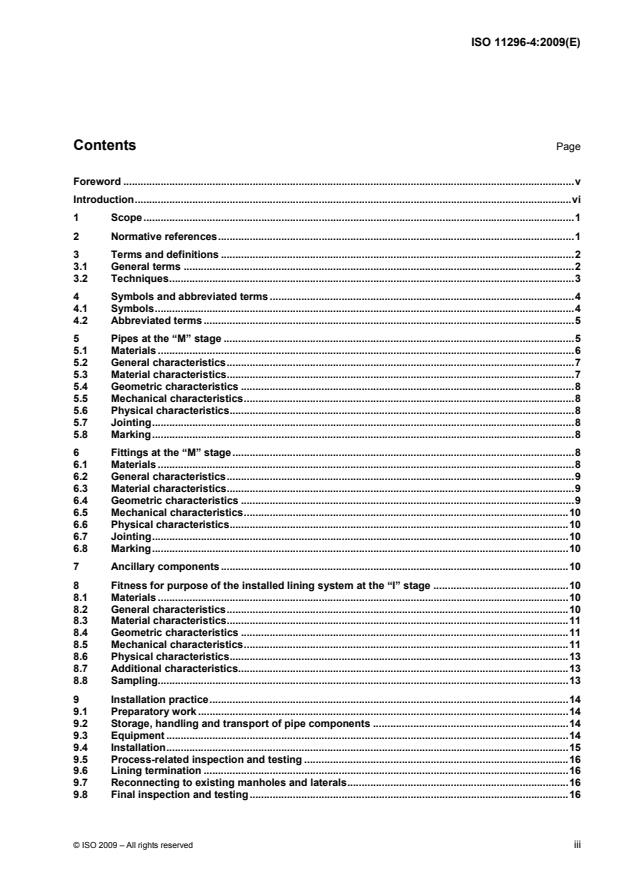
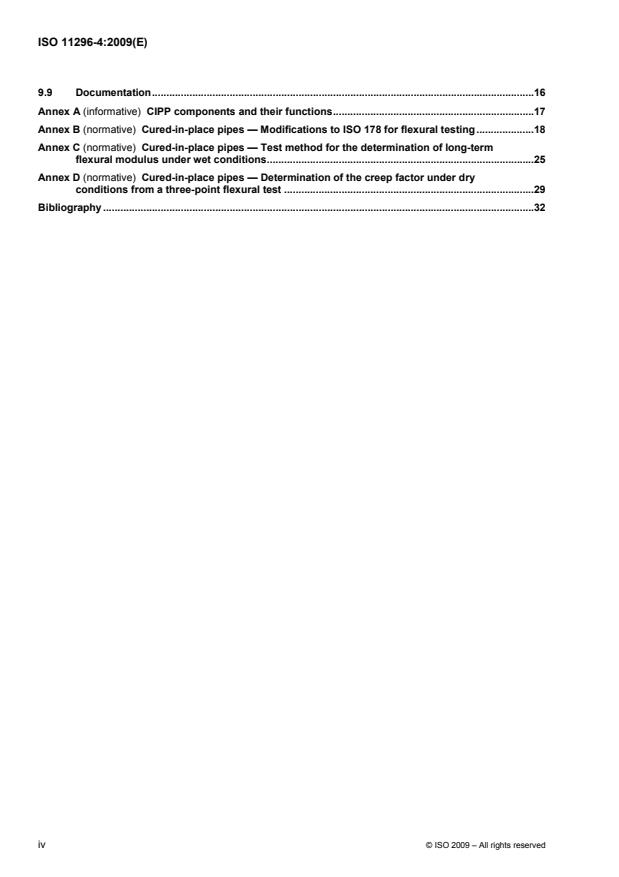
Contents Page
Foreword .v
Introduction.vi
1 Scope.1
2 Normative references.1
3 Terms and definitions .2
3.1 General terms .2
3.2 Techniques.3
4 Symbols and abbreviated terms .4
4.1 Symbols.4
4.2 Abbreviated terms .5
5 Pipes at the “M” stage .5
5.1 Materials .6
5.2 General characteristics.7
5.3 Material characteristics.7
5.4 Geometric characteristics .8
5.5 Mechanical characteristics.8
5.6 Physical characteristics.8
5.7 Jointing.8
5.8 Marking.8
6 Fittings at the “M” stage.8
6.1 Materials .8
6.2 General characteristics.9
6.3 Material characteristics.9
6.4 Geometric characteristics .9
6.5 Mechanical characteristics.10
6.6 Physical characteristics.10
6.7 Jointing.10
6.8 Marking.10
7 Ancillary components.10
8 Fitness for purpose of the installed lining system at the “I” stage .10
8.1 Materials .10
8.2 General characteristics.10
8.3 Material characteristics.11
8.4 Geometric characteristics .11
8.5 Mechanical characteristics.11
8.6 Physical characteristics.13
8.7 Additional characteristics.13
8.8 Sampling.13
9 Installation practice.14
9.1 Preparatory work .14
9.2 Storage, handling and transport of pipe components .14
9.3 Equipment .14
9.4 Installation.15
9.5 Process-related inspection and testing .16
9.6 Lining termination .16
9.7 Reconnecting to existing manholes and laterals.16
9.8 Final inspection and testing.16
9.9 Documentation.16
Annex A (informative) CIPP components and their functions.17
Annex B (normative) Cured-in-place pipes — Modifications to ISO 178 for flexural testing.18
Annex C (normative) Cured-in-place pipes — Test method for the determination of long-term
flexural modulus under wet conditions.25
Annex D (normative) Cured-in-place pipes — Determination of the creep factor under dry
conditions from a three-point flexural test .29
Bibliography .32
iv © ISO 2009 – All rights reserved
Foreword
ISO (the International Organization for Standardization) is a worldwide federation of national standards bodies
(ISO member bodies). The work of preparing International Standards is normally carried out through ISO
technical committees. Each member body interested in a subject for which a technical committee has been
established has the right to be represented on that committee. International organizations, governmental and
non-governmental, in liaison with ISO, also take part in the work. ISO collaborates closely with the
International Electrotechnical Commission (IEC) on all matters of electrotechnical standardization.
International Standards are drafted in accordance with the rules given in the ISO/IEC Directives, Part 2.
The main task of technical committees is to prepare International Standards. Draft International Standards
adopted by the technical committees are circulated to the member bodies for voting. Publication as an
International Standard requires approval by at least 75 % of the member bodies casting a vote.
Attention is drawn to the possibility that some of the elements of this document may be the subject of patent
rights. ISO shall not be held responsible for identifying any or all such patent rights.
ISO 11296-4 was prepared by Technical Committee ISO/TC 138, Plastics pipes, fittings and valves for the
transport of fluids.
ISO 11296 consists of the following parts, under the general title Plastics piping systems for renovation of
underground non-pressure drainage and sewerage networks:
⎯ Part 1: General
⎯ Part 3: Lining with close-fit pipes
⎯ Part 4: Lining with cured-in-place pipes
Lining with continuous pipes is to form the subject of a part 2, lining with discrete pipes is to form the subject
of a part 5 and lining with spirally-wound pipes is to form the subject of a part 7.
This corrected version of ISO 11296-4:2009 incorporates the replacement of “ISO 178” with “ISO 178 as
modified by Annex B” in the fourth row and fifth column of Table 5.
Introduction
The System Standard, of which this is part 4, specifies the requirements for plastics piping systems of various
materials used for renovation of existing pipelines in a specified application area. System Standards for
renovation specify procedures for the following applications:
⎯ plastics piping systems for renovation of underground non-pressure drainage and sewerage networks;
⎯ plastics piping systems for renovation of underground drainage and sewerage networks under pressure;
⎯ plastics piping systems for renovation of underground water supply networks;
⎯ plastics piping systems for renovation of underground gas supply networks.
These System Standards are distinguished from those for conventionally installed plastics piping systems
because they set requirements for certain characteristics in the as-installed condition, after site processing.
This is in addition to specifying requirements for plastics piping system components, as manufactured.
Each of the System Standards comprises a part 1 (general) and all applicable renovation technique family-
related parts from the following:
⎯ part 2: lining with continuous pipes;
⎯ part 3: lining with close-fit pipes;
⎯ part 4: lining with cured-in-place pipes;
⎯ part 5: lining with discrete pipes;
⎯ part 7: lining with spirally-wound pipes.
The requirements for any given renovation technique family are given in part 1, applied in conjunction with the
other relevant part. For example, parts 1 and 2 specify the requirements relating to lining with continuous
pipes. For complementary information, see ISO 11295. Not all technique families are applicable to every area
of application and this is reflected in the part numbers included in each System Standard.
A consistent structure of clause headings has been adopted for all parts to facilitate direct comparisons across
renovation technique families.
Figure 1 gives the common structure and the relationship between ISO 11296 and the System Standards for
other application areas.
vi © ISO 2009 – All rights reserved
Figure 1 — Format of the renovation System Standards
INTERNATIONAL STANDARD ISO 11296-4:2009(E)
Plastics piping systems for renovation of underground
non-pressure drainage and sewerage networks —
Part 4:
Lining with cured-in-place pipes
1 Scope
This part of ISO 11296, in conjunction with ISO 11296-1, specifies requirements and test methods for cured-
in-place pipes and fittings used for the renovation of underground non-pressure drainage and sewerage
networks.
It applies to the use of various thermosetting resin systems, in combination with compatible fibrous carrier
materials and other process-related plastics components (see 5.1).
2 Normative references
The following referenced documents are indispensable for the application of this document. For dated
references, only the edition cited applies. For undated references, the latest edition of the referenced
document (including any amendments) applies.
ISO 75-2, Plastics — Determination of temperature of deflection under load — Part 2: Plastics and ebonite
ISO 178:2001, Plastics — Determination of flexural properties
ISO 527-2, Plastics — Determination of tensile properties — Part 2: Test conditions for moulding and
extrusion plastics
ISO 899-2:2003, Plastics — Determination of creep behaviour — Part 2: Flexural creep by three-point loading
ISO 3126, Plastics piping systems — Plastics components — Determination of dimensions
ISO 4435, Plastics piping systems for non-pressure underground drainage and sewerage — Unplasticized
poly(vinyl chloride) (PVC-U)
ISO 7684, Plastics piping systems — Glass-reinforced thermosetting plastics (GRP) pipes — Determination of
the creep factor under dry conditions
ISO 7685, Plastics piping systems — Glass-reinforced thermosetting plastics (GRP) pipes — Determination of
initial specific ring stiffness
ISO 8513, Plastics piping systems — Glass-reinforced thermosetting plastics (GRP) pipes — Determination of
longitudinal tensile properties
ISO 8773, Plastics piping systems for non-pressure underground drainage and sewerage — Polypropylene
(PP)
1)
ISO 10928 , Plastics piping systems — Glass-reinforced thermosetting plastics (GRP) pipes and fittings —
Methods for regression analysis and their use
ISO 10952, Plastics piping systems — Glass-reinforced thermosetting plastics (GRP) pipes and fittings —
Determination of the resistance to chemical attack for the inside of a section in a deflected condition
2)
ISO 11296-1:— , Plastics piping systems for renovation of underground non-pressure drainage and
sewerage networks — Part 1: General
ISO 13002, Carbon fibre — Designation system for filament yarns
3)
ISO 25780:— , Plastics piping systems for pressure and non-pressure water supply, irrigation, drainage or
sewerage — Glass-reinforced thermosetting plastics (GRP) systems based on unsaturated polyester (UP)
resin — Pipes with flexible joints intended to be installed using jacking techniques
EN 14364:2006, Plastics piping systems for drainage and sewerage with or without pressure — Glass-
reinforced thermosetting plastics (GRP) based on unsaturated polyester resin (UP) — Specifications for pipes,
fittings and joints
3 Terms and definitions
For the purposes of this document, the terms and definitions given in ISO 11296-1 and the following apply.
3.1 General terms
3.1.1
carrier material
porous component of the liner, which carries the liquid resin system during insertion into the pipe being
renovated and forms part of the installed lining system once the resin has been cured
3.1.2
CIPP product
cured-in-place pipe product
cured-in-place pipe of a particular design, produced from a liner of specified materials, with a wall structure
which is uniquely defined for each diameter/wall thickness combination, and which is impregnated with a
specific resin system and installed by a specific process
3.1.3
CIPP unit
specific cured-in-place pipe produced from a continuous liner, which has been impregnated in one process
and installed as a single length
3.1.4
close-fit
situation of the outside of the installed liner relative to the inside of the existing pipeline, which may either be
an interference fit or include a small annular gap resulting from shrinkage and tolerances only
3.1.5
composite
combination of cured resin system, carrier material and/or reinforcement, excluding any internal or external
membranes or any layer of excess neat resin
1) To be published.
2) To be published.
3) To be published.
2 © ISO 2009 – All rights reserved
3.1.6
first break
elastic limit or first major discontinuity of the stress-strain curve associated with local failure of the resin matrix
or reinforcing fibres
3.1.7
curing
process of resin polymerization, which may be initiated or accelerated by the use of heat or exposure to light
3.1.8
design thickness
required wall thickness of the composite, as determined by structural design
3.1.9
internal membrane
membrane forming the inside surface of the pipe after installation
3.1.10
external membrane
membrane forming the outside surface of the pipe after installation
3.1.11
lateral connection collar
fitting for reconnecting a lined main pipe to an existing or renovated lateral pipe
3.1.12
lining tube
flexible tube, consisting of carrier material, resin system and any membranes and/or reinforcement, as
combined prior to insertion in the pipe to be lined
3.1.13
nominal thickness
one of a range of discrete liner wall thicknesses dictated by the materials used for liner construction and
chosen so as to result in a finished wall thickness of the composite not less than the design thickness
3.1.14
preliner
external membrane which is installed separately and before the resin-impregnated liner
3.1.15
reinforcement
fibres incorporated in the liner, which enhance the dimensional stability of the liner and/or the structural
properties of the cured composite
NOTE The reinforcement can be incorporated in the carrier material, constitute the carrier material, or can be a
separate layer.
3.1.16
resin system
thermosetting resin including the curing agent(s) and any fillers or other additives, in specified proportions
3.2 Techniques
3.2.1
inversion
process of turning a flexible tube or hose inside out by the use of fluid (water or air) pressure
3.2.2
inverted-in-place insertion
method whereby the impregnated liner is introduced by inversion to achieve simultaneous insertion and
inflation
3.2.3
winched-in-place insertion
method whereby the flat impregnated liner is first pulled into the pipe to be lined and then inflated to bring it up
to size
NOTE Inflation can be achieved by means of a separate pressurized tube or hose inside the liner which is either
withdrawn after resin cure or left in place as a permanent internal membrane.
3.2.4
temporary membrane
internal membrane, used to separate process fluid (typically water or air) from the resin system during liner
insertion, which is withdrawn after resin cure
4 Symbols and abbreviated terms
The symbols and abbreviated terms given in ISO 11296-1 and the following apply.
4.1 Symbols
b width of test piece
E short-term flexural modulus
E long-term flexural modulus at x years
x
E flexural creep modulus at time t
t
F force applied in flexural test
h thickness of test piece
h mean thickness of test piece
m
I moment of inertia (the second moment of area) per unit length of the pipe wall
L distance between supports in flexural test
L distance between points of contact of curved flexural test piece with supports
L true span of curved flexural test piece
r radius of support
R radius of curvature of test piece at mid-thickness
V rise of centre of curved flexural test piece above its points of contact with supports
S initial specific ring stiffness
δ deflection of flexural test piece at time t
t
α dry creep factor at x years
x, dry
4 © ISO 2009 – All rights reserved
ε initial flexural strain at zero stress
f0
ε flexural strain at first break
fb
ε flexural strain at maximum applied load
fM
σ required flexural stress in creep test
σ flexural stress at first break
fb
σ flexural stress at maximum applied load
fM
σ ultimate longitudinal tensile stress
l
4.2 Abbreviated terms
CIPP Cured-in-place pipe
EP Epoxy resin
GRP Glass-reinforced thermosetting plastics
PA Polyamide
PAN Polyacrylonitrile
PE Polyethylene
PEN Poly(ethylene naphthate)
PET Poly(ethylene terephthalate)
PP Polypropylene
PUR Polyurethane
PVC-U Unplasticized poly(vinyl chloride)
UP Unsaturated polyester resin
VE Vinyl ester resin
5 Pipes at the “M” stage
NOTE This clause specifies requirements for the lining tube (i.e. all components before resin cure). For requirements
for the cured composite, see Clause 8.
5.1 Materials
Lining tubes shall comprise at least the following components:
⎯ resin system;
⎯ carrier material.
In addition, they may optionally comprise:
⎯ reinforcement;
⎯ internal membrane or temporary membrane;
⎯ external membrane.
For the relationship between these components, see Figure 2.
NOTE 1 Various components can have end-product or purely process-related functions dependent on the specific
method used. The possible functions of components are given in Table A.1.
NOTE 2 The carrier material can itself have a reinforcing effect.
Key
1 internal or temporary membrane
2 composite (resin in carrier material/reinforcement)
3 external membrane
4 existing pipeline
Figure 2 — Typical wall construction of lining tube
Lining tube components shall comprise materials conforming to Table 1 and the material used for each
component shall be declared.
6 © ISO 2009 – All rights reserved
Table 1 — Classification of lining tube components by their material
Lining tube component Materials
Resin system:
⎯ resin type UP, VE or EP
⎯ filler type None, inorganic or organic
⎯ curing system Heat-initiated, light-initiated or ambient cure
Carrier material/reinforcement Polymeric fibres: PA, PAN, PEN, PET or PP
Glass fibres conforming to ISO 25780:—, 4.2.2
Carbon fibres of declared designation conforming to ISO 13002
a
Combinations of the above fibres
b
Membranes (internal, external or
Unrestricted
temporary)
a
Where a combination of fibres is used, the proportions by mass of each fibre type shall be declared to within 5 %.
b
As there are no requirements for membranes, there are also no restrictions on the choice of materials used for membranes.
5.2 General characteristics
Colouration may be used for resin mix and/or impregnation control.
5.3 Material characteristics
When tested in accordance with the methods given in Table 2, the resin system, cast singly without filler,
carrier material or reinforcement shall, after cure, conform to the material requirements specified in Table 2,
according to resin type.
Table 2 — Material characteristics of resin systems
Test parameter
Characteristic Requirement Test method
Parameter Value
Flexural stress at For UP and VE: W 100 MPa Speed of testing 2 mm/min ISO 178:2001
first break
For EP: W 80 MPa Number of test pieces 3
Dimensions of test piece:
thickness h 3 u h u 6 mm
width b (15 ± 0,5) mm
Tensile elongation For UP and VE: W 2 % Speed of testing 5 mm/min ISO 527-2
at break
For EP: W 2,5 % Number of test pieces 3
Test piece shape and initial Specimen type 1B
gauge length
Temperature of For UP and VE: W 85 °C Orientation of test piece Edgewise Method A of
deflection under ISO 75-2
For EP: W 70 °C Number of test pieces 3
load
5.4 Geometric characteristics
No geometric requirements apply at the “M” stage.
The perimeter of the lining tube should be dimensioned such that when installed, it forms a close fit to the
existing sewer wall or as otherwise required by the design. The manufactured length and thickness of the
lining tube should include allowances for any longitudinal and circumferential stretch during installation.
5.5 Mechanical characteristics
No mechanical requirements apply at the “M” stage.
5.6 Physical characteristics
No physical requirements apply.
5.7 Jointing
The lining tube after impregnation shall be provided in lengths such that no jointing is required between points
of access to the sewer.
5.8 Marking
The marking shall conform to ISO 11296-1:—, 5.8. It shall be applied to the outside of the lining tube as
delivered to the installation site or in the case of pre-packaged lining tubes, on the outside of the packaging.
As specified in ISO 11296-1:—, 5.8 c), the dimensions marked shall be the nominal outside diameter or in the
case of lining tubes to be installed in non-circular sewers, the diameter of the circle having the same outside
perimeter as the lining tube.
As specified in ISO 11296-1:—, 5.8 d), the dimension marked shall be the wall thickness.
As specified in ISO 11296-1:—, 5.8 f), the manufacturer's information shall enable identification of the lining
tube structure and (if pre-impregnated) the resin system used.
6 Fittings at the “M” stage
NOTE 1 This clause describes the various materials which a cured-in-place fitting conforming to this part of ISO 11296
can comprise, and specifies requirements relating to those materials and intermediate fabrications at the “M” stage.
NOTE 2 Since by definition a cured-in-place pipe is partly manufactured on site, requirements of the finished product
can only be verified at the “I” stage. For “I” stage requirements, see Clause 8.
NOTE 3 The only cured-in-place fittings covered by this part of ISO 11296 are lateral connections collars. Such collars
can be an integral part of a complete lining of a lateral pipe. External saddle connections between cured-in-place main
pipes and lateral pipes can also be made with standard thermoplastic or GRP fittings.
6.1 Materials
Lateral connection collars shall comprise cured-in-place components conforming to 5.1, but may also include
additional thermoplastic components of declared composition.
External saddles shall be of PP, PVC-U or GRP-UP, conforming to ISO 4435, ISO 8773 or EN 14364:2006,
6.5, as applicable.
8 © ISO 2009 – All rights reserved
6.2 General characteristics
No general requirements apply.
6.3 Material characteristics
The resin system of cured-in-place fittings shall conform to 5.3.
6.4 Geometric characteristics
Cured-in-place lateral connection collars shall be classified, as indicated in Table 3, according to the minimum
distance extended into the lateral pipe.
Table 3 — Classification of cured-in-place lateral connection collars
Class Minimum extension into lateral pipe
A 1 000 mm
B 400 mm and at least 150 mm beyond first joint in existing lateral pipe
C 100 mm
In addition, the rim of any cured-in-place lateral connection collar shall overlap the main pipe by not less than
50 mm (see Figure 3).
To avoid obstructions to flow and maintenance equipment, the transitions between the collar and both main
and lateral pipes should be smooth.
a) Top-hat b) Tee piece
Key
1 lateral pipe
2 main pipe
a
Extension of collar.
b
Rim of collar.
Figure 3 — Schematic of cured-in-place lateral connection collars
6.5 Mechanical characteristics
No mechanical requirements apply to cured-in-place fittings at the “M” stage.
6.6 Physical characteristics
No physical requirements apply to cured-in-place fittings.
6.7 Jointing
Joints shall be either mechanical or adhesive.
6.8 Marking
The marking shall conform to ISO 11296-1:—, 6.8. It shall be applied to the outside of the lining tube as
delivered to the installation site or, in the case of pre-packaged lining tubes, on the outside of the packaging.
As specified in ISO 11296-1:—, 6.8 c), the dimension marked shall be the nominal outside diameter of the part
of the lateral connection collar which fits into the lateral pipe.
As specified in ISO 11296-1:—, 6.8 d), the dimension marked shall be the nominal wall thickness.
As specified in ISO 11296-1:—, 6.8 f), the manufacturer's information shall enable identification of the lining
tube structure and (if pre-impregnated) the resin system used.
7 Ancillary components
This part of ISO 11296 does not apply to any ancillary components.
8 Fitness for purpose of the installed lining system at the “I” stage
NOTE This clause includes the requirements for the finished CIPP system, the manufacture of which, by definition, is
not completed until the resin is cured at the “I” stage.
8.1 Materials
The pipe and any fittings may consist of different material components selected from the ranges defined in 5.1
and 6.1.
NOTE This part of ISO 11296 does not specify requirements for any end-product functions of internal membranes
(see Annex B).
8.2 General characteristics
In straight lengths of pipe of constant internal perimeter, the CIPP shall not introduce surface irregularities in
addition to those of the host pipe, which exceed 2 % of the nominal diameter or 6 mm, whichever is the
greater.
NOTE 1 This requirement can be changed, where appropriate, to meet hydraulic performance requirements of the
lined pipe.
NOTE 2 A feature of cured-in-place pipes is that they generally conform to the surface features of the host pipe. At
bends and at irregularities in the host pipe, including local reductions of internal perimeter, folding generally occurs.
10 © ISO 2009 – All rights reserved
8.3 Material characteristics
Resin cure shall be demonstrated by conformity to 8.5.
8.4 Geometric characteristics
NOTE When assessing minimum free bore attainable after CIPP installation at bends, changes of cross-section or
stepped joints in the existing pipe, the likelihood of local folding can be taken into account (see 8.2).
8.4.1 CIPP wall structure
The thicknesses and relative positions of each component layer of the CIPP wall, including tolerances, shall
be specified as declared values. The maximum proportional volume of any entrained air and/or evolved gas
shall likewise be specified. The wall structure shall be verified by visual examination of the edge of a cut
section of pipe, with magnification, as necessary, and use of a scale or caliper capable of measuring to within
0,1 mm.
NOTE For the purposes of verifying that any entrained air and/or evolved gas does not exceed the declared
maximum proportional volume, microscopic examination of a thin section can be carried out. For uniform composites only,
measurement of test piece density can also provide a useful guide.
8.4.2 Wall thickness
When measured in a laboratory in accordance with the relevant test method specified, the wall thickness of
the installed pipe shall conform to the requirements of Table 4.
NOTE Wall thickness measured along the cut edge of the CIPP at manholes or lateral openings might not be
representative of the main body of the liner.
Table 4 — Geometric characteristics
Characteristic Requirement Test method
Mean wall thickness, e , of Not less than the design thickness
m
the composite
ISO 7685 (ring test pieces, see Table 5)
Minimum wall thickness, Not less than 80 % of the design or B.4.1 (flexural test pieces)
e , of the composite thickness, or 3 mm, whichever is the
min
a
greater
a
The e requirement does not apply to points where local wall thickness reduction is caused by irregularity in the host pipe.
min
8.5 Mechanical characteristics
When tested in accordance with the methods given in Table 5, the mechanical characteristics of pipe samples
taken from actual or simulated installations in accordance with 8.8 shall conform to this table.
NOTE The dry creep factor referred to in Table 5 is the inverse of the creep ratio for thermoplastics liner pipes
defined in ISO 11296-3. To compare the creep performance of CIPP with that of a thermoplastics liner pipe, an equivalent
creep ratio at x years for CIPP can be computed simply as 1/(α ).
x, dry
Table 5 — Mechanical characteristics of pipes
Test parameters
Characteristic Requirement Test method
Parameter Value
a
Initial specific ring Declared value, but Number of test pieces 2 Method A or
stiffness, S not less than the Method B
Test piece length for:
greater of 0,25 kPa or of ISO 7685
d u 300 mm d mm ± 5 %
(0,125/α ) kPa
n n
50, dry
d > 300 mm 300 mm ± 5 %
n
Temperature (23 ± 2) °C
For method B: relative deflection (3 ± 0,5) %
b c
Dry creep factor , Declared value but not Method 1 (ring test) ISO 7684
α less than 0,2
x, dry
— number of test pieces 2
— test piece length for:
d u 300 mm d mm ± 5 %
n n
d > 300 mm
n 300 mm ± 5 %
— test period
10 000 h
— time to which values are to be
50 years
extrapolated
— temperature
(23 ± 2) °C
— relative humidity
(50 ± 5) %
c
Method 2 (3-point flexural test) Annex D
— number of test pieces 5
— sample orientation Shall conform to 8.8
— test period 10 000 h
— time to which values are to be
extrapolated 50 years (i.e. x = 50)
— temperature (23 ± 2) °C
— relative humidity (50 ± 5) %
Short-term flexural Declared value but not Number of test pieces 5 ISO 178 as
modulus, E less than 1 500 MPa modified by
Speed of testing 10 mm/min
Annex B
Flexural stress at first Declared value but not
Sample orientation Shall conform to 8.8
break, σ less than 25 MPa
fb
Temperature (23 ± 2) °C
Flexural strain at first Declared value but not
break, ε less than 0,75 %
fb
Long-term flexural Declared value but not Number of test pieces 5 Annex C
modulus under wet less than 300 MPa at
b
conditions , E 50 years
x, wet
Ultimate longitudinal Declared value but not Temperature (23 ± 2) °C Method A
a
tensile stress, σ less than 15 MPa or Method B
l
of ISO 8513
Ultimate elongation Declared value but not Number of test pieces 5
less than 0,5 %
Speed of testing 5 mm/min
a
In case of dispute, Method A applies.
b
It is expected that only one of these methods of creep testing (dry or wet) will be applied, according to national preferences.
c
Where it is difficult to acquire a full ring for testing, Method 2 provides a practical alternative.
12 © ISO 2009 – All rights reserved
8.6 Physical characteristics
No physical requirements apply.
8.7 Additional characteristics
When tested in accordance with the method given in Table 6, the resistance of the CIPP to chemical attack
under constant deflection (strain corrosion resistance) shall conform to the requirement stated in the table.
NOTE If the carrier material/reinforcement consists entirely of fibres of PET, testing experience indicates that no
strain corrosion failure occurs.
Table 6 — Additional characteristics
Test parameter
Test
Characteristic Requirement
method
Parameter Value
Resistance to Minimum extrapolated Composition of test liquid 0,5 mol/l sulfuric acid ISO 10952
chemical attack in a failure strain at 50 years:
Number of test pieces 18
deflected condition W 0,45 %
Test piece length for
d u 300 mm d mm ± 5 %
n n
d > 300 mm 300 mm ± 5 %
n
Test piece diameter 150 u d u 400
n
Test temperature (23 ± 2) °C
Time to which the extrapolated 50 years
value is to be calculated
8.8 Sampling
Simulated installations used to produce samples for type testing shall be executed in accordance with 9.4.3.
Off-cut samples for installation quality control should preferably be formed by confining an otherwise free
section of liner during inflation and cure to the same perimeter as the pipe being lined. As far as possible such
supported samples shall be formed at an intermediate manhole in preference to one or other end of the
overall installation.
Any other method of acquiring non-destructive off-cut samples shall be documented in the installation manual,
and supported by test data demonstrating that the relevant characteristics of such samples do not
systematically exceed those of samples cut from the actual pipe wall.
Sampling in manholes by use of a confining pipe or sleeve is generally practicable when lining circular pipes
of diameter up to 600 mm only. In other circumstances, samples should preferably be taken from the actual
pipe wall, and the resulting hole in the liner made good with similar materials by a procedure documented in
the installation manual.
Alternative off-cut sampling methods may exceptionally be considered if pipe wall sampling is either not
permitted by the client, or rendered impractical by site conditions (e.g. where running groundwater prevents
satisfactory filling and resealing of the liner after sampling).
For the purposes of three-point flexural testing conforming to ISO 178, in accordance with Table 5 and
Annex B, the orientation of samples shall be as follows:
a) For CIPP products in which the mean hoop and longitudinal flexural properties can be shown by tests on
flat plates to differ by no more than ± 10 %, either longitudinal or hoop samples may be used. The sample
orientation chosen for type testing shall, however, become the sample orientation requirement for all
further flexural testing.
b) For CIPP products of anisotropic wall construction, hoop samples only shall be used.
In all cases, test pieces shall be placed in the testing machine in such a manner that the inside surface of the
CIPP is in contact with the supports and therefore subjected to tension.
NOTE A ring stiffness calculated from the short-term flexural modulus determined by testing conforming to ISO 178
and the measured diameter/thickness ratio, d /e , does not generally equate to the initial specific ring stiffness determined
n m
by testing in accordance with ISO 7685, due to material and geometric non-linearities.
9 Installation practice
9.1 Preparatory work
For the preparatory work, ISO 11296-1 applies.
9.2 Storage, handling and transport of pipe components
Raw materials shall be stored and used in accordance with the recommendation of their respective
manufacturers. The liner shall be stored, impregnated and transported under conditions which do not impair
performance of the as-installed product in such a way as to prevent conformity to this part of ISO 11296.
9.3 Equipment
All technique specific equipment shall be documented in the installation manual. The items described should
include the following, as applicable.
a) Resin storage, mixing and impregnation equipment (if impregnation takes place at the installation site).
b) Insertion equipment, including:
1) winch and controls for winched-in-place insertion;
2) inversion collars or elbows for inverted-in-place insertion;
3) water column, air compressor and/or air/water pressure vessel for inflation or inversion;
4) equipment for maintaining and/or monitoring pressure.
c) Curing equipment, including:
1) boiler or steam generator;
2) recording equipment for time, temperature and pressure;
3) for light cure systems: UV source, winch for lamp assembly and equipment to record its speed of
advance along the pipe;
4) for electrical cure systems: power supply and associated metering equipment.
d) Finishing equipment: manual or robotic cutters and/or grinders for trimming ends and reopening lateral
connections.
14 © ISO 2009 – All rights reserved
9.4 Installation
9.4.1 Environmental precautions
The installation manual shall describe any measures necessary to prevent liquid resin from contaminating the
environment and to reduce the accumulation of volatile materials in the atmosphere. If hot processing fluids
are used, they shall not be disposed of into the sewerage network at temperatures and/or release rates which
could cause damage.
Any local regulations specifying maximum fluid release temperatures should be taken into account.
Any lubricant used to reduce friction during installation shall be declared. The installation manual shall
describe any precautions necessary to prevent possible adverse effects of such lubricant on the CIPP or the
environment.
9.4.2 Installation procedures
The procedures for site handling, site impregnation (if applicable), insertion and cure of lining tubes shall be
documented in the installation manual.
The installer shall further ensure that the pressure in the lining tube during inversion or inflation is sufficient to
hold it tight to the pipe wall and prevent any internal deformation of the lining tube, which can be caused by
groundwater pressure or the pressure of sewerage in laterals.
NOTE In sewers with running infiltration, a pre-liner or integral external membrane can be used to prevent
contamination of the resin system by water entering the existing pipeline.
The fluid pressure used for inversion or inflation and the rate of inser
...
NORME ISO
INTERNATIONALE 11296-4
Première édition
2009-11-01
Systèmes de canalisations en plastique
pour la rénovation des réseaux de
branchement et de collecteurs
d'assainissement enterrés sans
pression —
Partie 4:
Tubage continu par tubes polymérisés
sur place
Plastics piping systems for renovation of underground non-pressure
drainage and sewerage networks —
Part 4: Lining with cured-in-place pipes
Numéro de référence
©
ISO 2009
PDF – Exonération de responsabilité
Le présent fichier PDF peut contenir des polices de caractères intégrées. Conformément aux conditions de licence d'Adobe, ce fichier
peut être imprimé ou visualisé, mais ne doit pas être modifié à moins que l'ordinateur employé à cet effet ne bénéficie d'une licence
autorisant l'utilisation de ces polices et que celles-ci y soient installées. Lors du téléchargement de ce fichier, les parties concernées
acceptent de fait la responsabilité de ne pas enfreindre les conditions de licence d'Adobe. Le Secrétariat central de l'ISO décline toute
responsabilité en la matière.
Adobe est une marque déposée d'Adobe Systems Incorporated.
Les détails relatifs aux produits logiciels utilisés pour la création du présent fichier PDF sont disponibles dans la rubrique General Info
du fichier; les paramètres de création PDF ont été optimisés pour l'impression. Toutes les mesures ont été prises pour garantir
l'exploitation de ce fichier par les comités membres de l'ISO. Dans le cas peu probable où surviendrait un problème d'utilisation,
veuillez en informer le Secrétariat central à l'adresse donnée ci-dessous.
DOCUMENT PROTÉGÉ PAR COPYRIGHT
© ISO 2009
Droits de reproduction réservés. Sauf prescription différente, aucune partie de cette publication ne peut être reproduite ni utilisée sous
quelque forme que ce soit et par aucun procédé, électronique ou mécanique, y compris la photocopie et les microfilms, sans l'accord écrit
de l'ISO à l'adresse ci-après ou du comité membre de l'ISO dans le pays du demandeur.
ISO copyright office
Case postale 56 • CH-1211 Geneva 20
Tel. + 41 22 749 01 11
Fax + 41 22 749 09 47
E-mail copyright@iso.org
Web www.iso.org
Version française parue en 2011
Publié en Suisse
ii © ISO 2009 – Tous droits réservés
Sommaire Page
Avant-propos .v
Introduction.vi
1 Domaine d'application .1
2 Références normatives.1
3 Termes et définitions .2
3.1 Termes généraux.2
3.2 Techniques.4
4 Symboles et abréviations .4
4.1 Symboles.4
4.2 Abréviations.5
5 Tuyaux au stade «M» .6
5.1 Matériaux.6
5.2 Caractéristiques générales .7
5.3 Caractéristiques des matériaux .7
5.4 Caractéristiques géométriques.8
5.5 Caractéristiques mécaniques .8
5.6 Caractères physiques .8
5.7 Assemblage .8
5.8 Marquage.8
6 Raccords au stade «M».8
6.1 Matériaux.8
6.2 Caractéristiques générales .9
6.3 Caractéristiques des matériaux .9
6.4 Caractéristiques géométriques.9
6.5 Caractéristiques mécaniques .10
6.6 Caractéristiques physiques .10
6.7 Assemblage .10
6.8 Marquage.10
7 Accessoires .10
8 Aptitude à l'emploi du système de rénovation installé au stade «I».10
8.1 Matériaux.10
8.2 Caractéristiques générales .10
8.3 Caractéristiques des matériaux .11
8.4 Caractéristiques géométriques.11
8.5 Caractéristiques mécaniques .11
8.6 Caractéristiques physiques .13
8.7 Caractéristiques supplémentaires.13
8.8 Échantillonnage.13
9 Pratique d'installation .14
9.1 Travaux préparatoires.14
9.2 Stockage, manutention et transport des composants du tubage.14
9.3 Équipement .14
9.4 Installation.15
9.5 Contrôle et essais relatifs au processus d'installation .16
9.6 Achèvement du tubage ou chemisage.16
9.7 Raccordement aux regards de visite et branchements existants.16
9.8 Inspection finale et essais.16
9.9 Documentation. 16
Annexe A (informative) Composants du CIPP et leurs fonctions . 17
Annexe B (normative) Tubage continu par tubes polymérisés sur place — Modifications de
l'ISO 178 pour des essais en flexion. 18
Annexe C (normative) Tubage continu par tubes polymérisés sur place — Méthode d'essai pour
la détermination du module en flexion à long terme dans des conditions humides . 25
Annexe D (normative) Tubage continu par tubes polymérisés sur place — Détermination du
facteur de fluage dans des conditions sèches à partir d'un essai de flexion en trois points . 29
Bibliographie . 32
iv © ISO 2009 – Tous droits réservés
Avant-propos
L'ISO (Organisation internationale de normalisation) est une fédération mondiale d'organismes nationaux de
normalisation (comités membres de l'ISO). L'élaboration des Normes internationales est en général confiée
aux comités techniques de l'ISO. Chaque comité membre intéressé par une étude a le droit de faire partie du
comité technique créé à cet effet. Les organisations internationales, gouvernementales et non
gouvernementales, en liaison avec l'ISO participent également aux travaux. L'ISO collabore étroitement avec
la Commission électrotechnique internationale (CEI) en ce qui concerne la normalisation électrotechnique.
Les Normes internationales sont rédigées conformément aux règles données dans les Directives ISO/CEI,
Partie 2.
La tâche principale des comités techniques est d'élaborer les Normes internationales. Les projets de Normes
internationales adoptés par les comités techniques sont soumis aux comités membres pour vote. Leur
publication comme Normes internationales requiert l'approbation de 75 % au moins des comités membres
votants.
L'attention est appelée sur le fait que certains des éléments du présent document peuvent faire l'objet de
droits de propriété intellectuelle ou de droits analogues. L'ISO ne saurait être tenue pour responsable de ne
pas avoir identifié de tels droits de propriété et averti de leur existence.
L'ISO 11296-4 a été élaborée par le comité technique ISO/TC 138, Tubes, raccords et robinetterie en
matières plastiques pour le transport des fluides.
L'ISO 11296 comprend les parties suivantes, présentées sous le titre général Systèmes de canalisations en
plastique pour la rénovation des réseaux de branchement et de collecteurs d'assainissement enterrés sans
pression:
⎯ Partie 1: Généralités
⎯ Partie 3: Tubage par tuyau continu sans espace annulaire
⎯ Partie 4: Tubage continu par tubes polymérisés sur place
Un tubage par tuyau continu avec espace annulaire fera l'objet d'une future Partie 2, un tubage par tuyaux
courts avec espace annulaire fera l'objet d'une future Partie 5 et un tubage par enroulement hélicoïdal avec
espace annulaire fera l'objet d'une future Partie 7.
La présente version française de l'ISO 11296-4:2009 correspond à la version anglaise corrigée de 2010-06-01.
Introduction
La Norme de Système, dont le présent document est la Partie 4, spécifie les exigences pour des systèmes de
canalisations en plastique à base de matériaux variés utilisés pour la rénovation de canalisations existantes
dans un domaine d'application spécifié. Les Normes de Systèmes relatives à la rénovation spécifient les
modes opératoires pour les applications suivantes:
⎯ systèmes de canalisations en plastique pour la rénovation des réseaux d'assainissement enterrés sans
pression;
⎯ systèmes de canalisations en plastique pour la rénovation des réseaux d'assainissement enterrés sous
pression;
⎯ systèmes de canalisations en plastique pour la rénovation de réseaux enterrés d'alimentation en eau;
⎯ systèmes de canalisations en plastique pour la rénovation des réseaux de gaz enterrés.
Ces Normes de Systèmes se distinguent des normes relatives aux systèmes de canalisations en plastique
installés traditionnellement du fait qu'elles établissent des exigences concernant certaines caractéristiques
liées aux conditions d'installation, après mise en œuvre sur le site. Cela s'ajoute aux exigences spécifiques
pour les composants du système tels que fabriqués.
Chacune des Normes de Systèmes comprend une Partie 1 (généralités) et toutes les parties applicables aux
familles de techniques de rénovation contenues dans la liste suivante:
⎯ Partie 2: Tubage par tuyau continu avec espace annulaire;
⎯ Partie 3: Tubage par tuyau continu sans espace annulaire;
⎯ Partie 4: Tubage continu par tubes polymérisés sur place;
⎯ Partie 5: Tubage par tuyaux courts avec espace annulaire;
⎯ Partie 7: Tubage par enroulement hélicoïdal avec espace annulaire.
Les exigences applicables à toute famille de techniques de rénovation donnée sont indiquées dans la partie 1,
appliquée conjointement à toute autre partie associée. Par exemple, les parties 1 et 2 spécifient les exigences
se rapportant au tubage par tuyau continu. Pour toute information complémentaire, voir l'ISO 11295. Toutes
les familles de techniques ne sont pas applicables à chaque domaine d'application et cela se reflète dans les
numéros de parties compris dans chaque Norme de Système.
Une structure cohérente des titres des articles a été adoptée pour toutes les parties afin de faciliter des
comparaisons directes entre les différentes familles de techniques de rénovation.
La Figure 1 illustre la structure commune et la relation entre l'ISO 11296 et les Normes de Systèmes
concernant d'autres domaines d'application.
vi © ISO 2009 – Tous droits réservés
Figure 1 — Présentation des Normes de Systèmes de rénovation
NORME INTERNATIONALE ISO 11296-4:2009(F)
Systèmes de canalisations en plastique pour la rénovation des
réseaux de branchement et de collecteurs d'assainissement
enterrés sans pression —
Partie 4:
Tubage continu par tubes polymérisés sur place
1 Domaine d'application
La présente partie de l'ISO 11296, conjointement à l'ISO 11296-1, spécifie les exigences et les méthodes
d'essais relatives aux tubages continus par tubes polymérisés sur place et aux raccords utilisés pour la
rénovation des réseaux d'assainissement enterrés sans pression.
Elle couvre l'utilisation de divers systèmes de résine thermodurcissable, en combinaison avec des matrices
fibreuses compatibles et autres procédés relatifs aux composants plastiques (voir 5.1).
2 Références normatives
Les documents de référence suivants sont indispensables à l'application du présent document. Pour les
références datées, seule l'édition citée s'applique. Pour les références non datées, la dernière édition du
document de référence s'applique (y compris les éventuels amendements).
ISO 75-2, Plastiques — Détermination de la température de fléchissement sous charge — Partie 2: Plastiques
et ébonite
ISO 178:2001, Plastiques — Détermination des propriétés en flexion
ISO 527-2, Plastiques — Détermination des propriétés en traction — Partie 2: Conditions d'essai des
plastiques pour moulage et extrusion
ISO 899-2:2003, Plastiques — Détermination du comportement au fluage — Partie 2: Fluage en flexion par
mise en charge en trois points
ISO 3126, Systèmes de canalisations en plastiques — Composants en plastiques — Détermination des
dimensions
ISO 4435, Systèmes de canalisations en plastique pour les branchements et les collecteurs d'assainissement
enterrés sans pression — Poly(chlorure de vinyle) non plastifié (PVC-U)
ISO 7684, Systèmes de canalisations en matières plastiques — Tubes plastiques thermodurcissables
renforcés de verre (PRV) — Détermination du coefficient de fluage en condition sèche
ISO 7685, Systèmes de canalisation en matières plastiques — Tubes en plastiques thermodurcissables
renforcés de verre (PRV) — Détermination de la rigidité annulaire spécifique initiale
ISO 8513, Systèmes de canalisations en plastiques — Tubes en plastiques thermodurcissables renforcés de
verre (PRV) — Détermination des propriétés en traction longitudinale
ISO 8773, Systèmes de canalisations en plastique pour les branchements et les collecteurs d'assainissement
enterrés sans pression — Polypropylène (PP)
ISO 10928, Systèmes de canalisation en matières plastiques — Tubes et raccords plastiques
thermodurcissables renforcés de verre (PRV) — Méthodes pour une analyse de régression et leurs
1)
utilisations
ISO 10952, Systèmes de canalisations en matières plastiques — Tubes et raccords en plastiques
thermodurcissables renforcés de verre (PRV) — Détermination de la résistance à une attaque chimique à
l'intérieur d'un tronçon de tube soumis à déflexion
ISO 11296-1:2009, Systèmes de canalisations en plastique pour la rénovation des réseaux d'assainissement
enterrés sans pression — Partie 1: Généralités
ISO 13002, Fibres de carbone — Système de désignation des fils continus
2)
ISO 25780:— , Systèmes de canalisations en matières plastiques pour l'alimentation en eau avec ou sans
pression, pour l'irrigation ou l'assainissement — Systèmes en matières plastiques thermodurcissables
renforcés de verre (PRV) à base de résine de polyester non saturé (UP) — Tubes avec assemblages flexibles
destinés à être installés par les techniques de poussée
EN 14364:2006, Systèmes de canalisations en plastiques pour l'évacuation et l'assainissement avec ou sans
pression — Plastiques thermodurcissables renforcés de verre (PRV) à base de résine de polyester non saturé
(UP) — Spécifications pour tubes, raccords et assemblages
3 Termes et définitions
Pour les besoins du présent document, les termes et définitions donnés dans l'ISO 11296-1 ainsi que les
suivants s'appliquent.
3.1 Termes généraux
3.1.1
matrice
composant poreux de la chemise, qui retient le système de résine liquide au cours de l'insertion dans la
canalisation à rénover et qui fait partie du système de tubage installé après polymérisation de la résine
3.1.2
produit CIPP
produit de tubage continu par tubes polymérisés sur place
tubage continu par tubes polymérisés sur place d'une conception particulière, produit à partir d'une chemise
en matériaux spécifiés, avec une structure de paroi définie de manière unique pour chaque combinaison
diamètre/épaisseur de paroi, imprégnée d'un système de résine spécifique et mise en œuvre selon un
procédé particulier
3.1.3
unité CIPP
tubage continu par tube spécifique polymérisé sur place, fabriqué à partir d'une chemise continue, imprégnée
en une seule opération et mise en œuvre en une seule insertion
1) À publier. (Révision de l'ISO 10928:1997)
2) À publier.
2 © ISO 2009 – Tous droits réservés
3.1.4
sans espace annulaire
situation de l'extérieur du chemisage installé par rapport à l'intérieur d'une canalisation existante, qui peut soit
être un contact avec interférence, soit inclure un petit espace annulaire dû uniquement au retrait et aux
tolérances
3.1.5
composite
combinaison du système de résine polymérisée, de la matrice et/ou du renfort, à l'exception de toute
membrane intérieure ou extérieure ou de toute couche de résine pure en excès
3.1.6
première rupture
limite élastique ou première discontinuité majeure de la courbe contrainte-déformation associée avec une
défaillance locale de la matrice de résine ou des fibres de renfort
3.1.7
polymérisation
processus de polymérisation de résine, qui peut être initié ou accéléré par l'utilisation de chaleur ou par
l'exposition à la lumière
3.1.8
épaisseur de dimensionnement
épaisseur de la paroi requise du composite, déterminée par la conception structurelle
3.1.9
membrane intérieure
membrane formant la surface interne du tuyau après installation
3.1.10
membrane extérieure
membrane formant la surface externe du tuyau après installation
3.1.11
selle de branchement
raccord permettant de relier le tubage d'une canalisation principale à un branchement existant ou rénové
3.1.12
chemise
tuyau flexible, composé d'une matrice, du système de résine et de toute membrane et/ou renfort, assemblés
avant leur insertion dans la canalisation à chemiser
3.1.13
épaisseur nominale
épaisseur faisant partie d'une gamme d'épaisseurs de parois de tubage par tuyaux courts imposée par les
matériaux utilisés pour la construction du tubage et choisie pour que l'épaisseur de paroi finie du composite
ne soit pas inférieure à l'épaisseur de dimensionnement
3.1.14
prémembrane
membrane extérieure installée séparément et avant la chemise imprégnée de résine
3.1.15
renfort
fibres incorporées à la chemise, qui améliorent la stabilité dimensionnelle de la chemise et/ou les propriétés
structurelles du composite polymérisé
NOTE Le renfort peut être incorporé dans la matrice, peut constituer la matrice ou peut être une couche distincte.
3.1.16
système de résine
résine thermodurcissable comprenant le(s) agent(s) de polymérisation et tout matériau de charge ou autres
additifs, dans des proportions spécifiées
3.2 Techniques
3.2.1
inversion
procédé qui consiste à retourner un tube ou une gaine flexible sur lui-même en utilisant la pression d'un fluide
(eau ou air)
3.2.2
insertion par inversion
méthode par laquelle la chemise imprégnée est introduite par inversion afin d'obtenir simultanément une
insertion et un gonflage
3.2.3
insertion par tractage
méthode par laquelle la chemise imprégnée est tout d'abord tirée à l'intérieur de la canalisation à chemiser,
puis gonflée pour lui donner sa section normale
NOTE Le gonflage peut être obtenu par l'intermédiaire d'un tube ou d'une gaine flexible distinct sous pression
introduit à l'intérieur de la chemise qui est soit retiré après polymérisation de la résine, soit laissé en place comme
membrane intérieure permanente.
3.2.4
membrane temporaire
membrane intérieure, utilisée pour séparer le fluide de traitement (généralement de l'air ou de l'eau) du
système de résine pendant l'insertion de la chemise, qui est retirée après polymérisation de la résine
4 Symboles et abréviations
4.1 Symboles
b largeur de l'éprouvette
E module en flexion à court terme
E module en flexion à long terme à x années
x
E module de fluage par flexion à l'instant t
t
F force appliquée lors de l'essai de flexion
h épaisseur de l'éprouvette
h épaisseur moyenne de l'éprouvette
m
I moment d'inertie (deuxième moment de la zone) de la paroi de canalisation par unité de longueur
L distance entre supports lors de l'essai de flexion
L distance entre les points de contact d'une éprouvette soumise à une flexion courbe avec supports
L portée réelle d'une éprouvette soumise à une flexion courbe
4 © ISO 2009 – Tous droits réservés
r rayon de support
R rayon de courbure d'une éprouvette à une épaisseur moyenne
V élévation du centre de l'éprouvette soumise à une flexion courbe au-dessus de ses points de contact
avec supports
S rigidité annulaire spécifique initiale
δ déformation de l'éprouvette en flexion à l'instant t
t
α coefficient de fluage à sec à x années
x,dry
ε déformation en flexion initiale sous une contrainte nulle
f0
ε déformation en flexion à la première rupture
fb
ε déformation en flexion sous la charge maximale appliquée
fM
σ contrainte en flexion initiale dans un essai de fluage
σ contrainte en flexion à la première rupture
fb
σ contrainte en flexion sous la charge maximale appliquée
fM
σ contrainte longitudinale en traction à l'état ultime
l
4.2 Abréviations
CIPP tubage continu par tubes polymérisés sur place
EP résine époxy
GRP plastiques thermodurcissables renforcés de verre
PA polyamide
PAN polyacrylonitrile
PE polyéthylène
PEN polyéthylène naphtalate
PET polyéthylène téréphtalate
PP polypropylène
PUR polyuréthane
PVC-U poly(chlorure de vinyle) non plastifié
UP résine polyester insaturée
VE résine ester de vinyle
5 Tuyaux au stade «M»
NOTE Le présent article spécifie les exigences pour la chemise (c'est-à-dire tous les composants avant la
polymérisation de la résine). Pour les exigences concernant le composite polymérisé, voir l'Article 8.
5.1 Matériaux
Les chemises doivent être composées, au minimum, des composants suivants:
⎯ un système de résine;
⎯ une matrice.
De plus, elles peuvent comprendre en option
⎯ un renfort,
⎯ une membrane intérieure ou une membrane temporaire,
⎯ une membrane extérieure.
Pour la relation entre ces composants, voir la Figure 2.
NOTE 1 Les divers composants peuvent avoir des fonctions d'un produit fini ou simplement celles relatives au procédé
suivant la méthode spécifique utilisée. Les fonctions possibles des composants sont données dans le Tableau A.1.
NOTE 2 La matrice peut avoir elle-même un effet de renfort.
Légende
1 membrane intérieure ou temporaire
2 composite (résine dans la matrice/renfort)
3 membrane extérieure
4 canalisation existante
Figure 2 — Composition type d'une paroi de chemise
6 © ISO 2009 – Tous droits réservés
Les composants d'une chemise doivent comprendre les matériaux conformes au Tableau 1 et le matériau
utilisé pour chaque composant doit être déclaré.
Tableau 1 — Classification des composants des chemises selon leurs matériaux
Composant d'une chemise Matériaux
Système de résine:
⎯ type de résine UP, VE ou EP
⎯ type de matériau de charge Aucun, minéral ou organique
⎯ système de polymérisation Initié à chaud, initié par la lumière ou polymérisation à température ambiante
Matrice/renfort Fibres polymères: PA, PAN, PEN, PET ou PP
Fibres de verre conformément à l'ISO 25780:—, 4.2.2
Fibres de carbone d'une référence déclarée conformément à l'ISO 13002
a
Combinaisons des fibres ci-dessus
b
Membranes (intérieure, extérieure ou Sans restriction
temporaire)
a
Dans le cas où une combinaison de fibres est utilisée, les proportions pondérales de chaque type de fibre doivent être déclarées
avec une exactitude de 5 %.
b
Comme il n'existe pas d'exigences pour les membranes, il n'existe pas également de restrictions pour le choix des matériaux
utilisés pour les membranes.
5.2 Caractéristiques générales
L'usage de colorant pour le mélange de résine et/ou pour le contrôle de l'imprégnation est autorisé.
5.3 Caractéristiques des matériaux
Lorsqu'il est soumis à essai conformément aux méthodes données dans le Tableau 2, le système de résine,
coulé séparément sans matériau de charge, sans matrice ou sans renfort doit, après polymérisation, être
conforme aux exigences des matériaux spécifiées dans le Tableau 2, selon le type de résine.
Tableau 2 — Caractéristiques des matériaux des systèmes de résine
Paramètre d'essai
Méthode
Caractéristique Exigence
d'essai
Paramètre Valeur
Contrainte en Pour UP et VE: ≥100 MPa Vitesse d'essai 2 mm/min ISO 178:2001
flexion à la
Pour EP: ≥80 MPa Nombre d'éprouvettes 3
première rupture
Dimensions d'éprouvette:
épaisseur h 3 ≤ h ≤ 6 mm
largeur b (15 ± 0,5) mm
Allongement en Pour UP et VE: ≥2 % Vitesse d'essai 5 mm/min ISO 527-2
traction à la
For EP: ≥2,5 % Nombre d'éprouvettes 3
rupture
Forme de l'éprouvette et Éprouvette de type 1B
longueur de référence
initiale
Température de Pour UP et VE: ≥85 °C Orientation de l'éprouvette De côté Méthode A de
fléchissement l'ISO 75-2
Pour EP: ≥70 °C Nombre d'éprouvettes 3
sous charge
5.4 Caractéristiques géométriques
Aucune exigence géométrique ne s'applique au stade «M».
Il convient que le périmètre de la chemise soit dimensionné de telle façon que, lorsqu'elle est installée, elle
soit sans espace annulaire avec la paroi de la canalisation existante ou, en d'autres termes, conforme au
dimensionnement. Il convient que la longueur et l'épaisseur de fabrication de la chemise incluent les
tolérances pour tout allongement longitudinal et circonférentiel durant l'installation.
5.5 Caractéristiques mécaniques
Aucune exigence mécanique ne s'applique au stade «M».
5.6 Caractères physiques
Aucune exigence physique ne s'applique.
5.7 Assemblage
La chemise après imprégnation doit être fournie dans des longueurs telles qu'aucun assemblage n'est requis
entre les points d'accès à l'égout.
5.8 Marquage
Le marquage doit être conforme à l'ISO 11296-1:2009, 5.8. Il doit être appliqué à l'extérieur de la chemise
livrée sur le chantier ou, dans le cas de chemises préemballées, sur l'extérieur de l'emballage.
Comme spécifié dans l'ISO 11296-1:2009, 5.8 c), les dimensions marquées doivent correspondre au diamètre
nominal extérieur ou, dans le cas de tubages devant être installés dans des égouts non circulaires, le
diamètre du cercle doit avoir la même circonférence extérieure que la chemise.
Comme spécifié dans l'ISO 11296-1:2009, 5.8 d), les dimensions marquées doivent correspondre à
l'épaisseur de la paroi.
Comme spécifié dans l'ISO 11296-1:2009, 5.8 f), les informations du fabricant doivent permettre l'identification
de la structure de la chemise et (si elle est pré-imprégnée) du système de résine utilisé.
6 Raccords au stade «M»
NOTE 1 Le présent article décrit les divers matériaux qui peuvent composer un raccord polymérisé sur place
conformément à la présente partie de l'ISO 11296, et spécifie les exigences relatives aux matériaux et aux fabrications
intermédiaires au stade «M».
NOTE 2 Par définition, comme un tubage continu par tubes polymérisés sur place est partiellement fabriqué sur site,
les exigences relatives au produit fini ne peuvent se vérifier qu'au stade «I». Pour les exigences de stade «I», voir
l'Article 8.
NOTE 3 Les seuls raccords polymérisés sur place couverts par la présente partie de l'ISO 11296 sont les selles de
branchement. Ces selles peuvent faire partie intégrante d'un tubage complet d'un branchement. Les raccordements
extérieurs en forme de selles entre le tubage de la canalisation principale et les branchements peuvent également être
obtenus au moyen de raccords thermoplastiques ou en GRP standard.
6.1 Matériaux
Les selles de branchement doivent comprendre les composants pour tubage continu par tubes polymérisés
sur place conformément à 5.1, mais peuvent également comprendre des composants thermoplastiques
supplémentaires de composition déclarée.
8 © ISO 2009 – Tous droits réservés
Les selles extérieures doivent être en PP, PVC-U ou GRP-UP, conformément à l'ISO 4435, l'ISO 8773 ou
l'EN 14364:2006, 6.5, selon le cas.
6.2 Caractéristiques générales
Aucune exigence générale ne s'applique.
6.3 Caractéristiques des matériaux
Le système de résine des raccords polymérisés sur place doit être conforme à 5.3.
6.4 Caractéristiques géométriques
Les selles de branchement polymérisées sur place doivent être classées, comme indiqué dans le Tableau 3,
en fonction de la longueur minimale développée à l'intérieur du branchement.
Tableau 3 — Classification des selles de branchement polymérisées sur place
Classe Longueur minimale développée dans le branchement
A 1 000 mm
B 400 mm et au moins 150 mm au-delà du premier assemblage dans le
branchement existant
C 100 mm
De plus, le bord de toute selle de branchement polymérisée sur place doit recouvrir la canalisation principale
sur au moins 50 mm (voir Figure 3).
Afin d'éviter toute obstruction à l'écoulement et à l'équipement de maintenance, il convient que les transitions
entre la selle et les canalisations principale et de branchement soient lisses.
a) Pièce en U renversé b) Pièce en T
Légende
1 branchement
2 canalisation principale
a
Extension de selle.
b
Bord de selle.
Figure 3 — Schéma des selles de branchement polymérisées sur place
6.5 Caractéristiques mécaniques
Aucune exigence mécanique ne s'applique aux raccords polymérisés sur place au stade «M».
6.6 Caractéristiques physiques
Aucune exigence physique ne s'applique aux raccords polymérisés sur place.
6.7 Assemblage
Les assemblages doivent être assurés mécaniquement ou par collage.
6.8 Marquage
Le marquage doit être conforme à l'ISO 11296-1:2009, 6.8. Il doit être appliqué à l'extérieur de la chemise
livrée sur le chantier ou, dans le cas de chemises préemballées, sur l'extérieur de l'emballage.
Comme spécifié dans l'ISO 11296-1:2009, 6.8 c), les dimensions marquées doivent correspondre au diamètre
nominal extérieur de la partie de la selle de branchement qui s'adapte dans le branchement.
Comme spécifié dans l'ISO 11296-1:2009, 6.8 d), les dimensions marquées doivent correspondre à
l'épaisseur de paroi nominale.
Comme spécifié dans l'ISO 11296-1:2009, 6.8 f), les informations du fabricant doivent permettre l'identification
de la structure de la chemise et (si elle est pré-imprégnée) du système de résine utilisé.
7 Accessoires
La présente partie de l'ISO 11296 ne s'applique à aucun accessoire.
8 Aptitude à l'emploi du système de rénovation installé au stade «I»
NOTE Le présent article comprend les exigences relatives au système CIPP fini, dont la fabrication, par définition,
n'est pas achevée tant que la résine n'est pas polymérisée au stade «I».
8.1 Matériaux
Le tuyau et tous les raccords peuvent être constitués de différents matériaux choisis parmi les gammes
définies en 5.1 et en 6.1.
NOTE La présente partie de l'ISO 11296 ne spécifie pas les exigences concernant les fonctions d'un produit fini des
membranes intérieures (voir Annexe B).
8.2 Caractéristiques générales
Pour des longueurs droites d'un tuyau de circonférence intérieure constante, le système CIPP ne doit pas
provoquer d'irrégularités de surface en plus de celles présentes dans la canalisation existante, qui dépassent
la valeur de 2 % du diamètre nominal ou 6 mm, qui est la valeur la plus grande.
NOTE 1 Cette exigence peut être modifiée, le cas échéant, pour satisfaire aux exigences de performance hydraulique
de la canalisation chemisée.
NOTE 2 Une caractéristique des tubages continus par tubes polymérisés sur place est qu'ils épousent généralement la
paroi de la canalisation existante. Un plissement se produit généralement au niveau des courbures et des irrégularités de
la canalisation existante, y compris aux réductions locales de la section.
10 © ISO 2009 – Tous droits réservés
8.3 Caractéristiques des matériaux
La polymérisation de la résine doit être réalisée conformément à 8.5.
8.4 Caractéristiques géométriques
NOTE Lors de l'évaluation de l'ouverture libre minimale pouvant être atteinte après l'installation du système CIPP au
niveau des courbes, des changements de la section transversale ou des assemblages étagés dans la canalisation
existante, la probabilité de plis localisés peut être prise en compte (voir 8.2).
8.4.1 Structure de la paroi d'un système CIPP
Les épaisseurs et les positions relatives de chaque couche de composant de la paroi d'un système CIPP,
tolérances incluses, doivent être spécifiées comme des valeurs déclarées. Le volume proportionnel maximal
d'air entraîné et/ou de gaz émis doit également être spécifié. La structure de la paroi doit être vérifiée par un
examen visuel du bord d'un tronçon de la canalisation, avec grossissement nécessaire et utilisation d'une
échelle ou d'un calibre pouvant effectuer un mesurage avec une exactitude de 0,1 mm.
NOTE Pour vérifier que tout air entraîné et/ou gaz émis ne dépasse pas le volume proportionnel maximal déclaré, un
examen microscopique d'une section mince peut être réalisé. Pour des composites uniformes uniquement, un mesurage
d'une densité d'éprouvette peut également être une directive utile.
8.4.2 Épaisseur de paroi
Lorsqu'elle est mesurée dans un laboratoire conformément à la méthode d'essai pertinente spécifiée,
l'épaisseur de paroi de la canalisation installée doit être conforme aux exigences du Tableau 4.
NOTE L'épaisseur de paroi mesurée le long du bord d'un tronçon du système CIPP au niveau de regards de visite ou
d'ouvertures latérales peut ne pas être représentative du corps principal de la chemise.
Tableau 4 — Caractéristiques géométriques
Caractéristique Exigence Méthode d'essai
Épaisseur de paroi Au minimum égale à l'épaisseur de
moyenne, e , du composite dimensionnement
m
ISO 7685 (éprouvettes annulaires, voir Tableau 5)
Épaisseur de paroi Au minimum égale à 80 % de
ou B.4.1 (éprouvettes soumises à une flexion)
minimale, e , du l'épaisseur de dimensionnement, ou
min
composite 3 mm, quelle que soit la valeur la plus
a
grande
a
L'exigence e ne s'applique pas aux points où une réduction locale de l'épaisseur de paroi est due à l'irrégularité dans la
min
canalisation existante.
8.5 Caractéristiques mécaniques
Lorsqu'ils sont soumis à essai conformément aux méthodes données dans le Tableau 5, les caractéristiques
mécaniques des échantillons de tuyaux prélevés à partir d'installations réelles ou simulées conformément à
8.8 doivent être conformes au présent tableau.
NOTE Le coefficient de fluage à sec auquel il est fait référence dans le Tableau 5 est l'inverse du coefficient de
fluage pour les tubages thermoplastiques défini dans l'ISO 11296-3. Pour comparer les performances de fluage du CIPP à
celles d'un tubage thermoplastique, un coefficient de fluage équivalent à x années pour le CIPP peut être calculé
simplement sous la forme 1/(α ).
x,dry
Tableau 5 — Caractéristiques mécaniques des tuyaux
Paramètres d'essai
Méthode
Caractéristique Exigence
d'essai
Paramètre Valeur
Rigidité annulaire Valeur déclarée, mais Nombre d'éprouvettes 2 Méthode A
a
spécifique initiale, S pas inférieure à la ou
Longueur de l'éprouvette pour:
valeur la plus grande Méthode B
d ≤ 300 mm d mm ± 5 %
de 0,25 kPa ou de l'ISO 7685
n n
d > 300 mm 300 mm ± 5 %
(0,125/α ) kPa n
50,dry
Température (23 ± 2) °C
Pour la méthode B: flèche (3 ± 0,5) %
relative
Coefficient de fluage à Valeur déclarée mais Méthode 1 (essai d'éprouvette ISO 7684
b c
sec , pas inférieure à 0,2 annulaire)
α
x,dry
— nombre d'éprouvettes 2
— longueur de l'éprouvette pour:
d ≤ 300 mm d mm ± 5 %
n n
d > 300 mm 300 mm ± 5 %
n
— durée d'essai 10 000 h
— durée à laquelle les valeurs 50 ans
doivent être extrapolées
— température (23 ± 2) °C
— humidité relative (50 ± 5) %
Méthode 2 (essai de flexion en Annexe D
c
3 points)
— nombre d'éprouvettes 5
— orientation des échantillons Doit être conforme à
8.8
— durée d'essai 10 000 h
— durée à laquelle les valeurs
doivent être extrapolées 50 ans (i.e. x = 50)
— température (23 ± 2) °C
— humidité relative (50 ± 5) %
Module en flexion à Valeur déclarée mais Nombre d'éprouvettes 5 ISO 178 telle
court terme, E pas inférieure à que modifiée
Vitesse de l'essai 10 mm/min
1 500 MPa par
Orientation des échantillons Doit être conforme à
l'Annexe B
Contrainte en flexion à Valeur déclarée mais
8.8
la première rupture, pas inférieure à
Température (23 ± 2) °C
σ 25 MPa
fb
Déformation en flexion Valeur déclarée mais
à la première rupture, pas inférieure à
ε 0,75 %
fb
Module en flexion à Valeur déclarée mais Nombre d'éprouvettes 5 Annexe C
long terme en milieu pas inférieure à
b
humide , E 300 MPa à 50 ans
x,wet
Contrainte Valeur déclarée mais Température (23 ± 2) °C Méthode A
longitudinale en pas inférieure à
a
Nombre d'éprouvettes 5 ou
traction à l'état ultime, 15 MPa
Vitesse d'essai 5 mm/min Méthode B de
σ
l
l'ISO 8513
Allongement à l'état Valeur déclarée mais
ultime pas inférieure à 0,5 %
a
En cas de conflit, la Méthode A s'applique.
b
Il est attendu que seule une de ces méthodes d'essai de fluage (à sec ou par voie humide) sera appliquée, conformément aux
préférences nationales.
c
Lorsqu'il est difficile d'acquérir une éprouvette annulaire complète pour un essai, la Méthode 2 fournit une alternative pratique.
12 © ISO 2009 – Tous droits réservés
8.6 Caractéristiques physiques
Aucune exigence physique ne s'applique.
8.7 Caractéristiques supplémentaires
Lorsqu'elle est soumise à essai conformément à la méthode donnée dans le Tableau 6, la résistance du CIPP
à une attaque chimique sous flèche constante (résistance à la corrosion sous déformation) doit être conforme
à l'exigence établie dans ce tableau.
NOTE Si la matrice/le renfort ne se compose que de fibres de PET, l'expérience de l'essai indique qu'il n'y a aucune
défaillance due à la corrosion sous déformation.
Tableau 6 — Caractéristiques supplémentaires
Paramètres d'essai
Méthode
Caractéristique Exigence
d'essai
Paramètre Valeur
Résistance à une Déformation minimale de Composition du liquide d'essai 0,5 mol/l d'acide ISO 10952
attaque chimique défaillance extrapolée à sulfurique
sous déformation 50 ans:
Nombre d'éprouvettes 18
≥0,45 %
Longueur de l'éprouvette pour
d ≤ 300 mm d mm ± 5 %
n n
d > 300 mm 300 mm ± 5 %
n
Diamètre de l'éprouvette 150 ≤ d ≤ 400
n
Température d'essai (23 ± 2) °C
Durée à laquelle la valeur 50 ans
extrapolée doit être calculée
8.8 Échantillonnage
Les installations simulées utilisées pour la production d'échantillons pour les essais de types doivent être
réalisées conformément à 9.4.3.
Il convient de former des échantillons découpés pour le contrôle qualité de l'installation en confinant une
section de tubage normalement libre au cours du gonflage et polymérisée au même diamètre que celui de la
canalisation à chemiser. Dans la mesure du possible, ces échantillons supportés doivent être formés au
niveau d'un regard de visite intermédiaire plutôt qu'à l'une ou l'autre des extrémités de l'installation globale.
Tout autre procédé d'acquisition d'échantillons découpés non destructeurs doit être décrit dans le manuel
d'installation et pris en charge par des données d'essais démontrant que les caractéristiques pertinentes de
ces échantil
...
МЕЖДУНАРОДНЫЙ ISO
СТАНДАРТ 11296-4
Первое издание
2009-11-01
Исправленная версия
2010-06-01
Системы трубопроводов из пластмасс
для обновления подземных
безнапорных дренажных и
канализационных сетей.
Часть 4.
Футеровка отвержденными на месте
трубами
Plastics piping systems for renovation of underground non-pressure
drainage and sewerage networks —
Part 4: Lining with cured-in-place pipes
Ответственность за подготовку русской версии несёт GOST R
(Российская Федерация) в соответствии со статьёй 18.1 Устава ISO
Ссылочный номер
©
ISO 2009
Отказ от ответственности при работе в PDF
Настоящий файл PDF может содержать интегрированные шрифты. В соответствии с условиями лицензирования, принятыми
фирмой Adobe, этот файл можно распечатать или смотреть на экране, но его нельзя изменить, пока не будет получена
лицензия на установку интегрированных шрифтов в компьютере, на котором ведется редактирование. В случае загрузки
настоящего файла заинтересованные стороны принимают на себя ответственность за соблюдение лицензионных условий
фирмы Adobe. Центральный секретариат ISO не несет никакой ответственности в этом отношении.
Adobe – торговый знак фирмы Adobe Systems Incorporated.
Подробности, относящиеся к программным продуктам, использованным для создания настоящего файла PDF, можно найти в
рубрике General Info файла; параметры создания PDF были оптимизированы для печати. Были приняты во внимание все
меры предосторожности с тем, чтобы обеспечить пригодность настоящего файла для использования комитетами-членами
ISO. В редких случаях возникновения проблемы, связанной со сказанным выше, просьба проинформировать Центральный
секретариат по адресу, приведенному ниже.
ДОКУМЕНТ ЗАЩИЩЕН АВТОРСКИМ ПРАВОМ
© ISO 2009
Все права сохраняются. Если не указано иное, никакую часть настоящей публикации нельзя копировать или использовать в
какой-либо форме или каким-либо электронным или механическим способом, включая фотокопии и микрофильмы, без
предварительного письменного согласия ISO, которое должно быть получено после запроса о разрешении, направленного по
адресу, приведенному ниже, или в комитет-член ISO в стране запрашивающей стороны.
ISO copyright office
Case postale 56 • CH-1211 Geneva 20
Tel. + 41 22 749 01 11
Fax + 41 22 749 09 47
E-mail copyright@iso.org
Web www.iso.org
Опубликовано в Швейцарии
ii © ISO 2009 – Все права сохраняются
Содержание Страница
Предисловие .v
Введение .vi
1 Область применения .1
2 Нормативные ссылки .1
3 Термины и определения .2
3.1 Общие термины .2
3.2 Технология.4
4 Обозначения и сокращенные термины.4
4.1 Обозначения.4
4.2 Сокращенные термины .5
5 Трубы в фазе “M” .6
5.1 Материалы .6
5.2 Общие характеристики .8
5.3 Характеристики материалов .8
5.4 Геометрические характеристики .8
5.5 Механические характеристики.8
5.6 Физические характеристики.8
5.7 Соединение.8
5.8 Маркировка .9
6 Фитинги в фазе “M”.9
6.1 Материалы .9
6.2 Общие характеристики .9
6.3 Характеристики материалов .9
6.4 Геометрические характеристики .9
6.5 Механические характеристики.10
6.6 Физические характеристики.10
6.7 Соединение.10
6.8 Маркировка .11
7 Вспомогательные компоненты .11
8 Пригодность к использованию по назначению установленной футеровочной
системы в фазе “I” .11
8.1 Материалы .11
8.2 Общие характеристики .11
8.3 Характеристики материалов .11
8.4 Геометрические характеристики .12
8.5 Механические характеристики.12
8.6 Физические характеристики.14
8.7 Дополнительные характеристики.14
8.8 Отбор образцов .15
9 Практика установки.16
9.1 Подготовительные работы .16
9.2 Хранение, обращение и транспортирование компонентов трубы .16
9.3 Оборудование .16
9.4 Установка .16
9.5 Контроль в ходе процесса и испытания.17
9.6 Завершение футеровки.18
9.7 Восстановление соединений со смотровыми люками и боковыми ответвлениями .18
9.8 Окончательный контроль и испытания . 18
9.9 Документация . 18
Приложение A (информативное) Компоненты CIPP и их функции. 19
Приложение B (нормативное) Отверждаемые на месте трубы. Модификации к ISO 178 для
испытаний на изгиб. 20
Приложение C (нормативное) Отверждаемые на месте трубы. Метод определения
долгосрочного модуля изгиба во влажных условиях . 27
Приложение D (нормативное) Отвержденные на месте трубы. Определение коэффициента
ползучести в сухих условиях по испытанию на трехточечный изгиб. 31
Библиография . 34
iv © ISO 2009 – Все права сохраняются
Предисловие
Международная организация по стандартизации (ISO) представляет собой всемирную федерацию,
состоящую из национальных органов по стандартизации (комитеты-члены ISO). Работа по разработке
международных стандартов обычно ведется Техническими комитетами ISO. Каждый комитет-член,
заинтересованный в теме, для решения которой образован данный технический комитет, имеет право
быть представленным в этом комитете. Международные организации, правительственные и
неправительственные, поддерживающие связь с ISO, также принимают участие в работе. ISO тесно
сотрудничает с Международной электротехнической комиссией (IEC) по всем вопросам
стандартизации в области электротехники.
Международные стандарты разрабатываются в соответствии с правилами, установленными в Части 2
Директив ISO/IEC.
Основное назначение технических комитетов заключается в разработке международных стандартов.
Проекты международных стандартов, принятые Техническими комитетами, направляются комитетам-
членам на голосование. Для их опубликования в качестве международных стандартов требуется
одобрение не менее 75 % комитетов-членов, участвовавших в голосовании.
Внимание обращается на тот факт, что отдельные элементы данного документы могут составлять
предмет патентных прав. ISO не несет ответственность за идентификацию каких–либо или всех
подобных патентных прав.
ISO 11296-4 был подготовлен Техническим комитетом ISO/TC 138, Трубы, фитинги и арматура из
пластмасс для транспортирования жидкостей.
ISO 11296 включает следующие части под общим заголовком Системы трубопроводов из пластмасс
для обновления подземных безнапорных дренажных и канализационных сетей:
⎯ Часть 1. Общие положения
⎯ Часть 3. Обкладка плотно прилегающими трубами
⎯ Часть 4. Футеровка трубами, отвержденными на месте
Футеровка плотно прилегающими трубами описана в части 2, В части 5 данного стандарта
предполагается описать футеровку отрезками труб, а в части 7 – футеровку трубами, полученными
спиральной навивкой.
настоящая исправленная версия ISO 11296-4:2009 включает замену “ISO 178” на “ISO 178 с заменой
на Приложение B” в четвертой строке и пятом столбце Таблицы 5.
Введение
Стандарт на системы трубопроводов, данная часть которого является 3, устанавливает требования к
трубопроводным системам из различных пластмасс используемых для ремонта существующих
трубопроводов в заданной сфере применения. Стандарты на системы трубопроводов для обновления
устанавливает методы для следующих приложений:
⎯ трубопроводные системы из пластмасс для обновления подземных безнапорных дренажных и
канализационных систем;
⎯ трубопроводные системы из пластмасс для обновления подземных напорных дренажных и
канализационных систем;
⎯ трубопроводные системы из пластмасс для обновления подземных систем водоснабжения;
⎯ трубопроводные системы из пластмасс для обновления подземных систем газоснабжения.
Эти стандарты отличаются от стандартов на традиционную укладку трубопроводных систем, поскольку
устанавливают требования к определенным характеристикам в состоянии непосредственно после
укладки после подготовки строительной площадки. Это дополнение к установлению требований к
выпускаемым компонентам системы.
Каждый из стандартов на трубопроводные системы включает часть 1 (общие положения) и все,
применяемые в технике обновления, детали одного технологического семейства, а именно:
⎯ Часть 2 футеровка непрерывными трубами;
⎯ Часть 3 футеровка плотно прилегающими трубами;
⎯ Часть 4 футеровка трубами, отвержденными на месте;
⎯ Часть 5 футеровка отрезками труб;
⎯ Часть 7 футеровка трубами, полученными намоткой по спирали.
Требования к любому методу обновления приводятся в части 1, применяемой совместно с другой,
соответствующей частью. Например, части 1 и 2 устанавливают требования, касающиеся футеровки
непрерывными трубами. Для дополнительной информации см. ISO 11295. Не все технологии
семейства применимы для любой задачи, что отражается в количестве частей, включенных в каждый
стандарт на систему.
Последовательная структура заголовков разделов принята для всех частей, чтобы облегчить прямое
сопоставление различных способов обновления.
На Рисунке 1 показана обычная конструкция и взаимосвязь между ISO 11296 и стандартами на
системы, применяемые в других областях.
vi © ISO 2009 – Все права сохраняются
Рисунок 1 — Формат стандартов на системы для обновления
МЕЖДУНАРОДНЫЙ СТАНДАРТ ISO 11296-4:2009(R)
Системы трубопроводов из пластмасс для обновления
подземных безнапорных дренажных и канализационных
сетей.
Часть 4.
Футеровка отвержденными на месте трубами
1 Область применения
Настоящая часть ISO 11296, наряду с ISO 11296-1, устанавливает требования и методы испытания к
отверждаемым на месте трубам и фитингам, используемым для обновления подземных безнапорных
дренажных и канализационных сетей.
Она применяется к использованию различных систем термореактивных смол в сочетании с
совместимыми волокнистыми носителями и другими пластмассовыми компонентами, связанными с
процессом (см. 5.1).
2 Нормативные ссылки
Нижеследующие документы являются обязательными для применения данного документа. Для
датированных ссылок действительно только указанное издание. В случае недатированных ссылок
используется последняя редакция документа, на который дается ссылка (включая все изменения).
ISO 75-2, Пластмассы. Определение температуры прогиба под нагрузкой. Часть 2. Пластмассы и
эбонит
ISO 178:2001, Пластмассы. Определение свойств при изгибе
ISO 527-2, Пластмассы. Определение механических свойств при растяжении. Часть 2. Условия
испытаний для литьевых и экструзионных пластмасс
ISO 899-2:2003, Пластмассы. Определение поведения при ползучести. Часть 2: Определение
ползучести при трехточечном нагружении
ISO 3126, Трубы пластмассовые. Пластмассовые компоненты. Определение размеров
ISO 4435, Сети трубопроводные пластмассовые для безнапорных подземных дренажных и
канализационных систем. Непластифицированный поливинилхлорид (НПВХ)
ISO 7684, Системы пластмассовых трубопроводов. Трубы из стеклопластиков на основе
термореактивных смол. Определение коэффициента ползучести в условиях низкой влажности
ISO 7685, Системы пластмассовых трубопроводов. Трубы из термореактивного стеклопластика
(GRP). Определение начальной характерной жесткости по кольцу
ISO 8513, Системы трубопроводов пластмассовые. Трубы из термореактивных стеклопластиков.
Определение механических свойств при продольном растяжении
ISO 8773, Трубопроводы платмассовые для безнапорных подземных дренажных и канализационных
систем. Полипропилен
1)
ISO 10928 , Системы пластмассовых трубопроводов. Трубы и фитинги из термореактивных
стеклопластиков. Методы регрессивного анализа и их применение
ISO 10952, Системы пластмассовых трубопроводов. Трубы и фитинги из термореактивных
стеклопластиков. Определение стойкости к химическому воздействию с внутренней стороны
сечения в условиях деформации
2)
ISO 11296-1:— , Системы пластмассовых трубопроводов для обновления подземных дренажных и
канализационных сетей без давления. Часть 1. Общие положения
ISO 13002, Волокно углеродное. Система обозначений филаментных нитей
3)
ISO 25780:— , Системы трубопроводные напорные и безнапорные из пластмасс для
водоснабжения, ирригации, дренажа или канализации. Термореактивные пластмассы, армированные
стекловолокном (GRP) на основе ненасыщенных полиэфирных (UP) смол. Трубы с гибкими
соединениями для укладки с помощью домкратов
EN 14364:2006, Системы трубопроводные напорные и безнапорные из пластмасс дренажные и
канализационные. Термореактивные пластмассы, армированные стекловолокном (GRP) на основе
ненасыщенных полиэфирных (UP) смол. Технические условия на трубы, фитинги и соединения
3 Термины и определения
Применительно к данному документу используются термины и определения, приведенные в
ISO 11296-1, а также следующие.
3.1 Общие термины
3.1.1
(материал)-носитель
carrier material
пористый компонент футеровочной трубы, который несет жидкую смолу при вставке внутрь
обновляемой трубы и образует часть установленной футеровочной системы, когда смола затвердеет
3.1.2
система CIPP
CIPP product
система труб, отвержденных на месте
cured-in-place pipe product
отвержденные на месте трубы определенной конструкции, полученные из вкладыша (футеровочной
трубы), изготовленного из конкретных материалов со структурой стенки, которая однозначно
определена для каждой комбинации диаметр/толщина стенки и которая пропитана специальным
составом смолы и установлена с помощью конкретной технологии
3.1.3
единица CIPP
CIPP unit
конкретная отвержденная на месте труба, полученная из непрерывной футеровочной трубы, которая
пропитана по определенной технологии и установлена как отдельный отрезок трубы
1) Готовится к публикации.
2) Готовится к публикации.
3) Готовится к публикации.
2 © ISO 2009 – Все права сохраняются
3.1.4
плотная пригонка
close-fit
расположение наружной части установленной футеровочной трубы относительно внутренней части
существующего трубопровода, которая может быть либо посадкой с натягом, либо включать
небольшой кольцевой зазор, образовавшийся исключительно в результате усадки и в пределах
допусков
3.1.5
композитный материал
composite
сочетание системы отвержденной смолы, носителя и/или армирующего материала, за исключением
внутренних или наружных оболочек или слоя избыточной чистой смолы
3.1.6
первое вскрытие
first break
предел упругости или первая крупная разрывность кривой напряжение-деформация, связанная с
местным разрушением смоляной матрицы или армирующих волокон
3.1.7
отверждение
curing
процесс полимеризации смолы, который можно инициировать или ускорить с помощью нагревания или
воздействия света
3.1.8
проектная (расчетная) толщина
design thickness
требуемая толщина стенки композитного материала, определенная структурным проектированием
3.1.9
внутренняя оболочка
internal membrane
оболочка, образующая внутреннюю поверхность трубы после установки
3.1.10
наружная оболочка
external membrane
оболочка, образующая наружную поверхность трубы после установки
3.1.11
поперечная соединительная муфта
lateral connection collar
фитинг для восстановления соединения футерованной основной трубы и существующей или
обновленной боковой трубы
3.1.12
футеровочная трубка
lining tube
гибкая трубка, состоящая из материала-носителя, смоляного состава и оболочек и/или армирующего
материала, скомбинированных для вставки в обновляемую трубу
3.1.13
номинальная толщина
nominal thickness
одно из значений толщины стенки в диапазоне значений отдельной футеровочной трубы,
определяемое материалами, используемыми в конструкции футеровочной трубы, и выбранное таким
образом, чтобы получить конечную толщину стенки композитного материала не меньше, чем
проектная толщина
3.1.14
предфутеровочная оболочка
preliner
наружная оболочка, которая устанавливается отдельно и до пропитанной смолой футеровочной трубы
3.1.15
армирующий материал
reinforcement
волокна, включенные в футеровочную трубу, которая способствует стабильности размеров
футеровочной трубы и /или структурных свойств отвержденного композитного материала
ПРИМЕЧАНИЕ Армирующий материал может быть включен в материал-носитель, сам являться носителем или
представлять отдельный слой.
3.1.16
смоляной состав
resin system
термореактивная смола, включая отверждающее вещество (вещества) и наполнители или добавки в
установленных пропорциях
3.2 Технология
3.2.1
инверсия
inversion
процесс выворачивания гибкой трубки или рукава наизнанку под напором текучей среды (воды или воздуха)
3.2.2
вставка выворачиванием на месте
inverted-in-place insertion
метод, посредством которого пропитанную смолой футеровочную трубу вводят путем инверсии для
одновременного достижения вставки накачивания
3.2.3
вставка с подъемом лебедкой
winched-in-place insertion
метод, посредством которого плоскую пропитанную трубу сначала протягивают в обновляемую трубу,
а затем накачивают, чтобы довести до нужного размера
ПРИМЕЧАНИЕ Накачивание можно выполнять с помощью отдельной трубы или рукава под давлением внутри
футеровочной трубы, который либо извлекают после отверждения смолы, либо оставляют на месте как
постоянную внутреннюю оболочку.
3.2.4
временная оболочка
temporary membrane
внутренняя оболочка, используемая для отделения текучей среды (обычно воды или воздуха) от
смоляного состава в процессе вставления футеровочной трубы, которую извлекают после
отверждения смолы
4 Обозначения и сокращенные термины
Применяются обозначения и сокращенные термины, приведенные в ISO 11296-1, а также следующие.
4.1 Обозначения
b ширина испытуемого образца
E краткосрочный модуль изгиба
4 © ISO 2009 – Все права сохраняются
E долгосрочный модуль изгиба на x лет
x
E модуль ползучести при изгибе за время t
t
F усилие (нагрузка) приложенное в испытании на изгиб
h толщина испытуемого образца
h средняя толщина испытуемого образца
m
I момент инерции (второй момент площади) на единицу длины стенки трубы
L расстояние между опорами в испытании на изгиб
L расстояние между точками контакта с опорами изогнутого испытуемого образца
L истинный пролет изогнутого испытуемого образца
r радиус опоры
R радиус кривизны испытуемого образца в середине толщины
V подъем средней части изогнутого испытуемого образца над точками контакта с опорами
S начальная удельная жесткость кольца
δ отклонение образца в испытании на изгиб в момент времени t
t
α коэффициент сухой ползучести на x лет
x, dry
ε начальная деформация изгиба при нулевом напряжении
f0
ε деформация изгиба при первом вскрытии
fb
ε деформация изгиба при максимальной приложенной нагрузке
fM
σ требуемое изгибающее усилие в испытании на ползучесть
σ изгибающее усилие при первом вскрытии
fb
σ изгибающее усилие при максимальной приложенной нагрузке
fM
σ максимальное напряжение при растяжении в продольном направлении
l
4.2 Сокращенные термины
CIPP Отвержденная на месте труба
EP Эпоксидная смола
GRP Термореактивные пластмассы, армированные стекловолокном
PA Полиамид
PAN Полиакрилонитрил
PE Полиэтилен
PEN Поли(этиленнафтат))
PET Поли(этилентерефталат)
PP Полипропилен
PUR Полиуретан
PVC-U Непластифицированный поли(винилхлорид) НПВХ
UP Ненасыщенная полиэфирная смола
VE Смола на основе винилового эфира
5 Трубы в фазе “M”
ПРИМЕЧАНИЕ В этом разделе устанавливаются требования к футеровочной трубке (т.е. ко всем компонентам
до отверждения смолы). В отношении требований в отвержденному композиту см. Раздел 8.
5.1 Материалы
Футеровочные трубки должны включать, как минимум, следующие компоненты:
⎯ смоляной состав;
⎯ материал-носитель.
Кроме того, они могут дополнительно включать:
⎯ армирующий материал;
⎯ внутреннюю оболочку или временную оболочку;
⎯ наружную оболочку.
Взаиморасположение этих компонентов показано на Рисунке 2.
ПРИМЕЧАНИЕ 1 Различные компоненты могут быть конечным продуктом или выполнять определенные функции
в ходе процесса в зависимости от конкретного используемого метода. Возможные функции компонентов
приведены в Таблице A.1.
ПРИМЕЧАНИЕ 2 Материал-носитель может сам являться упрочняющим (армирующим) компонентом.
6 © ISO 2009 – Все права сохраняются
Обозначение
1 внутренняя или временная оболочка
2 композитный материал (смола на материале-носителе/армирующем материале)
3 наружная оболочка
4 обновляемый трубопровод
Рисунок 2 — Типовая конструкция стенки футеровочной трубы
Компоненты футеровочной трубки должны включать материалы, соответствующие Таблице 1:
материал, используемый для каждого компонгента, необходимо декларировать.
Таблица 1 — Классификация компонентов футеровочной трубки по материалу
Компонент футеровочной трубки Материалы
Смоляной состав:
⎯ тип смолы UP, VE или EP
⎯ тип наполнителя отсутствует, неорганический или органический
⎯ отверждающий состав нагреваемый, светоотверждаемый или отверждаемый при температуре
окружающей среды
Материал-носитель/rармирующий Полимерные волокна: PA, PAN, PEN, PET или PP
материал
Стекловолокно по ISO 25780:—, 4.2.2
Углеродные волокна с обозначением, заявленным в соответствии с
ISO 13002
a
Комбинация вышеуказанных волокон
b
Оболочки (внутренняя, наружная
Без ограничений
или временная)
a
Там где используется сочетание волокон, пропорции по массе каждого типа волокна необходимо заявить в пределах 5 %.
b
Поскольку требований к оболочкам не определено, также не существует ограничений на выбор материалов, используемых
в качестве оболочек.
5.2 Общие характеристики
Можно использовать окраску для смоляной смеси и/или контроля пропитывания.
5.3 Характеристики материалов
При испытании в соответствии с методами, приведенными в Таблице 2, смоляной состав, отлитый
отдельно без наполнителя, материал-носителя или армирующего материала, должен после
отверждения соответствовать требованиям к материалу, установленным в Таблице 2, согласно типу
смолы.
Таблица 2 — Характеристики материалов смоляных составов
Параметры испытания
Метод
Характеристика Требование
испытания
Параметр Значение
Изгибающее Для UP и VE: W 100 MПa Скорость испытания 2 мм/мин ISO 178:2001
напряжение при
Для EP: W 80 MПa Число испытуемых образцов 3
первом вскрытии
Размеры испытуемого образца:
толщина h 3 u h u 6 мм
ширина b (15 ± 0,5) мм
Удлинение при Для UP и VE: W 2 % Скорость испытания 5 мм/мин ISO 527-2
разрыве
Для EP: W 2,5 % Число испытуемых образцов 3
Форма испытуемого образца и Тип образца 1B
начальная базовая длина
Температура Для UP и VE: W 85 °C Ориентация испытуемого В поперечном Метод A
изгиба под образца направлении ISO 75-2
Для EP: W 70 °C
нагрузкой
Число испытуемых образцов 3
5.4 Геометрические характеристики
В фазе “M” геометрические характеристики не задаются.
Периметр футеровочной трубы должен иметь такие размеры, чтобы после установки труба плотно
прилегала в стенке обновляемого трубопровода или располагалась иным образом в соответствии с
проектом. Строительная длина и толщина футеровочной трубы должны включать допуски на
растяжение в продольном направлении или по окружности в процессе установки.
5.5 Механические характеристики
В фазе “M” механические характеристики не задаются.
5.6 Физические характеристики
Физические характеристики не задаются.
5.7 Соединение
Футеровочная труба после пропитки должна поставляться такими длинами, чтобы не потребовалось
соединения между точками доступа к канализационной трубе.
8 © ISO 2009 – Все права сохраняются
5.8 Маркировка
Маркировка должна соответствовать требованиям ISO 11296-1:—, 5.8. Она должна иметься на
наружной стороне футеровочной трубы в состоянии поставки на место установки или в случае
упакованных футеровочных труб – на внешней стороне упаковки.
В соответствии с ISO 11296-1:—, 5.8 c), маркировка должна включать следующие размеры:
номинальный наружный диаметр или, в случае футеровочных труб, устанавливаемых в
канализационные трубы некруглого сечения, диаметр окружности, периметр которой равен наружному
периметру футеровочной трубы.
В соответствии с ISO 11296-1:—, 5.8 d), необходимо внести в маркировку толщину стенки трубы.
В соответствии с ISO 11296-1:—, 5.8 f), информация от изготовителя должна помочь в идентификации
структуры футеровочной трубы и (при предварительной пропиткой) использованного смоляного состава.
6 Фитинги в фазе “M”
ПРИМЕЧАНИЕ 1 Данный раздел описывает различные материалы, которые могут быть включены в состав
отверждаемых на месте фитингов, соответствующих данной части ISO 11296, и устанавливает требования,
касающиеся этих материалов и промежуточных изделий в фазе “M”.
ПРИМЕЧАНИЕ 2 Поскольку по определению отверждаемая на месте труба доводится до готовности на месте,
требования к готовому изделию можно проверить только в фазе “I”. В отношении требований в фазе “I” см. Раздел 8.
ПРИМЕЧАНИЕ 3 Единственным отверждаемыми на месте фитингами, подпадающими под данную часть
ISO 11296, являются боковые соединительные муфты. такие муфты могут быть выполнены за одно целое с
полной футеровочной системой боковой трубы. Наружные седлообразные соединения между отверждаемыми на
месте основными трубами и боковыми ответвлениями могут быть также выполнены с помощью стандартных
фитингов из термопластов или GRP.
6.1 Материалы
Боковые соединительные муфты должны включать отверждаемые на месте компоненты,
соответствующие 5.1, а также могут включать дополнительные компоненты из термопластов
заявленного состава.
Наружные седла должны быть изготовлены из PP, PVC-U или GRP-UP, соответствующие ISO 4435,
ISO 8773 или EN 14364:2006, 6.5, в зависимости от рассматриваемого случая.
6.2 Общие характеристики
Общие требования не предъявляются.
6.3 Характеристики материалов
Смоляной состав отверждаемых на месте фитингов должен соответствовать 5.3.
6.4 Геометрические характеристики
Отверждаемые на месте соединительные муфты для ответвления должны классифицироваться, как
показано в Таблице 3, в соответствии с минимальным расстоянием захода в боковую трубу.
Таблица 3 — Классификация отверждаемых на месте соединительных муфт для ответвления
Класс Минимальный заход в боковую трубу
A 1 000 мм
B 400 мм и не менее 150 мм за первое соединение в обновляемой боковой трубе
C 100 мм
Кроме того, выступ отверждаемой на месте соединительной муфты для ответвления должен заходить
на магистральную трубу не менее чем на 50 мм (см. Рисунок 3).
Чтобы избежать препятствий для потока и оборудования технического обслуживания переходы между
муфтой и магистральной трубой и ответвлением должны быть гладкими.
a) Профиль с верхней полкой b) Тавровый профиль
Обозначение
1 боковая труба (ответвление)
2 магистральная труба
a
Заход муфты.
b
Выступ муфты.
Рисунок 3 — Схематическое изображение отверждаемой на месте соединительной муфты
ответвтления
6.5 Механические характеристики
К отверждаемым на месте фитингам в фазе “M” stage механических требований не предъявляется.
6.6 Физические характеристики
К отверждаемым на месте фитингам в фазе “M” stage физических требований не предъявляется.
6.7 Соединение
Соединения должны быть либо механическими либо клеевыми.
10 © ISO 2009 – Все права сохраняются
6.8 Маркировка
Маркировка должна соответствовать требованиям ISO 11296-1:—, 6.8. Она должна иметься на
наружной стороне футеровочной трубы в состоянии поставки на место установки или в случае
упакованных футеровочных труб – на внешней стороне упаковки.
В соответствии с ISO 11296-1:—, 6.8 c), маркировка должна включать следующие размеры:
номинальный наружный диаметр части соединительной муфты для ответвления, который вставляется
в боковую трубу.
В соответствии с ISO 11296-1:—, 6.8 d), необходимо внести в маркировку толщину стенки трубы.
В соответствии с ISO 11296-1:—, 6.8 f), информация от изготовителя должна помочь в идентификации
структуры футеровочной трубы и (при предварительной пропитке) использованного смоляного состава.
7 Вспомогательные компоненты
Данная часть ISO 11296 не применяется к вспомогательным компонентам.
8 Пригодность к использованию по назначению установленной футеровочной
системы в фазе “I”
ПРИМЕЧАНИЕ Данный раздел включает требованию к готовой системе CIPP, производство которой, по
определению, не завершено, пока смола не затвердеет в фазе “I”.
8.1 Материалы
Труба и фитинги могут состоять из компонентов, изготовленных из разных материалов, выбранных из
материалов, указанных в 5.1 и 6.1.
ПРИМЕЧАНИЕ Настоящая часть ISO 11296 не устанавливает требования к каким-либо функциям внутренних
оболочек как конечного продукта (см. Приложение B).
8.2 Общие характеристики
В прямолинейных отрезках трубы с постоянным внутренним периметром поверхность CIPP не должна
иметь внутренних неровностей, кроме неровностей основной трубы, которые превышают 2 % от
номинального диаметра или 6 мм, в зависимости от того, какая величина больше.
ПРИМЕЧАНИЕ 1 Это требование можно изменить, там где необходимо, чтобы выполнить требования к
гидравлическим характеристикам обновленной трубы.
ПРИМЕЧАНИЕ 2 Характерной особенностью отверждаемых на месте футеровочных труб является то, что такие
трубы обычно соответствуют характеру поверхности основной трубы. На изгибах и в местах неровностей
основной трубы, включая локальное уменьшение внутреннего периметра, обычно происходит образование
складок.
8.3 Характеристики материалов
Отверждение смолы должно быть продемонстрировано по соответствию с 8.5.
8.4 Геометрические характеристики
ПРИМЕЧАНИE При оценке минимального размера отверстия в свету, достигаемого после установки CIPP на
изгибах трубы, изменения поперечного сечения или ступенчатые стыки в существующей трубе, необходимо
принимать во внимание возможность образования складок (см. 8.2).
8.4.1 Структура стенки CIPP
Значения толщины и относительное расположение каждого слоя в стенке CIPP, включая допуски,
должны устанавливаться как заявленные значения. Также необходимо установить максимальный
пропорциональный объем захваченного воздуха и/или выделяющегося газа. Структура стенки должна
быть проверена визуально по краю отрезанной секции трубы, с увеличением, по мере необходимости,
и применением линейки (рулетки) или толщиномера, обеспечивающих точность в пределах 0,1 мм.
ПРИМЕЧАНИЕ Для подтверждения того, что объем захваченного воздуха и/или выделяемого газа не
превышает заявленного максимального относительного объема можно выполнить исследование тонкого среда
под микроскопом. Полезно также измерить плотность испытуемого образца, но только для однородных
композиционных материалов.
8.4.2 Толщина стенки
При лабораторных измерениях в соответствии с установленным методом толщина стенки
установленной трубы должна соответствовать требованиям Таблицы 4.
ПРИМЕЧАНИЕ Толщина стенки, измеренная вдоль отрезанного края CIPP в канализационных люках или
боковых отверстиях может не являться репрезентативной для основного тела футеровочной трубы.
Таблица 4 — Геометрические характеристики
Характеристика Требование Метод испытания
Средняя толщина стенки, Не менее чем расчетная толщина
e , композита
m
ISO 7685 (образцы в форме кольца, см.
Таблицу 5)
Минимальная толщина Не менее чем 80 % от расчетной
илиr B.4.1 (образцы для испытания на изгиб)
стенки, e , композита толщины, или 3 мм, в зависимости
min
a
от того, какая величина больше
a
Требование к e не применяется в точках, где локальное уменьшение толщины стенки вызвано неровностью основной
min
трубы.
8.5 Механические характеристики
При испытании в соответствии с методами, приведенными в Таблице 5, механические характеристики
образцов трубы, взятых от реальной и имитированной установки в соответствии с 8.8 должны
соответствовать этой таблице.
ПРИМЕЧАНИЕ Коэффициент сухой ползучести, указанный в Таблице 5, является обратной величиной
коэффициента ползучести для футеровочных труб из термопластов, определенных в ISO 11296-3. Чтобы
сравнить характеристики ползучести CIPP с характеристиками термопластичных футеровочных труб,
эквивалентный коэффициент ползучести на x лет для CIPP можно просто вычислить как 1/(α ).
x, dry
12 © ISO 2009 – Все права сохраняются
Таблица 5 — Механические характеристики труб
Параметры испытания
Метод
Характеристика Требование
испытания
Параметр Значение
a
Исходная удельная Заявленное Число испытуемых образцов 2 Метод A или
жесткость кольца, S значение, но не Метод B
Длина испытуемого образца
меньше чем ISO 7685
для:
большее из двух
d u 300 мм
значений: 0,25 kПa
n d мм ± 5 %
n
d > 300 мм
или (0,125/α )
n 300 мм ± 5 %
50, dry
kПa
Температура
(23 ± 2) °C
Для метода B: относительный
(3 ± 0,5) %
прогиб
c
Коэффициент сухой Заявленное Метод 1 (испытание кольца) ISO 7684
b
ползучести , значение, но не
— число образцов 2
α меньше чем 0,2
x, dry
— для образца для:
d u 300 мм d мм ± 5 %
n n
d > 300 мм
n 300 мм ± 5 %
— период испытания 10 000 ч
— время, по которому будут
экстраполироваться
значения 50 лет
— температура
(23 ± 2) °C
— отн. влажность
(50 ± 5) %
c
Метод 2 (3-точечный изгиб) Приложение
D
— число образцов 5
— ориентация образца В соответствии с 8.8
— период испытания 10 000 ч
— время, по которому будут
экстраполироваться
значения 50 лет (т.e. x = 50)
— температура
(23 ± 2) °C
— отн. влажность
(50 ± 5) %
Краткосрочный Заявленное Число образцов 5 ISO 178
модуль изгиба, E значение, но не измененный
Скорость испытания 10 мм/мин
меньше чем Приложением
1 500 MПa B
Ориентация образца В соответствии с 8.8
Изгибающее Заявленное
Температура (23 ± 2) °C
напряжение при значение, но не
первом вскрытии, σ меньше чем 25 MПa
fb
Деформация при Заявленное
изгибе при первом значение, но не
вскрытии, ε меньше чем 0,75 %
fb
Долгосрочный Заявленное Число образцов 5 Приложение
модуль изгиба во значение, но не C
b
влажных условиях , меньше чем 300 MПa
E на 50 лет
x, wet
Таблица 6 — (продолжение)
Параметры испытания
Метод
Характеристика Требование
испытания
Параметр Значение
Максимальное Заявленное Температура (23 ± 2) °C Метод A
a
напряжение при значение, но не или Метод B
растяжении в меньше чем 15 MПa ISO 8513
Число образцов 5
продольном
направлении, σ
Скорость испытания 5 мм/мин
l
Максимальное Заявленное
удлинение значение, но не
меньше чем 0,5 %
a
В случае разногласий, применяется Метод A.
b
Ожидается, что будет применен только один из этих методов определения ползучести (сухой или влажный) в соответствии
с национальными предпочтениями.
c
Та где затруднительно получить полное кольцо от трубы для испытания, Метод 2 является хорошей альтернативой.
8.6 Физические характеристики
Физических требований не предъявляется.
8.7 Дополнительные характеристики
При испытании в соответствии с методом, представленным в Таблице 6, стойкость CIPP к химическому
воздействию при постоянном прогибе (стойкость к коррозии под действием напряжений) должна
соответствовать значениям, установленным в данной таблице.
ПРИМЕЧАНИЕ Если материал-носитель/армирующий материал состоит целиком из волокон PET, опыт
испытаний показывает, что коррозии под действием напряжений не возникает.
Таблица 7 — Дополнительные характеристики
Параметры испытания
Метод
Характеристика Требование
испытания
Параметр Значение
Стойкость к Минимальное Состав испытательной серная кислота, ISO 10952
химическому экстраполированное жидкости 0,5 моль/л
воздействию в значение деформации
Число образцов 18
состоянии прогиба разрушения на 50 лет:
W 0,45 %
Длина образца для
d u 300 мм d мм ± 5 %
n n
d > 300 мм 300 мм ± 5 %
n
Диаметр образца 150 u d u 400
n
Температура испытания (23 ± 2) °C
Время, по которому будут 50 лет
рассчитаны
экстраполированные значения
14 © ISO 2009 – Все права сохраняются
8.8 Отбор образцов
Смоделированные установки, которые используют для получения образцов для типовых испытаний,
должны быть выполнены в соответствии с 9.4.3.
Отрезанные образцы для контроля качества установки предпочтительно должны быть образованы
ограничением в ином случае свободного участка футеровочной трубы во время накачивания и
отверждают до такого же периметра, как периметр обновляемой трубы. По мере возможности такие
поддерживаемые образцы должны формироваться в промежуточных люках на одном или другом конце
всей установки.
Любой другой метод получения неразрушающих отрезаемых образцов должен быть подтвержден
документально в инструкциях по монтажу, и поддержан данными испытаний, демонстрирующими, что
соответствующие характеристики таких образцов не превышают систематически характеристики
образцов, отрезанных от реальной стенки трубы.
Отбор проб в смотровых люках с использованием ограничивающей трубы или рукава обычно
практикуется только для футеровочных труб круглого сечения диаметром до 600 мм. В других случаях
образцы необходимо отбирать преимущественно из стенки реальной трубы, а полученное в
результате отверстие в футеровочной трубе закрывать подходящими материалами по методу,
описанному в инструкциях по монтажу.
Альтернативные методы получения (вырезания) образцов можно рассматривать в исключительных
случаях, если отбор образцов из стенки трубы либо запрещается заказчиком, либо непрактичен ввиду
условий на месте (например, там где течение грунтовых вод мешает удовлетворительному
наполнению и герметизации футеровочной трубы после отбора образцов).
Для целей испытания на трехточечный изгиб в соответствии с ISO 178, Таблицей 5 и Приложением B,
ориентация образцов должна быть следующей:
a) Для продуктов CIPP, для которых среднее гидростатическое сжатие и свойства при изгибе в
...
Questions, Comments and Discussion
Ask us and Technical Secretary will try to provide an answer. You can facilitate discussion about the standard in here.
Loading comments...