

ISO/TS 24530-3:2006
(Main)Traffic and Travel Information (TTI) — TTI via Transport Protocol Experts Group (TPEG) Extensible Markup Language (XML) — Part 3: tpeg-rtmML
General Information
- Abstract
ISO/TS 24530-3:2006 establishes the XML encoding of the method of the Road Traffic Message application.
- Status
- Published
- Publication Date
- 18-Apr-2006
- Technical Committee
- ISO/TC 204 - Intelligent transport systems
- Drafting Committee
- ISO/TC 204/WG 10 - Traveller information systems
- Current Stage
- 9093 - International Standard confirmed
- Start Date
- 06-Nov-2024
- Completion Date
- 29-Aug-2026
Overview
ISO/TS 24530-3:2006 specifies the XML encoding for the Transport Protocol Experts Group (TPEG) Road Traffic Message application, known as tpeg-rtmML. It defines how road traffic events and status information are represented in tpegML (TPEG in XML) so that Traffic and Travel Information (TTI) can be generated, exchanged and rendered across multiple delivery bearers (for example DAB, DVB, ARIB, ATSC and the Internet). The Technical Specification uses a DTD-based approach and language entity files to support language-independent message rendering.
Key topics and technical requirements
- XML encoding of RTM application: formal element definitions for constructing road traffic messages (root element: road_traffic_message).
- Structure and elements: standard elements include accident, obstructions, activities, road_conditions, network_performance, moving_hazards, visibility, weather, diversion_advice, public_transport_info, and others listed in the specification.
- Location referencing: integration with tpeg-locML and the TPEG location referencing system (WGS84 coordinates, location descriptors).
- Tables and entity references: uses TPEG RTM tables (word-oriented data dictionaries) encoded as entity references (e.g., rtmX_Y) to standardize attributes like vehicle types, severity and positional descriptors.
- DTD and examples: normative Annexes provide the tpeg-rtmML.dtd and external entity files to validate and localize messages; the document includes example XML and encoding guidelines.
- Interoperability & timing: aligns with ISO date/time formats (ISO 8601) and country coding (ISO 3166-1) as referenced normative documents.
- Relationship to TPEG binary: tpeg-rtmML complements the binary RTM specification - implementers should understand the underlying TPEG-RTM binary model for full semantic mapping.
Practical applications and users
Who benefits:
- Traffic and travel service providers generating standard TTI feeds
- Broadcast operators and OTT platforms delivering traffic data via DAB, DVB, Internet or broadcast systems
- Navigation system vendors and map providers for ingesting standardized RTM feeds into routing engines
- Intelligent Transport Systems (ITS) integrators and public authorities for interoperable incident reporting and infrastructure status
- Localization teams using the DTD/entity approach to present messages in multiple languages
Practical value:
- Creates a standardized message-generation interface for exchange of pre-edited traffic data
- Enables bearer-independent delivery and easier multi-channel distribution
- Improves machine readability for filtering, routing and automated driver assistance systems
Related standards
- ISO/TS 24530-1 (tpegML core), 24530-2 (tpeg-locML), 24530-4 (tpeg-ptiML)
- ISO/TS 18234 series (TPEG data-streams, RTM binary, location referencing)
- ISO 8601 (date/time), ISO 3166-1 (country codes)
Keywords: ISO/TS 24530-3, tpeg-rtmML, TPEG, tpegML, Road Traffic Message, TTI, XML, DTD, traffic and travel information.
Relations
- Effective Date
- 25-Aug-2026
- Effective Date
- 25-Aug-2026
- Effective Date
- 12-Feb-2026
Get Certified
Connect with accredited certification bodies for this standard

BSI Group
BSI (British Standards Institution) is the business standards company that helps organizations make excellence a habit.

Great Wall Tianjin Quality Assurance Center
Established 1993, first batch to receive national accreditation with IAF recognition.
Hong Kong Quality Assurance Agency (HKQAA)
Hong Kong's leading certification body.
Sponsored listings
Frequently Asked Questions
ISO/TS 24530-3:2006 is a technical specification published by the International Organization for Standardization (ISO). Its full title is "Traffic and Travel Information (TTI) — TTI via Transport Protocol Experts Group (TPEG) Extensible Markup Language (XML) — Part 3: tpeg-rtmML". This standard covers: ISO/TS 24530-3:2006 establishes the XML encoding of the method of the Road Traffic Message application.
ISO/TS 24530-3:2006 establishes the XML encoding of the method of the Road Traffic Message application.
ISO/TS 24530-3:2006 is classified under the following ICS (International Classification for Standards) categories: 03.220.20 - Road transport; 35.240.60 - IT applications in transport. The ICS classification helps identify the subject area and facilitates finding related standards.
ISO/TS 24530-3:2006 has the following relationships with other standards: It is inter standard links to CEN ISO/TS 24530-1:2006, CEN ISO/TS 24530-2:2006, CEN ISO/TS 24530-3:2006. Understanding these relationships helps ensure you are using the most current and applicable version of the standard.
ISO/TS 24530-3:2006 is available in PDF format for immediate download after purchase. The document can be added to your cart and obtained through the secure checkout process. Digital delivery ensures instant access to the complete standard document.
Standards Content (Sample)
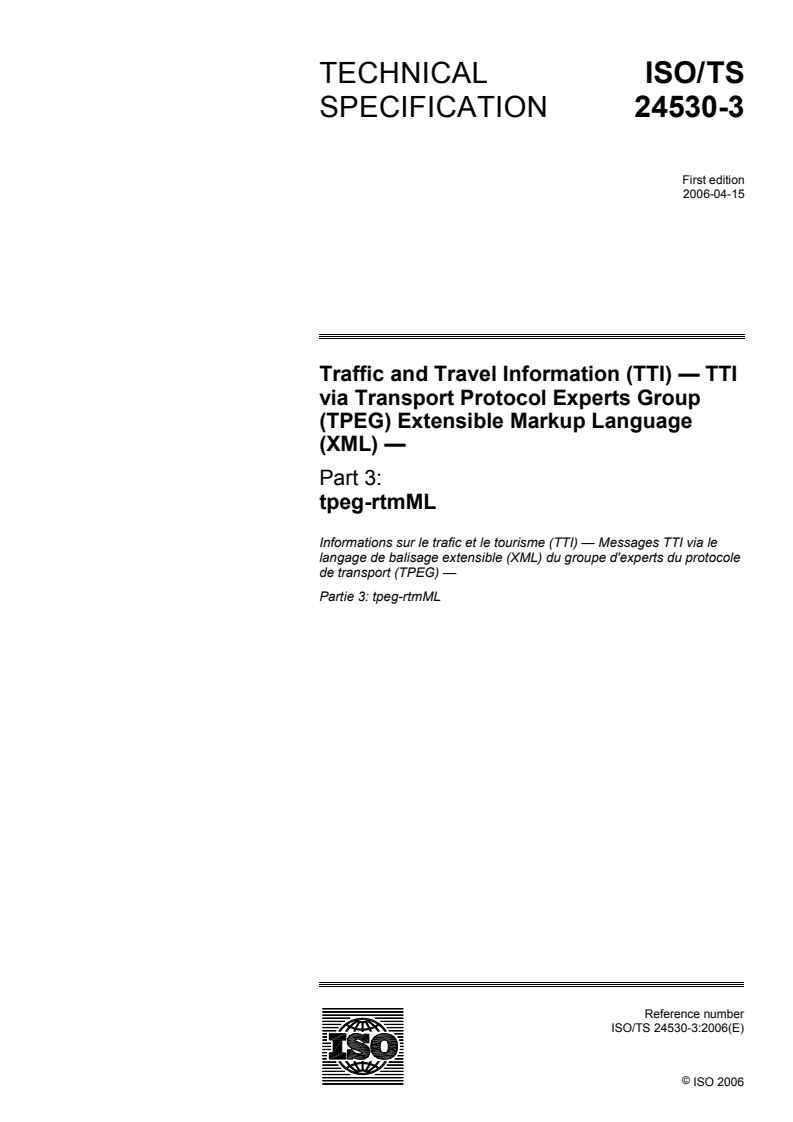
TECHNICAL ISO/TS
SPECIFICATION 24530-3
First edition
2006-04-15
Traffic and Travel Information (TTI) — TTI
via Transport Protocol Experts Group
(TPEG) Extensible Markup Language
(XML) —
Part 3:
tpeg-rtmML
Informations sur le trafic et le tourisme (TTI) — Messages TTI via le
langage de balisage extensible (XML) du groupe d'experts du protocole
de transport (TPEG) —
Partie 3: tpeg-rtmML
Reference number
©
ISO 2006
PDF disclaimer
This PDF file may contain embedded typefaces. In accordance with Adobe's licensing policy, this file may be printed or viewed but
shall not be edited unless the typefaces which are embedded are licensed to and installed on the computer performing the editing. In
downloading this file, parties accept therein the responsibility of not infringing Adobe's licensing policy. The ISO Central Secretariat
accepts no liability in this area.
Adobe is a trademark of Adobe Systems Incorporated.
Details of the software products used to create this PDF file can be found in the General Info relative to the file; the PDF-creation
parameters were optimized for printing. Every care has been taken to ensure that the file is suitable for use by ISO member bodies. In
the unlikely event that a problem relating to it is found, please inform the Central Secretariat at the address given below.
© ISO 2006
All rights reserved. Unless otherwise specified, no part of this publication may be reproduced or utilized in any form or by any means,
electronic or mechanical, including photocopying and microfilm, without permission in writing from either ISO at the address below or
ISO's member body in the country of the requester.
ISO copyright office
Case postale 56 • CH-1211 Geneva 20
Tel. + 41 22 749 01 11
Fax + 41 22 749 09 47
E-mail copyright@iso.org
Web www.iso.org
Published in Switzerland
ii © ISO 2006 – All rights reserved
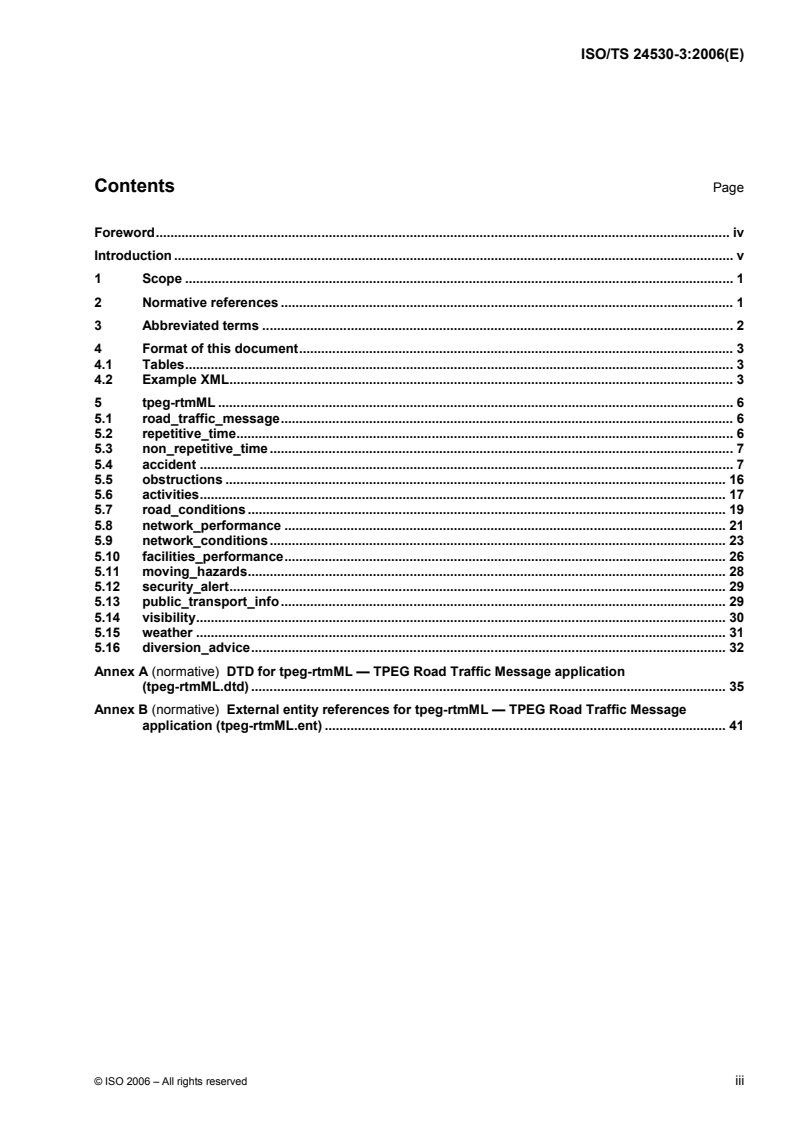
Contents Page
Foreword. iv
Introduction . v
1 Scope . 1
2 Normative references . 1
3 Abbreviated terms . 2
4 Format of this document. 3
4.1 Tables. 3
4.2 Example XML. 3
5 tpeg-rtmML . 6
5.1 road_traffic_message. 6
5.2 repetitive_time. 6
5.3 non_repetitive_time. 7
5.4 accident . 7
5.5 obstructions . 16
5.6 activities. 17
5.7 road_conditions . 19
5.8 network_performance . 21
5.9 network_conditions. 23
5.10 facilities_performance. 26
5.11 moving_hazards. 28
5.12 security_alert. 29
5.13 public_transport_info. 29
5.14 visibility. 30
5.15 weather . 31
5.16 diversion_advice. 32
Annex A (normative) DTD for tpeg-rtmML — TPEG Road Traffic Message application
(tpeg-rtmML.dtd) . 35
Annex B (normative) External entity references for tpeg-rtmML — TPEG Road Traffic Message
application (tpeg-rtmML.ent) . 41
Foreword
ISO (the International Organization for Standardization) is a worldwide federation of national standards bodies
(ISO member bodies). The work of preparing International Standards is normally carried out through ISO
technical committees. Each member body interested in a subject for which a technical committee has been
established has the right to be represented on that committee. International organizations, governmental and
non-governmental, in liaison with ISO, also take part in the work. ISO collaborates closely with the
International Electrotechnical Commission (IEC) on all matters of electrotechnical standardization.
International Standards are drafted in accordance with the rules given in the ISO/IEC Directives, Part 2.
The main task of technical committees is to prepare International Standards. Draft International Standards
adopted by the technical committees are circulated to the member bodies for voting. Publication as an
International Standard requires approval by at least 75 % of the member bodies casting a vote.
In other circumstances, particularly when there is an urgent market requirement for such documents, a
technical committee may decide to publish other types of normative document:
⎯ an ISO Publicly Available Specification (ISO/PAS) represents an agreement between technical experts in
an ISO working group and is accepted for publication if it is approved by more than 50 % of the members
of the parent committee casting a vote;
⎯ an ISO Technical Specification (ISO/TS) represents an agreement between the members of a technical
committee and is accepted for publication if it is approved by 2/3 of the members of the committee casting
a vote.
An ISO/PAS or ISO/TS is reviewed after three years with a view to deciding whether it should be confirmed for
a further three years, revised to become an International Standard, or withdrawn. In the case of a confirmed
ISO/PAS or ISO/TS, it is reviewed again after six years at which time it has to be either transposed into an
International Standard or withdrawn.
Attention is drawn to the possibility that some of the elements of this document may be the subject of patent
rights. ISO shall not be held responsible for identifying any or all such patent rights.
ISO/TS 24530-3 was prepared by the European Committee for Standardization (CEN) in collaboration with
Technical Committee ISO/TC 204, Intelligent transport systems, in accordance with the Agreement on
technical cooperation between ISO and CEN (Vienna Agreement).
Throughout the text of this document, read “.this European pre-Standard.” to mean “.this Technical
Specification.”.
ISO/TS 24530 consists of the following parts, under the general title Traffic and Travel Information (TTI) —
TTI via Transport Protocol Experts Group (TPEG) Extensible Markup Language (XML):
⎯ Part 1: Introduction, common data types and tpegML
⎯ Part 2: tpeg-locML
⎯ Part 3: tpeg-rtmML
⎯ Part 4: tpeg-ptiML
iv © ISO 2006 – All rights reserved
Introduction
TPEG in XML (tpegML) provides the solution to diverse requirements for the ultimate delivery of TPEG
applications (potentially simultaneously) via for example ARIB, ATSC, DAB, DVB and the Internet. This will
solve the minimal adaptation layers requirement and without doubling up on message carousels, which are
handled at different layers of the protocol stacks.
The original TPEG technology uses a byte-oriented stream format, which may be carried on almost any digital
bearer with an appropriate adaptation layer. TPEG messages are delivered from service providers to end-
users, and are used to transfer application data from the database of a service provider to an end-user’s
equipment.
TPEG binary was initially designed to meet a particular brief, from the EBU’s Broadcast Management
Committee; to develop a new protocol for Traffic and Travel Information, for use in the multimedia
broadcasting environment. TPEG applications were developed with service and transport features, which
enable travel-related messages to be coded, decoded, filtered and understood both by humans (visually
and/or audibly) and by agent systems. This brief was also endorsed by the EBU TTI Broadcast Strategy Team,
who recognized the vital importance of a bearer independent TTI protocol.
The development of TPEG binary technology is excellently matched both technically and economically to DAB
and possibly to internet bearers, where of the order of up to 10 kbits/s is considered acceptable. However
other bearers such as ARIB, ATSC and DVB may be able to offer much higher data rates with economic and
technical utility. Nevertheless these bearers are highly structured (layered) in their ability to handle transparent
data services and they include mechanisms suitable for carousel delivery, which would require a considerably
different TPEG data structure before real transparency could be achieved.
Another potential use of tpegML is provided to Service Providers who would have a standardised message
generation interface, yet be able to develop systems suited to their own requirements. This will enable Service
Providers to exchange pre-edited information regardless of their message generation systems and be
substantially language independent.
tpegML has been developed using the DTD approach, which allows the use of different language entity files to
easily provide a truly language independent service. This approach has the advantage that tpegML files can
be rendered in any language, provided the language entity file is available to the internet browser. This
document provides English language entity files only. For other languages the entity files in this document
only require direct translation.
The development of this ISO/TS 24530 series was undertaken jointly with European Broadcasting Union
B/TPEG Group, which has evolved into the TPEG Forum Standards Task Force. Attention is drawn to the
EBU sponsored TPEG Forum development principles, which require all inputs containing IPR to be declared
during drafting work. No such declarations have been made.
TECHNICAL SPECIFICATION ISO/TS 24530-3:2006(E)
Traffic and Travel Information (TTI) — TTI via Transport
Protocol Experts Group (TPEG) Extensible Markup Language
(XML) —
Part 3:
tpeg-rtmML
1 Scope
This document establishes the XML encoding of the method of the Road Traffic Message application.
The TPEG-RTM Application is intended to convey information to road users. The information provided relates
to event and some status information on the road network and on associated infrastructure affecting a road
journey. For example, limited information about abnormal operation of links in the network may be included,
such as ferries, lifting-bridges, etc.
The TPEG-RTM Application has the broad objective to allow the generation of Traffic and Travel Information
(TTI) messages, for delivery to the end-user by one or more bearers. A hierarchical methodology has been
developed to allow the creation of messages from a set of TPEG-RTM tables, which are essentially
word-oriented and cover most needs.
These TPEG-RTM tables (essentially word-oriented data object dictionaries) comprise a wide ranging ability
to describe a TTI event and some status information, introducing new precision in a number of areas such as
“Vehicle types”, “Positional information on the carriageway” and “Diversion routing advice”.
It is vital, for further understanding of this document, to have more than a passing understanding of the
TPEG-RTM binary specification which describes, among other things, in a step-by step approach: Message
Management, Level One Classes and how they are structured, hierarchically to provide a full Road Traffic
Message together with the TPEG Location Referencing system.
2 Normative references
The following referenced documents are indispensable for the application of this document. For dated
references, only the edition cited applies. For undated references, the latest edition of the referenced
document (including any amendments) applies.
ISO/TS 24530-1, Traffic and Travel Information (TTI) — TTI via Transport Protocol Experts Group (TPEG)
Extensible Markup Language (XML) — Part 1: Introduction, common data types and tpegML
ISO/TS 18234-1, Traffic and Travel Information (TTI) — TTI via Transport Protocol Expert Group (TPEG)
data-streams — Part 1: Introduction, Numbering and Versions
ISO/TS 18234-2, Traffic and Travel Information (TTI) — TTI via Transport Protocol Expert Group (TPEG)
data-streams — Part 2: Syntax, Semantics and Framing Structure (SSF)
ISO/TS 18234-4, Traffic and Travel Information (TTI) — TTI via Transport Protocol Expert Group (TPEG)
data-streams — Part 4: Road Traffic Message (RTM) application
ISO/TS 18234-6, Traffic and Travel Information (TTI) — TTI via Transport Protocol Expert Group (TPEG)
data-streams — Part 6: Location Referencing for applications
ISO 3166-1, Codes for the representation of names of countries and their subdivisions — Part 1: Country
codes
ISO 8601, Data elements and interchange formats — Information interchange — Representation of dates and
times
3 Abbreviated terms
For the purposes of this document, the following abbreviations apply.
3.1
ARIB
Association of Radio Industries and Business (Japan)
3.2
ATSC
American Television Standards Committee (USA)
3.3
DAB
Digital Audio Broadcasting
3.4
DTD/dtd
Document Type Definition - lower case used for file naming
3.5
DVB
Digital Video Broadcasting
3.6
EBU
European Broadcasting Union
3.7
IPR
Intellectual Property Right(s)
3.8
RTM
Road Traffic Message
3.9
TPEG
Transport Protocol Experts Group
3.10
tpegML
tpeg XML applications - use lower case to distinguish them from the TPEG binary applications which use
upper case
3.11
tpeg-loc
location referencing for applications
2 © ISO 2006 – All rights reserved
3.12
TTI
Traffic and Travel Information
3.13
WGS84
World Geodetic System 1984
3.14
XML
Extensible Markup Language
4 Format of this document
This document is divided into Sections, each describes an XML element used in tpegML. Each element has
an introduction explaining what it is for, the DTD definition relevant to it, guidelines “extending” the DTD and
an example. The complete .dtd and .ent files are contained in Annexes A and B.
4.1 Tables
A large number of attributes used in elements in tpegML are based on tables in the TPEG specifications. To
encode this in XML there are defined general entity references for all the table entries. In this Technical
Specification series these entities are taken from the TPEG tables defined in the equivalent part of
ISO/TS 18234.
For display in other languages these entity files only need to be replaced by directly translated equivalents.
These are named, for example rtmX_Y, where X is the table number and Y is the row number (e.g.
“rtm01_01” is the entry in the RTM vehicle_type table for car). The DTD does not restrict the entity
references that can be used in an attribute so the ‘guidelines’ sections indicate which entities/tables should be
used for which attributes.
Table numbers use a leading zero below 10, whereas the row number within a table does not use a leading
zero. Table numbers are random and entries within a table are random – no priority order is implied.
4.2 Example XML
This example shows the following message: “An accident closes A12 at Brentwood, Essex” expressed as a
single tpegML message using elements from tpeg-locML and tpeg-rtmML.
version_number="1"
message_generation_time="2002-04-03T13:03:00Z"
severity_factor="&rtm31_4;">
This example shows the following message: “Temporary traffic lights on A811 at Drymen”.
version_number="1"
message_generation_time="2002-04-03T13:40:00Z"
severity_factor="&rtm31_2;">
< location_descriptor descriptor_type="&loc03_7;" descriptor="A811"/>
< location_descriptor descriptor_type="&loc03_8;" descriptor="A809"/>
< location_descriptor descriptor_type="&loc03_24;" descriptor="Dumbarton"/>
< location_descriptor descriptor_type="&loc03_24;" descriptor="Stirling"/>
This example shows the following message: “Collision of a motor bike and a large car in Munich right in front
of the IBIS hotel on Ungerer Straße between the junctions with Fröttmaninger Straße
(E11.60028°/N48.17583°) and Schenkendorfstraße/Isar- ring (E11.59722°/N48.17306°) on wet road (all
lanes).”
4 © ISO 2006 – All rights reserved
between the junctions with Fröttmaninger Straße (E11.60028°/N48.17583°) and Schenkendorfstraße/Isar- ring (E11.59722°/N48.17306°)
on wet road (all lanes).
Straße zwischen den Kreuzungen mit Fröttmaniger Straße (E11.60028°/N48.17583°) und Schenkendorfstraße/Isar- ring
(E11.59722°/N48.17306°) auf nasser Straße (alle Spuren).
version_number="25"
message_expiry_time="2000-09-30T12:05:00Z"
severity_factor="&rtm31_5;">
5 tpeg-rtmML
These are defined fully in the tpeg-rtmML.dtd and tpeg-rtmML.ent files (see Annexes A and B).
5.1 road_traffic_message
activities | road_conditions | network_performance | network_conditions | facilities_performance | moving_hazard |
security_alert | public_transport_info | visibility | weather | diversion_advice)*)>
message_id CDATA #REQUIRED
version_number CDATA #REQUIRED
message_generation_time %time; #IMPLIED
start_time %time; #IMPLIED
stop_time %time; #IMPLIED
message_expiry_time %time; #IMPLIED
severity_factor CDATA #IMPLIED
unverified_information CDATA #IMPLIED
>
road_traffic_message: This represents a road traffic message (RTM) from TPEG-RTM. An RTM is intended to
convey information to road users. The information provided relates to event and some status information on
the road network and on the associated infrastructure affecting a road journey. RTMs have a hierarchical
structure that allows the creation of messages from a set of RTM tables, which are essentially word-oriented
and cover most needs.
The severity_factor attribute shall use entity references of the form rtm31_x. The unverified_information
attribute shall use entity references of the form rtm46_x.
Example:
message_generation_time="2001-02-12T12:01:13Z"
start_time="2001-02-12T15:00:00Z"
stop_time="2001-02-12T15:30:00Z"
message_expiry_time="2001-02-12T15:45:00Z"
severity_factor="&rtm31_2;"
unverified_information="&rtm46_1;">
…
…
5.2 repetitive_time
hour %intunti; #REQUIRED
minute %intunti; #REQUIRED
duration %intunli; #REQUIRED
day_mask %day_mask; #REQUIRED
>
6 © ISO 2006 – All rights reserved
repetitive_time: This describes a repetitive time that applies to the current message. The repetitive time
information is bounded by the message start and stop time. The duration attribute shall describe the duration
in minutes from 0 to 10079 (one week).
Example:
5.3 non_repetitive_time
non_repetitive_time: This describes a set of operating times that are non-repetitive.
5.3.1 non_rep_time
start_time %time; #REQUIRED
duration %intunlo; #REQUIRED
>
non_rep_time: This describes one of the operating times in a non_repetitive_time element. The duration
attribute shall be in seconds, 0 represents a start time without a duration.
Example:
5.4 accident
number_of %intunti; #REQUIRED
>
accident: This describes situations in which road users (vehicles, animals and people) do not behave in a
predictable or safe manner and either impact with each other or the roadside infrastructure and in some cases
may leave the road.
It contains position, animals, vehicles and people sub-elements that give information on the position of
the accident, what was involved and what happened.
Example:
…
…
…
5.4.1 position
8 © ISO 2006 – All rights reserved
position CDATA #REQUIRED
>
position: This represents the position on the carriageway where the hazard occurs. The position attribute shall
use entity references of the form rtm10_x.
Example:
5.4.2 animals
number_of %numag; #REQUIRED
>
animals: This represents information about animals. It contains position, animal_problem, and
animal_info sub-elements that give information on the position of the animals, the type of gathering and the
type of animals.
Example:
…
…
5.4.2.1 animal_problem
animal_problem CDATA #REQUIRED
>
animal_problem: This describes the type of gathering of animals that may be near or on the carriageway. The
animal_problem attribute shall use entity references of the form rtm23_x.
Example:
5.4.2.2 animal_info
animal_type CDATA #REQUIRED
animal_size CDATA #REQUIRED
>
animal_info: This describes the type and size of animals involved that may be near or on the carriageway. The
animal_type attribute should only use entity references of the form rtm21_x. The animal_size attribute shall
use entity references of the form rtm22_x.
Example:
10 © ISO 2006 – All rights reserved
5.4.3 vehicles
number_of %numag; #REQUIRED
>
vehicles: This represents information about vehicles. It contains position, vehicle_problem, and
vehicle_info sub-elements that give information on the position of the vehicles, the type of problem and the
type of vehicles.
Example:
…
…
5.4.3.1 vehicle_problem
vehicle_problem CDATA #REQUIRED
>
vehicle_problem: This describes the type of problem or circumstance happening to vehicles on or near the
carriageway. The vehicle_problem attribute shall use entity references of the form rtm03_x.
Example:
5.4.3.2 vehicle_info
12 © ISO 2006 – All rights reserved
vehicle_type CDATA #REQUIRED
vehicle_subtype CDATA #IMPLIED
>
vehicle_info: This describes a category of vehicle. Many of the categories have a sub-type that describes the
type of vehicle in greater detail. The vehicle_type attribute should only use entity references of the form
rtm01_x. The vehicle_subtype attribute should use entity references of the form shown in Table 1 (if there is
no subtype then this attribute should not be present).
Table 1
vehicle_type vehicle_subtype
rtm01_0 “unknown”
rtm01_1 “car” rtm07_x
rtm01_2 “light goods vehicle” rtm09_x
rtm01_3 “heavy goods vehicle” rtm11_x
rtm01_4 “public transport vehicle”
...