

ISO/IEC 15408-2:2026
(Main)Information security, cybersecurity and privacy protection — Evaluation criteria for IT security — Part 2: Security functional components
General Information
- Abstract
This document specifies requirements for the required structure and content of security functional components for use during a security evaluation. It includes a catalogue of functional components that meet the common security functionality requirements of many IT products.
- Status
- Published
- Publication Date
- 18-May-2026
- Current Stage
- 6060 - International Standard published
- Start Date
- 19-May-2026
- Due Date
- 27-Oct-2026
- Completion Date
- 19-May-2026
Buy Documents
ISO/IEC 15408-2:2026 - Information security, cybersecurity and privacy protection — Evaluation criteria for IT security — Part 2: Security functional components
ISO/IEC 15408-2:2026 - Sécurité de l'information, cybersécurité et protection de la vie privée — Critères d'évaluation pour la sécurité des technologies de l'information — Partie 2: Composants fonctionnels de sécurité
Overview
ISO/IEC 15408-2:2026 is an international standard developed by ISO and IEC, forming Part 2 of the Common Criteria (CC) framework for information security, cybersecurity, and privacy protection. This document specifies the required structure and content of security functional components, essential during the security evaluation of IT products and systems. It serves as a catalogue of functional components that address common security functionality needs across diverse IT environments. By providing a uniform reference, this standard helps guide developers, evaluators, and procurement professionals in specifying and assessing IT security functions.
Key Topics
- Security Functional Components: A structured catalogue enabling consistent specification of security functions for IT products.
- Component Structure: Standardized templates for class, family, and component-level requirements, ensuring clarity and comparability.
- Functional Families and Classes: Grouping of requirements by function, such as audit, access control, communication, and cryptographic support.
- Component Management and Audit: Documentation and auditing guidance for each security function to support verification and evaluation.
- Application and Evaluator Notes: Advice and clarifications to assist those implementing or evaluating the selected components.
- Component Rationale and Relationships: Explanation of purpose and how components interact or build on one another.
Applications
ISO/IEC 15408-2:2026 is widely applied in multiple sectors for enhancing the security trustworthiness of IT products. Its practical applications include:
- Product Security Evaluation: Developers and evaluators use the standard’s functional components to demonstrate and assess security features of products such as operating systems, network devices, smart cards, and other IT solutions.
- Procurement Requirements: Organizations specify required security functions based on this catalogue when procuring secure IT products or services, ensuring compliance with recognized international benchmarks.
- Security Architecture Development: Architects and engineers reference these components when designing or upgrading IT systems to implement robust, consistent security controls.
- Certification and Accreditation: The standard forms part of evaluation schemes for product certifications, supporting internationally recognized security assurance.
- Regulatory Compliance: Governments and industries incorporate these requirements into laws, regulations, and best practices to safeguard sensitive data and maintain privacy protection.
Related Standards
To effectively address comprehensive IT security and privacy needs, ISO/IEC 15408-2:2026 is often used in conjunction with the following standards:
- ISO/IEC 15408-1: Information security, cybersecurity and privacy protection - Evaluation criteria for IT security - Part 1: Introduction and general model
- ISO/IEC 15408-3: Information security, cybersecurity and privacy protection - Evaluation criteria for IT security - Part 3: Security assurance components
- ISO/IEC 18045: Information technology - Security techniques - Methodology for IT security evaluation
- ISO/IEC 27001: Information security management systems - Requirements
- ISO/IEC 27002: Code of practice for information security controls
Practical Value
Adopting ISO/IEC 15408-2:2026 provides significant benefits:
- Consistency in specifying and verifying security requirements across IT products and environments.
- Transparency in security evaluation processes, increasing confidence for all stakeholders.
- Interoperability by harmonizing security expectations internationally.
- Reduced Risk of security gaps by applying internationally vetted security functional components.
By utilizing this standard, organizations and product developers ensure that essential security functions are clearly defined, properly implemented, and rigorously evaluated to support robust information security, cybersecurity, and privacy protection.
Relations
- Effective Date
- 24-Jun-2026
- Effective Date
- 09-Feb-2026
- Effective Date
- 12-Feb-2026
- Effective Date
- 28-Oct-2023
Buy Documents
ISO/IEC 15408-2:2026 - Information security, cybersecurity and privacy protection — Evaluation criteria for IT security — Part 2: Security functional components
ISO/IEC 15408-2:2026 - Sécurité de l'information, cybersécurité et protection de la vie privée — Critères d'évaluation pour la sécurité des technologies de l'information — Partie 2: Composants fonctionnels de sécurité
Get Certified
Connect with accredited certification bodies for this standard

BSI Group
BSI (British Standards Institution) is the business standards company that helps organizations make excellence a habit.

Bureau Veritas
Bureau Veritas is a world leader in laboratory testing, inspection and certification services.

DNV
DNV is an independent assurance and risk management provider.
Sponsored listings
Frequently Asked Questions
ISO/IEC 15408-2:2026 is a standard published by the International Organization for Standardization (ISO). Its full title is "Information security, cybersecurity and privacy protection — Evaluation criteria for IT security — Part 2: Security functional components". This standard covers: This document specifies requirements for the required structure and content of security functional components for use during a security evaluation. It includes a catalogue of functional components that meet the common security functionality requirements of many IT products.
This document specifies requirements for the required structure and content of security functional components for use during a security evaluation. It includes a catalogue of functional components that meet the common security functionality requirements of many IT products.
ISO/IEC 15408-2:2026 is classified under the following ICS (International Classification for Standards) categories: 35.030 - IT Security. The ICS classification helps identify the subject area and facilitates finding related standards.
ISO/IEC 15408-2:2026 has the following relationships with other standards: It is inter standard links to EN ISO/IEC 15408-3:2026, EN ISO/IEC 19896-3:2025, EN ISO/IEC 15408-2:2026, ISO/IEC 15408-2:2022. Understanding these relationships helps ensure you are using the most current and applicable version of the standard.
ISO/IEC 15408-2:2026 is available in PDF format for immediate download after purchase. The document can be added to your cart and obtained through the secure checkout process. Digital delivery ensures instant access to the complete standard document.
Standards Content (Sample)
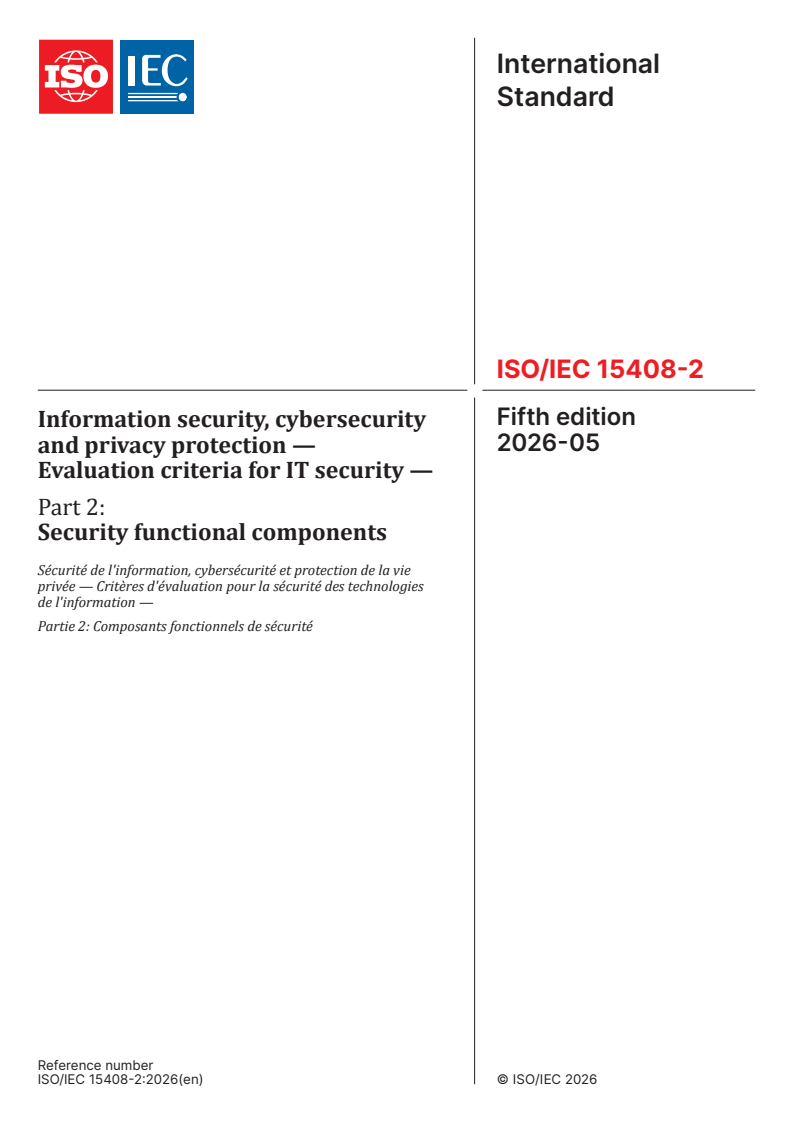
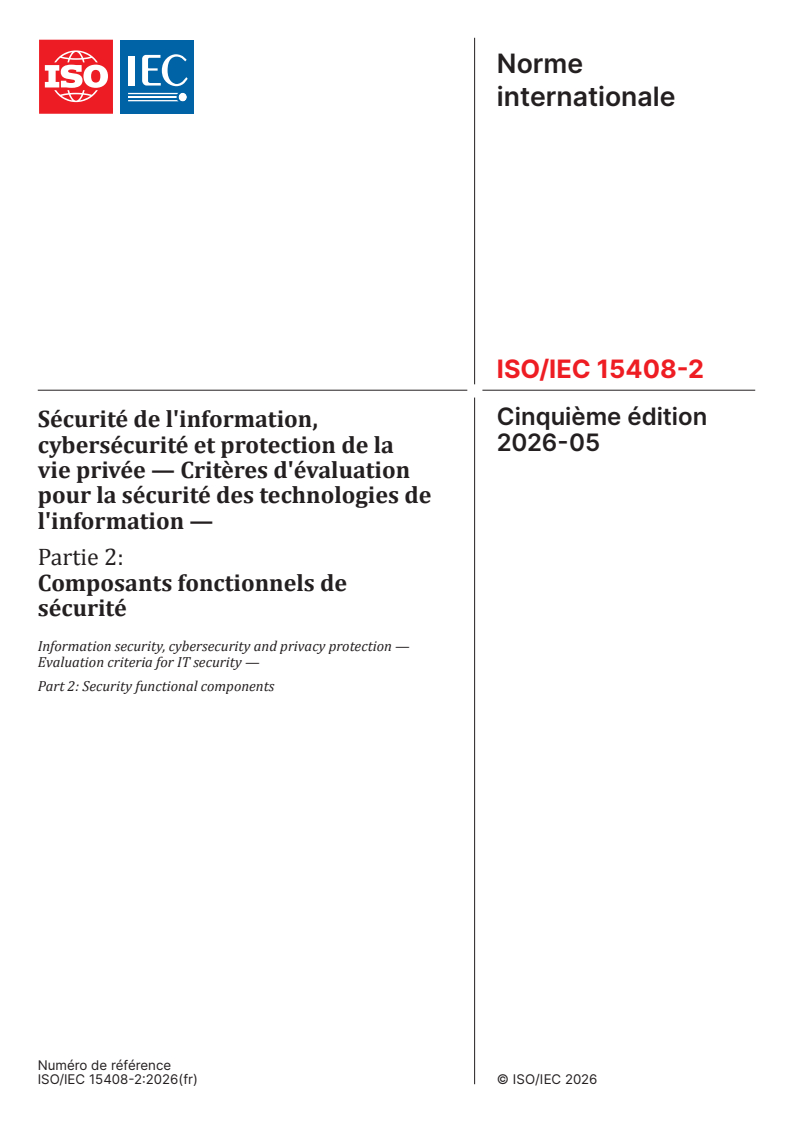
International
Standard
ISO/IEC 15408-2
Fifth edition
Information security, cybersecurity
2026-05
and privacy protection —
Evaluation criteria for IT security —
Part 2:
Security functional components
Sécurité de l'information, cybersécurité et protection de la vie
privée — Critères d'évaluation pour la sécurité des technologies
de l'information —
Partie 2: Composants fonctionnels de sécurité
Reference number
© ISO/IEC 2026
All rights reserved. Unless otherwise specified, or required in the context of its implementation, no part of this publication may
be reproduced or utilized otherwise in any form or by any means, electronic or mechanical, including photocopying, or posting on
the internet or an intranet, without prior written permission. Permission can be requested from either ISO at the address below
or ISO’s member body in the country of the requester.
ISO copyright office
CP 401 • Ch. de Blandonnet 8
CH-1214 Vernier, Geneva
Phone: +41 22 749 01 11
Email: copyright@iso.org
Website: www.iso.org
Published in Switzerland
© ISO/IEC 2026 – All rights reserved
ii
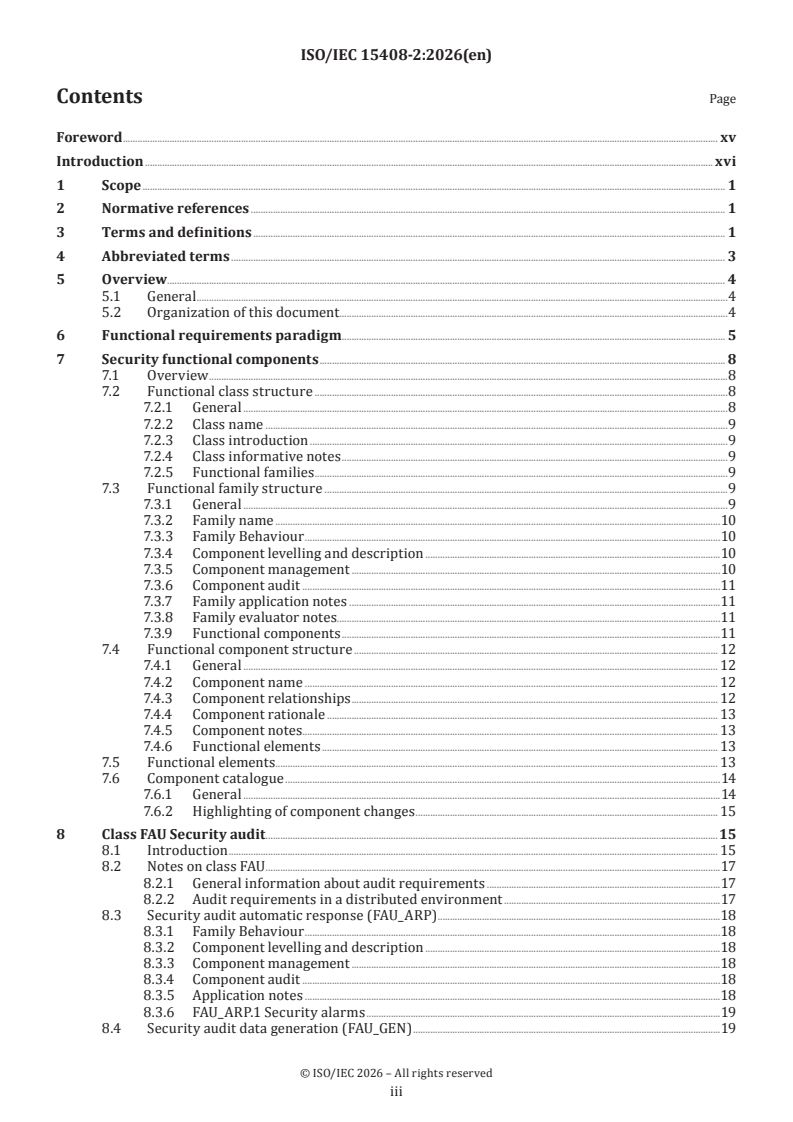
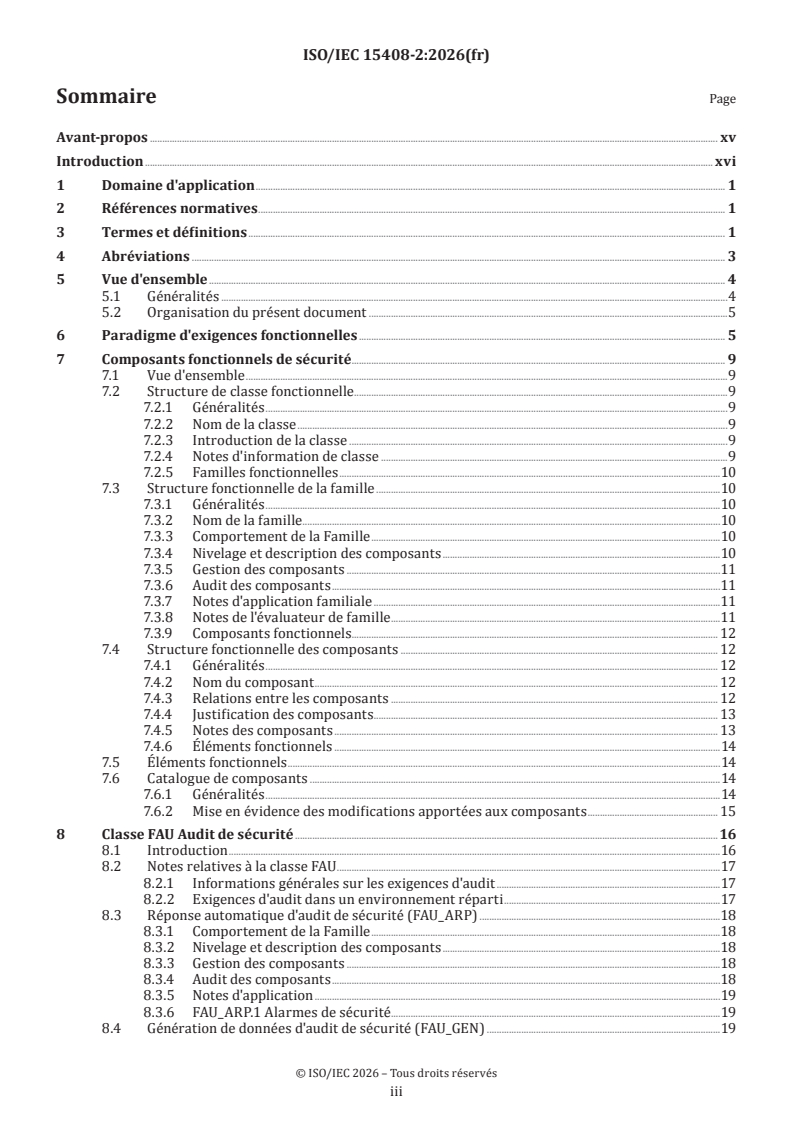
Contents Page
Foreword . xv
Introduction . xvi
1 Scope . 1
2 Normative references . 1
3 Terms and definitions . 1
4 Abbreviated terms . 3
5 Overview . 4
5.1 General .4
5.2 Organization of this document . .4
6 Functional requirements paradigm . . 5
7 Security functional components . 8
7.1 Overview .8
7.2 Functional class structure .8
7.2.1 General .8
7.2.2 Class name .9
7.2.3 Class introduction .9
7.2.4 Class informative notes .9
7.2.5 Functional families .9
7.3 Functional family structure .9
7.3.1 General .9
7.3.2 Family name .10
7.3.3 Family Behaviour .10
7.3.4 Component levelling and description .10
7.3.5 Component management .10
7.3.6 Component audit .11
7.3.7 Family application notes .11
7.3.8 Family evaluator notes.11
7.3.9 Functional components .11
7.4 Functional component structure . 12
7.4.1 General . 12
7.4.2 Component name . 12
7.4.3 Component relationships . 12
7.4.4 Component rationale . 13
7.4.5 Component notes . . 13
7.4.6 Functional elements . 13
7.5 Functional elements. 13
7.6 Component catalogue .14
7.6.1 General .14
7.6.2 Highlighting of component changes . 15
8 Class FAU Security audit .15
8.1 Introduction . 15
8.2 Notes on class FAU .17
8.2.1 General information about audit requirements .17
8.2.2 Audit requirements in a distributed environment .17
8.3 Security audit automatic response (FAU_ARP) .18
8.3.1 Family Behaviour .18
8.3.2 Component levelling and description .18
8.3.3 Component management .18
8.3.4 Component audit .18
8.3.5 Application notes .18
8.3.6 FAU_ARP.1 Security alarms .19
8.4 Security audit data generation (FAU_GEN) .19
© ISO/IEC 2026 – All rights reserved
iii
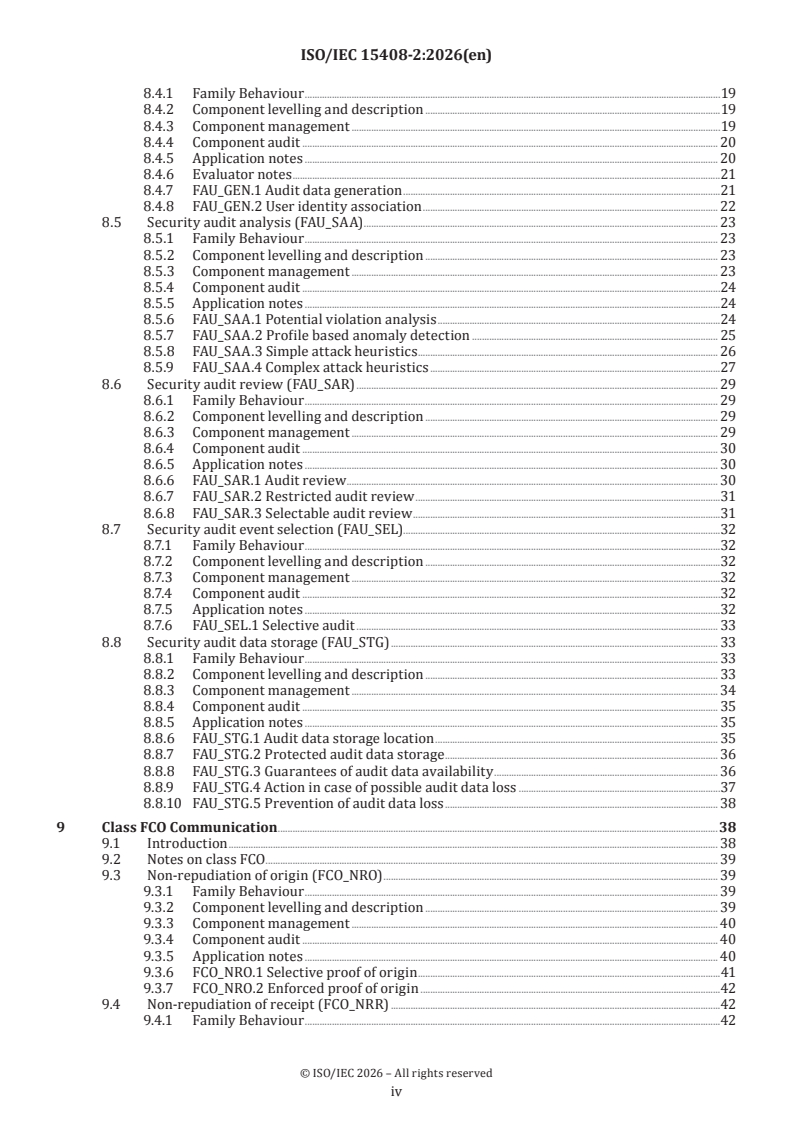
8.4.1 Family Behaviour .19
8.4.2 Component levelling and description .19
8.4.3 Component management .19
8.4.4 Component audit . 20
8.4.5 Application notes . 20
8.4.6 Evaluator notes .21
8.4.7 FAU_GEN.1 Audit data generation .21
8.4.8 FAU_GEN.2 User identity association . 22
8.5 Security audit analysis (FAU_SAA) . 23
8.5.1 Family Behaviour . 23
8.5.2 Component levelling and description . 23
8.5.3 Component management . 23
8.5.4 Component audit .24
8.5.5 Application notes .24
8.5.6 FAU_SAA.1 Potential violation analysis .24
8.5.7 FAU_SAA.2 Profile based anomaly detection . 25
8.5.8 FAU_SAA.3 Simple attack heuristics . 26
8.5.9 FAU_SAA.4 Complex attack heuristics .27
8.6 Security audit review (FAU_SAR) . 29
8.6.1 Family Behaviour . 29
8.6.2 Component levelling and description . 29
8.6.3 Component management . 29
8.6.4 Component audit . 30
8.6.5 Application notes . 30
8.6.6 FAU_SAR.1 Audit review . 30
8.6.7 FAU_SAR.2 Restricted audit review .31
8.6.8 FAU_SAR.3 Selectable audit review .31
8.7 Security audit event selection (FAU_SEL) .32
8.7.1 Family Behaviour .32
8.7.2 Component levelling and description .32
8.7.3 Component management .32
8.7.4 Component audit .32
8.7.5 Application notes .32
8.7.6 FAU_SEL.1 Selective audit . 33
8.8 Security audit data storage (FAU_STG) . 33
8.8.1 Family Behaviour . 33
8.8.2 Component levelling and description . 33
8.8.3 Component management . 34
8.8.4 Component audit . 35
8.8.5 Application notes . 35
8.8.6 FAU_STG.1 Audit data storage location . 35
8.8.7 FAU_STG.2 Protected audit data storage . 36
8.8.8 FAU_STG.3 Guarantees of audit data availability . 36
8.8.9 FAU_STG.4 Action in case of possible audit data loss .37
8.8.10 FAU_STG.5 Prevention of audit data loss . 38
9 Class FCO Communication .38
9.1 Introduction . 38
9.2 Notes on class FCO . . 39
9.3 Non-repudiation of origin (FCO_NRO) . 39
9.3.1 Family Behaviour . 39
9.3.2 Component levelling and description . 39
9.3.3 Component management . 40
9.3.4 Component audit . 40
9.3.5 Application notes . 40
9.3.6 FCO_NRO.1 Selective proof of origin .41
9.3.7 FCO_NRO.2 Enforced proof of origin .42
9.4 Non-repudiation of receipt (FCO_NRR) .42
9.4.1 Family Behaviour .42
© ISO/IEC 2026 – All rights reserved
iv
9.4.2 Component levelling and description .43
9.4.3 Component management .43
9.4.4 Component audit .43
9.4.5 Application notes .43
9.4.6 FCO_NRR.1 Selective proof of receipt . 44
9.4.7 FCO_NRR.2 Enforced proof of receipt .45
10 Class FCS Cryptographic support .46
10.1 Introduction . 46
10.2 Notes on class FCS . 48
10.3 Cryptographic key management (FCS_CKM) . 50
10.3.1 Family Behaviour . 50
10.3.2 Component levelling and description . 50
10.3.3 Component management .51
10.3.4 Component audit .51
10.3.5 Application notes .51
10.3.6 Evaluator notes .52
10.3.7 FCS_CKM.1 Cryptographic key generation .52
10.3.8 FCS_CKM.2 Cryptographic key distribution . 53
10.3.9 FCS_CKM.3 Cryptographic key access . 53
10.3.10 FCS_CKM.5 Cryptographic key derivation . 54
10.3.11 FCS_CKM.6 Timing and event of cryptographic key destruction . 55
10.4 Cryptographic operation (FCS_COP) . 56
10.4.1 Family Behaviour . 56
10.4.2 Component levelling and description . 56
10.4.3 Component management . 56
10.4.4 Component audit . 56
10.4.5 Application notes . 56
10.4.6 FCS_COP.1 Cryptographic operation .57
10.5 Random bit generation (FCS_RBG) . 58
10.5.1 Family Behaviour . 58
10.5.2 Component levelling and description . 58
10.5.3 Component management .59
10.5.4 Component audit .59
10.5.5 Application notes .59
10.5.6 FCS_RBG.1 Random bit generation (RBG) .59
10.5.7 FCS_RBG.2 Random bit generation (external seeding) .61
10.5.8 FCS_RBG.3 Random bit generation (internal seeding - single source) .61
10.5.9 FCS_RBG.4 Random bit generation (internal seeding - multiple sources) .62
10.5.10 FCS_RBG.5 Random bit generation (combining entropy sources) .62
10.5.11 FCS_RBG.6 Random bit generation service . 63
10.6 Generation of random numbers (FCS_RNG) . 63
10.6.1 Family Behaviour . 63
10.6.2 Component levelling and description . 64
10.6.3 Component management . 64
10.6.4 Component audit . 64
10.6.5 Application notes . 64
10.6.6 FCS_RNG.1 Random number generation . 64
11 Class FDP User data protection .66
11.1 Introduction . 66
11.2 Notes on class FDP . 69
11.3 Access control policy (FDP_ACC) .71
11.3.1 Family Behaviour .71
11.3.2 Component levelling and description . 72
11.3.3 Component management . 72
11.3.4 Component audit . 72
11.3.5 Application notes . 72
11.3.6 FDP_ACC.1 Subset access control . 73
11.3.7 FDP_ACC.2 Complete access control . 73
© ISO/IEC 2026 – All rights reserved
v
11.4 Access control functions (FDP_ACF) .74
11.4.1 Family Behaviour .74
11.4.2 Component levelling and description .74
11.4.3 Component management .74
11.4.4 Component audit . 75
11.4.5 Application notes . 75
11.4.6 FDP_ACF.1 Security attribute-based access control . 75
11.5 Data authentication (FDP_DAU) . 77
11.5.1 Family Behaviour . 77
11.5.2 Component levelling and description . 77
11.5.3 Component management . 77
11.5.4 Component audit . 77
11.5.5 Application notes . 78
11.5.6 FDP_DAU.1 Basic Data Authentication . 78
11.5.7 FDP_DAU.2 Data Authentication with Identity of Guarantor . 78
11.6 Export from the TOE (FDP_ETC) . 79
11.6.1 Family Behaviour . 79
11.6.2 Component levelling and description . 79
11.6.3 Component management . 80
11.6.4 Component audit . 80
11.6.5 Application notes . 80
11.6.6 FDP_ETC.1 Export of user data without security attributes . 80
11.6.7 FDP_ETC.2 Export of user data with security attributes . 81
11.7 Information flow control policy (FDP_IFC) . 82
11.7.1 Family Behaviour . 82
11.7.2 Component levelling and description . 82
11.7.3 Component management . 82
11.7.4 Component audit . 82
11.7.5 Application notes . 82
11.7.6 FDP_IFC.1 Subset information flow control. 83
11.7.7 FDP_IFC.2 Complete information flow control . 84
11.8 Information flow control functions (FDP_IFF) . 85
11.8.1 Family Behaviour . 85
11.8.2 Component levelling and description . 85
11.8.3 Component management . 86
11.8.4 Component audit . 86
11.8.5 Application notes . 86
11.8.6 FDP_IFF.1 Simple security attributes . 87
11.8.7 FDP_IFF.2 Hierarchical security attributes . 88
11.8.8 FDP_IFF.3 Limited illicit information flows. 90
11.8.9 FDP_IFF.4 Partial elimination of illicit information flows .91
11.8.10 FDP_IFF.5 No illicit information flows .91
11.8.11 FDP_IFF.6 Illicit information flow monitoring . 92
11.9 Information retention control (FDP_IRC) . 92
11.9.1 Family Behaviour . 92
11.9.2 Component levelling and description . 93
11.9.3 Component management . 93
11.9.4 Component audit . 93
11.9.5 Application notes . 93
11.9.6 FDP_IRC.1 Information retention control . 94
11.10 Import from outside of the TOE (FDP_ITC) . 94
11.10.1 Family Behaviour . 94
11.10.2 Component levelling and description . 94
11.10.3 Component management . 95
11.10.4 Component audit . 95
11.10.5 Application notes . 95
11.10.6 FDP_ITC.1 Import of user data without security attributes . 96
11.10.7 FDP_ITC.2 Import of user data with security attributes . 97
11.11 Internal TOE transfer (FDP_ITT) . 98
© ISO/IEC 2026 – All rights reserved
vi
11.11.1 Family Behaviour . 98
11.11.2 Component levelling and description . 98
11.11.3 Component management . 98
11.11.4 Component audit . 99
11.11.5 Application notes . 99
11.11.6 FDP_ITT.1 Basic internal transfer protection . 99
11.11.7 FDP_ITT.2 Transmission separation by attribute . 100
11.11.8 FDP_ITT.3 Integrity monitoring . 101
11.11.9 FDP_ITT.4 Attribute-based integrity monitoring . 101
11.12 Resid
...
Norme
internationale
ISO/IEC 15408-2
Cinquième édition
Sécurité de l'information,
2026-05
cybersécurité et protection de la
vie privée — Critères d'évaluation
pour la sécurité des technologies de
l'information —
Partie 2:
Composants fonctionnels de
sécurité
Information security, cybersecurity and privacy protection —
Evaluation criteria for IT security —
Part 2: Security functional components
Numéro de référence
DOCUMENT PROTÉGÉ PAR COPYRIGHT
© ISO/IEC 2026
Tous droits réservés. Sauf prescription différente ou nécessité dans le contexte de sa mise en œuvre, aucune partie de cette
publication ne peut être reproduite ni utilisée sous quelque forme que ce soit et par aucun procédé, électronique ou mécanique,
y compris la photocopie, ou la diffusion sur l’internet ou sur un intranet, sans autorisation écrite préalable. Une autorisation peut
être demandée à l’ISO à l’adresse ci-après ou au comité membre de l’ISO dans le pays du demandeur.
ISO copyright office
Case postale 401 • Ch. de Blandonnet 8
CH-1214 Vernier, Genève
Tél.: +41 22 749 01 11
E-mail: copyright@iso.org
Web: www.iso.org
Publié en Suisse
© ISO/IEC 2026 – Tous droits réservés
ii
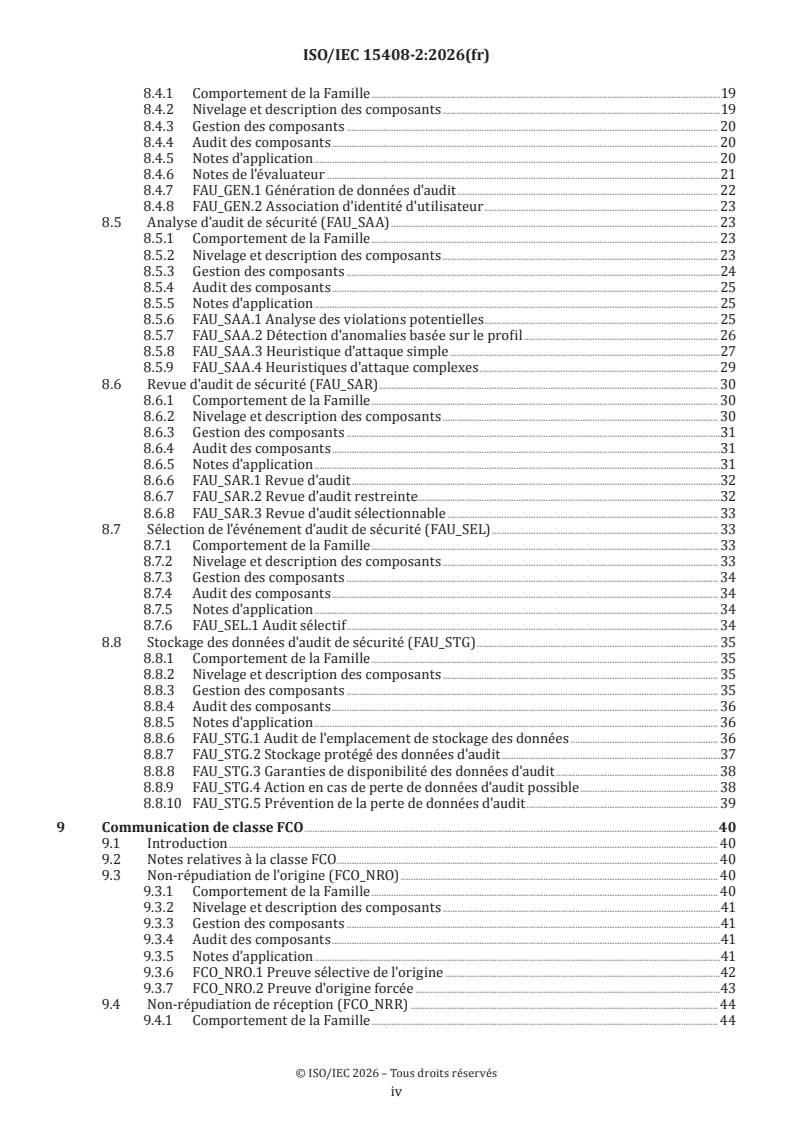
Sommaire Page
Avant-propos . xv
Introduction . xvi
1 Domaine d'application . 1
2 Références normatives . 1
3 Termes et définitions . 1
4 Abréviations . 3
5 Vue d'ensemble . 4
5.1 Généralités .4
5.2 Organisation du présent document .5
6 Paradigme d'exigences fonctionnelles . 5
7 Composants fonctionnels de sécurité . 9
7.1 Vue d'ensemble .9
7.2 Structure de classe fonctionnelle . .9
7.2.1 Généralités .9
7.2.2 Nom de la classe .9
7.2.3 Introduction de la classe .9
7.2.4 Notes d'information de classe .9
7.2.5 Familles fonctionnelles .10
7.3 Structure fonctionnelle de la famille .10
7.3.1 Généralités .10
7.3.2 Nom de la famille . .10
7.3.3 Comportement de la Famille .10
7.3.4 Nivelage et description des composants .10
7.3.5 Gestion des composants .11
7.3.6 Audit des composants .11
7.3.7 Notes d'application familiale .11
7.3.8 Notes de l'évaluateur de famille .11
7.3.9 Composants fonctionnels. 12
7.4 Structure fonctionnelle des composants . 12
7.4.1 Généralités . 12
7.4.2 Nom du composant . 12
7.4.3 Relations entre les composants . 12
7.4.4 Justification des composants . . 13
7.4.5 Notes des composants . 13
7.4.6 Éléments fonctionnels .14
7.5 Éléments fonctionnels .14
7.6 Catalogue de composants .14
7.6.1 Généralités .14
7.6.2 Mise en évidence des modifications apportées aux composants . 15
8 Classe FAU Audit de sécurité .16
8.1 Introduction .16
8.2 Notes relatives à la classe FAU .17
8.2.1 Informations générales sur les exigences d'audit .17
8.2.2 Exigences d'audit dans un environnement réparti .17
8.3 Réponse automatique d'audit de sécurité (FAU_ARP) .18
8.3.1 Comportement de la Famille .18
8.3.2 Nivelage et description des composants .18
8.3.3 Gestion des composants .18
8.3.4 Audit des composants .18
8.3.5 Notes d'application .19
8.3.6 FAU_ARP.1 Alarmes de sécurité . .19
8.4 Génération de données d'audit de sécurité (FAU_GEN) .19
© ISO/IEC 2026 – Tous droits réservés
iii
8.4.1 Comportement de la Famille .19
8.4.2 Nivelage et description des composants .19
8.4.3 Gestion des composants . 20
8.4.4 Audit des composants . 20
8.4.5 Notes d'application . 20
8.4.6 Notes de l'évaluateur .21
8.4.7 FAU_GEN.1 Génération de données d'audit . 22
8.4.8 FAU_GEN.2 Association d'identité d'utilisateur . 23
8.5 Analyse d'audit de sécurité (FAU_SAA) . 23
8.5.1 Comportement de la Famille . 23
8.5.2 Nivelage et description des composants . 23
8.5.3 Gestion des composants .24
8.5.4 Audit des composants . 25
8.5.5 Notes d'application . 25
8.5.6 FAU_SAA.1 Analyse des violations potentielles . 25
8.5.7 FAU_SAA.2 Détection d'anomalies basée sur le profil . 26
8.5.8 FAU_SAA.3 Heuristique d'attaque simple .27
8.5.9 FAU_SAA.4 Heuristiques d'attaque complexes . 29
8.6 Revue d'audit de sécurité (FAU_SAR) . 30
8.6.1 Comportement de la Famille . 30
8.6.2 Nivelage et description des composants . 30
8.6.3 Gestion des composants .31
8.6.4 Audit des composants .31
8.6.5 Notes d'application .31
8.6.6 FAU_SAR.1 Revue d'audit .32
8.6.7 FAU_SAR.2 Revue d'audit restreinte . .32
8.6.8 FAU_SAR.3 Revue d'audit sélectionnable . 33
8.7 Sélection de l'événement d'audit de sécurité (FAU_SEL) . 33
8.7.1 Comportement de la Famille . 33
8.7.2 Nivelage et description des composants . 33
8.7.3 Gestion des composants . 34
8.7.4 Audit des composants . 34
8.7.5 Notes d'application . 34
8.7.6 FAU_SEL.1 Audit sélectif . 34
8.8 Stockage des données d'audit de sécurité (FAU_STG) . 35
8.8.1 Comportement de la Famille . 35
8.8.2 Nivelage et description des composants . 35
8.8.3 Gestion des composants . 35
8.8.4 Audit des composants . 36
8.8.5 Notes d'application . 36
8.8.6 FAU_STG.1 Audit de l'emplacement de stockage des données . 36
8.8.7 FAU_STG.2 Stockage protégé des données d'audit .37
8.8.8 FAU_STG.3 Garanties de disponibilité des données d'audit . 38
8.8.9 FAU_STG.4 Action en cas de perte de données d'audit possible . 38
8.8.10 FAU_STG.5 Prévention de la perte de données d'audit . 39
9 Communication de classe FCO .40
9.1 Introduction . 40
9.2 Notes relatives à la classe FCO . . 40
9.3 Non-répudiation de l'origine (FCO_NRO) . 40
9.3.1 Comportement de la Famille . 40
9.3.2 Nivelage et description des composants .41
9.3.3 Gestion des composants .41
9.3.4 Audit des composants .41
9.3.5 Notes d'application .41
9.3.6 FCO_NRO.1 Preuve sélective de l'origine .42
9.3.7 FCO_NRO.2 Preuve d'origine forcée .43
9.4 Non-répudiation de réception (FCO_NRR) . 44
9.4.1 Comportement de la Famille . 44
© ISO/IEC 2026 – Tous droits réservés
iv
9.4.2 Nivelage et description des composants . 44
9.4.3 Gestion des composants . 44
9.4.4 Audit des composants . 44
9.4.5 Notes d'application .45
9.4.6 FCO_NRR.1 Preuve sélective de réception . 46
9.4.7 FCO_NRR.2 Preuve de réception forcée .47
10 Classe FCS Support cryptographique . 47
10.1 Introduction .47
10.2 Notes relatives à la classe FCS . 49
10.3 Gestion des clés cryptographiques (FCS_CKM) .51
10.3.1 Comportement de la Famille .51
10.3.2 Nivelage et description des composants .51
10.3.3 Gestion des composants .52
10.3.4 Audit des composants .52
10.3.5 Notes d'application .52
10.3.6 Notes de l'évaluateur . 53
10.3.7 FCS_CKM.1 Génération de clés cryptographiques . 53
10.3.8 FCS_CKM.2 Distribution de clés cryptographiques . 54
10.3.9 FCS_CKM.3 Accès aux clés cryptographiques . 54
10.3.10 FCS_CKM.5 Dérivement de clés cryptographiques . 55
10.3.11 FCS_CKM.6 Moment et événement de la destruction des clés cryptographiques . 56
10.4 Opération cryptographique (FCS_COP) .57
10.4.1 Comportement de la Famille .57
10.4.2 Nivelage et description des composants .57
10.4.3 Gestion des composants .57
10.4.4 Audit des composants .57
10.4.5 Notes d'application .57
10.4.6 FCS_COP.1 Opération cryptographique . 58
10.5 Génération aléatoire de bits (FCS_RBG) .59
10.5.1 Comportement de la Famille .59
10.5.2 Nivelage et description des composants .59
10.5.3 Gestion des composants . 60
10.5.4 Audit des composants . 60
10.5.5 Notes d'application .61
10.5.6 FCS_RBG.1 Génération aléatoire de bits (RBG) .61
10.5.7 FCS_RBG.2 Génération aléatoire de bits (semencement externe) .62
10.5.8 FCS_RBG.3 Génération aléatoire de bits (semence interne - source unique) . 63
10.5.9 FCS_RBG.4 Génération aléatoire de bits (semence interne - sources multiples) . 64
10.5.10 FCS_RBG.5 Génération aléatoire de bits (combinant sources d'entropie) . 64
10.5.11 FCS_RBG.6 Service aléatoire de génération de bits . 65
10.6 Génération de nombres aléatoires (FCS_RNG) . 65
10.6.1 Comportement de la Famille . 65
10.6.2 Nivelage et description des composants . 65
10.6.3 Gestion des composants . 66
10.6.4 Audit des composants . 66
10.6.5 Notes d'application . 66
10.6.6 FCS_RNG.1 Génération aléatoire de nombres . 66
11 Classe FDP Protection des données de l'utilisateur .68
11.1 Introduction . 68
11.2 Notes relatives à la classe FDP. 72
11.3 Politique de contrôle d'accès (FDP_ACC) .74
11.3.1 Comportement de la Famille .74
11.3.2 Nivelage et description des composants .74
11.3.3 Gestion des composants .74
11.3.4 Audit des composants .74
11.3.5 Notes d'application . 75
11.3.6 FDP_ACC.1 Sous-ensemble de contrôle d'accès . 75
11.3.7 FDP_ACC.2 Contrôle d'accès complet .76
© ISO/IEC 2026 – Tous droits réservés
v
11.4 Fonctions de contrôle d'accès (FDP_ACF) .76
11.4.1 Comportement de la Famille .76
11.4.2 Nivelage et description des composants . 77
11.4.3 Gestion des composants . 77
11.4.4 Audit des composants . 77
11.4.5 Notes d'application . 77
11.4.6 FDP_ACF.1 Contrôle d'accès basé sur les attributs de sécurité . 78
11.5 Authentification des données (FDP_DAU) . 79
11.5.1 Comportement de la Famille . 79
11.5.2 Nivelage et description des composants . 79
11.5.3 Gestion des composants . 80
11.5.4 Audit des composants . 80
11.5.5 Notes d'application . 80
11.5.6 FDP_DAU.1 Authentification de base des données . 80
11.5.7 FDP_DAU.2 Authentification des données avec l'identité du garant . 81
11.6 Export de la TOE (FDP_ETC) . 82
11.6.1 Comportement de la Famille . 82
11.6.2 Nivelage et description des composants . 82
11.6.3 Gestion des composants . 82
11.6.4 Audit des composants . 82
11.6.5 Notes d'application . 82
11.6.6 FDP_ETC.1 Export de données utilisateur sans attributs de sécurité . 83
11.6.7 FDP_ETC.2 Export de données utilisateur avec attributs de sécurité . 83
11.7 Politique de contrôle du flux d'informations (FDP_IFC) . 84
11.7.1 Comportement de la Famille . 84
11.7.2 Nivelage et description des composants . 85
11.7.3 Gestion des composants . 85
11.7.4 Audit des composants . 85
11.7.5 Notes d'application . 85
11.7.6 FDP_IFC.1 Contrôle du flux d'informations du sous-ensemble . 86
11.7.7 FDP_IFC.2 Contrôle complet du flux d'informations . 87
11.8 Fonctions de contrôle du flux d'information (FDP_IFF) . 87
11.8.1 Comportement de la Famille . 87
11.8.2 Nivelage et description des composants . 88
11.8.3 Gestion des composants . 88
11.8.4 Audit des composants . 89
11.8.5 Notes d'application . 89
11.8.6 FDP_IFF.1 Attributs de sécurité simples . 90
11.8.7 FDP_IFF.2 Attributs de sécurité hiérarchiques .91
11.8.8 FDP_IFF.3 Flux limités d'informations illicites . 93
11.8.9 FDP_IFF.4 Élimination partielle des flux d'informations illicites . 94
11.8.10 FDP_IFF.5 Aucun flux d'informations illicites . 95
11.8.11 FDP_IFF.6 Surveillance du flux d'informations illicites . 95
11.9 Contrôle de la conservation de l'information (FDP_IRC) . 96
11.9.1 Comportement de la Famille . 96
11.9.2 Nivelage et description des composants . 96
11.9.3 Gestion des composants . 97
11.9.4 Audit des composants . 97
11.9.5 Notes d'application . 97
11.9.6 FDP_IRC.1 Contrôle de la conservation de l'information . 97
11.10 Importation depuis l'extérieur de la TOE (FDP_ITC) . 98
11.10.1 Comportement de la Famille . 98
11.10.2 Nivelage et description des composants . 98
11.10.3 Gestion des composants . 99
11.10.4 Audit des composants . 99
11.10.5 Notes d'application . 99
11.10.6 FDP_ITC.1 Importation de données utilisateur sans attributs de sécurité . 100
11.10.7 FDP_ITC.2 Importation de données utilisateur avec attributs de sécurité . 101
11.11 Transfert interne de la TOE (FDP_ITT) . 102
© ISO/IEC 2026 – Tous droits réservés
vi
11.11.1 Comportement de la Famille . 102
11.11.2 Nivelage et description des composants . 102
11.11.3 Gestion des composants . 103
11.11.4 Audit des composants . 103
11.11.5 Notes d'application . 103
11.11.6 FDP_ITT.1 Protection de transfert interne de base . 104
11.11.7 FDP_ITT.2 Séparation de transmission par attribut . 104
11.11.8 FDP_ITT.3 Surveillance de l'intégrité . 105
11.11.9 FDP_ITT.4 Surveillance de l'intégrité basée sur les attributs . 106
11.12 Protection des informations résiduelles (FDP_RIP) . 107
11.12.1 Comportement de la Famille . 107
11.12.2 Nivelage et description des composants . 107
11.12.3 Gestion des composants . 107
11.12.4 Audit des composants . 107
11.12.5 Notes d'application . 108
11.12.6 FDP_RIP.1 Sous-ensemble de protection des informations résiduelles . 109
11.12.7 FDP_RIP.2 Protection complète des informations résiduelles . 109
11.13 Rollback (FDP_ROL) .110
11.13.1 Comportement de la Famille .110
11.13.2 Nivelage et description des composants .
...