


ISO 22197-3:2019
(Main)Fine ceramics (advanced ceramics, advanced technical ceramics) — Test method for air-purification performance of semiconducting photocatalytic materials — Part 3: Removal of toluene
Fine ceramics (advanced ceramics, advanced technical ceramics) — Test method for air-purification performance of semiconducting photocatalytic materials — Part 3: Removal of toluene
This document specifies a test method for the determination of the air-purification performance of materials that contain a photocatalyst or have photocatalytic films on the surface, usually made from semiconducting metal oxides, such as titanium dioxide or other ceramic materials, by continuous exposure of a test piece to the model air pollutant under irradiation with ultraviolet light (UV-A). This document is intended for use with different kinds of materials, such as construction materials in flat sheet, board or plate shape, that are the basic forms of materials for various applications. This document also applies to structured filter materials including honeycomb-form, woven and non-woven fabrics, and to plastic or paper materials if they contain ceramic microcrystals and composites. This document does not apply to powder or granular photocatalytic materials. This test method is usually applicable to photocatalytic materials produced for air purification. This method is not suitable for the determination of other performance attributes of photocatalytic materials, i.e. decomposition of water contaminants, self-cleaning, antifogging and antibacterial actions. It concerns the removal of toluene.
Céramiques techniques — Méthodes d'essai relatives à la performance des matériaux photocatalytiques semi-conducteurs pour la purification de l'air — Partie 3: Élimination du toluène
General Information
- Status
- Published
- Publication Date
- 14-Oct-2019
- Technical Committee
- ISO/TC 206 - Fine ceramics
- Drafting Committee
- ISO/TC 206/WG 9 - Photocatalysis
- Current Stage
- 9093 - International Standard confirmed
- Start Date
- 05-Mar-2025
- Completion Date
- 14-Feb-2026
Relations
- Effective Date
- 10-Dec-2016
Overview
ISO 22197-3:2019 defines a standardized laboratory test method for the air‑purification performance of semiconducting photocatalytic materials - specifically measuring the removal of toluene, a representative aromatic volatile organic compound (VOC). The standard applies to materials that incorporate or are coated with photocatalysts (commonly titanium dioxide or other semiconducting metal oxides) in planar forms (sheets, boards, plates), structured filters (honeycomb, woven/non‑woven), and composite plastics or papers that contain ceramic microcrystals. It excludes powders/granular photocatalysts and does not address other photocatalytic functions (e.g., water‑phase decomposition, self‑cleaning, antifogging, antibacterial).
Key topics and technical requirements
- Test principle: Continuous flow photoreactor exposes a defined test piece to toluene‑containing air under UV‑A irradiation; photocatalytic oxidation and adsorption are quantified.
- Pollutant and metrics: Uses toluene as a model VOC; removal is reported in micromoles (µmol) and as removal percentage. Dark tests evaluate adsorption separate from photocatalysis.
- Photoreactor design: Test piece placed with a controlled air gap (nominal 5.0 mm ±0.5 mm) between sample and optical window; flow is limited to the gap region.
- Light source: UV‑A irradiation in the 300–400 nm range (black‑light/BL(B) fluorescent lamps or filtered xenon), with specified irradiance at the sample surface (document specifies a target irradiance and uniformity requirement).
- Gas supply and flow control: Continuous test gas with controlled toluene concentration, temperature and humidity; thermal mass‑flow controllers and low‑adsorption materials are required for accurate low‑concentration testing.
- Analytical system: Sensitive pollutant measurement to detect low toluene concentrations and calculate removed amount; system construction must minimize background adsorption.
- Procedure elements: Sample pretreatment (including removal of water‑soluble contaminants), dark adsorption check, UV exposure testing, calculation and acceptance criteria for adsorption/performance.
- Scope limits: Not suitable for powder/granular materials or for assessing non‑air purification photocatalytic properties.
Applications
- Performance evaluation of photocatalytic building materials (tiles, panels), air‑purification coatings and structured photocatalytic filters.
- Quality control and R&D for manufacturers of fine/advanced ceramics and photocatalytic composites.
- Comparative testing in product development and certification programs where toluene or aromatic VOC removal is a target.
- Laboratory method for researchers studying VOC degradation by semiconductor photocatalysts.
Who should use this standard
- Material manufacturers (ceramics, coatings, composite panels)
- Filter and HVAC component producers integrating photocatalytic functions
- Independent testing and calibration laboratories (ISO/IEC 17025 accredited)
- Product certifiers, specifiers, and researchers evaluating VOC air‑purification performance
Related standards
- ISO 22197 series (other parts for different pollutants)
- ISO 10677 (UV light source for photocatalytic testing)
- ISO 4892‑3 (fluorescent UV lamps)
- ISO/IEC 17025 (laboratory competence)
Keywords: ISO 22197‑3:2019, photocatalytic materials, air‑purification performance, toluene removal, fine ceramics, titanium dioxide, UV‑A photoreactor, VOC testing, photocatalyst test method.
Buy Documents


ISO 22197-3:2019 - Fine ceramics (advanced ceramics, advanced technical ceramics) -- Test method for air-purification performance of semiconducting photocatalytic materials
ISO 22197-3:2019 - Fine ceramics (advanced ceramics, advanced technical ceramics) — Test method for air-purification performance of semiconducting photocatalytic materials — Part 3: Removal of toluene Released:10/15/2019
Frequently Asked Questions
ISO 22197-3:2019 is a standard published by the International Organization for Standardization (ISO). Its full title is "Fine ceramics (advanced ceramics, advanced technical ceramics) — Test method for air-purification performance of semiconducting photocatalytic materials — Part 3: Removal of toluene". This standard covers: This document specifies a test method for the determination of the air-purification performance of materials that contain a photocatalyst or have photocatalytic films on the surface, usually made from semiconducting metal oxides, such as titanium dioxide or other ceramic materials, by continuous exposure of a test piece to the model air pollutant under irradiation with ultraviolet light (UV-A). This document is intended for use with different kinds of materials, such as construction materials in flat sheet, board or plate shape, that are the basic forms of materials for various applications. This document also applies to structured filter materials including honeycomb-form, woven and non-woven fabrics, and to plastic or paper materials if they contain ceramic microcrystals and composites. This document does not apply to powder or granular photocatalytic materials. This test method is usually applicable to photocatalytic materials produced for air purification. This method is not suitable for the determination of other performance attributes of photocatalytic materials, i.e. decomposition of water contaminants, self-cleaning, antifogging and antibacterial actions. It concerns the removal of toluene.
This document specifies a test method for the determination of the air-purification performance of materials that contain a photocatalyst or have photocatalytic films on the surface, usually made from semiconducting metal oxides, such as titanium dioxide or other ceramic materials, by continuous exposure of a test piece to the model air pollutant under irradiation with ultraviolet light (UV-A). This document is intended for use with different kinds of materials, such as construction materials in flat sheet, board or plate shape, that are the basic forms of materials for various applications. This document also applies to structured filter materials including honeycomb-form, woven and non-woven fabrics, and to plastic or paper materials if they contain ceramic microcrystals and composites. This document does not apply to powder or granular photocatalytic materials. This test method is usually applicable to photocatalytic materials produced for air purification. This method is not suitable for the determination of other performance attributes of photocatalytic materials, i.e. decomposition of water contaminants, self-cleaning, antifogging and antibacterial actions. It concerns the removal of toluene.
ISO 22197-3:2019 is classified under the following ICS (International Classification for Standards) categories: 81.060.30 - Advanced ceramics. The ICS classification helps identify the subject area and facilitates finding related standards.
ISO 22197-3:2019 has the following relationships with other standards: It is inter standard links to ISO 22197-3:2011. Understanding these relationships helps ensure you are using the most current and applicable version of the standard.
ISO 22197-3:2019 is available in PDF format for immediate download after purchase. The document can be added to your cart and obtained through the secure checkout process. Digital delivery ensures instant access to the complete standard document.
Standards Content (Sample)
INTERNATIONAL ISO
STANDARD 22197-3
Second edition
2019-10
Fine ceramics (advanced ceramics,
advanced technical ceramics) —
Test method for air-purification
performance of semiconducting
photocatalytic materials —
Part 3:
Removal of toluene
Céramiques techniques — Méthodes d'essai relatives à la performance
des matériaux photocatalytiques semi-conducteurs pour la
purification de l'air —
Partie 3: Élimination du toluène
Reference number
©
ISO 2019
© ISO 2019
All rights reserved. Unless otherwise specified, or required in the context of its implementation, no part of this publication may
be reproduced or utilized otherwise in any form or by any means, electronic or mechanical, including photocopying, or posting
on the internet or an intranet, without prior written permission. Permission can be requested from either ISO at the address
below or ISO’s member body in the country of the requester.
ISO copyright office
CP 401 • Ch. de Blandonnet 8
CH-1214 Vernier, Geneva
Phone: +41 22 749 01 11
Fax: +41 22 749 09 47
Email: copyright@iso.org
Website: www.iso.org
Published in Switzerland
ii © ISO 2019 – All rights reserved
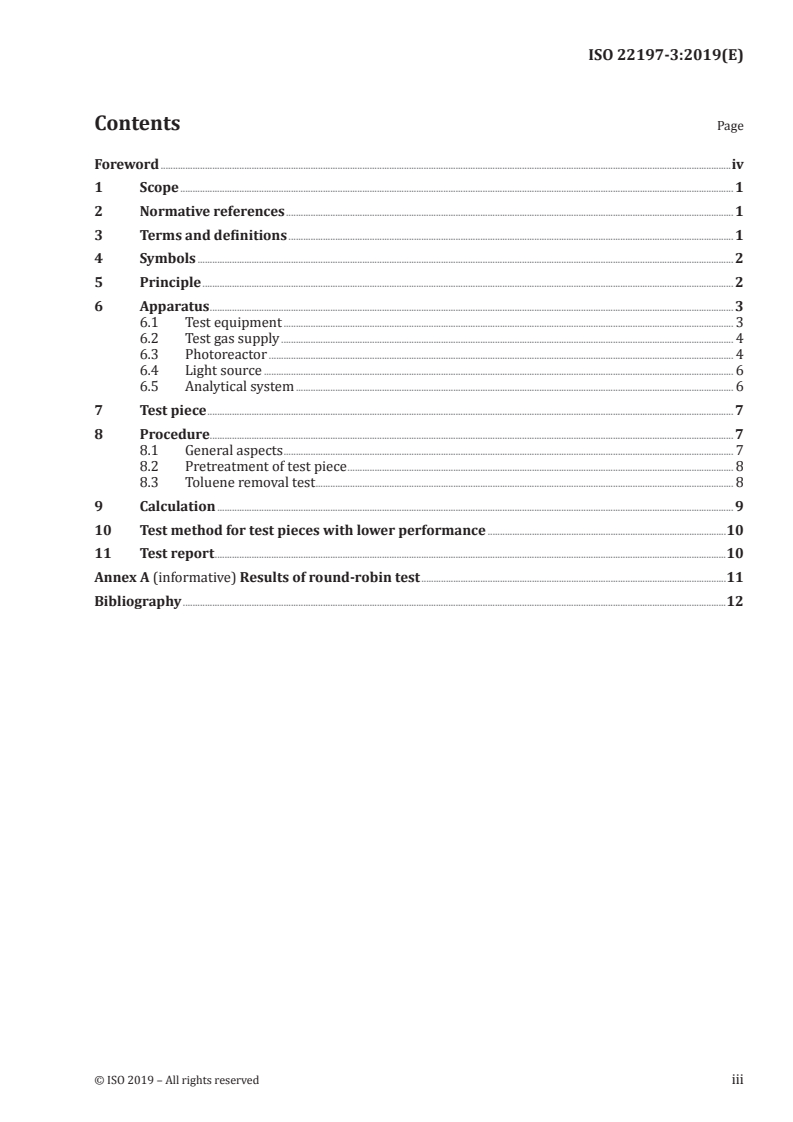
Contents Page
Foreword .iv
1 Scope . 1
2 Normative references . 1
3 Terms and definitions . 1
4 Symbols . 2
5 Principle . 2
6 Apparatus . 3
6.1 Test equipment . 3
6.2 Test gas supply . 4
6.3 Photoreactor . 4
6.4 Light source . 6
6.5 Analytical system . 6
7 Test piece . 7
8 Procedure. 7
8.1 General aspects . 7
8.2 Pretreatment of test piece . 8
8.3 Toluene removal test . 8
9 Calculation . 9
10 Test method for test pieces with lower performance .10
11 Test report .10
Annex A (informative) Results of round-robin test .11
Bibliography .12
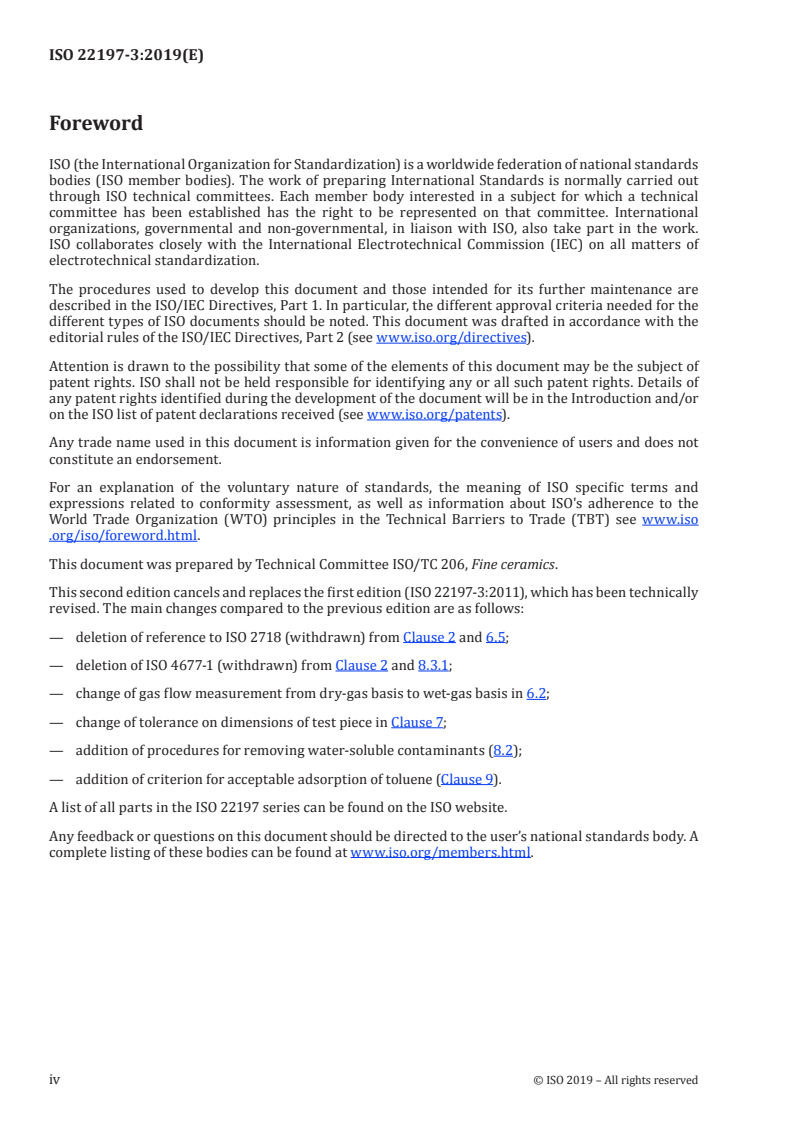
Foreword
ISO (the International Organization for Standardization) is a worldwide federation of national standards
bodies (ISO member bodies). The work of preparing International Standards is normally carried out
through ISO technical committees. Each member body interested in a subject for which a technical
committee has been established has the right to be represented on that committee. International
organizations, governmental and non-governmental, in liaison with ISO, also take part in the work.
ISO collaborates closely with the International Electrotechnical Commission (IEC) on all matters of
electrotechnical standardization.
The procedures used to develop this document and those intended for its further maintenance are
described in the ISO/IEC Directives, Part 1. In particular, the different approval criteria needed for the
different types of ISO documents should be noted. This document was drafted in accordance with the
editorial rules of the ISO/IEC Directives, Part 2 (see www .iso .org/directives).
Attention is drawn to the possibility that some of the elements of this document may be the subject of
patent rights. ISO shall not be held responsible for identifying any or all such patent rights. Details of
any patent rights identified during the development of the document will be in the Introduction and/or
on the ISO list of patent declarations received (see www .iso .org/patents).
Any trade name used in this document is information given for the convenience of users and does not
constitute an endorsement.
For an explanation of the voluntary nature of standards, the meaning of ISO specific terms and
expressions related to conformity assessment, as well as information about ISO's adherence to the
World Trade Organization (WTO) principles in the Technical Barriers to Trade (TBT) see www .iso
.org/iso/foreword .html.
This document was prepared by Technical Committee ISO/TC 206, Fine ceramics.
This second edition cancels and replaces the first edition (ISO 22197-3:2011), which has been technically
revised. The main changes compared to the previous edition are as follows:
— deletion of reference to ISO 2718 (withdrawn) from Clause 2 and 6.5;
— deletion of ISO 4677-1 (withdrawn) from Clause 2 and 8.3.1;
— change of gas flow measurement from dry-gas basis to wet-gas basis in 6.2;
— change of tolerance on dimensions of test piece in Clause 7;
— addition of procedures for removing water-soluble contaminants (8.2);
— addition of criterion for acceptable adsorption of toluene (Clause 9).
A list of all parts in the ISO 22197 series can be found on the ISO website.
Any feedback or questions on this document should be directed to the user’s national standards body. A
complete listing of these bodies can be found at www .iso .org/members .html.
iv © ISO 2019 – All rights reserved
INTERNATIONAL STANDARD ISO 22197-3:2019(E)
Fine ceramics (advanced ceramics, advanced technical
ceramics) — Test method for air-purification performance
of semiconducting photocatalytic materials —
Part 3:
Removal of toluene
1 Scope
This document specifies a test method for the determination of the air-purification performance of
materials that contain a photocatalyst or have photocatalytic films on the surface, usually made from
semiconducting metal oxides, such as titanium dioxide or other ceramic materials, by continuous
exposure of a test piece to the model air pollutant under irradiation with ultraviolet light (UV-A).
This document is intended for use with different kinds of materials, such as construction materials in
flat sheet, board or plate shape, that are the basic forms of materials for various applications.
This document also applies to structured filter materials including honeycomb-form, woven and non-
woven fabrics, and to plastic or paper materials if they contain ceramic microcrystals and composites.
This document does not apply to powder or granular photocatalytic materials.
This test method is usually applicable to photocatalytic materials produced for air purification.
This method is not suitable for the determination of other performance attributes of photocatalytic
materials, i.e. decomposition of water contaminants, self-cleaning, antifogging and antibacterial
actions. It concerns the removal of toluene.
2 Normative references
The following documents are referred to in the text in such a way that some or all of their content
constitutes requirements of this document. For dated references, only the edition cited applies. For
undated references, the latest edition of the referenced document (including any amendments) applies.
ISO 4892-3, Plastics — Methods of exposure to laboratory light sources — Part 3: Fluorescent UV lamps
ISO 10677, Fine ceramics (advanced ceramics, advanced technical ceramics) — Ultraviolet light source for
testing semiconducting photocatalytic materials
ISO/IEC 17025, General requirements for the competence of testing and calibration laboratories
ISO 80000-1, Quantities and units — Part 1: General
3 Terms and definitions
For the purposes of this document, the following terms and definitions apply.
ISO and IEC maintain terminological databases for use in standardization at the following addresses:
— ISO Online browsing platform: available at https: //www .iso .org/obp
— IEC Electropedia: available at http: //www .electropedia .org/
3.1
photocatalyst
substance that performs one or more functions based on oxidization and reduction reactions under
photoirradiation, including decomposition and removal of air and water contaminants, deodorization,
and antibacterial, self-cleaning and antifogging actions
3.2
photocatalytic materials
materials in which or on which the photocatalyst is added by, for example, coating, impregnation or mixing
Note 1 to entry: Such photocatalytic materials are intended primarily for use as building and road construction
materials to obtain the functions described in 3.1.
3.3
zero-calibration gas
air that does not contain pollutants (i.e. in which common pollutants are below 0,01 µl/l)
Note 1 to entry: The zero-calibration gas is prepared from indoor air using a laboratory air-purification system,
or supplied as synthetic air in a gas cylinder.
3.4
standard gas
diluted gas of known concentration supplied in cylinders and certified by an accredited laboratory
3.5
test gas
mixture of air and pollutant(s) of known concentration prepared from a standard gas or a zero-
calibration gas, to be used for the performance test of a photocatalytic material
3.6
dark condition
test condition with no light irradiation by the light source for testing and room lighting
4 Symbols
For the purposes of this document, the following symbols apply.
f flow rate of test gas converted into that at the standard state (0 °C and 101,3 kPa) (l/min)
ϕ volume fraction of toluene at the reactor exit (µl/l)
T
ϕ supply volume fraction of toluene (µl/l)
T0
ϕ toluene volume fraction at the reactor exit under dark condition (µl/l)
TD
n quantity of toluene removed by the test piece (µmol)
T
R removal percentage, by test piece, of toluene (%)
5 Principle
This document concerns the development, comparison, quality assurance, characterization, reliability,
and design data generation of photocatalytic materials (see Reference [1]). The method described is
intended to obtain the air-purification performance of photocatalytic materials by exposing a test
piece to model polluted air under irradiation by ultraviolet (UV) light (Reference [2]). Toluene (C H ) is
7 8
[3]
chosen as a typical aromatic volatile organic compound (VOC) with offensive odour . The test piece,
placed in a flow-type photoreactor, is activated by UV irradiation, and adsorbs and oxidizes gas-phase
toluene to form carbon dioxide (CO ) and other oxidation products (References [4] to [6]). The air-
purification performance is determined from the amount of toluene removed by the test piece, in
2 © ISO 2019 – All rights reserved
micromoles (μmol). The simple adsorption by the test piece (not due to photocatalysis) is evaluated by
tests in the dark. However, some test pieces adsorb toluene very strongly, and a stable concentration
of toluene may not be attained in the designated time of test. The photocatalytic activity may depend
on physical and chemical properties of pollutants, mainly due to the adsorption process involved. For
a better evaluation of air-purification performance of photocatalytic materials, it is recommended that
one or more suitable test methods are combined as described in other parts of the ISO 22197 series.
6 Apparatus
6.1 Test equipment
The test equipment enables a photocatalytic material to be examined for its pollutant-removal capability
by supplying the test gas continuously, while providing photoirradiation to activate the photocatalyst.
[2]
It is the same as that used in the test method for the removal of nitric oxide (ISO 22197-1 ) and consists
of a test gas supply, a photoreactor, a light source and pollutant-measurement equipment. Since low
concentrations of pollutants are to be tested, the system shall be constructed with materials of low
adsorption and resistant to UV radiation (e.g. acrylic resin, borosilicate glass). An example of a testing
system is shown in Figure 1.
Key
1 test gas supply 9 4-way valve
2 air compressor 10 photoreactor
3 air-purification system 11 test piece
4 standard gas (pollutant) 12 air-tight optical window
5 pressure regulator 13 light source
6 mass-flow controller 14 analyser
7 humidifier 15 vent
8 gas mixer
Figure 1 — Schematic diagram of test equipment
6.2 Test gas supply
The test gas supply provides air polluted with the model contaminant at a predetermined concentration,
temperature and humidity, and supplies it continuously to the photoreactor. It consists of flow
regulators, a humidifier, gas mixers and so forth. The flow rate of each gas should be within 5 % of the
designated value, which is easily attained by using thermal mass-flow controllers, with knowledge of
[7]
the temperature and gas type at calibration in accordance with ISO 6145-7 . The expression of gas flow
rate in this document is that converted to the standard state (0 °C and 101,3
...
INTERNATIONAL ISO
STANDARD 22197-3
Second edition
2019-10
Fine ceramics (advanced ceramics,
advanced technical ceramics) —
Test method for air-purification
performance of semiconducting
photocatalytic materials —
Part 3:
Removal of toluene
Céramiques techniques — Méthodes d'essai relatives à la performance
des matériaux photocatalytiques semi-conducteurs pour la
purification de l'air —
Partie 3: Élimination du toluène
Reference number
©
ISO 2019
© ISO 2019
All rights reserved. Unless otherwise specified, or required in the context of its implementation, no part of this publication may
be reproduced or utilized otherwise in any form or by any means, electronic or mechanical, including photocopying, or posting
on the internet or an intranet, without prior written permission. Permission can be requested from either ISO at the address
below or ISO’s member body in the country of the requester.
ISO copyright office
CP 401 • Ch. de Blandonnet 8
CH-1214 Vernier, Geneva
Phone: +41 22 749 01 11
Fax: +41 22 749 09 47
Email: copyright@iso.org
Website: www.iso.org
Published in Switzerland
ii © ISO 2019 – All rights reserved
Contents Page
Foreword .iv
1 Scope . 1
2 Normative references . 1
3 Terms and definitions . 1
4 Symbols . 2
5 Principle . 2
6 Apparatus . 3
6.1 Test equipment . 3
6.2 Test gas supply . 4
6.3 Photoreactor . 4
6.4 Light source . 6
6.5 Analytical system . 6
7 Test piece . 7
8 Procedure. 7
8.1 General aspects . 7
8.2 Pretreatment of test piece . 8
8.3 Toluene removal test . 8
9 Calculation . 9
10 Test method for test pieces with lower performance .10
11 Test report .10
Annex A (informative) Results of round-robin test .11
Bibliography .12
Foreword
ISO (the International Organization for Standardization) is a worldwide federation of national standards
bodies (ISO member bodies). The work of preparing International Standards is normally carried out
through ISO technical committees. Each member body interested in a subject for which a technical
committee has been established has the right to be represented on that committee. International
organizations, governmental and non-governmental, in liaison with ISO, also take part in the work.
ISO collaborates closely with the International Electrotechnical Commission (IEC) on all matters of
electrotechnical standardization.
The procedures used to develop this document and those intended for its further maintenance are
described in the ISO/IEC Directives, Part 1. In particular, the different approval criteria needed for the
different types of ISO documents should be noted. This document was drafted in accordance with the
editorial rules of the ISO/IEC Directives, Part 2 (see www .iso .org/directives).
Attention is drawn to the possibility that some of the elements of this document may be the subject of
patent rights. ISO shall not be held responsible for identifying any or all such patent rights. Details of
any patent rights identified during the development of the document will be in the Introduction and/or
on the ISO list of patent declarations received (see www .iso .org/patents).
Any trade name used in this document is information given for the convenience of users and does not
constitute an endorsement.
For an explanation of the voluntary nature of standards, the meaning of ISO specific terms and
expressions related to conformity assessment, as well as information about ISO's adherence to the
World Trade Organization (WTO) principles in the Technical Barriers to Trade (TBT) see www .iso
.org/iso/foreword .html.
This document was prepared by Technical Committee ISO/TC 206, Fine ceramics.
This second edition cancels and replaces the first edition (ISO 22197-3:2011), which has been technically
revised. The main changes compared to the previous edition are as follows:
— deletion of reference to ISO 2718 (withdrawn) from Clause 2 and 6.5;
— deletion of ISO 4677-1 (withdrawn) from Clause 2 and 8.3.1;
— change of gas flow measurement from dry-gas basis to wet-gas basis in 6.2;
— change of tolerance on dimensions of test piece in Clause 7;
— addition of procedures for removing water-soluble contaminants (8.2);
— addition of criterion for acceptable adsorption of toluene (Clause 9).
A list of all parts in the ISO 22197 series can be found on the ISO website.
Any feedback or questions on this document should be directed to the user’s national standards body. A
complete listing of these bodies can be found at www .iso .org/members .html.
iv © ISO 2019 – All rights reserved
INTERNATIONAL STANDARD ISO 22197-3:2019(E)
Fine ceramics (advanced ceramics, advanced technical
ceramics) — Test method for air-purification performance
of semiconducting photocatalytic materials —
Part 3:
Removal of toluene
1 Scope
This document specifies a test method for the determination of the air-purification performance of
materials that contain a photocatalyst or have photocatalytic films on the surface, usually made from
semiconducting metal oxides, such as titanium dioxide or other ceramic materials, by continuous
exposure of a test piece to the model air pollutant under irradiation with ultraviolet light (UV-A).
This document is intended for use with different kinds of materials, such as construction materials in
flat sheet, board or plate shape, that are the basic forms of materials for various applications.
This document also applies to structured filter materials including honeycomb-form, woven and non-
woven fabrics, and to plastic or paper materials if they contain ceramic microcrystals and composites.
This document does not apply to powder or granular photocatalytic materials.
This test method is usually applicable to photocatalytic materials produced for air purification.
This method is not suitable for the determination of other performance attributes of photocatalytic
materials, i.e. decomposition of water contaminants, self-cleaning, antifogging and antibacterial
actions. It concerns the removal of toluene.
2 Normative references
The following documents are referred to in the text in such a way that some or all of their content
constitutes requirements of this document. For dated references, only the edition cited applies. For
undated references, the latest edition of the referenced document (including any amendments) applies.
ISO 4892-3, Plastics — Methods of exposure to laboratory light sources — Part 3: Fluorescent UV lamps
ISO 10677, Fine ceramics (advanced ceramics, advanced technical ceramics) — Ultraviolet light source for
testing semiconducting photocatalytic materials
ISO/IEC 17025, General requirements for the competence of testing and calibration laboratories
ISO 80000-1, Quantities and units — Part 1: General
3 Terms and definitions
For the purposes of this document, the following terms and definitions apply.
ISO and IEC maintain terminological databases for use in standardization at the following addresses:
— ISO Online browsing platform: available at https: //www .iso .org/obp
— IEC Electropedia: available at http: //www .electropedia .org/
3.1
photocatalyst
substance that performs one or more functions based on oxidization and reduction reactions under
photoirradiation, including decomposition and removal of air and water contaminants, deodorization,
and antibacterial, self-cleaning and antifogging actions
3.2
photocatalytic materials
materials in which or on which the photocatalyst is added by, for example, coating, impregnation or mixing
Note 1 to entry: Such photocatalytic materials are intended primarily for use as building and road construction
materials to obtain the functions described in 3.1.
3.3
zero-calibration gas
air that does not contain pollutants (i.e. in which common pollutants are below 0,01 µl/l)
Note 1 to entry: The zero-calibration gas is prepared from indoor air using a laboratory air-purification system,
or supplied as synthetic air in a gas cylinder.
3.4
standard gas
diluted gas of known concentration supplied in cylinders and certified by an accredited laboratory
3.5
test gas
mixture of air and pollutant(s) of known concentration prepared from a standard gas or a zero-
calibration gas, to be used for the performance test of a photocatalytic material
3.6
dark condition
test condition with no light irradiation by the light source for testing and room lighting
4 Symbols
For the purposes of this document, the following symbols apply.
f flow rate of test gas converted into that at the standard state (0 °C and 101,3 kPa) (l/min)
ϕ volume fraction of toluene at the reactor exit (µl/l)
T
ϕ supply volume fraction of toluene (µl/l)
T0
ϕ toluene volume fraction at the reactor exit under dark condition (µl/l)
TD
n quantity of toluene removed by the test piece (µmol)
T
R removal percentage, by test piece, of toluene (%)
5 Principle
This document concerns the development, comparison, quality assurance, characterization, reliability,
and design data generation of photocatalytic materials (see Reference [1]). The method described is
intended to obtain the air-purification performance of photocatalytic materials by exposing a test
piece to model polluted air under irradiation by ultraviolet (UV) light (Reference [2]). Toluene (C H ) is
7 8
[3]
chosen as a typical aromatic volatile organic compound (VOC) with offensive odour . The test piece,
placed in a flow-type photoreactor, is activated by UV irradiation, and adsorbs and oxidizes gas-phase
toluene to form carbon dioxide (CO ) and other oxidation products (References [4] to [6]). The air-
purification performance is determined from the amount of toluene removed by the test piece, in
2 © ISO 2019 – All rights reserved
micromoles (μmol). The simple adsorption by the test piece (not due to photocatalysis) is evaluated by
tests in the dark. However, some test pieces adsorb toluene very strongly, and a stable concentration
of toluene may not be attained in the designated time of test. The photocatalytic activity may depend
on physical and chemical properties of pollutants, mainly due to the adsorption process involved. For
a better evaluation of air-purification performance of photocatalytic materials, it is recommended that
one or more suitable test methods are combined as described in other parts of the ISO 22197 series.
6 Apparatus
6.1 Test equipment
The test equipment enables a photocatalytic material to be examined for its pollutant-removal capability
by supplying the test gas continuously, while providing photoirradiation to activate the photocatalyst.
[2]
It is the same as that used in the test method for the removal of nitric oxide (ISO 22197-1 ) and consists
of a test gas supply, a photoreactor, a light source and pollutant-measurement equipment. Since low
concentrations of pollutants are to be tested, the system shall be constructed with materials of low
adsorption and resistant to UV radiation (e.g. acrylic resin, borosilicate glass). An example of a testing
system is shown in Figure 1.
Key
1 test gas supply 9 4-way valve
2 air compressor 10 photoreactor
3 air-purification system 11 test piece
4 standard gas (pollutant) 12 air-tight optical window
5 pressure regulator 13 light source
6 mass-flow controller 14 analyser
7 humidifier 15 vent
8 gas mixer
Figure 1 — Schematic diagram of test equipment
6.2 Test gas supply
The test gas supply provides air polluted with the model contaminant at a predetermined concentration,
temperature and humidity, and supplies it continuously to the photoreactor. It consists of flow
regulators, a humidifier, gas mixers and so forth. The flow rate of each gas should be within 5 % of the
designated value, which is easily attained by using thermal mass-flow controllers, with knowledge of
[7]
the temperature and gas type at calibration in accordance with ISO 6145-7 . The expression of gas flow
rate in this document is that converted to the standard state (0 °C and 101,3
...
Questions, Comments and Discussion
Ask us and Technical Secretary will try to provide an answer. You can facilitate discussion about the standard in here.
Loading comments...