


ISO/IEC 16262:1998
(Main)Information technology - ECMAScript language specification
Information technology - ECMAScript language specification
Technologies de l'information - ECMAscript spécifications du langage
General Information
- Status
- Withdrawn
- Publication Date
- 19-Dec-1998
- Withdrawal Date
- 19-Dec-1998
- Current Stage
- 9599 - Withdrawal of International Standard
- Start Date
- 13-Jun-2002
- Completion Date
- 14-Feb-2026
Relations
- Consolidated By
ISO 11130:2010 - Corrosion of metals and alloys — Alternate immersion test in salt solution - Effective Date
- 06-Jun-2022
- Effective Date
- 15-Apr-2008


Get Certified
Connect with accredited certification bodies for this standard

BSI Group
BSI (British Standards Institution) is the business standards company that helps organizations make excellence a habit.

NYCE
Mexican standards and certification body.
Sponsored listings
Frequently Asked Questions
ISO/IEC 16262:1998 is a standard published by the International Organization for Standardization (ISO). Its full title is "Information technology - ECMAScript language specification". This standard covers: Information technology - ECMAScript language specification
Information technology - ECMAScript language specification
ISO/IEC 16262:1998 is classified under the following ICS (International Classification for Standards) categories: 35.060 - Languages used in information technology. The ICS classification helps identify the subject area and facilitates finding related standards.
ISO/IEC 16262:1998 has the following relationships with other standards: It is inter standard links to ISO 11130:2010, ISO/IEC 16262:2002. Understanding these relationships helps ensure you are using the most current and applicable version of the standard.
ISO/IEC 16262:1998 is available in PDF format for immediate download after purchase. The document can be added to your cart and obtained through the secure checkout process. Digital delivery ensures instant access to the complete standard document.
Standards Content (Sample)
INTERNATIONAL ISO/IEC
STANDARD 16262
First edition
1998-12-15
Information technology — ECMAScript
language specification
Technologies de l'information — Spécifications du langage ECMAScript
Reference number
B C
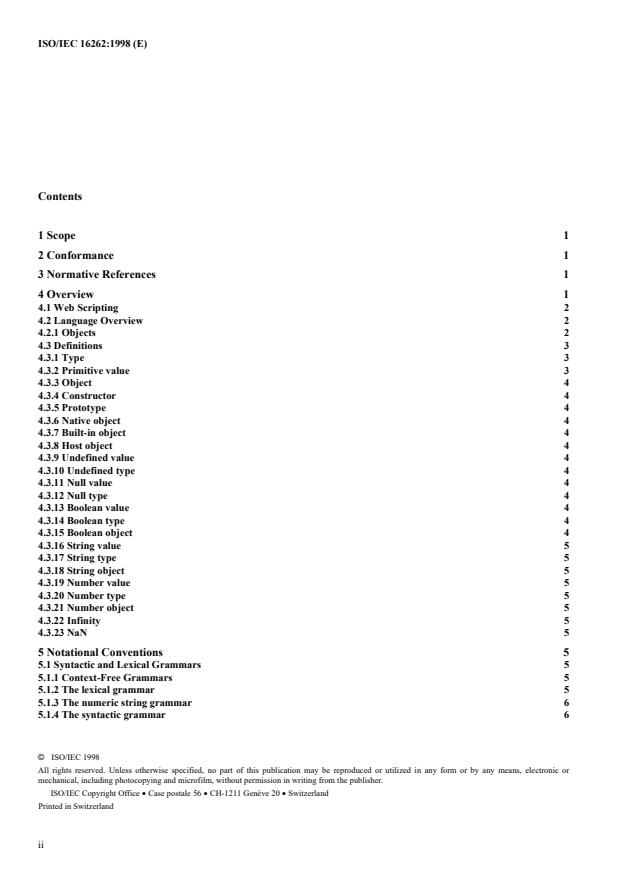
Contents
1 Scope 1
2 Conformance 1
3 Normative References 1
4 Overview 1
4.1 Web Scripting 2
4.2 Language Overview 2
4.2.1 Objects 2
4.3 Definitions 3
4.3.1 Type 3
4.3.2 Primitive value 3
4.3.3 Object 4
4.3.4 Constructor 4
4.3.5 Prototype 4
4.3.6 Native object 4
4.3.7 Built-in object 4
4.3.8 Host object 4
4.3.9 Undefined value 4
4.3.10 Undefined type 4
4.3.11 Null value 4
4.3.12 Null type 4
4.3.13 Boolean value 4
4.3.14 Boolean type 4
4.3.15 Boolean object 4
4.3.16 String value 5
4.3.17 String type 5
4.3.18 String object 5
4.3.19 Number value 5
4.3.20 Number type 5
4.3.21 Number object 5
4.3.22 Infinity 5
4.3.23 NaN 5
5 Notational Conventions 5
5.1 Syntactic and Lexical Grammars 5
5.1.1 Context-Free Grammars 5
5.1.2 The lexical grammar 5
5.1.3 The numeric string grammar 6
5.1.4 The syntactic grammar 6
© ISO/IEC 1998
All rights reserved. Unless otherwise specified, no part of this publication may be reproduced or utilized in any form or by any means, electronic or
mechanical, including photocopying and microfilm, without permission in writing from the publisher.
ISO/IEC Copyright Office • Case postale 56 • CH-1211 Genève 20 • Switzerland
Printed in Switzerland
ii
ISO/IEC ISO/IEC 16262:1998 (E)
5.1.5 Grammar Notation 6
5.2 Algorithm Conventions 8
6 Source Text 9
7 Lexical Conventions 9
7.1 White Space 9
7.2 Line Terminators 10
7.3 Comments 10
7.4 Tokens 11
7.4.1 Reserved Words 11
7.4.2 Keywords 11
7.4.3 Future Reserved Words 12
7.5 Identifiers 12
7.6 Punctuators 13
7.7 Literals 13
7.7.1 Null Literals 13
7.7.2 Boolean Literals 13
7.7.3 Numeric Literals 14
7.7.4 String Literals 16
7.8 Automatic semicolon insertion 19
7.8.1 Rules of automatic semicolon insertion 19
7.8.2 Examples of Automatic Semicolon Insertion 20
8 Types 21
8.1 The Undefined type 21
8.2 The Null type 21
8.3 The Boolean type 21
8.4 The String type 21
8.5 The Number type 21
8.6 The Object type 23
8.6.1 Property attributes 23
8.6.2 Internal Properties and Methods 23
8.7 The Reference Type 25
8.7.1 GetBase(V) 26
8.7.2 GetPropertyName(V) 26
8.7.3 GetValue(V) 26
8.7.4 PutValue(V, W) 26
8.8 The List type 26
8.9 The Completion Type 26
9 Type Conversion 27
9.1 ToPrimitive 27
9.2 ToBoolean 27
9.3 ToNumber 28
9.3.1 ToNumber Applied to the String Type 28
9.4 ToInteger 31
9.5 ToInt32: (signed 32 bit integer) 31
9.6 ToUint32: (unsigned 32 bit integer) 31
9.7 ToUint16: (unsigned 16 bit integer) 32
9.8 ToString 32
9.8.1 ToString Applied to the Number Type 32
9.9 ToObject 33
10 Execution Contexts 33
10.1 Definitions 33
10.1.1 Function Objects 33
10.1.2 Types of Executable Code 34
iii
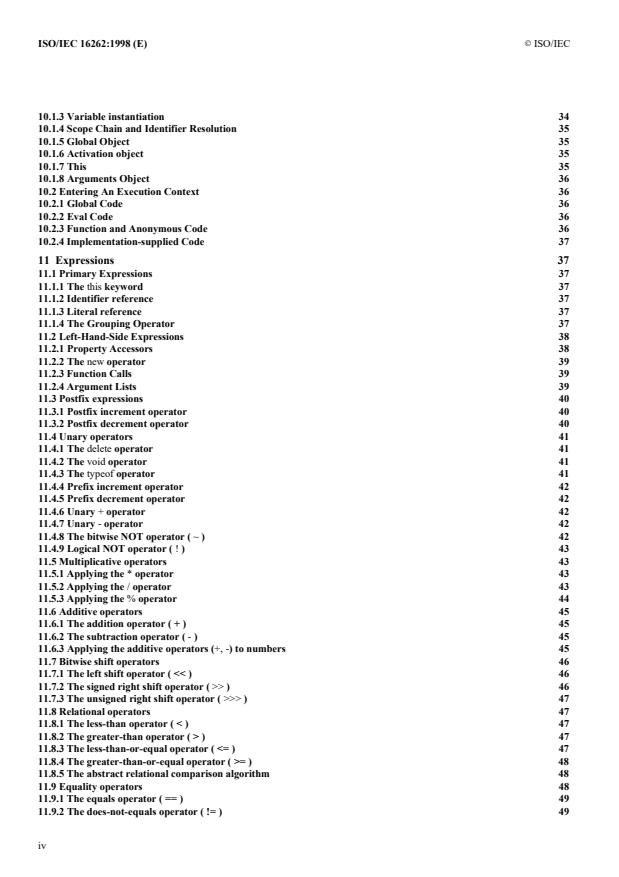
10.1.3 Variable instantiation 34
10.1.4 Scope Chain and Identifier Resolution 35
10.1.5 Global Object 35
10.1.6 Activation object 35
10.1.7 This 35
10.1.8 Arguments Object 36
10.2 Entering An Execution Context 36
10.2.1 Global Code 36
10.2.2 Eval Code 36
10.2.3 Function and Anonymous Code 36
10.2.4 Implementation-supplied Code 37
11 Expressions 37
11.1 Primary Expressions 37
11.1.1 The this keyword 37
11.1.2 Identifier reference 37
11.1.3 Literal reference 37
11.1.4 The Grouping Operator 37
11.2 Left-Hand-Side Expressions 38
11.2.1 Property Accessors 38
11.2.2 The new operator 39
11.2.3 Function Calls 39
11.2.4 Argument Lists 39
11.3 Postfix expressions 40
11.3.1 Postfix increment operator 40
11.3.2 Postfix decrement operator 40
11.4 Unary operators 41
11.4.1 The delete operator 41
11.4.2 The void operator 41
11.4.3 The typeof operator 41
11.4.4 Prefix increment operator 42
11.4.5 Prefix decrement operator 42
11.4.6 Unary + operator 42
11.4.7 Unary - operator 42
11.4.8 The bitwise NOT operator ( ~ ) 42
11.4.9 Logical NOT operator ( ! ) 43
11.5 Multiplicative operators 43
11.5.1 Applying the * operator 43
11.5.2 Applying the / operator 43
11.5.3 Applying the % operator 44
11.6 Additive operators 45
11.6.1 The addition operator ( + ) 45
11.6.2 The subtraction operator ( - ) 45
11.6.3 Applying the additive operators (+, -) to numbers 45
11.7 Bitwise shift operators 46
11.7.1 The left shift operator ( << ) 46
11.7.2 The signed right shift operator ( >> )46
11.7.3 The unsigned right shift operator ( >>> )47
11.8 Relational operators 47
11.8.1 The less-than operator ( < ) 47
11.8.2 The greater-than operator ( > ) 47
11.8.3 The less-than-or-equal operator ( <= ) 47
11.8.4 The greater-than-or-equal operator ( >= ) 48
11.8.5 The abstract relational comparison algorithm 48
11.9 Equality operators 48
11.9.1 The equals operator ( == ) 49
11.9.2 The does-not-equals operator ( != ) 49
iv
ISO/IEC ISO/IEC 16262:1998 (E)
11.9.3 The abstract equality comparison algorithm 49
11.10 Binary bitwise operators 50
11.11 Binary logical operators 50
11.12 Conditional operator ( ?: ) 51
11.13 Assignment operators 51
11.13.1 Simple Assignment ( = ) 52
11.13.2 Compound assignment ( op= ) 52
11.14 Comma operator ( , ) 52
12 Statements 52
12.1 Block 53
12.2 Variable statement 53
12.3 Empty statement 54
12.4 Expression statement 54
12.5 The if statement 55
12.6 Iteration statements 55
12.6.1 The while statement 55
12.6.2 The for statement 56
12.6.3 The for.in statement 57
12.7 The continue statement 57
12.8 The break statement 58
12.9 The return statement 58
12.10 The with statement 58
13 Function Definition 59
14 Program 59
15 Native ECMAScript objects 60
15.1 The Global Object 61
15.1.1 Value properties of the Global Object 61
15.1.2 Function properties of the Global Object 61
15.1.3 Constructor Properties of the Global Object 64
15.1.4 Other Properties of the Global Object 64
15.2 Object Objects 64
15.2.1 The Object Constructor Called as a Function 64
15.2.2 The Object Constructor 64
15.2.3 Properties of the Object Constructor 65
15.2.4 Properties of the Object Prototype Object 65
15.2.5 Properties of Object Instances 65
15.3 Function Objects 65
15.3.1 The Function Constructor Called as a Function 65
15.3.2 The Function Constructor 65
15.3.3 Properties of the Function Constructor 67
15.3.4 Properties of the Function Prototype Object 67
15.3.5 Properties of Function Instances 67
15.4 Array Objects 67
15.4.1 The Array Constructor Called as a Function 67
15.4.2 The Array Constructor 68
15.4.3 Properties of the Array Constructor 68
15.4.4 Properties of the Array Prototype Object 68
15.4.5 Properties of Array Instances 71
15.5 String Objects 71
15.5.1 The String Constructor Called as a Function 71
15.5.2 The String Constructor 71
15.5.3 Properties of the String Constructor 72
15.5.4 Properties of the String Prototype Object 72
15.5.5 Properties of String Instances 75
v
15.6 Boolean Objects 76
15.6.1 The Boolean Constructor Called as a Function 76
15.6.2 The Boolean Constructor 76
15.6.3 Properties of the Boolean Constructor 76
15.6.4 Properties of the Boolean Prototype Object 76
15.6.5 Properties of Boolean Instances 77
15.7 Number Objects 77
15.7.1 The Number Constructor Called as a Function 77
15.7.2 The Number Constructor 77
15.7.3 Properties of the Number Constructor 77
15.7.4 Properties of the Number Prototype Object 78
15.7.5 Properties of Number Instances 78
15.8 The Math Object 78
15.8.1 Value Properties of the Math Object 78
15.8.2 Function Properties of the Math Object 79
15.9 Date Objects 84
15.9.1 Overview of Date Objects and Definitions of Internal Operators 84
15.9.2 The Date Constructor Called As a Function 87
15.9.3 The Date Constructor 88
15.9.4 Properties of the Date Constructor 90
15.9.5 Properties of the Date Prototype Object 93
15.9.6 Properties of Date Instances 98
16 Errors 98
vi
ISO/IEC ISO/IEC 16262:1998 (E)
Foreword
ISO (the International Organization for Standardization) and IEC (the International Electrotechnical Commission) form the
specialized system for worldwide standardization. National bodies that are members of ISO or IEC participate in the
development of International Standards through technical committees established by the respective organization to deal with
particular fields of technical activity. ISO and IEC technical committees collaborate in fields of mutual interest. Other
international organizations, governmental and non-governmental, in liaison with ISO and IEC, also take part in the work.
In the field of information technology, ISO and IEC have established a joint technical committee, ISO/IEC JTC 1. Draft
International Standards adopted by the joint technical committee are circulated to national bodies for voting. Publication as an
International Standard requires approval by at least 75 % of the national bodies casting a vote.
International Standard ISO/IEC 16262 was prepared by ECMA (as ECMA-262) and was adopted, under a special “fast-track
procedure”, by Joint Technical Committee ISO/IEC JTC 1, Information technology, in parallel with its approval by national
bodies of ISO and IEC.
vii
©
INTERNATIONAL STANDARD ISO/IEC ISO/IEC 16262:1998 (E)
Information technology - ECMAScript language specification
1 Scope
This Standard defines the ECMAScript scripting language.
2 Conformance
A conforming implementation of ECMAScript must provide and support all the types, values, objects, properties, functions,
and program syntax described in this specification.
A conforming implementation of this International Standard shall interpret characters in conformance with the Unicode
Standard, Version 2.0, and ISO/IEC 10646-1 with UCS-2 as the adopted encoding form, implementation level 3. If the
adopted ISO/IEC 10646-1 subset is not otherwise specified, it is presumed to be the BMP subset, collection 300.
A conforming implementation of ECMAScript is permitted to provide additional types, values, objects, properties, and
functions beyond those described in this specification. In particular, a conforming implementation of ECMAScript is permitted
to provide properties not described in this specification, and values for those properties, for objects that are described in this
specification.
A conforming implementation of ECMAScript is permitted to support program syntax not described in this specification. In
particular, a conforming implementation of ECMAScript is permitted to support program syntax that makes use of the “future
reserved words” listed in 7.4.3.
3 Normative References
The following standards contain provisions which, through reference in this text, constitute provisions of this International
Standard. At the time of publication, the editions indicated were valid. All standards are subject to revision, and parties to
agreements based on this International Standard are encouraged to investigate the possibility of applying the most recent editions
of the standards indicated below. Members of IEC and ISO maintain registers of currently valid International Standards.
ISO/IEC 9899:1990,
Programming languages – C.
ISO/IEC 10646-1:1993,
Information technology – Universal Multiple-Octet Coded Character Set (UCS) – Part 1:
Architecture and Basic Multilingual Plane.
ISO/IEC 646:1991,
Information technology – ISO 7-bit coded character set for information interchange.
Unicode Inc. (1996), The Unicode Standard™, Version 2.0. ISBN: 0-201-48345-9, Addison-Wesley Publishing Co., Menlo
Park, California.
ANSI/IEEE Std 754-1985: IEEE Standard for Binary Floating-Point Arithmetic. Institute of Electrical and Electronics
Engineers, New York (1985).
4 Overview
This clause contains a non-normative overview of the ECMAScript language.
ECMAScript is an object-oriented programming language for performing computations and manipulating computational
objects within a host environment. ECMAScript as defined here is not intended to be computationally self-sufficient; indeed,
there are no provisions in this specification for input of external data or output of computed results. Instead, it is expected that
the computational environment of an ECMAScript program will provide not only the objects and other facilities described in
this specification but also certain environment-specific host objects, whose description and behaviour are beyond the scope of
this specification except to indicate that they may provide certain properties that can be accessed and certain functions that can
be called from an ECMAScript program.
A scripting language is a programming language that is used to manipulate, customise, and automate the facilities of an
existing system. In such systems, useful functionality is already available through a user interface, and the scripting language
is a mechanism for exposing that functionality to program control. In this way, the existing system is said to provide a host
environment of objects and facilities, which completes the capabilities of the scripting language. A scripting language is
intended for use by both professional and non-professional programmers, and therefore there may be a number of informalities
built into the language.
ECMAScript was originally designed to be a Web scripting language, providing a mechanism to enliven Web pages in
browsers and to perform server computation as part of a Web-based client-server architecture. ECMAScript can provide core
scripting capabilities for a variety of host environments, and therefore the core scripting language is specified in this document
apart from any particular host environment.
Some of the facilities of ECMAScript are similar to those used in other programming languages; in particular Java and Self,
as described in:
Gosling, James, Bill Joy and Guy Steele. The Java Language Specification. Addison Wesley Publishing Co., 1996.
Ungar, David, and Smith, Randall B. Self: The Power of Simplicity. OOPSLA '87 Conference Proceedings, pp. 227–241,
Orlando, FL, October, 1987.
4.1 Web Scripting
A web browser provides an ECMAScript host environment for client-side computation including, for instance, objects that
represent windows, menus, pop-ups, dialog boxes, text areas, anchors, frames, history, cookies, and input/output. Further, the
host environment provides a means to attach scripting code to events such as change of focus, page and image loading,
unloading, error and abort, selection, form submission, and mouse actions. Scripting code appears within the HTML and the
displayed page is a combination of user interface elements and fixed and computed text and images. The scripting code is
reactive to user interaction and there is no need for a main program.
A web server provides a different host environment for server-side computation including objects representing requests, clients,
and files; and mechanisms to lock and share data. By using browser-side and server side scripting together it is possible to
distribute computation between the client and server while providing a customised user interface for a Web-based application.
Each Web browser and server that supports ECMAScript supplies its own host environment, completing the ECMAScript
execution environment.
4.2 Language Overview
The following is an informal overview of ECMAScript—not all parts of the language are described. This overview is not part
of the standard proper.
ECMAScript is object-based: basic language and host facilities are provided by objects, and an ECMAScript program is a
cluster of communicating objects. An ECMAScript object is an unordered collection of properties each with 0 or more
attributes which determine how each property can be used—for example, when the ReadOnly attribute for a property is set to
true, any attempt by executed ECMAScript code to change the value of the property has no effect. Properties are containers
that hold other objects, primitive values, or methods. A primitive value is a member of one of the following built-in types:
Undefined, Null, Boolean, Number, and String; an object is a member of the remaining built-in type Object; and a method is
a function associated with an object via a property.
ECMAScript defines a collection of built-in objects which round out the definition of ECMAScript entities. These built-in
objects include the Global object, the Object object, the Function object, the Array object, the String object, the Boolean
object, the Number object, the Math object, and the Date object.
ECMAScript also defines a set of built-in operators that may not be, strictly speaking, functions or methods. ECMAScript
operators include various unary operations, multiplicative operators, additive operators, bitwise shift operators, relational
operators, equality operators, binary bitwise operators, binary logical operators, assignment operators, and the comma operator.
ECMAScript syntax intentionally resembles Java syntax. ECMAScript syntax is relaxed to enable it to serve as an easy-to-use
scripting language. For example, a variable is not required to have its type declared nor are types associated with properties,
and defined functions are not required to have their declarations appear textually before calls to them.
4.2.1 Objects
ECMAScript does not contain proper classes such as those in C++, Smalltalk, or Java, but rather, supports constructors which
create objects by executing code that allocates storage for the objects and initialises all or part of them by assigning initial
values to their properties. All functions including constructors are objects, but not all objects are constructors. Each constructor
has a Prototype property that is used to implement prototype-based inheritance and shared properties. Objects are created by
using constructors in new expressions; for example, new String("A String") creates a new string object. Invoking a
constructor without using new has consequences that depend on the constructor. For example, String("A String")
produces a primitive string, not an object.
ISO/IEC ISO/IEC 16262:1998 (E)
ECMAScript supports prototype-based inheritance. Every constructor has an associated prototype, and every object created by
that constructor has an implicit reference to the prototype (called the object’s prototype) associated with its constructor.
Furthermore, a prototype may have a non-null implicit reference to its prototype, and so on; this is called the prototype chain.
When a reference is made to a property in an object, that reference is to the property of that name in the first object in the
prototype chain that contains a property of that name. In other words, first the object mentioned directly is examined for such a
property; if that object contains the named property, that is the property to which the reference refers; if that object does not
contain the named property, the prototype for that object is examined next; and so on.
In a class-based object-oriented language, in general, state is carried by instances, methods are carried by classes, and
inheritance is only of structure and behaviour. In ECMAScript, the state and methods are carried by objects, and structure,
behaviour, and state are all inherited.
All objects that do not directly contain a particular property that their prototype contains share that property and its value. The
following diagram illustrates this:
CF is a constructor (and also an object). Five objects have been created by using new expressions: CF1, CF2, CF3, CF4, and
CF5. Each of these objects contains properties named q1 and q2. The dashed lines represent the implicit prototype
relationship; so, for example, CF3’s prototype is CFp. The constructor, CF, has two properties itself, named p1 and p2, which
are not visible to CFp, CF1, CF2, CF3, CF4, or CF5. The property named CFp1 in CFp is shared by CF1, CF2, CF3, CF4, and
CF5, as are any properties found in CFp’s implicit prototype chain which are not named q1, q2, or CFp1. Notice that there is
no implicit prototype link between CFp and CF.
Unlike class-based object languages, properties can be added to objects dynamically by assigning values to them. That is,
constructors are not required to name or assign values to all or any of the constructed object’s properties. In the above
diagram, one could add a new shared property for CF1, CF2, CF3, CF4, and CF5 by assigning a new value to the property in
CFp.
4.3 Definitions
The following are informal definitions of key terms associated with ECMAScript.
4.3.1 Type
A type is a set of data values.
4.3.2 Primitive value
A primitive value is a member of one of the types Undefined, Null, Boolean, Number, or String. A primitive value is a
datum that is represented directly at the lowest level of the language implementation.
4.3.3 Object
An object is a member of the type Object. It is an unordered collection of properties each of which contains a primitive value,
object, or function. A function stored in a property of an object is called a method.
4.3.4 Constructor
A constructor is a function object that creates and initialises objects. Each constructor has an associated prototype object that
is used to implement inheritance and shared properties.
4.3.5 Prototype
A prototype is an object used to implement structure, state, and behaviour inheritance in ECMAScript. When a constructor
creates an object, that object implicitly references the constructor’s associated prototype for the purpose of resolving property
references. The constructor’s associated prototype can be referenced by the program expression constructor.prototype,
and properties added to an object’s prototype are shared, through inheritance, by all objects sharing the prototype.
4.3.6 Native object
A native object is any object supplied by an ECMAScript implementation independent of the host environment. Standard
native objects are defined in this specification. Some native objects are built-in; others may be constructed during the course of
execution of an ECMAScript program.
4.3.7 Built-in object
A built-in object is any object supplied by an ECMAScript implementation, independent of the host environment, which is
present at the start of the execution of an ECMAScript program. Standard built-in objects are defined in this specification, and
the ECMAScript implementation may specify and define others. Every built-in object is a native object.
4.3.8 Host object
A host object is any object supplied by the host environment to complete the execution environment of ECMAScript. Any
object that is not native is a host object.
4.3.9 Undefined value
The undefined value is a primitive value used when a variable has not been assigned a value.
4.3.10 Undefined type
The type Undefined has exactly one value, called undefined.
4.3.11 Null value
The null value is a primitive value that represents the null, empty, or non-existent reference.
4.3.12 Null type
The type Null has exactly one value, called null.
4.3.13 Boolean value
A boolean value is a member of the type Boolean and is one of two unique values, true and false.
4.3.14 Boolean type
The type Boolean represents a logical entity and consists of exactly two unique values. One is called true and the other is
called false.
4.3.15 Boolean object
A boolean object is a member of the type Object and is an instance of the built-in Boolean object. That is, a boolean object is
created by using the Boolean constructor in a new expression, supplying a boolean as an argument. The resulting object has an
implicit (unnamed) property that is the boolean. A boolean object can be coerced to a boolean value. A boolean object can be
used anywhere a boolean value is expected.
This is an example of one of the conveniences built into ECMAScript—in this case, the purpose is to accommodate
programmers of varying backgrounds. Those familiar with imperative or procedural programming languages may find
boolean, string and number values more natural, while those familiar with object-oriented languages may find boolean, string
and number objects more intuitive.
ISO/IEC ISO/IEC 16262:1998 (E)
4.3.16 String value
A string value is a member of the type String and is a finite ordered sequence of zero or more Unicode characters.
4.3.17 String type
The type String is the set of all finite ordered sequences of zero or more Unicode characters.
4.3.18 String object
A string object is a member of the type Object and is an instance of the built-in String object. That is, a string object is created
by using the String constructor in a new expression, supplying a string as an argument. The resulting object has an implicit
(unnamed) property that is the string. A string object can be coerced to a string value. A string object can be used anywhere a
string value is expected.
4.3.19 Number value
A number value is a member of the type Number and is a direct representation of a number.
4.3.20 Number type
The type Number is a set of values representing numbers. In ECMAScript the set of values represent the double-precision 64-
bit format IEEE 754 values including the special “Not-a-Number” (NaN) values, positive infinity, and negative infinity.
4.3.21 Number object
A number object is a member of the type Object and is an instance of the built-in Number object. That is, a number object is
created by using the Number constructor in a new expression, supplying a number as an argument. The resulting object has an
implicit (unnamed) property that is the number. A number object can be coerced to a number value. A number object can be
used anywhere a number value is expected. Note that a number object can have shared properties by adding them to the
Number prototype.
4.3.22 Infinity
The primitive value Infinity represents the positive infinite number value.
4.3.23 NaN
The primitive value NaN represents the set of IEEE Standard “Not-a-Number” values.
5 Notational Conventions
5.1 Syntactic and Lexical Grammars
This clause describes the context-free grammars used in this specification to define the lexical and syntactic structure of an
ECMAScript program.
5.1.1 Context-Free Grammars
A context-free grammar consists of a number of productions. Each production has an abstract symbol called a nonterminal as
its left-hand side, and a sequence of one or more nonterminal and terminal symbols as its right-hand side. For each grammar,
the terminal symbols are drawn from a specified alphabet.
Starting from a sentence consisting of a single distinguished nonterminal, called the goal symbol, a given context-free
grammar specifies a language, namely, the (perhaps infinite) set of possible sequences of terminal symbols that can result
from repeatedly replacing any nonterminal in the sequence with a right-hand side of a production for which the nonterminal is
the left-hand side.
5.1.2 The lexical grammar
A lexical grammar for ECMAScript is given in clause 7. This grammar has as its terminal symbols the characters of the
Unicode character set. It defines a set of productions, starting from the goal symbol InputElement, that describe how sequences
of Unicode characters are translated into a sequence of input elements.
Input elements other than white space and comments form the terminal symbols for the syntactic grammar for ECMAScript
and are called ECMAScript tokens. These tokens are the reserved words, identifiers, literals, and punctuators of the
ECMAScript language. Moreover, line terminators, although not considered to be tokens, also become part of the stream of
input elements and guide the process of automatic semicolon insertion (see 7.8). Simple white space and single-line comments
are simply discarded and do not appear in the stream of input elements for the syntactic grammar. A MultiLineComment (that
is, a comment of the form “/*…*/” regardless of whether it spans more than one line) is likewise simply discarded if it
contains no line terminator; but if a multi-line comment contains one or more line terminators, then it is replaced by a single
line terminator, which becomes part of the stream of input elements for the syntactic grammar.
Productions of the lexical grammar are distinguished by having two colons “::” as separating punctuation.
5.1.3 The numeric string grammar
A second grammar is used for translating strings into numeric values. This grammar is similar to the part of the lexical
grammar having to do with numeric literals and has as its terminal symbols the characters of the Unicode character set. This
grammar appears in clause 9.3.1.
Productions of the numeric string grammar are distinguished by having three colons “:::” as punctuation.
5.1.4 The syntactic grammar
The syntactic grammar for ECMAScript is given in clauses 11, 12, 13, and 14. This grammar has ECMAScript tokens defined
by the lexical grammar as its terminal symbols (see 5.1.2). It defines a set of productions, starting from the goal symbol
Program, that describe how sequences of tokens can form syntactically correct ECMAScript programs.
When a stream of Unicode characters is to be parsed as an ECMAScript program, it is first converted to a stream of input
elements by repeated application of the lexical grammar; this stream of input elements is then parsed by a single application of
the syntax grammar. The program is syntactically in error if the tokens in the stream of input elements cannot be parsed as a
single instance of the goal nonterminal Program, with no tokens left over.
Productions of the syntactic grammar are distinguished by having just one colon “:” as punctuation.
The syntactic grammar as presented in clauses 11, 12, 13, and 14 is actually not a complete account of which token sequences
are accepted as correct ECMAScript programs. Certain additional token sequences are also accepted, namely, those that would
be described by the grammar if only semicolons were added to the sequence in certain places (such as before line terminator
characters). Furthermore, certain token sequences that are described by the grammar are not considered acceptable if a
terminator character appears in certain “awkward” places.
5.1.5 Grammar Notation
Terminal symbols of the lexical and string grammars, and some of the terminal symbols of the syntactic grammar, are shown
in fixed width font, both in the productions of the grammars and throughout this specification whenever the text directly
refers to such a terminal symbol. These are to appear in a program exactly as written.
Nonterminal symbols are shown in italic type. The definition of a nonterminal is introduced by the name of the nonterminal
being defined followed by one or more colons. (The number of colons indicates to which grammar the production belongs.)
One or more alternative right-hand sides for the nonterminal then follow on succeeding lines. For example, the syntactic
definition:
WithStatement :
with ( Expression ) Statement
states that the nonterminal WithStatement represents the token with, followed by a left parenthesis token, followed by an
Expression, followed by a right parenthesis token, followed by a Statement. The occurrences of Expression and Statement are
themselves nonterminals. As another example, the syntactic definition:
ArgumentList :
AssignmentExpression
ArgumentList , AssignmentExpression
states that an ArgumentList may represent either a single AssignmentExpression or an ArgumentList, followed by a comma,
followed by an AssignmentExpression. This definition of ArgumentList is recursive, that is, it is defined in terms of itself. The
result is that an ArgumentList may contain any positive number of arguments, separated by commas, where each argument
expression is an AssignmentExpression. Such recursive definitions of nonterminals are common.
The subscripted suffix “opt”, which may appear after a terminal or nonterminal, indicates an optional symbol. The alternative
containing the optional symbol actually specifies two right-hand sides, one that omits the optional element and one that
includes it. This means that:
ISO/IEC ISO/IEC 16262:1998 (E)
VariableDeclaration :
Identifier Initializer
opt
is a convenient abbreviation for:
VariableDeclaration :
Identifier
Identifier Initializer
and that:
IterationStatement :
for ( ; ; )
Expression Expression Expression Statement
opt opt opt
is a convenient abbreviation for:
IterationStatement :
for ( ; Expression ; Expression ) Statement
opt opt
for ( Expression ; Expression ; Expression ) Statement
opt opt
which in turn is an abbreviation for:
IterationStatement :
for ( ; ; Expression ) Statement
opt
for ( ; Expression ; Expression ) Statement
opt
for ( Expression ; ; Expression ) Statement
opt
for ( Expression ; Expression ; Expression ) Statement
opt
which in turn is an abbreviation for:
IterationStatement :
for ( ; ; ) Statement
for ( ; ; Expression ) Statement
for ( ; Expression ; ) Statement
for ( ; Expression ; Expression ) Statement
for ( Expression ; ; ) Statement
for ( Expression ; ; Expression ) Statement
for ( Expression ; Expression ; ) Statement
for ( Expression ; Expression ; Expression ) Statement
so the nonterminal IterationStatement actually has eight alternative right-hand sides.
If the phrase “[no LineTerminator here]” appears in the right-hand side of a production of the syntactic grammar, it indicates that
the production is a restricted production: it may not be used if a LineTerminator occurs in the input stream at the indicated
position. For example, the production:
ReturnStatement :
return [no LineTerminator here] Expression ;
opt
indicates that the production may not be used if a LineTerminator occurs in the program between the return token and the
Expression.
Unless the presence of a LineTerminator is forbidden by a restricted production, any number of occurrences of LineTerminator
may appear between any two consecutive tokens in the stream of input elements without affecting the syntactic acceptability
of the program.
When the words “one of” follow the colon(s) in a grammar definition, they signify that each of the terminal symbols on the
following line or lines is an alternative definition. For example, the lexical grammar for ECMAScript contains the production:
ZeroToThree :: one of
which is merely a convenient abbreviation for:
ZeroToThree ::
When an alternative in a production of the lexical grammar or the numeric string grammar appears to be a multicharacter
token, it represents the sequence of characters that would make up such a token.
The right-hand side of a production may specify that certain expansions are not permitted by using the phrase “but not” and
then indicating the expansions to be excluded. For example, the production:
Identifier ::
IdentifierName but not ReservedWord
means that the nonterminal Identifier may be replaced by any sequence of characters that could replace IdentifierName
provided that the same sequence of characters could not replace ReservedWord.
Finally, a few nonterminal symbols are described by a descriptive phrase in roman type in cases where it would be impractical
to list all the alternatives:
SourceCharacter ::
any Unicode character
5.2 Algorithm Conventions
The specification often uses a numbered list to specify steps in an algorithm. These algorithms are used to clarify semantics. In
practice, there may be more efficient algorithms available to implement a given feature.
When an algorithm is to produce a value as a result, the directive “return x” is used to indicate that the result of the algorithm
is the value of x and that the algorithm should terminate. The notation Result(n) is used as shorthand for “the result of step n”.
Type(x) is used as shorthand for “the type of x”.
Mathematical operations such as addition, subtraction, negation, multiplication, division, and the mathematical functions
defined later in this clause should always be understood as computing exact mathematical results on mathematical real
numbers, which do not include infinities and do not include a negative zero that is distinguished from positive zero.
Algorithms in this standard that model floating-point arithmetic include explicit steps, where necessary, to handle infinities and
signed zero and to perform rounding. If a mathematical operation or function is applied to a floating-point number, it should
be understood as being applied to the exact mathematical value represented by that floating-point number; such a floating-
point number must be finite, and if it is +0 or −0 then the corresponding mathematical value is simply 0.
The mathematical function abs(x) yields the absolute value of x, which is x if x is negative (less than zero) and otherwise is x
−
itself.
The mathematical function sign(x) yields 1 if x is positive and −1 if x is negative. The sign function is not used in this standard
for cases when x is zero.
The notation “x modulo y” (y must be finite and nonzero) computes a value k of the same sign as y such that abs(k) < abs(y)
and x−k = q⋅y for some integer q.
The mathematical function floor(x) yields the largest integer (closest to positive infinity) that is not larger than x.
NOTE floor(x) = x−(x modulo 1).
ISO/IEC ISO/IEC 16262:1998 (E)
If an algorithm is defined to “generate a runtime error”, execution of the algorithm (and any calling algorithms) is terminated
and no result is returned.
6 Source Text
ECMAScript source text is represented as a sequence of characters representable using the Unicode version 2.0 character
encoding.
SourceCharacter ::
any Unicode character
Except within comments and string literals, every ECMAScript program shall consist of only characters from the first 128
Unicode characters (that is, the first half of row zero). Other Unicode characters may appear only within comments and string
literals. In string literals, any Unicode character may also be expressed as a Unicode escape sequence consisting of six
characters from the first 128 characters, namely \u plus four hexadecimal digits. Within a comment, such an escape sequence
is effectively ignored as part of the comment. Within a string literal, the Unicode escape sequence contributes one character to
the string value of the literal.
Although the characters in an ECMAScript program are Unicode characters, they are treated as independent 16-bit values with
none of the context-dependent interpretation specified in the Unicode standard. Such values are often called “code points”.
The Unicode standard refers to code points as “coded character data elements”. Throughout this International standard the
terms “character” and “code point” are understood to mean “coded character data element”.
NOTE ECMAScript differs from the Java programming language in the behaviour of Unicode escape sequences. In a Java
\u000A
program, if the Unicode escape sequence , for example, occurs within a single-line comment, it is interpreted as a line
terminator (Unicode character 000A is line feed) and therefore the next character is not part of the comment. Similarly, if the
Unicode escape sequence \u000A occurs within a string literal in a Java program, it is likewise interpreted as a line terminator,
which is not allowed within a string literal—one must write \n instead of \u000A to cause a line feed to be part of the string
value of a string literal. In an ECMAScript program, a Unicode escape sequence occurring within a comment is never
interpreted and therefore cannot contribute to termination of the comment. Similarly, a Unicode escape sequence occurring
within a string literal in an ECMAScript program always contributes a character to the string value of the literal and is never
interpreted as a line terminator or as a quote mark that might terminate the string literal.
7 Lexical Conventions
The source text of an ECMAScript program is first converted into a sequence of input elements, which are either tokens, line
terminators, comments, or white space. The source text is scanned from left to right, repeatedly taking the longest possible
sequence of characters as the next input element.
Syntax
InputElement ::
WhiteSpace
LineTerminator
Comment
Token
7.1 White Space
White space characters are used to improve source text readability and to separate tokens (indivisible lexical units) from each
other, but are otherwise insignificant. White space may occur between any two tokens, and may occur within strings (where
they are considered significant characters forming part of the literal string value), but cannot appear within any other kind of
token.
The following characters are considered to be white space:
Unicode Value Name Formal Name
\u0009 Tab
\u000B Vertical Tab
\u000C Form Feed
\u0020 Space
Syntax
WhiteSpace ::
7.2 Line Terminators
Like whitespace characters, line terminator characters are used to improve source text readability and to separate tokens
(indivisible lexical units) from each other. However, unlike whitespace characters, line terminators have some influence over
the behaviour of the syntactic grammar. In general, line terminators may occur between any two tokens, but there are a few
places where they are forbidden by the syntactic grammar. A line terminator cannot occur within any token, not even a string.
Line terminators also affect the process of automatic semicolon insertion (see 7.8).
The following characters are considered to be line terminators:
Unicode Value Name Formal Name
\u000A Line Feed
\u000D Carriage Return
Syntax
LineTerminator ::
7.3 Comments
Description
Comments can be either single or multi-line. Multi-line comments cannot nest.
Because a single-line comment can contain any character except a LineTerminator character, and because of the general rule
that a token is always as long as possible, a single-line comment always consists of all characters from the // marker to the
end of the line. However, the LineTerminator at the end of the line is not considered to be part of the single-line comment; it is
recognised separately by the lexical grammar and becomes part of the stream of input elements for the syntactic grammar. This
point is very important, because it implies that the presence or absence of single-line comments does not affect the process of
automatic semicolon insertion (see 7.8.2).
Comments behave like white space and are discarded except that, if a MultiLineComment contains a line terminator character,
then the entire comment is considered to be a LineTerminator for purposes of parsing by the syntactic grammar.
Syntax
Comment ::
MultiLineComment
SingleLineComment
ISO/IEC ISO/IEC 16262:1998 (E)
MultiLineComment ::
/* MultiLineCommentChars */
opt
MultiLineCommentChars ::
MultiLineNotAsteriskChar MultiLineCommentChars
opt
* PostAsteriskCommentChars
opt
PostAsteriskCommentChars ::
MultiLineNotForwardSlashOrAsteriskChar MultiLineCommentChars
opt
* PostAsteriskCommentChars
opt
MultiLineNotAsteriskChar ::
SourceCharacter but not asterisk *
MultiLineNotForwardSlashOrAsteriskChar ::
SourceCharacter but neither forward-slash / nor asterisk *
SingleLineComment ::
// SingleLineCommentChars
opt
SingleLineCommentChars ::
SingleLineCommentChar SingleLineCommentChars
opt
SingleLineCommentChar ::
SourceCharacter but not LineTerminator
7.4 Tokens
Syntax
Token ::
ReservedWord
Identifier
Punctuator
NumericLiteral
StringLiteral
7.4.1 Reserved Words
Description
Reserved words cannot be used as identifiers.
Syntax
ReservedWord ::
Keyword
FutureReservedWord
NullLiteral
BooleanLiteral
7.4.2 Keywords
The following tokens are ECMAScript keywords and may not be used as identifiers in ECMAScript programs.
Syntax
Keyword :: one of
break for new var
continue function return void
delete if this while
else in typeof with
7.4.3 Future Reserved Words
The following words are used as keywords in proposed extensions and are therefore reserved to allow for the possibility of
future adoption of those extensions.
Syntax
FutureReservedWord :: one of
abstract do import short
bo
...
Questions, Comments and Discussion
Ask us and Technical Secretary will try to provide an answer. You can facilitate discussion about the standard in here.
Loading comments...