

ISO/IEC TS 24718:2025
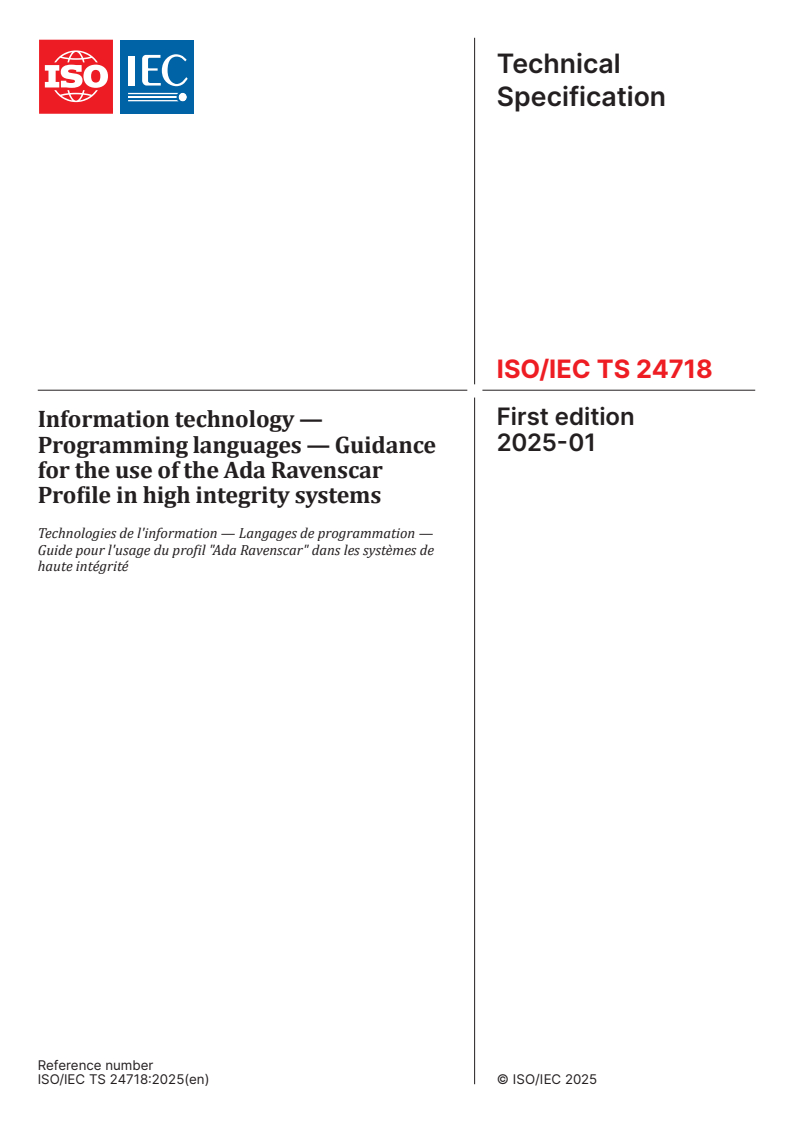
(Main)Information technology — Programming languages — Guidance for the use of the Ada Ravenscar Profile in high integrity systems
General Information
- Abstract
This document provides guidance on the use of the Ravenscar profile for concurrent Ada software intended for verification up to, and including, the very highest levels of integrity. To this end, this document provides a complete description of the motivations behind the Ravenscar profile, to show how conformant programs can be analysed, and to give examples of usage. This document is aimed at a broad audience, including application programmers, implementers of run-time systems, those responsible for defining company or project guidelines, and academics. Familiarity with the Ada language is assumed.
- Status
- Published
- Publication Date
- 23-Jan-2025
- Current Stage
- 6060 - International Standard published
- Start Date
- 24-Jan-2025
- Due Date
- 30-May-2026
- Completion Date
- 24-Jan-2025

Overview
ISO/IEC TS 24718:2025 - Information technology - Programming languages - Guidance for the use of the Ada Ravenscar Profile in high integrity systems - provides focused guidance on using the Ada Ravenscar profile to build concurrent Ada software suitable for verification up to the highest integrity levels. The technical specification explains the motivations behind Ravenscar, maps Ada constructs to a deterministic scheduling model, defines the Ravenscar restrictions (including the pragma Profile (Ravenscar)), and supplies worked examples and verification guidance for implementers, developers and certifiers.
Key topics
- Ravenscar profile definition and rationale - a clear description of the language-level restrictions that enable analyzable, deterministic concurrency.
- Scheduling theory and mappings - how tasks, priorities and dispatching map to real-time scheduling models used for analysis.
- Static existence and synchronization models - static task creation, protected objects, entries, and deterministic communication.
- Deterministic memory and execution models - restrictions that eliminate dynamic allocation and unpredictable behaviors at run time.
- Run-time semantics and errors - rules for locking, queuing, task dispatch, and additional run-time error conditions introduced by Ravenscar.
- Verification techniques - static analysis, scheduling analysis (rate monotonic and response-time methods), formal analysis and certification-oriented checks (e.g., Max_Entry_Queue_Length, priority-ceiling considerations, potentially-blocking operations in protected actions).
- Practical examples - cyclic tasks, event-triggered tasks, protected objects, interrupt handlers, coordination patterns, and an extended annotated application example.
Applications and who should use it
ISO/IEC TS 24718:2025 is targeted at:
- Application programmers developing safety-critical Ada systems
- Run-time system implementers and compiler vendors who must support Ravenscar semantics
- Project or company guideline authors creating development rules for high-integrity systems
- Academics and verification engineers studying analyzable concurrency models
Practical uses include safety-critical, real-time embedded systems where deterministic behavior and rigorous verification are required - for example avionics, automotive, medical devices and industrial control systems. Using the Ravenscar profile simplifies static analysis, enables sound scheduling analysis, and supports evidence-based certification.
Related standards
- Ada language standard (ISO/IEC 8652) - Ravenscar is a profile within the Ada language ecosystem.
- Scheduling and verification literature - the specification aligns Ravenscar semantics with real-time scheduling theory and common verification practices.
For engineers building verifiable, deterministic concurrent Ada applications, ISO/IEC TS 24718:2025 is the definitive guidance on applying the Ravenscar profile effectively.
Relations
- Effective Date
- 04-Feb-2023
Get Certified
Connect with accredited certification bodies for this standard

BSI Group
BSI (British Standards Institution) is the business standards company that helps organizations make excellence a habit.

NYCE
Mexican standards and certification body.
Sponsored listings
Frequently Asked Questions
ISO/IEC TS 24718:2025 is a technical specification published by the International Organization for Standardization (ISO). Its full title is "Information technology — Programming languages — Guidance for the use of the Ada Ravenscar Profile in high integrity systems". This standard covers: This document provides guidance on the use of the Ravenscar profile for concurrent Ada software intended for verification up to, and including, the very highest levels of integrity. To this end, this document provides a complete description of the motivations behind the Ravenscar profile, to show how conformant programs can be analysed, and to give examples of usage. This document is aimed at a broad audience, including application programmers, implementers of run-time systems, those responsible for defining company or project guidelines, and academics. Familiarity with the Ada language is assumed.
This document provides guidance on the use of the Ravenscar profile for concurrent Ada software intended for verification up to, and including, the very highest levels of integrity. To this end, this document provides a complete description of the motivations behind the Ravenscar profile, to show how conformant programs can be analysed, and to give examples of usage. This document is aimed at a broad audience, including application programmers, implementers of run-time systems, those responsible for defining company or project guidelines, and academics. Familiarity with the Ada language is assumed.
ISO/IEC TS 24718:2025 is classified under the following ICS (International Classification for Standards) categories: 35.060 - Languages used in information technology. The ICS classification helps identify the subject area and facilitates finding related standards.
ISO/IEC TS 24718:2025 has the following relationships with other standards: It is inter standard links to ISO/IEC TR 24718:2005. Understanding these relationships helps ensure you are using the most current and applicable version of the standard.
ISO/IEC TS 24718:2025 is available in PDF format for immediate download after purchase. The document can be added to your cart and obtained through the secure checkout process. Digital delivery ensures instant access to the complete standard document.
Standards Content (Sample)
Technical
Specification
ISO/IEC TS 24718
First edition
Information technology —
2025-01
Programming languages — Guidance
for the use of the Ada Ravenscar
Profile in high integrity systems
Technologies de l'information — Langages de programmation —
Guide pour l'usage du profil "Ada Ravenscar" dans les systèmes de
haute intégrité
Reference number
© ISO/IEC 2025
All rights reserved. Unless otherwise specified, or required in the context of its implementation, no part of this publication may
be reproduced or utilized otherwise in any form or by any means, electronic or mechanical, including photocopying, or posting on
the internet or an intranet, without prior written permission. Permission can be requested from either ISO at the address below
or ISO’s member body in the country of the requester.
ISO copyright office
CP 401 • Ch. de Blandonnet 8
CH-1214 Vernier, Geneva
Phone: +41 22 749 01 11
Email: copyright@iso.org
Website: www.iso.org
Published in Switzerland
© ISO/IEC 2025 – All rights reserved
ii
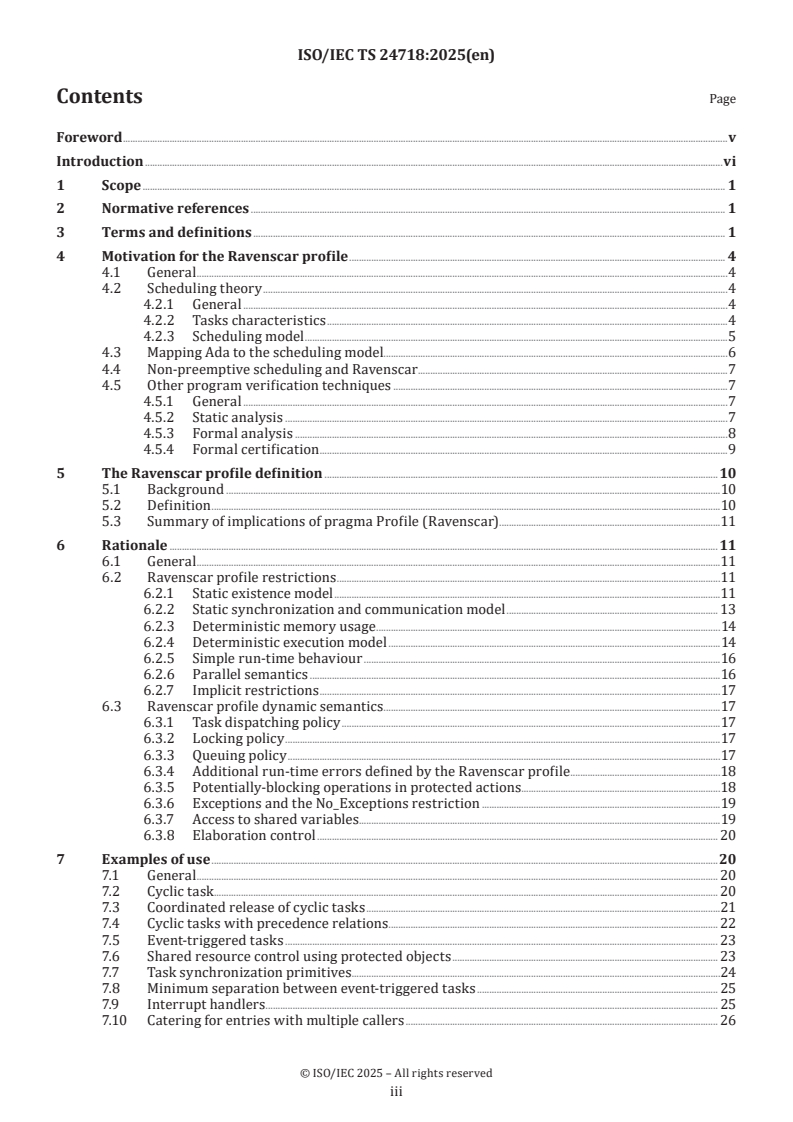
Contents Page
Foreword .v
Introduction .vi
1 Scope . 1
2 Normative references . 1
3 Terms and definitions . 1
4 Motivation for the Ravenscar profile . 4
4.1 General .4
4.2 Scheduling theory .4
4.2.1 General .4
4.2.2 Tasks characteristics .4
4.2.3 Scheduling model .5
4.3 Mapping Ada to the scheduling model.6
4.4 Non-preemptive scheduling and Ravenscar .7
4.5 Other program verification techniques .7
4.5.1 General .7
4.5.2 Static analysis .7
4.5.3 Formal analysis .8
4.5.4 Formal certification .9
5 The Ravenscar profile definition .10
5.1 Background .10
5.2 Definition .10
5.3 Summary of implications of pragma Profile (Ravenscar) .11
6 Rationale .11
6.1 General .11
6.2 Ravenscar profile restrictions .11
6.2.1 Static existence model .11
6.2.2 Static synchronization and communication model . 13
6.2.3 Deterministic memory usage .14
6.2.4 Deterministic execution model .14
6.2.5 Simple run-time behaviour .16
6.2.6 Parallel semantics .16
6.2.7 Implicit restrictions .17
6.3 Ravenscar profile dynamic semantics .17
6.3.1 Task dispatching policy .17
6.3.2 Locking policy .17
6.3.3 Queuing policy .17
6.3.4 Additional run-time errors defined by the Ravenscar profile .18
6.3.5 Potentially-blocking operations in protected actions.18
6.3.6 Exceptions and the No_Exceptions restriction .19
6.3.7 Access to shared variables . .19
6.3.8 Elaboration control . 20
7 Examples of use .20
7.1 General . 20
7.2 Cyclic task. 20
7.3 Coordinated release of cyclic tasks .21
7.4 Cyclic tasks with precedence relations . 22
7.5 Event-triggered tasks . 23
7.6 Shared resource control using protected objects . 23
7.7 Task synchronization primitives.24
7.8 Minimum separation between event-triggered tasks . 25
7.9 Interrupt handlers . 25
7.10 Catering for entries with multiple callers . 26
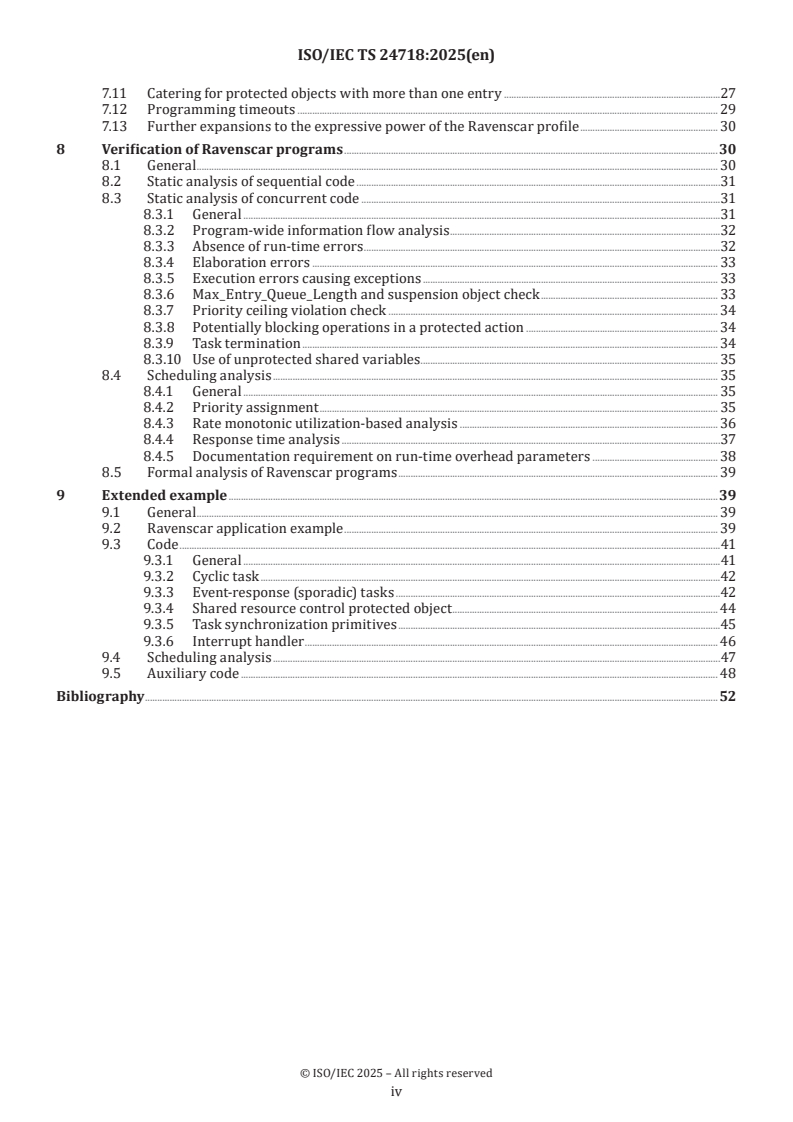
© ISO/IEC 2025 – All rights reserved
iii
7.11 Catering for protected objects with more than one entry .27
7.12 Programming timeouts . 29
7.13 Further expansions to the expressive power of the Ravenscar profile . 30
8 V erification of Ravenscar programs .30
8.1 General . 30
8.2 Static analysis of sequential code .31
8.3 Static analysis of concurrent code .31
8.3.1 General .31
8.3.2 Program-wide information flow analysis .32
8.3.3 Absence of run-time errors .32
8.3.4 Elaboration errors . 33
8.3.5 Execution errors causing exceptions . 33
8.3.6 Max_Entry_Queue_Length and suspension object check . 33
8.3.7 Priority ceiling violation check . 34
8.3.8 Potentially blocking operations in a protected action . 34
8.3.9 Task termination . 34
8.3.10 Use of unprotected shared variables . . 35
8.4 Scheduling analysis . 35
8.4.1 General . 35
8.4.2 Priority assignment . 35
8.4.3 Rate monotonic utilization-based analysis . 36
8.4.4 Response time analysis .37
8.4.5 Documentation requirement on run-time overhead parameters . 38
8.5 Formal analysis of Ravenscar programs . 39
9 Extended example .39
9.1 General . 39
9.2 Ravenscar application example . 39
9.3 Code .41
9.3.1 General .41
9.3.2 Cyclic task .42
9.3.3 Event-response (sporadic) tasks .42
9.3.4 Shared resource control protected object . 44
9.3.5 Task synchronization primitives .45
9.3.6 Interrupt handler . 46
9.4 Scheduling analysis .47
9.5 Auxiliary code . 48
Bibliography .52
© ISO/IEC 2025 – All rights reserved
iv
Foreword
ISO (the International Organization for Standardization) and IEC (the International Electrotechnical
Commission) form the specialized system for worldwide standardization. National bodies that are
members of ISO or IEC participate in the development of International Standards through technical
committees established by the respective organization to deal with particular fields of technical activity.
ISO and IEC technical committees collaborate in fields of mutual interest. Other international organizations,
governmental and non-governmental, in liaison with ISO and IEC, also take part in the work.
The procedures used to develop this document and those intended for its further maintenance are described
in the ISO/IEC Directives, Part 1. In particular, the different approval criteria needed for the different types
of document should be noted. This document was drafted in accordance with the editorial rules of the ISO/
IEC Directives, Part 2 (see www.iso.org/directives or www.iec.ch/members_experts/refdocs).
ISO and IEC draw attention to the possibility that the implementation of this document may involve the
use of (a) patent(s). ISO and IEC take no position concerning the evidence, validity or applicability of any
claimed patent rights in respect thereof. As of the date of publication of this document, ISO and IEC had not
received notice of (a) patent(s) which may be required to implement this document. However, implementers
are cautioned that this may not represent the latest information, which may be obtained from the patent
database available at www.iso.org/patents and https://patents.iec.ch. ISO and IEC shall not be held
responsible for identifying any or all such patent rights.
Any trade name used in this document is information given for the convenience of users and does not
constitute an endorsement.
For an explanation of the voluntary nature of standards, the meaning of ISO specific terms and expressions
related to conformity assessment, as well as information about ISO's adherence to the World Trade
Organization (WTO) principles in the Technical Barriers to Trade (TBT) see www.iso.org/iso/foreword.html.
In the IEC, see www.iec.ch/understanding-standards.
This document was prepared by Joint Technical Committee ISO/IEC JTC 1, Information technology,
Subcommittee SC 22, Programming languages, their environments and system software interfaces.
This first edition cancels and replaces the first edition (ISO/IEC TR 24718:2005).
The main changes are as follows:
— a relatively minor change to the use of a newer syntactic form for specifying aspects of entities, such as
the relative priority of a task, rather than the prior use of pragmas;
— a more important change resulting from updates to the definition of the Ravenscar profile, in which
support for multiple cores is now included. The primary change is to specify that all assignments of tasks
to CPUs are static. In addition, some language-defined facilities are specified as not required or included
in the profile for the sake of ensuring a relatively simple run-time library implementation.
Any feedback or questions on this document should be directed to the user’s national standards
body. A complete listing of these bodies can be found at www.iso.org/members.html and
www.iec.ch/national-committees.
© ISO/IEC 2025 – All rights reserved
v
Introduction
0.1 General
There is an increasing recognition that the software components of critical real-time applications can be
demonstrated as predictable. This is particularly the case for a hard real-time system, in which the failure
of a component of the system to meet its timing deadline can result in an unacceptable degradation of the
whole system. The choice of a suitable design and development method, in conjunction with supporting tools
that enable the real-time performance of a system to be analysed and simulated, can lead to a high level of
confidence that the final system meets its real-time constraints.
Traditional methods used for the design and development of complex applications, which concentrate
primarily on functionality, are increasingly inadequate for hard real-time systems. This is because non-
functional requirements such as dependability (e.g. safety and reliability), timeliness, memory usage and
dynamic change management are left until too late in the development cycle.
The traditional approach to formal verification and certification of critical real-time systems has been to
dispense entirely with separate processes, each with their own independent thread of control, and to use
a cyclic executive that calls a series of procedures in a fully deterministic manner. Such a system becomes
easy to analyse but is difficult to design for systems of more than moderate complexity, inflexible to change,
and not well suited to applications where sporadic activity can occur and where error recovery is important.
Moreover, it can lead to poor software engineering if small procedures must be artificially constructed to fit
the cyclic schedule.
The use of the Ada programming language has proven to be of great value within high-integrity and real-
time applications, albeit via language subsets of deterministic constructs, to ensure full analysability of
the code. Such subsets have been defined for ISO/IEC 8652:1987 (conventionally known as “Ada 83” by
language users), but these have excluded tasking on the grounds of its non-determinism and inefficiency.
Subsequent advances in the area of schedulability analysis have allowed hard deadlines to be checked, even
in the presence of a run-time system that enforces pre-emptive task scheduling based on multiple priorities.
This valuable research work has been mapped onto a number of new Ada constructs and rules that have
been incorporated into the Real-Time Annex of the Ada language Standard (ISO/IEC 8652:2023, Annex D).
This evolution has opened the way for these tasking constructs to be used in high integrity subsets while
retaining the core elements of predictability and reliability.
The Ravenscar profile is a subset of the tasking model as defined in ISO/IEC 8652:2023. It is restricted to meet
the real-time community requirements for determinism, schedulability analysis and memory-boundedness,
and is also suitable for mapping to a small and efficient run-time system that supports task synchronization
and communication, and which can be certifiable to the highest integrity levels. The concurrency model
promoted by the Ravenscar profile is consistent with the use of tools that allow the static properties of
programs to be verified. Applicable verification techniques include information flow analysis, schedulability
analysis, execution-order analysis and model checking. These techniques allow analyses of a system to be
performed throughout its development life cycle, thus avoiding the common problem of discovering only
during system integration and testing that the design fails to meet its non-functional requirements.
It is important to note that the Ravenscar profile is silent on the non-tasking (i.e. sequential) aspects of the
language. For example, it does not dictate how exceptions should, or should not, be used. For any application
in the intended domain, it is likely that constraints on the sequential part of the language will be required.
These can be due to other forms of static analysis to be applied to the code, or to enable worst-case execution
time information to be derived for the sequential code. See ISO/IEC TR 15942 for a detailed discussion on all
aspects of static analysis of sequential Ada.
The Ravenscar profile has been designed such that the restricted form of tasking that it defines can be used
even for software that should be verified to the very highest integrity levels. The Ravenscar profile has
already been included in ISO/IEC TR 15942.
0.2 Structure
The document is organized as follows. The motivation for the development of the Ravenscar profile is given
in Clause 4. Clause 4 also includes the definition of the profile as specified by ISO/IEC 8652:2023 (the Ada
© ISO/IEC 2025 – All rights reserved
vi
Standard); the definition is included here for convenience, but this document is not the definitive statement
of the profile. In Clause 6, the rationale for each aspect of the profile is described. Examples of usage are then
provided in Clause 7. The need for verification is an important design goal for the Ravenscar profile: Clause 8
reviews the verification approach appropriate to Ravenscar programs. Finally, in Clause 9 an extended
example is given.
0.3 Conventions
For all Ada-related terms, this document follows the style of the ISO/IEC 8652:2023 (the Ada standard): it
uses a distinct font where there is a reference to defined syntax entities (e.g. delay_relative_statement).
© ISO/IEC 2025 – All rights reserved
vii
Technical Specification ISO/IEC TS 24718:2025(en)
Information technology — Programming languages —
Guidance for the use of the Ada Ravenscar Profile in high
integrity systems
1 Scope
This document provides guidance on the use of the Ravenscar profile for concurrent Ada software intended
for verification up to, and including, the very highest levels of integrity.
To this end, this document provides a complete description of the motivations behind the Ravenscar profile,
to show how conformant programs can be analysed, and to give examples of usage.
This document is aimed at a broad audience, including application programmers, implementers of run-time
systems, those responsible for defining company or project guidelines, and academics. Familiarity with the
Ada language is assumed.
2 Normative references
There are no normative references in this document.
3 Terms and definitions
For the purposes of this document, the following terms and definitions apply.
ISO and IEC maintain terminology databases for use in standardization at the following addresses:
— ISO Online browsing platform: available at https:// www .iso .org/ obp
— IEC Electropedia: available at https:// www .electropedia .org/
3.1
atomic
type of operation performed by a task that is guaranteed to always produce the same effect as if it were
executed in total isolation and without interruption
3.2
blocked
waiting for mutually exclusive access to a shared resource that is currently held by a lower priority task
3.3
bounded error
implementation- or language-defined error in the application program whose effect is predictable and
documented
3.4
ceiling priority
static default priority of a shared resource greater than or equal to the highest priority of any accessing task
3.5
context switch
replacement of one task by another as the executing task on a processor
© ISO/IEC 2025 – All rights reserved
3.6
critical region
sequence of statements that appear to be executed indivisibly
3.7
critical task
task whose deadline (3.10) is significant and whose failure to meet its deadline can cause system failure
3.8
cyclic executive
system scheduler that uses procedure calls to execute each periodic process in a predetermined sequence at
a predetermined rate
3.9
cyclic task
periodic task
task whose execution is repeated based on a fixed period of time
3.10
deadline
maximum time allowed to a task to produce a response following its invocation
3.11
deadlock
situation in which a group of tasks (possibly the whole system) block each other permanently
3.12
dynamic testing
analysis method that determines properties of the software by observing its execution
Note 1 to entry: See static analysis (3.28).
3.13
epilogue
code executed by the Ada run-time system to finish service to protected calls
3.14
event-triggered task
task whose invocation is triggered either by an asynchronous action by another task, or by an external
stimulus such as an interrupt
3.15
finalization
operation which occurs for controlled objects at the point of their destruction
Note 1 to entry: See ISO/IEC 8652:2023, 7.6 for further information.
3.16
jitter
variation in time between the occurrence of a periodic event and a period of the same frequency
3.17
livelock
situation in which several tasks (possibly comprising the whole system) remain ready to run, and execute,
but fail to make progress
3.18
liveness
system property implying that a set of tasks will reach all desirable states
© ISO/IEC 2025 – All rights reserved
3.19
mode change
change in operating characteristics of a system that requires a co-ordinated change in the operation of
several different processes in the system
3.20
monitor
module containing one or more critical regions (3.6) such that all variables potentially accessed under
mutual exclusion are hidden and all procedure calls are guaranteed to execute with mutual exclusion
3.21
mutex
locking mechanism used to ensure mutually exclusive access to a shared resource
3.22
overhead
execution time within the Ada run-time system which is included in the schedulability analysis
3.23
priority inversion
situation in which a high-priority task is blocked (3.2) waiting for a shared resource (including the processor
itself) currently in use by a low-priority task
3.24
race condition
timing condition that causes processes to operate in an unpredictable sequence so that operation of the
system can be incorrect
3.25
ready
state of a task when it is no longer suspended (3.29) (but not necessarily executing, depending on available
processor resources)
3.26
safety
system property implying that a set of tasks cannot reach any undesirable state from any desirable state
3.27
sporadic task
event-triggered task (3.14) with defined minimum inter-arrival time
3.28
static analysis
group of analysis techniques that determine properties of the system from analysis of the program source code
Note 1 to entry: See dynamic testing (3.12).
3.29
suspended
state of a task when its execution is stopped due to execution of a language-defined construct that waits for
a given time (e.g. a delay statement) or an event
3.30
suspending operation
operation which causes the current task to be suspended (3.29) until released by another task, a timer event
or an interrupt handler
3.31
suspension object
Ada construct which is used for basic task synchronization, i.e. suspend and resume, which does not involve
data transfer
© ISO/IEC 2025 – All rights reserved
Note 1 to entry: See ISO/IEC 8652:2023, D.10.
3.32
time-triggered task
task whose invocation is triggered by the expiry of a delay set by that task
3.33
worst-case execution time
maximum bound on the time required to execute some sequential code
4 Motivation for the Ravenscar profile
4.1 General
Before describing the Ravenscar profile in detail, this clause explains some of the reasoning behind its
features. These primarily come from the need to be able to verify concurrent real-time programs, and to
have these programs implemented reliably and efficiently.
This clause examines mainly scheduling theory, as this is the main driver for the definition of the restrictions
of the Ravenscar profile. In addition, there is a subclause that summarizes other program verification
techniques that can be used with the profile.
4.2 Scheduling theory
4.2.1 General
State-of-the-art research in scheduling theory has found that accurate analysis of real-time behaviour is
possible given a careful choice of scheduling or dispatching method together with suitable restrictions on
the interactions allowed between tasks. An example of a scheduling method is fixed priority pre-emptive
scheduling, in which each process has a static priority and the scheduler ensures that the currently selected
process is the ready process with the highest priority. Examples of analysis schemes are rate monotonic
[5] [6]
analysis (RMA) and response time analysis (RTA).
Fixed-priority pre-emptive scheduling is normally used with a Priority Ceiling Protocol (PCP) to avoid
unbounded priority inversion and the risk of circular deadlock on access to shared resources. Adoption of
the PCP provides a model suitable for the analysis of concurrent real-time systems. The approach supports
cyclic and sporadic activities, the notions of hard, soft, firm, and non-critical application components,
and controlled communication and synchronization among application components. It is also scalable to
programs for distributed and multiprocessor systems.
Tool support exists for RMA and RTA, and for the static simulation of concurrent real-time programs. The
primary aim of analysing the real-time behaviour of a system is to determine whether it can be scheduled
in such a way that it is guaranteed to meet its timing constraints. Whether the timing constraints are
appropriate for meeting the requirements of the application is not an issue for scheduling analysis. Such
verification requires a more formal model of the program and the application of techniques such as model
checking, see 4.5.
4.2.2 Tasks characteristics
The various tasks in an application will each have timing constraints, which correspond to deadlines.
Each task is classified into one of the following four basic levels of criticality according to the importance of
meeting its deadline.
— Hard: a hard deadline task is one that is required to meet its deadline. The failure of such a task to meet
its deadline can result in an unacceptable failure at the system level.
— Firm: a firm deadline task is one that is required to meet its deadline under “average” or “normal”
conditions. An occasional missed deadline can be tolerated without causing system failure (but can
© ISO/IEC 2025 – All rights reserved
result in degraded system performance). There is no value, and thus there is a system-level degradation
of service, in completing a firm task after its deadline.
— Soft: a soft deadline task is also one that is required to meet its deadline under “average” or “normal”
conditions. An occasional missed deadline can be tolerated without causing system failure (but can
result in degraded system performance). There is value in completing a soft task even if it has missed its
deadline.
— Non-critical: a non-critical task has no strict deadline. Such a task is typically a background task
that performs activities such as system logging. Failure of a non-critical task does not endanger the
performance of the system.
4.2.3 Scheduling model
At any moment in time, some tasks can be ready to run, meaning that they are able to execute instructions
if processor time is made available. Others are suspended, meaning that they cannot execute until some
event occurs, or blocked, meaning that they await access to a shared resource that is currently exclusively
owned by another task. Suspended tasks can become ready synchronously (as a result of an action taken
by a currently running task) or asynchronously (as a result of an external event, such as an interrupt or
timeout, that is not directly stimulated by the current task).
With priority-based pre-emptive scheduling on a mono-processor, a priority is assigned to each task and the
scheduler ensures that the highest priority ready task is always executing. If a task with a priority higher
than the currently running task becomes ready, the scheduler performs a context switch, as soon as it can, to
enable the higher-priority task to begin or resume execution. The term “pre-emptive” indicates that this can
occur because of an asynchronous event (i.e. one that is not caused by the running task).
Tasks will normally be required to interact as a result of contention for shared resources, exchange of data,
and the need to synchronize their activities. Uncontrolled use of such interactions can lead to a number of
problems:
— Unbounded priority inversion (also known as blocking): where a high-priority task is blocked awaiting
a resource in use by a low-priority task. As a result, ready tasks of intermediate priority can hold up the
high priority task for an unbounded amount of time since they will run in preference to the low priority
task that has locked the resource.
— Deadlock: where a group of tasks (possibly the whole system) block each other permanently due to
circularities in the ownership of and the contention for shared resources.
— Livelock: where several tasks (possibly the whole system) remain ready to run, and do indeed execute,
but fail to make progress due to circular data dependencies between the tasks that can never be broken.
— Missed deadline: where a task fails to complete its response before its deadline has expired due to factors
such as system overload, excessive pre-emption, excessive blocking, deadlocks, livelocks or overruns.
The restricted scheduling model that is defined by the Ravenscar profile is designed to minimize the
upper bound on blocking time, to prevent deadlocks and (via tool support) to verify that there is sufficient
processing power available to ensure that all critical tasks meet their deadlines.
In this model, tasks do not interact directly, but instead interact via shared resources known as protected
objects. Each protected object typically provides either a resource access control function (including a
repository for the private data to manage and implement the resource), or a synchronization function, or a
combination of both.
A protected object that is used for resource access control requires a mutual exclusion facility, commonly
known as a monitor or critical region, where a maximum of one task at a time can have access to the object.
During the period that a task has access to the object, the task is not allowed to perform any operation
that can result in it becoming suspended. Ada directly supports protected objects and disallows internal
suspension within these objects.
© ISO/IEC 2025 – All rights reserved
A protected object that is used for synchronization provides a signalling facility, whereby tasks can signal
and/or wait on events. In the Ravenscar profile definition, the use of protected objects for synchronization
by the critical tasks is constrained so that at most one task can wait on each protected object. A simplified
version of wait/signal is also provided in the Ravenscar profile via the Ada real-time annex functionality
known as suspension objects (see ISO/IEC 8652:2023, D.10). These can be used in preference to the protected
object approach for simple resumption of a suspended task, whereas the protected object approach should
be used when more complex resumption semantics are required, for example, including deterministic (race-
condition-free) exchange of data between signaller and waiter tasks.
The Ravenscar profile definition ensures the absence of deadlocks by requiring use of an appropriate locking
policy. This policy requires a ceiling priority to be assigned to each protected object that is no lower than
the highest priority of all its calling tasks, and results in the raising of the priority of the task that is using
the protected object to this ceiling priority value. In addition to the absence of deadlocks, this policy also
allows an almost optimal time bound on the worst-case blocking time to be computed for use within the
schedulability analysis, thereby eliminating the unbounded priority inversion problem. This time bound is
calculated as the maximum time that the object is in use by lower-priority tasks. Therefore, the smaller
the worst-case time bound for this blocking period, the greater the likelihood that the task set will be
schedulable.
The use of priority-based pre-emptive dispatching defines a mechanism for scheduling. The scheduling
policy is defined by the mapping of tasks to priority values. Many different schemes exist for different
temporal characteristics of the tasks and other factors such as criticality. What most of these schemes
require is an adequate range of distinct priority values. Ada and the Ravenscar profile ensure this.
The Ada programming language also provides another facility to help control object sharing: the atomic
aspect. All reads and updates applied to an object marked with the atomic aspect are indivisible. Moreover,
all tasks of the program (on all processors) that read or update an object marked atomic will see the same
order of updates, as that marking also makes the object volatile. The language defines such reads and
updates as interactions of the program with the external environment (memory in this case). However, for
safe sharing of atomic objects, static assurance of a proper read/write protocol is highly recommended. In
order to map Ada to the scheduling model being discussed here, however, protected objects are the primary
and preferable abstraction as they are inherently safe.
4.3 Mapping Ada to the scheduling model
The analysis of an Ada application that makes unrestricted use of Ada run-time features including tasking
rendezvous, select statements and abort is not currently feasible. In addition, the non-deterministic and
potentially unbounded behaviour of many tasking and other run-time calls can make it impossible to
provide the upper bounds on execution time that are used to perform schedulability analysis and scheduling
simulation. Thus, Ada coding style rules and subset restrictions should be followed to ensure that all code
within critical tasks is statically time-bounded, and that the execution of the tasks can be defined in terms of
response times, deadlines, cycle times, and blocking times due to contention for shared resources.
The application is decomposed into a number of separate tasks, each with a single thread of control, with
...