


ISO/IEC 16262:2002
(Main)Information technology - ECMAScript language specification
Information technology - ECMAScript language specification
ISO/IEC 16262:2002 defines the ECMAScript scripting language.
Technologies de l'information - ECMAscript spécifications du langage
General Information
- Status
- Withdrawn
- Publication Date
- 12-Jun-2002
- Withdrawal Date
- 12-Jun-2002
- Current Stage
- 9599 - Withdrawal of International Standard
- Start Date
- 25-May-2011
- Completion Date
- 14-Feb-2026
Relations
- Effective Date
- 19-Dec-2009
- Effective Date
- 15-Apr-2008
Get Certified
Connect with accredited certification bodies for this standard

BSI Group
BSI (British Standards Institution) is the business standards company that helps organizations make excellence a habit.

NYCE
Mexican standards and certification body.
Sponsored listings
Frequently Asked Questions
ISO/IEC 16262:2002 is a standard published by the International Organization for Standardization (ISO). Its full title is "Information technology - ECMAScript language specification". This standard covers: ISO/IEC 16262:2002 defines the ECMAScript scripting language.
ISO/IEC 16262:2002 defines the ECMAScript scripting language.
ISO/IEC 16262:2002 is classified under the following ICS (International Classification for Standards) categories: 35.060 - Languages used in information technology. The ICS classification helps identify the subject area and facilitates finding related standards.
ISO/IEC 16262:2002 has the following relationships with other standards: It is inter standard links to ISO/IEC 16262:2011, ISO/IEC 16262:1998. Understanding these relationships helps ensure you are using the most current and applicable version of the standard.
ISO/IEC 16262:2002 is available in PDF format for immediate download after purchase. The document can be added to your cart and obtained through the secure checkout process. Digital delivery ensures instant access to the complete standard document.
Standards Content (Sample)
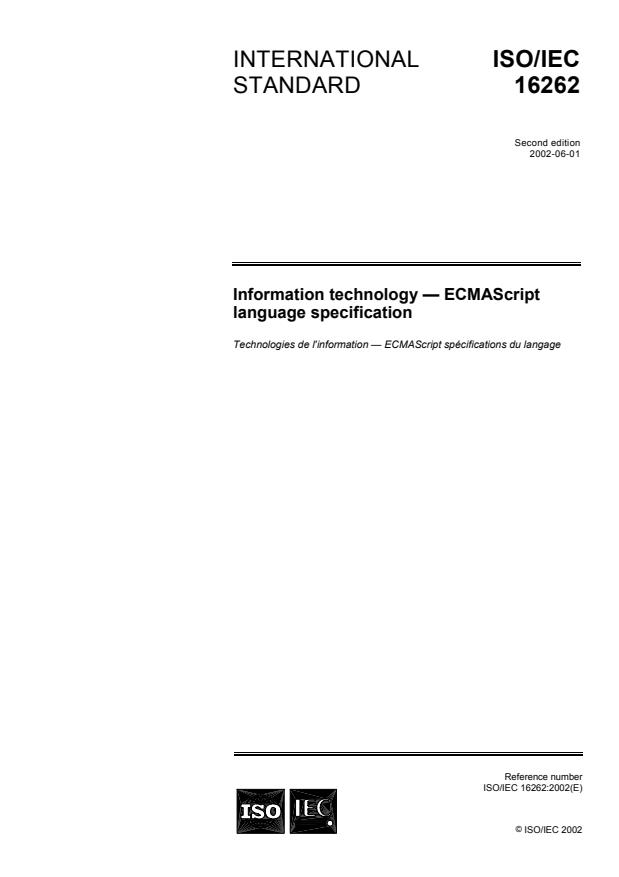
INTERNATIONAL ISO/IEC
STANDARD 16262
Second edition
2002-06-01
Information technology — ECMAScript
language specification
Technologies de l'information — ECMAScript spécifications du langage
Reference number
©
ISO/IEC 2002
PDF disclaimer
This PDF file may contain embedded typefaces. In accordance with Adobe's licensing policy, this file may be printed or viewed but shall not
be edited unless the typefaces which are embedded are licensed to and installed on the computer performing the editing. In downloading this
file, parties accept therein the responsibility of not infringing Adobe's licensing policy. The ISO Central Secretariat accepts no liability in this
area.
Adobe is a trademark of Adobe Systems Incorporated.
Details of the software products used to create this PDF file can be found in the General Info relative to the file; the PDF-creation parameters
were optimized for printing. Every care has been taken to ensure that the file is suitable for use by ISO member bodies. In the unlikely event
that a problem relating to it is found, please inform the Central Secretariat at the address given below.
© ISO/IEC 2002
All rights reserved. Unless otherwise specified, no part of this publication may be reproduced or utilized in any form or by any means, electronic
or mechanical, including photocopying and microfilm, without permission in writing from either ISO at the address below or ISO's member body
in the country of the requester.
ISO copyright office
Case postale 56 • CH-1211 Geneva 20
Tel. + 41 22 749 01 11
Fax + 41 22 749 09 47
E-mail copyright@iso.ch
Web www.iso.ch
Printed in Switzerland
ii © ISO/IEC 2002 – All rights reserved
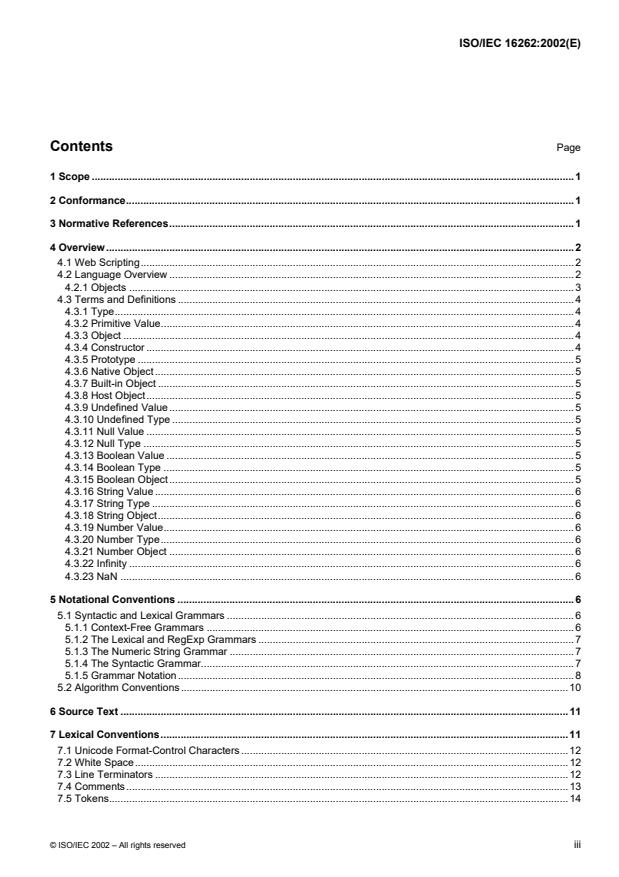
Contents Page
1 Scope .1
2 Conformance.1
3 Normative References.1
4 Overview.2
4.1 Web Scripting.2
4.2 Language Overview .2
4.2.1 Objects .3
4.3 Terms and Definitions .4
4.3.1 Type.4
4.3.2 Primitive Value.4
4.3.3 Object .4
4.3.4 Constructor .4
4.3.5 Prototype .5
4.3.6 Native Object .5
4.3.7 Built-in Object .5
4.3.8 Host Object.5
4.3.9 Undefined Value.5
4.3.10 Undefined Type .5
4.3.11 Null Value .5
4.3.12 Null Type .5
4.3.13 Boolean Value .5
4.3.14 Boolean Type .5
4.3.15 Boolean Object.5
4.3.16 String Value .6
4.3.17 String Type .6
4.3.18 String Object.6
4.3.19 Number Value.6
4.3.20 Number Type.6
4.3.21 Number Object .6
4.3.22 Infinity .6
4.3.23 NaN .6
5 Notational Conventions .6
5.1 Syntactic and Lexical Grammars .6
5.1.1 Context-Free Grammars .6
5.1.2 The Lexical and RegExp Grammars .7
5.1.3 The Numeric String Grammar .7
5.1.4 The Syntactic Grammar.7
5.1.5 Grammar Notation.8
5.2 Algorithm Conventions.10
6 Source Text .11
7 Lexical Conventions.11
7.1 Unicode Format-Control Characters.12
7.2 White Space.12
7.3 Line Terminators .12
7.4 Comments.13
7.5 Tokens.14
© ISO/IEC 2002 – All rights reserved iii
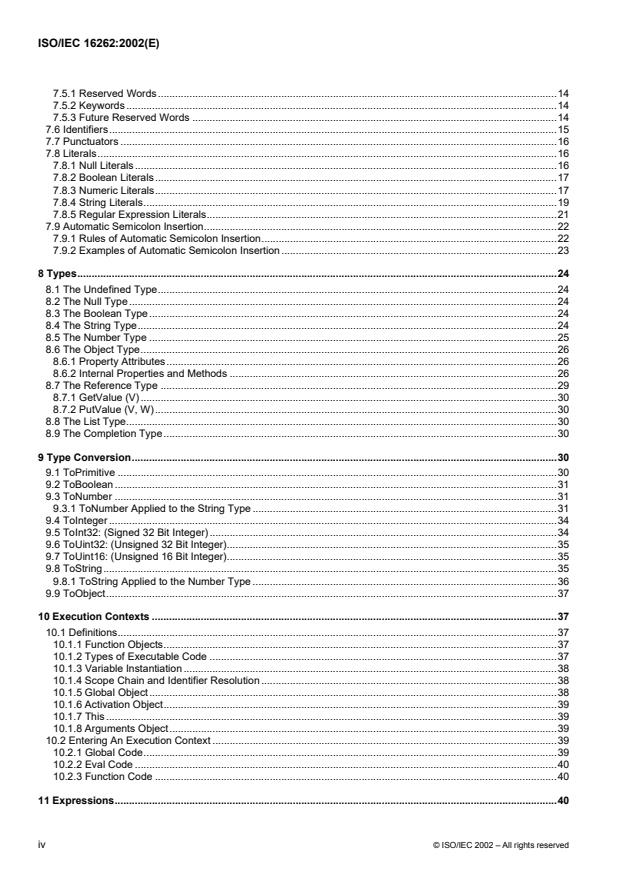
7.5.1 Reserved Words.14
7.5.2 Keywords.14
7.5.3 Future Reserved Words .14
7.6 Identifiers.15
7.7 Punctuators .16
7.8 Literals.16
7.8.1 Null Literals.16
7.8.2 Boolean Literals.17
7.8.3 Numeric Literals.17
7.8.4 String Literals.19
7.8.5 Regular Expression Literals.21
7.9 Automatic Semicolon Insertion.22
7.9.1 Rules of Automatic Semicolon Insertion.22
7.9.2 Examples of Automatic Semicolon Insertion .23
8 Types.24
8.1 The Undefined Type.24
8.2 The Null Type.24
8.3 The Boolean Type.24
8.4 The String Type.24
8.5 The Number Type .25
8.6 The Object Type.26
8.6.1 Property Attributes.26
8.6.2 Internal Properties and Methods .26
8.7 The Reference Type .29
8.7.1 GetValue (V).30
8.7.2 PutValue (V, W).30
8.8 The List Type.30
8.9 The Completion Type.30
9 Type Conversion.30
9.1 ToPrimitive .30
9.2 ToBoolean .31
9.3 ToNumber .31
9.3.1 ToNumber Applied to the String Type .31
9.4 ToInteger .34
9.5 ToInt32: (Signed 32 Bit Integer).34
9.6 ToUint32: (Unsigned 32 Bit Integer).35
9.7 ToUint16: (Unsigned 16 Bit Integer).35
9.8 ToString.35
9.8.1 ToString Applied to the Number Type .36
9.9 ToObject.37
10 Execution Contexts .37
10.1 Definitions.37
10.1.1 Function Objects.37
10.1.2 Types of Executable Code .37
10.1.3 Variable Instantiation .38
10.1.4 Scope Chain and Identifier Resolution .38
10.1.5 Global Object.38
10.1.6 Activation Object.39
10.1.7 This .39
10.1.8 Arguments Object.39
10.2 Entering An Execution Context .39
10.2.1 Global Code.39
10.2.2 Eval Code .40
10.2.3 Function Code .40
11 Expressions.40
iv © ISO/IEC 2002 – All rights reserved
11.1 Primary Expressions .40
11.1.1 The this Keyword.40
11.1.2 Identifier Reference .40
11.1.3 Literal Reference .40
11.1.4 Array Initialiser.40
11.1.5 Object Initialiser.42
11.1.6 The Grouping Operator .43
11.2 Left-Hand-Side Expressions .43
11.2.1 Property Accessors .44
11.2.2 The new Operator.44
11.2.3 Function Calls.45
11.2.4 Argument Lists.45
11.2.5 Function Expressions .45
11.3 Postfix Expressions.46
11.3.1 Postfix Increment Operator .46
11.3.2 Postfix Decrement Operator.46
11.4 Unary Operators.46
11.4.1 The delete Operator.46
11.4.2 The void Operator.47
11.4.3 The typeof Operator .47
11.4.4 Prefix Increment Operator .47
11.4.5 Prefix Decrement Operator .47
11.4.6 Unary + Operator .47
11.4.7 Unary - Operator .48
11.4.8 Bitwise NOT Operator ( ~ ).48
11.4.9 Logical NOT Operator ( ! ).48
11.5 Multiplicative Operators.48
11.5.1 Applying the * Operator .49
11.5.2 Applying the / Operator .49
11.5.3 Applying the % Operator .49
11.6 Additive Operators .50
11.6.1 The Addition operator ( + ) .50
11.6.2 The Subtraction Operator ( - ) .51
11.6.3 Applying the Additive Operators ( +,- ) to Numbers .51
11.7 Bitwise Shift Operators.51
11.7.1 The Left Shift Operator ( << ) .51
11.7.2 The Signed Right Shift Operator ( >> ) .52
11.7.3 The Unsigned Right Shift Operator ( >>> ) .52
11.8 Relational Operators .52
11.8.1 The Less-than Operator ( < ).53
11.8.2 The Greater-than Operator ( > ) .53
11.8.3 The Less-than-or-equal Operator ( <= ) .53
11.8.4 The Greater-than-or-equal Operator ( >= ) .53
11.8.5 The Abstract Relational Comparison Algorithm .54
11.8.6 The instanceof operator .54
11.8.7 The in operator .54
11.9 Equality Operators .55
11.9.1 The Equals Operator ( == ) .55
11.9.2 The Does-not-equals Operator ( != ).55
11.9.3 The Abstract Equality Comparison Algorithm .56
11.9.4 The Strict Equals Operator ( === ).57
11.9.5 The Strict Does-not-equal Operator ( !== ) .57
11.9.6 The Strict Equality Comparison Algorithm.57
11.10 Binary Bitwise Operators .57
11.11 Binary Logical Operators .58
11.12 Conditional Operator ( ?: ) .59
11.13 Assignment Operators .60
11.13.1 Simple Assignment ( = ) .60
© ISO/IEC 2002 – All rights reserved v
11.13.2 Compound Assignment ( op= ) .60
11.14 Comma Operator ( , ) .60
12 Statements.61
12.1 Block.61
12.2 Variable statement .62
12.3 Empty Statement.63
12.4 Expression Statement .63
12.5 The if Statement .64
12.6 Iteration Statements .64
12.6.1 The do-while Statement.65
12.6.2 The while statement.65
12.6.3 The for Statement.65
12.6.4 The for-in Statement .66
12.7 The continue Statement .67
12.8 The break Statement.67
12.9 The return Statement.68
12.10 The with Statement .68
12.11 The switch Statement.68
12.12 Labelled Statements .70
12.13 The throw statement .70
12.14 The try statement.71
13 Function Definition .72
13.1 Definitions .73
13.1.1 Equated Grammar Productions.73
13.1.2 Joined Objects.73
13.2 Creating Function Objects.73
13.2.1 [[Call]].75
13.2.2 [[Construct]] .75
14 Program .75
15 Native ECMAScript Objects .76
15.1 The Global Object .77
15.1.1 Value Properties of the Global Object .77
15.1.2 Function Properties of the Global Object .77
15.1.3 URI Handling Function Properties.79
15.1.4 Constructor Properties of the Global Object.83
15.1.5 Other Properties of the Global Object .84
15.2 Object Objects.84
15.2.1 The Object Constructor Called as a Function .84
15.2.2 The Object Constructor .84
15.2.3 Properties of the Object Constructor .84
15.2.4 Properties of the Object Prototype Object.85
15.2.5 Properties of Object Instances .86
15.3 Function Objects .86
15.3.1 The Function Constructor Called as a Function.86
15.3.2 The Function Constructor.86
15.3.3 Properties of the Function Constructor.87
15.3.4 Properties of the Function Prototype Object .87
15.3.5 Properties of Function Instances.88
15.4 Array Objects.88
15.4.1 The Array Constructor Called as a Function .89
15.4.2 The Array Constructor .89
15.4.3 Properties of the Array Constructor.89
15.4.4 Properties of the Array Prototype Object.90
15.4.5 Properties of Array Instances .97
vi © ISO/IEC 2002 – All rights reserved
15.5 String Objects.98
15.5.1 The String Constructor Called as a Function .98
15.5.2 The String Constructor .98
15.5.3 Properties of the String Constructor.99
15.5.4 Properties of the String Prototype Object.99
15.5.5 Properties of String Instances .106
15.6 Boolean Objects.107
15.6.1 The Boolean Constructor Called as a Function .107
15.6.2 The Boolean Constructor .107
15.6.3 Properties of the Boolean Constructor .107
15.6.4 Properties of the Boolean Prototype Object.107
15.6.5 Properties of Boolean Instances .108
15.7 Number Objects .108
15.7.1 The Number Constructor Called as a Function.108
15.7.2 The Number Constructor.108
15.7.3 Properties of the Number Constructor.108
15.7.4 Properties of the Number Prototype Object .109
15.7.5 Properties of Number Instances.112
15.8 The Math Object.112
15.8.1 Value Properties of the Math Object .112
15.8.2 Function Properties of the Math Object.113
15.9 Date Objects .118
15.9.1 Overview of Date Objects and Definitions of Internal Operators .118
15.9.2 The Date Constructor Called as a Function .122
15.9.3 The Date Constructor .122
15.9.4 Properties of the Date Constructor.123
15.9.5 Properties of the Date Prototype Object.124
15.9.6 Properties of Date Instances .131
15.10 RegExp (Regular Expression) Objects .131
15.10.1 Patterns .131
15.10.2 Pattern Semantics .133
15.10.3 The RegExp Constructor Called as a Function.145
15.10.4 The RegExp Constructor.145
15.10.5 Properties of the RegExp Constructor.146
15.10.6 Properties of the RegExp Prototype Object .146
15.10.7 Properties of RegExp Instances.147
15.11 Error Objects .148
15.11.1 The Error Constructor Called as a Function.148
15.11.2 The Error Constructor.148
15.11.3 Properties of the Error Constructor .148
15.11.4 Properties of the Error Prototype Object .148
15.11.5 Properties of Error Instances.149
15.11.6 Native Error Types Used in This Standard.149
15.11.7 NativeError Object Structure .149
16 Errors .151
Annex A (informative) Grammar Summary.152
A.1 Lexical Grammar .152
A.2 Number Conversions.156
A.3 Expressions .157
A.4 Statements.161
A.5 Functions and Programs.163
A.6 Uni
...
Questions, Comments and Discussion
Ask us and Technical Secretary will try to provide an answer. You can facilitate discussion about the standard in here.
Loading comments...