

ISO 14621-2:2019
(Main)Space systems — Electrical, electronic and electromechanical (EEE) parts — Part 2: Control programme requirements
General Information
- Abstract
This document establishes technical guidelines for developing and documenting an electrical, electronic and electromechanical (EEE) parts control program, in order to assure that the parts used in the flight hardware are acceptable and possess adequate functional, radiation and reliability characteristics to meet the system requirements. The family of EEE parts includes electro-optical parts. This document identifies a set of management guidelines for dealing with space systems engineering activities and defines the minimum existing processes on the subject. These guidelines are tailorable to the needs of each individual programme based on the project performance criteria, risk tolerance, budget, mission duration, environment, schedule and other considerations. This document is applicable to all customers and suppliers furnishing flight hardware and is suitable for reference in proposal instructions.
- Status
- Published
- Publication Date
- 22-May-2019
- Technical Committee
- ISO/TC 20/SC 14 - Space systems and operations
- Drafting Committee
- ISO/TC 20/SC 14/WG 5 - Space System Program Management and Quality
- Current Stage
- 9093 - International Standard confirmed
- Start Date
- 04-Sep-2024
- Completion Date
- 29-Aug-2026
Buy Documents


ISO 14621-2:2019 - Space systems -- Electrical, electronic and electromechanical (EEE) parts
ISO 14621-2:2019 - Space systems — Electrical, electronic and electromechanical (EEE) parts — Part 2: Control programme requirements/23/2019
Overview
ISO 14621-2:2019 defines requirements for an EEE parts control programme for space systems. It provides technical guidelines to develop and document processes that ensure electrical, electronic and electromechanical (EEE) parts - including electro‑optical devices - used in flight hardware meet functional, radiation and reliability requirements. The standard is tailorable to programme needs (performance, risk tolerance, budget, mission duration and environment) and is intended for customers and suppliers involved in space hardware procurement and manufacturing.
Key topics and requirements
ISO 14621-2 sets out minimum management and technical processes for parts control, including:
- Organization and responsibilities - define roles, authority and reporting for parts control.
- Parts selection and standardization - processes to select, standardize and optimize use of qualified/approved parts; maintain preferred parts lists (PPL).
- Parts evaluation and characterization - verification of part capability, configuration control and equivalence (form, fit, function).
- Parts authorization and risk management - control of limited‑life, unstable or custom parts; requirement for a parts risk management plan.
- Radiation hardness assurance (RHA) - programmatic approach to address space radiation effects and verification testing.
- Derating and approval processes - electrical/thermal derating policies and formal approval gates for parts.
- Procurement and inspection - requirements for purchase documents, supplier surveillance, screening, Lot Acceptance Test (LAT), Quality/Technology Conformance Inspection (QCI/TCI) and Radiation Verification Test (RVT).
- Testing and forensic analysis - guidance on Destructive Physical Analysis (DPA) and failure investigation.
- Non‑conformance, traceability and documentation - control of non‑conforming parts, full traceability and required records.
- Handling, storage and transmission - preservation, storage and transmission of parts control programme data.
Applications and users
ISO 14621-2 is practical for:
- Space hardware suppliers, manufacturers and service companies (distributors, screening/DPA labs).
- Procurement, quality, reliability and systems engineers writing SOWs or proposal instructions.
- Program managers establishing a parts control programme tailored to mission risk and budget.
- Test organizations conducting LAT/QCI/TCI, RVT or DPA activities.
Typical uses include writing procurement requirements, defining supplier surveillance, planning radiation assurance, and documenting parts selection and traceability for flight hardware.
Related standards
Relevant companion and normative references:
- ISO 14621-1 (Parts management - system approach to risk)
- ISO 14300-1 / ISO 14300-2 (Programme management and product assurance)
- ISO 17666 (Risk management)
Keywords: ISO 14621-2, parts control programme, EEE parts, space systems, radiation hardness assurance, parts selection, lot acceptance test, destructive physical analysis, traceability, parts procurement.
Relations
- Effective Date
- 18-Jun-2016
Buy Documents
ISO 14621-2:2019 - Space systems -- Electrical, electronic and electromechanical (EEE) parts
ISO 14621-2:2019 - Space systems — Electrical, electronic and electromechanical (EEE) parts — Part 2: Control programme requirements/23/2019
Get Certified
Connect with accredited certification bodies for this standard

BUREAU VERITAS Certification Germany
Bureau Veritas certification in Germany.

Element Materials Technology
Materials testing and product certification.

AQMS Ltd.
AQMS provides ISO certification to SMEs across the UK.
Sponsored listings
Frequently Asked Questions
ISO 14621-2:2019 is a standard published by the International Organization for Standardization (ISO). Its full title is "Space systems — Electrical, electronic and electromechanical (EEE) parts — Part 2: Control programme requirements". This standard covers: This document establishes technical guidelines for developing and documenting an electrical, electronic and electromechanical (EEE) parts control program, in order to assure that the parts used in the flight hardware are acceptable and possess adequate functional, radiation and reliability characteristics to meet the system requirements. The family of EEE parts includes electro-optical parts. This document identifies a set of management guidelines for dealing with space systems engineering activities and defines the minimum existing processes on the subject. These guidelines are tailorable to the needs of each individual programme based on the project performance criteria, risk tolerance, budget, mission duration, environment, schedule and other considerations. This document is applicable to all customers and suppliers furnishing flight hardware and is suitable for reference in proposal instructions.
This document establishes technical guidelines for developing and documenting an electrical, electronic and electromechanical (EEE) parts control program, in order to assure that the parts used in the flight hardware are acceptable and possess adequate functional, radiation and reliability characteristics to meet the system requirements. The family of EEE parts includes electro-optical parts. This document identifies a set of management guidelines for dealing with space systems engineering activities and defines the minimum existing processes on the subject. These guidelines are tailorable to the needs of each individual programme based on the project performance criteria, risk tolerance, budget, mission duration, environment, schedule and other considerations. This document is applicable to all customers and suppliers furnishing flight hardware and is suitable for reference in proposal instructions.
ISO 14621-2:2019 is classified under the following ICS (International Classification for Standards) categories: 49.140 - Space systems and operations. The ICS classification helps identify the subject area and facilitates finding related standards.
ISO 14621-2:2019 has the following relationships with other standards: It is inter standard links to ISO 14621-2:2003. Understanding these relationships helps ensure you are using the most current and applicable version of the standard.
ISO 14621-2:2019 is available in PDF format for immediate download after purchase. The document can be added to your cart and obtained through the secure checkout process. Digital delivery ensures instant access to the complete standard document.
Standards Content (Sample)
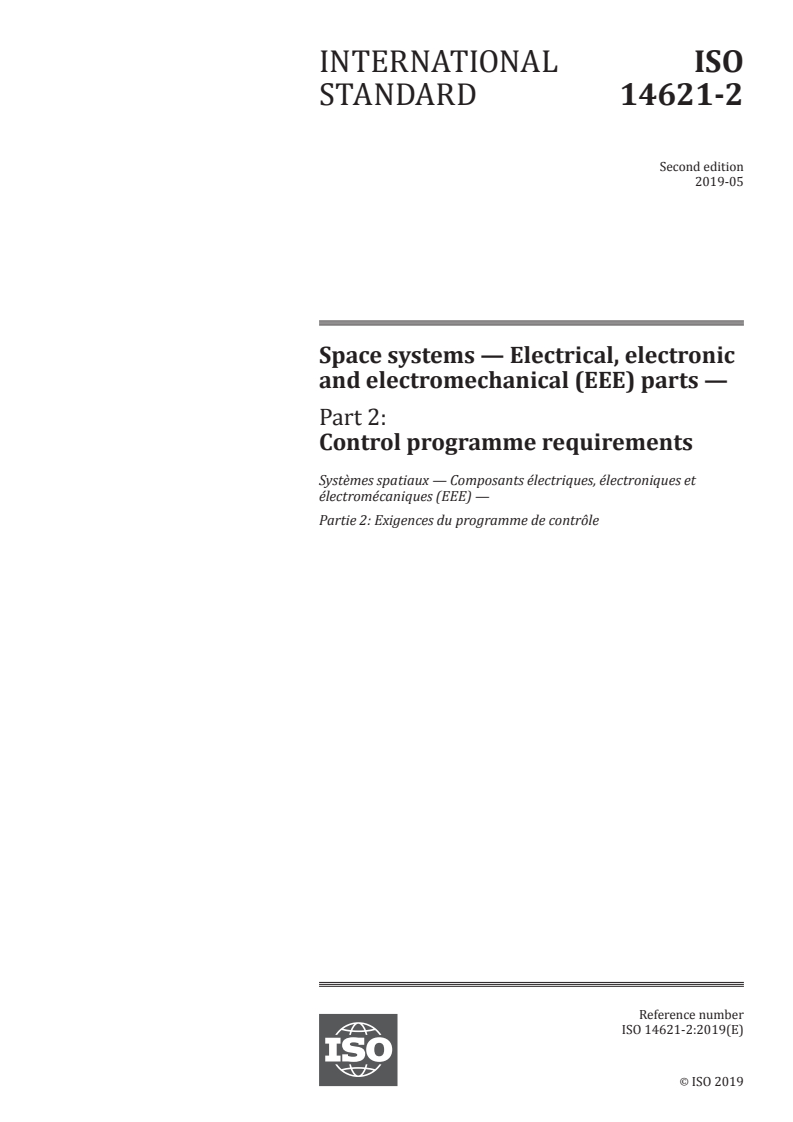
INTERNATIONAL ISO
STANDARD 14621-2
Second edition
2019-05
Space systems — Electrical, electronic
and electromechanical (EEE) parts —
Part 2:
Control programme requirements
Systèmes spatiaux — Composants électriques, électroniques et
électromécaniques (EEE) —
Partie 2: Exigences du programme de contrôle
Reference number
©
ISO 2019
© ISO 2019
All rights reserved. Unless otherwise specified, or required in the context of its implementation, no part of this publication may
be reproduced or utilized otherwise in any form or by any means, electronic or mechanical, including photocopying, or posting
on the internet or an intranet, without prior written permission. Permission can be requested from either ISO at the address
below or ISO’s member body in the country of the requester.
ISO copyright office
CP 401 • Ch. de Blandonnet 8
CH-1214 Vernier, Geneva
Phone: +41 22 749 01 11
Fax: +41 22 749 09 47
Email: copyright@iso.org
Website: www.iso.org
Published in Switzerland
ii © ISO 2019 – All rights reserved
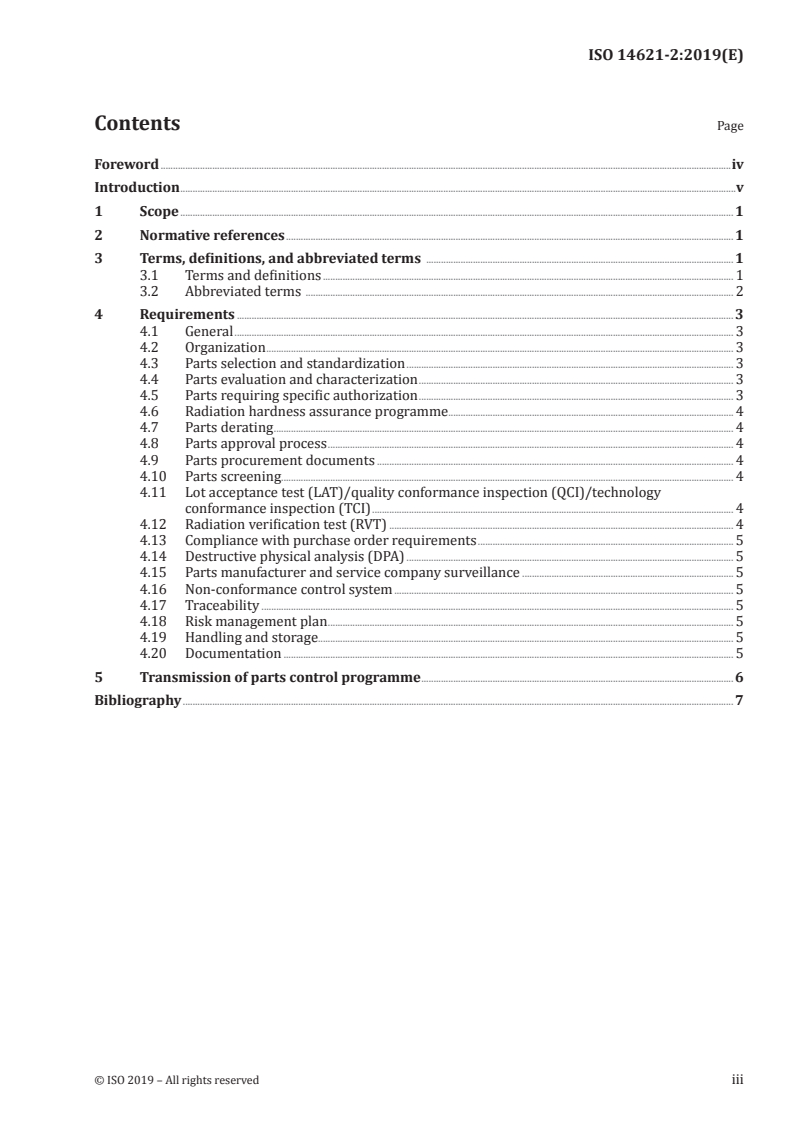
Contents Page
Foreword .iv
Introduction .v
1 Scope . 1
2 Normative references . 1
3 Terms, definitions, and abbreviated terms . 1
3.1 Terms and definitions . 1
3.2 Abbreviated terms . 2
4 Requirements . 3
4.1 General . 3
4.2 Organization . 3
4.3 Parts selection and standardization . 3
4.4 Parts evaluation and characterization . 3
4.5 Parts requiring specific authorization . 3
4.6 Radiation hardness assurance programme . 4
4.7 Parts derating . 4
4.8 Parts approval process . 4
4.9 Parts procurement documents . 4
4.10 Parts screening. 4
4.11 Lot acceptance test (LAT)/quality conformance inspection (QCI)/technology
conformance inspection (TCI) . 4
4.12 Radiation verification test (RVT) . 4
4.13 Compliance with purchase order requirements . 5
4.14 Destructive physical analysis (DPA) . 5
4.15 Parts manufacturer and service company surveillance . 5
4.16 Non-conformance control system . 5
4.17 Traceability . 5
4.18 Risk management plan . 5
4.19 Handling and storage. 5
4.20 Documentation . 5
5 Transmission of parts control programme . 6
Bibliography . 7
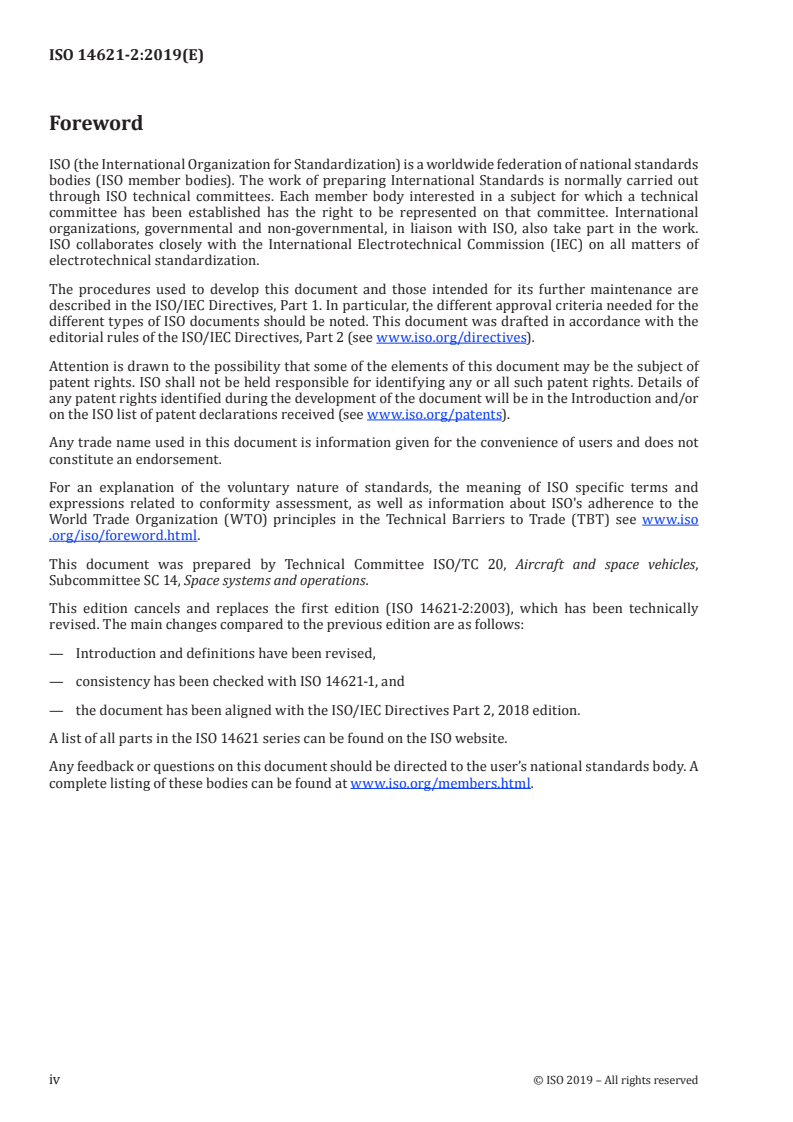
Foreword
ISO (the International Organization for Standardization) is a worldwide federation of national standards
bodies (ISO member bodies). The work of preparing International Standards is normally carried out
through ISO technical committees. Each member body interested in a subject for which a technical
committee has been established has the right to be represented on that committee. International
organizations, governmental and non-governmental, in liaison with ISO, also take part in the work.
ISO collaborates closely with the International Electrotechnical Commission (IEC) on all matters of
electrotechnical standardization.
The procedures used to develop this document and those intended for its further maintenance are
described in the ISO/IEC Directives, Part 1. In particular, the different approval criteria needed for the
different types of ISO documents should be noted. This document was drafted in accordance with the
editorial rules of the ISO/IEC Directives, Part 2 (see www .iso .org/directives).
Attention is drawn to the possibility that some of the elements of this document may be the subject of
patent rights. ISO shall not be held responsible for identifying any or all such patent rights. Details of
any patent rights identified during the development of the document will be in the Introduction and/or
on the ISO list of patent declarations received (see www .iso .org/patents).
Any trade name used in this document is information given for the convenience of users and does not
constitute an endorsement.
For an explanation of the voluntary nature of standards, the meaning of ISO specific terms and
expressions related to conformity assessment, as well as information about ISO's adherence to the
World Trade Organization (WTO) principles in the Technical Barriers to Trade (TBT) see www .iso
.org/iso/foreword .html.
This document was prepared by Technical Committee ISO/TC 20, Aircraft and space vehicles,
Subcommittee SC 14, Space systems and operations.
This edition cancels and replaces the first edition (ISO 14621-2:2003), which has been technically
revised. The main changes compared to the previous edition are as follows:
— Introduction and definitions have been revised,
— consistency has been checked with ISO 14621-1, and
— the document has been aligned with the ISO/IEC Directives Part 2, 2018 edition.
A list of all parts in the ISO 14621 series can be found on the ISO website.
Any feedback or questions on this document should be directed to the user’s national standards body. A
complete listing of these bodies can be found at www .iso .org/members .html.
iv © ISO 2019 – All rights reserved
Introduction
ISO 14621-1 and ISO 14621-2 are designed to jointly assist the user and supplier communities in
developing and executing an effective process for the design, selection and application of electrical,
electronic, and electromechanical (EEE) space parts throughout the life cycle of the programme.
NOTE In both ISO 14621-1 and ISO 14621-2, the family of EEE parts includes electro-optical parts.
The strategy represented in the ISO 14621 series is:
— for ISO 14621-1 a system approach to managing risk throughout the life cycle of the programme, by
developing, selecting and properly applying the right EEE part for its intended application;
— for ISO 14621-2 a framework for developing and documenting an EEE parts control programme
to assure that the parts used in space flight hardware have acceptable risk, i.e. possess adequate
functional, radiation and reliability characteristics to meet the system requirements.
Both ISO 14621-1 and ISO 14621-2 should be tailored to meet the specific needs of each individual
programme, i.e. to address the applicable system performance requirements, risk tolerance, budget,
mission duration, operating environment, and schedule. Tailoring should result in a set of planned
activities that are not only capable of achieving all contractual EEE parts related requirements, but
also commensurate with the space system’s unit-value/mission-criticality and life cycle technical data
product requirements.
NOTE This type of planning is sometimes referred to as capability-based Safety, Dependability, and Quality
Assurance (SD&QA) programme tailoring; and the guidance for performing it is provided in ISO/TS 18667.
ISO 14621-1 and ISO 14621-2 are relevant to all users and customers of space systems, and the suppliers
and vendors that furnish space flight hardware. However, to utilize these documents to their fullest
potential, it is necessary to understand the commercial space business environment which has unique
cost and schedule constraint challenges.
INTERNATIONAL STANDARD ISO 14621-2:2019(E)
Space systems — Electrical, electronic and
electromechanical (EEE) parts —
Part 2:
Control programme requirements
1 Scope
This document establishes technical guidelines for developing and documenting an electrical, electronic
and electromechanical (EEE) parts control program, in order to assure that the parts used in the flight
hardware are acceptable and possess adequate functional, radiation and reliability characteristics to
meet the system requirements. The family of EEE parts includes electro-optical parts.
This document identifies a set of management guidelines for dealing with space systems engineering
activities and defines the minimum existing processes on the subject.
These guidelines are tailorable to the needs of each individual programme based on the project
performance criteria, risk tolerance, budget, mission duration, environment, schedule and other
considerations. This document is applicable to all customers and suppliers furnishing flight hardware
and is suitable for re
...
INTERNATIONAL ISO
STANDARD 14621-2
Second edition
2019-05
Space systems — Electrical, electronic
and electromechanical (EEE) parts —
Part 2:
Control programme requirements
Systèmes spatiaux — Composants électriques, électroniques et
électromécaniques (EEE) —
Partie 2: Exigences du programme de contrôle
Reference number
©
ISO 2019
© ISO 2019
All rights reserved. Unless otherwise specified, or required in the context of its implementation, no part of this publication may
be reproduced or utilized otherwise in any form or by any means, electronic or mechanical, including photocopying, or posting
on the internet or an intranet, without prior written permission. Permission can be requested from either ISO at the address
below or ISO’s member body in the country of the requester.
ISO copyright office
CP 401 • Ch. de Blandonnet 8
CH-1214 Vernier, Geneva
Phone: +41 22 749 01 11
Fax: +41 22 749 09 47
Email: copyright@iso.org
Website: www.iso.org
Published in Switzerland
ii © ISO 2019 – All rights reserved
Contents Page
Foreword .iv
Introduction .v
1 Scope . 1
2 Normative references . 1
3 Terms, definitions, and abbreviated terms . 1
3.1 Terms and definitions . 1
3.2 Abbreviated terms . 2
4 Requirements . 3
4.1 General . 3
4.2 Organization . 3
4.3 Parts selection and standardization . 3
4.4 Parts evaluation and characterization . 3
4.5 Parts requiring specific authorization . 3
4.6 Radiation hardness assurance programme . 4
4.7 Parts derating . 4
4.8 Parts approval process . 4
4.9 Parts procurement documents . 4
4.10 Parts screening. 4
4.11 Lot acceptance test (LAT)/quality conformance inspection (QCI)/technology
conformance inspection (TCI) . 4
4.12 Radiation verification test (RVT) . 4
4.13 Compliance with purchase order requirements . 5
4.14 Destructive physical analysis (DPA) . 5
4.15 Parts manufacturer and service company surveillance . 5
4.16 Non-conformance control system . 5
4.17 Traceability . 5
4.18 Risk management plan . 5
4.19 Handling and storage. 5
4.20 Documentation . 5
5 Transmission of parts control programme . 6
Bibliography . 7
Foreword
ISO (the International Organization for Standardization) is a worldwide federation of national standards
bodies (ISO member bodies). The work of preparing International Standards is normally carried out
through ISO technical committees. Each member body interested in a subject for which a technical
committee has been established has the right to be represented on that committee. International
organizations, governmental and non-governmental, in liaison with ISO, also take part in the work.
ISO collaborates closely with the International Electrotechnical Commission (IEC) on all matters of
electrotechnical standardization.
The procedures used to develop this document and those intended for its further maintenance are
described in the ISO/IEC Directives, Part 1. In particular, the different approval criteria needed for the
different types of ISO documents should be noted. This document was drafted in accordance with the
editorial rules of the ISO/IEC Directives, Part 2 (see www .iso .org/directives).
Attention is drawn to the possibility that some of the elements of this document may be the subject of
patent rights. ISO shall not be held responsible for identifying any or all such patent rights. Details of
any patent rights identified during the development of the document will be in the Introduction and/or
on the ISO list of patent declarations received (see www .iso .org/patents).
Any trade name used in this document is information given for the convenience of users and does not
constitute an endorsement.
For an explanation of the voluntary nature of standards, the meaning of ISO specific terms and
expressions related to conformity assessment, as well as information about ISO's adherence to the
World Trade Organization (WTO) principles in the Technical Barriers to Trade (TBT) see www .iso
.org/iso/foreword .html.
This document was prepared by Technical Committee ISO/TC 20, Aircraft and space vehicles,
Subcommittee SC 14, Space systems and operations.
This edition cancels and replaces the first edition (ISO 14621-2:2003), which has been technically
revised. The main changes compared to the previous edition are as follows:
— Introduction and definitions have been revised,
— consistency has been checked with ISO 14621-1, and
— the document has been aligned with the ISO/IEC Directives Part 2, 2018 edition.
A list of all parts in the ISO 14621 series can be found on the ISO website.
Any feedback or questions on this document should be directed to the user’s national standards body. A
complete listing of these bodies can be found at www .iso .org/members .html.
iv © ISO 2019 – All rights reserved
Introduction
ISO 14621-1 and ISO 14621-2 are designed to jointly assist the user and supplier communities in
developing and executing an effective process for the design, selection and application of electrical,
electronic, and electromechanical (EEE) space parts throughout the life cycle of the programme.
NOTE In both ISO 14621-1 and ISO 14621-2, the family of EEE parts includes electro-optical parts.
The strategy represented in the ISO 14621 series is:
— for ISO 14621-1 a system approach to managing risk throughout the life cycle of the programme, by
developing, selecting and properly applying the right EEE part for its intended application;
— for ISO 14621-2 a framework for developing and documenting an EEE parts control programme
to assure that the parts used in space flight hardware have acceptable risk, i.e. possess adequate
functional, radiation and reliability characteristics to meet the system requirements.
Both ISO 14621-1 and ISO 14621-2 should be tailored to meet the specific needs of each individual
programme, i.e. to address the applicable system performance requirements, risk tolerance, budget,
mission duration, operating environment, and schedule. Tailoring should result in a set of planned
activities that are not only capable of achieving all contractual EEE parts related requirements, but
also commensurate with the space system’s unit-value/mission-criticality and life cycle technical data
product requirements.
NOTE This type of planning is sometimes referred to as capability-based Safety, Dependability, and Quality
Assurance (SD&QA) programme tailoring; and the guidance for performing it is provided in ISO/TS 18667.
ISO 14621-1 and ISO 14621-2 are relevant to all users and customers of space systems, and the suppliers
and vendors that furnish space flight hardware. However, to utilize these documents to their fullest
potential, it is necessary to understand the commercial space business environment which has unique
cost and schedule constraint challenges.
INTERNATIONAL STANDARD ISO 14621-2:2019(E)
Space systems — Electrical, electronic and
electromechanical (EEE) parts —
Part 2:
Control programme requirements
1 Scope
This document establishes technical guidelines for developing and documenting an electrical, electronic
and electromechanical (EEE) parts control program, in order to assure that the parts used in the flight
hardware are acceptable and possess adequate functional, radiation and reliability characteristics to
meet the system requirements. The family of EEE parts includes electro-optical parts.
This document identifies a set of management guidelines for dealing with space systems engineering
activities and defines the minimum existing processes on the subject.
These guidelines are tailorable to the needs of each individual programme based on the project
performance criteria, risk tolerance, budget, mission duration, environment, schedule and other
considerations. This document is applicable to all customers and suppliers furnishing flight hardware
and is suitable for re
...