


ISO 13643-1:2013
(Main)Ships and marine technology — Manoeuvring of ships — Part 1: General concepts, quantities and test conditions
Ships and marine technology — Manoeuvring of ships — Part 1: General concepts, quantities and test conditions
ISO 13643-1:2013 applies to manoeuvring tests with surface ships, submarines, and models. ISO 13643-1:2013 defines concepts, symbols, and test conditions constituting general fundamentals which are to be applied for the description and determination of certain ship manoeuvring characteristics together with the respective test-specific physical quantities contained in ISO 13643-2 to ISO 13643-6.
Navires et technologie maritime — Manoeuvres des navires — Partie 1: Notions générales, grandeurs et conditions d'essai
General Information
- Status
- Withdrawn
- Publication Date
- 18-Jun-2013
- Withdrawal Date
- 18-Jun-2013
- Technical Committee
- ISO/TC 8/SC 6 - Navigation and ship operations
- Drafting Committee
- ISO/TC 8/SC 6 - Navigation and ship operations
- Current Stage
- 9599 - Withdrawal of International Standard
- Start Date
- 09-Feb-2017
- Completion Date
- 14-Feb-2026
Relations
- Effective Date
- 28-May-2016
Get Certified
Connect with accredited certification bodies for this standard

DNV
DNV is an independent assurance and risk management provider.

Lloyd's Register
Lloyd's Register is a global professional services organisation specialising in engineering and technology.

ABS Quality Evaluations Inc.
American Bureau of Shipping quality certification.
Sponsored listings
Frequently Asked Questions
ISO 13643-1:2013 is a standard published by the International Organization for Standardization (ISO). Its full title is "Ships and marine technology — Manoeuvring of ships — Part 1: General concepts, quantities and test conditions". This standard covers: ISO 13643-1:2013 applies to manoeuvring tests with surface ships, submarines, and models. ISO 13643-1:2013 defines concepts, symbols, and test conditions constituting general fundamentals which are to be applied for the description and determination of certain ship manoeuvring characteristics together with the respective test-specific physical quantities contained in ISO 13643-2 to ISO 13643-6.
ISO 13643-1:2013 applies to manoeuvring tests with surface ships, submarines, and models. ISO 13643-1:2013 defines concepts, symbols, and test conditions constituting general fundamentals which are to be applied for the description and determination of certain ship manoeuvring characteristics together with the respective test-specific physical quantities contained in ISO 13643-2 to ISO 13643-6.
ISO 13643-1:2013 is classified under the following ICS (International Classification for Standards) categories: 47.020.70 - Navigation and control equipment. The ICS classification helps identify the subject area and facilitates finding related standards.
ISO 13643-1:2013 has the following relationships with other standards: It is inter standard links to ISO 13643-1:2017. Understanding these relationships helps ensure you are using the most current and applicable version of the standard.
ISO 13643-1:2013 is available in PDF format for immediate download after purchase. The document can be added to your cart and obtained through the secure checkout process. Digital delivery ensures instant access to the complete standard document.
Standards Content (Sample)
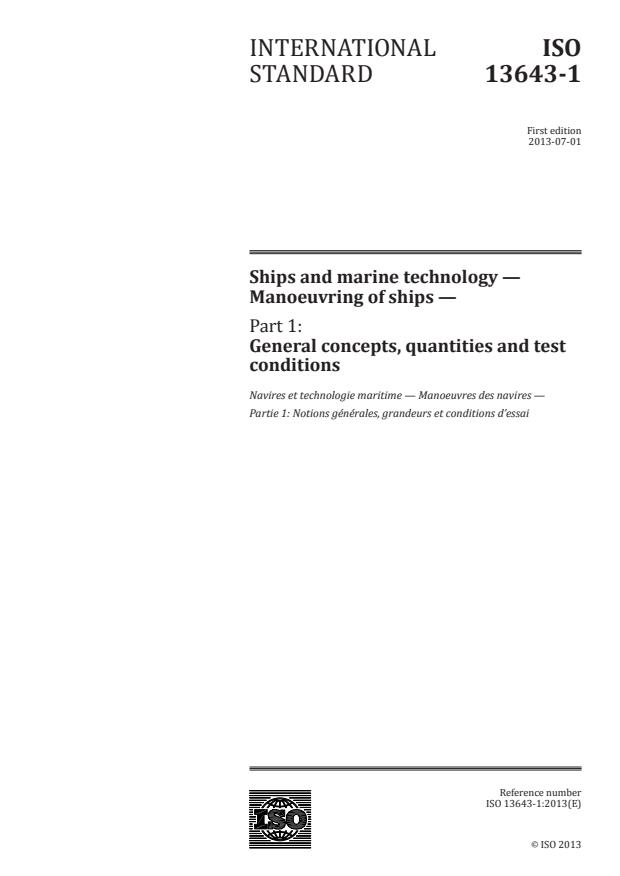
INTERNATIONAL ISO
STANDARD 13643-1
First edition
2013-07-01
Ships and marine technology —
Manoeuvring of ships —
Part 1:
General concepts, quantities and test
conditions
Navires et technologie maritime — Manoeuvres des navires —
Partie 1: Notions générales, grandeurs et conditions d’essai
Reference number
©
ISO 2013
© ISO 2013
All rights reserved. Unless otherwise specified, no part of this publication may be reproduced or utilized otherwise in any form
or by any means, electronic or mechanical, including photocopying, or posting on the internet or an intranet, without prior
written permission. Permission can be requested from either ISO at the address below or ISO’s member body in the country of
the requester.
ISO copyright office
Case postale 56 • CH-1211 Geneva 20
Tel. + 41 22 749 01 11
Fax + 41 22 749 09 47
E-mail copyright@iso.org
Web www.iso.org
Published in Switzerland
ii © ISO 2013 – All rights reserved
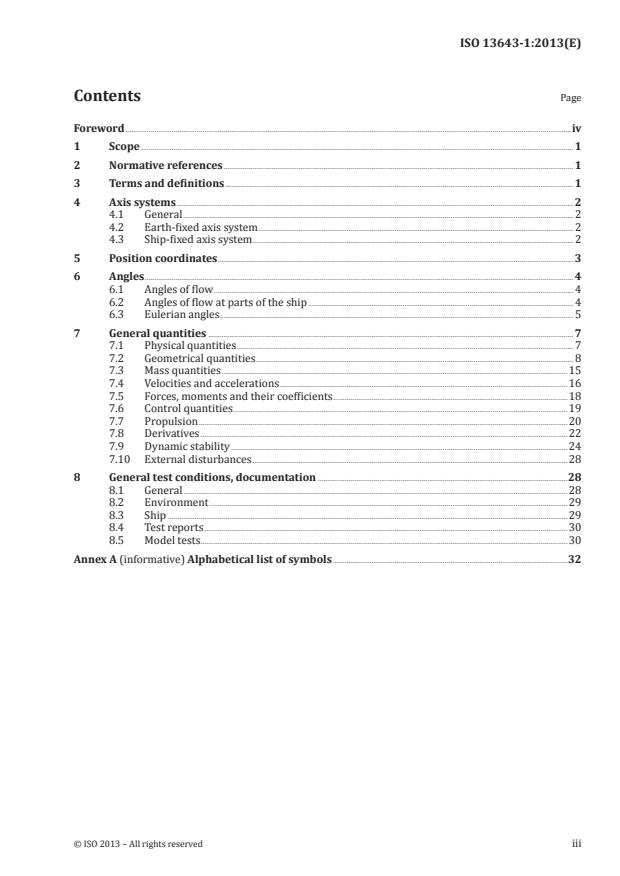
Contents Page
Foreword .iv
1 Scope . 1
2 Normative references . 1
3 Terms and definitions . 1
4 Axis systems . 2
4.1 General . 2
4.2 Earth-fixed axis system . 2
4.3 Ship-fixed axis system . 2
5 Position coordinates . 3
6 Angles . 4
6.1 Angles of flow . 4
6.2 Angles of flow at parts of the ship . 4
6.3 Eulerian angles . 5
7 General quantities . 7
7.1 Physical quantities . 7
7.2 Geometrical quantities . 8
7.3 Mass quantities .15
7.4 Velocities and accelerations .16
7.5 Forces, moments and their coefficients .18
7.6 Control quantities .19
7.7 Propulsion .20
7.8 Derivatives .22
7.9 Dynamic stability .24
7.10 External disturbances .28
8 General test conditions, documentation .28
8.1 General .28
8.2 Environment .29
8.3 Ship .29
8.4 Test reports .30
8.5 Model tests.30
Annex A (informative) Alphabetical list of symbols .32
Foreword
ISO (the International Organization for Standardization) is a worldwide federation of national standards
bodies (ISO member bodies). The work of preparing International Standards is normally carried out
through ISO technical committees. Each member body interested in a subject for which a technical
committee has been established has the right to be represented on that committee. International
organizations, governmental and non-governmental, in liaison with ISO, also take part in the work.
ISO collaborates closely with the International Electrotechnical Commission (IEC) on all matters of
electrotechnical standardization.
The procedures used to develop this document and those intended for its further maintenance are
described in the ISO/IEC Directives, Part 1. In particular the different approval criteria needed for the
different types of ISO documents should be noted. This document was drafted in accordance with the
editorial rules of the ISO/IEC Directives, Part 2. www.iso.org/directives
Attention is drawn to the possibility that some of the elements of this document may be the subject of
patent rights. ISO shall not be held responsible for identifying any or all such patent rights. Details of
any patent rights identified during the development of the document will be in the Introduction and/or
on the ISO list of patent declarations received. www.iso.org/patents
Any trade name used in this document is information given for the convenience of users and does not
constitute an endorsement.
The committee responsible for this document is ISO/TC 8, Ships and marine technology, Subcommittee
SC 6, Navigation and ship operations.
ISO 13643 consists of the following parts, under the general title Ships and marine technology —
Manoeuvring of ships:
— Part 1: General concepts, quantities and test conditions
— Part 2: Tuning and yaw checking
— Part 3: Yaw stability and steering
— Part 4: Stopping, acceleration, traversing
— Part 5: Submarine specials
— Part 6: Model test specials
iv © ISO 2013 – All rights reserved
INTERNATIONAL STANDARD ISO 13643-1:2013(E)
Ships and marine technology — Manoeuvring of ships —
Part 1:
General concepts, quantities and test conditions
1 Scope
This part of ISO 13643 applies to manoeuvring tests with surface ships, submarines, and models.
This part of ISO 13643 defines concepts, symbols, and test conditions constituting general fundamentals
which are to be applied for the description and determination of certain ship manoeuvring characteristics
together with the respective test-specific physical quantities contained in ISO 13643-2 to ISO 13643-6.
2 Normative references
The following documents, in whole or in part, are normatively referenced in this document and are
indispensable for its application. For dated references, only the edition cited applies. For undated
references, the latest edition of the referenced document (including any amendments) applies.
ISO 19019, Sea-going vessels and marine technology — Instructions for planning, carrying out and
reporting sea trials
ISO 80000-1, Quantities and units — Part 1: General
ISO 80000-3, Quantities and units — Part 3: Space and time
3 Terms and definitions
For the purposes of this document, the following terms and definitions apply.
3.1
manoeuvring
all manoeuvres, manoeuvring tests, and tests or other methods, such as computations, simulations, etc.
to establish manoeuvring characteristics
Note 1 to entry: Manoeuvring includes measures to maintain cruising conditions under external disturbances.
3.2
manoeuvre
ship operation measures to change course and/or speed, and in case of submarines, depth
Note 1 to entry: Special actions taken, e.g. for casting-off, turning aside, or rescuing (person over board), are included.
3.3
manoeuvring test
test conducted with a full-scale ship, submarine, or a model to determine and evaluate the manoeuvring
characteristics under standardized conditions
Note 1 to entry: Manoeuvring tests are often similar to manoeuvres but organized in such a manner that, as far as
possible, specific manoeuvring characteristics can be measured individually.
3.4
CC-Code
computer compatible symbols introduced by the 14th International Towing Tank Conference
3.5
manoeuvring device
rudder, azimuthing thruster, hydroplane, cycloidal propeller, or equivalent system used to
manoeuvre a vessel
3.6
quantities and units
quantities and their units shall be in accordance with ISO 80000-1 and ISO 80000-3
4 Axis systems
4.1 General
Axis systems are three-dimensional, orthogonal, right-handed systems. Earth-fixed and ship-fixed axis
systems are defined in Table 1 and Table 2.
4.2 Earth-fixed axis system
Table 1 — Symbols and their definitions for the earth-fixed axis system
Symbol CC-Code SI-Unit Term Position Positive sense
O ORIG0 — Origin, earth-fixed Arbitrary, but preferably in
—
the water surface
O ORIG — Origin, ship-fixed Preferably according to
—
Table 2
(moving with the ship)
a
x X0 m — In the horizontal plane Arbitrary
a
y Y0 m Transverse axis In the horizontal plane Right-handed system
with x , z
0 0
z Z0 m Vertical axis In the direction of gravity Down
a
Assuming earth or water surfaces to be plane.
4.3 Ship-fixed axis system
Table 2 — Symbols and their definitions for the ship-fixed axis system
Symbol CC-Code SI-Unit Term Position Positive sense
O ORIG — Origin, ship fixed For surface ships in CL at the
height of DWL at MP
—
For submarines on MA in the
B
∇
lateral plane of
x X m Longitudinal axis In CL or MA Forward
y Y m Lateral axis Perpendicular to CL Starboard
z Z m Normal axis In CL Right-handed
system with x and
y (under normal
cruising conditions
down)
2 © ISO 2013 – All rights reserved
5 Position coordinates
Table 3 — Symbols and their definitions for position coordinates of points under consideration
Concept
Symbol CC-Code SI-Unit
Term Definition or explanation
a a
x (.) X (.) m Longitudinal Distance between point under consideration and
position origin O measured parallel to the ship’s longitudinal
axis (see Table 2), positive if point under consideration
is forward of origin O
a a
y (.) Y (.) m Lateral position Distance between point under consideration and
origin O measured parallel to the ship’s lateral axis,
positive if point under consideration is starboard of
origin O
a a
z (.) Z (.) m Normal position Distance between point under consideration and
origin O measured parallel to the ship’s normal axis,
positive if point under consideration is below origin O
a
(.) = Supplement to symbol/CC-code by code letters for points under consideration.
Code letters for the following special points:
A Antenna (reference point)
B Centre of buoyancy (static)
BB Bow plane (reference point)
F Stabilising fin (reference point)
G Centre of gravity
L Lateral area below waterline (centre of area)
LV Lateral area above waterline (centre of area)
P Propeller (reference point)
R Manoeuvring device (reference point)
S Stern plane (reference point)
T Thruster (reference point)
EXAMPLE z resp. ZR: Normal position of manoeuvring device (reference point)
R
6 Angles
6.1 Angles of flow
6.1.1 Angle of attack
Table 4 — Symbol and definition for the angle of attack
Concept
Axis of Measurement
Symbol CC-Code SI-Unit
rotation plane
Term Definition or explanation
a
α ALFA rad Angle of Angle by which the projection y xz
attack of the direction of heading
through the water upon CL
has to be turned about lateral
axis y such that it coincides
with the x-axis
w
arctan
u
w
arcsin
2 2
uw+
a
For angles, the unit ° (degree) may be used.
6.1.2 Drift angle
Table 5 — Symbol and definition for the drift angle
Concept
Axis of Measurement
Symbol CC-Code SI-Unit
rotation plane
Term Definition or explanation
a
β BET rad Drift angle Angle to the principal plane of z xy
symmetry from the vector of
b
the ship’s speed relative to the
water, positive in the positive
sense of rotation about the
z-axis.
−v
arctan
u
−v
arcsin
uv+
a
For angles, the unit ° (degree) may be used.
b
Reference point for the path through the water within the ship usually is the origin O of the ship-fixed axis system
according to Table 2.
6.2 Angles of flow at parts of the ship
The definition of angles of flow at parts of the ship is to follow the definition of the ship’s angles of flow
as far as possible. Their symbols are to be derived from those in 6.1.1 and 6.1.2 by means of suitable
subscripts (for a selection see Table 3).
EXAMPLE
α Angle of attack at stern plane
S
4 © ISO 2013 – All rights reserved
β Drift angle at manoeuvring device
R
6.3 Eulerian angles
6.3.1 General
Eulerian angles are described in Figure 1 and in Table 6 and Table 7.
6.3.2 Nodal axes
In this subclause, the rotational position of two axis systems relative to one another is described by
Eulerian angles which are defined with the aid of nodal axes (see Table 6).
Table 6 — Symbols and their definitions for nodal axes
Symbol Definition or explanation
k Projection of the longitudinal axis x onto the horizontal x y -plane
1 0 0
k Positioned with respect to y as k to x
2 0 1 0
k Projection of vertical axis z onto yz-plane
3 0
Key
1 x y plane
0 0
2 xz plane
3 xy plane
Figure 1 — Angles between earth-fixed and ship-fixed axis system
6.3.3 Eulerian angles between earth-fixed and ship-fixed axis systems
Table 7 — Symbols and their definitions for angles between earth-fixed and ship-fixed axis systems
Concept
Axis of Measurement
Symbol CC-Code SI-Unit
rotation plane
Term Definition or explanation
a
θ TRIMS rad Trim angle Angle of turn about nodal axis k , k xz
S 2 2 0
measured from nodal axis k to
x-axis (angle between x-axis and
horizontal plane); positive if unit
vector in the direction of x-axis has
a negative component in the direc-
tion of z -axis
a
For angles, the unit ° (degree) may be used.
6 © ISO 2013 – All rights reserved
Table 7 (continued)
Concept
Axis of Measurement
Symbol CC-Code SI-Unit
rotation plane
Term Definition or explanation
a
θ TETP rad Pitch angle Definition as for θ above; used k xz
S 2 0
for oscillatory processes; usually
measured relative to mean trim
angle
a
ϕ HEELANG rad Heel (bank) Angle of turn about the x-axis, x yz
S
angle measured from nodal axis k to
y-axis; positive in clockwise direc-
tion
a
ϕ PHIR rad Roll angle Definition as for ϕ above; used x yz
S
for oscillatory processes; usually
measured relative to mean heel
angle
a
ψ PSIH rad Heading Angle of turn about vertical axis z x y
0 0 0
z , measured from x -axis to nodal
0 0
axis k ; positive in clockwise direc-
tion; usually x -direction coincides
with north or initial heading
a
PSIY rad Yaw angle Definition as above; used for oscil- z x y
0 0 0
latory processes; usually measured
relative to mean heading
a
For angles, the unit ° (degree) may be used.
7 General quantities
7.1 Physical quantities
Table 8 — Symbols and their definitions for physical quantities
Concept
a a
Symbol CC-Code SI-Unit
Term Definition or explanation
F FN 1 Froude number
n
V
gL
F FH 1 Froude depth number
nh
V
gh
FV 1 Froude displacement number
F V
n∇
/
g∇
−2
g G m s Acceleration due to gravity —
h DE m Water depth —
h DEME m Mean water depth During the test
m
m MA kg Ship’s mass Mass which must be accelerated for
speed changes, but without added mass
−1
n N s Rate of revolution, general —
P P W Power, general —
Table 8 (continued)
Concept
a a
Symbol CC-Code SI-Unit
Term Definition or explanation
R RN 1 Reynolds number
n
VL
v
s SP m Track length Measured along ship’s track
t TI s Time, general —
t° TEAI °C Air temperature —
A
t° TEWA °C Water temperature —
W
−1 b
V V m s Ship’s speed Speed through the water; usually given
for origin O
W WT N Ship’s weight —
Δ DISPM kg Displacement mass
ρ
∇
Δ DISPF N Displacement force
F
ρ g
∇
2 −1
Ν VK m s Kinematic viscosity —
−3
Ρ RHOWA kg m Water density —
−3
ρ RHOAI kg m Air density —
A
−1
Ω OMN rad s Angular velocity —
Symbol and CC-Code can have the additional subscripts S (for ship) or M (for model) if necessary for
a
distinction.
The unit kn, common in the navigation, may be used.
b
7.2 Geometrical quantities
7.2.1 Symbols for manoeuvring
Table 9 — Symbols and their definitions for geometrical quantities
Concept
Symbol CC-Code SI-Unit
Term Definition or explanation
A AC m Canal cross section Cross section area of the canal
C
A AL m Lateral area below waterline Moulded lateral area up to DWL, not
L
including manoeuvring devices, fixed
and movable parts of propulsors
A ALV m Lateral area above waterline Lateral area of the ship above DWL,
LV
generally without rigging, railings
etc.
A AM m Midship section area Sectional area of moulded hull paral-
M
lel to yz-plane at MP between BL and
DWL
8 © ISO 2013 – All rights reserved
Table 9 (continued)
Concept
Symbol CC-Code SI-Unit
Term Definition or explanation
AP AP — After perpendicular For surface ships: Straight line on CL
perpendicular to DWL through its
intersection with the moulded stern
contour (common practice for naval
ships) or through the centreline of
manoeuvring device stock (common
practice for merchant ships)
For submarines with one shaft:
Straight line perpendicular to MA
through the intersection of the aft
edge of stern tube with the centreline
of the shaft. For submarines with sev-
eral shafts, AP has to be determined
adequately
A ARU m Rudder area For the movable part (incl. flap); in
R
way of a fixed post, aft of the stock
axis only
A ARF m Flap area For the flap movable relative to the
RF
rudder, aft of its hinge axis only
A ARP m Rudder area in the propeller
RP
For rudder in neutral position
race
A ART m Total rudder area A + A
RT R RX
A ARX m Fixed post area of a rudder Forward of the stock axis
RX
A ASK m Skeg area For skeg or fixed fin
SK
A AX m Maximum transverse section Maximum sectional area of moulded
X
area hull parallel to the yz-plane up to the
DWL
B B m Breadth Reference breadth of a ship; usually
B
DWL
B BDWL m Breadth of design waterline Maximum moulded breadth of design
DWL
waterline
BL BL — Baseline Line on CL parallel to DWL through
the moulded keel line at MP
— — Centre of buoyancy of form
B
∇
∇
Relative to
displacement
b SP m Rudder span, general Distance between planes perpen-
dicular to the stock axis through the
extremities of the rudder
b SPRU m Rudder span Distance between planes perpen-
R
dicular to the stock axis through the
extremities of the movable part (incl.
flap); in way of a fixed post, aft of the
stock axis only
b SPRUF m Flap span for a rudder Distance between planes perpen-
RF
dicular to its hinge axis through the
extremities of the flap, aft of its hinge
axis only
b SPRUT m Total rudder span Distance between planes perpen-
RT
dicular to the stock axis through the
extremities of the total rudder incl.
flap and fixed post
Table 9 (continued)
Concept
Symbol CC-Code SI-Unit
Term Definition or explanation
b SPRUX m Fixed post span for a rudder Distance between planes perpen-
RX
dicular to the stock axis through the
extremities of the fixed post, forward
of the stock axis only
b SPSK m Skeg span For skeg or fixed fin:
SK
Distance between planes perpen-
dicular to the skeg axis through the
extremities of the skeg
CL CL — Centreline plane Vertical longitudinal plane of sym-
metry of the hull; for asymmetrical
ships CL is to be specified in a suit-
able manner
c CH m Chord length, general Maximum profile length normal to
the stock axis
c CHME m Mean chord length, general
m
A
R
b
c CHMERU m Mean rudder chord length
mR
A
R
b
R
c CHMERUF m Mean flap chord length for a
mRF
A
RF
rudder
b
RF
c CHMERUT m Mean total rudder chord
mRT
A
RT
length
b
RT
c CHMERUX m Mean fixed post chord length
mRX
A
RX
for a rudder
b
RX
c CHMESK m Mean skeg chord length
mSK
A
SK
b
SK
c CHRU m Rudder chord length Maximum profile length of the mov-
R
able part (including flap) normal to
the stock axis; in way of a fixed post,
aft of the stock axis only
c CHRUF m Flap chord length for a rudder Maximum flap profile length normal
RF
to its hinge axis; aft of the hinge axis
only
c CHRUT m Total rudder chord length Maximum profile length, incl. flap
RT
and fixed post normal to the stock
axis
c CHRUX m Fixed post chord length for a Maximum profile length of the fixed
RX
rudder post normal to the rudder stock,
forward of the stock axis only
c CHRT m Rudder root chord length, Profile length normal to the stock
r
general axis on the inboard side
10 © ISO 2013 – All rights reserved
Table 9 (continued)
Concept
Symbol CC-Code SI-Unit
Term Definition or explanation
c CHRRU m Rudder root chord length On the inboard side of the movable
rR
part (incl. flap), normal to the stock
axis; in way of a fixed post, aft of the
stock axis only
c CHRRUF m Flap root chord length for a On the inboard side normal to its
rRF
rudder hinge axis, aft of the hinge axis only
c CHRRUT m Total rudder root chord On the inboard side of the total rud-
rRT
length der incl. flap and fixed post, meas-
ured normal to the stock axis
c CHRRUX m Fixed post root chord length On the inboard side normal to the
rRX
for a rudder stock axis, forward of the stock axis
only
c CHRSK m Skeg root chord length For skeg or fixed fin:
rSK
On the inboard side normal to the
skeg axis
c CHSK m Skeg chord length For skeg or fixed fin:
SK
Maximum profile length normal to
the skeg axis
c CHT m Tip chord length, general Profile length on the outboard side,
t
normal to the stock axis
c CHTRU m Rudder tip chord length On the outboard side of the movable
tR
part (incl. flap), normal to the stock
axis; in way of a fixed post, aft of the
stock axis only
c CHTRUF m Flap tip chord length for a On the outboard side normal to the
tRF
rudder hinge axis, aft of the hinge axis only
c CHTRUT m Total rudder tip chord length On the outboard side of the total rud-
tRT
der incl. flap and fixed post, normal
to the stock axis
c CHTRUX m Fixed post tip chord length On the outboard side normal to the
tRX
for a rudder stock axis, forward of the stock axis
only
c CHTSK m Skeg tip chord length For skeg or fixed fin:
tSK
On the outboard side normal to the
skeg axis
DWL DWL — Design waterline Intersection of a horizontal plane,
which is specified in the design for
loaded condition of the ship (e.g.
summer load line), with the moulded
surface of the ship
FP FP — Fore perpendicular For surface ships: Straight line on
CL perpendicular to DWL through
its intersection with the outer stem
contour
For submarines: Straight line perpen-
dicular to MA through its intersec-
tion with the outer stem contour
f F m Camber of a foil Maximum separation of median and
nose-tail line
Table 9 (continued)
Concept
Symbol CC-Code SI-Unit
Term Definition or explanation
G — — Centre of gravity Point at which the resultant of the
gravitational forces on the ship acts
GM m Metacentric height
Distance M to G
GM
K — — Keel reference on BL
KG m Centre of gravity above keel
KG
—
reference
L L m Length Reference length of a ship; usually
L for merchant ships and subma-
PP
rines, L for naval surface ships
DWL
L LDWL m Length of design waterline Moulded length of design waterline
DWL
L LPP m Length between
PP
Distance between AP and FP
perpendiculars
M — — Metacentre (transverse) Intersection of the vertical line
through the centre of buoyancy with
CL, for small angles of heel
MA MAX — Main axis Centreline of cylindrical part of the
pressure hull extended over the
boat’s length
MP MP — Mid between perpendiculars Straight line perpendicular to DWL in
CL at the mid between
perpendiculars
P — — Port (side)
PH PH — Pressure hull Part of the submarine hull without
pressure tight appendages, which
resists the water pressure at depth
S — — Starboard (side)
T T m Draught Reference draught of the ship; usu-
ally T
DWL
T TA m Draught aft Moulded draft at AP
A
T TDWL m Design draught Distance between BL and DWL
DWL
T TF m Draught forward Moulded draft at FP
F
t TMX m Profile thickness, general Maximum profile thickness at 0,5 b,
normal to the camber surface
t TMRU m Rudder thickness Maximum thickness of the movable
R
part (incl. flap) at 0,5 b , normal to
RT
the camber surface; in way of a fixed
post, aft of the stock axis only
t TMRUF m Flap thickness of a rudder Maximum thickness of the flap at
RF
0,5 b , normal to the camber sur-
RT
face; aft of its hinge axis only
t TMRUT m Total rudder thickness Maximum thickness of the total rud-
RT
der incl. flap and fixed post at 0,5 b ,
RT
normal to the camber surface
t TMRUX m Fixed post thickness for a Maximum thickness of the fixed post
RX
rudder at 0,5 b , normal to the camber sur-
RX
face; forward of the stock axis only
12 © ISO 2013 – All rights reserved
Table 9 (continued)
Concept
Symbol CC-Code SI-Unit
Term Definition or explanation
t TMSK m Skeg thickness For skeg or fixed fin:
SK
Maximum thickness at 0,5 b , nor-
SK
mal to the camber surface
WL WL — Waterline Intersection of any selected plane
on which the ship may float with the
moulded surface of the ship
w WCANB m Bottom width of canal Effective width of the canal at its
B
deepest point
w WCANS m Surface width of canal Width of the canal from bank to bank
S
at the water surface
Λ ASRU 1 Rudder aspect ratio
R 2
b
A
RT
λ SCALE 1 Model scale Ratio of linear ship to model
dimensions
λ TARU 1 Rudder taper
R
c
t
c
r
DISPV m Displacement volume or form
∇
∇ +−∇ ∇
SP AP LB
for surface ships;
displacement
complete enveloped displacement
volume for submarines
DISPVAP m Displacement volume of Plating included;
∇
AP
appendages for surface ships: for all relevant
appendages, e.g. shaft bossings,
outer shaft lines including struts and
propellers, manoeuvring devices,
stabiliser fins (fixed or foldable),
structures guiding the stream lines
(e.g. nozzles) and box keels; usually
without bilge keels, unless these
enclose a void space
for submarines: for all relevant
pressure tight appendages, e.g. shell
plating, stiffeners, and plating of free
flooded spaces, pipe lines, cables,
gas bottles, weapon tubes, fins, rods,
rudders, planes, propeller shaft, stern
tube, propeller, sensors, antennae,
hoistable masts, solid ballast, etc.
outside of PH
DISPVLB m Lost buoyancy volume Permanently flooded volumes, e.g.
∇
LB
sea chests, thruster tunnels, and fin
boxes, but not seawater pipes; major
lost volumes, e.g. moon pools of drill-
ing ships are not usually taken into
∇
SP
account here nor in
DISPVSP m Displacement volume of hull Shell plating included, without
∇
SP
∇
LB
appendages; not deducted
7.2.2 Additional and alternative indices
Table 10 — Definition and use of additional and alternative indices to symbols according to Table 9
Example for the use with symbols and
Index
CC-Codes according to Table 9
resp.
Explanation
extension for
Symbol CC- Term
CC-Code
Code
(n) Additional index to distinguish c CHRU2 Chord length of the 1st single
R2
between multiple arrangements of rudder at the inner port side of an
manoeuvring devices, skegs, and arrangement of parallel rudders
fixed fins, respectively. Numerals (see Figure 2).
with the digit 0 designate manoeu-
vring devices, skegs, and fixed fins
located on the centreline. Counting
begins with 0 from aft to forward
(see Figure 4). Odd figures are used
to identify installations to starboard
of the centreline, even figures (except
those with the digit 0) for those to
port. Counting begins with 1 for the
innermost fitting to starboard and
2 for the innermost fitting to port,
thereafter increasing with successive
fittings outwards. For X- or V- plane
arrangement, counting proceeds from
upper to lower (see Figure 3). (n) is
always the last index.
A For the designation of stern planes c CHA3 Chord length of 2nd single plane
A3
which have not an exclusively vertical from above on starboard side
or horizontal effect. In this case, A of an X-plane arrangement (see
replaces the index R with respect to Figure 3).
RU in the CC-Code and is to be com-
bined with a number (n).
B For the designation of a bow plane c CHB Chord length of the bow plane
B
of a submarine or a bow rudder of a and of the bow rudder of a surface
surface ship. In this case, B replaces ship, respectively.
the index R with respect to RU in the
CC-Code.
S For the designation of a stern plane of c CHS Chord length of the stern plane.
S
a submarine. In this case, S replaces
the index R with respect to RU in the
CC-Code.
Key
a
rudder
Figure 2 — Arrangement of parallel manoeuvring devices (view from aft); example: Stern of an
inland navigation ship with five rudders
14 © ISO 2013 – All rights reserved
Key
a
plane
Figure 3 — X-plane arrangement for submarines (view from aft)
Key
1 Fin 01
2 Fin 02
3 Fin 03
Figure 4 — Numbering of centreline fitted fixed skegs or fins
7.3 Mass quantities
Table 11 — Symbols and their definitions for mass quantities
Concept
Symbol CC-Code SI-Unit
Definition or
Term
explanation
I IXX kg m Moment of inertia about
xx
yy− +−zz dm
() ()
x-axis
{}GG
∫
a
I IYY kg m Moment of inertia about
yy
xx− +−zz dm
() ()
y-axis
GG
{}
∫
a
a
x, y, z stand for the coordinates of the mass element dm relative to the ship-fixed axis system (see Table 2).
Table 11 (continued)
Concept
Symbol CC-Code SI-Unit
Definition or
Term
explanation
I IZZ kg m Moment of inertia about
zz
xx− +−yy dm
() ()
z-axis
{}GG
∫
a
I IXY kg m Product of inertia
xy
xx− yy− dm
() ()
GG
∫
a
I IYZ kg m
yz
yy− zz− dm
()()
GG
∫
a
I IZX kg m
zx
zz− xx− dm
() ()
GG
∫
a
k RDGX m Radius of inertia about
xx
x-axis
yy− +−zz dm
() ()
GG
( )
∫
Δ
a
k RDGY m Radius of inertia about
yy 1
y-axis
xx− +−zz dm
() ()
( GG )
∫
Δ
a
k RDGZ m Radius of inertia about
zz
z-axis
xx− +−yy dm
() ()
GG
( )
∫
Δ
a
a
x, y, z stand for the coordinates of the mass element dm relative to the ship-fixed axis system (see Table 2).
7.4 Velocities and accelerations
Table 12 — Symbols and their definitions for velocities and accelerations
Symbol Concept
and CC-Code SI-Unit
Term Definition or explanation
vector
−1
p OMX rad s Roll velocity Angular velocity about x-axis
Relative to ship-fixed axis system
−1
q OMY rad s Angular velocity about y-axis Relative to ship-fixed axis system
−1
r OMZ rad s Angular velocity about z-axis Relative to ship-fixed axis system
−2
OXRT rad s Roll acceleration Angular acceleration about x-axis
p
Relative to ship-fixed axis system
−2
OYRT rad s Angular acceleration about y-axis Relative to ship-fixed axis system
q
−2
OZRT rad s Angular acceleration about z-axis Relative to ship-fixed axis system
r
a
The unit kn, common in the navigation, may be used.
b
The path of the ship is usually given for the origin O.
16 © ISO 2013 – All rights reserved
Table 12 (continued)
Symbol Concept
and CC-Code SI-Unit
Term Definition or explanation
vector
−1
u VX m s Longitudinal velocity Velocity in direction of x-, y-, and
z-axes, respectively
−1
v VY m s Lateral velocity
Relative to ship-fixed axis system;
−1
w VZ m s Normal velocity
if otherwise, use subscripts accord-
ing to Clause 5
−2
VXRT m s Longitudinal acceleration Acceleration in direction of x-, y-,
u
and z-axes, respectively
−2
VYRT m s Lateral acceleration
v
Relative to ship-fixed axis system;
−2
VZRT m s Normal acceleration
if otherwise, use subscripts accord-
w
ing to Clause 5
−1a b
V VKA m s Speed over ground Relative to earth-fixed origin
K
(ground) directed along the tangent
to ship’s path
−1a
V VCU m s Current velocity Relative to earth-fixed axis system
U
−1a
V VWREL m s Relative wind velocity Relative to ship-fixed axis system
WR
−1a
V VWABS m s True wind velocity Relative to earth-fixed axis system
WT
VV+−2VV cos Ψβ+
()
KWRK WR WR
−1a
V V0 m s Initial speed Ship’s speed through the water at
b
start of the test (run)
−1
YART rad s Yaw velocity Time derivative of ψ (see Clause 6)
ψ
a
The unit kn, common in the navigation, may be used.
b
The path of the ship is usually given for the origin O.
7.5 Forces, moments and their coefficients
Forces and moments are given in Table 13.
Their coefficients are obtained as follows:
-1
Force coefficient: Force × (dynamic pressure × reference area)
or
-1
Force × (mass × acceleration due to gravity)
-1
Moment coefficient: Moment × (dynamic pressure × reference area × reference length)
or
-1
Moment × (mass × acceleration due to gravity × reference length)
Table 13 — Symbols and their definitions for forces, moments and their coefficients
Concept
Symbol CC-Code SI-Unit
Term Definition or explanation
C FNORM N Cross force Force normal to lift and drag, on a body
L FL N Dynamic lift force Force normal to direction of movement
R R N Resistance, general Force opposite to direction of movement
K MX N m Roll moment Moment about x-axis
Relative to ship-fixed axis system
M MY N m Moment about y-axis Relative to ship-fixed axis system
N MZ N m Moment about z-axis
a
K MXR N m Manoeuvring device moment Relative to ship-fixed axis system
R
about x-axis
a
M MYR N m Manoeuvring device moment
R
about y-axis
a
N MZR N m Manoeuvring device moment
R
about z-axis
a
Q QRU N m Torque on manoeuvring
R
—
device stock
a
Q QRUF N m Torque on flap stock —
RF
X FX N Longitudinal force Force components in direction of ship-
fixed x-, y-, and z-axes, respectively
Y FY N Lateral force
Z FZ N Normal force
a
X FXR N Longitudinal manoeuvring Components of manoeuvring device
R
device force force in direction of ship-fixed
x-, y-, z-axes, respectively
a
Y FYR N Lateral manoeuvring device
R
force
a
Z FZR N Normal manoeuvring device
R
force
a
For special arrangements of manoeuvring devices, the additional and alternative indices according to Table 10 shall be
used.
18 © ISO 2013 – All rights reserved
7.6 Control quantities
Table 14 — Symbols and their definitions for control quantities
Concept
Symbol CC-Code SI-Unit
Term Definition or explanation
A ALT m Cross section of lateral thrust unit Effective cross section
LT
e EXF 1 Control point eccentricity for For ahead and astern action; meas-
F
longitudinal thrust of cycloidal ured in per cent design eccentricity
propeller and related to cylindrical axles of
control point servomotors
e EXR 1 Control point eccentricity for lat- For rudder action; measured in per
R
eral thrust of cycloidal propeller cent design eccentricity and related
to cylindrical axles of control point
servomotors
−1
n NLT s Rate of revolution of lateral thrust —
LT
unit
P PITCHLT m Propeller pitch of lateral thrust —
LT
unit
P PSLT W (Shaft) power of lateral thrust —
SLT
unit
p PPFR 1 Relative fore-and-aft pitch of For ahead and astern action; meas-
F
cycloidal propeller ured at control stand and relative
to maximum fore-and-aft pitch
adjustment
p PPRR 1 Relative athwartship pitch of For rudder action; measured at con-
R
cycloidal propeller trol stand and relative to maximum
athwartship pitch adjustment
b
δ ANB rad Bow plane angle Relative to zero position of bow
B
plane, positive downward tilt
a b
δ ANRU rad Manoeuvring device angle Actual value measured against zero
R
position of manoeuvring device;
positive to port
a b
δ ANRUF rad Rudder flap angle Measured relative to main rudder,
RF
positive to port
a b
δ ANRUOR rad Manoeuvring device angle, Positive to port
RO
ordered
b
δ ANS rad Stern plane angle Relative to zero position of stern
S
plane, positive downward tilt; if
necessary, an equivalent stern
plane angle is to be given, e.g.
for submarines with X-planes;
¼(δ + δ + δ + δ )
A1 A2 A3 A4
b
δ ANRU0 rad Neutral manoeuvring device Manoeuvring device angle for which
angle the sums of hydrodynamic forces
and moments are zero, if the ship is
moving straight ahead, positive to
port
a
For special arrangements of manoeuvring devices, the additional and alternative indices according to Table 10 shall
be used. For planes which have both vertical and horizontal effect, the plane angle is positive if the trailing edge is moved
downwards. This does not apply to slightly sloped rudders of surface ships.
b
For angles, the unit ° (degree) may be used.
7.7 Propulsion
Table 15 — Symbols and their definitions for quantities related to propulsion
Concept
Symbol CC-Code SI-Unit
Term Definition or explanation
A AE m Expanded blade area of
E R
propeller
Zcdr
∫
05, d
h
A A0 m Propeller disc area
0 2
π D
for screw propellers
Propeller swept area
D L for cycloidal propellers
a
C * CQS 1 Torque coefficient
Q
Q
05, ρ Vu+ AD
A 0
C CT 1 Total resistance coefficient
T
R
T
05, ρVS
C CTH 1 Thrust loading coefficient
TH
T
05, ρVA
A 0
a
C * CTHS 1 Thrust coefficient
T
T
05, ρ Vu+ A
A 0
c CHP m Chord length of propeller —
blade
D DP m Propeller diameter —
d DH m Hub diameter —
h
J ADVC 1 Advance coefficient of
V
A
propeller
nD
J ADVCV 1 Apparent advance coefficient
V
V
of propeller
nD
K KP 1 Power coefficient
P
P
D
ρnD
for screw propellers
K KPC 1 Power coefficient
PC
P
D
ρnLD
for cycloidal propellers
K KQ 1 Torque coefficient
Q
Q
ρnD
for screw propellers
K KQC 1 Torque coefficient
QC
Q
ρnLD
for cycloidal propellers
a
In this case, the asterisk is part of the symbol.
b
For angles, the unit ° (degree) may be used.
20 © ISO 2013 – All rights reserved
Table 15 (continued)
Concept
Symbol CC-Code SI-Unit
Term Definition or explanation
K KT 1 Thrust coefficient
T
T
ρnD
for screw propellers
K KTC 1 Thrust coefficient
TC
T
ρnLD
for cycloidal propellers
L LF m Blade length For cycloidal propellers
P PITCH m Propeller pitch, general —
P PB W Brake power Power at prime mover output
B
P PD W Delivered power At propeller
D
2 π Q n
P PS W Shaft power P plus losses in shaft between
S D
propeller and the position of power
measurement at the shaft
Q Q Nm Torque Torque at propeller according to P
D
R RDP m Propeller radius —
R RT N Total resistance Total towing resistance
T
S S m Wetted surface S + S
BH AP
S SAP m Wetted surface of appendages Plating included; for all relevant
AP
appendages, e.g. shaft bossings,
outer shaft lines including struts and
propellers, manoeuvring devices,
stabiliser fins (fixed and foldable),
structures guiding the stream lines
(e.g. nozzles), and box keels; usually
without bilge keels, unless these are
very wide
S SBH m Wetted surface of bare hull Moulded, without appendages
BH
T TH N Propeller thrust —
t THDF 1 Thrust deduction fraction
TR−
T
T
−1
u UP m s Effective circumferential 0,7 π n D for screw propellers
velocity of blades
π n D for cycloidal propellers
−1
V VA m s Speed of advance of propeller V (1 − w)
A
w WFT 1 Taylor wake fraction
VV−
A
V
Z NPB 1 Number of propeller blades —
* a b
β BETS rad Effective advance angle
V
A
arctan
u
η ETA 1 Efficiency, general —
a
In this case, the asterisk is part of the symbol.
b
For angles, the unit ° (degree) may be used.
Table 15 (continued)
Concept
Symbol CC-Code SI-Unit
Term Definition or explanation
η ETAB 1 Efficiency of propeller behind
B
TV
A
the ship
2πQn
η ETAD 1 Propulsive efficiency or quasi
D
RV
T
propulsive coefficient
2πQn
η ETAH 1 Hull efficiency
...
Questions, Comments and Discussion
Ask us and Technical Secretary will try to provide an answer. You can facilitate discussion about the standard in here.
Loading comments...