

ISO 17451-1:2016
(Main)Packaging — Codification of contents for inventories for shipments of household goods and personal effects — Part 1: Numeric codification of inventories
General Information
- Abstract
ISO 17451-1:2016 relates to the moving of household goods and personal effects. It provides the codification of items and their condition, the transportation modes and associated data relating to a shipment. The relevant codes can be found in the related annexes and information regarding their use can be found in Clause 4. The objective of this document is to provide a common set of codes which allow movers of household goods and personal effects to exchange shipment-related information with each other and with external partners.
- Status
- Published
- Publication Date
- 21-Jul-2016
- Technical Committee
- ISO/TC 122 - Packaging
- Drafting Committee
- ISO/TC 122 - Packaging
- Current Stage
- 9093 - International Standard confirmed
- Start Date
- 17-Jan-2022
- Completion Date
- 29-Aug-2026
Buy Documents
ISO 17451-1:2016 - Packaging -- Codification of contents for inventories for shipments of household goods and personal effects
ISO 17451-1:2016 - Packaging — Codification of contents for inventories for shipments of household goods and personal effects — Part 1: Numeric codification of inventories/22/2016
Overview
ISO 17451-1:2016 - Packaging - Codification of contents for inventories for shipments of household goods and personal effects - Part 1: Numeric codification of inventories - defines a common numeric coding system for inventories used when moving household goods (HHG) and personal effects. The standard codifies items, packaging types, methods of preparation, transport modes, locations, exceptions and exception locations so movers, carriers and partners can exchange shipment information reliably and multilingually.
Key topics and technical requirements
- Codified lists (Annexes A–G): Numeric codes for HHG items (Annex A), packaging types (Annex B), preparation methods (Annex C), mode/type codes (Annex D), location codes (Annex E), exception codes (Annex F) and exception location codes (Annex G).
- Application rules (Clause 4): Users shall apply the relevant numeric codes from the annexes when preparing inventories. Multiple codes may be used where applicable (e.g., multiple packaging types or preparation methods).
- Use of “other”: If no code exists, users shall select “other” and provide a free-text description (e.g., “African Mask”).
- Minimum inventory metadata: Inventories shall include basic information - client name, origin address and inventory creation date. Recommended fields include destination address, delivery date and sealed-container seal code.
- Condition reporting: Exception codes capture suspected or actual damage/irregularities; absence of exceptions implies good condition. Exception locations identify where damage occurred on an item or its packaging.
- Multilingual support: Code lists are provided in English, French, German and Spanish to support international exchange.
- Interoperability: The standard is intended to be machine-readable and suitable for integration into inventory, TMS, CRM or claims systems.
Practical applications and users
ISO 17451-1 is designed for practical use across the moving and logistics ecosystem:
- Moving and relocation companies: Standardize inventories during pickup, storage and delivery.
- Freight forwarders and carriers: Exchange consistent HHG content data across transport modes.
- Customs and regulatory authorities: Improve visibility and classification for cross-border moves.
- Insurers and claims handlers: Use standardized exception codes for faster claims processing.
- Software vendors / TMS developers: Integrate numeric codification into inventory management, quoting and tracking systems.
- Corporate relocation managers / household clients: Ensure transparent, auditable item lists.
Benefits include improved transparency, multilingual interoperability, reduced disputes, faster claims handling and greater efficiency in shipment processing.
Related standards
- ISO 17451 series (other parts): for related codification topics.
- ISO 21067: referenced for terms and definitions.
- ANSI/HHGFAA NCC 2008-001-2010: original basis for this document (withdrawn upon publication of ISO 17451-1).
Keywords: ISO 17451-1, packaging codification, household goods inventory, numeric codification, HHG item codes, moving industry standard, inventory management, transport modes, exception codes.
Buy Documents
ISO 17451-1:2016 - Packaging -- Codification of contents for inventories for shipments of household goods and personal effects
ISO 17451-1:2016 - Packaging — Codification of contents for inventories for shipments of household goods and personal effects — Part 1: Numeric codification of inventories/22/2016
Get Certified
Connect with accredited certification bodies for this standard

BRCGS (Brand Reputation Compliance Global Standards)
Global food safety and quality standards owner.
Sponsored listings
Frequently Asked Questions
ISO 17451-1:2016 is a standard published by the International Organization for Standardization (ISO). Its full title is "Packaging — Codification of contents for inventories for shipments of household goods and personal effects — Part 1: Numeric codification of inventories". This standard covers: ISO 17451-1:2016 relates to the moving of household goods and personal effects. It provides the codification of items and their condition, the transportation modes and associated data relating to a shipment. The relevant codes can be found in the related annexes and information regarding their use can be found in Clause 4. The objective of this document is to provide a common set of codes which allow movers of household goods and personal effects to exchange shipment-related information with each other and with external partners.
ISO 17451-1:2016 relates to the moving of household goods and personal effects. It provides the codification of items and their condition, the transportation modes and associated data relating to a shipment. The relevant codes can be found in the related annexes and information regarding their use can be found in Clause 4. The objective of this document is to provide a common set of codes which allow movers of household goods and personal effects to exchange shipment-related information with each other and with external partners.
ISO 17451-1:2016 is classified under the following ICS (International Classification for Standards) categories: 55.020 - Packaging and distribution of goods in general. The ICS classification helps identify the subject area and facilitates finding related standards.
ISO 17451-1:2016 is available in PDF format for immediate download after purchase. The document can be added to your cart and obtained through the secure checkout process. Digital delivery ensures instant access to the complete standard document.
Standards Content (Sample)
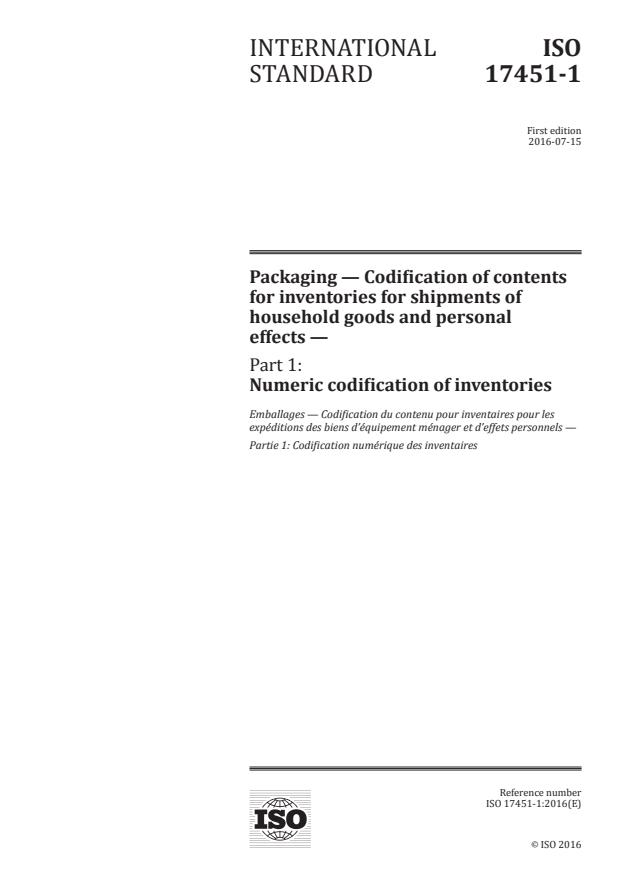
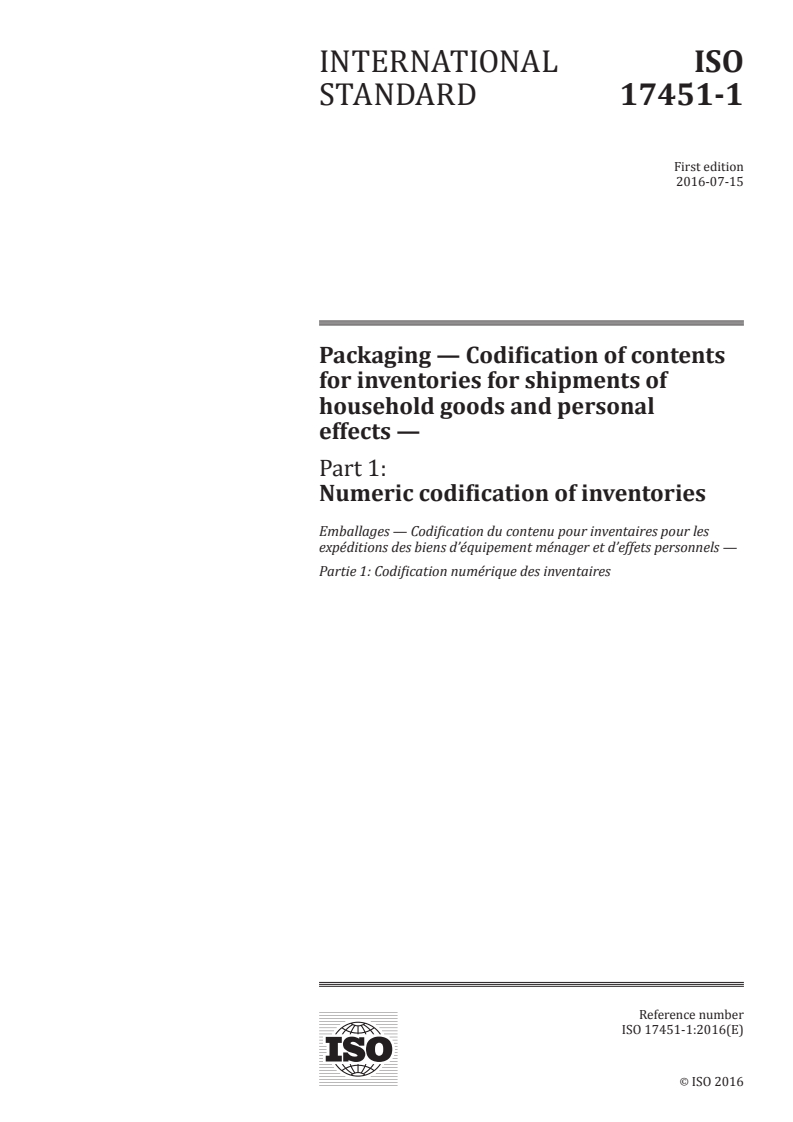
INTERNATIONAL ISO
STANDARD 17451-1
First edition
2016-07-15
Packaging — Codification of contents
for inventories for shipments of
household goods and personal
effects —
Part 1:
Numeric codification of inventories
Emballages — Codification du contenu pour inventaires pour les
expéditions des biens d’équipement ménager et d’effets personnels —
Partie 1: Codification numérique des inventaires
Reference number
©
ISO 2016
© ISO 2016, Published in Switzerland
All rights reserved. Unless otherwise specified, no part of this publication may be reproduced or utilized otherwise in any form
or by any means, electronic or mechanical, including photocopying, or posting on the internet or an intranet, without prior
written permission. Permission can be requested from either ISO at the address below or ISO’s member body in the country of
the requester.
ISO copyright office
Ch. de Blandonnet 8 • CP 401
CH-1214 Vernier, Geneva, Switzerland
Tel. +41 22 749 01 11
Fax +41 22 749 09 47
copyright@iso.org
www.iso.org
ii © ISO 2016 – All rights reserved
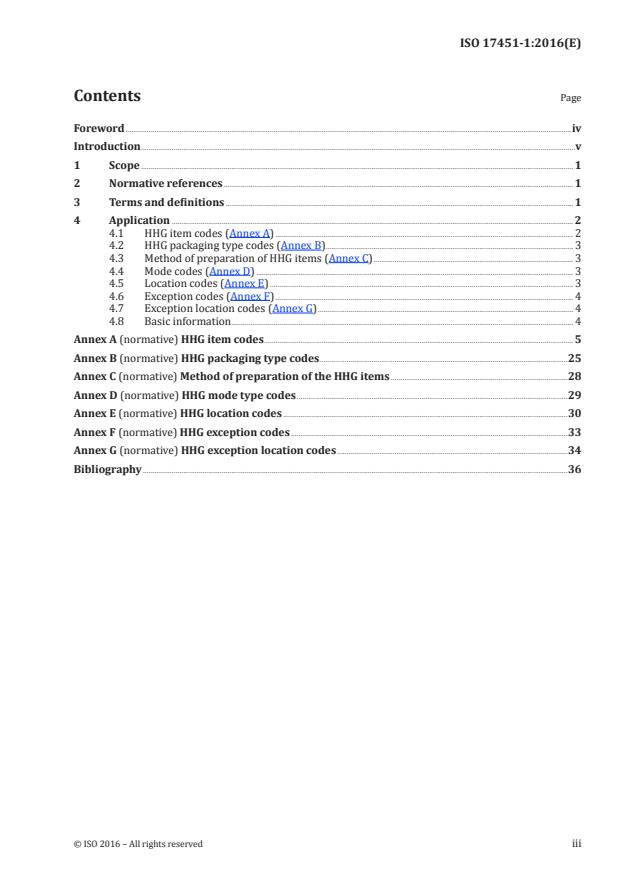
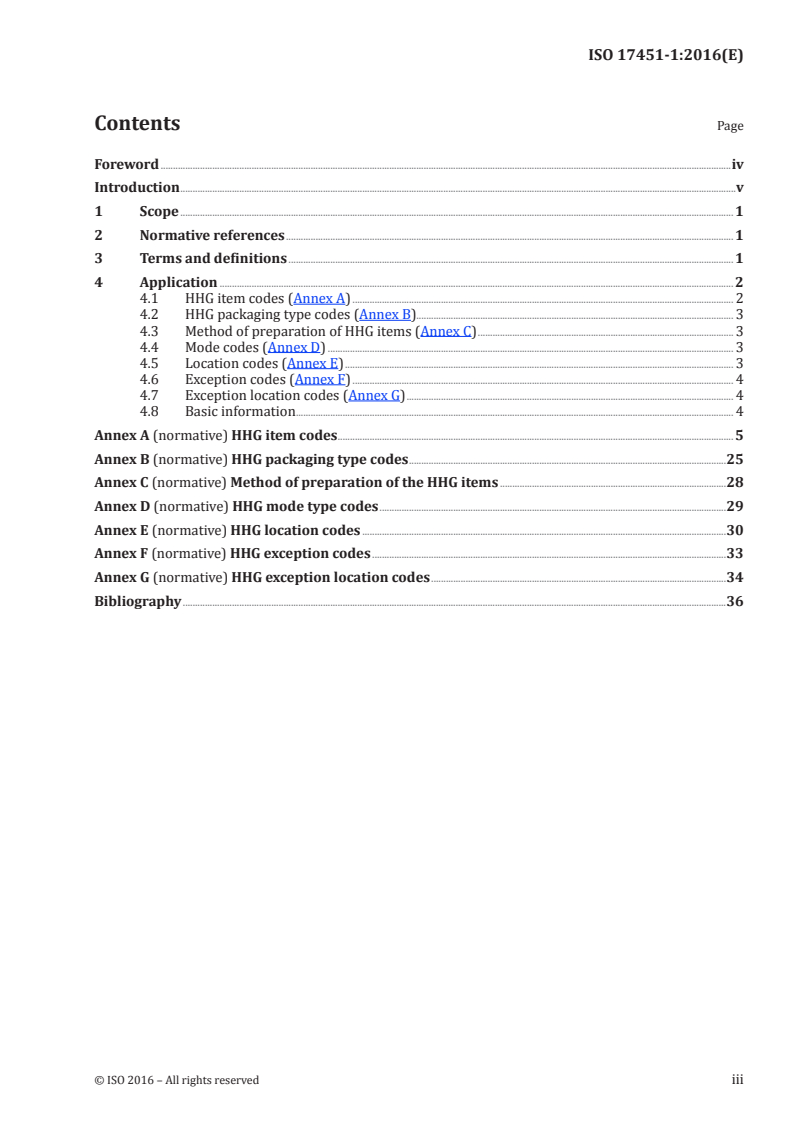
Contents Page
Foreword .iv
Introduction .v
1 Scope . 1
2 Normative references . 1
3 Terms and definitions . 1
4 Application . 2
4.1 HHG item codes (Annex A) . 2
4.2 HHG packaging type codes (Annex B). 3
4.3 Method of preparation of HHG items (Annex C) . 3
4.4 Mode codes (Annex D) . 3
4.5 Location codes (Annex E) . 3
4.6 Exception codes (Annex F) . 4
4.7 Exception location codes (Annex G) . 4
4.8 Basic information . 4
Annex A (normative) HHG item codes . 5
Annex B (normative) HHG packaging type codes .25
Annex C (normative) Method of preparation of the HHG items .28
Annex D (normative) HHG mode type codes .29
Annex E (normative) HHG location codes .30
Annex F (normative) HHG exception codes .33
Annex G (normative) HHG exception location codes .34
Bibliography .36
Foreword
ISO (the International Organization for Standardization) is a worldwide federation of national standards
bodies (ISO member bodies). The work of preparing International Standards is normally carried out
through ISO technical committees. Each member body interested in a subject for which a technical
committee has been established has the right to be represented on that committee. International
organizations, governmental and non-governmental, in liaison with ISO, also take part in the work.
ISO collaborates closely with the International Electrotechnical Commission (IEC) on all matters of
electrotechnical standardization.
The procedures used to develop this document and those intended for its further maintenance are
described in the ISO/IEC Directives, Part 1. In particular the different approval criteria needed for the
different types of ISO documents should be noted. This document was drafted in accordance with the
editorial rules of the ISO/IEC Directives, Part 2 (see www.iso.org/directives).
Attention is drawn to the possibility that some of the elements of this document may be the subject of
patent rights. ISO shall not be held responsible for identifying any or all such patent rights. Details of
any patent rights identified during the development of the document will be in the Introduction and/or
on the ISO list of patent declarations received (see www.iso.org/patents).
Any trade name used in this document is information given for the convenience of users and does not
constitute an endorsement.
For an explanation on the meaning of ISO specific terms and expressions related to conformity assessment,
as well as information about ISO’s adherence to the World Trade Organization (WTO) principles in the
Technical Barriers to Trade (TBT) see the following URL: www.iso.org/iso/foreword.html.
The committee responsible for this document is Technical Committee ISO/TC 122, Packaging.
A list of all parts in the ISO 17451 series can be found on the ISO website.
This document is based upon ANSI/HHGFAA NCC 2008-001-2010 and has been revised during the ISO
standards development process. ANSI/HHGFAA NCC 2008-001-2010 will be withdrawn upon publication.
iv © ISO 2016 – All rights reserved
Introduction
This document seeks to codify the components of household goods and personal effects shipments.
These shipments consist of items which are for residential and/or professional use, not for commercial
resale and belong to private individuals.
By codifying the components of these shipments, the international moving industry seeks to provide
a common codified language, which will enable users and industry stakeholders to communicate this
information regardless of their language of choice and, as a result, promote transparency and visibility
for these shipments.
A secondary motivation for the development of this document is to encourage standardization and, in
turn, efficiency within the industry.
INTERNATIONAL STANDARD ISO 17451-1:2016(E)
Packaging — Codification of contents for inventories for
shipments of household goods and personal effects —
Part 1:
Numeric codification of inventories
1 Scope
This document relates to the moving of household goods and personal effects. It provides the
codification of items and their condition, the transportation modes and associated data relating to a
shipment. The relevant codes can be found in the related annexes and information regarding their use
can be found in Clause 4.
The objective of this document is to provide a common set of codes which allow movers of household
goods and personal effects to exchange shipment-related information with each other and with external
partners.
2 Normative references
There are no normative references cited in this document.
3 Terms and definitions
For the purposes of this document, the terms and definitions given in ISO 21067 and the following apply.
ISO and IEC maintain terminological databases for use in standardization at the following addresses:
— IEC Electropedia: available at http://www.electropedia.org/
— ISO Online browsing platform: available at http://www.iso.org/obp
3.1
inventory
complete list of items in a particular shipment (3.9)
3.2
household goods (HHG) items
goods and personal effects normally used within private residences
Note 1 to entry: They are tangible and movable personal property found in domestic premises.
3.3
HHG packaging type
product to be used for the containment, protection, handling, delivery, storage, and transport of a
HHG item
3.4
method of preparation of HHG items
status of HHG items when control is transferred to the moving company
3.5
mode
means by which a shipment (3.9) is transported from origin to destination including storage
3.6
location
place where household goods can be found in the domestic premises
3.7
exception
suspected or actual damage or irregularities of an HHG item or its packaging
3.8
exception location
place where an exception (3.7) can be found on an HHG item or its packaging
3.9
shipment
HHG items transported and/or stored under the terms of a single bill of lading, waybill, or contract of
carriage irrespective of the quantity or number of containers, packages, or pieces
4 Application
The following words are used to make the distinctions within this document:
— requirements: shall, shall not;
— recommendations: should, should not;
— permissions: may, may not;
— possibility and capability: can, cannot.
The following elements are codified in this document:
— HHG items;
— packaging types;
— methods of preparation of HHG items;
— modes;
— locations;
— exceptions;
— exception locations.
The code lists have been set up in the following languages:
— English;
— French;
— German;
— Spanish.
More information on each set of codes can be found below.
4.1 HHG item codes (Annex A)
The objective of Annex A is to list the items which comprise a typical Household Goods shipment and
their corresponding numerical item codes.
Users shall utilize this codification in order to classify the items which constitute the shipment.
2 © ISO 2016 – All rights reserved
It is recommended that users should describe items with the most specific code practical, for example,
“table-coffee”, “table-computer”, or “table-kitchen”. However, Annex A also provides users with the
ability to classify an item as a “Generic Item”, for example, “table”, whenever the term “not further
specified” follows at the next level.
Where a specific code does not exist for an item and “other” is selected, users shall provide a description
of that item. For example, if users need to classify an unlisted item, they shall use the term “other” and
provide details such as “African Mask”, “Cuckoo Clock”, etc. in the description.
4.2 HHG packaging type codes (Annex B)
The objective of Annex B is to list the types of packaging which may be used in a Household Goods
shipment and their corresponding numeric codes.
Users should utilize Annex B to classify the packaging types which have been used in the preparation of
HHG items for the shipment. Multiple codes can be used to describe the packaging.
Users can describe the packaging type with a specific code, for example, “carton-book”, “carton-file”,
or “carton-china”. However, Annex B also provides users with the ability to classify the packaging as
“Generic”, for example, “carton”, whenever the term “not further specified” follows at the next level.
If a specific code does not exist for packaging and “other” is selected, users shall provide a description
of the packaging. For example, if users classify packaging as “other”, they shall provide details such as
“Steel Frame Pallet”, “Roll File Container”, etc. in the description.
4.3 Method of preparation of HHG items (Annex C)
The objective of Annex C is to list the types of preparation methods of HHG items when control is
transferred to the moving company and their corresponding codes.
Users should utilize Annex C to describe the method of preparation of the HHG items for transport or
storage. Multiple codes can be used to describe the methods of preparation.
If a specific code does not exist for a method of preparation and “other” is selected, users shall provide
a description of the method of preparation. For example, if users classify method of preparation as
“other”, they shall provide details such as “Sealed by customer” in the description.
4.4 Mode codes (Annex D)
The objective of Annex D is to list the types of HHG transportation modes and their corresponding codes.
Users shall utilize Annex D to describe how the shipment will be transported and/or stored from origin
to destination. If multiple modes are to be used, the primary transport mode shall be stated at least.
If a specific code does not exist for a mode and “other” is selected, users shall provide a description of the
mode. For example, if users classify the mode as “other”, they shall provide details such as “Helicopter”
in the description.
4.5 Location codes (Annex E)
The objective of Annex E is to list the places where HHG items are located in the home and the
corresponding location codes.
Users may utilize Annex E to describe either or both of the places in which the HHG item was located at
origin and/or where it will be placed at destination.
It is recommended that users should describe locations with the most specific code practical, for
example, “bathroom-first” or “bathroom-second”. However, Annex E also provides users with the ability
to classify a location as a “Generic Location”, for example, “bathroom”, whenever the term “not further
specified” follows at the next level.
If a specific code does not exist for a location and “other” is selected, users shall provide a description
of the location. For example, if users classify the location as “other”, they shall provide details such as
“Landing”, “Prayer Room”, “Mud Room”, etc. in the description.
4.6 Exception codes (Annex F)
The objective of Annex F is to list the exceptions which explain the condition of the contents within a
HHG shipment and the corresponding exception codes.
Users should utilize Annex F to describe the condition of the HHG item and/or packaging at origin as
well as when it was received. Multiple exceptions can be recorded.
If a specific code does not exist for an exception and “other” is selected, users shall provide a description
of the exception. For example, if users classify the exception as “other”, they shall provide details such
as “bowed”, “bubbled”, etc. in the description.
In the event that exceptions are identified between origin and destination, these codes should be
utilized.
Note Absence of exceptions can imply good condition.
4.7 Exception location codes (Annex G)
The objective of Annex G is to list the place where an exception has been identified on a HHG item or its
packaging and the corresponding exception location code.
If an exception has been identified, users shall utilize Annex G to describe the location of the exception.
Multiple locations can be recorded.
If a specific code does not exist for an exception location and “other” is selected, users shall provide a
description of the exception location. For example, if users classify the exception location as “other”,
they shall provide details such as “Hose”, etc. in the description.
4.8 Basic information
The following basic information shall be provided with the inventory:
— first and last name of the client;
— address of origin (street, town, postal code, country);
— creation date of the inventory.
The following basic information should be additionally provided with the inventory, if available:
— address of destination (street, town, postal code, country);
— date of delivery;
— for sealed container: Seal Code.
4 © ISO 2016 – All rights reserved
Annex A
(normative)
HHG item codes
The translations in French, German and Spanish of the HHG item descriptions presented in Annex A are
available at the following link:
http://standards.iso.org/iso/17451/-1
The user is permitted to use the translation in its original format without any modifications for the
purposes specified in this document.
1st Level 2nd Level 3rd Level
Baby Item 001 Not further specified 000
Baby Changing Table 001 Not further specified 000
Baby Toys 002 Not further specified 000
Carriage/Stroller 003 Not further specified 000
Cradle 004 Not further specified 000
Crib 005 Not further specified 000
Crib-Canopy 006 Not further specified 000
Mattress Crib 007 Not further specified 000
Other 999
Bathroom Items 002 Not further specified 000
Hairdryer/Curling Iron 001 Not further specified 000
Medicine 002 Not further specified 000
Toiletries/Cosmetics 003 Not further specified 000
Washlet 004 Not further specified 000
Other 999
Books 003 Not further specified 000
Album 001 Not further specified 000
Children’s Book 002 Not further specified 000
Computer Book 003 Not further specified 000
Cookbook 004 Not further specified 000
Encyclopaedia 005 Not further specified 000
Literature 006 Not further specified 000
Magazine 007 Not further specified 000
Manual 008 Not further specified 000
Professional Book 009 Not further specified 000
Religious Literature 010 Not further specified 000
Other 999
Children’s Items 004 Not further specified 000
1st Level 2nd Level 3rd Level
School Item 001 Not further specified 000
Toy 002 Not further specified 000
Bicycle - Child 001
Boogie Board 002
Car/Truck - Child’s 003
Dollhouse 004
Plush toy 005
Tricycle 006
Other 999
Other 999
Clothing Items 005 Not further specified 000
Accessories 001 Not further specified 000
Belt 001
Handbag 002
Hat 003
Other 999
Clothes - Baby 002 Not further specified 000
Clothes - Children 003 Not further specified 000
Clothes - Men 004 Not further specified 000
Clothes - Women 005 Not further specified 000
Clothes - Occasional 006 Kimono 001
Tailcoat 002
Traditional costume 003
Wedding Dress 004
Other 999
Clothes - Professional 007 Not further specified 000
Organization 008 Not further specified 000
Clothes Hamper 001
Coat Rack 002
Hangers 003
Other 999
Shoes 009 Not further specified 000
Men 001
Women 002
Children 003
Other 999
Other 999
Decoration 006 Not further specified 000
Artificial Plant 001 Not further specified 000
Artificial Flower 001
Other 999
Artwork 002 Not further specified 000
Column 001
6 © ISO 2016 – All rights reserved
1st Level 2nd Level 3rd Level
Figurine 002
Painting 003
Painting - Wall Framed 004
Poster 005
Sculpture 006
Sign 007
Sign - Neon 008
Statue 009
Other 999
Curtains 003 Not further specified 000
Doll 004 Not further specified 000
Flower / Plant 005 Not further specified 000
Dried Flower 001
Other 999
Mirror 006 Not further specified 000
Seasonal Items 007 Not further specified 000
Taxidermy/Stuffed Animal 008 Not further specified 000
Other 999
Electronic
Equipment
and Items 007 Not further specified 000
Cables and Wires 001 Not further specified 000
Computer Equipment 002 Not further specified 000
Computer - External Hard Drive 001
Computer - Keyboard 002
Computer - Monitor 003
Computer - Scanner 004
Other 999
Computer 003 Not further specified 000
Desktop 001
Laptop 002
Other 999
Digital or Electronic Media 004 Not further specified 000
Blu-ray Disc 001
Cassette 002
Compact Disc (CD) 003
DVD 004
Video Game 005
Video Tape 006
Other 999
Game Console/Machine 005 Not further specified 000
Arcade Machine 001
Jukebox 002
Pinball Machine 003
1st Level 2nd Level 3rd Level
Video Game Console 004
Other 999
Media Player 006 Not further specified 000
Blu-ray Disc Player 001
Cassette Player 002
CD Player 003
Digital Music Player 004
E-book Reader 005
Mobile Phone 006
Multimedia Player 007
Record Player 008
Tablet 009
VCD/DVD/DVR Player 010
Other 999
Printer/Copier 007 Not further specified 000
Copier 001
Multifunction 002
Scanner 003
Printer 004
Other 999
Radio 008 Not further specified 000
Remote Control 009 Not further specified 000
Sound Equipment 010 Not further specified 000
Loudspeaker 001
Microphone 002
Other 999
Tuner 011 Not further specified 000
TV 012 Not further specified 000
Antenna-Dish Type 001
TV-Flat Screen LCD 002
TV-Flat Screen Plasma 003
TV Antenna 006
Other 999
Projector 013 Not further specified 000
Projector Screen 001
Other 999
Other 999
Floor Covering 008 Not further specified 000
Animal Skin 001 Not further specified 000
Carpet 002 Not further specified 000
Mat 003 Not further specified 000
Rug 004 Not further specified 000
Other 999
8 © ISO 2016 – All rights reserved
1st Level 2nd Level 3rd Level
Food and Beverage
Items 009 Not further specified 000
Beverage 001 Not further specified 000
Beer 001
Liquor 002
Wine 003
Other 999
Foodstuff 002 Not further specified 000
Canned Goods 001
Dried Food 002
Preserves 003
Seasoning 004
Spices 005
Other 999
Other 999
Garden Equipment 010 Not further specified 000
Barbecue Grill 001 Not further specified 000
Barbecue Grill Coal 001
Barbecue Grill Electric 002
Barbecue Grill Gas 003
Other 999
Composter 002 Not further specified 000
Fire Pit 003 Not further specified 000
Flowerpot 004 Not further specified 000
Jungle Gym 005 Not further specified 000
Lawn Tool/Equipment 006 Not further specified 000
Hose 001
Lawn Roller 002
Spreader 003
Sprinkler 004
Wheelbarrow 005
Other 999
Leaf Blower/Sweeper 007 Not further specified 000
Mower 008 Not further specified 000
Mower-Electric 001
Mower-Fuel 002
Mower-Gas 003
Mower-Hand 004
Grass Catcher 005
Other 999
Patio Heater 009 Not further specified 000
Patio Heater - Electric 001
Patio Heater - Gas 002
Other 999
1st Level 2nd Level 3rd Level
Sandbox 010 Not further specified 000
Snow blower 011 Not further specified 000
Trimmer 012 Not further specified 000
Trimmer - Electric 001
Trimmer - Gas 002
Other 999
Weeder 013 Not further specified 000
Weeder - Electric 001
Weeder - Gas 002
Other 999
Other 999
Hazardous Materials 011 Not further specified 000
Aerosol 001 Not further specified 000
Ammunition 002 Not further specified 000
Battery 003 Not further specified 000
Battery - Lead Acid 001
Battery - Lithium 002
Other 999
Cleaning Supplies 005 Not further specified 000
Bleach 001
Other 999
Fertilizer 006 Not further specified 000
Other 999
Firearms 007 Not further specified 000
Other 999
Fire Extinguisher 008 Not further specified 000
Other 999
Gas Canister 009 Not further specified 000
Other 999
Lighter 010 Not further specified 000
Other 999
Oxygen Tank 012 Not further specified 000
Other 999
Paint Thinner 013 Not further specified 000
Other 999
Pharmaceutical 014 Not further specified 000
Other 999
Pool Chemical or Part 015 Not further specified 000
Other 999
Propane Tank 016 Not further specified 000
Other 999
Refrigerant or Refrigeration
Equipment 017 Not further specified 000
Other 999
10 © ISO 2016 – All rights reserved
1st Level 2nd Level 3rd Le
...
INTERNATIONAL ISO
STANDARD 17451-1
First edition
2016-07-15
Packaging — Codification of contents
for inventories for shipments of
household goods and personal
effects —
Part 1:
Numeric codification of inventories
Emballages — Codification du contenu pour inventaires pour les
expéditions des biens d’équipement ménager et d’effets personnels —
Partie 1: Codification numérique des inventaires
Reference number
©
ISO 2016
© ISO 2016, Published in Switzerland
All rights reserved. Unless otherwise specified, no part of this publication may be reproduced or utilized otherwise in any form
or by any means, electronic or mechanical, including photocopying, or posting on the internet or an intranet, without prior
written permission. Permission can be requested from either ISO at the address below or ISO’s member body in the country of
the requester.
ISO copyright office
Ch. de Blandonnet 8 • CP 401
CH-1214 Vernier, Geneva, Switzerland
Tel. +41 22 749 01 11
Fax +41 22 749 09 47
copyright@iso.org
www.iso.org
ii © ISO 2016 – All rights reserved
Contents Page
Foreword .iv
Introduction .v
1 Scope . 1
2 Normative references . 1
3 Terms and definitions . 1
4 Application . 2
4.1 HHG item codes (Annex A) . 2
4.2 HHG packaging type codes (Annex B). 3
4.3 Method of preparation of HHG items (Annex C) . 3
4.4 Mode codes (Annex D) . 3
4.5 Location codes (Annex E) . 3
4.6 Exception codes (Annex F) . 4
4.7 Exception location codes (Annex G) . 4
4.8 Basic information . 4
Annex A (normative) HHG item codes . 5
Annex B (normative) HHG packaging type codes .25
Annex C (normative) Method of preparation of the HHG items .28
Annex D (normative) HHG mode type codes .29
Annex E (normative) HHG location codes .30
Annex F (normative) HHG exception codes .33
Annex G (normative) HHG exception location codes .34
Bibliography .36
Foreword
ISO (the International Organization for Standardization) is a worldwide federation of national standards
bodies (ISO member bodies). The work of preparing International Standards is normally carried out
through ISO technical committees. Each member body interested in a subject for which a technical
committee has been established has the right to be represented on that committee. International
organizations, governmental and non-governmental, in liaison with ISO, also take part in the work.
ISO collaborates closely with the International Electrotechnical Commission (IEC) on all matters of
electrotechnical standardization.
The procedures used to develop this document and those intended for its further maintenance are
described in the ISO/IEC Directives, Part 1. In particular the different approval criteria needed for the
different types of ISO documents should be noted. This document was drafted in accordance with the
editorial rules of the ISO/IEC Directives, Part 2 (see www.iso.org/directives).
Attention is drawn to the possibility that some of the elements of this document may be the subject of
patent rights. ISO shall not be held responsible for identifying any or all such patent rights. Details of
any patent rights identified during the development of the document will be in the Introduction and/or
on the ISO list of patent declarations received (see www.iso.org/patents).
Any trade name used in this document is information given for the convenience of users and does not
constitute an endorsement.
For an explanation on the meaning of ISO specific terms and expressions related to conformity assessment,
as well as information about ISO’s adherence to the World Trade Organization (WTO) principles in the
Technical Barriers to Trade (TBT) see the following URL: www.iso.org/iso/foreword.html.
The committee responsible for this document is Technical Committee ISO/TC 122, Packaging.
A list of all parts in the ISO 17451 series can be found on the ISO website.
This document is based upon ANSI/HHGFAA NCC 2008-001-2010 and has been revised during the ISO
standards development process. ANSI/HHGFAA NCC 2008-001-2010 will be withdrawn upon publication.
iv © ISO 2016 – All rights reserved
Introduction
This document seeks to codify the components of household goods and personal effects shipments.
These shipments consist of items which are for residential and/or professional use, not for commercial
resale and belong to private individuals.
By codifying the components of these shipments, the international moving industry seeks to provide
a common codified language, which will enable users and industry stakeholders to communicate this
information regardless of their language of choice and, as a result, promote transparency and visibility
for these shipments.
A secondary motivation for the development of this document is to encourage standardization and, in
turn, efficiency within the industry.
INTERNATIONAL STANDARD ISO 17451-1:2016(E)
Packaging — Codification of contents for inventories for
shipments of household goods and personal effects —
Part 1:
Numeric codification of inventories
1 Scope
This document relates to the moving of household goods and personal effects. It provides the
codification of items and their condition, the transportation modes and associated data relating to a
shipment. The relevant codes can be found in the related annexes and information regarding their use
can be found in Clause 4.
The objective of this document is to provide a common set of codes which allow movers of household
goods and personal effects to exchange shipment-related information with each other and with external
partners.
2 Normative references
There are no normative references cited in this document.
3 Terms and definitions
For the purposes of this document, the terms and definitions given in ISO 21067 and the following apply.
ISO and IEC maintain terminological databases for use in standardization at the following addresses:
— IEC Electropedia: available at http://www.electropedia.org/
— ISO Online browsing platform: available at http://www.iso.org/obp
3.1
inventory
complete list of items in a particular shipment (3.9)
3.2
household goods (HHG) items
goods and personal effects normally used within private residences
Note 1 to entry: They are tangible and movable personal property found in domestic premises.
3.3
HHG packaging type
product to be used for the containment, protection, handling, delivery, storage, and transport of a
HHG item
3.4
method of preparation of HHG items
status of HHG items when control is transferred to the moving company
3.5
mode
means by which a shipment (3.9) is transported from origin to destination including storage
3.6
location
place where household goods can be found in the domestic premises
3.7
exception
suspected or actual damage or irregularities of an HHG item or its packaging
3.8
exception location
place where an exception (3.7) can be found on an HHG item or its packaging
3.9
shipment
HHG items transported and/or stored under the terms of a single bill of lading, waybill, or contract of
carriage irrespective of the quantity or number of containers, packages, or pieces
4 Application
The following words are used to make the distinctions within this document:
— requirements: shall, shall not;
— recommendations: should, should not;
— permissions: may, may not;
— possibility and capability: can, cannot.
The following elements are codified in this document:
— HHG items;
— packaging types;
— methods of preparation of HHG items;
— modes;
— locations;
— exceptions;
— exception locations.
The code lists have been set up in the following languages:
— English;
— French;
— German;
— Spanish.
More information on each set of codes can be found below.
4.1 HHG item codes (Annex A)
The objective of Annex A is to list the items which comprise a typical Household Goods shipment and
their corresponding numerical item codes.
Users shall utilize this codification in order to classify the items which constitute the shipment.
2 © ISO 2016 – All rights reserved
It is recommended that users should describe items with the most specific code practical, for example,
“table-coffee”, “table-computer”, or “table-kitchen”. However, Annex A also provides users with the
ability to classify an item as a “Generic Item”, for example, “table”, whenever the term “not further
specified” follows at the next level.
Where a specific code does not exist for an item and “other” is selected, users shall provide a description
of that item. For example, if users need to classify an unlisted item, they shall use the term “other” and
provide details such as “African Mask”, “Cuckoo Clock”, etc. in the description.
4.2 HHG packaging type codes (Annex B)
The objective of Annex B is to list the types of packaging which may be used in a Household Goods
shipment and their corresponding numeric codes.
Users should utilize Annex B to classify the packaging types which have been used in the preparation of
HHG items for the shipment. Multiple codes can be used to describe the packaging.
Users can describe the packaging type with a specific code, for example, “carton-book”, “carton-file”,
or “carton-china”. However, Annex B also provides users with the ability to classify the packaging as
“Generic”, for example, “carton”, whenever the term “not further specified” follows at the next level.
If a specific code does not exist for packaging and “other” is selected, users shall provide a description
of the packaging. For example, if users classify packaging as “other”, they shall provide details such as
“Steel Frame Pallet”, “Roll File Container”, etc. in the description.
4.3 Method of preparation of HHG items (Annex C)
The objective of Annex C is to list the types of preparation methods of HHG items when control is
transferred to the moving company and their corresponding codes.
Users should utilize Annex C to describe the method of preparation of the HHG items for transport or
storage. Multiple codes can be used to describe the methods of preparation.
If a specific code does not exist for a method of preparation and “other” is selected, users shall provide
a description of the method of preparation. For example, if users classify method of preparation as
“other”, they shall provide details such as “Sealed by customer” in the description.
4.4 Mode codes (Annex D)
The objective of Annex D is to list the types of HHG transportation modes and their corresponding codes.
Users shall utilize Annex D to describe how the shipment will be transported and/or stored from origin
to destination. If multiple modes are to be used, the primary transport mode shall be stated at least.
If a specific code does not exist for a mode and “other” is selected, users shall provide a description of the
mode. For example, if users classify the mode as “other”, they shall provide details such as “Helicopter”
in the description.
4.5 Location codes (Annex E)
The objective of Annex E is to list the places where HHG items are located in the home and the
corresponding location codes.
Users may utilize Annex E to describe either or both of the places in which the HHG item was located at
origin and/or where it will be placed at destination.
It is recommended that users should describe locations with the most specific code practical, for
example, “bathroom-first” or “bathroom-second”. However, Annex E also provides users with the ability
to classify a location as a “Generic Location”, for example, “bathroom”, whenever the term “not further
specified” follows at the next level.
If a specific code does not exist for a location and “other” is selected, users shall provide a description
of the location. For example, if users classify the location as “other”, they shall provide details such as
“Landing”, “Prayer Room”, “Mud Room”, etc. in the description.
4.6 Exception codes (Annex F)
The objective of Annex F is to list the exceptions which explain the condition of the contents within a
HHG shipment and the corresponding exception codes.
Users should utilize Annex F to describe the condition of the HHG item and/or packaging at origin as
well as when it was received. Multiple exceptions can be recorded.
If a specific code does not exist for an exception and “other” is selected, users shall provide a description
of the exception. For example, if users classify the exception as “other”, they shall provide details such
as “bowed”, “bubbled”, etc. in the description.
In the event that exceptions are identified between origin and destination, these codes should be
utilized.
Note Absence of exceptions can imply good condition.
4.7 Exception location codes (Annex G)
The objective of Annex G is to list the place where an exception has been identified on a HHG item or its
packaging and the corresponding exception location code.
If an exception has been identified, users shall utilize Annex G to describe the location of the exception.
Multiple locations can be recorded.
If a specific code does not exist for an exception location and “other” is selected, users shall provide a
description of the exception location. For example, if users classify the exception location as “other”,
they shall provide details such as “Hose”, etc. in the description.
4.8 Basic information
The following basic information shall be provided with the inventory:
— first and last name of the client;
— address of origin (street, town, postal code, country);
— creation date of the inventory.
The following basic information should be additionally provided with the inventory, if available:
— address of destination (street, town, postal code, country);
— date of delivery;
— for sealed container: Seal Code.
4 © ISO 2016 – All rights reserved
Annex A
(normative)
HHG item codes
The translations in French, German and Spanish of the HHG item descriptions presented in Annex A are
available at the following link:
http://standards.iso.org/iso/17451/-1
The user is permitted to use the translation in its original format without any modifications for the
purposes specified in this document.
1st Level 2nd Level 3rd Level
Baby Item 001 Not further specified 000
Baby Changing Table 001 Not further specified 000
Baby Toys 002 Not further specified 000
Carriage/Stroller 003 Not further specified 000
Cradle 004 Not further specified 000
Crib 005 Not further specified 000
Crib-Canopy 006 Not further specified 000
Mattress Crib 007 Not further specified 000
Other 999
Bathroom Items 002 Not further specified 000
Hairdryer/Curling Iron 001 Not further specified 000
Medicine 002 Not further specified 000
Toiletries/Cosmetics 003 Not further specified 000
Washlet 004 Not further specified 000
Other 999
Books 003 Not further specified 000
Album 001 Not further specified 000
Children’s Book 002 Not further specified 000
Computer Book 003 Not further specified 000
Cookbook 004 Not further specified 000
Encyclopaedia 005 Not further specified 000
Literature 006 Not further specified 000
Magazine 007 Not further specified 000
Manual 008 Not further specified 000
Professional Book 009 Not further specified 000
Religious Literature 010 Not further specified 000
Other 999
Children’s Items 004 Not further specified 000
1st Level 2nd Level 3rd Level
School Item 001 Not further specified 000
Toy 002 Not further specified 000
Bicycle - Child 001
Boogie Board 002
Car/Truck - Child’s 003
Dollhouse 004
Plush toy 005
Tricycle 006
Other 999
Other 999
Clothing Items 005 Not further specified 000
Accessories 001 Not further specified 000
Belt 001
Handbag 002
Hat 003
Other 999
Clothes - Baby 002 Not further specified 000
Clothes - Children 003 Not further specified 000
Clothes - Men 004 Not further specified 000
Clothes - Women 005 Not further specified 000
Clothes - Occasional 006 Kimono 001
Tailcoat 002
Traditional costume 003
Wedding Dress 004
Other 999
Clothes - Professional 007 Not further specified 000
Organization 008 Not further specified 000
Clothes Hamper 001
Coat Rack 002
Hangers 003
Other 999
Shoes 009 Not further specified 000
Men 001
Women 002
Children 003
Other 999
Other 999
Decoration 006 Not further specified 000
Artificial Plant 001 Not further specified 000
Artificial Flower 001
Other 999
Artwork 002 Not further specified 000
Column 001
6 © ISO 2016 – All rights reserved
1st Level 2nd Level 3rd Level
Figurine 002
Painting 003
Painting - Wall Framed 004
Poster 005
Sculpture 006
Sign 007
Sign - Neon 008
Statue 009
Other 999
Curtains 003 Not further specified 000
Doll 004 Not further specified 000
Flower / Plant 005 Not further specified 000
Dried Flower 001
Other 999
Mirror 006 Not further specified 000
Seasonal Items 007 Not further specified 000
Taxidermy/Stuffed Animal 008 Not further specified 000
Other 999
Electronic
Equipment
and Items 007 Not further specified 000
Cables and Wires 001 Not further specified 000
Computer Equipment 002 Not further specified 000
Computer - External Hard Drive 001
Computer - Keyboard 002
Computer - Monitor 003
Computer - Scanner 004
Other 999
Computer 003 Not further specified 000
Desktop 001
Laptop 002
Other 999
Digital or Electronic Media 004 Not further specified 000
Blu-ray Disc 001
Cassette 002
Compact Disc (CD) 003
DVD 004
Video Game 005
Video Tape 006
Other 999
Game Console/Machine 005 Not further specified 000
Arcade Machine 001
Jukebox 002
Pinball Machine 003
1st Level 2nd Level 3rd Level
Video Game Console 004
Other 999
Media Player 006 Not further specified 000
Blu-ray Disc Player 001
Cassette Player 002
CD Player 003
Digital Music Player 004
E-book Reader 005
Mobile Phone 006
Multimedia Player 007
Record Player 008
Tablet 009
VCD/DVD/DVR Player 010
Other 999
Printer/Copier 007 Not further specified 000
Copier 001
Multifunction 002
Scanner 003
Printer 004
Other 999
Radio 008 Not further specified 000
Remote Control 009 Not further specified 000
Sound Equipment 010 Not further specified 000
Loudspeaker 001
Microphone 002
Other 999
Tuner 011 Not further specified 000
TV 012 Not further specified 000
Antenna-Dish Type 001
TV-Flat Screen LCD 002
TV-Flat Screen Plasma 003
TV Antenna 006
Other 999
Projector 013 Not further specified 000
Projector Screen 001
Other 999
Other 999
Floor Covering 008 Not further specified 000
Animal Skin 001 Not further specified 000
Carpet 002 Not further specified 000
Mat 003 Not further specified 000
Rug 004 Not further specified 000
Other 999
8 © ISO 2016 – All rights reserved
1st Level 2nd Level 3rd Level
Food and Beverage
Items 009 Not further specified 000
Beverage 001 Not further specified 000
Beer 001
Liquor 002
Wine 003
Other 999
Foodstuff 002 Not further specified 000
Canned Goods 001
Dried Food 002
Preserves 003
Seasoning 004
Spices 005
Other 999
Other 999
Garden Equipment 010 Not further specified 000
Barbecue Grill 001 Not further specified 000
Barbecue Grill Coal 001
Barbecue Grill Electric 002
Barbecue Grill Gas 003
Other 999
Composter 002 Not further specified 000
Fire Pit 003 Not further specified 000
Flowerpot 004 Not further specified 000
Jungle Gym 005 Not further specified 000
Lawn Tool/Equipment 006 Not further specified 000
Hose 001
Lawn Roller 002
Spreader 003
Sprinkler 004
Wheelbarrow 005
Other 999
Leaf Blower/Sweeper 007 Not further specified 000
Mower 008 Not further specified 000
Mower-Electric 001
Mower-Fuel 002
Mower-Gas 003
Mower-Hand 004
Grass Catcher 005
Other 999
Patio Heater 009 Not further specified 000
Patio Heater - Electric 001
Patio Heater - Gas 002
Other 999
1st Level 2nd Level 3rd Level
Sandbox 010 Not further specified 000
Snow blower 011 Not further specified 000
Trimmer 012 Not further specified 000
Trimmer - Electric 001
Trimmer - Gas 002
Other 999
Weeder 013 Not further specified 000
Weeder - Electric 001
Weeder - Gas 002
Other 999
Other 999
Hazardous Materials 011 Not further specified 000
Aerosol 001 Not further specified 000
Ammunition 002 Not further specified 000
Battery 003 Not further specified 000
Battery - Lead Acid 001
Battery - Lithium 002
Other 999
Cleaning Supplies 005 Not further specified 000
Bleach 001
Other 999
Fertilizer 006 Not further specified 000
Other 999
Firearms 007 Not further specified 000
Other 999
Fire Extinguisher 008 Not further specified 000
Other 999
Gas Canister 009 Not further specified 000
Other 999
Lighter 010 Not further specified 000
Other 999
Oxygen Tank 012 Not further specified 000
Other 999
Paint Thinner 013 Not further specified 000
Other 999
Pharmaceutical 014 Not further specified 000
Other 999
Pool Chemical or Part 015 Not further specified 000
Other 999
Propane Tank 016 Not further specified 000
Other 999
Refrigerant or Refrigeration
Equipment 017 Not further specified 000
Other 999
10 © ISO 2016 – All rights reserved
1st Level 2nd Level 3rd Le
...