

ISO 17881-1:2016
(Main)Textiles — Determination of certain flame retardants — Part 1: Brominated flame retardants
General Information
- Abstract
ISO 17881-1:2016 specifies a test method for determining some brominated flame retardants in textiles by gas chromatography ? mass spectrometry (GC-MS). The method is applicable to all kinds of textile products.
- Status
- Published
- Publication Date
- 25-Jan-2016
- Technical Committee
- ISO/TC 38 - Textiles
- Drafting Committee
- ISO/TC 38/WG 22 - Composition and chemical testing
- Current Stage
- 9092 - International Standard to be revised
- Start Date
- 14-Jun-2024
- Completion Date
- 29-Aug-2026
Buy Documents
ISO 17881-1:2016 - Textiles -- Determination of certain flame retardants
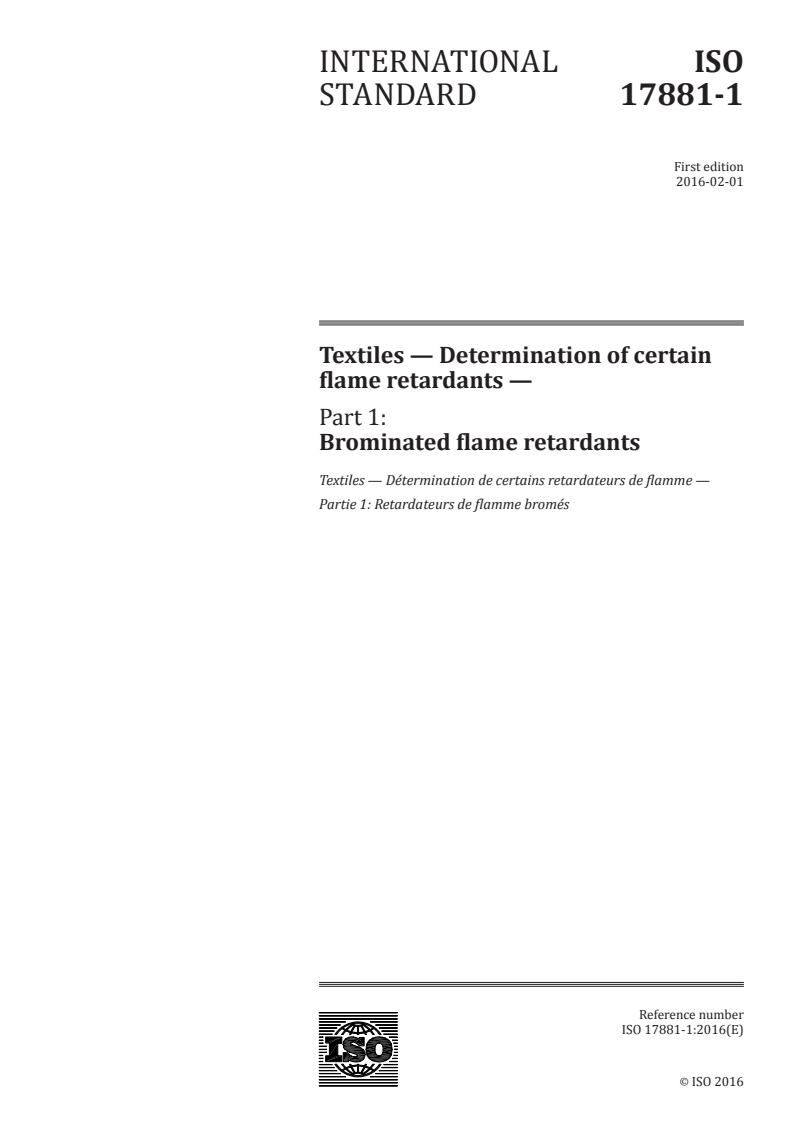
ISO 17881-1:2016 - Textiles — Determination of certain flame retardants — Part 1: Brominated flame retardants/26/2016
ISO 17881-1:2016 - Textiles -- Détermination de certains retardateurs de flamme
ISO 17881-1:2016 - Textiles — Détermination de certains retardateurs de flamme — Partie 1: Retardateurs de flamme bromés/26/2016
Overview
ISO 17881-1:2016 - Textiles - Determination of certain flame retardants - Part 1: Brominated flame retardants - is an international test method for identifying and quantifying selected brominated flame retardants (BFRs) in textile products using gas chromatography–mass spectrometry (GC‑MS). The method is applicable to all kinds of textile products and sets out sample preparation, analytical instrumentation and reporting requirements for laboratory testing.
Key topics and technical requirements
- Scope and principle
- Extraction of BFRs from textile specimens by ultrasonic-assisted extraction with toluene, followed by GC‑MS identification and quantification using an internal standard method.
- Target analytes
- A list of common brominated compounds covered, including mono‑ to decabromobiphenyls (MonoBB to DecaBB), polybromodiphenyl ethers (Tetra‑ to DecaBDE), and hexabromocyclododecane (HBCDD).
- Reagents and standards
- Use of analytical-grade reagents; decachlorobiphenyl specified as the internal standard.
- Apparatus
- Required equipment includes GC‑MS, ultrasonic generator (35–45 kHz), evaporator (50 °C water bath), filtration membrane (0.45 µm), and precision balance.
- Procedure highlights
- Representative specimen cut to ~1.00 g; extraction in 20 ml toluene (30 min), a second extraction with 10 ml toluene (15 min), combined extracts evaporated, reconstituted with internal standard and filtered prior to GC‑MS analysis.
- Calibration and calculation
- At least five calibration dilutions to build calibration curves; results expressed as mass ratio (µg/g) with blank correction.
- Performance data
- Annex A provides example GC‑MS parameters and typical ions; example detection limits are provided (commonly 5–10 µg/g for many BFRs).
- Quality and reporting
- Run blanks to check contamination; test report must reference ISO 17881‑1:2016, include sample identification, content of each flame retardant and any procedural deviations.
Applications and users
- Laboratories performing flame retardant testing for textiles and consumer goods.
- Textile manufacturers and finishers verifying product composition and quality control.
- Regulatory and compliance testing labs assessing presence of regulated BFRs in trade and import/export screening.
- Environmental and occupational testing groups monitoring brominated compound residues in textile waste or recycled fibers.
Related standards
- ISO 17881 series - Part 2 covers phosphorus flame retardants (ISO 17881‑2).
- Use ISO 17881‑1:2016 in conjunction with laboratory QA/QC practices and any jurisdictional regulatory limits when interpreting results.
Keywords: ISO 17881-1:2016, brominated flame retardants, textiles, GC‑MS, ultrasonic extraction, HBCDD, PBDE, biphenyls, flame retardant testing.
Relations
- Effective Date
- 12-Feb-2026
- Consolidated By
ISO 9554:2019 - Fibre ropes — General specifications - Effective Date
- 06-Jun-2022
Buy Documents
ISO 17881-1:2016 - Textiles -- Determination of certain flame retardants
ISO 17881-1:2016 - Textiles — Determination of certain flame retardants — Part 1: Brominated flame retardants/26/2016
ISO 17881-1:2016 - Textiles -- Détermination de certains retardateurs de flamme
ISO 17881-1:2016 - Textiles — Détermination de certains retardateurs de flamme — Partie 1: Retardateurs de flamme bromés/26/2016
Get Certified
Connect with accredited certification bodies for this standard

Control Union Certifications
Global certification for agriculture and sustainability.

Hohenstein Institut
Textile testing and certification.

Bureau Veritas Bangladesh
Bureau Veritas certification services in Bangladesh.
Sponsored listings
Frequently Asked Questions
ISO 17881-1:2016 is a standard published by the International Organization for Standardization (ISO). Its full title is "Textiles — Determination of certain flame retardants — Part 1: Brominated flame retardants". This standard covers: ISO 17881-1:2016 specifies a test method for determining some brominated flame retardants in textiles by gas chromatography ? mass spectrometry (GC-MS). The method is applicable to all kinds of textile products.
ISO 17881-1:2016 specifies a test method for determining some brominated flame retardants in textiles by gas chromatography ? mass spectrometry (GC-MS). The method is applicable to all kinds of textile products.
ISO 17881-1:2016 is classified under the following ICS (International Classification for Standards) categories: 59.080.01 - Textiles in general. The ICS classification helps identify the subject area and facilitates finding related standards.
ISO 17881-1:2016 has the following relationships with other standards: It is inter standard links to EN ISO 17881-1:2016, ISO 9554:2019. Understanding these relationships helps ensure you are using the most current and applicable version of the standard.
ISO 17881-1:2016 is available in PDF format for immediate download after purchase. The document can be added to your cart and obtained through the secure checkout process. Digital delivery ensures instant access to the complete standard document.
Standards Content (Sample)
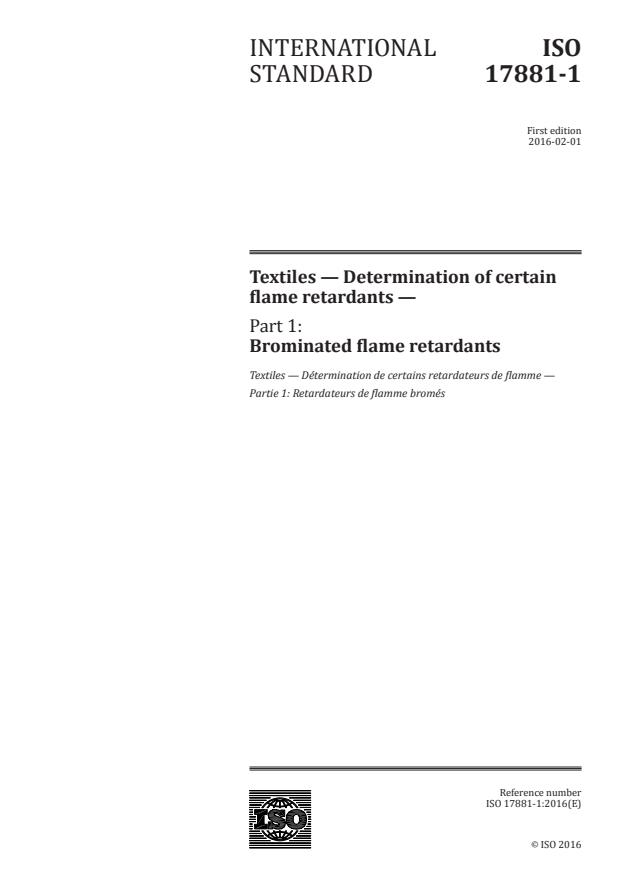
INTERNATIONAL ISO
STANDARD 17881-1
First edition
2016-02-01
Textiles — Determination of certain
flame retardants —
Part 1:
Brominated flame retardants
Textiles — Détermination de certains retardateurs de flamme —
Partie 1: Retardateurs de flamme bromés
Reference number
©
ISO 2016
© ISO 2016, Published in Switzerland
All rights reserved. Unless otherwise specified, no part of this publication may be reproduced or utilized otherwise in any form
or by any means, electronic or mechanical, including photocopying, or posting on the internet or an intranet, without prior
written permission. Permission can be requested from either ISO at the address below or ISO’s member body in the country of
the requester.
ISO copyright office
Ch. de Blandonnet 8 • CP 401
CH-1214 Vernier, Geneva, Switzerland
Tel. +41 22 749 01 11
Fax +41 22 749 09 47
copyright@iso.org
www.iso.org
ii © ISO 2016 – All rights reserved
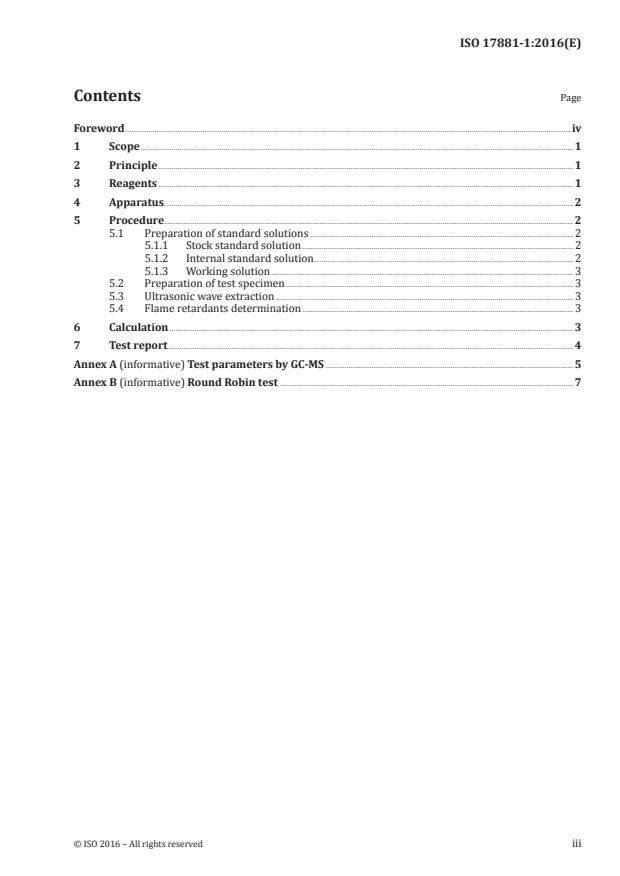
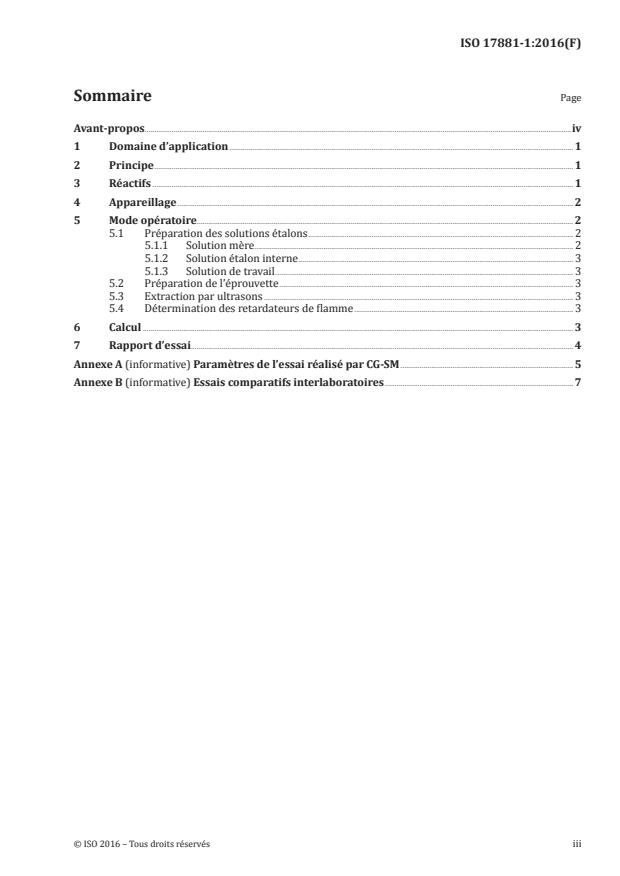
Contents Page
Foreword .iv
1 Scope . 1
2 Principle . 1
3 Reagents . 1
4 Apparatus . 2
5 Procedure. 2
5.1 Preparation of standard solutions . 2
5.1.1 Stock standard solution . 2
5.1.2 Internal standard solution . 2
5.1.3 Working solution . 3
5.2 Preparation of test specimen . 3
5.3 Ultrasonic wave extraction . 3
5.4 Flame retardants determination . 3
6 Calculation . 3
7 Test report . 4
Annex A (informative) Test parameters by GC-MS . 5
Annex B (informative) Round Robin test . 7
Foreword
ISO (the International Organization for Standardization) is a worldwide federation of national standards
bodies (ISO member bodies). The work of preparing International Standards is normally carried out
through ISO technical committees. Each member body interested in a subject for which a technical
committee has been established has the right to be represented on that committee. International
organizations, governmental and non-governmental, in liaison with ISO, also take part in the work.
ISO collaborates closely with the International Electrotechnical Commission (IEC) on all matters of
electrotechnical standardization.
The procedures used to develop this document and those intended for its further maintenance are
described in the ISO/IEC Directives, Part 1. In particular the different approval criteria needed for the
different types of ISO documents should be noted. This document was drafted in accordance with the
editorial rules of the ISO/IEC Directives, Part 2 (see www.iso.org/directives).
Attention is drawn to the possibility that some of the elements of this document may be the subject of
patent rights. ISO shall not be held responsible for identifying any or all such patent rights. Details of
any patent rights identified during the development of the document will be in the Introduction and/or
on the ISO list of patent declarations received (see www.iso.org/patents).
Any trade name used in this document is information given for the convenience of users and does not
constitute an endorsement.
For an explanation on the meaning of ISO specific terms and expressions related to conformity
assessment, as well as information about ISO’s adherence to the WTO principles in the Technical
Barriers to Trade (TBT) see the following URL: Foreword - Supplementary information
The committee responsible for this document is ISO/TC 38, Textiles.
ISO 17881 consists of the following parts, under the general title Textiles — Determination of certain
flame retardants:
— Part 1: Brominated flame retardants
— Part 2: Phosphorus flame retardants
iv © ISO 2016 – All rights reserved
INTERNATIONAL STANDARD ISO 17881-1:2016(E)
Textiles — Determination of certain flame retardants —
Part 1:
Brominated flame retardants
WARNING — This International Standard calls for the use of substances and/or procedures
that may be injurious to health if adequate precautions are not taken. It refers only to technical
suitability and does not absolve the user from legal obligations relating to health and safety at
any stage. It has been assumed in the drafting of this International Standard that the execution
of its provisions is entrusted to appropriately qualified and experienced people.
1 Scope
This part of ISO 17881 specifies a test method for determining some brominated flame retardants in
textiles by gas chromatography – mass spectrometry (GC-MS).
The method is applicable to all kinds of textile products.
2 Principle
The flame retardants are extracted from textile specimen by ultrasonic generator with toluene. The flame
retardants in the specimen are identified by GC-MS and quantified by using internal standard method.
3 Reagents
Unless otherwise specified, use only reagents of recognized analytical grade.
3.1 Monobromobiphenyl (MonoBB), CAS no. 2052-07-5.
3.2 Dibromobiphenyl (DiBB), CAS no. 57422-77-2.
3.3 Tribromobiphenyl (TriBB), CAS no. 59080-34-1.
3.4 Tetrabromobiphenyl (TetraBB), CAS no. 60044-24-8.
3.5 Pentabromo-1,1’-biphenyl (PentaBB), CAS no. 59080-39-6.
3.6 Hexabromobiphenyl (HexaBB), CAS no. 60044-26-0.
3.7 Heptabromo-1,1’-biphenyl (HeptaBB), CAS no. 88700-06-5.
3.8 Octabromobiphenyl (OctaBB), CAS no. 67889-00-3.
3.9 Nonabromobiphenyl (NonaBB), CAS no. 69278-62-2.
3.10 Decabromobiphenyl (DecaBB), CAS no. 13654-09-6.
3.11 Tetrabromodiphenylether (TetraBDE), CAS no. 5436-43-1.
3.12 Pentabromodiphenylether (PentaBDE), CAS no.32534-81-9.
3.13 Hexabromodiphenylether (HexaBDE), CAS no. 207122-15-4.
3.14 Heptabromodiphenylether (HeptaBDE), CAS no. 207122-16-5.
3.15 Octabromodiphenylether (OctaBDE), CAS no. 337513-72-1.
3.16 Decabromodiphenylether (DecaBDE), CAS no. 1163-19-5.
3.17 Hexabromocyclododecane (HBCDD), CAS no. 25637-99-4.
3.18 Decachlorobiphenyl, CAS no.2051-24-3, internal standard (IS).
3.19 Toluene.
NOTE Since brominated flame retardants have many isomers, this method might not cover all of them.
Determination of the isomers of flame retardants in Clause 3 can refer to this method according to the principle.
4 Apparatus
4.1 Gas chromatography – mass spectrometry (GC-MS).
4.2 Ultrasonic generator, with a frequency from 35 kHz to 45 kHz.
4.3 Evaporator device, with water bath at 50 °C.
4.4 Brown glass vial, 40 ml with tight clos
...
INTERNATIONAL ISO
STANDARD 17881-1
First edition
2016-02-01
Textiles — Determination of certain
flame retardants —
Part 1:
Brominated flame retardants
Textiles — Détermination de certains retardateurs de flamme —
Partie 1: Retardateurs de flamme bromés
Reference number
©
ISO 2016
© ISO 2016, Published in Switzerland
All rights reserved. Unless otherwise specified, no part of this publication may be reproduced or utilized otherwise in any form
or by any means, electronic or mechanical, including photocopying, or posting on the internet or an intranet, without prior
written permission. Permission can be requested from either ISO at the address below or ISO’s member body in the country of
the requester.
ISO copyright office
Ch. de Blandonnet 8 • CP 401
CH-1214 Vernier, Geneva, Switzerland
Tel. +41 22 749 01 11
Fax +41 22 749 09 47
copyright@iso.org
www.iso.org
ii © ISO 2016 – All rights reserved
Contents Page
Foreword .iv
1 Scope . 1
2 Principle . 1
3 Reagents . 1
4 Apparatus . 2
5 Procedure. 2
5.1 Preparation of standard solutions . 2
5.1.1 Stock standard solution . 2
5.1.2 Internal standard solution . 2
5.1.3 Working solution . 3
5.2 Preparation of test specimen . 3
5.3 Ultrasonic wave extraction . 3
5.4 Flame retardants determination . 3
6 Calculation . 3
7 Test report . 4
Annex A (informative) Test parameters by GC-MS . 5
Annex B (informative) Round Robin test . 7
Foreword
ISO (the International Organization for Standardization) is a worldwide federation of national standards
bodies (ISO member bodies). The work of preparing International Standards is normally carried out
through ISO technical committees. Each member body interested in a subject for which a technical
committee has been established has the right to be represented on that committee. International
organizations, governmental and non-governmental, in liaison with ISO, also take part in the work.
ISO collaborates closely with the International Electrotechnical Commission (IEC) on all matters of
electrotechnical standardization.
The procedures used to develop this document and those intended for its further maintenance are
described in the ISO/IEC Directives, Part 1. In particular the different approval criteria needed for the
different types of ISO documents should be noted. This document was drafted in accordance with the
editorial rules of the ISO/IEC Directives, Part 2 (see www.iso.org/directives).
Attention is drawn to the possibility that some of the elements of this document may be the subject of
patent rights. ISO shall not be held responsible for identifying any or all such patent rights. Details of
any patent rights identified during the development of the document will be in the Introduction and/or
on the ISO list of patent declarations received (see www.iso.org/patents).
Any trade name used in this document is information given for the convenience of users and does not
constitute an endorsement.
For an explanation on the meaning of ISO specific terms and expressions related to conformity
assessment, as well as information about ISO’s adherence to the WTO principles in the Technical
Barriers to Trade (TBT) see the following URL: Foreword - Supplementary information
The committee responsible for this document is ISO/TC 38, Textiles.
ISO 17881 consists of the following parts, under the general title Textiles — Determination of certain
flame retardants:
— Part 1: Brominated flame retardants
— Part 2: Phosphorus flame retardants
iv © ISO 2016 – All rights reserved
INTERNATIONAL STANDARD ISO 17881-1:2016(E)
Textiles — Determination of certain flame retardants —
Part 1:
Brominated flame retardants
WARNING — This International Standard calls for the use of substances and/or procedures
that may be injurious to health if adequate precautions are not taken. It refers only to technical
suitability and does not absolve the user from legal obligations relating to health and safety at
any stage. It has been assumed in the drafting of this International Standard that the execution
of its provisions is entrusted to appropriately qualified and experienced people.
1 Scope
This part of ISO 17881 specifies a test method for determining some brominated flame retardants in
textiles by gas chromatography – mass spectrometry (GC-MS).
The method is applicable to all kinds of textile products.
2 Principle
The flame retardants are extracted from textile specimen by ultrasonic generator with toluene. The flame
retardants in the specimen are identified by GC-MS and quantified by using internal standard method.
3 Reagents
Unless otherwise specified, use only reagents of recognized analytical grade.
3.1 Monobromobiphenyl (MonoBB), CAS no. 2052-07-5.
3.2 Dibromobiphenyl (DiBB), CAS no. 57422-77-2.
3.3 Tribromobiphenyl (TriBB), CAS no. 59080-34-1.
3.4 Tetrabromobiphenyl (TetraBB), CAS no. 60044-24-8.
3.5 Pentabromo-1,1’-biphenyl (PentaBB), CAS no. 59080-39-6.
3.6 Hexabromobiphenyl (HexaBB), CAS no. 60044-26-0.
3.7 Heptabromo-1,1’-biphenyl (HeptaBB), CAS no. 88700-06-5.
3.8 Octabromobiphenyl (OctaBB), CAS no. 67889-00-3.
3.9 Nonabromobiphenyl (NonaBB), CAS no. 69278-62-2.
3.10 Decabromobiphenyl (DecaBB), CAS no. 13654-09-6.
3.11 Tetrabromodiphenylether (TetraBDE), CAS no. 5436-43-1.
3.12 Pentabromodiphenylether (PentaBDE), CAS no.32534-81-9.
3.13 Hexabromodiphenylether (HexaBDE), CAS no. 207122-15-4.
3.14 Heptabromodiphenylether (HeptaBDE), CAS no. 207122-16-5.
3.15 Octabromodiphenylether (OctaBDE), CAS no. 337513-72-1.
3.16 Decabromodiphenylether (DecaBDE), CAS no. 1163-19-5.
3.17 Hexabromocyclododecane (HBCDD), CAS no. 25637-99-4.
3.18 Decachlorobiphenyl, CAS no.2051-24-3, internal standard (IS).
3.19 Toluene.
NOTE Since brominated flame retardants have many isomers, this method might not cover all of them.
Determination of the isomers of flame retardants in Clause 3 can refer to this method according to the principle.
4 Apparatus
4.1 Gas chromatography – mass spectrometry (GC-MS).
4.2 Ultrasonic generator, with a frequency from 35 kHz to 45 kHz.
4.3 Evaporator device, with water bath at 50 °C.
4.4 Brown glass vial, 40 ml with tight clos
...
NORME ISO
INTERNATIONALE 17881-1
Première édition
2016-02-01
Textiles — Détermination de certains
retardateurs de flamme —
Partie 1:
Retardateurs de flamme bromés
Textiles — Determination of certain flame retardants —
Part 1: Brominated flame retardants
Numéro de référence
©
ISO 2016
DOCUMENT PROTÉGÉ PAR COPYRIGHT
© ISO 2016, Publié en Suisse
Droits de reproduction réservés. Sauf indication contraire, aucune partie de cette publication ne peut être reproduite ni utilisée
sous quelque forme que ce soit et par aucun procédé, électronique ou mécanique, y compris la photocopie, l’affichage sur
l’internet ou sur un Intranet, sans autorisation écrite préalable. Les demandes d’autorisation peuvent être adressées à l’ISO à
l’adresse ci-après ou au comité membre de l’ISO dans le pays du demandeur.
ISO copyright office
Ch. de Blandonnet 8 • CP 401
CH-1214 Vernier, Geneva, Switzerland
Tel. +41 22 749 01 11
Fax +41 22 749 09 47
copyright@iso.org
www.iso.org
ii © ISO 2016 – Tous droits réservés
Sommaire Page
Avant-propos .iv
1 Domaine d’application . 1
2 Principe . 1
3 Réactifs . 1
4 Appareillage . 2
5 Mode opératoire. 2
5.1 Préparation des solutions étalons . 2
5.1.1 Solution mère. 2
5.1.2 Solution étalon interne . 3
5.1.3 Solution de travail . 3
5.2 Préparation de l’éprouvette . 3
5.3 Extraction par ultrasons . 3
5.4 Détermination des retardateurs de flamme . 3
6 Calcul . 3
7 Rapport d’essai . 4
Annexe A (informative) Paramètres de l’essai réalisé par CG-SM . 5
Annexe B (informative) Essais comparatifs interlaboratoires . 7
Avant-propos
L’ISO (Organisation internationale de normalisation) est une fédération mondiale d’organismes
nationaux de normalisation (comités membres de l’ISO). L’élaboration des Normes internationales est
en général confiée aux comités techniques de l’ISO. Chaque comité membre intéressé par une étude
a le droit de faire partie du comité technique créé à cet effet. Les organisations internationales,
gouvernementales et non gouvernementales, en liaison avec l’ISO participent également aux travaux.
L’ISO collabore étroitement avec la Commission électrotechnique internationale (IEC) en ce qui
concerne la normalisation électrotechnique.
Les procédures utilisées pour élaborer le présent document et celles destinées à sa mise à jour sont
décrites dans les Directives ISO/IEC, Partie 1. Il convient, en particulier de prendre note des différents
critères d’approbation requis pour les différents types de documents ISO. Le présent document a été
rédigé conformément aux règles de rédaction données dans les Directives ISO/IEC, Partie 2 (voir www.
iso.org/directives).
L’attention est appelée sur le fait que certains des éléments du présent document peuvent faire l’objet de
droits de propriété intellectuelle ou de droits analogues. L’ISO ne saurait être tenue pour responsable
de ne pas avoir identifié de tels droits de propriété et averti de leur existence. Les détails concernant
les références aux droits de propriété intellectuelle ou autres droits analogues identifiés lors de
l’élaboration du document sont indiqués dans l’Introduction et/ou dans la liste des déclarations de
brevets reçues par l’ISO (voir www.iso.org/brevets).
Les appellations commerciales éventuellement mentionnées dans le présent document sont données
pour information, par souci de commodité, à l’intention des utilisateurs et ne sauraient constituer
un engagement.
Pour une explication de la signification des termes et expressions spécifiques de l’ISO liés à
l’évaluation de la conformité, ou pour toute information au sujet de l’adhésion de l’ISO aux principes
de l’OMC concernant les obstacles techniques au commerce (OTC), voir le lien suivant: Avant-propos —
Informations supplémentaires.
Le comité chargé de l’élaboration du présent document est l’ISO/TC 38, Textiles.
L’ISO 17881 comprend les parties suivantes, présentées sous le titre général Textiles — Détermination
de certains retardateurs de flamme:
— Partie 1: Retardateurs de flamme bromés
— Partie 2: Retardateurs de flamme phosphorés
iv © ISO 2016 – Tous droits réservés
NORME INTERNATIONALE ISO 17881-1:2016(F)
Textiles — Détermination de certains retardateurs de
flamme —
Partie 1:
Retardateurs de flamme bromés
AVERTISSEMENT — La présente Norme internationale nécessite l’utilisation de substances et/ou
modes opératoires qui peuvent être préjudiciables à la santé si les précautions appropriées ne
sont pas prises. Elle ne traite que de l’aptitude à l’emploi technique et ne dispense pas l’utilisateur
de ses obligations légales concernant la santé et la sécurité, à quelque étape que ce soit. Lors de
l’élaboration de la présente Norme internationale, il a été pris pour principe que l’exécution des
dispositions qu’elle renferme sera confiée à des personnes expérimentées et qualifiées.
1 Domaine d’application
La présente partie de l’ISO 17881 spécifie une méthode d’essai pour la détermination d’un certain
nombre de retardateurs de flamme bromés dans les textiles, par chromatographie en phase gazeuse –
spectrométrie de masse (CG-SM).
Cette méthode s’applique à tous les types de produits textiles.
2 Principe
Les retardateurs de flamme sont extraits d’une éprouvette de textile au moyen d’un générateur à
ultrasons, avec du toluène. Les retardateurs de flamme présents dans l’éprouvette sont identifiés par
CG-SM et quantifiés par la méthode de l’étalon interne.
3 Réactifs
Sauf spécification contraire, n’utiliser que des réactifs de qualité analytique reconnue.
3.1 Monobromobiphényle (MonoBB), CAS nº 2052-07-5.
3.2 Dibromobiphényle (DiBB), CAS nº 57422-77-2.
3.3 Tribromobiphényle (TriBB), CAS nº 59080-34-1.
3.4 Tétrabromobiphényle (TétraBB), CAS nº 60044-24-8.
3.5 Pentabromo-1,1’-biphényle (PentaBB), CAS nº 59080-39-6.
3.6 Hexabromobiphényle (HexaBB), CAS nº 60044-26-0.
3.7 Heptabromo-1,1’-biphényle (HeptaBB), CAS no. 88700-06-5.
3.8 Octabromobiphényle (OctaBB), CAS no. 67889-00-3.
3.9 Nonabromobiphényle (NonaBB), CAS no. 69278-62-2.
3.10 Décabromobiphényle (DecaBB), CAS no. 13654-09-6.
3.11 Tétrabromodiphényléther (TetraBDE), CAS no. 5436-43-1.
3.12 Pentabromodiphényléther (PentaBDE), CAS nº 32534-81-9.
3.13 Hexabromodiphényléther (HexaBDE), CAS nº 207122-15-4.
3.14 Heptabromodiphényléther (HeptaBDE), CAS nº 207122-16-5.
3.15 Octabromodiphényléther (OctaBDE), CAS nº 337513-72-1.
3.16 Décabromodiphényléther (DecaBDE), CAS nº 1163-19-5.
3.17 Hexabromocyclododécane (HBCDD), CAS nº 25637-99-4.
3.18 Décachlorobiphényle, CAS nº 2051-24-3, Étalon interne.
3.19 Toluène.
NOTE Étant donné que les retardateurs de flamme bromés ont de nombreux isomères, la présente méthode
peut ne pas les couvrir tous. La détermination des isomères des retardateurs de flamme mentionnés dans
l’Article 3 peut référer à la présente méthode conformément au principe.
4 Appareillage
4.1 Chromatographe en phase gazeuse, couplé à un spectromètre de masse (CG-SM).
4.2 Générateur d’ultrasons, avec une plage de fréquences allant de 35 kHz à 45 kHz.
4.3 Évaporateur, avec bain-
...
NORME ISO
INTERNATIONALE 17881-1
Première édition
2016-02-01
Textiles — Détermination de certains
retardateurs de flamme —
Partie 1:
Retardateurs de flamme bromés
Textiles — Determination of certain flame retardants —
Part 1: Brominated flame retardants
Numéro de référence
©
ISO 2016
DOCUMENT PROTÉGÉ PAR COPYRIGHT
© ISO 2016, Publié en Suisse
Droits de reproduction réservés. Sauf indication contraire, aucune partie de cette publication ne peut être reproduite ni utilisée
sous quelque forme que ce soit et par aucun procédé, électronique ou mécanique, y compris la photocopie, l’affichage sur
l’internet ou sur un Intranet, sans autorisation écrite préalable. Les demandes d’autorisation peuvent être adressées à l’ISO à
l’adresse ci-après ou au comité membre de l’ISO dans le pays du demandeur.
ISO copyright office
Ch. de Blandonnet 8 • CP 401
CH-1214 Vernier, Geneva, Switzerland
Tel. +41 22 749 01 11
Fax +41 22 749 09 47
copyright@iso.org
www.iso.org
ii © ISO 2016 – Tous droits réservés
Sommaire Page
Avant-propos .iv
1 Domaine d’application . 1
2 Principe . 1
3 Réactifs . 1
4 Appareillage . 2
5 Mode opératoire. 2
5.1 Préparation des solutions étalons . 2
5.1.1 Solution mère. 2
5.1.2 Solution étalon interne . 3
5.1.3 Solution de travail . 3
5.2 Préparation de l’éprouvette . 3
5.3 Extraction par ultrasons . 3
5.4 Détermination des retardateurs de flamme . 3
6 Calcul . 3
7 Rapport d’essai . 4
Annexe A (informative) Paramètres de l’essai réalisé par CG-SM . 5
Annexe B (informative) Essais comparatifs interlaboratoires . 7
Avant-propos
L’ISO (Organisation internationale de normalisation) est une fédération mondiale d’organismes
nationaux de normalisation (comités membres de l’ISO). L’élaboration des Normes internationales est
en général confiée aux comités techniques de l’ISO. Chaque comité membre intéressé par une étude
a le droit de faire partie du comité technique créé à cet effet. Les organisations internationales,
gouvernementales et non gouvernementales, en liaison avec l’ISO participent également aux travaux.
L’ISO collabore étroitement avec la Commission électrotechnique internationale (IEC) en ce qui
concerne la normalisation électrotechnique.
Les procédures utilisées pour élaborer le présent document et celles destinées à sa mise à jour sont
décrites dans les Directives ISO/IEC, Partie 1. Il convient, en particulier de prendre note des différents
critères d’approbation requis pour les différents types de documents ISO. Le présent document a été
rédigé conformément aux règles de rédaction données dans les Directives ISO/IEC, Partie 2 (voir www.
iso.org/directives).
L’attention est appelée sur le fait que certains des éléments du présent document peuvent faire l’objet de
droits de propriété intellectuelle ou de droits analogues. L’ISO ne saurait être tenue pour responsable
de ne pas avoir identifié de tels droits de propriété et averti de leur existence. Les détails concernant
les références aux droits de propriété intellectuelle ou autres droits analogues identifiés lors de
l’élaboration du document sont indiqués dans l’Introduction et/ou dans la liste des déclarations de
brevets reçues par l’ISO (voir www.iso.org/brevets).
Les appellations commerciales éventuellement mentionnées dans le présent document sont données
pour information, par souci de commodité, à l’intention des utilisateurs et ne sauraient constituer
un engagement.
Pour une explication de la signification des termes et expressions spécifiques de l’ISO liés à
l’évaluation de la conformité, ou pour toute information au sujet de l’adhésion de l’ISO aux principes
de l’OMC concernant les obstacles techniques au commerce (OTC), voir le lien suivant: Avant-propos —
Informations supplémentaires.
Le comité chargé de l’élaboration du présent document est l’ISO/TC 38, Textiles.
L’ISO 17881 comprend les parties suivantes, présentées sous le titre général Textiles — Détermination
de certains retardateurs de flamme:
— Partie 1: Retardateurs de flamme bromés
— Partie 2: Retardateurs de flamme phosphorés
iv © ISO 2016 – Tous droits réservés
NORME INTERNATIONALE ISO 17881-1:2016(F)
Textiles — Détermination de certains retardateurs de
flamme —
Partie 1:
Retardateurs de flamme bromés
AVERTISSEMENT — La présente Norme internationale nécessite l’utilisation de substances et/ou
modes opératoires qui peuvent être préjudiciables à la santé si les précautions appropriées ne
sont pas prises. Elle ne traite que de l’aptitude à l’emploi technique et ne dispense pas l’utilisateur
de ses obligations légales concernant la santé et la sécurité, à quelque étape que ce soit. Lors de
l’élaboration de la présente Norme internationale, il a été pris pour principe que l’exécution des
dispositions qu’elle renferme sera confiée à des personnes expérimentées et qualifiées.
1 Domaine d’application
La présente partie de l’ISO 17881 spécifie une méthode d’essai pour la détermination d’un certain
nombre de retardateurs de flamme bromés dans les textiles, par chromatographie en phase gazeuse –
spectrométrie de masse (CG-SM).
Cette méthode s’applique à tous les types de produits textiles.
2 Principe
Les retardateurs de flamme sont extraits d’une éprouvette de textile au moyen d’un générateur à
ultrasons, avec du toluène. Les retardateurs de flamme présents dans l’éprouvette sont identifiés par
CG-SM et quantifiés par la méthode de l’étalon interne.
3 Réactifs
Sauf spécification contraire, n’utiliser que des réactifs de qualité analytique reconnue.
3.1 Monobromobiphényle (MonoBB), CAS nº 2052-07-5.
3.2 Dibromobiphényle (DiBB), CAS nº 57422-77-2.
3.3 Tribromobiphényle (TriBB), CAS nº 59080-34-1.
3.4 Tétrabromobiphényle (TétraBB), CAS nº 60044-24-8.
3.5 Pentabromo-1,1’-biphényle (PentaBB), CAS nº 59080-39-6.
3.6 Hexabromobiphényle (HexaBB), CAS nº 60044-26-0.
3.7 Heptabromo-1,1’-biphényle (HeptaBB), CAS no. 88700-06-5.
3.8 Octabromobiphényle (OctaBB), CAS no. 67889-00-3.
3.9 Nonabromobiphényle (NonaBB), CAS no. 69278-62-2.
3.10 Décabromobiphényle (DecaBB), CAS no. 13654-09-6.
3.11 Tétrabromodiphényléther (TetraBDE), CAS no. 5436-43-1.
3.12 Pentabromodiphényléther (PentaBDE), CAS nº 32534-81-9.
3.13 Hexabromodiphényléther (HexaBDE), CAS nº 207122-15-4.
3.14 Heptabromodiphényléther (HeptaBDE), CAS nº 207122-16-5.
3.15 Octabromodiphényléther (OctaBDE), CAS nº 337513-72-1.
3.16 Décabromodiphényléther (DecaBDE), CAS nº 1163-19-5.
3.17 Hexabromocyclododécane (HBCDD), CAS nº 25637-99-4.
3.18 Décachlorobiphényle, CAS nº 2051-24-3, Étalon interne.
3.19 Toluène.
NOTE Étant donné que les retardateurs de flamme bromés ont de nombreux isomères, la présente méthode
peut ne pas les couvrir tous. La détermination des isomères des retardateurs de flamme mentionnés dans
l’Article 3 peut référer à la présente méthode conformément au principe.
4 Appareillage
4.1 Chromatographe en phase gazeuse, couplé à un spectromètre de masse (CG-SM).
4.2 Générateur d’ultrasons, avec une plage de fréquences allant de 35 kHz à 45 kHz.
4.3 Évaporateur, avec bain-
...