


ISO/IEC 7812-2:2007
(Main)Identification cards — Identification of issuers — Part 2: Application and registration procedures
Identification cards — Identification of issuers — Part 2: Application and registration procedures
ISO/IEC 7812-2:2007 is one of a series of International Standards describing the parameters for identification cards, and the use of such cards for international and/or inter-industry interchange. It describes the application and registration procedures for numbers issued in accordance with ISO/IEC 7812-1. ISO/IEC 7812-1 specifies the numbering system for the identification of issuers of identification cards used in international and/or inter-industry interchange.
Cartes d'identification — Identification des émetteurs — Partie 2: Application et procédures de demande d'enregistrement
General Information
- Status
- Withdrawn
- Publication Date
- 19-Apr-2007
- Withdrawal Date
- 19-Apr-2007
- Technical Committee
- ISO/IEC JTC 1/SC 17 - Cards and security devices for personal identification
- Current Stage
- 9599 - Withdrawal of International Standard
- Start Date
- 31-Jul-2015
- Completion Date
- 14-Feb-2026
Relations
- Effective Date
- 12-Feb-2014
- Effective Date
- 27-Feb-2010
- Effective Date
- 15-Apr-2008
Get Certified
Connect with accredited certification bodies for this standard

BSI Group
BSI (British Standards Institution) is the business standards company that helps organizations make excellence a habit.

NYCE
Mexican standards and certification body.
Sponsored listings
Frequently Asked Questions
ISO/IEC 7812-2:2007 is a standard published by the International Organization for Standardization (ISO). Its full title is "Identification cards — Identification of issuers — Part 2: Application and registration procedures". This standard covers: ISO/IEC 7812-2:2007 is one of a series of International Standards describing the parameters for identification cards, and the use of such cards for international and/or inter-industry interchange. It describes the application and registration procedures for numbers issued in accordance with ISO/IEC 7812-1. ISO/IEC 7812-1 specifies the numbering system for the identification of issuers of identification cards used in international and/or inter-industry interchange.
ISO/IEC 7812-2:2007 is one of a series of International Standards describing the parameters for identification cards, and the use of such cards for international and/or inter-industry interchange. It describes the application and registration procedures for numbers issued in accordance with ISO/IEC 7812-1. ISO/IEC 7812-1 specifies the numbering system for the identification of issuers of identification cards used in international and/or inter-industry interchange.
ISO/IEC 7812-2:2007 is classified under the following ICS (International Classification for Standards) categories: 35.240.15 - Identification cards. Chip cards. Biometrics. The ICS classification helps identify the subject area and facilitates finding related standards.
ISO/IEC 7812-2:2007 has the following relationships with other standards: It is inter standard links to ISO/IEC 7812-2:2015, ISO/IEC FDIS 7812-2, ISO/IEC 7812-2:2000. Understanding these relationships helps ensure you are using the most current and applicable version of the standard.
ISO/IEC 7812-2:2007 is available in PDF format for immediate download after purchase. The document can be added to your cart and obtained through the secure checkout process. Digital delivery ensures instant access to the complete standard document.
Standards Content (Sample)
INTERNATIONAL ISO/IEC
STANDARD 7812-2
Third edition
2007-05-01
Identification cards — Identification of
issuers —
Part 2:
Application and registration procedures
Cartes d'identification — Identification des émetteurs —
Partie 2: Application et procédures de demande d'enregistrement
Reference number
©
ISO/IEC 2007
PDF disclaimer
This PDF file may contain embedded typefaces. In accordance with Adobe's licensing policy, this file may be printed or viewed but
shall not be edited unless the typefaces which are embedded are licensed to and installed on the computer performing the editing. In
downloading this file, parties accept therein the responsibility of not infringing Adobe's licensing policy. The ISO Central Secretariat
accepts no liability in this area.
Adobe is a trademark of Adobe Systems Incorporated.
Details of the software products used to create this PDF file can be found in the General Info relative to the file; the PDF-creation
parameters were optimized for printing. Every care has been taken to ensure that the file is suitable for use by ISO member bodies. In
the unlikely event that a problem relating to it is found, please inform the Central Secretariat at the address given below.
© ISO/IEC 2007
All rights reserved. Unless otherwise specified, no part of this publication may be reproduced or utilized in any form or by any means,
electronic or mechanical, including photocopying and microfilm, without permission in writing from either ISO at the address below or
ISO's member body in the country of the requester.
ISO copyright office
Case postale 56 • CH-1211 Geneva 20
Tel. + 41 22 749 01 11
Fax + 41 22 749 09 47
E-mail copyright@iso.org
Web www.iso.org
Published in Switzerland
ii © ISO/IEC 2007 – All rights reserved
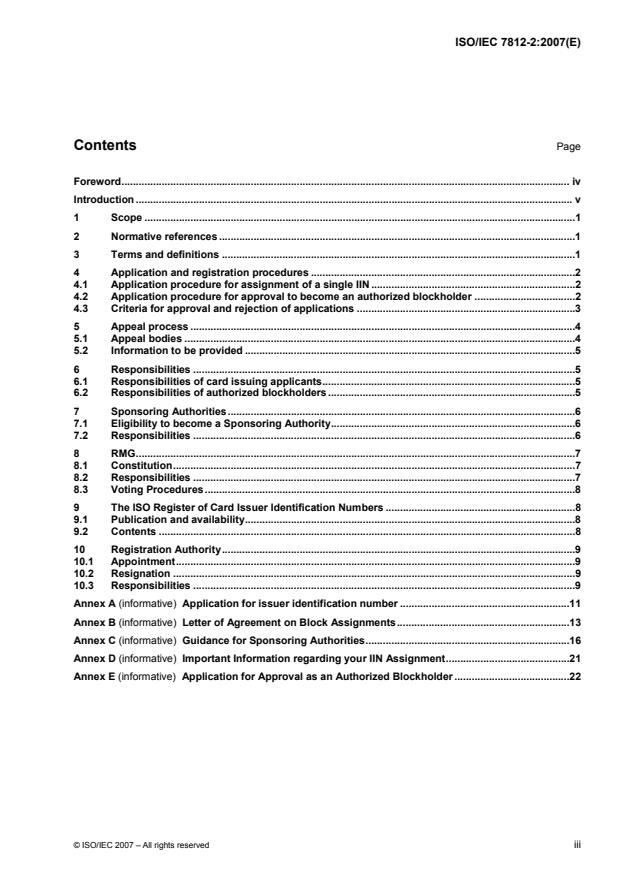
Contents Page
Foreword. iv
Introduction . v
1 Scope .1
2 Normative references .1
3 Terms and definitions .1
4 Application and registration procedures .2
4.1 Application procedure for assignment of a single IIN .2
4.2 Application procedure for approval to become an authorized blockholder .2
4.3 Criteria for approval and rejection of applications .3
5 Appeal process .4
5.1 Appeal bodies .4
5.2 Information to be provided .5
6 Responsibilities .5
6.1 Responsibilities of card issuing applicants.5
6.2 Responsibilities of authorized blockholders .5
7 Sponsoring Authorities.6
7.1 Eligibility to become a Sponsoring Authority.6
7.2 Responsibilities .6
8 RMG.7
8.1 Constitution.7
8.2 Responsibilities .7
8.3 Voting Procedures.8
9 The ISO Register of Card Issuer Identification Numbers .8
9.1 Publication and availability.8
9.2 Contents .8
10 Registration Authority.9
10.1 Appointment.9
10.2 Resignation .9
10.3 Responsibilities .9
Annex A (informative) Application for issuer identification number .11
Annex B (informative) Letter of Agreement on Block Assignments.13
Annex C (informative) Guidance for Sponsoring Authorities.16
Annex D (informative) Important Information regarding your IIN Assignment.21
Annex E (informative) Application for Approval as an Authorized Blockholder .22
© ISO/IEC 2007 – All rights reserved iii
Foreword
ISO (the International Organization for Standardization) and IEC (the International Electrotechnical
Commission) form the specialized system for worldwide standardization. National bodies that are members of
ISO or IEC participate in the development of International Standards through technical committees
established by the respective organization to deal with particular fields of technical activity. ISO and IEC
technical committees collaborate in fields of mutual interest. Other international organizations, governmental
and non-governmental, in liaison with ISO and IEC, also take part in the work. In the field of information
technology, ISO and IEC have established a joint technical committee, ISO/IEC JTC 1.
International Standards are drafted in accordance with the rules given in the ISO/IEC Directives, Part 2.
The main task of the joint technical committee is to prepare International Standards. Draft International
Standards adopted by the joint technical committee are circulated to national bodies for voting. Publication as
an International Standard requires approval by at least 75 % of the national bodies casting a vote.
Attention is drawn to the possibility that some of the elements of this document may be the subject of patent
rights. ISO and IEC shall not be held responsible for identifying any or all such patent rights.
ISO/IEC 7812-2 was prepared by Joint Technical Committee ISO/IEC JTC 1, Information technology,
Subcommittee SC 17, Cards and personal identification.
This third edition cancels and replaces the second edition (ISO/IEC 7812-2:2000), which has been technically
revised.
ISO/IEC 7812 consists of the following parts, under the general title Identification cards — Identification of
issuers:
⎯ Part 1: Numbering system
⎯ Part 2: Application and registration procedures
iv © ISO/IEC 2007 – All rights reserved
Introduction
This International Standard is one of a series describing the parameters for identification cards, and the use of
such cards for international, interindustry and/or intra-industry interchange.
© ISO/IEC 2007 – All rights reserved v
INTERNATIONAL STANDARD ISO/IEC 7812-2:2007(E)
Identification cards — Identification of issuers —
Part 2:
Application and registration procedures
1 Scope
This part of ISO/IEC 7812 specifies the application and registration procedures for Issuer Identification
Numbers (IINs) issued in accordance with ISO/IEC 7812-1.
ISO/IEC 7812-1 specifies a numbering system for the identification of issuers of cards that require an IIN to
operate in international, interindustry and/or intra-industry interchange.
2 Normative references
The following referenced document is indispensable for the application of this document. For dated
references, only the edition cited applies. For undated references, the latest edition of the referenced
document (including any amendments) applies.
ISO/IEC 7812-1, Identification cards — Identification of issuers — Part 1: Numbering system
3 Terms and definitions
For the purposes of this document, the terms and definitions given in ISO/IEC 7812-1 and the following apply.
3.1
administrative blockholder
body/business entity that is assigned a block of Issuer Identification Numbers (IINs) for re-assignment to card
issuing organizations within its specific geographic or industry sector area of jurisdiction
NOTE These IINs are assigned in accordance with the procedures established herein and under legal agreement
with the Registration Authority.
3.2
block of IINs
reservation in the ISO Register of Card Issuer Identification Numbers of a series of two or more IINs for
assignment by an administrative or card scheme blockholder
3.3
card acceptor
party accepting the identification card for the purpose of presenting transaction data to an acquirer
3.4
card scheme blockholder
body/business entity representing a group of card issuers, one purpose of which is to facilitate the issuance
and acceptance of the cards of that group
NOTE Interchange among the card scheme members is governed by a set of operating procedures.
© ISO/IEC 2007 – All rights reserved 1
3.5
Sponsoring Authority
body authorized by the Sub-Committee responsible for administering an ISO numbering system, (in this case
ISO/IEC JTC 1/SC 17) to receive, process and approve applications for IINs submitted in accordance with
ISO/IEC 7812-1
4 Application and registration procedures
4.1 Application procedure for assignment of a single IIN
An applicant shall apply to its national standards body, or its national body's designated Sponsoring Authority
for the assignment of a single IIN using the form shown in Annex A. In the absence of a national standards
body, or designated Sponsoring Authority, the application should be sent to the secretariat of the ISO/IEC
technical body responsible for this International Standard. Application forms are also available, on request
from the Registration Authority, the secretariat of the Registration Management Group (RMG) and the
secretariat of ISO/IEC JTC 1/SC 17. The national standards body or the secretariat of ISO/IEC JTC 1/SC 17
then acts as the “Sponsoring Authority” (see Clause 7) with respect to the application.
4.2 Application procedure for approval to become an authorized blockholder
4.2.1 Types of blockholders
There are two types of blockholders, administrative blockholders and card scheme blockholders.
Administrative blockholders (see 3.1) are assigned a block of IINs, following approval by the RMG, for
re-assignment to organizations that fall within their specific industry or geographic area of jurisdiction. Once
assigned, the IIN belongs to the organization unless it specifically agrees to relinquish the IIN because it is no
longer used by them. The Registration Authority fee applies to each IIN assigned from the block.
Card scheme blockholders (see 3.4) represent a group of card issuers. These blockholders are assigned a
block of IINs, following approval by the RMG, for assignment to the members of that particular card scheme. If
a card issuer relinquishes membership of that scheme the IIN reverts back to the blockholder and use of it by
the organization must cease. The Registration Authority fee applies to each IIN assigned from the block.
4.2.2 Application procedure
Where the applicant is applying for a block of IINs either as an administrative blockholder (see 3.1), or as a
card scheme blockholder (see 3.4), the applicant shall complete a Blockholder Application Form (see
Annex E) and provide the following supplementary information as justification:
a) whether the application is to become an administrative blockholder or a card scheme blockholder;
b) the reason why card issuers must receive IINs from a blockholder, rather than each card issuer applying
individually to the Registration Authority for an IIN;
c) description of the nature of the service that the applicant's organization is planning to provide;
d) whether the proposed blockholder will act as an agent for issuers legally associated with it, but each
issuer is a separate corporate legal entity;
e) details of any future proposed plans, including where relevant the following:
1) estimated number of cards issuers by country;
2) timing plans, (i.e. estimated date for allocation of all IINs in the proposed block);
f) whether card acceptors can access all the card issuers in the card scheme, through an acquiring link;
2 © ISO/IEC 2007 – All rights reserved
g) whether the service provided to the issuers extends beyond networking, i.e. communications switching,
and if so in what way;
h) any common aspects of services offered by card issuers within a proposed card scheme.
The RMG may request additional information where further clarification is needed.
4.3 Criteria for approval and rejection of applications
4.3.1 Criteria for approval of an application for a single IIN
Applications for a single IIN shall meet all the criteria for approval below and shall not comply with any of the
criteria for rejection in 4.3.2.
The criteria for approval are:
a) the applicant applying for a single IIN shall not already have an IIN assigned to it in its own right (outside
of any card scheme);
b) the IIN shall be for immediate use, preferably within 12 months of the date of issue of the IIN;
c) the card being issued shall be for use in an interchange environment (see ISO/IEC 7812-1);
d) the applicant shall be a single corporate entity operating under a specific legislative regulation.
Where cards are for use solely within the country of issue and/or there is no interchange, card issuers shall
contact their national standards body for information on the availability of a national numbering system (see
ISO/IEC 7812-1).
4.3.2 Criteria for rejection of an application for a single IIN
An application for a single IIN shall be rejected by the Sponsoring Authority or the RMG when any one of the
following conditions exist:
a) the applicant is not a card issuer;
b) the applicant has previously been assigned an IIN in its own right (outside of its membership of any card
scheme) that it is still using;
c) the cards issued by the applicant would not be used in an international, interindustry and/or intra-industry
interchange environment;
d) the IIN will be used to identify or differentiate between products, services, or technologies (i.e. including
but not limited to integrated circuit cards), or solely to facilitate routing, or to identify geographic location;
e) the IIN will be used to identify or differentiate between branches or subsidiaries within the applicant's
organization (i.e. these branches or subsidiaries are not separate corporate entities);
f) the applicant has requested a specific IIN or the reservation of a specific IIN that is outside the scope of
this part of ISO/IEC 7812;
g) no card will be issued for immediate use, e.g. within 12 months from the date of issue of an IIN.
Where special circumstances exist, the Sponsoring Authority may approve an application for assignment of a
specific IIN and forward the application to the Registration Authority for assignment of the IIN. All such
requests shall be reported by the Sponsoring Authority to the RMG.
© ISO/IEC 2007 – All rights reserved 3
4.3.3 Criteria for approval as an authorized blockholder
Applications to become an administrative or card scheme blockholder shall be approved only by the RMG,
following sponsorship by a Sponsoring Authority.
Requests to become a blockholder shall meet all the criteria for approval below and shall not comply with any
of the criteria for rejection in 4.3.4.
The criteria for approval are:
a) the applicant has provided adequate supplementary information as justification to become an
administrative or card scheme blockholder (see 4.2);
b) the applicant shall request a block size that accommodates only a single IIN for each entity that it
currently represents or may reasonably expect to represent in the future;
c) the applicant agrees to assign a single IIN from the block to each card issuer and not to assign
subsequent IINs to differentiate between products, services, technologies or geographic location;
d) the applicant agrees to forward requests for second or additional IINs to the RMG for their decision;
e) the applicant shall agree to sign a legal agreement with the Registration Authority (see letter of
agreement on block assignments, annex B) and shall accept the responsibilities enumerated in the letter
of agreement.
4.3.4 Criteria for rejection of an application to become an authorized blockholder
An application to become an administrative or card scheme blockholder shall be rejected by the Sponsoring
Authority or the RMG where any one of the following conditions exist:
a) the applicant does not meet the criteria for approval as a blockholder in 4.3.3;
b) the organizations represented by the applicant (i.e. the card issuers) will not issue cards for use in an
international, interindustry and/or intra-industry interchange environment;
c) the organizations represented by the applicant (i.e. the card issuers) will use the IINs to identify or
differentiate between products, services, or technologies (i.e. including but not limited to integrated circuit
cards), or to identify geographic locations;
d) the blockholder will not be in a position to assign any IINs from the reserved block within 12 months from
the date of issue of the block of IINs;
e) the service provided to the issuers does not extend beyond networking, i.e., switching transactions.
5 Appeal process
5.1 Appeal bodies
Where an application has been rejected by a Sponsoring Authority, the applicant may appeal to the secretariat
of the RMG (see Clause 8). Where an application has been rejected by the RMG, the applicant may appeal to
ISO/IEC JTC 1/SC 17 through the secretariat of ISO/IEC JTC 1/SC 17. Applicants may submit for appeal,
applications that have been rejected by ISO/IEC JTC 1/SC 17, to the ISO Central Secretariat.
Appeal against rejection of an application shall be lodged with the appropriate body within 90 days of the date
of the letter of rejection.
4 © ISO/IEC 2007 – All rights reserved
5.2 Information to be provided
Where an application for either a single IIN or to become an authorized blockholder has been rejected by the
Sponsoring Authority, the following information shall be provided by the applicant to the relevant appeal body
in support of the appeal:
a) statement of which rejection clause (see 4.3.2 or 4.3.4) is disputed and why the applicant believes that
the rejected application fulfils the criteria for acceptance (see 4.3.1 or 4.3.3). The applicant must provide
adequate supplementary information as justification for the approval of the request as submitted under
the appeal.
b) statement of special circumstances whereby a specific requirement of the rejected application can be
met, but such requirement is outside the current procedures and criteria for acceptance outlined in this
part of ISO/IEC 7812.
6 Responsibilities
6.1 Responsibilities of card issuing applicants
The responsibilities of card issuing applicants shall be:
a) to forward to its national standards body, or designated Sponsoring Authority, a completed application
form, (see Annex A) together with the requisite fee. In the absence of a national standards body, or
designated Sponsoring Authority, the application should be sent to the secretariat of the ISO/IEC
technical body responsible for this International Standard.
b) to retain the completed application form containing the IIN assigned to the applicant by the Registration
Authority;
c) to issue cards using the IIN assigned by the Registration Authority within a reasonable timeframe (defined
as within 12 months of the date of assignment of the IIN);
d) to fully comply with the numbering system as contained in ISO/IEC 7812-1 and this part of ISO/IEC 7812;
e) to inform the Registration Authority of any change to the details provided on the original application form.
6.2 Responsibilities of authorized blockholders
Applicants meeting the criteria in 4.3.3 and approved to become an administrative or card scheme blockholder
shall enter into a written legal agreement with the Registration Authority (see Annex B). The responsibilities of
blockholders shall be:
a) to process applications for IINs from within its area of responsibility within 30 days of receipt of the
application;
b) to approve applications that meet the criteria in 4.3.1;
c) to assign sequentially a single IIN, within 30 days of receipt of the request, from the reserved block to
each card issuer whose application fulfils the criteria for acceptance in 4.3.1;
d) to inform its constituents in writing, within 30 days of receipt of the application, as to the disposition of
their application;
e) to inform the Registration Authority in writing, within the agreed timeframe (see 10.3.3) of each IIN
assignment; and to notify the Registration Authority regarding changes to the information as originally
supplied. This information shall be provided either when such changes arise or as stipulated in the written
agreement with the Registration Authority. The Registration Authority shall stipulate the format for
supplying the information (see 10.3.3);
© ISO/IEC 2007 – All rights reserved 5
f) where an application has been rejected, to inform the applicant in writing, within 30 days of receipt of the
application, of the rejection and of the appeal process (see Clause 5);
g) to verify that the ISO Register of Card Issuer Identification Numbers (see 9.2) contains accurate
information regarding IINs issued from within its block;
h) to establish and maintain records relative to the request for or assignment of an IIN including notification
of the assignment to the Registration Authority. Records of IIN issuance shall be permanently maintained
and available for reference by the RMG. Requests for an IIN that have been denied, shall be maintained
for a minimum period of 90 days where no appeal is initiated; or when an appeal is initiated, until that
process is complete. In the event that the blockholder's organization relinquishes the management of the
block, or the block is terminated by action of the RMG, all records shall be transferred to the Registration
Authority.
7 Sponsoring Authorities
7.1 Eligibility to become a Sponsoring Authority
The following bodies may act as Sponsoring Authorities in processing applications for IINs:
a) any national member body of ISO (or agent appointed to act for its national member body);
b) ISO/IEC JTC 1/SC 17; and
c) any group within ISO/IEC JTC 1/SC 17 appointed for purposes concerning the identification card
numbering system.
A document entitled 'Guidance for Sponsoring Authorities' (Annex C) is available to assist Sponsoring
Authorities in assessing the eligibility of applications and to assist in the procedures for dealing with
applications. This document is also available from the Registration Authority, the secretariat of the RMG and
the secretariat of ISO/IEC JTC 1/SC 17.
7.2 Responsibilities
The responsibilities of a Sponsoring Authority shall be:
a) to perform due diligence as it deems appropriate to verify the authenticity of the applicant;
b) to ensure that the applicant meets the criteria for assignment of an IIN and fully complies with the
procedures for applying for IINs in ISO/IEC 7812-1 and this part of ISO/IEC 7812;
c) to process, within 30 days of receipt of the request, applications for IINs from within their countries or
areas of responsibility;
d) to notify the applicant in writing, within 30 days of receipt of the application, as to the disposition of their
application;
e) to forward to the Registration Authority (see 10.3.2) within 30 days of receipt, those sponsored requests
for single IINs that it is satisfied shall be used for the purposes described in this part of ISO/IEC 7812 and
that meet the approval criteria in 4.3.1;
f) where special circumstances exist, to approve applications for assignment of a specific IIN and forward
the application to the Registration Authority for assignment of the IIN. All other requests of an unusual
nature must be reported to the RMG for review;
6 © ISO/IEC 2007 – All rights reserved
g) to sponsor requests for blocks of IINs submitted to the RMG where appropriate supplementary
information has been provided as justification and that justification satisfies the criteria for approval to
become an authorized blockholder (see 4.3.3);
h) to respond to general enquiries covering the IIN numbering system;
i) ensure that applicants are aware that additional IINs will not be assigned to identify products, services,
technologies or geographical location. How this information is passed to the applicant is at the discretion
of the Sponsoring Authority.
8 RMG
8.1 Constitution
In order to effectively manage the numbering system for the identification of card issuers,
ISO/IEC JTC 1/SC 17 has established a RMG, ISO/IEC JTC 1/SC 17/WG 5, which is delegated to act on its
behalf.
The RMG shall be made up of:
a) a representative of the Registration Authority who shall be a non-voting member of the RMG and shall be
expected to attend all meetings;
b) the Convenor of the RMG, appointed by the P members (national standards body with Participant status)
of ISO/IEC JTC 1/SC 17;
c) the secretariat of the RMG, appointed by the P members of ISO/IEC JTC 1/SC 17.
In addition, each member of ISO/IEC JTC 1/SC 17 is entitled to nominate one delegate and one alternate to
the RMG. The alternate may attend all meetings, but is entitled to vote only in the absence of the principal
delegate.
8.2 Responsibilities
The responsibilities of the RMG shall be:
a) to enforce the requirements for approving applications to become authorized blockholders (see 4.3.3) and
to ensure that applicants whose applications do not fulfil the criteria in 4.3.1 or 4.3.3 are rejected and
informed of their right to appeal (see Clause 5);
b) to process within 60 days of receipt of the request, applications to become authorized blockholders which
have been submitted by Sponsoring Authorities to the Secretariat of the RMG. This may be done either
by electronic ballot or at a meeting;
c) to provide, on request, guidance and counsel to any national standards body on the establishment of a
national numbering system (see ISO/IEC 7812-1);
d) to provide guidance to Sponsoring Authorities on applications that demonstrate special circumstances,
requests for block assignments and requests for specific IINs. This guidance shall be decided by
resolution at a meeting or in writing following an electronic ballot;
e) to approve the report on the cost recovery scheme from the Registration Authority;
f) to monitor Sponsoring Authorities to ensure that they comply with the criteria enumerated within this
International Standard (see Clause 7);
© ISO/IEC 2007 – All rights reserved 7
g) to respond to all requests for guidance from the Registration Authority within 60 days of the date of
request; to review annually the ISO Register of Card Issuer Identification Numbers, to review at each
meeting all block assignments and to report its activities to each meeting of ISO/IEC JTC 1/SC 17 and as
required between meetings;
h) to maintain ISO/IEC 7812-1 and ISO/IEC 7812-2.
8.3 Voting Procedures
Any specific request outside the scope of this International Standard, that has been forwarded to the RMG by
a Sponsoring Authority, may be dealt with either by voting at a meeting or by 30 day electronic ballot.
By approval of a majority of returned votes in an electronic ballot or by majority voting at a meeting, the RMG
may authorize:
a) assignment of up to ten consecutive IINs;
b) specific unusual requests.
By unanimous approval of the RMG (with at least five members voting), either by electronic ballot or by voting
at a meeting, the RMG may approve the assignment of more than ten consecutive IINs.
Where an electronic ballot has failed, it shall be referred to a meeting. If the RMG cannot resolve the failed
ballot at a meeting the matter shall be referred to ISO/IEC JTC 1/SC 17.
Where an application to become a blockholder has been rejected, the RMG shall notify the applicant in
writing, within 30 days of the close of the ballot, or where a vote was taken at a meeting, within 30 days of that
meeting, that the request has been rejected. The RMG shall state the specific reason(s) for the rejection
(see 4.3.4) and advise the applicant of their right to appeal to ISO/IEC JTC 1/SC 17 (see Clause 5).
9 The ISO Register of Card Issuer Identification Numbers
9.1 Publication and availability
The Registration Authority shall maintain a database of information taken directly from either the application
form or from the information forwarded from blockholders. All information in the database (whether published
or not) is considered confidential.
Based on the information contained in this database, the Registration Authority shall publish the ISO Register
of Card Issuer Identification Numbers. The register shall be published in both numerical and alphabetical
order.
The ISO Register of Card Issuer Identification Numbers is not a publicly available document. It is available at
a charge to card issuers appearing in the register, blockholders, Sponsoring Authorities and network providers
only.
NOTE The register is available to the members of the RMG upon request.
9.2 Contents
The ISO Register of Card Issuer Identification Numbers shall contain the following information:
a) name of card issuer or blockholder;
b) address;
c) IIN assigned to the card issuer by the Registration Authority or by an authorized blockholder.
NOTE A copy of each application received shall be maintained on file by the Registration Authority. Where the IIN
has been issued by an authorized blockholder, a copy of the application fo
...
Questions, Comments and Discussion
Ask us and Technical Secretary will try to provide an answer. You can facilitate discussion about the standard in here.
Loading comments...