

ISO 24043:2020
(Main)Marine structures — Crude oil offloading systems — Hose reels
General Information
- Abstract
This document specifies requirements for the design, operation and acceptance tests of hose reels for crude oil offloading systems. It is applicable to the design, manufacture and acceptance of hose reels for crude oil offloading systems used on marine structures such as floating production storage & offloading (FPSO) and mobile platforms.
- Status
- Published
- Publication Date
- 22-Oct-2020
- Technical Committee
- ISO/TC 8/SC 4 - Outfitting and deck machinery
- Drafting Committee
- ISO/TC 8/SC 4/WG 2 - Deck machinery
- Current Stage
- 9093 - International Standard confirmed
- Start Date
- 17-Aug-2026
- Completion Date
- 29-Aug-2026
Buy Documents


ISO 24043:2020 - Marine structures -- Crude oil offloading systems -- Hose reels
ISO 24043:2020 - Marine structures — Crude oil offloading systems — Hose reels/23/2020
Overview
ISO 24043:2020 sets internationally recognized requirements for the design, operation, and acceptance testing of hose reels used in crude oil offloading systems on marine structures. Specifically applicable to facilities such as Floating Production Storage and Offloading (FPSO) units and mobile platforms, this standard ensures hose reels maintain safety, reliability, and efficiency under demanding marine conditions. By adhering to ISO 24043:2020, manufacturers and operators can optimize hose reel performance critical for safe crude oil transfer operations.
Key Topics
- Design Requirements: The standard specifies detailed design criteria including drum dimensions, materials stress limits, and structural integrity to guarantee durability and compatibility with offloading hoses. Hose reels must accommodate full hose storage in up to two layers without causing damage.
- Operational Features: Hose reels shall facilitate smooth hose retrieval, launching, and fluid flow at rated pressures. Key features include drive units with redundancy for reliability, drum brakes capable of withstanding maximum loads, emergency release mechanisms to prevent damage during excessive hose tension, and user-friendly operating devices.
- Material Stress Limits: The maximum material stress during rated load and braking scenarios must stay below specified yield limits to ensure structural safety under operational forces.
- Emergency Release Systems: Hose reels must incorporate emergency release equipment capable of handling sudden load releases while preventing environmental contamination by closing shutdown valves promptly.
- Acceptance Testing: Mandatory factory acceptance tests, including no-load operation, load bearing, braking performance, and pressure testing, validate the hose reel’s compliance and operational readiness before deployment.
- Identification: The standard defines a clear product designation system and requires durable nameplates displaying essential information such as rated load, speed, model, and manufacturer for traceability and maintenance.
Applications
ISO 24043:2020 is primarily intended for designers, manufacturers, and operators of crude oil offloading systems on marine platforms. It applies to:
- Floating Production Storage and Offloading (FPSO) vessels
- Mobile offshore drilling units (MODUs)
- Other marine structures involved in transferring crude oil through hose systems
Using ISO 24043-compliant hose reels enhances offshore safety by ensuring mechanical reliability under high stress, minimizing hose damage and spills during offloading operations, and enabling quick emergency responses.
Related Standards
- ISO 3828: Shipbuilding and marine structures - Deck machinery - Vocabulary and symbols - Provides essential terminology referenced in ISO 24043.
- ISO/IEC Directives: Governing the editorial and technical framework for standards development referenced within ISO 24043.
- Other offshore and marine equipment standards for integrated system safety and performance.
Keywords: ISO 24043:2020, marine hose reels, crude oil offloading, FPSO, offshore platforms, hose reel design, marine structures, emergency release, hose reel testing, marine oil transfer safety.
Buy Documents
ISO 24043:2020 - Marine structures -- Crude oil offloading systems -- Hose reels
ISO 24043:2020 - Marine structures — Crude oil offloading systems — Hose reels/23/2020
Get Certified
Connect with accredited certification bodies for this standard

DNV
DNV is an independent assurance and risk management provider.

Lloyd's Register
Lloyd's Register is a global professional services organisation specialising in engineering and technology.

FSC International
Forest Stewardship Council certification.
Sponsored listings
Frequently Asked Questions
ISO 24043:2020 is a standard published by the International Organization for Standardization (ISO). Its full title is "Marine structures — Crude oil offloading systems — Hose reels". This standard covers: This document specifies requirements for the design, operation and acceptance tests of hose reels for crude oil offloading systems. It is applicable to the design, manufacture and acceptance of hose reels for crude oil offloading systems used on marine structures such as floating production storage & offloading (FPSO) and mobile platforms.
This document specifies requirements for the design, operation and acceptance tests of hose reels for crude oil offloading systems. It is applicable to the design, manufacture and acceptance of hose reels for crude oil offloading systems used on marine structures such as floating production storage & offloading (FPSO) and mobile platforms.
ISO 24043:2020 is classified under the following ICS (International Classification for Standards) categories: 47.020.50 - Deck equipment and installations. The ICS classification helps identify the subject area and facilitates finding related standards.
ISO 24043:2020 is available in PDF format for immediate download after purchase. The document can be added to your cart and obtained through the secure checkout process. Digital delivery ensures instant access to the complete standard document.
Standards Content (Sample)
INTERNATIONAL ISO
STANDARD 24043
First edition
2020-10
Marine structures — Crude oil
offloading systems — Hose reels
Structures maritimes — Systèmes de déchargement de pétrole brut —
Dévidoirs
Reference number
©
ISO 2020
© ISO 2020
All rights reserved. Unless otherwise specified, or required in the context of its implementation, no part of this publication may
be reproduced or utilized otherwise in any form or by any means, electronic or mechanical, including photocopying, or posting
on the internet or an intranet, without prior written permission. Permission can be requested from either ISO at the address
below or ISO’s member body in the country of the requester.
ISO copyright office
CP 401 • Ch. de Blandonnet 8
CH-1214 Vernier, Geneva
Phone: +41 22 749 01 11
Email: copyright@iso.org
Website: www.iso.org
Published in Switzerland
ii © ISO 2020 – All rights reserved
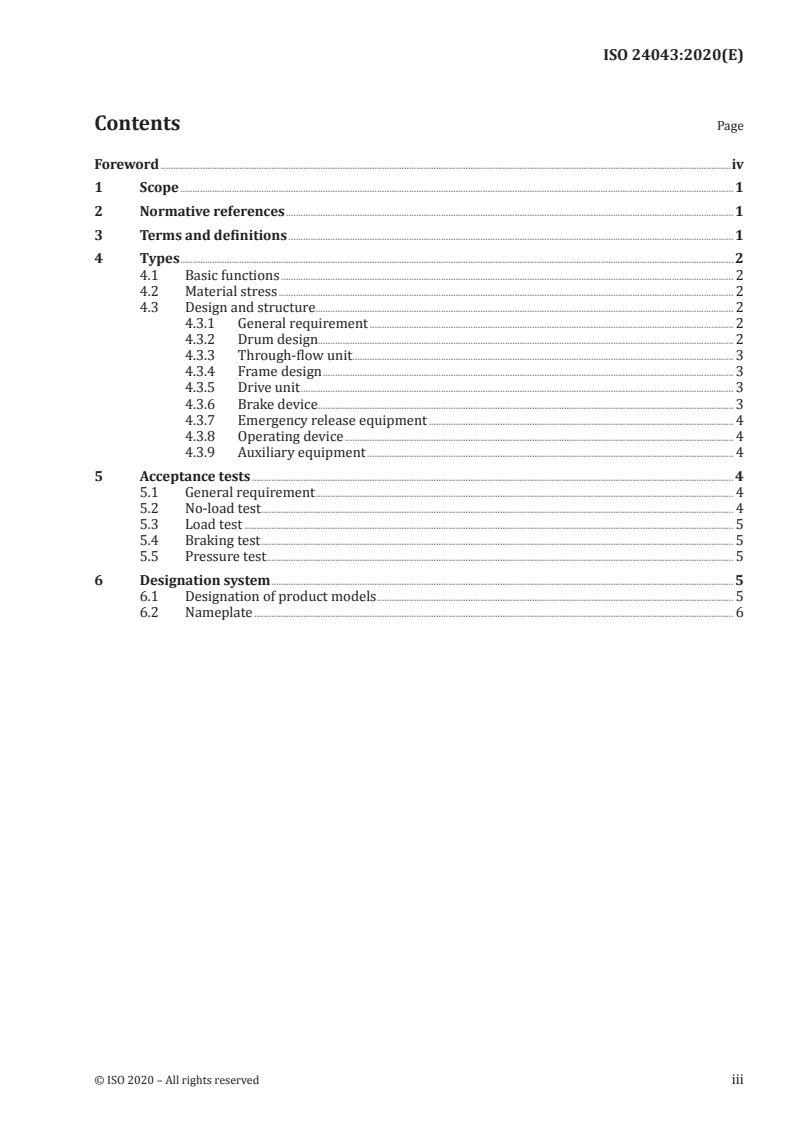
Contents Page
Foreword .iv
1 Scope . 1
2 Normative references . 1
3 Terms and definitions . 1
4 Types . 2
4.1 Basic functions . 2
4.2 Material stress . 2
4.3 Design and structure . 2
4.3.1 General requirement . 2
4.3.2 Drum design. 2
4.3.3 Through-flow unit . . 3
4.3.4 Frame design . 3
4.3.5 Drive unit . 3
4.3.6 Brake device . 3
4.3.7 Emergency release equipment . 4
4.3.8 Operating device . 4
4.3.9 Auxiliary equipment . 4
5 Acceptance tests . 4
5.1 General requirement . 4
5.2 No-load test . 4
5.3 Load test . 5
5.4 Braking test . 5
5.5 Pressure test . 5
6 Designation system . 5
6.1 Designation of product models . 5
6.2 Nameplate . 6
Foreword
ISO (the International Organization for Standardization) is a worldwide federation of national standards
bodies (ISO member bodies). The work of preparing International Standards is normally carried out
through ISO technical committees. Each member body interested in a subject for which a technical
committee has been established has the right to be represented on that committee. International
organizations, governmental and non-governmental, in liaison with ISO, also take part in the work.
ISO collaborates closely with the International Electrotechnical Commission (IEC) on all matters of
electrotechnical standardization.
The procedures used to develop this document and those intended for its further maintenance are
described in the ISO/IEC Directives, Part 1. In particular, the different approval criteria needed for the
different types of ISO documents should be noted. This document was drafted in accordance with the
editorial rules of the ISO/IEC Directives, Part 2 (see www .iso .org/ directives).
Attention is drawn to the possibility that some of the elements of this document may be the subject of
patent rights. ISO shall not be held responsible for identifying any or all such patent rights. Details of
any patent rights identified during the development of the document will be in the Introduction and/or
on the ISO list of patent declarations received (see www .iso .org/ patents).
Any trade name used in this document is information given for the convenience of users and does not
constitute an endorsement.
For an explanation of the voluntary nature of standards, the meaning of ISO specific terms and
expressions related to conformity assessment, as well as information about ISO's adherence to the
World Trade Organization (WTO) principles in the Technical Barriers to Trade (TBT), see www .iso .org/
iso/ foreword .html.
This document was prepared by Technical Committee ISO/TC 8, Ships and marine technology,
Subcommittee SC 4, Outfitting and deck machinery.
Any feedback or questions on this document should be directed to the user’s national standards body. A
complete listing of these bodies can be found at www .iso .org/ members .html.
iv © ISO 2020 – All rights reserved
INTERNATIONAL STANDARD ISO 24043:2020(E)
Marine structures — Crude oil offloading systems —
Hose reels
1 Scope
This document specifies requirements for the design, operation and acceptance tests of hose reels for
crude oil offloading systems.
It is applicable to the design, manufacture and acceptance of hose reels for crude oil offloading systems
used on marine structures such as floating production storage & offloading (FPSO) and mobile
platforms.
2 Normative references
The following documents are referred to in the text in such a way that some or all of their content
constitutes requirements of this document. For dated references, only the edition cited applies. For
undated references, the latest edition of the referenced document (including any amendments) applies.
ISO 3828, Shipbuilding and marine structures — Deck machinery — Vocabulary and symbols
3 Terms and definitions
For the purposes of this document, the terms and definitions
...
INTERNATIONAL ISO
STANDARD 24043
First edition
2020-10
Marine structures — Crude oil
offloading systems — Hose reels
Structures maritimes — Systèmes de déchargement de pétrole brut —
Dévidoirs
Reference number
©
ISO 2020
© ISO 2020
All rights reserved. Unless otherwise specified, or required in the context of its implementation, no part of this publication may
be reproduced or utilized otherwise in any form or by any means, electronic or mechanical, including photocopying, or posting
on the internet or an intranet, without prior written permission. Permission can be requested from either ISO at the address
below or ISO’s member body in the country of the requester.
ISO copyright office
CP 401 • Ch. de Blandonnet 8
CH-1214 Vernier, Geneva
Phone: +41 22 749 01 11
Email: copyright@iso.org
Website: www.iso.org
Published in Switzerland
ii © ISO 2020 – All rights reserved
Contents Page
Foreword .iv
1 Scope . 1
2 Normative references . 1
3 Terms and definitions . 1
4 Types . 2
4.1 Basic functions . 2
4.2 Material stress . 2
4.3 Design and structure . 2
4.3.1 General requirement . 2
4.3.2 Drum design. 2
4.3.3 Through-flow unit . . 3
4.3.4 Frame design . 3
4.3.5 Drive unit . 3
4.3.6 Brake device . 3
4.3.7 Emergency release equipment . 4
4.3.8 Operating device . 4
4.3.9 Auxiliary equipment . 4
5 Acceptance tests . 4
5.1 General requirement . 4
5.2 No-load test . 4
5.3 Load test . 5
5.4 Braking test . 5
5.5 Pressure test . 5
6 Designation system . 5
6.1 Designation of product models . 5
6.2 Nameplate . 6
Foreword
ISO (the International Organization for Standardization) is a worldwide federation of national standards
bodies (ISO member bodies). The work of preparing International Standards is normally carried out
through ISO technical committees. Each member body interested in a subject for which a technical
committee has been established has the right to be represented on that committee. International
organizations, governmental and non-governmental, in liaison with ISO, also take part in the work.
ISO collaborates closely with the International Electrotechnical Commission (IEC) on all matters of
electrotechnical standardization.
The procedures used to develop this document and those intended for its further maintenance are
described in the ISO/IEC Directives, Part 1. In particular, the different approval criteria needed for the
different types of ISO documents should be noted. This document was drafted in accordance with the
editorial rules of the ISO/IEC Directives, Part 2 (see www .iso .org/ directives).
Attention is drawn to the possibility that some of the elements of this document may be the subject of
patent rights. ISO shall not be held responsible for identifying any or all such patent rights. Details of
any patent rights identified during the development of the document will be in the Introduction and/or
on the ISO list of patent declarations received (see www .iso .org/ patents).
Any trade name used in this document is information given for the convenience of users and does not
constitute an endorsement.
For an explanation of the voluntary nature of standards, the meaning of ISO specific terms and
expressions related to conformity assessment, as well as information about ISO's adherence to the
World Trade Organization (WTO) principles in the Technical Barriers to Trade (TBT), see www .iso .org/
iso/ foreword .html.
This document was prepared by Technical Committee ISO/TC 8, Ships and marine technology,
Subcommittee SC 4, Outfitting and deck machinery.
Any feedback or questions on this document should be directed to the user’s national standards body. A
complete listing of these bodies can be found at www .iso .org/ members .html.
iv © ISO 2020 – All rights reserved
INTERNATIONAL STANDARD ISO 24043:2020(E)
Marine structures — Crude oil offloading systems —
Hose reels
1 Scope
This document specifies requirements for the design, operation and acceptance tests of hose reels for
crude oil offloading systems.
It is applicable to the design, manufacture and acceptance of hose reels for crude oil offloading systems
used on marine structures such as floating production storage & offloading (FPSO) and mobile
platforms.
2 Normative references
The following documents are referred to in the text in such a way that some or all of their content
constitutes requirements of this document. For dated references, only the edition cited applies. For
undated references, the latest edition of the referenced document (including any amendments) applies.
ISO 3828, Shipbuilding and marine structures — Deck machinery — Vocabulary and symbols
3 Terms and definitions
For the purposes of this document, the terms and definitions
...