

ISO/TR 16401-2:2018
(Main)Electronic fee collection — Evaluation of equipment for conformity to ISO 17575-2 — Part 2: Abstract test suite
General Information
- Abstract
ISO/TR 16401-2:2018 contains the definition of test cases, reflecting the individual steps listed in specific test purposes defined in ISO/TR 16401-1. The test cases are written in Testing and Test Control Notation version 3 (TTCN-3).
- Status
- Published
- Publication Date
- 04-Jan-2018
- Technical Committee
- ISO/TC 204 - Intelligent transport systems
- Drafting Committee
- ISO/TC 204/WG 5 - Fee and toll collection
- Current Stage
- 6060 - International Standard published
- Start Date
- 05-Jan-2018
- Due Date
- 21-Oct-2018
- Completion Date
- 21-Oct-2018
Buy Documents
ISO/TR 16401-2:2018 - Electronic fee collection — Evaluation of equipment for conformity to ISO 17575-2 — Part 2: Abstract test suite Released:1/5/2018
ISO/TR 16401-2:2018 - Electronic fee collection — Evaluation of equipment for conformity to ISO 17575-2 — Part 2: Abstract test suite/5/2018
Overview
ISO/TR 16401-2:2018 defines an abstract test suite (ATS) for evaluating conformity of electronic fee collection (EFC) equipment to the context-data requirements in ISO 17575-2. The document contains executable test cases written in TTCN‑3 (Testing and Test Control Notation version 3) and mirrors the test purposes described in ISO/TR 16401-1. It focuses on conformance testing of the Front End (FE) - including the Front End Communications API and Front End application - and the Back End (BE) in autonomous EFC (GNSS/CN) environments.
Key topics and technical content
- Test cases in TTCN‑3: All test cases are provided as TTCN‑3 modules so testers can execute standardized, repeatable tests.
- Abstract Test Method (ATM): Describes the test architecture where the tester runs TTCN‑3 tests using an emulated communication sub-layer to exercise the IUT (Implementation Under Test) - either FE or BE.
- ATS data structures: Uses ASN.1 data definitions from base standards; complex parameterized structures are redefined in TTCN‑3 where needed.
- PIXIT (Protocol Implementation Extra Information for Testing): Suppliers provide PIXIT information (proforma in Annex B) to support testing and reduce ambiguity.
- Message filtering and default behaviours: Guidance on handling callback events and default ignore behaviours to ensure consistent test executions.
- Naming conventions: Standardized TTCN‑3 naming rules for modules, messages, variables, timers and test-case identifiers to improve readability and interoperability of test suites.
- Conformance testing terminology: Aligns with ISO/IEC testing terms (IUT, SUT, TC, TP, ATS, ATM) for clarity and consistency.
Practical applications
- Test laboratories and certification bodies use ISO/TR 16401-2 to perform conformance testing and type approval of EFC on-board equipment (OBE) and backend systems.
- Equipment manufacturers and ITS integrators use the ATS to validate Front End Communications API and Front End application behaviour against ISO 17575-2 requirements.
- Toll service providers and system operators rely on these tests to ensure interoperability across GNSS/CN autonomous tolling deployments and to achieve comparable results across testing sites.
Who should use this standard
- EFC equipment manufacturers (OBE vendors)
- Conformance test laboratories and certification authorities
- Toll operators and service providers
- ITS (Intelligent Transport Systems) test engineers and system integrators
- Software developers implementing Front End Communications APIs
Related standards
- ISO/TR 16401-1 - Test purposes for EFC conformity evaluation
- ISO 17575-2 - Application interface definition: context data (requirements under test)
- ISO 17575-1 - Charging (related application interface definitions)
Keywords: ISO/TR 16401-2, electronic fee collection, EFC, abstract test suite, TTCN‑3, ISO 17575-2, conformance testing, Front End Communications API, PIXIT, GNSS/CN.
Relations
- Effective Date
- 12-Feb-2026
- Effective Date
- 05-Nov-2015
Buy Documents
ISO/TR 16401-2:2018 - Electronic fee collection — Evaluation of equipment for conformity to ISO 17575-2 — Part 2: Abstract test suite Released:1/5/2018
ISO/TR 16401-2:2018 - Electronic fee collection — Evaluation of equipment for conformity to ISO 17575-2 — Part 2: Abstract test suite/5/2018
Get Certified
Connect with accredited certification bodies for this standard

BSI Group
BSI (British Standards Institution) is the business standards company that helps organizations make excellence a habit.

Great Wall Tianjin Quality Assurance Center
Established 1993, first batch to receive national accreditation with IAF recognition.
Hong Kong Quality Assurance Agency (HKQAA)
Hong Kong's leading certification body.
Sponsored listings
Frequently Asked Questions
ISO/TR 16401-2:2018 is a technical report published by the International Organization for Standardization (ISO). Its full title is "Electronic fee collection — Evaluation of equipment for conformity to ISO 17575-2 — Part 2: Abstract test suite". This standard covers: ISO/TR 16401-2:2018 contains the definition of test cases, reflecting the individual steps listed in specific test purposes defined in ISO/TR 16401-1. The test cases are written in Testing and Test Control Notation version 3 (TTCN-3).
ISO/TR 16401-2:2018 contains the definition of test cases, reflecting the individual steps listed in specific test purposes defined in ISO/TR 16401-1. The test cases are written in Testing and Test Control Notation version 3 (TTCN-3).
ISO/TR 16401-2:2018 is classified under the following ICS (International Classification for Standards) categories: 03.220.20 - Road transport; 35.240.60 - IT applications in transport. The ICS classification helps identify the subject area and facilitates finding related standards.
ISO/TR 16401-2:2018 has the following relationships with other standards: It is inter standard links to CEN/ISO TR 16401-2:2018, ISO/TS 16401-2:2012. Understanding these relationships helps ensure you are using the most current and applicable version of the standard.
ISO/TR 16401-2:2018 is available in PDF format for immediate download after purchase. The document can be added to your cart and obtained through the secure checkout process. Digital delivery ensures instant access to the complete standard document.
Standards Content (Sample)
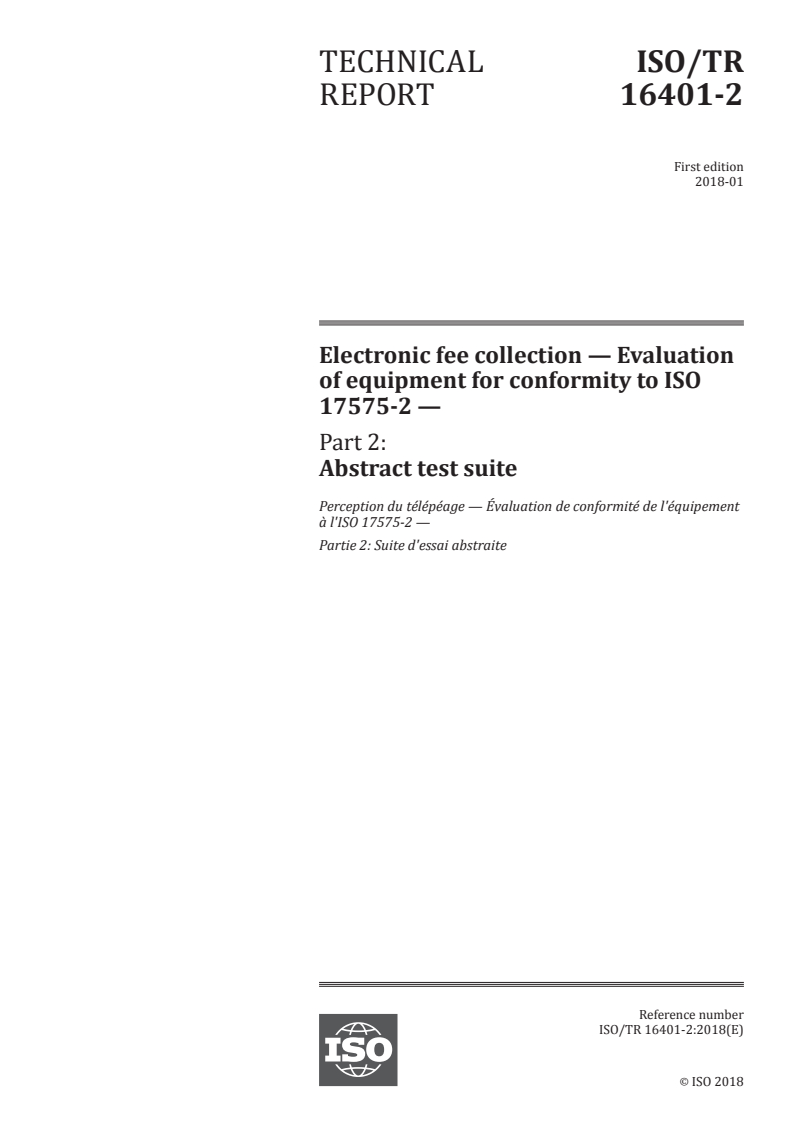
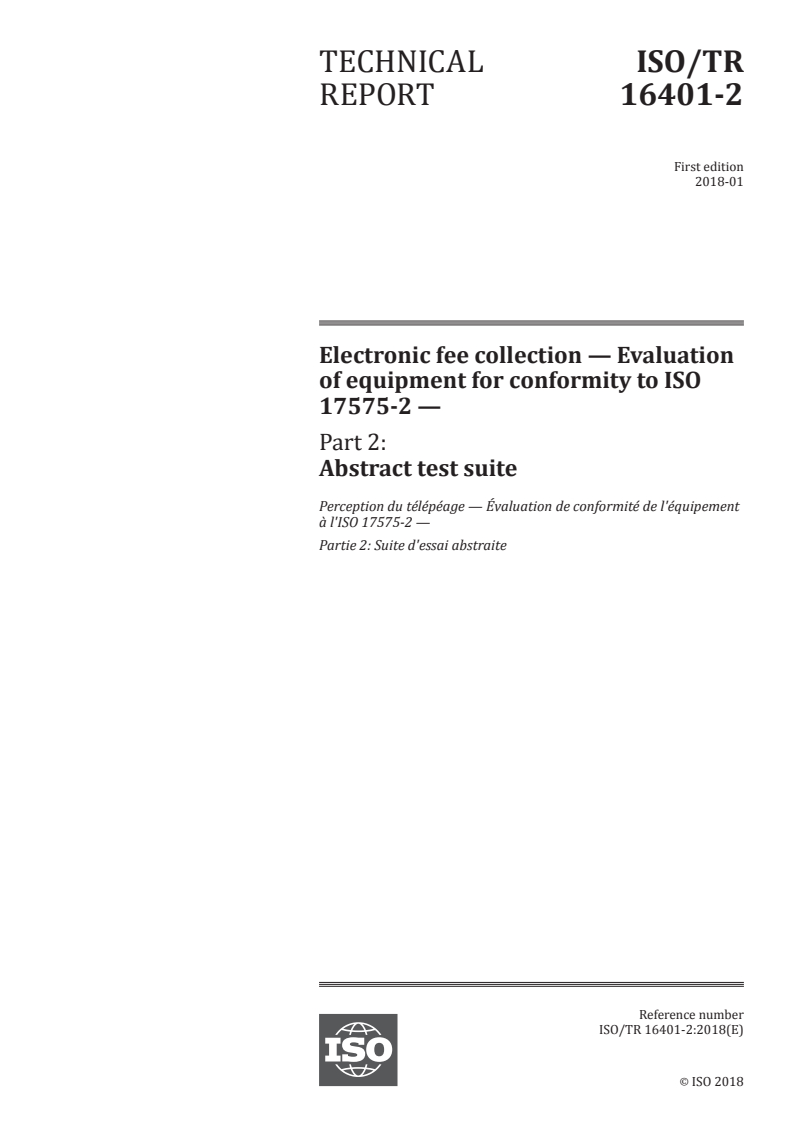
TECHNICAL ISO/TR
REPORT 16401-2
First edition
2018-01
Electronic fee collection — Evaluation
of equipment for conformity to ISO
17575-2 —
Part 2:
Abstract test suite
Perception du télépéage — Évaluation de conformité de l'équipement
à l'ISO 17575-2 —
Partie 2: Suite d'essai abstraite
Reference number
©
ISO 2018
© ISO 2018, Published in Switzerland
All rights reserved. Unless otherwise specified, no part of this publication may be reproduced or utilized otherwise in any form
or by any means, electronic or mechanical, including photocopying, or posting on the internet or an intranet, without prior
written permission. Permission can be requested from either ISO at the address below or ISO’s member body in the country of
the requester.
ISO copyright office
Ch. de Blandonnet 8 • CP 401
CH-1214 Vernier, Geneva, Switzerland
Tel. +41 22 749 01 11
Fax +41 22 749 09 47
copyright@iso.org
www.iso.org
ii © ISO 2018 – All rights reserved
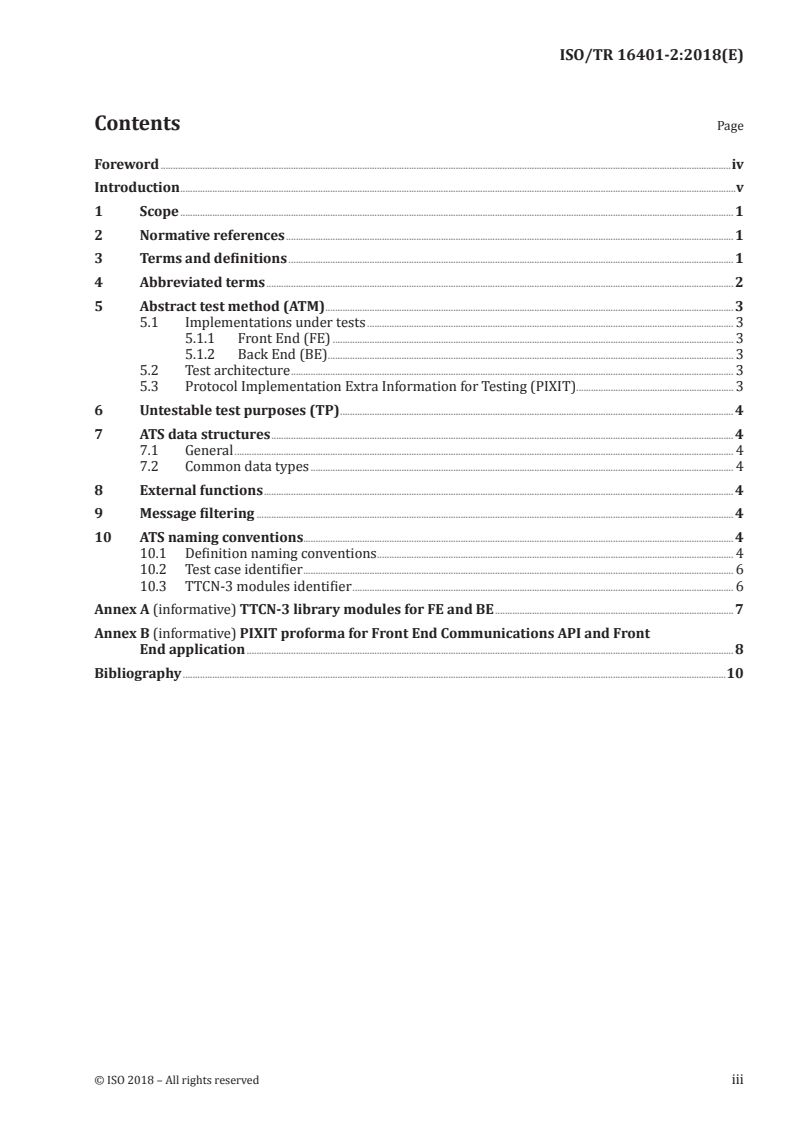
Contents Page
Foreword .iv
Introduction .v
1 Scope . 1
2 Normative references . 1
3 Terms and definitions . 1
4 Abbreviated terms . 2
5 Abstract test method (ATM) . 3
5.1 Implementations under tests . 3
5.1.1 Front End (FE) . 3
5.1.2 Back End (BE) . . 3
5.2 Test architecture . 3
5.3 Protocol Implementation Extra Information for Testing (PIXIT). 3
6 Untestable test purposes (TP) . 4
7 ATS data structures . 4
7.1 General . 4
7.2 Common data types . 4
8 External functions . 4
9 Message filtering . 4
10 ATS naming conventions. 4
10.1 Definition naming conventions . 4
10.2 Test case identifier . 6
10.3 TTCN-3 modules identifier . 6
Annex A (informative) TTCN-3 library modules for FE and BE . 7
Annex B (informative) PIXIT proforma for Front End Communications API and Front
End application . 8
Bibliography .10
Foreword
ISO (the International Organization for Standardization) is a worldwide federation of national standards
bodies (ISO member bodies). The work of preparing International Standards is normally carried out
through ISO technical committees. Each member body interested in a subject for which a technical
committee has been established has the right to be represented on that committee. International
organizations, governmental and non-governmental, in liaison with ISO, also take part in the work.
ISO collaborates closely with the International Electrotechnical Commission (IEC) on all matters of
electrotechnical standardization.
The procedures used to develop this document and those intended for its further maintenance are
described in the ISO/IEC Directives, Part 1. In particular the different approval criteria needed for the
different types of ISO documents should be noted. This document was drafted in accordance with the
editorial rules of the ISO/IEC Directives, Part 2 (see www.iso.org/directives).
Attention is drawn to the possibility that some of the elements of this document may be the subject of
patent rights. ISO shall not be held responsible for identifying any or all such patent rights. Details of
any patent rights identified during the development of the document will be in the Introduction and/or
on the ISO list of patent declarations received (see www.iso.org/patents).
Any trade name used in this document is information given for the convenience of users and does not
constitute an endorsement.
For an explanation on the voluntary nature of standards, the meaning of ISO specific terms and
expressions related to conformity assessment, as well as information about ISO's adherence to the
World Trade Organization (WTO) principles in the Technical Barriers to Trade (TBT) see the following
URL: www.iso.org/iso/foreword.html.
This document was prepared by Technical Committee ISO/TC 204, Intelligent transport systems.
This first edition of ISO/TR 16401-2 cancels and replaces ISO/TS 16401-2:2012, which has been
technically revised.
The main changes compared to the previous edition are as follows:
— conversion from a Technical Specification to Technical Report has been made;
— the terms and definitions have been revised;
— editorial and formal corrections as well as changes to improve readability have been made.
A list of all parts in the ISO 16401 series can be found on the ISO website.
iv © ISO 2018 – All rights reserved
Introduction
This document is part of a set of standards that supports interoperability of autonomous electronic fee
collection (EFC) systems. Autonomous systems use satellite positioning, often combined with additional
sensor technologies such as gyroscopes, odometers, and accelerometers, to localize the vehicle and to
find its position on a map containing the charged geographic objects, such as charged roads or charged
areas. From the charged objects, the vehicle characteristics, the time of day and other data that are
relevant for describing road use, the tariff and ultimately the road usage fee are determined.
The ISO/TR 16401 series provides tests to assess the Front End Communications API and Front End
application behaviours compliancy towards the requirements listed in ISO 17575-2. ISO/TR 16401-1
contains the definition of such tests in the form of test purposes, listing the initial conditions, references
and individual steps in a structured textual manner. This document contains the identical tests written
in Testing and Test Control Notation version 3 (TTCN-3).
Autonomous on-board equipment (OBE) operates without relying on dedicated road-side infrastructure
by employing wide-area technologies such as Global Navigation Satellite Systems (GNSS) and Cellular
Communications Networks (CN). Therefore, autonomous systems may also be referred to as GNSS/CN
systems.
Within the suite of EFC standards, this document defines tests for conformity evaluation of Front End
and Back End that comply with the requirements towards the context data specified in ISO 17575-2.
This document is intended to
— assess Front End Communications API and Front End application capabilities,
— assess Front End Communications API and Front End application behaviour,
— serve as a guide for Front End Communications API and Front End application conformance
evaluation and type approval,
— achieve comparability between the results of the corresponding tests applied in different places at
different times, and
— facilitate communications between parties.
TECHNICAL REPORT ISO/TR 16401-2:2018(E)
Electronic fee collection — Evaluation of equipment for
conformity to ISO 17575-2 —
Part 2:
Abstract test suite
1 Scope
This document contains the definition of test cases, reflecting the individual steps listed in specific test
purposes defined in ISO/TR 16401-1. The test cases are written in Testing and Test Control Notation
version 3 (TTCN-3).
2 Normative references
The following documents are referred to in the text in such a way that some or all of their content
constitutes requirements of this document. For dated references, only the edition cited applies. For
undated references, the latest edition of the referenced document (including any amendments) applies.
ISO 17575-1, Electronic fee collection — Application interface definition for autonomous systems — Part 1:
Charging
3 Terms and definitions
For the purposes of this document, the terms and definitions given in ISO 17575-1 and the following apply.
ISO and IEC maintain terminological databases for use in standardization at the following addresses:
— IEC Electropedia: available at http://www.electropedia.org/
— ISO Online browsing platform: available at http://www.iso.org/obp
3.1
conformance testing
testing the extent to which an IUT is a conforming implementation
[SOURCE: ISO/IEC 9646-1:1994, 3.3.23]
3.2
Front End application
part of the Front End above the API
[SOURCE: ISO/TR 16401-1:2017, 3.12]
3.3
implementation under test
IUT
implementation of one or more OSI protocols in an adjacent user/provider relationship, being that part
of a real open system which is to be studied by testing
[SOURCE: ISO/IEC 9646-1:1994, 3.3.43]
...
TECHNICAL ISO/TR
REPORT 16401-2
First edition
2018-01
Electronic fee collection — Evaluation
of equipment for conformity to ISO
17575-2 —
Part 2:
Abstract test suite
Perception du télépéage — Évaluation de conformité de l'équipement
à l'ISO 17575-2 —
Partie 2: Suite d'essai abstraite
Reference number
©
ISO 2018
© ISO 2018, Published in Switzerland
All rights reserved. Unless otherwise specified, no part of this publication may be reproduced or utilized otherwise in any form
or by any means, electronic or mechanical, including photocopying, or posting on the internet or an intranet, without prior
written permission. Permission can be requested from either ISO at the address below or ISO’s member body in the country of
the requester.
ISO copyright office
Ch. de Blandonnet 8 • CP 401
CH-1214 Vernier, Geneva, Switzerland
Tel. +41 22 749 01 11
Fax +41 22 749 09 47
copyright@iso.org
www.iso.org
ii © ISO 2018 – All rights reserved
Contents Page
Foreword .iv
Introduction .v
1 Scope . 1
2 Normative references . 1
3 Terms and definitions . 1
4 Abbreviated terms . 2
5 Abstract test method (ATM) . 3
5.1 Implementations under tests . 3
5.1.1 Front End (FE) . 3
5.1.2 Back End (BE) . . 3
5.2 Test architecture . 3
5.3 Protocol Implementation Extra Information for Testing (PIXIT). 3
6 Untestable test purposes (TP) . 4
7 ATS data structures . 4
7.1 General . 4
7.2 Common data types . 4
8 External functions . 4
9 Message filtering . 4
10 ATS naming conventions. 4
10.1 Definition naming conventions . 4
10.2 Test case identifier . 6
10.3 TTCN-3 modules identifier . 6
Annex A (informative) TTCN-3 library modules for FE and BE . 7
Annex B (informative) PIXIT proforma for Front End Communications API and Front
End application . 8
Bibliography .10
Foreword
ISO (the International Organization for Standardization) is a worldwide federation of national standards
bodies (ISO member bodies). The work of preparing International Standards is normally carried out
through ISO technical committees. Each member body interested in a subject for which a technical
committee has been established has the right to be represented on that committee. International
organizations, governmental and non-governmental, in liaison with ISO, also take part in the work.
ISO collaborates closely with the International Electrotechnical Commission (IEC) on all matters of
electrotechnical standardization.
The procedures used to develop this document and those intended for its further maintenance are
described in the ISO/IEC Directives, Part 1. In particular the different approval criteria needed for the
different types of ISO documents should be noted. This document was drafted in accordance with the
editorial rules of the ISO/IEC Directives, Part 2 (see www.iso.org/directives).
Attention is drawn to the possibility that some of the elements of this document may be the subject of
patent rights. ISO shall not be held responsible for identifying any or all such patent rights. Details of
any patent rights identified during the development of the document will be in the Introduction and/or
on the ISO list of patent declarations received (see www.iso.org/patents).
Any trade name used in this document is information given for the convenience of users and does not
constitute an endorsement.
For an explanation on the voluntary nature of standards, the meaning of ISO specific terms and
expressions related to conformity assessment, as well as information about ISO's adherence to the
World Trade Organization (WTO) principles in the Technical Barriers to Trade (TBT) see the following
URL: www.iso.org/iso/foreword.html.
This document was prepared by Technical Committee ISO/TC 204, Intelligent transport systems.
This first edition of ISO/TR 16401-2 cancels and replaces ISO/TS 16401-2:2012, which has been
technically revised.
The main changes compared to the previous edition are as follows:
— conversion from a Technical Specification to Technical Report has been made;
— the terms and definitions have been revised;
— editorial and formal corrections as well as changes to improve readability have been made.
A list of all parts in the ISO 16401 series can be found on the ISO website.
iv © ISO 2018 – All rights reserved
Introduction
This document is part of a set of standards that supports interoperability of autonomous electronic fee
collection (EFC) systems. Autonomous systems use satellite positioning, often combined with additional
sensor technologies such as gyroscopes, odometers, and accelerometers, to localize the vehicle and to
find its position on a map containing the charged geographic objects, such as charged roads or charged
areas. From the charged objects, the vehicle characteristics, the time of day and other data that are
relevant for describing road use, the tariff and ultimately the road usage fee are determined.
The ISO/TR 16401 series provides tests to assess the Front End Communications API and Front End
application behaviours compliancy towards the requirements listed in ISO 17575-2. ISO/TR 16401-1
contains the definition of such tests in the form of test purposes, listing the initial conditions, references
and individual steps in a structured textual manner. This document contains the identical tests written
in Testing and Test Control Notation version 3 (TTCN-3).
Autonomous on-board equipment (OBE) operates without relying on dedicated road-side infrastructure
by employing wide-area technologies such as Global Navigation Satellite Systems (GNSS) and Cellular
Communications Networks (CN). Therefore, autonomous systems may also be referred to as GNSS/CN
systems.
Within the suite of EFC standards, this document defines tests for conformity evaluation of Front End
and Back End that comply with the requirements towards the context data specified in ISO 17575-2.
This document is intended to
— assess Front End Communications API and Front End application capabilities,
— assess Front End Communications API and Front End application behaviour,
— serve as a guide for Front End Communications API and Front End application conformance
evaluation and type approval,
— achieve comparability between the results of the corresponding tests applied in different places at
different times, and
— facilitate communications between parties.
TECHNICAL REPORT ISO/TR 16401-2:2018(E)
Electronic fee collection — Evaluation of equipment for
conformity to ISO 17575-2 —
Part 2:
Abstract test suite
1 Scope
This document contains the definition of test cases, reflecting the individual steps listed in specific test
purposes defined in ISO/TR 16401-1. The test cases are written in Testing and Test Control Notation
version 3 (TTCN-3).
2 Normative references
The following documents are referred to in the text in such a way that some or all of their content
constitutes requirements of this document. For dated references, only the edition cited applies. For
undated references, the latest edition of the referenced document (including any amendments) applies.
ISO 17575-1, Electronic fee collection — Application interface definition for autonomous systems — Part 1:
Charging
3 Terms and definitions
For the purposes of this document, the terms and definitions given in ISO 17575-1 and the following apply.
ISO and IEC maintain terminological databases for use in standardization at the following addresses:
— IEC Electropedia: available at http://www.electropedia.org/
— ISO Online browsing platform: available at http://www.iso.org/obp
3.1
conformance testing
testing the extent to which an IUT is a conforming implementation
[SOURCE: ISO/IEC 9646-1:1994, 3.3.23]
3.2
Front End application
part of the Front End above the API
[SOURCE: ISO/TR 16401-1:2017, 3.12]
3.3
implementation under test
IUT
implementation of one or more OSI protocols in an adjacent user/provider relationship, being that part
of a real open system which is to be studied by testing
[SOURCE: ISO/IEC 9646-1:1994, 3.3.43]
...